


I arrived in Seychelles thinking the “Inner Islands” were just marketing language for a few photogenic beaches near the main airport. Ten days later, after hauling a backpack across Mahé, Praslin, La Digue and two smaller nature islands, I understood them as a compact but surprisingly varied granitic world, where each island has its own pace, infrastructure and logistics. This guide is rooted in that multi-island itinerary, the ferries I actually took, the guesthouses where I slept, the bikes and rental cars I used, and the very real learning curve of trying to do more than one resort beach in the Seychelles’ granitic heart.
How I Structured an Inner Islands Trip (And What I Misunderstood)
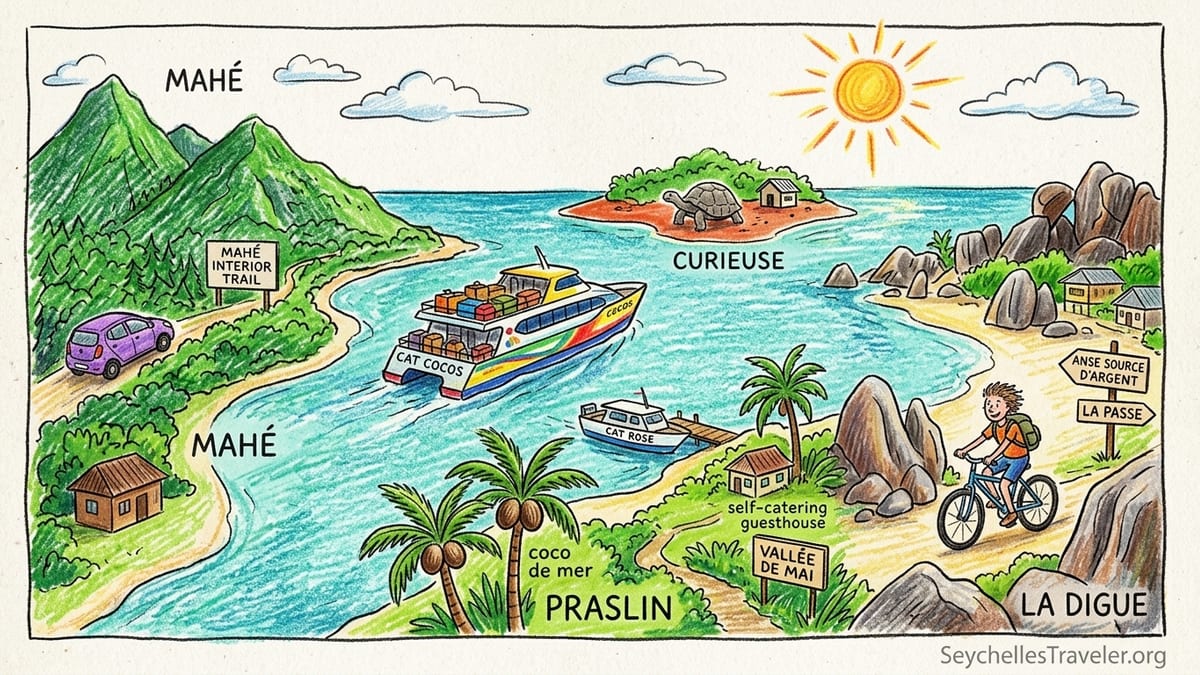
My Inner Islands trip lasted ten days, split across four bases. I started with three nights on Mahé, using a rented Hyundai i10 to explore the west coast and the forested interior. From Victoria’s Inter Island Quay I then boarded a Cat Cocos high-speed ferry to Praslin, where I stayed three nights at a self-catering apartment near Cote d’Or and relied on local buses and taxis instead of a car. From Praslin I hopped on the short Cat Rose ferry to La Digue for three nights in a Creole guesthouse near La Passe, getting around almost entirely by bicycle. The final day was a boat excursion that linked Curieuse and nearby islets inside a marine park, before looping back to Praslin and on toward Mahé.
Before this, I assumed “Inner Islands” meant Mahé plus a couple of easy day trips. On the map, everything looked close. The distances are indeed small in nautical miles, but in practice each island change took half a day once I factored in packing, check-out, transfers to the jetty, check-in for ferries, and settling into the next guesthouse. The Inner Islands feel like one region geologically and culturally, but traveling across them feels more like hopping between mini-countries, each with its own transport habits, price points and evening rhythm.
I also underestimated how different the granitic Inner Islands feel from one another on the ground. I expected Mahé, Praslin and La Digue to be near-clones with interchangeable white-sand bays. Instead, Mahé’s granite mountains loom steep and forested, Praslin is smaller and softer, with a rolling interior, and La Digue compresses steep boulder ridges and postcard beaches into an island you can cross by bike in minutes. The smaller satellites, like Curieuse or the islands inside Ste Anne Marine National Park, add another layer again, with almost no independent services once the day boats leave.
The most useful mistake I made was trying to see too many islands for the time I had. It taught me how much of an Inner Islands trip is about accepting the friction of ferries, luggage and bus timetables, instead of treating Mahé as an airport and everything else as a string of quick beach photo stops. This guide focuses on what that actually feels like in practice.
Granitic Landscapes, Beaches and Mountain Interiors
The Inner Islands are the visible peaks of an underwater granitic plateau, and you feel that as soon as you leave the airport road on Mahé. Within 15 minutes of picking up my rental car near Pointe Larue, I was climbing into dense, wet-green forest, with granite outcrops slick from passing showers. Trails like Copolia, Trois Frères and Morne Seychellois require a modest entrance fee collected by the Seychelles Parks and Gardens Authority, around a couple of hundred rupees for non-residents for some routes, and they bring you onto bare rock slabs with views over Victoria, the airport runway cutting across the lagoon, and the scattered Inner Islands beyond.
On Praslin, the granite is softer and rounder. Inside Vallée de Mai the boulders are mostly hidden beneath an astonishing canopy of coco de mer palms, but at the coast they reappear as weather-rounded headlands at Anse Lazio or Anse Georgette. Walking the minor roads, I passed cinnamon and breadfruit trees pushing against granite walls, with the tar road squeezed between rock and sea. The scale is smaller than Mahé, but I was constantly moving between lush shade and open, bleached-sand bays.
La Digue is where the iconic granite really hits you. Approaching on the ferry from Praslin, the island looks like a single dark ridge, piled high with boulders. Cycling towards Anse Source d’Argent, I repeatedly stopped just to touch the rock. It feels coarse and warm by late morning, sculpted into curves and channels that could almost be artificial. The beaches are narrow at high tide, so you quickly understand how the rock shapes the swimming conditions and shelter, not just the Instagram angles.
The smaller nature islands add a wilder twist. On Curieuse, I stepped off the excursion boat into shallow water and walked across a beach backed by mangroves and rust-red earth. The granite here is fractured into low ridges that the trail between Baie Laraie and Anse José skirts and climbs. Combined with the giant Aldabra tortoises roaming freely, it felt more like walking in a rough, open-air geology and biology classroom than visiting a resort.
Weather, Seasons and How Humidity Shapes Your Days
Seychelles lies close to the equator, so temperatures across the Inner Islands hover around the high twenties Celsius most of the year, with only a few degrees of variation between seasons. What changes most for travelers is humidity, wind and rainfall patterns. Around April and May, and again in October and November, the winds between the monsoon periods tend to ease, which often means calmer seas for inter-island ferries and a bit less surface chop for snorkeling and swimming.
From roughly late May to September, the southeast trade winds pick up, bringing slightly cooler and drier air, along with stronger winds that can make some south and east facing beaches choppy or, at times, flagged as unsafe. During my June visit, Mahé’s west coast beaches could be rough in the afternoon, while coves tucked behind headlands or on more sheltered sides of the islands were noticeably calmer. Planning beach days became about matching the wind to the coastline, not just chasing famous names on a map.
Humidity is a constant companion. Even with relatively dry trade-wind conditions, any uphill walk in the forest turned my t-shirt damp within minutes. On La Digue, biking in the middle of the day quickly felt like pedaling inside a greenhouse. I learned to front-load more ambitious activities, like hiking the Anse Major trail on Mahé or biking across La Digue, into the early morning, then save snorkeling, shaded beach time or slower bus rides for midday.
Short tropical showers can arrive at almost any time of year, and I experienced them as fast, sharp bursts that darkened the granite and cooled the air without derailing the day. The key lesson was not to over-plan around weather categories like “dry” and “wet” season. For Inner Islands travel, it is more useful to think in terms of how wind and humidity interact with ferry comfort, hiking safety and your own tolerance for exertion in heat, rather than expecting a neatly predictable pattern.
Ferries, Flights and the Reality of Transfer Days
Moving between Inner Islands is often the highlight of the trip, but it is also where first-time visitors underestimate time, cost and energy. The main fast ferry operator, Cat Cocos, runs modern catamarans between Mahé and Praslin, with some sailings continuing to La Digue. The crossing between Mahé and Praslin is usually around an hour, depending on route and conditions, and services operate several times most days, though there can be occasional days without sailings around maintenance or weather.
Between Praslin and La Digue, the Cat Rose ferry and additional fast boats shuttle back and forth, with crossing times of roughly 15 minutes. On paper, that makes La Digue feel perfect for a day trip. In reality, I found that by the time I checked out of my accommodation, took a taxi to the jetty, queued with luggage, boarded, and did the same in reverse on arrival, half the day had evaporated. I quickly saw why tourism officials often suggest spending two or three nights on La Digue instead of compressing it into a rushed visit.
One of my key mistakes was stacking too many inter-island moves back-to-back, especially when combining guesthouse check-ins and marine excursions. For example, trying to squeeze a half-day Curieuse trip into the same day as my Praslin arrival left me juggling luggage storage at the jetty and watching the clock on the beach. On reflection, dedicating transfer days primarily to moving and settling, and then using full days between ferries for excursions, would have made the trip more relaxed.
There is also a small domestic flight between Mahé and Praslin, operated by the national airline, which reduces travel time to around 20 minutes in the air. However, it still requires early check-in, security and transfers on each side. For most independent travelers, ferries remain the default. Recent fare guides show that seats on the main routes are a significant line item in a Seychelles budget, and local advice often suggests booking popular sailings in advance, particularly if you need a specific time to connect with international flights.
Life on Mahé: Infrastructure, Buses and Restaurant Choices
Mahé is the main island and it feels like the Inner Islands’ backbone. The road network loops and zigzags around much of the coast and interior, public buses reach almost every inhabited pocket, and the island hosts the majority of supermarkets, ATMs, government services and larger restaurants. Staying in a self-catering apartment near Beau Vallon, I was able to walk to a grocery store, beach takeaway stalls selling grilled fish and curries in the 75 to 125 rupee range, and a couple of mid-range restaurants, then drive or catch a bus into Victoria when I needed to restock or visit the market.
The bus system on Mahé is robust and inexpensive, with flat fares that locals rely on. The trade-off is that buses can be crowded, and timetables are designed for residents rather than tourists rushing to snorkeling trips. Air conditioning is not standard, and the vehicles grind up narrow mountain roads that can be dizzying if you are sensitive to motion. For all-day exploring, renting a small car felt more practical, particularly because it allowed me to stash snorkeling gear, water and rain jackets without carrying them through humidity between beaches.
Ferry terminals reflect Mahé’s status as the hub. The Inter Island Quay in Victoria is busy at sailing times, with luggage trolleys, porters, ticket counters and small kiosks selling snacks and SIM cards. It pays to arrive early, partly to choose a comfortable seat in case seas are choppy, but also because check-in queues and baggage tagging can take longer than you expect. Walking aboard with a light backpack felt straightforward, while passengers wrangling multiple hard-shell suitcases clearly had a more stressful experience.
In the evenings, Mahé does not shut down in the way that smaller islands often do. Takeaway grills and casual bars around Beau Vallon stayed lively well after sunset, and Victoria’s streets, while quiet, still had open food stalls early in the night. This contrasts sharply with the resort-focused rhythm elsewhere in the Inner Islands, and it is one reason I now recommend giving Mahé two or three full days in any multi-island itinerary instead of using it simply as an airport and ferry terminal.
Praslin, La Digue and the Shift to Slower Rhythms
Praslin sits in the middle of the Inner Islands both geographically and in feel. It has an airport, several distinct beach villages and enough independent infrastructure to support travelers without a car, yet the pace is noticeably slower than Mahé. I stayed near Cote d’Or, where I could walk from my apartment to the beach, a couple of minimarkets and a handful of restaurants. Most evenings I chose between grilled fish at a takeaway hut, Creole buffets at small guesthouses and one slightly more formal restaurant with a printed menu and higher prices.
Local buses circulate to the island’s main settlements, to the Vallée de Mai entrance and across to Anse Lazio’s access road. They run less frequently than on Mahé and can be full in the morning and late afternoon, so I learned to accept some waiting at roadside stops. For trips that did not line up well with buses, particularly early-morning excursions, I budgeted for taxis, which added noticeably to daily costs. In exchange, the island rewarded me with quieter beaches, shorter drives and more interaction with small, locally run businesses.
La Digue tightens the scale again. There is no airport and very few cars apart from hotel and utility vehicles. As soon as I rolled my suitcase off the ferry at La Passe, I walked past a row of bike rental shops, picked up a simple single-speed bicycle with a basket, and wobbled off along the shore road. Within ten minutes I had effectively crossed half the island’s width. Most of my days settled into a gentle pattern of morning rides to beaches like Anse Severe or Grand Anse, midday shade breaks back at the guesthouse, and a final pedal to a beach for sunset.
Evenings on La Digue were markedly quieter than on Mahé or even Praslin. A few restaurants near the jetty and along the main street stayed open into the evening, but by around 21:00 much of the island felt sleepy. Street lighting was limited outside the main settlement, and the soundscape was more about waves and insects than music. This slower rhythm was deeply relaxing but it also meant planning ahead for dinners, withdrawing cash while ATMs were accessible, and buying snacks before shops closed, rather than assuming city-like late opening hours.
Smaller Nature Islands and Marine Parks: Rules, Fees and Quiet Nights
The Inner Islands are not just the three big names. Satellite islands such as Curieuse, Cousin, Cousine and those within Ste Anne Marine National Park off Victoria offer protected environments where nature and marine life take priority over human infrastructure. Access is typically via organized day tours on small boats, privately chartered trips or, in some cases, scheduled shuttles linked to specific resorts. These excursions can be among the most memorable parts of an Inner Islands trip, but they also operate within firm rules and fee structures.
Parks and marine areas managed by the Seychelles Parks and Gardens Authority charge entrance fees to non-residents, collected either directly through an online ticketing system or folded into excursion prices. For example, day visitors over 12 years entering Curieuse Marine National Park pay a few hundred Seychelles rupees per person, and marine parks such as Ste Anne, Baie Ternay, Port Launay and Iles Cocos carry their own entrance fees in a similar range. Enforcement exists; park staff check permits, and penalties apply if you enter without a valid ticket.
My day on Curieuse began with a 20 to 30 minute boat ride from Praslin, followed by a wet landing on a beach where giant tortoises grazed under casuarina trees. Beyond the tortoise area, a marked trail crossed mangroves on boardwalks and climbed over low granite ridges to reach Anse José, where another stretch of white sand backed by red earth and palms awaited. There was a simple picnic area with barbecue grills, but no independent restaurants, shops or ATMs. Our boat crew provided water and a basic barbecue lunch, and by mid-afternoon most vessels had departed, leaving the island quiet apart from park rangers and a few overnight guests associated with scientific or conservation work.
This pattern is typical across smaller Inner Islands. Once the last day boats head back to Mahé, Praslin or La Digue, there is little to no nightlife, and services beyond the resort or research station, if any, effectively vanish. It is important to bring sufficient water, sunscreen, reef-safe snorkeling gear and any medications you might need for the day, because you will not find convenience stores tucked behind the beaches. Weather and sea conditions also matter more, as rougher water can cancel or delay excursions at short notice, particularly during windier months.
Transport on the Ground: Buses, Bicycles, Cars and Luggage
One of the most practical lessons from traveling between several Inner Islands is that choosing how you move on each island shapes your experience as much as where you sleep. On Mahé, I opted for a small rental car collected at the airport. The roads are narrow and often steep, but traffic moves relatively slowly and distances are short. Having a car let me combine an uphill hike with multiple beach stops and supermarket visits in a single day, using the trunk to store snorkels, towels and spare clothes. Fuel costs over three days were significant but manageable for the freedom gained.
On Praslin, I experimented with relying more on public buses and occasional taxis. Buses radiate from hubs like Baie Ste Anne and Grand Anse, charging modest flat fares. They are a good way to meet local residents and observe daily life, from school runs to market trips, but they are not built around tourism schedules. I often planned an extra hour of slack time before any paid excursion, just in case a bus filled up or a connection ran late. For early-morning departures, like trips to Curieuse, I usually arranged a taxi through my guesthouse instead of risking a missed boat.
La Digue was where bicycles came into their own. Rental shops near the jetty typically offer sturdy single or three-speed bikes, sometimes with child seats or trailers. Daily rates are not trivial, but spread over a stay of several days they become one of the more affordable transport options in Seychelles. Cycling meant I could detour down sandy side roads, stop spontaneously at fruit stands and reach beaches inaccessible to cars. It also made me very aware of the midday heat and humidity; on one particularly hot day, a short hill between La Passe and Grand Anse left me dripping with sweat and grateful for every patch of shade.
Luggage deserves its own mention. Rolling suitcases are workable on Mahé and Praslin, where roads and guesthouse driveways are typically paved or compacted, but they become awkward on La Digue’s sandy lanes. Switching to a durable backpack, or at least ensuring your suitcase wheels can cope with sand and gravel, makes jetty-to-guesthouse walks easier. On mixed ferry days, I carried a smaller day pack with valuables, a rain jacket and medication, in case checked luggage was delayed or stacked separately on the boat.
Snorkeling, Beaches and How Evenings Really Feel
Snorkeling is often a key reason people come to Seychelles, and the Inner Islands offer a mix of shore-access sites and boat-based spots within marine parks. Near Mahé, boat trips to the Ste Anne Marine National Park include shallow coral gardens and seagrass areas where sea turtles sometimes glide past, while smaller bays like Port Launay and Baie Ternay on Mahé’s northwest flank are valued for clear water when conditions are right. On Praslin and La Digue, I found that snorkeling straight from beaches like Anse Lazio or Anse Severe could be rewarding in calm weather, with parrotfish and reef fish visible close to shore.
Marine park rules are strict about not touching coral, feeding fish or removing shells, and some tours now emphasize reef-safe sunscreen to reduce chemical impact on shallow reefs. I appreciated operators who included clear briefings on these points and provided flotation equipment for less confident swimmers. Fees for entering marine parks such as Curieuse or Iles Cocos are collected either in advance or indirectly through tour prices, and boats display authorizations from the parks authority when operating legally inside protected areas.
Beach time looks very different across the Inner Islands once the sun dips. On Mahé, especially around Beau Vallon, I could walk the sand at dusk with music drifting from beach bars and the smell of barbecued fish lingering into the evening. The promenade behind the beach had food trucks and kiosks open after dark, and there was always a trickle of taxis and buses along the main road.
By contrast, on Praslin’s Cote d’Or, the mood after sunset shifted to low key almost immediately. A few restaurants with open verandas stayed open a bit later, but beach activity dwindled quickly. On La Digue, once dinner hours passed, the only lights on some stretches were a handful of guesthouses and the occasional bicycle headlamp. This quietness was one of the biggest differences between a multi-island Inner Islands trip and a single resort stay. You have to think one or two steps ahead about meals, cash and torch batteries, but you are repaid with warm, starry walks and the sound of waves without crowd noise.
The Takeaway
Traveling through Seychelles’ Inner Islands is fundamentally different from booking a single beach resort for a week. It means accepting ferries as part of the narrative, feeling granite underfoot in different forms as you move from Mahé’s high ridges to Praslin’s valleys and La Digue’s sculpted coves, and adjusting your expectations around infrastructure and evening life as islands get smaller and more nature-dominated.
The key lessons from my trip were simple but powerful. First, do not underestimate transfer days; every island change is more than just an hour on a ferry. Second, treat Mahé as a destination in its own right, not only an airport, because its buses, restaurants and mountain trails give essential context to the rest of the Inner Islands. Third, choose your transport strategy island by island, shifting from car to bus to bicycle as scale and terrain demand, and keep your luggage manageable enough for jetties and sand.
Finally, build your itinerary around how you want to feel rather than around a checklist of famous beaches. If you want nightlife and dining variety, extend time on Mahé or the busier parts of Praslin. If you crave slow evenings and starry walks, allow several nights on La Digue and perhaps a full day in a marine park like Curieuse or Ste Anne. Traveling across several Inner Islands means trading the simplicity of a single-hotel stay for the richness of seeing how geology, climate, culture and infrastructure shift in just a few miles. For many travelers, that trade is exactly what turns a Seychelles holiday into a deeper journey.
FAQ
Q1. How many Inner Islands should I visit on a first trip to Seychelles?
For a ten to twelve day trip, visiting Mahé plus one other main island, either Praslin or La Digue, offers a good balance. Adding a third island is rewarding if you accept that each extra transfer takes time and energy that could otherwise be spent on beaches or hikes.
Q2. Is it better to fly or take the ferry between Mahé and Praslin?
The fast ferry is the default for most travelers because it connects directly to Praslin’s main jetty and onward boats to La Digue. The short domestic flight can save some time, but still involves airport transfers and check-in. If you are prone to seasickness, the flight is worth considering; otherwise, the ferry works well when seas are moderate.
Q3. Do I need a rental car on Mahé and Praslin?
On Mahé, a small rental car is very useful if you want to explore multiple beaches and interior viewpoints in a single day, especially given the island’s size and mountainous terrain. On Praslin, you can combine local buses, walking and occasional taxis if you base yourself near services, though a car adds flexibility for early or late outings.
Q4. Is La Digue possible as a day trip from Praslin?
Yes, regular ferries make La Digue accessible for a day, and you can rent a bicycle at the jetty to reach several beaches. However, by the time you factor in ferry check-in, bike rental and returning for an afternoon boat, the day feels rushed. Staying at least two nights allows you to experience La Digue’s quiet evenings and early mornings.
Q5. How expensive are inter-island ferries in the Inner Islands?
Recent fare guides show that ferries between Mahé, Praslin and La Digue can represent a noticeable portion of a Seychelles budget, especially for families. Exact prices depend on route, class of seat and season, so it is best to check current schedules and fares when planning, and to book popular sailings in advance where possible.
Q6. What should I know about marine park and trail fees?
Many protected areas in the Inner Islands, including marine parks such as Curieuse and Ste Anne and certain official hiking trails, charge entrance fees for non-residents over 12 years old. These fees help maintain trails, facilities and conservation work, and tickets are checked by staff. Some excursions include the fees in their price, so confirm what is covered when booking.
Q7. When is the best time of year for an Inner Islands hopping trip?
Shoulder periods around April to May and October to November often offer a mix of calmer seas and warm temperatures, which suits island hopping and snorkeling. The southeast trade wind season from late May to September brings cooler, breezier conditions that are comfortable for hiking but can make some beaches rougher. Weather can vary, so flexibility is valuable at any time of year.
Q8. How early do the smaller islands and villages quieten down in the evening?
On Praslin and especially on La Digue, many shops and smaller restaurants start closing not long after sunset, and by around 21:00 some areas feel very quiet. Planning dinners a bit earlier, buying snacks before dusk and carrying a small torch or phone light for walking back to your guesthouse is wise.
Q9. What is the best way to handle luggage when moving between islands?
Travel as light as you comfortably can, because you will be lifting bags on and off boats and rolling them along jetties or sandy lanes. A single checked bag plus a small day pack works well. On La Digue, backpacks or suitcases with robust wheels are particularly helpful, since some guesthouses are reached via unpaved or sandy paths.
Q10. How is traveling through the Inner Islands different from staying on one resort island?
Staying at a single resort focuses the trip on one beach and the services of that property. Traveling through several Inner Islands adds ferries, buses, bikes and small boats to your days, along with exposure to local markets, family-run guesthouses and varied landscapes. It is more logistically complex, but it offers a far richer sense of Seychelles as a living archipelago rather than a single postcard bay.