


I arrived in the Seychelles convinced I had done my homework. I knew about the two wind seasons, I had read that April, May, October and November were the “golden months,” and I had even chosen hotels based on which side of each island was supposed to be calm. What I did not realise until I was standing on a seaweed-streaked beach, watching whitecaps roll across a supposedly tranquil lagoon, was just how local the Seychelles climate really is. On the inner islands, the best time to visit is not just about the month, but about which coast you sleep on, which ferry you take in which direction, and how clouds pile up over mountainous Mahé or Silhouette on a given afternoon.
Understanding Seychelles Seasons From the Ground, Not the Brochure
Across several trips to the inner islands, I experienced three different windows: an April transition period, a late May to early June stretch under strengthening southeast trade winds, and an October visit as the winds eased again. Those weeks confirmed that Tourism Seychelles is broadly right to highlight April, May, October and November as especially attractive months, and that December to April is generally warmer and more humid, with January and February usually the wettest. They also confirmed something that glossy brochures tend to underplay: which way your balcony faces can matter more than what the monthly averages say.
Instead of four neat seasons, Seychelles lives by two main wind regimes and the short lulls between them, as local sailing and weather guides now explain. From roughly November to March, lighter northwest winds and a warmer, wetter air mass dominate, with humidity often nudging 80 percent and short but intense showers possible. From about May to October, cooler, drier southeast trade winds build, often reaching 10 to 20 knots around the inner islands. April and October usually sit in between, with lighter and more variable winds and some of the calmest seas of the year. Those patterns lined up well with what I felt on the beaches and decks, but the details changed dramatically with orientation.
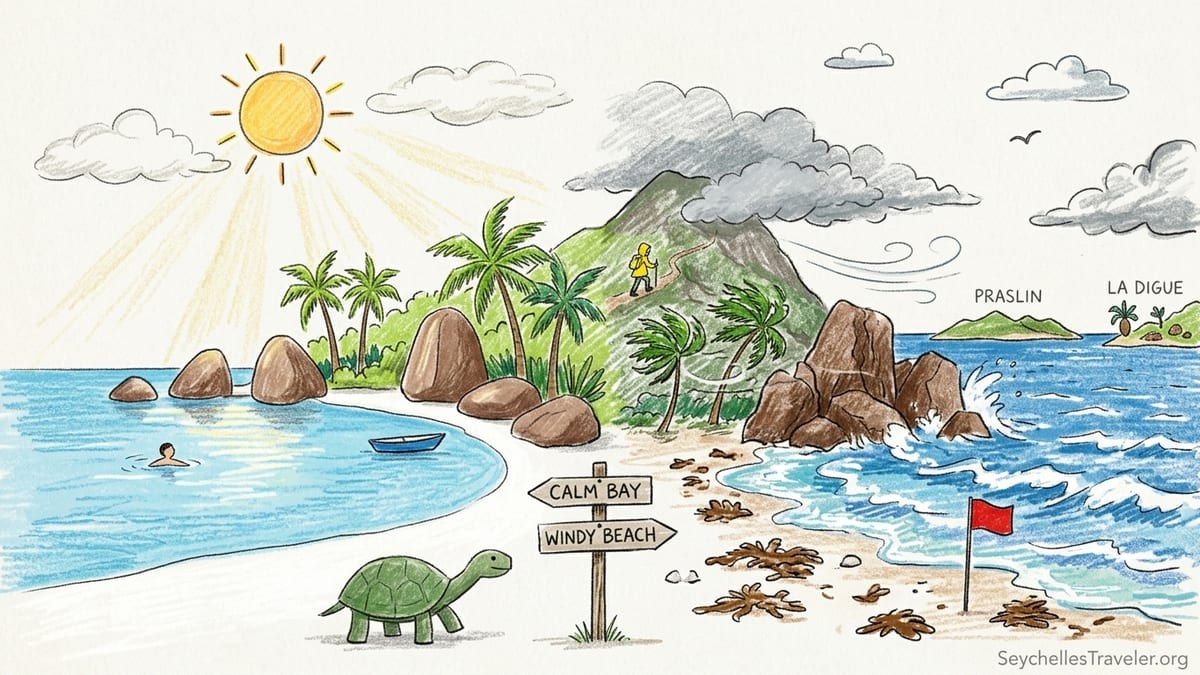
On paper, it is tempting to ask a simple question: “Is April good for Mahé?” or “Is June bad for Praslin?” In practice, my experience was much more granular. An April swim on Mahé’s sheltered northwest Beau Vallon felt like a placid hotel pool, while the same week saw a noticeable groundswell thumping into the open southwest coast near Baie Lazare. In late May, La Digue’s east-facing Grand Anse felt like a wind tunnel with big, dumping surf, yet the island’s west side, facing Praslin, was calm enough for children to play at the waterline. The right question is less “Which island in which month?” and more “Which side of which island for what you want to do?”
Crucially, nothing in my experience suggested that whole islands were “bad” or “off limits” in a given season. Even in what locals casually called the “windy months,” I found quiet pockets for a morning swim and sheltered reefs for snorkeling. What changed was how much effort it took. In the calmer transition months I could simply step out of a beachside guesthouse and fall into glassy water. Under full southeast trades, I was more likely to hire a local skipper for a half-day trip to find the lee of an outlying islet, or to accept that some postcard beaches were better for photography than for actually getting in.
Mahé: One Island, Several Microclimates
Mahé is the island where Seychelles’ microclimates are most obvious, because the central granite spine catches clouds and creates its own weather. On my April trip I stayed first on the northwest coast near Beau Vallon, then moved to the southeast around Anse Royale. The contrast over a single week was striking. Mornings on the northwest side often began with almost windless, mirror-flat seas and long views north toward Silhouette. The only ripples came from fishing pirogues and the Cat Cocos ferry passing far offshore. Humidity was high, but a light onshore breeze usually developed by midday, enough to keep the heat from feeling oppressive.
Rain behaved differently on either flank of the island. Around Beau Vallon in April, I saw short, sharp showers that drifted in over the ridge, dropped a burst of warm rain and cleared within 20 minutes, leaving a pearly, filtered light over the bay. When I drove across to the east coast on the same afternoon, dense cloud was often clinging to the mountain crest, and in the higher interior near Morne Seychellois National Park the road was still wet from heavier earlier downpours. In October, that pattern repeated: low cloud tended to cap the summit, while the coasts alternated between bright sun and fast-moving showers.
Wind and sea conditions on Mahé were very sensitive to coastline orientation. In late May, as the southeast trades strengthened, the difference between the southwest and northwest was almost comical. At Anse Intendance and Police Bay, powerful shore break made swimming risky for anyone not very confident, and the lifeguards at popular spots were busy waving people back from the steep drop-off. The air felt cooler and very fresh, with strong gusts blowing sand along the beach. That same afternoon, Beau Vallon on the northwest was choppy but manageable, with small wind waves that made it fun for body-surfing and stand-up paddle boarding but still comfortable for an easy swim close to shore.
Seaweed on Mahé followed the official pattern, but with nuance. Tourism and weather sources warn that southeast trade winds can push weed onto southern beaches, and in June I certainly saw broad brown lines of seaweed washed up along stretches of the south and southeast, especially near Anse Royale and Anse Parnel. It was unsightly in patches and sometimes floated in the shallows, brushing your legs as you swam. However, even on windy days there were clean sections in the same bay, and the northwest beaches were largely free of weed. For me, the lesson was not that “Mahé has seaweed in June” but that a ten-minute drive can change your experience completely.
Praslin and La Digue: How Orientation Ruled My Beach Days
On Praslin and La Digue, which lie lower and have less dramatic peaks than Mahé, the mountains do not trap cloud in quite the same way, but orientation still shaped every day of my stays. On Praslin in April, I split my time between the east-facing Côte d’Or area and the more sheltered northwest near Anse Lazio. Mornings on Côte d’Or were usually very calm, with long, gentle waves and water so clear that I could see the pattern of rays on the sandy bottom from the jetty. By mid-afternoon, a light onshore breeze ruffled the surface, but it remained easily swimmable. When I visited again around early June, the same beach had more noticeable wind, small chop and occasional rafts of seaweed, confirming what Seychelles meteorological notes now say about seasonal weed arriving on some northeast-facing shores when the wind flips later in the year.
On the southern and southwestern coast of Praslin, near Anse Marie-Louise and Anse Consolation, the southeast trades made a much bigger impression. In June, I found the surf here more forceful and the water slightly murkier, with suspended sand and seagrass fragments clouding the shallows. It was still possible to paddle close to shore, but snorkeling from the beach lost its appeal compared with the calmer northwest. Locals I spoke with emphasised that this rougher feel is normal for that time of year and that conditions usually improve toward October and November when the trades ease and the sea clears again.
La Digue offered perhaps the clearest illustration of how the same island can feel like two different destinations in one day. On an October morning bicycle ride to Anse Source d’Argent on the west coast, the lagoon was almost lake-like. Small fish flitted among coral heads just a few fin kicks from the sand, and the visibility was good enough for casual snorkeling with children. That same afternoon, when I cycled over to east-facing Grand Anse and Petite Anse, the ocean felt much more energetic. Even in October, with lighter winds overall, there was a long-period swell pounding into the open bay, and red flags discouraged swimming. In late May, under stronger southeast trades, the difference was even more pronounced. The east side felt exposed, noisy and wild, while the west facing Praslin remained mostly calm.
Seaweed around Praslin and La Digue mirrored official guidance in broad strokes, but again with local quirks. During my June stay, the highest concentrations of weed I personally saw were along some southern coves of Praslin and at the downwind end of long beaches, where wind and currents naturally collect floating debris. On La Digue, the classic west-coast spots remained remarkably clean, while some low-lying corners of the east coast accumulated narrow bands of weed after stronger blows. None of it was enough to “ruin” a beach, but it did influence where I chose to swim or photograph at different times of day.
Cloud, Rain and Humidity Around the High Islands
The visual drama of Seychelles weather is most obvious around the taller inner islands, especially Mahé and Silhouette. Flying into Mahé in April, my first glimpse of the climate at work came as the aircraft descended through a stack of high, puffy cumulus that were firmly anchored on the mountain ridge. The coasts on both sides looked brightly lit, but the spine of the island was cloaked in darker cloud. Over the next days, that pattern repeated. Morning skies often started mostly clear, with a slight haze from humidity, and by late morning clouds began to gather over the central peaks.
Afternoon showers tended to fall first and heaviest in the interior. Hiking the Copolia trail one April afternoon, I watched as thick mist rolled up from the forest, swallowed the granite slabs at the summit and then spilled over toward Victoria. Thirty minutes later, on the drive back toward Beau Vallon, the road was slick from rain higher up but the beach itself sat under broken blue sky. The cloud sometimes meant dramatic sunset light, with shafts of sun punching through gaps in the cloud deck and illuminating Silhouette in sharp relief across the water.
Silhouette itself, when seen from Mahé’s northwest, often wore its own halo of cloud. On several evenings in April and October, its high peak was wrapped in a stationary cap of white while the lower flanks basked in golden light. Locals told me this is common, especially in the more humid months when moist air rises rapidly over the island. From a practical perspective, that meant I treated day trips that combined inland hiking and coastal swimming with some flexibility. If the summit looked socked in by midday, I would often downgrade a planned hike and linger at sea level instead, where conditions were brighter and less enclosed.
In terms of raw comfort, humidity was the biggest difference between my April and October visits and the late May to June stretch. In April, daytime highs felt close to 30 degrees Celsius, and the thick air meant that a short, steep walk left clothes damp and camera lenses fogging when I stepped from air conditioning into the outside world. Showers, when they came, were heavy enough to soak sandals in a few seconds, although they usually passed quickly. By early June, while the thermometer did not drop dramatically, the southeast breeze made everything more bearable. Even on clear days the air felt drier, and hiking on Mahé’s western slopes was more comfortable, though the wind at exposed viewpoints could be surprisingly brisk.
Sea Conditions, Ferries and Boat Trips in Different Months
The way the wind translated into sea conditions was most obvious on the inter-island ferries. I travelled the Mahé to Praslin route four times, twice in April, once in early June and once in October, all with the main high-speed operator on its large catamarans. In April, both crossings felt relatively gentle. There was a light swell, enough to make walking around the cabin a matter of holding seat backs, but very few passengers looked uncomfortable. The outside deck at the stern was breezy but pleasant, and the captain made good time across the roughly one-hour route.
The June crossing in the middle of the southeast trade wind season was a different story. Whitecaps flecked almost the entire channel and the catamaran occasionally slapped into the oncoming waves hard enough for a shudder to run through the hull. The crew proactively handed out sick bags, and a few families opted to stay on the open deck where the fresh air seemed to help. I did not feel unsafe, but it was not a crossing I would recommend to anyone with serious motion sickness. For those travellers, during the stronger wind months, the short domestic flight between Mahé and Praslin is worth considering, even though it costs more than the ferry.
Smaller boat tours amplified the seasonal contrast. In April and October, full-day snorkeling and island-hopping trips from Praslin to Curieuse, St Pierre, Cousin and Felicité ran in mostly glassy or gently undulating seas. The skippers were comfortable mooring close to reef edges, and short open-water swims from the boat to the snorkeling spots felt relaxed, with little surface chop. In late May and June, some operators adjusted itineraries or warned guests that landings at more exposed islets might be weather-dependent. On one June outing from La Digue, the ride around the island’s southeast corner into the wind turned into a wet affair, with spray flying over the bow and conversations reduced to shouts over the engine and wind.
For divers, these shifts have direct consequences. Local dive centres and regional dive guides now consistently point to the transition months of March or April and October or November as the sweet spots for visibility, with underwater clarity often reaching 20 to 30 metres on offshore sites when the sea is calm. During my own diving around Mahé and Praslin in April and October, visibility was indeed striking, with sunbeams cutting clean columns of light among the granite boulders. On a June dive, by contrast, the combination of more suspended particles and a restless surface made the water appear milkier, even though the sites were still enjoyable.
Snorkeling, Swimming and the Reality of Seaweed
From a swimmer’s perspective, the inner islands rewarded early starts in all the months I visited. In April and October, the first hours after sunrise often delivered the flattest seas and clearest shallows, before daily breezes developed. I remember wading into the lagoon at Anse Lazio one April morning to find visibility so high that I could count sea cucumbers on the sand several metres away with my mask still dry on my forehead. By mid-afternoon, the same bay had gained a gentle ripple, enough to slightly disturb surface reflections but not enough to trouble relaxed swimmers.
In late May and June, picking the right beach became more important. On Mahé, the southeast and south coasts often had a shore break that made entry and exit awkward, with waves knocking knees at the waterline and a quick drop-off beyond. Strong swimmers still got in, but families tended to gravitate to more protected coves, including parts of the west and northwest. On Praslin and La Digue, I watched the same pattern repeat. Open, east-facing beaches collected more swell and onshore breeze, while coves sheltered by headlands or small offshore islands kept calmer patches where the water remained clear enough for casual snorkeling.
Seaweed understandably worries many travellers, especially those who have seen dramatic images from other parts of the world. In the Seychelles, my direct experience aligned with the more measured local descriptions. I never found entire coastlines carpeted in thick rotting mats. Instead, I saw moderate lines of weed washed up after windier days on specific south and southeast-facing stretches in June, and occasional floating clumps in the shallows on some north and northeast beaches when the wind pattern shifted later in the year. It sometimes spoiled the idealised white-sand look, and I chose other spots for long swims on those days, but it never made the water unusable.
For snorkeling, weed and wind worked together. On calm April and October days, even beaches that are more exposed in theory, such as Anse Georgette on Praslin or some of La Digue’s east-coast stretches, could offer rewarding snorkeling close to shore when the swell dropped. In June, I found boat-based snorkeling in the lee of small islets, such as St Pierre or the back side of Curieuse, more enjoyable than trying to fight the chop from a public beach. Guides kept a close eye on currents and took us to spots where the reef structure and island mass broke the wind and waves, preserving visibility.
Firsthand and Researched Timing Advice by Activity
Based on the conditions I personally experienced and on current guidance from Tourism Seychelles and local marine and weather sources, the best timing within the year depends strongly on what you want to prioritise. For travellers who care most about beaches and casual swimming, my most satisfying days were in April and October on coasts that faced away from the prevailing wind. In April, that meant northwest Mahé, northwest and north Praslin, and the west coast of La Digue. The combination of warm water, high humidity and light breeze meant long, lazy swims with minimal chop. October offered similar pleasures, with perhaps slightly less heat but still comfortable sea temperatures and generally calm mornings.
For snorkeling and diving, I would lean even more strongly into the transition windows around March to May and late September to November. In those periods, the sea surface was calmer on a higher percentage of days, and underwater visibility on my dives off Mahé and Praslin was noticeably better than in early June. Local dive centres confirm that these same months often bring visibility that can exceed 20 metres on offshore sites, with water temperatures in the upper twenties Celsius. If you are combining scuba with land-based sightseeing, April and October offer a sweet spot where you can schedule early-morning dives and still expect decent conditions for an afternoon beach stop.
Hikers might actually prefer the slightly cooler, windier stretch from around late May through August, while accepting that some ridges will be very breezy and that clouds will often decorate the mountain tops. On my own hikes in early June, the southeast breeze made climbs on Mahé’s steep trails feel more comfortable than in April, even if views were sometimes softened by haze or fleeting cloud. Trails on Praslin and La Digue, which are lower and less exposed, remained accessible in all my visits, but footing could be slick after interior showers in the wetter months from December to February.
Island hopping by ferry and smaller boat is technically possible year round, yet the comfort level changes by season. If you are prone to seasickness and plan multiple crossings between Mahé, Praslin and La Digue, I would strongly consider April, May, October or November, when seas are more often moderate and winds lighter. Within those windows, mornings tended to be smoother in my experience, and sitting toward the stern and centre of the large catamarans reduced motion. During the stronger southeast trades from about June to September, it may be worth booking the short domestic flight between Mahé and Praslin for at least one leg, and focusing your boat excursions on leeward coasts where operators can shelter behind islands.
Finally, for quieter travel and better value, shoulder periods at the edges of the main European holiday months worked well for me. Late April before the northern summer holidays, and mid to late October after them, combined the calmer seas and good visibility praised in official guidance with fewer full hotels and a more relaxed feel at popular beaches. Restaurant staff had time to chat, day-trip boats were half full rather than packed, and it was easier to make last-minute decisions based on each morning’s sky and sea instead of feeling locked into pre-booked itineraries.
The Takeaway
My time on Mahé, Praslin, La Digue and their neighbouring islets convinced me that in the Seychelles there is no single “perfect” month that guarantees flat seas, empty beaches and cloudless skies. Instead, there is a shifting dance between wind direction, island orientation and daily weather that reshapes the inner islands from week to week. April, May, October and November did, in my direct experience, deliver some of the calmest seas, clearest snorkeling and most reliable ferry crossings, in line with what Tourism Seychelles now promotes. The wetter, warmer stretch from December to April brought heavier showers and higher humidity, while the southeast trade wind season roughly from May to October made some coasts choppy and pushed seaweed onto downwind beaches.
What mattered most on the ground was not the month printed on my boarding pass but whether I matched my base and my daily plans to those patterns. Facing the prevailing wind in June meant more drama and less swimming. Turning my back to it, by choosing northwest Mahé or the west side of La Digue, restored the calm lagoon idyll that sells the islands in brochures. Watching how cloud formed over Mahé’s spine or Silhouette told me when to hike high and when to stay near the shoreline. Listening to ferry crews and dive guides who live by the winds helped me pick the right days for crossings and offshore trips.
If you come prepared to adjust your expectations to the season and to pick your coast with care, Seychelles will usually meet you halfway. Whether you are stepping through powdered sand into a still turquoise bay in April, leaning into the southeast breeze on a June cliff walk, or watching trade-wind clouds catch the last light over Silhouette in October, the islands reward those who think about orientation as much as they think about the calendar. The reward is not just better photos, but more time in the water and less time wondering why the sea does not match the brochure.
FAQ
Q1. What is the single best month to visit the inner islands for beaches?
There is no guaranteed “best” month, but in my experience April and October gave the most consistently calm seas and good beach swimming on coasts facing away from the prevailing wind.
Q2. How rough are the ferries between Mahé, Praslin and La Digue in the windy season?
In the strong southeast trade wind months, my Mahé–Praslin crossing had frequent slaps against oncoming waves and plenty of whitecaps, which made it uncomfortable for travellers prone to motion sickness but still safe and well managed by the crew.
Q3. Did seaweed ever completely ruin a beach for you?
No. I saw moderate bands of seaweed on some south and southeast-facing shores in June and smaller patches elsewhere later in the year, but I always found cleaner sections or alternative beaches within a short drive or boat ride.
Q4. When did you find the best snorkeling visibility?
My clearest snorkeling and diving days were in April and October, especially around northwest Mahé, northwest Praslin and the islets off Praslin, when winds were lighter and the sea surface stayed flatter.
Q5. Is June a bad time to visit Seychelles?
June was not bad, but it was different. I enjoyed cooler hiking and dramatic surf, yet needed to be more selective about which coasts I used for swimming and relied more on boat trips to find sheltered snorkeling spots.
Q6. How did clouds around Mahé and Silhouette affect your plans?
Afternoon cloud and mist often clung to the higher peaks, so I tried to start hikes early and stayed flexible, switching to coastal activities when the summits disappeared into cloud for hours at a time.
Q7. Which side of Mahé felt best in the southeast trade wind season?
During late May and June, the northwest coast around Beau Vallon felt more sheltered for everyday swimming and beach time than the exposed south and southeast, where surf and seaweed were more noticeable.
Q8. Are April and November guaranteed to be dry and calm?
No. Even in those recommended months I saw short, heavy showers and the occasional choppy day, but overall the proportion of calm, clear conditions for beaches and boat trips was higher than in June.
Q9. When would you go if your priority was hiking comfort over swimming?
If hiking was my main focus, I would aim for late May to August, when the southeast breeze made climbs cooler, accepting that some ridges would be windy and that seas on exposed coasts might be too rough for relaxed swimming.
Q10. How far in advance should I fix my island-hopping plan?
I found it best to book the main inter-island legs and accommodation in advance, then leave day-by-day activities flexible so I could adjust beaches, ferries and boat tours according to each morning’s wind, cloud and sea state.