


Choosing the “best” beach in the Inner Islands of Seychelles is less about postcard looks and more about what the sea and wind are doing on the day you arrive. On Mahé, Praslin and La Digue, a bay that feels like a private lagoon in March can be a seaweed trap with a dangerous shorebreak in July. After several trips spread across both the southeast trade wind season from roughly May to October and the calmer shoulder months around April and November, these are the Inner Islands beaches I would personally go back to, and why.
How the Inner Islands Really Compare for Beaches
Across the Inner Islands, Praslin still has the densest cluster of beaches I would cross an ocean for, La Digue has the most dramatic granite scenery, and Mahé quietly delivers the most variety if you rent a car and chase the right coast for the wind. That is not a ranking based on fame. It reflects days spent in the water with a mask on, watching which bays collect seaweed when the southeast trade winds set in between May and October and which ones stay clear and swimmable when a northwest swell rolls through later in the year.
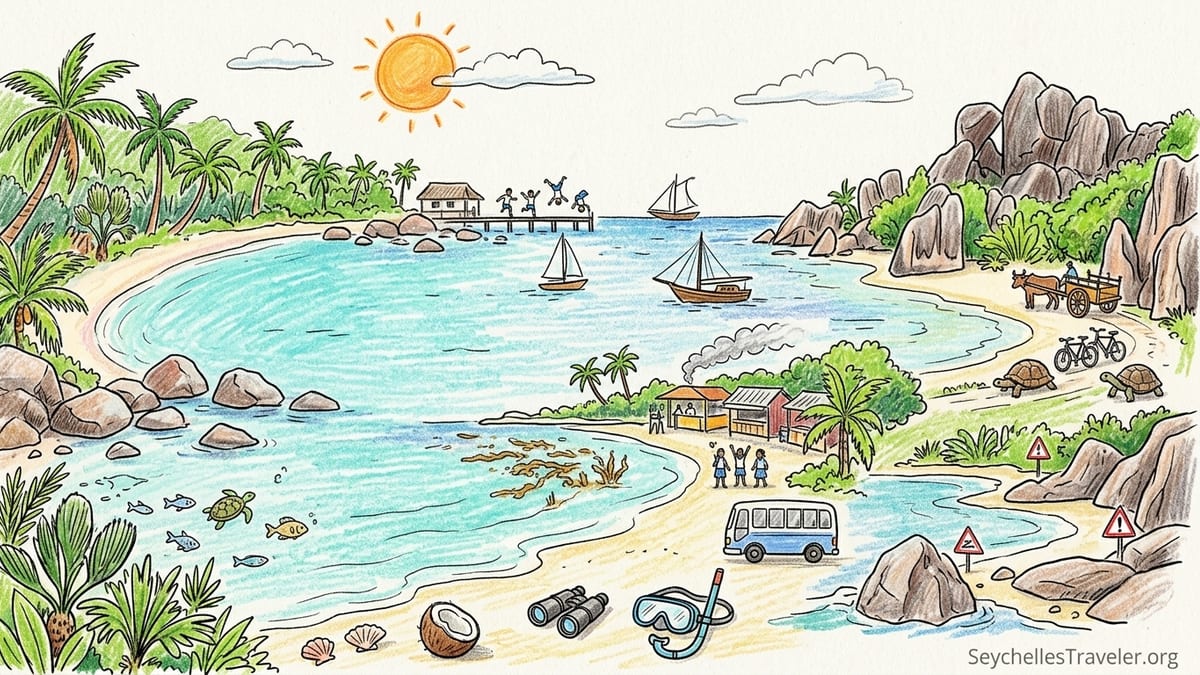
On Mahé, I would return for the long arc of Beau Vallon and the smaller coves like Anse Major and Sunset Beach. They are not as hyped as La Digue’s granite alleys, but they offer deeper water close to shore, reliable swimming outside the windiest months, and the everyday texture of island life, from school kids doing somersaults off the pier to grill smoke drifting from takeaway shacks at dusk.
Praslin, for me, wins on pure swim quality. Anse Lazio and Anse Georgette have a combination that is rarer than glossy photos suggest: reasonably predictable waves, relatively clean sand on more days of the year, and water deep enough for proper laps without needing to wade over coral heads at low tide. When the southeast trade winds are blowing, the south coast of Praslin can be covered in seaweed, but its northwest-facing bays often remain clear, which is one reason I keep going back.
La Digue is the island that most visitors expect to love the most, and for scenery I often do. Its beaches, though, are very specific tools. Anse Source d’Argent is beautiful and unusual, but I rarely want to swim there for more than a few minutes because the lagoon is shallow with a coral floor and the tide controls everything. For real swimming and snorkeling on La Digue, I would return instead to Anse Sévère and the more remote trio of Grand Anse, Petite Anse and Anse Cocos, accepting that those southern-facing beaches can be rough and weed-strewn during the southeast trade wind season.
Mahé Beaches I Would Actually Go Back To
Beau Vallon, on Mahé’s northwest coast, is the beach I have spent the most cumulative hours on, and it remains the one I would return to for an unhurried day that mixes actual swimming with food and people-watching. Access is simple: you drive or take the bus and step directly onto a long crescent of pale sand. The sand here is medium-fine, comfortable underfoot, and the water drops off gradually, with enough depth for swimming within about ten to fifteen metres of shore at mid-tide.
In the calm months around April and again in October and November, Beau Vallon can feel almost like a giant hotel pool, with low waves and minimal current. On several late-afternoon swims in November, I was comfortable staying in the water for an hour at a time, moving parallel to the shore, with only a gentle lateral drift that was easy to correct by sighting a landmark on the sand. In the core of the southeast trade wind season, I have seen the same bay chopped up with short wind waves, still swimmable for confident adults but not ideal for small children near the open middle of the bay.
Shade at Beau Vallon comes from trees along the back of the beach rather than umbrellas, and by mid-morning many of the established spots are taken by families. Basic facilities are one of the reasons I keep returning: there are public restrooms in walking distance, several takeaway stalls selling grilled fish plates that were roughly in the equivalent of 8 to 15 US dollars on my last visit, and small kiosks for coconut water and snacks. Crowd levels change a lot by day and season. On a weekday morning outside school holidays, I have shared the bay with a handful of hotel guests and local joggers; on a Sunday in August, busloads of day-trippers and residents filled most of the shade and the feeling shifted from tranquil to busy picnic ground.
For snorkeling, Beau Vallon is serviceable rather than spectacular. There are patches of rock and coral toward the northern end where I have watched damselfish and the occasional turtle, but live coral is patchy and visibility worsens as wind and boat traffic pick up. I would not choose this bay as a pure snorkeling destination, but I do choose it repeatedly as a mixed-purpose beach: good for swimming, children near the shore under supervision, casual photography at sunset, and easy access to food without changing out of a swimsuit. On my last calm-season visit, I arrived mid-morning with the intention of staying two hours and ended up staying five.
By contrast, Anse Major, further along Mahé’s northwest, is a beach I only visit when I have half a day to spare and a reasonable level of fitness. Reaching it by land requires a hike of roughly 45 minutes to an hour each way along a coastal trail that climbs and dips through forest and granite. There are boat taxis from Bel Ombre that shorten the effort, but the hike is part of what makes the beach feel remote. There are no facilities, no permanent shade structures, and no restaurants directly on the sand, only pockets of shade cast by boulders and the backdrop of vegetation.
When I have arrived mid-morning in the calmer shoulder months, Anse Major has offered clear, glassy water with a stronger drop-off than Beau Vallon. You can find swimming depth within a few steps, and on my last visit the waves were low enough that families were letting older children play in the shallows while adults floated just beyond. The snorkeling along the rocks at either end of the bay has been among the best I have experienced on Mahé, with schools of reef fish, sea cucumbers, and in one case an octopus that remained visible for several minutes. That said, this is a pocket-sized bay. If a tour boat anchors offshore and sends in a dozen snorkelers, the sense of solitude disappears quickly.
Because there is no infrastructure, Anse Major is not well suited to very young children, people who need easy bathroom access, or anyone who wants to sit in the shade with a cold drink on demand. It excels instead at scenery, snorkeling, and the feeling of having earned your swim. I usually plan to stay just long enough to swim, snorkel, dry off and eat a packed lunch, roughly three hours on the sand. Longer than that, the lack of shade and facilities becomes uncomfortable, especially once the sun slides past midday.
Praslin Beaches Worth Crossing an Ocean For
On Praslin, Anse Lazio is one of the few famous beaches that fully met and then exceeded its reputation for me. Access is straightforward by car or taxi, with a short walk down from the parking area to the sand. There is no entry fee. The sand is very fine and pale, the sort that squeaks slightly underfoot, and the bay curves between granite headlands that create a partial sense of enclosure. The water becomes chest-deep for an average adult within several metres of shore, making it excellent for swimming without a long wade.
I have visited Anse Lazio both during the southeast trade wind season and in calmer, transitional weeks. On a late-September morning with the trades still blowing, there was a definite swell running, with waves shoulder-high at their largest near the centre of the bay. Confident swimmers, myself included, could dive under and enjoy long body-surfing rides, but several people closer to the shore were visibly surprised by the power of the shorebreak. In those conditions, I was comfortable in the water for twenty to thirty minutes at a stretch but took long breaks on the sand between swims. On an April visit, with lighter wind, the same bay felt like a different place: lower, more regular waves, minimal sideways current, and water so clear that I could see the pattern of white sand ripples under my feet.
Snorkeling at Anse Lazio works best at either end of the beach, near the rocks, and more so on calmer days. The coral here is not pristine, and I did not see dense fields of branching live coral, but I did encounter reef fish, rays, and once a turtle on an early-morning swim. Shade is available under trees set back from the high-tide line, and small snack bars and a more formal restaurant sit just behind the beach, which makes it easy to spend much of a day here. On my most recent calm-season visit, I arrived around 9 a.m. with plans for a single swim and lunch; I left just before sunset, which tells you how well the beach holds a full day.
Anse Georgette, on the same island, is the Praslin beach I would return to when I want a quieter version of that same archetypal Seychelles bay. Access is less straightforward because the beach lies beside a golf course and resort. At the time of my last visit, non-guests could still enter on foot, but it required securing permission in advance and reporting to a gate, then walking down through the property. Conditions and rules here can change, and anyone planning a visit should confirm current access with their accommodation or a local operator before setting out.
The sand and water colour at Anse Georgette are similar to Lazio, with the same fine-grained texture and luminous turquoise shallows, but the bay is a touch smaller and feels more intimate. I have experienced it in light-wind conditions when the sea was calm enough for relaxed floating and easy laps, and in a breezier spell when waves pounded the middle of the beach hard enough that I stayed at the fringes near the rocks. There are no public facilities directly on the beach for non-resort guests, which reduces casual crowds. As a result, my typical stay here has been shorter than at Anse Lazio, in the range of three to four hours, focused on one swim, a snorkeling session, some photography and then retreating before the lack of shade and amenities becomes uncomfortable.
Further along Praslin’s north coast, the sweeping bay of Anse Volbert, also called Côte d’Or, is less dramatic in photographs but has become one of my most practical, repeatable beaches. It backs directly onto guesthouses, small hotels and restaurants, so accessing it often means stepping out from your accommodation. The sand is firm and suitable for long walks or runs, and the water is shallow for a considerable distance, which is good for families with young children but less interesting for serious swimmers at low tide.
Wind and seaweed affect Anse Volbert strongly. In the northwest monsoon months from roughly December to March, the bay can be very pleasant, with light onshore breezes and clear shallows. In the heart of the southeast trade wind season, the same beach often collects seaweed, and choppy surface conditions make snorkeling from shore less appealing. I have stayed along Côte d’Or in both patterns. On a calm February afternoon I spent nearly six hours drifting between swims, beach walks and drinks at a small beachfront bar, happy to have everything within a few metres. In late July of another year, I treated the beach more as a launching point for boat trips and dinners, with only quick dips in the water because the shallows were clouded by sand and weed.
La Digue’s Granite Icons and When They Work
On La Digue, the granite-framed lanes of Anse Source d’Argent are every bit as striking in person as in the images that sell Seychelles holidays, but they behave more like a tidal sculpture garden than a conventional swimming beach. Access involves entering through a privately managed estate where visitors pay a modest entry fee, then following a sandy track past vanilla vines and giant tortoises to reach a sequence of coves. Once there, you find narrow bands of soft sand slipping between hulking boulders and a broad, shallow lagoon protected by an offshore reef.
The day’s tide and wind direction govern everything at Source d’Argent. At mid to high tide on a calm day, I have been able to float and wade comfortably in knee to waist-deep water, weaving between coral heads and patches of seagrass. At very low tide, much of the lagoon becomes ankle-deep, exposing sharp coral and making proper swimming nearly impossible in some sections. Even on clearer days, the combination of seagrass and sand means visibility is not what you would get at a dedicated snorkeling site. I have seen rays and grazing turtles here, but the appeal is more about the shapes of the rocks, the way morning light angles through gaps, and the filtered views toward Praslin in the distance.
Shade at Anse Source d’Argent is irregular. Some coves have overhanging branches and boulders that cast deep shade, others are exposed. There are simple facilities and small stands selling fruit juices and basic snacks in the estate area behind the beach, and bicycle parking just outside. Crowd levels peak from late morning through the afternoon, especially when day-trippers from Praslin arrive. For that reason, the longest I have stayed here was about four hours, on a day when I entered early, explored and photographed several of the coves in relatively soft light, took a short swim where depth allowed, and left just as the main wave of visitors arrived.
For a more traditional swimming and snorkeling experience on La Digue, I keep returning to Anse Sévère. This small, north-facing beach sits a comfortable bike ride from the ferry jetty, with easy access from the coastal road. The sand is a little coarser than at Seychelles’ most famous bays, but still pleasant underfoot. A fringe of trees provides pockets of shade, and at low to mid-tide you can wade out over sand and scattered rocks into a lagoon that deepens enough for casual swimming within a moderate distance.
Snorkeling at Anse Sévère has been some of the most rewarding I have found from shore on La Digue. Along the left-hand side facing the sea, where rocks and coral heads cluster, I have seen a healthy mix of reef fish, including parrotfish and butterflyfish, and on a still morning in November the visibility was clear enough that I could see details of the reef ten metres away. There are no lifeguards, and currents can strengthen with wind and tide shifts, so I treat the conditions on each visit as a fresh unknown rather than assuming consistency. Facilities here are basic but welcome: a small beach bar has operated at the back of the sand on several of my visits, renting sunbeds and selling simple snacks and drinks. With that support, I am happy to spend half a day at Anse Sévère, mixing snorkeling sessions with shaded reading, something I would not do as easily on the more remote southern beaches.
The trio of Grand Anse, Petite Anse and Anse Cocos on La Digue’s southeast side are the beaches I recommend most cautiously. They are visually spectacular and worth the hike if you are fit and visiting outside the windiest weeks, but the surf and currents here can be strong even when the rest of the island feels calm. From the road on the eastern side, you walk a short path through vegetation to reach Grand Anse, then climb and descend coastal tracks to reach Petite Anse and finally Anse Cocos. There are no permanent lifeguards and, beyond occasional seasonal setups, almost no facilities.
On a dry-season visit in July, with the southeast trade winds in full effect, Grand Anse presented double to triple overhead sets crashing onto the steep sand, with visible rip currents pulling foam back out to sea. There were posted warnings against swimming, and I limited my time in the water to brief paddles in the very edge of the shorebreak, more to cool off than to swim. In those conditions, I would not bring children here to swim at all. A calmer April visit produced a much more manageable surf, but even then I treated the water respectfully, limiting my swims to twenty minutes and staying near other people. What the southern trio consistently delivers is scenery, solitude relative to Source d’Argent, and excellent photography opportunities when the light is right. My stays here are usually three to four hours in total, dominated by hiking, looking and sitting rather than prolonged swimming.
Seasonal Winds, Seaweed and Reading the Day
Tourism authorities and local operators are clear that the Seychelles’ two main wind regimes, the southeast trade winds roughly from May to October and the northwest monsoon from around December to March, make a tangible difference to beach conditions. In the southeast season, south and southeast-facing coasts on Mahé and Praslin often see heavier swell and more seaweed accumulation, while northwest-facing beaches can stay calmer and cleaner. Later in the year, that pattern can flip, with the northeast coasts of Praslin, including sections of Côte d’Or, sometimes catching more weed and chop while southern bays quieten down.
On the ground, what this has meant for my own trips is that I do not treat any single beach as always “the best.” In July and August, I have kept returning to Beau Vallon and the northwest of Mahé, and to the north and northwest coasts of Praslin, because they were more sheltered from the prevailing wind and offered clearer shallows. In shoulder months like April and November, I have used the relative calm to explore more exposed coasts, including the south of Mahé and the southeast side of La Digue, knowing that smaller daily variations in wind and tide still mattered but that the baseline conditions were gentler.
Seaweed can be the biggest surprise for first-time visitors who arrive with mental images of untouched sand. I have walked onto otherwise idyllic bays in the heart of the trade wind season and found a wide band of dried and decaying weed at the high-tide line, enough to make the first steps into the sea unappealing. A taxi driver on Praslin once showed me, within a span of twenty minutes, one south coast beach where the shoreline was thick with weed and another north coast bay that was nearly pristine that same morning, illustrating how localised the effect can be. Rather than relying on static advice, I now ask guesthouse owners and boat captains where the cleanest swimming is that week.
It is equally important to distinguish the conditions I experienced on a given day from any blanket safety claims. A flat, glassy sea at Anse Lazio in April does not cancel the very real power of its waves when a larger swell is running in September. Likewise, a calm low-tide paddle at Source d’Argent does not mean the lagoon will always feel safe for nervous swimmers, especially when the wind pushes chop across the reef. I now treat every arrival at a Seychelles beach like a new site inspection: watch the water for five to ten minutes, look for breaking patterns that signal rip currents or shallow reefs, notice how and where other people are entering and exiting, and only then decide how long I plan to stay in.
The Takeaway
After multiple circuits through the Inner Islands, the beaches I would willingly spend my own limited holiday time on again are not just the ones with the most famous names, but the ones that match a clear purpose on the day. On Mahé, that means returning to Beau Vallon when I want a long, easy swimming day with food and facilities, and to Anse Major when I want a half-day of hiking, snorkeling and quiet. On Praslin, it means investing full days in Anse Lazio and returning to Anse Georgette and Côte d’Or when I want slightly different blends of swim quality, convenience and atmosphere.
On La Digue, my repeat visits split between early, carefully timed entries to Anse Source d’Argent for its sculpture-like granite and filtered light, several-hour snorkeling and reading sessions at Anse Sévère, and weather-dependent hikes to the southern trio of Grand Anse, Petite Anse and Anse Cocos for scenery and solitude rather than long swims. Across all three main islands, reading the wind, tides and seaweed patterns each week has made more difference to my enjoyment than chasing an abstract ranking of “best beach.”
If you are planning your first Inner Islands trip, it can help to think in concrete scenarios. If you have young children and are travelling in July, favour accommodation near more sheltered coves on the northwest coasts of Mahé or Praslin and use day trips to sample more exposed showpiece beaches. If you are strong swimmers visiting in a shoulder month, build in days for Anse Lazio, Grand Anse on La Digue and some of Mahé’s wilder south coast bays, with the understanding that flat water one morning does not guarantee the same the next. The Inner Islands reward travellers who match their expectations to what the sea is actually doing when they arrive and who are willing to treat each bay as a different tool in a very beautiful toolkit.
FAQ
Q1. When is the best time of year to visit Seychelles for beach swimming?
The most consistently comfortable beach conditions I have experienced were in the shoulder months of April, May, October and November, when the major wind systems are shifting and seas are generally calmer. Outside those windows, there are still excellent days, but picking the right coast on each island becomes more important.
Q2. Which Inner Island has the best overall beaches for a first-time visitor?
If I had to choose one island purely for beach quality, I would lean toward Praslin because Anse Lazio, Anse Georgette and Côte d’Or give you a strong mix of world-class scenery and practical, repeatable swimming options within short distances of each other.
Q3. Is Anse Source d’Argent on La Digue worth the entry fee if I mainly want to swim?
It is worth visiting for its granite formations and atmosphere, but the lagoon is shallow, tidal and not ideal for long, deep swims. If swimming is your priority, I would pair a quick visit there with more time at Anse Sévère or beaches on Praslin.
Q4. How risky are currents on the more exposed beaches like Grand Anse and Anse Intendance?
On days with strong swell, the shorebreak and rip currents at exposed south and southeast-facing beaches can be powerful enough that I avoid swimming entirely or limit myself to the very edge of the surf. There are often warning signs but rarely lifeguards, so you should assess each day’s conditions independently and err on the side of caution.
Q5. Can I rely on online photos to judge how much seaweed there will be?
Not really. Seaweed levels can change within days depending on wind and current. I have seen bays that looked flawless in recent photos covered in weed a week later. The most reliable information comes from accommodation hosts and local boat operators who see their nearby beaches daily.
Q6. Which Inner Island beach would you pick for a full day with children?
For a mixed-age family, I would choose Beau Vallon on Mahé or Côte d’Or on Praslin outside the windiest weeks. Both offer gentle entry into the water at certain tides, nearby food, shade and relatively easy access to restrooms, which makes staying five or six hours practical.
Q7. Where did you find the best snorkeling directly from the beach?
From shore, my most rewarding snorkeling sessions were at Anse Major on Mahé and Anse Sévère on La Digue, particularly on calm mornings when wind and swell were low and visibility was high in the shallows along the rocks.
Q8. Do I need a car to enjoy the beaches on Mahé and Praslin?
A car is not strictly necessary, but having one on Mahé and Praslin has consistently made my beach days more flexible. It allows you to switch bays quickly if you find unexpected seaweed, rough water or crowds, instead of being limited to whichever beach sits in front of your hotel.
Q9. How long should I plan to stay at each beach in a typical day?
For practical planning, I usually allow a half day for more remote spots like Anse Major or the southern La Digue trio, and a full day for beaches with facilities such as Beau Vallon, Anse Lazio or Côte d’Or, where it is easy to alternate swimming with meals and shade breaks.
Q10. Is it realistic to visit beaches on more than one island in a single day?
It is physically possible using the inter-island ferries, but I have found that transferring between islands, renting bikes or cars and finding each beach eats into the time you actually spend in the water. For a more relaxed experience, I prefer to focus each full day on one island and one or two carefully chosen beaches.