


Island hopping in the Inner Islands of Seychelles sounds blissfully simple: a quick ferry here, a short flight there, a few dreamy days on each island. In reality, the way you string Mahé, Praslin, La Digue and the smaller islands together will decide whether you spend your holiday barefoot on beaches or sitting in ferry terminals, watching your precious days evaporate. After completing a full loop through the main Inner Islands and several marine parks, I came home with a notebook full of timings, tickets and transfer notes that completely changed how I would plan Seychelles next time.
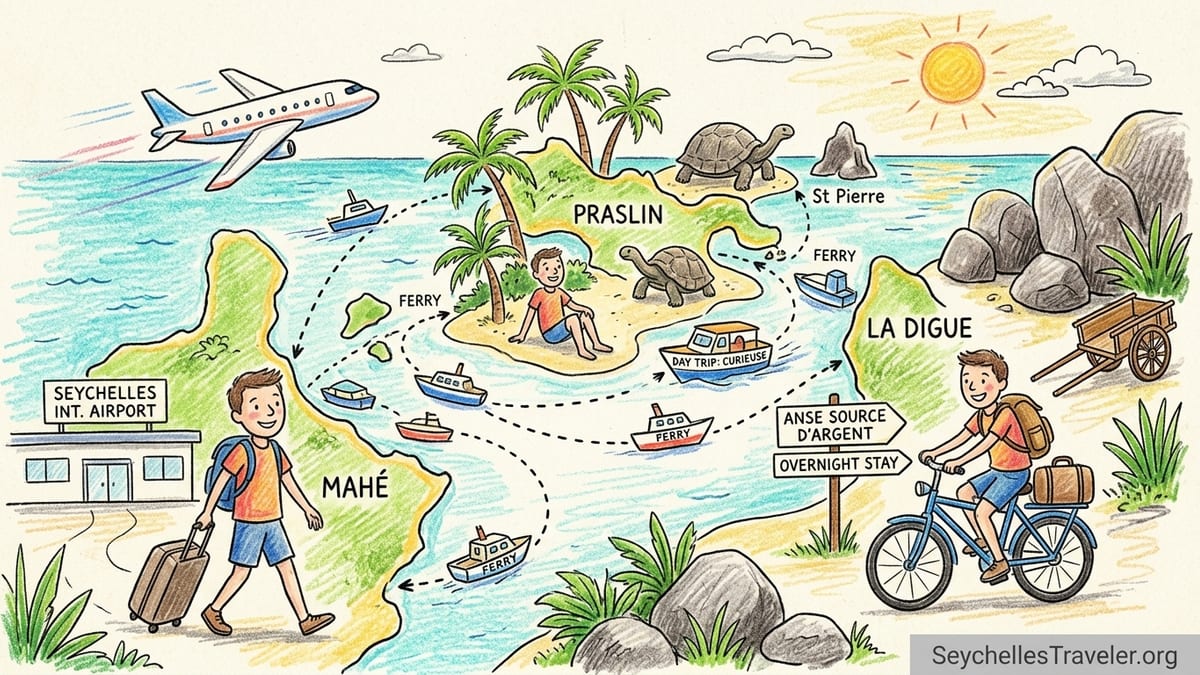
The Journey I Actually Took: Route, Nights and Rhythm
To keep this guide practical, here is the exact route I followed on a 10-night trip: 3 nights on Mahé, 3 nights on Praslin, 3 nights on La Digue and a final 1 night back on Mahé before flying out. I moved accommodation only three times, using Mahé as both the international gateway and my final staging post. From these bases I added day trips to Curieuse and St Pierre from Praslin, and to the Ile Cocos marine area from La Digue.
The order Mahé → Praslin → La Digue → Mahé worked well for one key reason. Long-haul flights in and out of Seychelles arrive and depart from Mahé’s Seychelles International Airport at often inconvenient hours. Keeping Mahé at the start and end meant I was never trying to race back from another island on departure day. My only true “transfer days” were Mahé to Praslin, Praslin to La Digue and La Digue back to Mahé.
Across the 10 nights I had three full days “lost” largely to logistics. Each inter-island move swallowed between half a day and two thirds of a day once I counted hotel check-out, road transfers, terminal time, the crossing itself and checking into the next hotel. In contrast, the days spent on day boats from a fixed base used only three to six hours of the day for logistics, leaving long, lazy mornings or afternoons on the same island.
That contrast is the single most important takeaway. In Seychelles there are really two different versions of “island hopping”. The first is changing accommodation between Mahé, Praslin and La Digue using ferries or flights. The second is using small day boats from those bases to reach Curieuse, St Pierre, Ile Cocos and other tiny Inner Islands. Plan your holiday as a blend of both and you dramatically reduce travel fatigue.
Mahé: Arrival, First Nights and When Not to Rush Onward
My flight landed on Mahé mid-morning. From the airport to the Inter Island Quay in Victoria it took about 20 to 30 minutes by pre-booked taxi, which cost in the region of 400 to 500 Seychellois rupees. I had deliberately booked three nights on Mahé at the start so I did not need to connect straight to another island the day I arrived. Looking around the Cat Cocos check-in area later that afternoon, watching tired long-haul passengers slumped over their luggage waiting for the next ferry, I was glad I had not scheduled a same-day transfer.
Cat Cocos is the main high-speed ferry operator between Mahé, Praslin and La Digue. Published journey times are around one hour Mahé to Praslin and about 1 hour 10 minutes Mahé to La Digue, depending on routing and sea conditions. Ticket prices for 2026, in economy class, are typically in the region of 60 euros one way for Mahé to Praslin and about 72 euros for Mahé to La Digue, with more expensive upper-deck and business options. I checked the schedule for my dates roughly two months before travel and found two to three sailings per day in each direction between Mahé and Praslin, with some boats continuing to La Digue.
During my first three nights on Mahé I used local buses and taxis to explore beaches on the west coast and the capital, Victoria. Buses are extremely affordable but can be slow and crowded, so if you are carrying luggage, taxis booked through your hotel are much more comfortable. Crucially, I also used one of these days to walk down to the Inter Island Quay, find the Cat Cocos office in person, confirm my onward tickets and ask about current check-in times. They recommended arriving at least 45 minutes before departure with printed or digital tickets and passports for all passengers.
Those first days taught me an early planning lesson. It is entirely possible to land on Mahé in the morning and be on Praslin or La Digue by lunchtime, but you pay for that efficiency in stress and fatigue. If your trip is under seven nights, you might accept that trade-off. With 10 nights I found that spending the first two or three on Mahé allowed my body clock to adjust and bought me a buffer in case my inbound flight was delayed. Only once I felt rested did I move on to the next island.
Mahé to Praslin: Ferry Versus Flight and How Much Time You Lose
On day four I checked out of my Mahé hotel at 10:00 a.m. and took a taxi to the Inter Island Quay for an early afternoon Cat Cocos to Praslin. I arrived at the terminal about one hour before departure, checked in my suitcase at the ferry counter and kept a small daypack with valuables and seasickness tablets. Bags were tagged to Baie Ste Anne jetty on Praslin and loaded by staff onto wheeled cages. From hotel door to sitting in the departure lounge had taken just under 90 minutes.
The crossing itself was scheduled for one hour and arrived roughly on time. Sea conditions were moderate. Inside, most travelers headed for the air-conditioned cabin, where motion feels stronger. I chose the outside rear deck instead, where the movement felt steadier and there was fresh air. For anyone prone to seasickness, taking tablets 30 to 45 minutes before departure and focusing on the horizon genuinely helps. When we docked at Baie Ste Anne my suitcase appeared on a small luggage carousel under a canopy beside the jetty about 10 minutes after disembarkation.
From Baie Ste Anne to my guesthouse near Côte d’Or beach it was another 20-minute taxi ride, arranged directly with the driver at the jetty for about 300 to 350 rupees. I reached my accommodation at around 3:30 p.m., checked in, dropped bags and still had time for a swim before sunset. Realistically, though, I had burned half a day in transit. From check-out on Mahé to beach towel on Praslin was about five hours.
The alternative would have been a domestic flight. Air Seychelles runs 15-minute flights between Mahé and Praslin on small Twin Otter aircraft, with multiple departures spread across the day. Economy fares on this route fluctuate but are often in the range of 120 to 180 euros return if booked directly in advance. Flight time is short, but the overall transfer still includes a 10 to 15-minute taxi from your Mahé hotel to the airport, arriving at least one hour early to check in and pass security, then a short taxi at the Praslin end from Iles des Palmes airport to your hotel. On my timings, flying might have saved an hour compared with the ferry, but not much more.
Praslin as a Base: When Day Trips Beat More Hotel Moves
Praslin sits at the heart of the Inner Islands. La Digue is about 15 minutes away by fast ferry, while Curieuse, St Pierre and other marine reserves lie in a loose arc off its northern shores. For this reason I chose to stay three nights on Praslin and treat it as a day-trip hub rather than constantly moving my luggage onward.
On my first full day I explored Praslin itself, hiring a small hatchback through a local rental company for about 50 to 60 euros for 24 hours. That made it easy to reach Vallée de Mai in the cool of the morning and Anse Lazio in the late afternoon, with a break in between back at the guesthouse. Crucially, this meant that when I went to Curieuse and St Pierre the next day, I was not sacrificing my only chance to see Praslin’s interior or northern beaches.
Curieuse is a marine national park roughly 2 kilometres off Praslin’s northeast coast, famous for its free-roaming Aldabra giant tortoises, mangrove boardwalk and old leper colony ruins. Local tour operators on Côte d’Or and in Baie Ste Anne sell combined Curieuse and St Pierre day trips. In 2026 group rates for a half- or full-day excursion commonly sit between about 60 and 90 euros per person depending on whether lunch is included and how many snorkel stops are promised. Separate from this, the Seychelles Parks and Gardens Authority currently charges a conservation and landing fee on Curieuse, collected by rangers on arrival, so you need extra cash in rupees or euros even if your boat ticket looked all-inclusive.
My Curieuse day began at 9:00 a.m. straight from Côte d’Or beach. The operator arranged a beach pick-up by small boat, so there was no extra taxi to pay. We reached Curieuse in about 20 minutes, spent two hours wandering among the tortoises and along the boardwalk, then walked across the island for a beachside barbecue. After lunch the boat moved on to St Pierre for a 45-minute snorkel stop. By 3:00 p.m. I was back on Côte d’Or, rinsing sand off my feet in front of the same guesthouse. I had enjoyed two different islands, a snorkel reef and a Creole barbecue without ever touching my suitcase.
Praslin to La Digue: Short Hop, Slow Day
On paper, moving from Praslin to La Digue looks like a trivial transfer. Cat Rose, the inter-island ferry, takes roughly 15 minutes to cover the short crossing between Baie Ste Anne jetty and La Passe jetty on La Digue. Ticket prices in 2026 are around 15 euros one way in economy, with several sailings spread through the day. Looking only at those numbers, it would be easy to assume you could switch islands after breakfast and still have a full afternoon on Anse Source d’Argent.
In practice, my transfer day unfolded more slowly. My Praslin guesthouse asked for check-out at 10:00 a.m. and could only guarantee luggage storage until midday because new arrivals were due. The Cat Rose crossing I wanted left around lunchtime. That meant a morning of waiting: nowhere private to shower after the beach and nowhere to fully unpack. I left for the jetty at 11:15 a.m., arrived by taxi 15 minutes later and checked in my suitcase at the ferry counter at Baie Ste Anne.
Boarding began about 20 minutes before departure. The boat left on time and arrived at La Digue’s tiny jetty just 15 minutes later, but bags took another 10 to 15 minutes to be unloaded. I then wheeled my suitcase the short distance from the jetty to my guesthouse near La Passe. Many hotels on La Digue offer complimentary or low-cost luggage pick-up by oxcart or electric buggy if you arrange it in advance, but because my guesthouse was walking distance I chose to roll the bag myself under the midday sun.
By the time I had checked in, found a bicycle rental (around 150 to 200 rupees per day in 2026) and grabbed a quick lunch, it was after 3:00 p.m. I managed a late-afternoon cycle down to Anse Source d’Argent and a sunset dip, but in all honesty the day felt like a write-off compared with my Curieuse day. I had successfully moved my “base camp” but lost another five to six hours in the friction of check-out, transport and check-in.
Living on La Digue: When Overnight Stays Beat Day Trips
La Digue is small, car-light and deeply relaxed. Most visitors explore by bicycle, coasting from the harbour through vanilla plantations and granite boulders down to famous beaches such as Anse Source d’Argent and Grand Anse. Because the island is so compact, many travellers attempt to see it on a day trip from either Mahé or Praslin. Tour desks in Mahé regularly sell “Praslin and La Digue in one day” packages that bundle early Cat Cocos ferries, bus transfers to Vallée de Mai, quick photo stops at Anse Lazio and a dash across to La Digue for an hour or two.
After three nights actually staying on La Digue, I would strongly argue that an overnight stay transforms the experience. My first morning began with an unhurried 15-minute cycle from my guesthouse to Anse Source d’Argent before 8:00 a.m. The tide was lower, the light softer and there were only a handful of other people on the sand. Most day trippers do not reach the beach until late morning or early afternoon because they must first cross from Mahé or Praslin. Having a bicycle and a room a short ride away let me time my visits for the quietest hours.
On my second full day I joined a small-boat snorkelling trip that looped through the Ile Cocos marine area north of La Digue. The exact itinerary depended on sea conditions, but the operator aimed for clear-water snorkel spots around Ile Cocos and Félicité, with a simple picnic on board. Prices for these outings, booked locally in 2026, often fall somewhere between 70 and 100 euros per person depending on group size and whether lunch is included. Because I was staying on La Digue, we left the harbour at 9:00 a.m. and were back by around 2:00 p.m., leaving time for a late siesta and another sunset swim.
Could I have done something similar as a day trip from Praslin? Yes. There are combined Curieuse and La Digue or multi-stop “three-island” days sold from both Praslin and Mahé, some including La Digue bike rentals. Yet every traveller I spoke to who had done those tours described them as a blur of cameras, head counts and timetables. Spending three nights on La Digue meant I had slow mornings, long evenings and enough slack in the schedule to simply sit in a beach bar and watch fruit bats spiral overhead.
La Digue Back to Mahé: The Longest Transfer Day
My final inter-island move, from La Digue back to Mahé for my last night, was the most time-consuming. I booked a through ticket on Cat Cocos that linked a short La Digue to Praslin hop with a longer Praslin to Mahé leg. The boat left La Digue mid-morning, so I checked out at 9:00 a.m., cycled to the jetty with my luggage balanced somewhat precariously on the back rack and returned the bicycle there. Hotels and guesthouses on La Digue can usually arrange for a buggy or oxcart to take your bags while you cycle free of weight, and in hindsight that small extra cost would have been wise.
Check-in at La Digue’s small terminal was quick. Bags were stacked in labelled trolleys and passengers were given colour-coded tags to distinguish those disembarking at Praslin from those continuing on to Mahé. The first crossing to Praslin took around 15 minutes. At Baie Ste Anne most transit passengers remained on board while dockside teams used forklifts to move luggage trolleys from one side of the quay to the other and new passengers boarded. The boat then continued on to Mahé, taking just over an hour in choppy afternoon seas.
Disembarkation at Mahé’s Inter Island Quay took another 15 to 20 minutes including the wait for luggage. From there I took a taxi back across the island to a small hotel near the airport, a journey of around 20 to 30 minutes depending on traffic. By the time I had checked in, showered and thought about dinner, it was nearly 4:00 p.m. I had left La Digue beach behind shortly after breakfast and spent essentially the whole middle of the day in transit.
This was the day that convinced me that trying to “squeeze in” another island on a short holiday can be counterproductive. If you have seven nights in Seychelles and attempt Mahé, Praslin and La Digue with a night or two on each, you will likely lose at least two full days to logistics. For many travellers a better compromise might be Mahé plus either Praslin or La Digue as a second base, then day trips from those islands to reach smaller islets and snorkel sites.
Two Kinds of Island Hopping: How to Choose When to Move
By the end of the trip I thought of Seychelles island hopping in two layers. The “heavy” layer is when you physically move your accommodation between Mahé, Praslin and La Digue. Each of these moves typically costs you four to six usable hours once you add up check-out, taxis, check-in, waiting around and the crossing itself. The “light” layer is when you keep your room and simply step off the beach onto a small boat for a few hours, as with Curieuse, St Pierre or the Ile Cocos marine area.
For short stays, it often makes sense to prioritise the light layer. For example, imagine you have six nights. One realistic pattern could be three nights on Mahé and three on Praslin, with a Curieuse and St Pierre day from Praslin and perhaps a single La Digue day trip rather than staying overnight there. You would still see three or four islands but only change hotels once, losing roughly one full day to logistics instead of two or three.
In contrast, if you have nine or ten nights or more, adding La Digue as a full base delivers a richer experience despite the extra transfer cost. My three nights there felt like the heart of the trip precisely because I did not have to look at ferry timetables every evening. I could respond to weather and whim. One overcast morning, instead of pushing on with a planned boat tour, I simply cycled the inland roads under the palm canopy and watched island life unfold at its natural pace.
The smaller islands such as Curieuse, St Pierre and the Ile Cocos area rarely need overnight stays to be satisfying. They are uninhabited or have extremely limited accommodation and are designed to be visited by day boats. The exception might be if you are joining a multi-day sailing cruise, in which case your bed moves with you. For most independent travellers, though, these smaller Inner Islands are the spice sprinkled on top of the main dish of Mahé, Praslin and La Digue.
Practical Tips on Tickets, Luggage and Minimising Wasted Time
Several practical details made a noticeable difference to how much time I lost on transfer days. First, I booked my main Cat Cocos and Cat Rose tickets online as soon as flight times were confirmed, then reconfirmed them in person at least a day in advance once in Seychelles. At the time of travel, economy tickets between Mahé and Praslin hovered around 60 euros one way and between Praslin and La Digue around 15 euros. Domestic flights were more expensive but offered more frequency. Having reservations locked in meant I could choose mid-morning or early afternoon crossings rather than the very first or last boats, which tend to be more crowded.
Second, I learned that every extra bag slows you down. On the ferries, luggage is checked in separately and stacked by staff, while on small day boats for Curieuse or Ile Cocos you keep your things with you. I travelled with one medium suitcase and one small backpack. On day tours I left the suitcase locked in my room and carried only the backpack. On transfer days I tried to pack in such a way that I did not need to reopen the suitcase between hotels. Watching other passengers repack entire cases on the terminal floor, I realised how easily 15 minutes here and there can vanish.
Third, I timed my check-outs carefully. Most guesthouses on the three main islands ask guests to leave rooms between 10:00 a.m. and 11:00 a.m. If your ferry is not until early afternoon, those hours before departure can become dead time. When possible, I asked in advance whether late check-out for a small fee was available or whether I could at least keep access to a shower room after returning from the beach. Where that was not possible, I planned slower morning activities, such as a coffee in the village or a stroll through local shops, instead of starting a hike that would leave me rushed and sweaty on the boat.
Finally, I accepted that some delays are part of island life. On one crossing the ferry left 20 minutes late due to a late-arriving coach of package tourists. On another, luggage at Baie Ste Anne took longer than usual to appear because of a squall on the jetty. None of these hiccups seriously affected the trip, but they underlined the wisdom of not planning tight onward connections. I never booked a same-day international flight and inter-island crossing in the same half-day window, and I kept one spare night on Mahé before departure.
The Takeaway
Looking back, the most important thing I learned moving between Mahé, Praslin, La Digue and the smaller Inner Islands is that more islands do not automatically mean a better trip. Every new hotel adds friction: check-outs, taxis, tickets, waiting rooms. On my 10-night journey, three base islands felt like the sweet spot, with Mahé anchoring both ends and Praslin and La Digue each getting a proper three-night stay.
Day trips, on the other hand, proved to be powerful tools for expanding the itinerary without burning whole days. From a single guesthouse on Praslin I reached Curieuse and St Pierre with only a six-hour outing that still left time for a sunset on the same beach. From La Digue a small snorkel boat took me into the Ile Cocos marine area and back by mid-afternoon, no luggage involved. Those “light” hops gave me many of my best memories at a fraction of the time cost.
If you are planning your own Seychelles journey, start by deciding how many times you are realistically willing to repack your suitcase. With five or six nights, one change of base is usually enough. With nine or more, two or three bases can work if you cluster day boats around each one. Factor in the true door-to-door time of each transfer, not just the advertised ferry or flight duration, and always keep one eye on the tides of your own energy. Island hopping in the Inner Islands can be wonderfully simple, but the smartest itineraries are built around the hours you keep for yourself, not the hours you lose to the sea.
FAQ
Q1. How many islands should I include on a one-week Seychelles trip?
For a seven-night holiday, two main islands are usually enough, for example Mahé plus Praslin or Mahé plus La Digue, with day trips by boat to smaller Inner Islands instead of constantly changing hotels.
Q2. Is it better to take the ferry or fly between Mahé and Praslin?
The ferry is usually cheaper and takes about one hour, while domestic flights take around 15 minutes of air time but cost more; once you include check-in and transfers on both sides, flying may only save about an hour overall.
Q3. Do I need to book Cat Cocos and Cat Rose ferries in advance?
In busy periods it is wise to book at least a few weeks ahead to secure preferred times, then reconfirm once you are on the islands; outside peaks you might find same-week availability but sailings can still fill up around weekends and holidays.
Q4. How much time does an inter-island transfer really take door to door?
Allow four to six hours from hotel check-out on one island to check-in on the next, covering road transfers, ferry or flight time, check-in, luggage handling and the inevitable waiting in between.
Q5. Are day trips to Curieuse and Ile Cocos worth it if I am on a budget?
Yes, group boat tours to Curieuse, St Pierre or the Ile Cocos area typically cost less than moving hotels and give you access to marine parks, giant tortoises and snorkelling without extra luggage or transfer costs.
Q6. Should I stay overnight on La Digue or visit on a day trip?
Staying at least one or two nights on La Digue offers quieter early mornings and evenings, while day trips can feel rushed; if your schedule allows, an overnight stay provides a more relaxed island experience.
Q7. How rough are the ferry crossings between the Inner Islands?
Conditions vary by season, but swells can be noticeable; taking motion-sickness tablets in advance, sitting near the centre or rear of the boat and looking at the horizon all help if you are prone to seasickness.
Q8. Is it easy to manage luggage on ferries and day boats?
Main ferries have staffed check-in for suitcases and return them on trolleys or carousels at the other end, while on small day boats you keep bags with you, so travelling with one main case and a light daypack makes life much easier.
Q9. Can I visit both Praslin and La Digue in a single day from Mahé?
Some organised tours do this by using early ferries and tight schedules, but it means only brief stops on each island; you will see more if you focus on one island per day or stay overnight.
Q10. How far in advance should I plan my overall island-hopping itinerary?
Once your international flights are set, it is sensible to fix your inter-island ferries and main accommodations several months out, especially for high season, then leave smaller boat excursions flexible so you can choose the best days for weather and energy.