


There is a moment on almost every Seychelles boat day when the engine cuts, the skipper tells you to slip in quietly and the blue around the hull suddenly feels enormous. In the Inner Islands, that happens in very different ways: on big glass-bottom boats in Ste Anne Marine National Park off Mahé, on small speedboats nosing up to Curieuse and St Pierre from Praslin, and on La Digue launches skimming out to the marine park around Île Cocos. After several trips spread across these islands, logging what I actually paid, how long I was in the water, what the current and visibility were like and which reef fish showed up, some patterns emerged about which styles of excursion really earn their price.
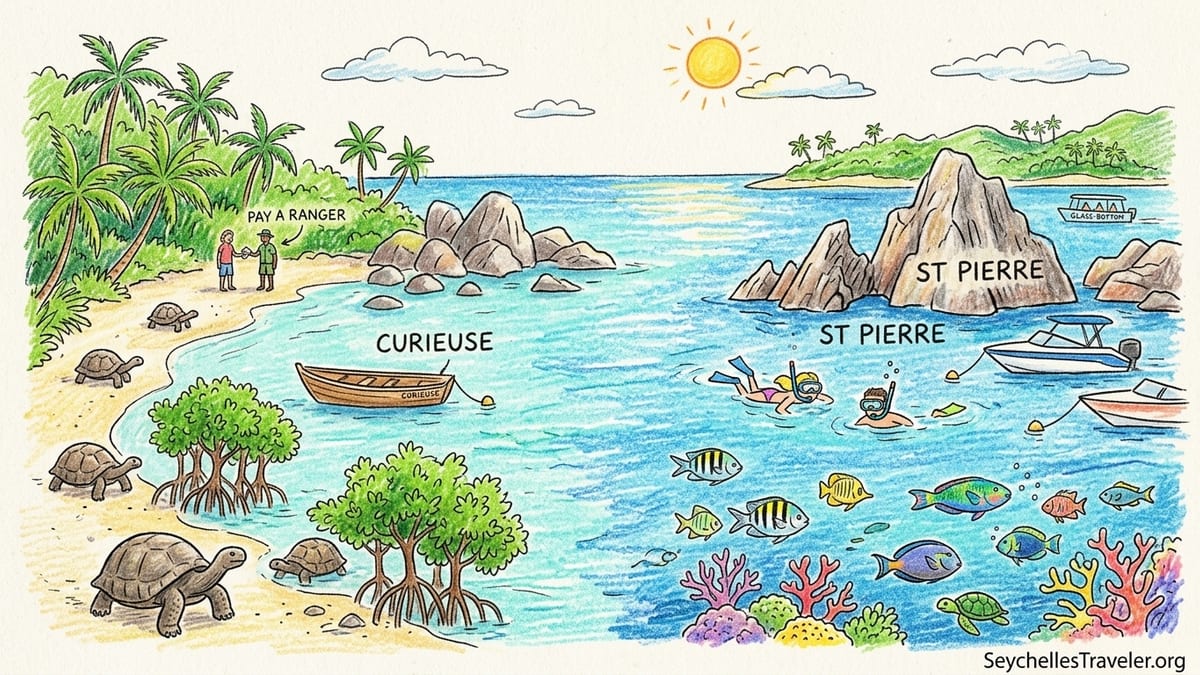
How Marine Parks and Fees Work Around the Inner Islands
The Inner Islands of Seychelles cluster tightly around Mahé, Praslin and La Digue, and several of the best snorkeling spots sit inside formal marine national parks. The Seychelles Parks and Gardens Authority (SPGA) manages these areas and, as of the current season, non-resident visitors over 12 pay around SCR 300 for Curieuse and about SCR 200 for Ste Anne, Baie Ternay / Port Launay and Île Cocos. The parks generally keep to daytime opening hours, which for most travelers translates into standard morning and full-day boat excursions timed to match the best light and usual trade-wind conditions.
Curieuse sits only about 2 kilometres off the north coast of Praslin and is roughly a 20 minute boat ride from Côte d’Or, which is why so many small-boat operators cluster along that beach offering Curieuse and St Pierre combinations. The Île Cocos Marine National Park lies just off Félicité, which itself is about 4 kilometres east of La Digue, and local skippers on La Digue quote about 10 minutes by speedboat from the jetty to the first mooring near Île Cocos when the sea is reasonable. From Mahé, Ste Anne Marine National Park spreads across a small archipelago just off Victoria, so travel times from the main island are also short, leaving a good share of the day for snorkeling rather than commuting.
Where that park fee appears in your budget varies by operator. On several tours I booked online to Curieuse and St Pierre from Praslin, the landing or park fee was explicitly excluded in the headline rate and collected in cash on the beach. When I compared this with a Sainte Anne glass-bottom boat tour from Mahé, the park fee was folded into the per-person price. It is worth asking directly before you pay, because a couple or family can easily add over SCR 1,000 in unplanned charges if park fees are not bundled.
What all of these marine parks have in common, despite different atmospheres and coral conditions, is that they are not zoos. I have seen green turtles on Curieuse snorkel stops, eagle rays in Ste Anne’s deeper channels and reef sharks around Coco, but not on every trip and never in predictable ways. Fish, currents and visibility all shift with wind, tide and season. Any operator who quietly admits that is usually the one whose other details you can trust.
From Praslin to Curieuse and St Pierre: Big Days, Small Boats
My most complete comparison came on Praslin, where Curieuse and St Pierre excursions are sold on almost every corner of Côte d’Or. Over several visits I tried three main versions: a value half-day Curieuse and St Pierre run on a 10 to 12 metre open speedboat, a more inclusive full-day trip with Creole barbecue and a guided mangrove walk, and a snorkel-focused tour with two longer water sessions for slightly higher cost. Prices in late 2026 ranged from about €46.50 for the four-hour, no-lunch option up to around €100 for a six-and-a-half to seven hour day with two dedicated snorkel stops and barbecue.
All my departures were from the sand in front of small guesthouses or restaurants on Côte d’Or, with group sizes between 10 and 20 people. The smallest boat I joined carried about 12 passengers plus skipper and guide on twin 150 to 200 hp engines, while the largest was closer to 20 guests on a high-sided speedboat with bench seating. Safety briefings varied, but most crews issued mask, snorkel and fins, with foam noodles available on request. I was glad I had my own mask more than once, because rental sets showed typical wear and a couple of snorkels had tired valves, although everything was basically functional.
Time in the water was where the differences really mattered. On the half-day Curieuse and St Pierre trip, my single St Pierre snorkel stop was advertised as 45 to 60 minutes. On a calm, clear morning we managed almost a full hour over the granite boulders, with the guide in the water pointing out shoals of sergeant majors, parrotfish, a few blue surgeonfish and one timid octopus. On a second visit with a different operator and a bit more swell, the captain cut the stop after about 35 minutes because several people on board were cold and tired. In both cases, the Curieuse element was more about giant tortoises and the boardwalk trail than snorkeling, so the fish time hinged almost entirely on that single St Pierre drop.
The full-day version shifted the balance. Once we had landed on Curieuse, paid the SCR 300 park fee (this time not included in the tour price), and followed the guide across the island and through the mangroves, we had a lazy barbecue lunch and nearly an hour of beach time before heading to St Pierre. That afternoon snorkel was shorter, around 30 to 40 minutes, but the guide also squeezed in a quick snorkel at a second rock outcrop inside the marine park earlier in the day. On that trip I logged roughly 70 to 80 minutes in the water across two separate sessions, on gently moving current and 15 to 20 metres of visibility, which felt like better value than the half-day if snorkeling was my priority.
Underwater Reality at Curieuse and St Pierre
Curieuse itself is not a classic snorkel destination so much as a land and wildlife stop inside a marine park. On both of my visits the guides offered a shallow beach snorkel after lunch, but recent storms had muddied the bay and the coral near shore was largely broken rubble dotted with hardy soft corals and scattered boulder corals. Visibility in the shallows rarely exceeded 5 to 8 metres, and the only fish I saw there in any numbers were small damselfish and juvenile wrasse nudging the rocks. For most snorkel-focused travellers, I would treat Curieuse as a scenic and wildlife stop, not the main underwater event.
St Pierre, by contrast, lives up to its reputation as the postcard rock in the sea, and its underwater scene is still relatively lively. Circling the granite pinnacles, I found gardens of branching corals clinging to the rock faces, islands of hard coral on the sand and a cloud of fusiliers and chromis over almost every outcrop. On my clearest day, visibility reached about 20 metres on the outer side of the rock, with a light, manageable current that nudged us gently along the reef. On a second visit, wind from the wrong direction chopped the surface, dropped visibility closer to 10 metres and kicked up a drift that inexperienced swimmers found tiring.
In terms of coral condition, St Pierre shows the same story as much of the Inner Islands. There are intact patches of hard coral and colourful soft corals on the rock faces, but also wide pale sections and some broken areas near the usual moorings, where hundreds of fins and boat wakes take their toll. Fish life remained rewarding on each trip, with surgeonfish, butterflyfish, snappers, Moorish idols and occasional batfish cruising the water column. Guides occasionally mentioned turtles or reef sharks, and I did see a turtle once gliding past in deep water, but they were not a feature of every outing. For most snorkelers who are used to the Mediterranean or Caribbean, St Pierre will still feel rich; for those who have logged hours on remote Pacific reefs, it will feel pleasant but not pristine.
Value-wise, St Pierre worked best when the operator clearly prioritized water time. On the snorkel-oriented full day, we slipped into the water before most of the barbecue boats arrived, enjoyed 45 minutes of relatively uncrowded reef and then moved to a second, quieter rock where coral heads hosted clouds of anthias. That same week I watched other boats pull up, drop 25 people in a tight circle over a single bommie and haul everyone back aboard before the first guests had really relaxed into their breathing. When you compare prices, ask not just “How many snorkel stops?” but “How long do we actually stay in the water at each stop, and at what time of day?”
La Digue to Île Cocos: Short Trips and Strong Currents
From La Digue, the signature snorkel excursion heads across to the Île Cocos Marine National Park, often combining Coco with brief drifts near Félicité and Sister Island. I booked a standard half-day tour sold locally for about €65 per person including the SCR 200 marine park fee, plus mask, snorkel and fins. Departure was from the main jetty on a mid-sized open speedboat about 9 to 10 metres long, with roughly 14 guests on board on my first trip and closer to 18 on the second, which pushed the upper limit of comfort for changing into fins and moving around.
The ride from La Digue to the first mooring by Île Cocos took just under 10 minutes on a relatively calm morning. On a windier afternoon, the same stretch pushed closer to 15 minutes with some spray, although still within sight of the La Digue coastline the whole way. Safety briefings again varied, but both operators insisted on lifejackets for weaker swimmers and kept a guide in the water with a lifebuoy. Equipment was similar in standard to Praslin: fins and masks that had clearly seen seasons of service but sealed well enough, with the usual benefit of bringing your own if you care about fit and clarity.
In the water, Île Cocos felt immediately different from Curieuse. The marine park surrounds tiny rock islets set in deeper blue water with steeper dropoffs, and current was noticeably stronger on every visit I made. One morning session began as an easy drift along the reef’s edge but picked up later in the hour, pulling the group faster than some could comfortably swim. The guide managed this well by having us start up-current and finish at the boat, but less confident swimmers clung to the lifebuoy for much of the time. Visibility was generally excellent, around 20 metres in the deeper sections, with clear views down onto sand channels and larger coral heads.
Coral at Île Cocos showed more variety than the sheltered bays of Curieuse, with big boulder corals, plate corals and colourful soft fans clinging to the rocks. Fish life felt denser, too, with large schools of blue and yellow fusiliers, triggerfish patrolling the edges, goatfish and groupers around the bases and occasional larger shapes cruising the blue that the guide would not promise to be anything specific. On one pass we watched a small school of barracuda hold position over a rocky ledge; on another, the highlight was a cascade of glassfish swirling around a bommie as jacks darted through. I did not see sharks or rays on these trips, but the setting felt like a place where it would not be surprising if they appeared.
Given the shorter overall excursion length, effective time in the water was good: about 45 to 60 minutes at the main Île Cocos reef, plus a second, slightly shorter snorkel near Sister Island when conditions allowed. Factoring in the relatively high park fee and fuel costs, the €65 price point felt reasonable, especially compared with longer but more mixed-focus full-day island hopping tours that spent as much time at beach picnics as over the reef. For strong swimmers and keen snorkelers based on La Digue, this style of short, punchy snorkel excursion is one of the best values in the Inner Islands.
Mahé Marine Parks: Glass-Bottom Boats vs Snorkel Runs
On Mahé, most visitors first encounter the sea through the Sainte Anne Marine National Park off Victoria or through boat trips into Baie Ternay and the adjacent Port Launay area on the northwest coast. I tried two very different Sainte Anne options: a large glass-bottom boat with a mixed sightseeing and snorkeling program, and a smaller snorkel-focused launch carrying fewer people but without the novelty of the glass panels.
The glass-bottom day was a classic big-boat affair. We boarded at a small marina near Victoria with around 40 other guests, on a covered vessel perhaps 14 to 16 metres long, with bench seating and a central viewing well. The tour cost just under the equivalent of €80 per person, with the SCR 200 park fee included and a Creole lunch on Moyenne Island as part of the price. Snorkeling was only one of several elements alongside fish feeding from the deck, time spent peering through the glass at coral heads and blue-spotted rays, and a guided walk on Moyenne to see giant tortoises and the small museum.
Actual time in the water on that Sainte Anne glass-bottom outing totalled perhaps 35 to 40 minutes, split into two short snorkel stops. The first took place over shallow coral gardens in 3 to 5 metres of water, where visibility was reasonable but coral damage from past bleaching events and daily traffic was obvious. Patches of live branching and boulder coral alternated with wide stretches of dead skeleton. There were still plenty of fish, especially near the fish-feeding spots the crew used to draw them in for those who stayed on board, but as a snorkel experience it felt constrained and crowded, with the entire group circling a small area close to the hull.
The second stop drifted over slightly deeper water near a sand channel. Current was minimal and visibility slightly better, around 12 to 15 metres, which made it easier to appreciate the scattered coral heads and the play of light on the sand. Again, fish life was comfortable rather than dramatic: wrasse, butterflyfish, snappers and clouds of small reef fish that had learned to associate boats with bread. For non-swimmers, children and anyone nervous about the sea, this Sainte Anne format is a gentle, accessible introduction. For snorkelers who care most about unhurried time over healthier reef, the cost per minute in the water is high.
By contrast, a smaller snorkel-oriented day from Beau Vallon to Baie Ternay delivered more of what I look for. On that trip, a 9 to 10 metre speedboat carried 10 to 12 guests, leaving from the sand with a simple briefing. The advertised price was in the €60 to €70 range without lunch, with the SCR 200 Baie Ternay marine park fee collected separately in cash. We spent almost the entire three-and-a-half to four hours on or in the water, with two main snorkel sessions of 45 to 60 minutes each and a shorter swim in the sheltered waters of Port Launay on the way back.
Currents in Baie Ternay were mild on my visit, with visibility around 15 metres. Coral condition felt slightly healthier than in Ste Anne, especially on the outer sections of the reef where fewer boats anchor. I saw patches of staghorn and table corals showing good colour, intermixed with inevitable areas of past damage. Fish life was engaging, with schools of fusiliers and jacks on the edges and dense communities of smaller reef fish inside the bay. Again, turtles were mentioned as a possibility, and one guest glimpsed a shell breaking the surface at a distance, but there was no guarantee. The key difference was that, for a similar outlay to the Sainte Anne glass-bottom boat, I spent nearly triple the time actually snorkeling.
Independent Beach Snorkeling: Quiet Reefs and Real Limits
Not every good snorkel in the Inner Islands requires a boat ticket. On both Mahé and Praslin I spent several mornings exploring right off the beach, comparing those unpaid hours with my excursion days. On Praslin, the east-facing beach at Côte d’Or offers accessible snorkeling along the rocky points at either end when the wind is light and the tide not too low. Entering from the sand and finning slowly out, I found scattered coral heads in 2 to 4 metres of water, with modest fish life including butterflyfish, small parrotfish and the occasional puffer. Visibility fluctuated between 5 and 12 metres depending on recent swell, and currents stayed weak inside the bay.
Another self-guided Praslin option, Anse Lazio, delivered more scenic drama on the surface but only patchy snorkeling when I visited. Along the granite boulders at either end of the bay I found narrow bands of coral in shallow water, but a recent storm had pushed sand across much of the reef flat, smothering some colonies. Fish sightings were pleasant rather than spectacular. The main advantage of these independent Praslin snorkels was cost and flexibility: no departure time, no group to follow, and the ability to spend as long or as short a time as I wished in the water without worrying about barbecue schedules.
On Mahé, beach snorkeling from Beau Vallon and Port Launay offered similar trade-offs. In front of the main strip at Beau Vallon, long stretches of sand meant extended swims before reaching anything much of interest. By moving towards the rocky headlands and timing entries for early morning when boat traffic was quiet, I found scattered coral and reasonable fish life in 3 to 6 metres of water, but visibility was more affected by suspended sand than on my boat days. Port Launay, being partly inside a marine protected area, felt richer, with clusters of coral and more fish, but again not on the level of the better offshore sites.
The limitations of independent snorkeling are practical as much as ecological. Without a boat, you are constrained to what the nearshore reef offers, which in the Inner Islands often means shallower, more impacted coral. Safety is entirely on you: there is no skipper calculating current, no guide in the water with a lifebuoy and no one counting heads. That matters in places like Île Cocos, where currents are simply too strong and channels too deep to reach safely from shore. For confident swimmers on calm days, beach snorkeling around the granite headlands can feel like a private marine park at zero marginal cost. For most visitors, it complements rather than replaces at least one well-chosen boat day.
Which Style of Excursion Really Delivers Best Value?
After adding up receipts and remembering where the best underwater moments happened, a clear pattern emerged. In straight financial terms, independent beach snorkeling is obviously the cheapest. On Praslin and Mahé my only costs were mask, snorkel, fins and whatever I spent on bus fares or car hire to reach a bay. For visitors staying a week or more and happy to poke around rocky points at their own pace, those free sessions can easily add up to several relaxed hours in the water, especially if you pick mornings with light wind and mid to high tide. The trade-off is that coral is generally less impressive and fish life thinner than at the prime marine-park reefs, and you accept more responsibility for reading currents and boat traffic yourself.
Among organized trips, the best value for active snorkelers came from mid-sized, snorkel-focused speedboat excursions with clear time-in-the-water promises. My Curieuse and St Pierre full day with two snorkel stops for just under €80 and my Baie Ternay run from Mahé in the €60 to €70 range both delivered around 90 minutes of snorkeling or more, a simple but filling meal in the Curieuse case, and small enough groups that guides could keep an eye on everyone in the water. Factoring in marine park fees, boat fuel, gear and guiding, those per-minute snorkel rates stacked up well.
By contrast, the big Sainte Anne glass-bottom tour felt less efficient for committed snorkelers. The overall experience was enjoyable, especially for families and those who wanted a mix of sightseeing, island walking and an easy introduction to the reef. However, with only around 35 to 40 minutes in the water and a large group to manage, there was little sense of immersion, and the cost per snorkel minute was high once you stripped away the non-snorkel components. Similar logic applied to some of the pricier island-hopping days that tried to tick off Curieuse, St Pierre, Coco and Sister in a single itinerary, where each snorkel stop was necessarily compressed.
Personal priorities matter. If your dream is to photograph giant tortoises on Curieuse, walk through its mangrove forest and float in shallow water after a barbecue lunch, then a full-day Curieuse-focused excursion earns its fee even if you only log an hour or so of serious snorkeling. If you are based on La Digue and mainly want clear water, lively reef and an intense, shorter session, the half-day Île Cocos outing for around €65 including park fees is hard to beat. For nervous swimmers and families with young children, Sainte Anne’s glass-bottom boat or a gentle Sainte Anne snorkel safari from Mahé offers calm conditions and the reassurance of a big, stable platform.
What my own days on the water confirmed is that no single style of excursion is “best” in every sense. The richest memories came from a combination: one or two serious snorkel trips tuned to the marine parks with healthier coral and more fish, plus low-pressure beach snorkels on quiet mornings to absorb the granite-and-palm scenery at my own pace. By being honest with yourself about whether you want wildlife, landscape, comfort or value per snorkel minute, it becomes much easier to choose between a full-day island excursion, a short snorkel trip or independent beach snorkeling when you are standing in the sun with a glossy brochure in your hand.
The Takeaway
Across Mahé, Praslin and La Digue, the Inner Islands offer a spectrum of ways to meet the Indian Ocean, and each comes with its own mix of cost, comfort and underwater reward. Marine park fees are substantial but pay for managed access to some of the region’s healthiest remaining reefs, from the granite slopes of St Pierre and the coco-de-mer forests of Curieuse to the currents sweeping the Île Cocos Marine National Park and the sheltered curves of Baie Ternay. Knowing whether that extra SCR 200 or 300 is already inside your tour price is a small but important detail that shapes the true cost of your day.
From my own logbook, the most satisfying snorkel experiences came when I boarded a mid-sized boat with a clear plan for long, unhurried time in the water rather than a packed itinerary of islands and activities. Full-day Curieuse and St Pierre trips with two snorkel stops, or focused half-days from La Digue to Île Cocos, justified their price through depth rather than breadth. Big glass-bottom boats at Sainte Anne and scenic island-hopping days had their role, especially for mixed groups and first-time visitors, but felt less efficient for travellers who measure value by minutes over the reef rather than number of islands seen.
Independent beach snorkels, meanwhile, gave me slow, reflective mornings at a fraction of the cost, trading headline coral gardens for small discoveries along granite headlands where no one else was counting my time. Taken together, these options suggest a simple strategy. Budget for at least one high-quality marine park excursion that matches your swimming confidence, add one or two do-it-yourself sessions from accessible beaches and then pick any glass-bottom or island-hopping extras for what they are: comfortable, scenic introductions to the Seychelles seascape rather than pure snorkeling days. If you do that, the moment when the engine cuts and you slide into the blue will almost always feel worth what you paid for it.
FAQ
Q1. Which island is the best base for snorkel excursions in the Inner Islands?
Praslin offers the widest choice of small-boat excursions into Curieuse Marine National Park and out to St Pierre, with short travel times and many operators along Côte d’Or. La Digue is ideal if you mainly want the Île Cocos Marine National Park, while Mahé works well for Sainte Anne, Baie Ternay and Port Launay but often with larger boats and more mixed-focus trips.
Q2. How much should I expect to pay for a good snorkel trip in Seychelles?
For mid-sized speedboat excursions with a strong snorkeling focus, recent prices run from about €46.50 for a four-hour Curieuse and St Pierre half-day from Praslin up to around €100 for full days with two snorkel stops and lunch. On La Digue, a half-day to Île Cocos commonly costs around €65 including park fees, while larger Sainte Anne glass-bottom boat days from Mahé sit near or slightly below €80 with lunch included.
Q3. Are marine park fees included in excursion prices or paid separately?
It depends entirely on the operator. Some Sainte Anne trips from Mahé bundle the SCR 200 park fee into the advertised price, while several Curieuse and St Pierre excursions from Praslin and Île Cocos trips from La Digue collect the SCR 300 or SCR 200 fee separately in cash. Always check in advance so you can compare tours on a like-for-like basis.
Q4. Is snorkeling from the beach worth it, or should I always book a boat?
Beach snorkeling can be very rewarding on quiet mornings, especially around rocky headlands at Côte d’Or and Anse Lazio on Praslin, or Port Launay on Mahé. You avoid excursion costs and can set your own pace, but nearshore coral is usually less impressive than in the marine parks and you are responsible for your own safety. For most visitors, combining at least one boat trip with a few self-guided beach snorkels works best.
Q5. What kind of visibility and currents should I expect in the marine parks?
On my recent trips, visibility in the main marine parks ranged from about 10 to 20 metres on good days, with clearer water at offshore sites like St Pierre and Île Cocos. Currents were generally mild in sheltered bays such as Baie Ternay and some Sainte Anne spots, but could be strong around exposed reefs, especially at Île Cocos. Conditions vary with wind, tide and season, so skippers may adjust exact snorkel locations on the day.
Q6. What equipment is typically provided on snorkel excursions?
Most operators include mask, snorkel and fins in the price, along with basic safety gear such as lifejackets and a lifebuoy or float for the guide. Quality varies, and equipment often shows signs of heavy use, so bringing your own well-fitting mask and snorkel can make a noticeable difference. Wetsuits or rash vests are rarely included but are useful for sun protection and warmth on longer sessions.
Q7. Can I count on seeing turtles, rays or sharks on these trips?
No operator can legitimately guarantee specific wildlife. I have seen turtles, rays and small sharks on some outings and not at all on others, even in the same marine park. What you can reasonably expect are healthy numbers of reef fish, from parrotfish and angelfish to snappers and fusiliers, with occasional special encounters when conditions and luck align.
Q8. How big are the groups on typical snorkel excursions?
Group size depends on the style of boat. Mid-sized speedboats from Praslin and La Digue usually carry around 10 to 20 guests, which allows guides to keep track of snorkelers in the water. Large Sainte Anne glass-bottom boats from Mahé can carry 30 to 40 people or more, which feels busier both on deck and in the water. If small groups matter to you, ask explicitly about maximum numbers before booking.
Q9. What should I look for when choosing a snorkel operator?
Ask direct questions about time in the water, group size, whether park fees are included, and how many guides will be in the sea with guests. Look for crews who talk realistically about conditions and wildlife, insist on lifejackets or floats for weaker swimmers and are clear about adapting plans if current or visibility are poor. Recent, detailed reviews that mention safety briefings and attentive guiding are a good sign.
Q10. When is the best time of day to snorkel in the Inner Islands?
Morning departures usually bring calmer seas, better light and less wind, which translates into clearer visibility and more comfortable conditions, especially for first-time snorkelers. Afternoon trips can be beautiful but may coincide with stronger trade winds and choppier surfaces. Wherever possible, I aim for early or mid-morning snorkel sessions and avoid very low tides, when shallow coral can be uncomfortably close to the surface.