


I spent three weeks moving slowly through Mahé, Praslin and La Digue, with day trips into the surrounding marine parks and reserves that make up the Inner Islands of Seychelles. I booked a mix of organized excursions and completely unstructured days, and in the end it was obvious which experiences I would happily repeat and which I would skip next time. This guide is organized by experience type, not by island, and only the first section covers activities I have personally done, paid for and would honestly recommend (or warn you about). A second, clearly separated section highlights well-known Inner Islands activities I researched on the ground but did not personally try.
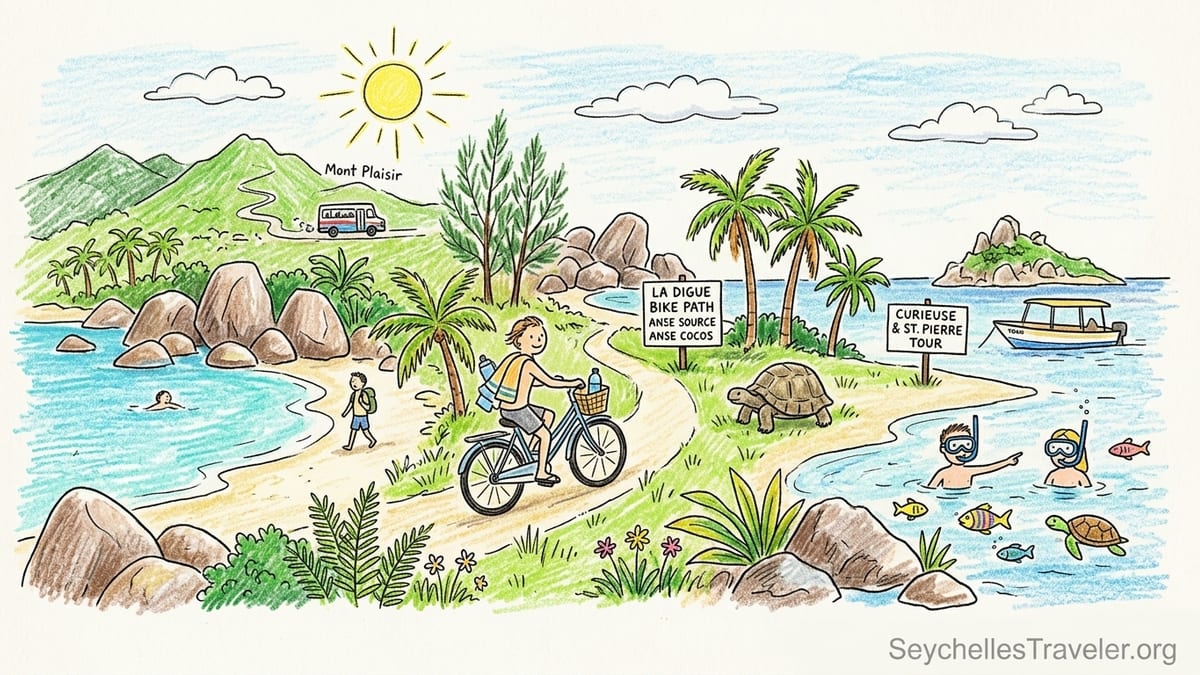
Beach Days Worth Organizing Your Trip Around
My best days in the Inner Islands were unscheduled beach days, especially on Praslin and La Digue. The standout was Anse Lazio on Praslin, where I went twice and would go again without hesitation. From Cote d’Or I took the local bus to Mont Plaisir (flat cash fare 12–15 rupees) and walked about 15 minutes down to the beach. There is no entry fee and no need to book anything in advance. I stayed from late morning through sunset, swimming in the calm side, reading in the shade and walking the length of the bay. The physical effort is low apart from the hot walk back up the access road. Both times I visited, conditions were classic Seychelles: clear water, scattered clouds, humid but with a breeze. I would 100 percent repeat this as a self-guided day rather than join a paid “Anse Lazio tour,” which often just replicates what you can do yourself.
On La Digue, Anse Source d’Argent was the most photogenic beach I visited, but the experience was more mixed. You access it through L’Union Estate on the south-west side of the island, which charged a day ticket of roughly 150 rupees per adult when I visited, payable at the main gate. I cycled from my guesthouse near La Passe in about 10 minutes, locked the bike inside the estate and walked the sandy track to the beach. The granite boulders and shallow turquoise lagoon really are extraordinary, and I spent several hours swimming and exploring small coves between the rocks. The disappointment was the feeling of crowding and the number of small stands pushing drinks, coconuts and photo props. Midday light was harsh and not comfortable for long, so I would repeat this but only early in the morning or later in the afternoon, and I would not book an organized excursion from another island just for this.
The beach that surprised me most was Anse Cocos on La Digue, which I reached on foot from Grand Anse via Petite Anse. There is no entry fee and no infrastructure beyond a small informal refreshment stand that may or may not be open. The walk in took about 40 minutes one way over undulating coastal path, including some short, steep and hot sections. This required moderate fitness and good footwear, and I carried 2 liters of water. The effort was absolutely worth it: a wild-feeling bay, natural rock pools when the tide is right, and only a handful of other visitors even in high season. Weather was mixed sun and cloud, which made the hike manageable. I would gladly repeat this hike-and-beach combo, but only with decent shoes and an early start to avoid the worst heat.
Overall, my repeat advice for beach days is to handle them independently. On all three islands I used a mix of buses, hired bicycles and occasional taxis rather than beach tours sold through hotels. The paid excursions I saw for “beach hopping” often bundled places it is easy and cheaper to reach alone, and they came with fixed timetables that would have cut short the slow, unscripted rhythm that makes the Inner Islands special.
Snorkeling and Marine Parks: When Tours Are Worth It
The one boat excursion I would happily book again was a full-day trip from Praslin to Curieuse Island and the snorkel sites around Saint Pierre. I booked directly in person with a small local operator from Cote d’Or beach after comparing a few offers along the sand. I paid the equivalent of around 80 euros per person in cash, which included boat transport, a simple Creole barbecue lunch, soft drinks, two snorkel stops, and the Seychelles Parks and Gardens Authority marine park entry fee for Curieuse, which is officially 300 rupees for non-residents over 12 years. The boat departed around 9:45 in the morning and returned shortly before 16:00, giving almost a full day on the water.
Conditions on the day were close to ideal: light wind, low swell and good visibility at the snorkel sites. The first stop near Saint Pierre delivered exactly what I had hoped for in a granitic Inner Islands reef: small shoals of reef fish, healthy hard corals in patches, and the occasional turtle gliding past. The second snorkel stop after lunch was more affected by current, and less experienced swimmers on our boat appreciated that the captain moved to a more sheltered spot when some guests looked uncomfortable. Physically the day involved climbing in and out of the boat by ladder, 30 to 45 minutes of snorkeling at a time, and a short but hot trail walk on Curieuse. You do need to be reasonably mobile and comfortable in open water, but it is not a strenuous trip.
Guide and operator quality on this Curieuse and Saint Pierre outing were solid rather than polished. Our skipper gave straightforward safety briefings, pointed out features like the mangrove boardwalk on Curieuse and the best side of the reef for turtles, and managed the group well. This was not a “luxury” experience with plush seating and gourmet food, but it felt authentic, safe and good value for what we paid, especially given that the marine park fees for Curieuse and neighboring protected islets have increased in recent years. I would book this type of outing again, though I would avoid the cheapest offers that cut out lunch or compress everything into a half day.
By contrast, a half-day glass-bottom-boat tour I tried from Mahé into Sainte Anne Marine National Park is one I would not repeat. I booked it through a hotel concierge near Beau Vallon, paying the equivalent of about 55 euros per person. The listing promised multiple snorkel stops and time on one of the park islands, but in practice we spent a lot of time motoring slowly across choppy water while the staff tried to find calm spots out of the wind. Visibility through the glass panels was mediocre in the swell, and our single short snorkel stop felt rushed, with 20 people trying to descend the same ladder at once. Although the crew remained cheerful and professional, and the park itself is a beautiful setting of small islands east of Mahé, I would skip this specific format next time and either charter a smaller boat with friends or put my money toward another Curieuse and Saint Pierre style day.
Mountain Hiking and Nature Reserves on Mahé and La Digue
The Inner Islands are often marketed almost exclusively as beaches, but some of my strongest repeat experiences were on mountain trails managed by the Seychelles Parks and Gardens Authority. On Mahé I hiked the Copolia Nature Trail twice, once in dry conditions and once after overnight rain. The trail starts along the Sans Souci road in Morne Seychellois National Park, and foreign visitors currently pay a 100 rupee entrance fee at the ranger kiosk. With a steady but not overly fast pace, it took me just under an hour to reach the granite summit and 45 minutes to descend. The ascent involves a series of stone steps, roots and occasional boulder sections, so I would describe the physical effort as moderate. You do not need a guide if you are used to marked tropical trails, but children or less confident hikers may appreciate one.
On my first visit the weather was textbook for hiking: overcast but bright, which kept temperatures manageable under the canopy and gave clear views across Victoria and the offshore islands from the top. After rain the trail became slick in places, especially on the final granite slabs, and I was grateful for trail shoes instead of flip-flops. The SPGA-maintained signage and railings were in good condition when I visited, and rangers checked tickets near the base. This is a hike I would repeat on any return to Mahé, ideally starting around 8:00 in the morning and carrying at least 1.5 liters of water per person.
On La Digue, the Veuve Special Reserve was a quieter but memorable experience that I would also happily repeat. The reserve protects the last breeding population of the Seychelles black paradise flycatcher, and sits inland from the west coast. I walked in from La Passe in about 15 minutes and paid the entry fee at the small visitor center, which for non-residents was similar to other SPGA terrestrial reserves, with a small supplement for a short guided walk. The guided portion lasted around 40 minutes, with a ranger leading me and a few other visitors along sandy forest paths and helping us spot male and female flycatchers, roosting fruit bats and a few endemic plants. The paths are flat and shaded, so the physical effort is light and suitable for families.
The main limitation at Veuve is that wildlife does not perform on cue. On my first afternoon visit we heard but did not clearly see the black paradise flycatcher, and it was only when I returned early one morning that I had close views of a male bird displaying. Weather plays a big role here: light morning conditions brought more birds into the open, while an afternoon shower made them vanish into the canopy. Despite this uncertainty, the combination of calm atmosphere, engaged staff and the knowledge that my entry fee supports a very specific conservation effort means I would repeat this reserve visit on future trips to La Digue, ideally early in the day.
Giant Tortoise Encounters: What Felt Ethical and What Did Not
Meeting Aldabra giant tortoises is high on many visitors’ wish lists, and I approached this with some caution. The encounter I felt most comfortable with was on Curieuse Island during the full-day marine park trip from Praslin. After landing at Anse José, our group followed the marked 1.7 kilometre trail across the interior and mangroves to Baie Laraie, where several hundred tortoises roam semi-wild within a protected zone managed by SPGA. The tortoises can move freely, and there are shaded areas, water points and signs requesting visitors not to sit or stand on them. Rangers were present, watching how people interacted. Our guide gave clear instructions: touch gently, avoid feeding unless using the provided leaves, and do not sit on shells for photos. This combination of relative freedom for the animals, ranger supervision and the context of a national park made the experience feel largely ethical, and I would repeat it.
In contrast, some of the privately kept tortoises I saw on Mahé, often in small pens next to roadside attractions or restaurants, were less appealing. In one case we stopped at a spice garden where a handful of tortoises lived in a compact fenced enclosure. Visitors were encouraged to feed them kitchen scraps and climb into the pen for selfies. There was no formal entry fee beyond a general garden ticket, and no clear guidance on how to behave around the animals. The tortoises seemed used to human contact, but the scene felt more like a petting zoo than a conservation setting. While I did take a few photos, I left with the impression that I would not seek out this kind of encounter again, and I would not recommend paying extra for it when the Curieuse option exists.
From a practical standpoint, the Curieuse visit involved moderate walking in heat and humidity, and the timing mattered. Arriving at Baie Laraie late in the morning, many tortoises were resting in shade, and only a subset remained active. Friends who did the same trip on a slightly cooler, overcast day saw more movement and feeding. If I were to repeat it, I would aim for a forecast with some cloud cover rather than perfectly clear skies, both for my own comfort and to see more natural tortoise behaviour.
Cycling, Island Transport and When Organized Tours Disappointed
La Digue is the Inner Island where cycling makes the most sense, and it is also where I most clearly saw the gap between self-guided travel and organized excursions. I rented a single-speed bicycle from a small shop near the ferry jetty, paying the equivalent of around 10 euros per day, including a simple lock and, on request, a basic front light for returning after sunset. The island road network is compact; you can ride from La Passe to Grand Anse in roughly 25 to 30 minutes at a relaxed pace. Over three days I used the bike to reach Anse Source d’Argent, Grand Anse, the Anse Cocos trailhead and various small coves on the north coast. I would absolutely repeat exploring La Digue by bicycle, as it gave complete flexibility to stop at fruit stands, small takeaways and viewpoints without watching the clock.
In contrast, I tried a packaged “La Digue in a day” tour while staying on Praslin, and this is something I would not book again. The tour bundled Cat Rose or similar ferry tickets from Baie Sainte Anne, bicycle rental, a quick guided loop through L’Union Estate and a set lunch at a beachside restaurant. The total cost was significantly higher than buying ferry tickets and renting a bike independently, and the day felt strangely rushed despite the island’s small size. We were expected to follow the guide’s schedule rather than linger where we wanted, and by the time lunch was finished there was barely time to reach Grand Anse and return before the scheduled ferry back.
Transport across the Inner Islands also shaped which experiences I would repeat. On Mahé and Praslin I used public buses extensively, buying reloadable smartcards at local kiosks and topping them up with cash. Fares were extremely reasonable compared with taxis, and the buses were a reliable way to reach trailheads, beaches and small villages. The trade-off is that buses can be crowded at commuting times and do not run late into the night in more remote areas. For early morning hikes or late dinners I used licensed taxis arranged through accommodations, which were noticeably more expensive but straightforward. I would not spend money on organized island “orientation tours” given that the bus system and a rental car, if you are comfortable driving on the left, cover the same ground with more freedom.
One disappointment came from an island-hopping boat trip from Mahé that promised landings on Moyenne, Round and Long Island, but ended up only briefly anchoring off one beach due to swell and a tight schedule. The operator handled safety correctly and did not control the weather, but the marketing felt more ambitious than the reality. I paid around 90 euros for the day, booked via a kiosk at Eden Island Marina, and left thinking that money would have been better invested in another focused marine park visit rather than a “see everything” sampler that did not allow enough time anywhere.
Creole Food Experiences I Would Repeat
Food on the Inner Islands is not an “attraction” in the same formal sense as parks or marine reserves, but several eating experiences became highlights I would plan around again. The most consistently rewarding meals were simple Creole buffets at small guesthouses and family-run takeaways, rather than set-menu dinners at upscale international resorts. On Praslin, a family table d’hôte near Cote d’Or served grilled fish, octopus curry, chutneys and lentil dishes for a fixed price that was lower than most hotel restaurants, with water and basic dessert included. I booked my spot by leaving my name on a clipboard in the afternoon and paying in cash on arrival. The atmosphere was informal, seating was at shared tables, and portions were generous after a day of swimming and walking.
I would also happily repeat the beach barbecues that formed part of the Curieuse marine park excursion. While the food itself was simple grilled fish, chicken, salad and rice, the setting under casuarina trees with the sound of waves and the sight of tortoises wandering nearby made it special. The crew cooked over charcoal and served everyone on reusable plates, with soft drinks included and beer available for a small supplement. Compared with some resort buffets where Creole dishes feel toned down for international tastes, these barbecues leaned into local flavors like chilli, lime and ginger. The main limitation is that dietary restrictions are harder to accommodate on a boat or beach than in a restaurant, so travelers with complex needs might prefer land-based eateries where they can discuss options in advance.
Not every food experience was one I would repeat. A couple of hotel buffet dinners on Mahé offered wide choice but little character, at prices that could easily match a half-day excursion. One particular “Creole night” at a large property near Beau Vallon combined lukewarm dishes with canned music and a crowded dining room. We had booked it as part of a half-board package, so there was no separate bill for that evening, but if I had been paying per meal I would have regretted it. Next time I return, I will focus my dining budget on smaller restaurants and takeaways, and on the occasional special meal at a well-reviewed mid-range spot, rather than defaulting to resort buffets.
Activities Researched but Not Personally Experienced
During my time in the Inner Islands, I spoke with other travelers, guides and staff at the Seychelles Parks and Gardens Authority about several activities that I did not manage to fit into my own schedule. The information below is based on that on-the-ground research and official sources, but I did not personally take part, so I cannot recommend them from first-hand experience in the same way as the earlier sections.
On Mahé, the Morne Blanc and Trois Frères trails were repeatedly described as excellent viewpoints for those comfortable with steeper ascents than Copolia. Both fall under SPGA management, and like other official nature trails they charge entrance fees for non-residents, with higher prices and a requirement for licensed guides on the long Morne Seychellois summit route. Hikers I spoke with at Copolia who had done Morne Blanc described it as a demanding but rewarding half-day, with cloud forest sections and occasional leech encounters in wet weather. If you are a keen hiker used to tropical conditions, these trails might be worth building into your itinerary, but they require more fitness and preparation than the easy viewpoint walks often advertised in brochures.
Sailing and crewed yacht charters are another side of the Inner Islands I only observed from shore and marina docks. From both Mahé and Praslin, companies based at Eden Island and Baie Sainte Anne offer multi-day liveaboard trips through Inner Islands marine parks such as Sainte Anne, Curieuse and Baie Ternay, often with a mix of snorkeling, kayaking and beach time. Prices for private charters run into the high hundreds or thousands of euros per day, depending on vessel size and season, placing them in a very different bracket from day boats aimed at independent travelers. I spoke to one couple who had joined a shared-cabin catamaran cruise; they praised the access to quiet anchorages but noted that schedules still felt structured, with limited scope to linger when they found a favourite bay.
Finally, scuba diving in marine protected areas around Mahé and Praslin is widely available through PADI and SSI-affiliated operators. I snorkelled above some of the same reefs, and the visibility and fish life suggested that diving could be excellent in the right conditions, particularly at sites with granite formations and cleaning stations for turtles and rays. However, I did not dive on this trip, so I cannot comment from direct experience on operator quality, equipment or specific sites. If diving is important to you, I would suggest contacting at least two dive centres, asking about group sizes, safety briefings and whether they include marine park fees in their quoted prices, then comparing answers with recent independent reviews.
The Takeaway
Looking back across my time in the Inner Islands of Seychelles, the pattern is clear. The experiences I would repeat were either self-directed days built around simple ingredients beaches, bikes, local buses, straightforward hikes or they were focused excursions into protected areas where national park rules and thoughtful guiding added real value. Curieuse and Saint Pierre as a combined marine park and snorkel trip stand out as worth the cost and logistics. Copolia and Veuve Reserve feel like essential inland counterpoints to the beaches. Anse Lazio, Anse Cocos and long afternoons wandering La Digue by bike delivered the exact mix of freedom and scenery I had hoped for when first dreaming about Seychelles.
The disappointments shared common traits: compressed schedules, marketing that oversold how much ground could be covered in a single day, and situations where animals were treated more as props than as wild or semi-wild beings. Glass-bottom-boat outings that never quite escape choppy water, island sampler tours that allow only brief landings, and buffet dinners in large hotels all left me wishing I had spent more time and money on fewer, better chosen experiences.
If you are planning your own Inner Islands trip, my strongest advice is to decide in advance which activities genuinely require a guide or organized structure marine parks, some hikes, perhaps a sailing day and which are better kept loose. Leave space for unplanned afternoons on beaches you reach by bus or bike. Use official SPGA resources and on-the-ground conversations to check current entry fees and trail conditions, since these can change. And when in doubt between a packed multi-stop excursion and a single well-chosen destination with time to breathe, the latter is almost always the experience you will want to repeat.
FAQ
Q1. Do I need to book Curieuse Island and Saint Pierre tours in advance?
In high season it is wise to reserve at least a day or two ahead, especially for full-day trips that include lunch and park fees, but outside peak dates you can often compare and book operators in person the day before departure.
Q2. Are SPGA hiking trails on Mahé suitable for beginners?
Shorter trails like Copolia are manageable for reasonably fit beginners who are used to uneven ground, but they still involve heat, humidity and roots, so proper shoes, water and an early start are important.
Q3. Is it better to see giant tortoises on Curieuse or at private enclosures?
Curieuse offers a more natural, conservation-focused setting with rangers and clear guidelines, whereas many private pens feel like petting zoos; if you can, prioritize the national park experience.
Q4. How expensive are day tours compared with exploring by bus or bike?
Day tours to marine parks commonly cost from the equivalent of 70 to 100 euros per person, while bus fares and bike rentals are a small fraction of that, making self-guided days far cheaper when a boat is not essential.
Q5. Do I need a guide for all hikes in the Inner Islands?
You are required to use a licensed guide on certain demanding routes such as the full Morne Seychellois summit trail, but many shorter SPGA trails can be done independently if you are comfortable on tropical paths.
Q6. When is the best time of day to visit Anse Source d’Argent?
Early morning and late afternoon tend to be quieter and cooler, with softer light on the granite boulders; midday often brings stronger sun and more visitors arriving on organized tours.
Q7. Are glass-bottom-boat tours a good way to see marine life?
In calm conditions they can work, but in practice swell and crowds often limit visibility and comfort, so many travelers find that classic snorkel trips from smaller boats feel more rewarding.
Q8. How reliable is public transport between beaches and trailheads?
On Mahé and Praslin, buses run regular routes that link major beaches, towns and many trail access points, though they can be crowded at peak times and do not always align with sunrise or late-evening plans.
Q9. Is La Digue worth more than a day trip?
Staying at least one or two nights allows you to enjoy quiet early mornings and evenings, cycle without watching a ferry schedule and reach places like Anse Cocos at a relaxed pace, which is difficult on a tight day-trip timetable.
Q10. How should I budget for park and reserve entry fees?
Expect to pay separate SPGA entrance fees for key terrestrial trails, marine parks and reserves, and check the latest rates shortly before you travel so you can set aside enough cash or card credit for these protected sites.