


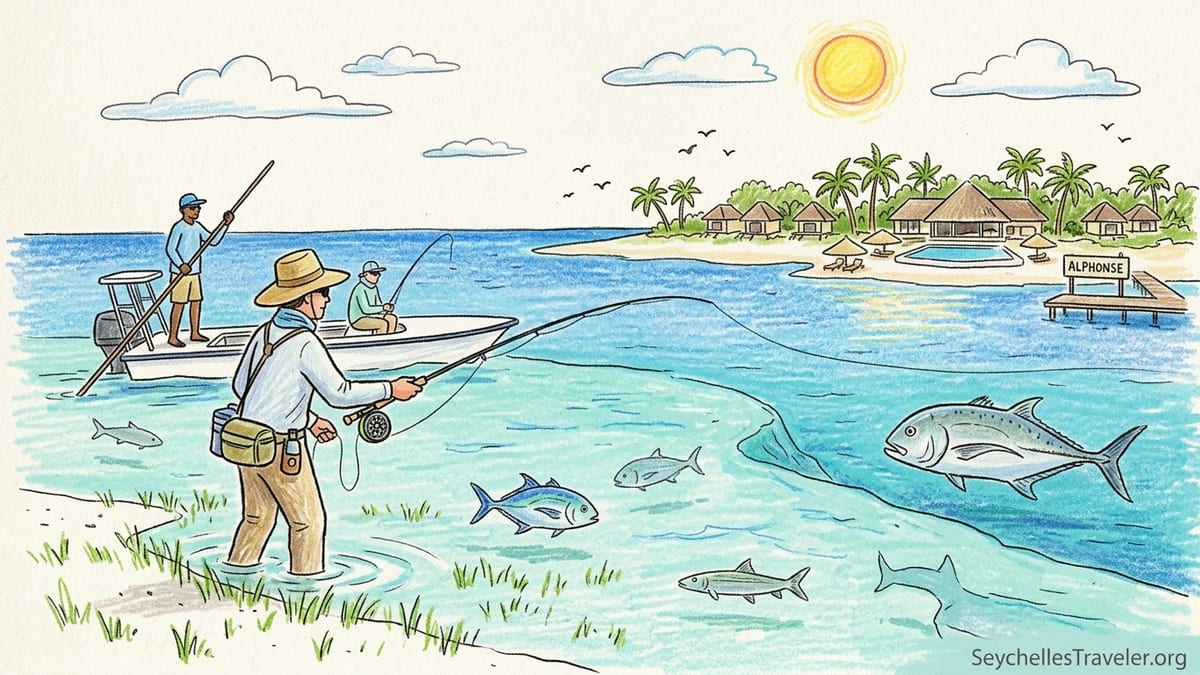
Fly fishing the Outer Islands of Seychelles sounds almost mythical until you are standing calf-deep on a blinding white flat, Indian Ocean swell breaking on the reef behind you and your guide quietly saying, "Bonefish, eleven o’clock, thirty meters, moving left." My week on Alphonse Island was built around moments like that. It was a seven-night stay where guided flats fishing was not a side activity but the spine of the entire experience, with everything from the daily schedule to the resort’s pricing and conservation ethos shaped around fly rods, tides and the remote atolls that surround this tiny speck of sand.
Why I Chose Alphonse for an Outer Islands Fly Fishing Week
When I started planning a fly fishing trip to the Seychelles Outer Islands, I quickly learned that these atolls are not interchangeable. Operations on Farquhar, Cosmoledo, Astove and Providence are marketed to hard-core anglers, often as liveaboard or dorm-style specialist weeks that revolve entirely around the tide tables. Alphonse Island, in contrast, is a private-island resort in the Alphonse Group that combines serious, professionally guided fishing with a comfortable lodge setup, good food and a full menu of non-fishing activities. That mixed focus is exactly why I chose it, travelling with a non-fishing partner who still wanted a true island holiday.
Alphonse is run by Blue Safari Seychelles and Alphonse Fishing Company, the operators behind much of the modern fly fishing story in the Outer Islands. Their guides spend seasons on Alphonse and on the more specialist atolls such as Cosmoledo and Farquhar, and they know the flats of nearby St François and Bijoutier intimately. Independent outfitters and booking agents consistently describe Alphonse as one of the world’s most prolific bonefish fisheries, with more than 60 targetable species on fly across the lagoon, drop-offs and offshore grounds. That reputation, combined with the promise of loaner gear and flexible flats activities, made it ideal for someone like me who owns some tackle but did not want to lug heavy rod tubes halfway across the world.
Another practical factor was that the standard Alphonse fly fishing packages are structured around seven nights with six full fishing days. The domestic flight from Mahé to Alphonse operates on a fixed schedule linked to those weeks, and the resort’s published fishing fact sheets and agents’ program descriptions make it clear that guided fly fishing and skiff logistics are planned that way. In other words, once you commit to the flats program, a seven-night stay is not just recommended. It is effectively required by the way the island operates its fishing product.
I also wanted a destination where conservation-oriented catch and release is the norm rather than the exception. Research supported by the Seychelles Fishing Authority and academic partners has documented that targeted species like giant trevally on Alphonse are handled under strict catch-and-release practices using barbless hooks and in-water releases. That ethic persuaded me I could enjoy the fishery without feeling I was taking something irreplaceable out of a delicate atoll environment.
The Cost of a Week on the Flats and What It Really Buys You
The first reality check of Outer Islands fly fishing is the price tag. By the time I travelled, recent rate sheets from respected operators and specialist travel agencies put a typical seven-night guided fishing package on Alphonse in the ballpark of 7,500 to 10,000 US dollars per angler, depending on season, room category, whether you share a skiff and guide, and how many dedicated guided fishing days you book. These figures usually include the charter flight between Mahé and Alphonse, accommodation on the island, all meals, standard non-motorised activities and six full days of guided flats fishing, generally in a two-anglers-per-guide configuration with a shared skiff.
On top of the core package price, there are additional conservation and park fees channelled into the island’s conservation fund, gratuities, bar drinks and any à la carte activities that sit outside the inclusive structure. My own invoice, with a shared-beach bungalow, six days of guided flats fishing on St François and a small bar bill, came in just under the equivalent of 9,000 US dollars. This is a considerable sum, but it is worth understanding what that actually buys when you are standing on the bow or wading a flat for eight hours at a time.
The value of the professional guiding became obvious on day one. Each fishing day for us started with a 30 to 40 minute run by large, shallow-draft skiff from Alphonse Island to St François Atoll. Fuel, maintenance and the use of these purpose-built boats are a significant hidden cost wrapped into the package. Once on the flats, guides rotated between polling the skiff and leading long wades over turtle grass, sand and coral. Loaner rods, high-end reels and tropical fly lines were included, which meant I could switch in seconds between a 9-weight for bonefish and triggers and a 12-weight rigged for giant trevally if a dark shape appeared on the edge of a channel.
Financially, it is not a casual decision. However, comparing notes with other anglers on the island, including first-timers and veterans who had fished Cosmoledo and Farquhar, the consensus was that Alphonse’s pricing reflected the remoteness of the operation, the professionalism of the staff and the fact that the packages bundled both the island-resort experience and a specialist-guided fishery in one place. For me, the combination of fishing intensity during the day and genuine comfort and variety for my non-fishing partner in the evenings made the cost feel justified.
On the Flats: Methods, Gear and a Very Real Learning Curve
My fishing days on Alphonse were split between skiff-based sight fishing and hours of wading. A typical schedule saw us leaving the island jetty after breakfast, motoring across to St François and then alternating between standing on the bow while the guide poled the skiff along a mangrove edge and stepping out to walk vast white-sand or turtle-grass flats with the skiff anchored far behind us. On most days we spent six to eight hours on the flats, broken only by a simple packed lunch under the shade of the skiff canopy or on a small sand spit.
In terms of equipment, I packed one 9-weight and one 12-weight fly rod, but the island’s packages include loaner outfits. For anglers without saltwater gear, this is a genuine benefit rather than a marketing line. My guide regularly suggested I try the Alphonse Fishing Company’s house rods and reels to better match the flies and lines they carry. Leaders were in the 12 to 16 pound range for bonefish and triggers and 100 pound shock tippets for giant trevally. Most of the bonefish flies were small spawning shrimp and mantis patterns in tan and pearl, while the GT set-ups carried brush flies and flashy baitfish imitations on heavy hooks.
The fishing method is pure sight casting. You stand ready with 15 to 20 meters of line stripped at your feet, watching the water ahead while your guide scans for movement or silhouettes. The learning curve for me, as someone who had only done limited tropical flats fishing before, was steep. Casting 18 to 20 meters accurately into the wind, with only a few seconds between the guide’s call and the fish disappearing, is hard work. On the first day, I routinely blew shots at bonefish by either lining them or under-powering my cast. The guide was patient but honest about it, spending long stretches drilling me on double-haul technique and stripping speed rather than simply pushing to rack up numbers.
Physically, the demands surprised me. Wading for hours across firm sand is pleasant enough, but many of the most interesting flats had patches of broken coral or softer turtle grass that forced you to concentrate hard on every step. Eight hours of that under equatorial sun, even with long-sleeve shirts, buffs and a wide-brimmed hat, left me exhausted at the end of each day. Anyone with knee or balance issues would need to think carefully about how much wading versus skiff time they wanted, and realistic communication with the guiding team at the start of the week would be essential.
Tides, Weather and How Conditions Really Felt Day to Day
Before the trip, I had read countless descriptions of how critical tides are on the Seychelles flats. Living through a week on Alphonse made that abstract knowledge very concrete. Our program spanned a set of neap tides that gradually built towards springs, and the guides tailored each day according to water movement. On the first couple of days, with smaller tidal ranges, we fished mid-tide periods when cool water still trickled in across the flats and bonefish tailed over white sand behind the reef crest. Later in the week, on bigger tides, much of the program shifted towards catching the start of the flood on inside edges and then riding the draining water off the flats to intercept fish funneling through channels.
Weather during my stay fell into what the island staff called settled trade-wind conditions. Mornings were often calm or with only a light breeze, cloud cover was minimal and visibility into the water was excellent. By midday the southeast trades picked up enough that casting into the wind became challenging for someone of my intermediate skill level. On two afternoons, high cloud pushed in and the guide pulled us off certain deeper flats because he could no longer confidently see tailing fish against the glare. Instead, we focused on shallower sand tongues where the body language of bonefish was easier to read even under diffuse light.
The interplay of conditions and casting difficulty shaped which species we genuinely caught or saw. Over six fishing days I landed bonefish into double digits each day, from small schoolies to a handful of fish the guides estimated at around 60 centimeters. I also hooked and landed several bluefin and golden trevally on the flats while blind casting into nerves of baitfish pushed tight against sandbars. Triggerfish were a constant, maddening presence, tailing over coral rubble and turtle grass but spooking easily. I managed to land one yellowmargin triggerfish after three separate break-offs earlier in the week.
Giant trevally were the fish I most wanted to encounter and also the ones that most starkly exposed my limitations. Across the week we genuinely saw a dozen or more GTs on the flats or at the edge of channels, either cruising singly or in small packs. I had four legitimate casting shots within range. In two cases I failed to get the fly in front of the fish quickly enough. In another, a fish charged the fly, ate, and I trout-set rather than strip-striking, pulling the fly from its mouth. On the final day, in milky water along a reef edge, I came tight briefly to a smaller GT that shook free after a few seconds. I did not land a giant trevally on this trip. That failure felt honest and, in a way, appropriate for a fishery that serious anglers travel across the world to experience.
Conservation, Handling Fish and the Ethics of a Catch-and-Release Fishery
Life on Alphonse revolves around the idea that the fish are worth more alive than dead. From the first evening briefing, the head guide walked us through the rules that govern flats fishing on the atoll. All bonefish, trevally, indo-Pacific permit, triggerfish and other classic flats species are strictly catch-and-release. Hooks must be barbless, and fish are to be kept in the water for unhooking and photos, with brief lifts allowed only at the guide’s discretion. Giant trevally, in particular, are handled under protocols developed in partnership with researchers who have studied their response to capture and release in this exact fishery.
On the water, these guidelines were not lip service. Guides carried de-hooking tools and were quick to cut leaders if a fish was too deeply hooked. Several times during the week I hooked smaller reef species where unhooking would have required too much handling, and the guide simply sacrificed the fly. Whenever we landed bonefish or trevally in very shallow water, the guide cradled them facing into the current until they kicked away under their own power. As an angler, this conservation-first culture did not feel restrictive. It felt like being allowed to borrow a resource that belongs to the atoll, the Seychellois authorities and to future anglers, not to me.
The resort’s conservation fee and various small surcharges feed into on-island projects ranging from turtle monitoring to habitat restoration. While not every guest on Alphonse is a fisherman, the presence of the guiding operation, research teams and visiting scientists is a visible part of daily life. Even my non-fishing partner found herself joining a turtle hatchling release one afternoon while I was on the flats, a reminder that the island’s tourism product is built around both enjoying and protecting its marine environment.
This emphasis on low-impact, high-value angling is also consistent with broader policy discussions in Seychelles, where sport and recreational fisheries have been recognised in official assessments as economically important but in need of careful management. Almost all dedicated fly fishing in the Outer Islands is now catch-and-release, and the relatively small number of anglers is balanced against significant per-guest revenues that help fund conservation and local employment.
Travelling With a Non-Fishing Partner: What They Actually Do All Week
One of my biggest concerns before booking was whether my partner would enjoy seven nights on a remote island while I disappeared after breakfast with a rod in hand. Our experience on Alphonse shows how thoroughly the resort has integrated non-fishing activities into its operation. While I was on the flats from about 8 a.m. until mid to late afternoon, she built her own routine from the menu of included and optional excursions that came with the leisure packages.
Mornings often started with a guided snorkeling trip on the outer reef or in one of the protected lagoons, using complimentary fins and masks provided by the dive center. On other days she joined group bike rides around the island’s sandy tracks, paddleboarded in the calm lagoon directly in front of the lodge or joined a nature walk with the resident conservation team to learn about the island’s birdlife. The resort offers diving courses and boat dives at published per-dive rates, and she completed a refresher course followed by a couple of afternoon dives while I was still waist-deep on the flats.
Crucially, she never felt like an appendage to a fishing lodge. Alphonse functions as a genuine private-island resort, with a spa, pool, beach bar and small but thoughtful program of evening activities that have nothing to do with fishing. Turtles often nest on the beaches near the villas, and simply sitting with a book under the palms or drifting along the shoreline with a mask and snorkel filled several of her afternoons. When we compared notes at dinner each night, her day sounded as rich and varied as mine, just in a different part of the island’s ecosystem.
If you are considering a similar trip with a non-angling partner, the key question is not whether they will have things to do. They will. The question is whether they are comfortable with the remoteness and the fact that there is effectively one restaurant, one bar and one beach, however beautiful. For us, travelling from an urban home, that deliberate narrowing of choice was part of the appeal rather than a limitation.
Who Alphonse Suits, and How It Compares to Farquhar and Cosmoledo
After a week of early starts, sunburnt ears and occasionally humbling casting lessons, I came away convinced that Alphonse sits in a sweet spot between pure fishing camp and pure resort. It is intense enough that serious anglers can spend every day on the skiff or waist-deep in the surf, chasing bonefish, triggers, trevally, milkfish and more. At the same time, it is forgiving enough that someone with limited flats experience can learn on the job with high-quality instruction, and a non-fishing companion can have a fulfilling holiday of their own without ever touching a rod.
Online research and conversations with guides on the island highlighted how Farquhar, Cosmoledo and Providence differ. Those destinations are marketed through the same operators and specialist agencies as true expedition-style angling trips. Guests typically sleep in simpler lodge-style accommodation or liveaboard vessels, and the daily routine is built almost entirely around the tide and weather. Prices for these specialist trips are broadly similar or slightly higher than Alphonse on a per-week basis, but they include even more remote logistics and an expectation that nearly every waking hour will be spent hunting giant trevally, bumphead parrotfish and other headline species.
I have not personally fished Farquhar, Cosmoledo or Providence, so I can only describe them here as researched alternatives rather than as first-hand experiences. However, the anglers on Alphonse who had also fished those atolls tended to sum up the choice this way. If you are a dedicated saltwater fly fisher whose primary dream is a trophy giant trevally and you are willing to sacrifice some comfort and non-fishing variety, then a Cosmoledo or Providence week might be the better fit. If, on the other hand, you want to combine world-class bonefishing and multi-species flats action with a more flexible resort environment, or you are travelling with a non-fishing partner, then Alphonse offers a more balanced Outer Islands experience.
What is constant across all these operations is the seven-night framework and the centrality of fly fishing to the tourism product. Domestic flights, guiding rosters and conservation staffing are all built around that rhythm. In practice, that means a trip to the Seychelles Outer Islands for fly fishing is not something you bolt on to the end of a general beach holiday. It is the core of the journey, financially and logistically, and the rest of your Indian Ocean time should probably be planned around it.
The Takeaway
My remote flats experience in the Seychelles Outer Islands was, at its heart, a week of repetitive simple actions carried out in an extraordinary place. Wake early, eat breakfast, step onto a skiff, run across a lagoon, wade a flat, watch, cast, strip, release. Some days the fish came easily, with bonefish lining up on a falling tide and bluefin trevally chasing bait into knee-deep channels. Other days, wind, light or my own shortcomings turned those same actions into work that felt almost agricultural. Through it all, the atoll scenery never stopped feeling otherworldly, and the knowledge and calm of the guides turned what could have been a frustrating learning curve into something deeply satisfying.
From a travel writer’s perspective, the crucial point is that fly fishing is not a side hustle on Alphonse or the wider Outer Islands. It is one of their defining commercial products, woven through the pricing, the weekly schedules, the conservation programs and the training of local staff. Packages explicitly include equipment loans, flats-oriented activities and dedicated guided fishing, and they are built around a seven-night rhythm that makes sense only when you understand that the tides and the fish are what dictate the pace of life here.
Would I recommend this experience to a non-expert angler? Yes, with honest caveats. You need a base level of fitness to wade for hours in heat and glare, a willingness to practice your casting before and during the trip, and an acceptance that you may not land a permit or a giant trevally even if you see them. If you come with that mindset, the fish you do catch, whether it is your first bonefish or a scrappy yellowmargin triggerfish, will feel earned in the best possible way.
For travellers weighing up the cost and commitment, the deciding factors will be your passion for the flats and your appetite for remoteness. Alphonse will not suit everyone. It is expensive, isolated and built around a very specific kind of outdoor experience. Yet for a week I felt I was inside a finely tuned system where my presence as a visiting angler helped fund conservation projects, sustain local jobs and support a model of low-volume, high-value tourism in one of the most delicate marine environments on earth. That, as much as the fish themselves, is what has stayed with me since I stepped off the skiff for the last time and watched the sun go down over the reef.
FAQ
Q1. Do I need to be an expert fly fisher to enjoy Alphonse Island?
A1. No. Several people on my week were new to saltwater fly fishing and still had productive days, especially with bonefish and smaller trevally. You should, however, be comfortable making a 15 to 20 meter cast in moderate wind and willing to spend time improving under your guide’s instruction.
Q2. How many hours per day are actually spent fishing on the flats?
A2. On my trip we generally left the island jetty after breakfast and returned by late afternoon, which translated into about six to eight hours on the flats or skiff each day, adjusted slightly for tides and weather.
Q3. Is fly fishing equipment really included, or should I bring my own?
A3. The packages I booked included the loan of high-quality fly rods and reels, plus appropriate lines for bonefish and giant trevally. I brought some of my own gear but often used the island’s equipment, which was well matched to local conditions and saved me the hassle of travelling with multiple heavy rod tubes.
Q4. What species did you genuinely catch or see during your week?
A4. Over six fishing days I caught good numbers of bonefish, several bluefin and golden trevally and one yellowmargin triggerfish. I also had visual encounters and casting shots at giant trevally but did not land one, and I saw but did not hook other flats species such as additional triggers and smaller reef fish.
Q5. How physically demanding is a typical day on the flats?
A5. A full day involves long periods of standing on a moving skiff and several hours of wading across sand, turtle grass and occasional coral rubble in strong sun. Reasonable fitness, good balance and proper sun protection are essential. Anyone with knee, back or mobility issues should discuss options for more skiff-based fishing with the operator in advance.
Q6. What can a non-fishing partner do during a seven-night stay?
A6. My non-fishing partner filled her days with snorkeling, diving, cycling, stand-up paddleboarding, spa visits, nature walks with the conservation team and simple beach time. The resort operates as a full private-island property, so there are plenty of structured and unstructured activities that have nothing to do with fishing.
Q7. Does fly fishing dictate the length of stay on Alphonse?
A7. Yes. The domestic flights and guided fishing programs are organised around seven-night schedules with six dedicated fishing days. While shorter leisure-only stays may occasionally be possible, a proper flats fishing package is effectively locked into that week-long rhythm.
Q8. How much should I budget for a full fly fishing week including guiding?
A8. Recent rates from operators and specialist agencies indicate that a seven-night Alphonse fly fishing package with six guided days, accommodation, meals and internal flights typically falls somewhere between roughly 7,500 and 10,000 US dollars per angler, excluding tips, bar drinks and some optional extras.
Q9. How are conservation and catch-and-release practices enforced?
A9. The guiding team sets clear expectations at the initial briefing, including mandatory barbless hooks and in-water releases for key flats species. On the water, guides handle almost all unhooking, cut leaders when necessary and prioritise the fish’s recovery, reflecting both company policy and broader regulations for the Outer Islands fishery.
Q10. Should I choose Alphonse, Farquhar or Cosmoledo for a first Seychelles trip?
A10. If you want a mix of serious flats fishing and resort-level comfort, especially when travelling with a non-fishing partner, Alphonse is a strong first choice. Farquhar and Cosmoledo are better suited to dedicated anglers seeking more intense, specialist trips in even more remote settings, but I cannot speak to them from personal experience, only from research and conversations with other guests.