


Reaching the outer islands of Seychelles is not a simple “book and go” exercise. These are some of the most remote specks of land in the Indian Ocean, and the way you plan your flights, bags and buffer time in Mahé can make the difference between a dream arrival on a sand-ringed atoll and a night unexpectedly stranded in Victoria. On recent journeys to Alphonse and to the Aldabra Group via Assumption, I kept meticulous notes on aircraft, check in times, delays and even the last bumpy minutes in the lagoon. This article brings those real transfer days together so you can plan your own route to the edge of Seychelles with realistic expectations.
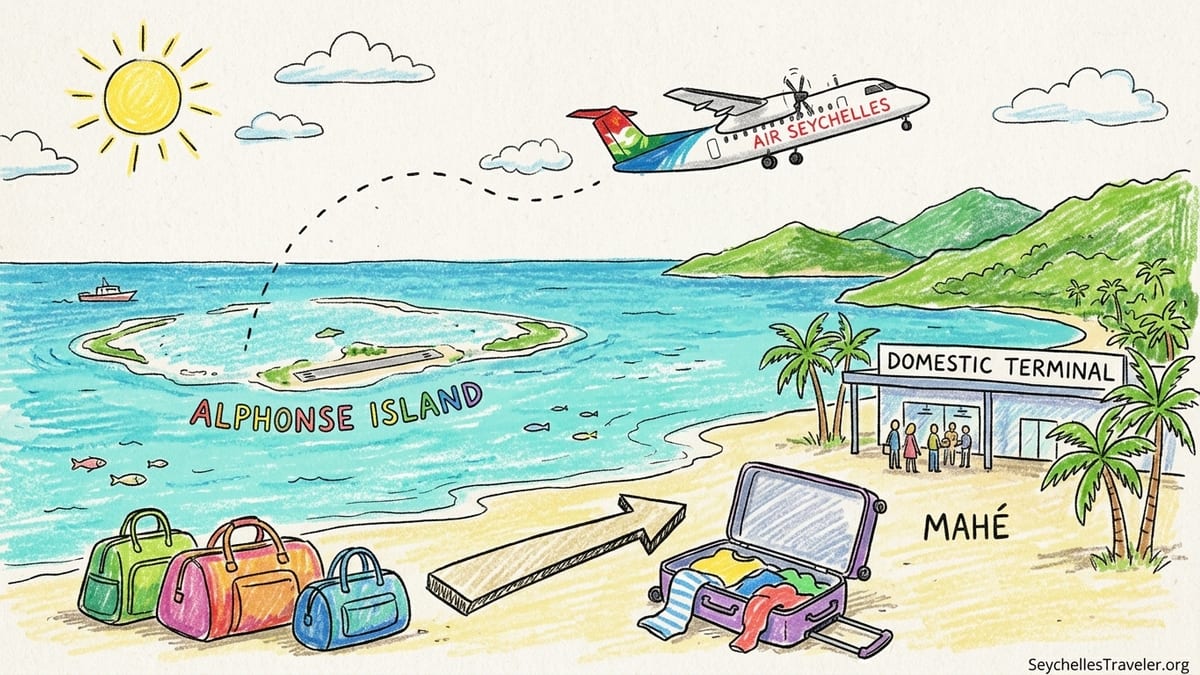
Understanding Mahé as Your Outer-Islands Hub
Almost every outer-island journey starts and ends at Seychelles International Airport on Mahé. The airport has two terminals set a few minutes’ walk apart: the busy international building where long haul flights arrive, and a compact domestic terminal for inter-island flights and charters. The walk between them, even with a roll-aboard, takes around five minutes along a covered pavement, but the actual time you need for a connection is dictated by immigration queues, baggage delivery and the fact that most resort and expedition flights do not operate as a frequent shuttle.
On my own trips, the pattern on arrival was consistent. After landing from overnight flights from Europe or the Middle East, it usually took 30 to 60 minutes to clear immigration, depending on how many widebody jets had arrived together. Bags for economy passengers started appearing around the 30-minute mark. Only then could I exit the glass doors into the humid air and walk across to the domestic building. This real-world timing matters when a resort charter requires you to be checked in a full hour before departure and explicitly asks for at least four hours between your international arrival and its own take-off window.
Standard domestic services to Praslin and other inner islands, often run by Air Seychelles with twin-otter aircraft, have multiple daily departures and behave more like a regional shuttle. Outer-island flights are different. Services to Alphonse, Astove or Assumption are typically organised as charter-style or resort-linked flights operated by the Islands Development Company or partner operators, with limited departure days and often only one rotation per day. That means missing your slot is not simply a matter of taking the next plane an hour later. In practice, it can mean losing a night on the island or shortening your stay.
This structural difference is why I now treat Mahé itself as part of the trip, not just a through hub. For both outer-island journeys described in this article I chose to overnight near the airport on at least one side of the expedition. It added cost, but it also turned tight, stressful connections into calm mornings where I could check in early at the domestic counters, repack down to the strict baggage limits and still have time for a coffee at the small café facing the runway.
Mahé to Alphonse Island: How the Flight Really Works
Alphonse Island sits more than 400 kilometres southwest of Mahé and is accessed by fixed-wing aircraft, usually a Beechcraft or similar turboprop configured with around 16 to 20 seats. The flight is marketed as taking about one hour, and in calm conditions my airborne time was roughly 55 minutes from wheels up on Mahé to touchdown on Alphonse’s coral airstrip. That short flying time hides a much longer door-to-door journey that begins when you arrive at the domestic terminal and check in for a resort-linked charter.
For my most recent trip, the resort’s pre-departure notes stressed that, because the Alphonse flights operate only on select days and not as an hourly shuttle, guests should arrive on Mahé with no fewer than four hours between their long-haul arrival and the onward island departure. On the ground, that requirement proved sensible. Check in for the Alphonse flight opened two hours before departure and closed one hour before. Bags were weighed carefully, including carry-on, against a strict allowance of around 15 kilograms of checked luggage plus 5 kilograms of hand baggage per person on the charter aircraft. Any excess needed prior approval and could be refused if the flight was full or conditions were hot and heavy.
After check in, passengers waited in the modest domestic departure lounge. On my flight the boarding time slipped about 20 minutes due to a localised rainstorm on the route, while ground staff watched weather radar and checked in by phone with the island. This kind of delay is common enough in the wet season that I now build it into my mental timetable. We eventually walked across the apron to a twin-engine turboprop with a single aisle and two seats on each side in most rows. Hand luggage that would be normal on a long-haul jet felt oversized here, and several roller bags were gate-checked at the aircraft steps and stowed in the rear hold instead.
The landing on Alphonse is part of the adventure. The island’s airstrip is unpressurised, surfaced for light aircraft and aligned almost parallel to the shoreline. On approach, we descended beneath a broken layer of cloud to see the lagoon and reef flash by under the wing. There is no jet bridge. After disembarking onto the warm tarmac, we were met by resort staff with electric buggies and a small tractor and trailer for luggage. The transfer from airstrip to accommodation took less than ten minutes, yet even there the resort team deliberately slowed the pace with a welcome drink and short orientation while ground staff loaded bags directly to each bungalow.
Door-to-Door Timing and Connection Buffers to Alphonse
When you add each component together, the one-hour flight to Alphonse expands into a door-to-door journey of at least half a day. On the outbound leg from Europe, I landed in Mahé around 08:00, reached immigration queues by 08:15, cleared formalities and customs by about 09:00, and walked to the domestic terminal by 09:10. Check in for the Alphonse charter was already open for a scheduled late-morning departure, and staff were quietly strict about closing the desks on time so the aircraft could be loaded and towed out to its stand.
Allowing for check-in cut-off, baggage weighing, security, a possible weather delay and the 55-minute flying time itself, I reached my villa on Alphonse close to five hours after the jet’s doors opened in Mahé. On the return, the pattern repeated in reverse: a mid-morning departure from the island, close to one hour of flight, and arrival back at Mahé around lunchtime, which safely allowed for an evening long-haul flight but would have felt uncomfortably tight for an early afternoon international departure.
Based on those experiences, I would treat the resort’s four-hour minimum buffer between international arrival and Alphonse departure as a hard floor, not a theoretical guideline. If your long-haul flight is due in at 07:30 and the Alphonse flight is scheduled around midday, book them on separate tickets and assume you might need to absorb a delay on either side. I would personally avoid pairing any long-haul arrival after 09:00 with a same-day Alphonse departure, even if, on paper, the minimum times look acceptable. A late bag, a slow immigration queue or a passing storm cell can easily eat through 60 to 90 minutes of that buffer.
If I were planning my trip again, I would keep exactly the same pattern at the start and be even more conservative on the way home. An overnight in Mahé after leaving Alphonse feels like an indulgence until you talk to other guests who have faced weather disruptions. Having a spare night on the main island absorbs those shocks, keeps your international flight safe and gives you time to re-pack urban clothes from the luggage that stayed in storage while you were on the atoll.
Baggage Limits and What to Do With the Rest
The single most surprising practical lesson from flying Mahé to Alphonse was how limiting a 15 kilogram checked baggage allowance feels once you add cameras, water housing, a light tripod and personal clothing. On the resort charter I took, ground staff weighed both hold luggage and carry-on bags, and they were open about the reason: weight and balance on short outer-island runways leave very little margin. In hot conditions, the captain may have to restrict payload further for performance reasons, and pre-agreed excess baggage cannot be guaranteed onto every flight.
To cope with this, many outer-island guests, including me, ended up using a form of left-luggage arrangement on Mahé. The Alphonse team based at the domestic terminal offered to store hard cases and city clothes in a locked area while we were on the island, and this turned out to be one of the most useful services of the whole trip. I packed a soft duffel to exactly meet the combined 20 kilogram checked and cabin limit and left a wheeled suitcase with less essential items behind. Returning to Mahé, that suitcase was waiting, labelled with my name, near the same domestic check-in desk.
The limitation is not only weight but also the physical dimensions of bags that can be loaded through the small cargo doors of a twin turboprop. Large hard-shell suitcases that slide easily into a widebody’s hold can be awkward to fit into short-haul aircraft, and on one departure I watched ground crew experiment with turning a large case end-on and sideways to make it work. That is not a good feeling when it is your camera kit. My advice, learned the hard way, is to travel to the outer islands with soft bags that can compress, to pre-pack into an “outer islands kit” and a “Mahé and onward” kit, and to confirm with your operator how and where excess will be stored.
On the Aldabra-side charter I joined to Assumption Island, there were similar constraints. The aircraft operated more like a research and logistics service with a mix of scientific staff and a small group of visitors heading onward by boat. Weight was again checked carefully, and some heavy items like diving gear were shipped on an earlier rotation to keep the main flight within limits. The lesson repeated: on Seychelles outer-island flights, assume that the stated allowance is genuine and designed around safety, not a target for creative negotiation.
From Mahé to Aldabra via Assumption: Expedition-Style Access
Aldabra Atoll lies more than 1,000 kilometres southwest of Mahé and has no airstrip, no harbour and no guest accommodation in the conventional sense. The atoll is a UNESCO World Heritage Site and a Special Reserve managed by the Seychelles Islands Foundation, with access heavily restricted to protect its environment. All visitors must obtain prior authorisation, and once there you are usually based on a live-aboard vessel rather than on the atoll itself. That reality shapes every transport decision you make well before you reach Seychelles.
On my journey, the only practical way to get close to Aldabra was to piggyback on a charter flight from Mahé to Assumption Island, part of the same outer group. The airstrip on Assumption takes light aircraft, again typically turboprops arranged by the Islands Development Company or by expedition cruise operators. Check in on Mahé looked at first like any other domestic charter, with a small group gathering at a dedicated desk in the domestic terminal, passports in hand, bags weighed and tagged. Behind the scenes, though, the operator had already secured Seychelles Islands Foundation permission for our vessel to approach Aldabra and had coordinated timing with the boat that would be waiting on Assumption.
The flight time from Mahé to Assumption on my trip was a little over two hours. Unlike more tourist-oriented services, the aircraft interior was utilitarian, with fewer creature comforts and a strong sense that this was a lifeline route for personnel and supplies. As we approached Assumption, there was none of the manicured resort welcome of Alphonse. The runway appears on a long, low coral island fringed by surf, and after landing we walked from the aircraft to a basic building that served as both terminal and operations hut. Luggage was unloaded by hand and moved a short distance to the waiting vehicles.
From there, the expedition rhythm took over. We were driven along a sandy track for around ten minutes to the beach on the lagoon side, where our live-aboard vessel lay at anchor. Sea conditions dictated the final stage. On my arrival in the dry season, the lagoon was calm and glassy, and it took roughly 20 minutes by motor launch to reach the ship. Colleagues travelling in shoulder seasons reported much rougher seas that stretched the transfer to 45 minutes and left everyone soaked. In all cases, transfers were timed for daylight, and contingency plans were in place if ocean swell or wind made it unsafe to cross at the scheduled hour.
Door-to-Door Time, Sea Conditions and Why Buffers Matter for Aldabra
The full journey from a hotel in Mahé to Aldabra’s inner lagoon can take the better part of two days once you factor in authorisation, staging and weather windows. On my itinerary, I left a guesthouse near Mahé airport shortly after dawn, checked in at the domestic terminal two hours before our Assumption departure, and was airborne by mid-morning. After the two-hour flight, a quick turnaround on Assumption and the motor launch transfer to our live-aboard, we still had an overnight passage across roughly 45 kilometres of open water before waking to Aldabra’s ring of coral in the early light.
That overnight segment is one of the big differences between resort-style flights and true expedition access. Aldabra has neither an airstrip nor a harbour, so even with the convenience of Assumption’s runway, you are at the mercy of sea conditions for the final approach. On my voyage, the crossing was calm, with a long swell and light winds that made for slow, steady progress. At other times of year, the Seychelles Islands Foundation has noted that seas can be rough enough that their own boats do not attempt a crossing from Aldabra back to Assumption. When that happens, charter flight schedules and visitor itineraries may need to flex by a day or more.
Because of this, I treated Mahé not just as an entry point but as an essential buffer on both sides of the Aldabra leg. I arrived on the main island two days before the Assumption charter in case an international delay would have jeopardised the connection, and I left the same gap on the return, with an extra night in Victoria at the end of the expedition. Those bookend days also provided breathing room for the operator to adjust sailing times around weather. Had I tried to arrive on Mahé on the same morning as the Assumption flight, a single missed connection could have derailed access to a site that might not be practical to reach again for years.
If I were fine-tuning my buffers after this experience, I would make two changes. First, I would align my international arrival to land in Mahé at least 24 hours before any outer-island charter connected to Aldabra, not just four or five hours earlier. Second, I would avoid booking a homebound long-haul flight earlier than the day after the planned return from the outer islands. Expedition logistics in Seychelles are still subject to the rhythms of weather and remote operations, and a flexible cushion of a day each way feels proportionate to the stakes involved in seeing a place as protected and hard to reach as Aldabra.
How Outer-Island Logistics Change Your International Flight Plan
One of the subtle traps in planning trips to Seychelles outer islands is assuming that the smooth, frequent mainline connections to Mahé extend outward in miniature. They do not. International arrivals often operate on predictable daily or near-daily schedules, while charter flights to Alphonse or Assumption may be limited to certain days of the week or tied to specific resort stays or expedition departure dates. That mismatch forces you to think in blocks of days rather than in neat hour-by-hour connections.
Practically, this means choosing your long-haul flights around the outer-island schedule, not the other way round. For Alphonse, I started by confirming the resort’s available charter days, then checked which international routes arrived on Mahé early enough the previous day to give me an overnight rest before the domestic connection. Only once those anchor points were fixed did I look at fare classes or redemption tickets. This is the opposite of how many travellers plan trips to more connected islands, where you can often bolt on inter-island flights at the end.
For Aldabra-style expeditions, the international leg becomes even more sensitive. There, operators might charter an aircraft to Assumption only for a specific expedition window, and if you are not physically present on Mahé to meet that flight you may have no realistic alternative. Cruise operators and NGOs I travelled with were explicit: arrive at least one day early and do not plan to depart Mahé on a long-haul flight until the day after the expedition is scheduled to return. Building those extra nights into your budget and mindset from the start helps avoid frustration when you see that your trip includes time on the main island at both ends.
Another knock-on effect is the treatment of tickets. Given the fragility of outer-island timings, I now favour booking international flights with changeable conditions and realistic options on alternative days. A non-refundable, non-changeable fare that connects tightly to a once- or twice-weekly charter can be a false economy if a storm front rolls through or if operational requirements shift a charter by 24 hours. Having seen fellow passengers forced into last-minute overnight stays because of weather and aircraft maintenance, I would rank flexibility well above shaving a small amount off the headline long-haul fare.
The Takeaway
Travelling from Mahé to the outer islands of Seychelles is not complicated in a technical sense: you will use small but well-run domestic terminals, light aircraft and simple boat transfers. The complexity lies in the spacing of flights, the strict baggage policies dictated by short runways, and the weather and sea conditions that can interrupt even the best-planned schedule. Having now flown to Alphonse and staged through Assumption to reach Aldabra’s waters, my main conclusion is that respect for these constraints is the single best gift you can give your future self.
For Alphonse and similar resort islands, plan your international flights around the resort’s charter days, accept that the one-hour flight is wrapped inside a half-day door-to-door journey, and be ruthless in packing only what fits into the real baggage allowance, with a clear system for leaving city luggage in Mahé. For Aldabra and other truly remote atolls, think like an expedition member rather than a holidaymaker. Build in whole days on Mahé as buffers, treat sea conditions as a governing factor, and be prepared for plans to flex.
If there is one detail I would change on my own itineraries, it would be even more generosity with time. An extra night at either end of an expedition costs less than the emotional and financial price of missing a once-in-a-lifetime charter because of a delayed inbound flight or a rough sea in the Aldabra Group. Approach Seychelles’ outer islands with that level of patience and respect, and the transfers themselves become part of the story: the twin-otter lifting away from Mahé, the coral runway on Alphonse, the low shape of Assumption from the air, and the first ring of Aldabra rising from the ocean at dawn.
FAQ
Q1. How early should I arrive in Mahé before a flight to Alphonse Island?
For resort-linked Alphonse flights, plan to land on Mahé at least four hours before the charter departs, and consider arriving the previous day to add a safety buffer.
Q2. What is the baggage allowance on outer-island charter flights?
Most charter-style flights to islands like Alphonse and Assumption work with around 15 kilograms of checked luggage plus about 5 kilograms of hand baggage per person, with strict weighing.
Q3. Can I store excess luggage on Mahé while I visit the outer islands?
Yes, many resort and expedition operators offer secure storage near the domestic terminal on Mahé so you can leave hard cases and non-essential items during your island stay.
Q4. How long is the flight from Mahé to Alphonse Island?
The airborne time is usually about one hour, but with check in, boarding, possible weather delays and the buggy transfer on arrival, the door-to-door journey often takes four to five hours.
Q5. How do I get to Aldabra Atoll as a regular traveler?
Most visitors reach Aldabra as part of an organised expedition that uses a charter flight from Mahé to Assumption Island and then a vessel for the roughly 45 kilometre sea crossing to the atoll.
Q6. Does Aldabra have an airstrip or harbour?
No, Aldabra has neither an airstrip nor a conventional harbour, so all access is by small vessel, usually from live-aboard ships or from nearby Assumption Island under Seychelles Islands Foundation authorisation.
Q7. How much buffer time should I leave in Mahé before and after an Aldabra expedition?
Plan to arrive in Mahé at least one full day before your charter to Assumption and to stay at least one night on Mahé after returning, in case sea or weather conditions cause delays.
Q8. Are weather delays common on outer-island flights and boat transfers?
Short delays due to rain or low cloud are reasonably common on flights, and sea conditions can sometimes postpone boat transfers, especially around Aldabra during rougher periods.
Q9. Can I visit Aldabra independently without joining a cruise or expedition?
Independent visits are difficult because all access requires prior Seychelles Islands Foundation authorisation and suitable vessels, so most travelers join approved cruises or organised expeditions.
Q10. What type of luggage works best for Seychelles outer islands?
Soft duffel bags or backpacks that can compress into small aircraft holds work far better than large hard-shell suitcases, and they make weight checks and handling on boats much easier.