


I went to the Seychelles outer islands expecting remote-Indian-Ocean magic and a very large bill. Both turned out to be true. What surprised me, though, was not just how expensive these trips are, but how differently the money is spent depending on whether you book an all-in-one resort package, a specialist diving or fishing expedition, or a once-in-a-lifetime voyage to Aldabra. The remoteness that makes these islands so special is exactly what shapes every line of the budget.
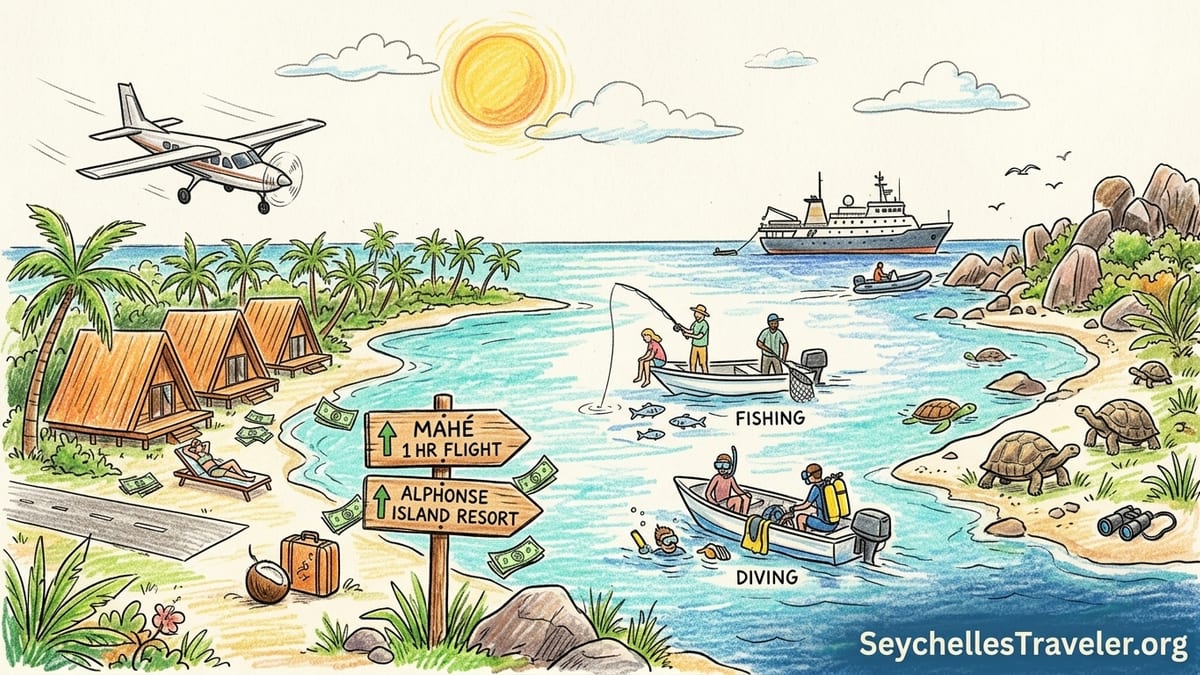
Why Remoteness Rewrites Your Budget
The Seychelles outer islands sit scattered hundreds of kilometres from Mahé, with no scheduled ferries, no local guesthouse scene and very little infrastructure. Everything and everyone has to fly or sail in. That distance is why a week on Alphonse or an Aldabra expedition costs what a month might cost on the inner islands. When I started planning, I quickly learned that “outer islands” is not one product. There are three very different cost models, each with its own drivers.
First are the remote resort packages, the classic example being Alphonse Island. These bundle return flights from Mahé, accommodation and meals into a single per-person rate that can easily run into the thousands of US dollars for a stay of just a few nights. Blue Safari Seychelles, which operates Alphonse, publishes leisure packages where even a three-night stay costs more than many people’s whole Seychelles holiday, and seven-night offers climb substantially higher, especially in peak fishing and diving season. That sticker shock makes more sense when you realise your resort is effectively running its own mini-island economy.
The second model is the specialist diving or fishing expedition, usually also based on Alphonse or companion atolls, but priced around guided activity days and boat time rather than pure leisure. Instead of paying primarily for your room and board, you are paying for highly skilled guides, skiffs, fuel and access to productive flats and reefs that are tightly regulated. Blue Safari’s dedicated fly-fishing packages, for example, layer daily guided skiff use, tackle-prep and conservation funding on top of accommodation, which shifts the budget centre of gravity away from your beach bungalow and directly onto the water.
The third model is the Aldabra-style expedition. There is no conventional resort here. The Seychelles Islands Foundation confirms that visitors must pay an impact fee of about 250 US dollars per person per day, on top of chartering or joining an expedition vessel that can safely cross to the atoll and provide onboard accommodation. Between the vessel charter, fuel, crew, permits and impact fees, the cost structure looks more like an Antarctic cruise than a tropical beach break. In all three models, it was not the obvious “luxuries” that drove my spending most sharply, but the hidden price of remoteness itself.
Remote Resort Packages: What I Actually Spent on Alphonse
My first exposure to the outer islands was a leisure-focused week on Alphonse Island in April 2024, booked through a Blue Safari partner agency. Publicly available rates show just how concentrated the costs are. A recent Blue Safari rate sheet lists a seven-night leisure package in a Beach Bungalow at several thousand US dollars per person, including return flights between Mahé and Alphonse, full board and selected activities. Older rate documents for 2022 show a seven-night package advertised around 4,300 US dollars per person in high season, explicitly stating that roughly 1,000 of that was the embedded cost of the inter-island flights. While exact current figures fluctuate by season, it is clear that even before you buy a drink, you have committed many thousands of dollars for the privilege of being on the island at all.
In my case, a shoulder-season package in April priced just under 6,000 US dollars per person for seven nights in a Beach Bungalow, based on two sharing. That amount folded in the charter-style domestic flights from Mahé, all meals, use of snorkelling gear, non-motorised water sports and a handful of guided nature activities with the island’s conservation team. On paper it looked eye-watering. On the ground it felt closer to an all-inclusive expedition base, with very few day-to-day decisions about transport or logistics because everything between Mahé and the reef edge was already prepaid.
What looked most expensive, but actually represented decent value for the remoteness, was the bundled flight and full-board combination. Scheduled flights to Alphonse are typically operated on a charter basis, with Blue Safari confirming that return flights from Mahé are included in its packages and run on specific days, especially between mid-November and mid-April. Stand-alone pricing for those flights, visible in older rate tables, climbs into the mid-hundreds of dollars each way. If you strip them out, the effective nightly rate for accommodation and three substantial meals a day starts to resemble high-end inner islands resorts, just delivered in a far more remote setting with vastly higher supply costs.
Where I did see large extra charges was anywhere that required motorised boats and specialist staff time. A three-hour “blue safari” boat excursion, for example, was priced at around 100 US dollars per person in May 2024, according to a detailed trip report, and my own experience tallied with that order of magnitude. A five-dive package with the on-island PADI centre showed up at around 750 US dollars in those same references, and my own bill for six dives and gear rental landed just north of 800 dollars. Add guided fishing, spa treatments, premium wines and private excursions, and it was easy for two people to double their on-the-ground spend over a week, despite having already paid for full board.
Where the Money Goes: Flights, Freight and Full Board
By the time I flew to Alphonse in 2024, I was already primed for a larger-than-normal domestic flight bill. The one-hour hop covers roughly 400 to 450 kilometres of open ocean, on small aircraft that have to carry not just passengers but freight for the island’s kitchens, bars and workshops. Historic information about Alphonse’s operations notes that the airstrip is served by dedicated flights from Mahé, some run by the Islands Development Company’s aviation arm. Current Blue Safari itineraries clearly state that return flights are wrapped into package pricing, with departures concentrated on certain days of the week to consolidate loads. The result is that you cannot meaningfully shop around on this route; your choice of resort effectively locks in your flight provider and cost.
Those flights are one reason full-board is not an optional upgrade but the default. Everything edible or drinkable that cannot be grown on the island arrives in those same aircraft or on infrequent supply vessels. Resorts try to balance this by running impressive kitchen gardens and sourcing some fish locally, but the logistics still skew toward bulk provisioning. On Alphonse, my package covered three daily meals: a buffet-style breakfast, lighter lunches and generous set-menu or buffet dinners. If you assign even conservative values of 70 to 100 dollars per person per day for three restaurant meals in a remote location, the food component starts to justify a big portion of the apparent overnight rate.
There is also a conservation dimension baked into the price. Blue Safari highlights its partnership with the Island Conservation Society in protecting turtles, birds and fragile reef ecosystems. Some packages are explicitly branded as “conservation experiences,” and rate documents note that a share of revenue goes to the island’s conservation programmes. On my bill this did not appear as a separate conservation fee, but it was clear from the staffing and facilities that the resort funds an unusually large environmental team for such a small property. In practice, your nightly rate is part hotel, part charter flight, part conservation levy and part remote logistics fee, all collapsed into one number.
None of this included alcoholic drinks or premium coffees. Cocktails on Alphonse hovered in the 15 to 20 US dollar range, with imported wines charged accordingly. Across seven nights, two of us spent just under 600 dollars on drinks outside standard mealtimes. That was one of the few cost areas I felt genuinely in control of day to day. Almost everything else, from the generator fuel that powered my air conditioning to the diesel in the dive boat, had already been pre-paid and was simply invisible in the resort’s package structure.
Diving and Fishing Expeditions: When Days on the Water Drive the Bill
A year after my leisure stay, I came back to the outer islands in March 2025 on a fishing-focused trip that piggybacked on Blue Safari’s fly-fishing operations. The pricing logic was different from the start. Instead of anchoring the conversation around a per-night rate, the operator quoted me a per-angler price for a fixed number of guided fishing days, with accommodation and meals described almost as support services for the real product: time with world-class guides on remote flats.
Publicly available fact sheets for Alphonse fishing packages outline this clearly. Anglers pay for a package that includes a specific number of shared skiff days, full guiding, use of basic gear, certain conservation contributions and, again, the return flights from Mahé. Figure in current long-haul fishing travel norms and discussions with other guests, and you often hear per-angler, per-week prices in the mid to high four figures or more, depending on whether you are sharing a skiff and how many prime-season days are involved. When I compare my March 2025 invoice to my leisure stay, the nightly accommodation component was similar, but the fishing uplift added roughly 40 to 50 percent to my total bill.
Diving works in a similar tiered way. Leisure guests on Alphonse can book ad hoc dives, but serious divers often join packages of multiple boat dives spread over several days. That May 2024 price list cited a five-dive package at around 765 US dollars. On my mixed diving and fishing visit, I opted for three two-tank boat days. By the time I added nitrox, gear rental and marine park surcharges, the diving segment of my bill sat around 900 dollars. Because those boats and compressors are finite resources, the island prices diving to reflect both the true cost of running them and the opportunity cost of allocating limited slots.
The hidden driver behind both fishing and diving prices is not simply profit, but restrictions. Flats and reefs around the outer islands are managed to limit pressure on fish and corals. Rod days and diver numbers are capped. Guides are kept on full-time contracts so they can invest in understanding tides and habitats instead of bouncing from job to job. When I probed why my fishing package was so much more than the leisure rate, staff explained that my fee supported a small army of guides, skippers, deckhands and support crew, as well as the fuel and maintenance on skiffs that spend long days covering large distances. The visible luxury of a flats skiff idling in turquoise water hides an entire back-office of costs.
In pure cash terms, that meant my daily spend on the second trip was being driven by how many days I booked on the water rather than how fancy my room was. A friend who travelled with me but did not fish paid almost exactly what I had paid on my earlier leisure visit. My own total, however, ended several thousand dollars higher, even though we shared a bungalow and ate from the same buffet. On remote outer islands, the marginal cost of adding another private-boat day or specialist guide is enormous compared with simply adding one more guest at the dinner table.
Aldabra-Style Expeditions: Impact Fees and Expedition Vessels
If Alphonse is a remote resort with expedition elements, Aldabra is the opposite: a scientific wilderness occasionally visited by small expeditions that happen to take tourists. There is no hotel, no nightly entertainment schedule, and no independent travel. Instead, you either charter a vessel capable of crossing to the atoll, or you buy into a scheduled expedition cruise operated by a specialist company that has secured permits and can meet Seychelles Islands Foundation regulations.
The Seychelles Islands Foundation, the public trust that manages Aldabra, notes clearly that any visitor must pay an impact fee of about 250 US dollars per person per day. That fee is separate from the cost of getting there, your onboard accommodation and any guiding. For a ten-day Aldabra itinerary that includes, for example, eight days actually spent within the atoll’s protected area, you are already looking at around 2,000 dollars per person purely in impact fees before counting a single litre of marine fuel or minute of guide time. That money goes directly to funding SIF’s conservation work, which includes monitoring of giant tortoises, turtles and coral reefs.
My own Aldabra visit in late 2024 was part of a longer Indian Ocean expedition cruise. The operator priced the eleven-night voyage, including Aldabra, Cosmoledo and other atolls, at just under 14,000 euros per person in a mid-level cabin. Breaking it down after the fact, and cross-checking against SIF’s own indications of impact levies, we estimated that roughly one-fifth of that cruise fare related directly to Aldabra: impact fees for several days inside the atoll, additional permitting, fuel for the long detour west, and the necessity of carrying extra guides and zodiacs to comply with landing protocols.
Unlike Alphonse, where everything is bundled into a per-night island rate, Aldabra’s costs remain visible in separate columns. The cruise invoice itemised port charges, conservation and impact fees, and a fuel surcharge that was pegged to global fuel prices. The impact fee, at 250 dollars per person per day, was obviously high in absolute terms, but it was one of the few line items I could see translated almost directly into conservation outcomes. The vessel, fuel and crew elements felt less discretionary; without them, you simply could not be there.
Even before paying the cruise fare, we also had to budget for connecting nights on Mahé. Aldabra expeditions usually depart from and return to Mahé, and international flights rarely mesh perfectly with those schedules. In November 2024, that meant booking two nights at a mid-range airport hotel on Mahé at around 180 US dollars per night including breakfast, plus about 40 dollars in transfer costs each way for a private taxi. On a trip where the headline price was driven by impact fees and expedition logistics, those Mahé connection costs were relatively small, but still added more than 400 dollars to the total bill for two people.
The Quiet Extras: Gear, Transfers, Hotel Nights and Tips
Across all three outer islands models, a cluster of smaller costs consistently surprised me in their cumulative impact. The first was equipment. For my 2025 fishing trip, airline baggage limits on the domestic flight to Alphonse nudged me toward renting part of my gear in situ. While basic rod rental fees were modest per day, paying them over a week, and adding wader and boot hire, grew into a few hundred dollars. Divers faced similar decisions. Owning a full cold-water kit at home does not mean you will want to lug it through Mahé Airport and onto a small aircraft, so many visitors rent BCDs, regulators and computers on the island at daily rates that reflect limited inventory and maintenance overheads.
Transfers on Mahé added up more than I expected. The domestic flights to the outer islands use specific check-in windows, and with fishing rod tubes and dive bags in tow I leaned heavily on pre-booked taxis rather than public transport. One-way private transfers between the international terminal, the domestic terminal and nearby hotels averaged 20 to 25 US dollars each in late 2024 and early 2025. String together four or six of those, including early-morning drop-offs, and transfers alone pushed past 150 dollars on each trip. Some higher-end hotels will wrap transfers into room rates, but on do-it-yourself itineraries these costs land squarely on your card.
International-connection hotel nights were another near-constant. Outer islands flights often run on fixed days, and expedition cruises have strict embarkation times. On my first Alphonse visit, I landed on Mahé in the late morning and had to overnight before catching the early afternoon domestic departure the next day. I chose a mid-range property on the east coast at about 200 dollars per night including breakfast. On the return, a late-evening international departure allowed me to avoid another night, but weather delays could have easily flipped that calculation. When I added in similar buffer nights around the Aldabra cruise, I had spent close to 1,200 dollars over two years on Mahé stays that were purely logistical.
Tipping was the final quiet category. Many Seychelles outer island operations include a discretionary staff fund on final bills, and both fishing and diving communities tend to add targeted tips for guides, boat crews and housekeepers. On Alphonse, guidance at the time of my visits suggested an envelope for general staff and separate gratuities for guides based on performance and number of days fished or dived. On my 2025 fishing trip, I ended up contributing about 10 percent of my already substantial fishing package cost to the guide team, plus smaller amounts to boat crews and lodge staff. On the Aldabra expedition cruise, the operator recommended a per-passenger, per-day gratuity that worked out to roughly 30 to 35 euros per passenger per day. Across all outer island travel I did in that period, tips quietly consumed more than 1,000 dollars.
Which Model Fits Which Traveler (and Budget)
Looking back across my own spending, the single biggest factor shaping the total was not how “luxury” I went on the accommodation, but which outer islands model I chose. A leisure-focused Alphonse stay in shoulder season, sharing a Beach Bungalow, cost less than half of my place on an Aldabra-heavy expedition cruise, even though the room on Alphonse was objectively more spacious and the meals more elaborate. The difference lay entirely in impact fees, fuel and complex vessel operations required to reach Aldabra and linger there responsibly.
For travellers who mainly want to experience the feel of a far-flung atoll, a remote resort package like Alphonse offers the most predictable budgeting. You pay a large, bundled amount upfront that covers flights, full board and a range of included experiences, then add a self-determined amount on drinks, a few paid boat excursions and maybe some à la carte diving. When I averaged my total Alphonse costs, including Mahé hotels and transfers, across the week, the per-person, per-day figure sat significantly lower than if I had tried to recreate the same isolation and activity mix by chartering a yacht and hiring independent guides.
Dedicated divers and anglers, by contrast, should think of the resort rate almost as a platform fee. The meaningful decisions happen when you choose how many guided days you want, whether to share skiffs or book privately, and how much high-end equipment you will rent locally. Once I framed my 2025 fishing trip that way, it helped to see that more than half my incremental spending over the previous year had gone directly to guide time, fuel and conservation-linked access to fragile ecosystems. If your priority is maximizing hours with world-class guides rather than spa time, this can still feel like money well spent, but it is not remotely a “cheap add-on” to a beach holiday.
For those drawn to Aldabra, there is almost no way to avoid a dramatically higher baseline cost, simply because very few vessels are allowed to operate there and the atoll lies so far from regular routes. Here, the 250 dollar per person per day impact fee is just the beginning. The real drivers are vessel charter or cruise fares and international flights scheduled tightly enough to meet fixed departure dates. My advice for anyone eyeing Aldabra is to treat the expedition as the core of your trip and accept that it will likely dwarf any inner islands or resort stays you tack on before or after. In my case, a two-week window centred on an eleven-night expedition ended up consuming more budget than a month of independent travel across several inner islands the year before.
The Takeaway
Outer islands travel in the Seychelles is not cheap, but it is also not opaque once you understand what remoteness does to every component of the bill. On Alphonse and similar resort islands, the visible headline rate folds in costly domestic charters, full-board catering and an unusually robust conservation presence. The result is that what initially looks like a simple “per night” price is actually a package holding together flight logistics, power generation, food supply and scientific monitoring on a tiny speck of land in a vast ocean.
Move into specialist fishing and diving territory and the balance shifts again. The room recedes into the background, while guided days on the flats and reefs dominate your spending. What felt extravagant in my leisure week became the baseline when I started adding daily skiff rates and dive packages. Yet those costs were, quite literally, the price of being guided safely and responsibly in some of the least pressured marine environments on earth. Skimping here would not just save money; it would likely undermine both safety and conservation.
Aldabra stands apart as a true expedition destination where impact fees, expedition vessels and strict management combine to push per-day costs into a different league entirely. You are paying not just for a berth and a plate of food, but for the privilege of briefly entering one of the planet’s most tightly protected atolls and leaving it, ideally, no worse than you found it. My own time there, spread across zodiacs, beach landings and quiet hours watching giant tortoises graze, remains one of the most powerful travel experiences I have had, and one of the hardest to summarise in simple budget-per-day terms.
If there is one lesson I took from tracking every invoice across these trips, it is that there is no single number that captures “the cost of the outer islands.” Instead, there are three very different ways of going remote: resort-based, activity-led and expeditionary. Each is expensive in its own way, each channels money into different combinations of comfort, access and conservation, and each demands that you think carefully not just about what you can afford, but what kind of remoteness you actually want to pay for.
FAQ
Q1. How much did you personally spend on a week at Alphonse Island in 2024?
On my April 2024 leisure trip to Alphonse, I paid just under 6,000 US dollars per person for a seven-night full-board package including return domestic flights, and then added roughly 1,500 dollars per person in extra costs for diving, boat excursions, drinks, Mahé hotels, transfers and tips.
Q2. What is the single biggest cost driver for an Aldabra expedition?
The largest combined cost driver is the expedition vessel itself, including fuel and crew, but the most visible line item is the Seychelles Islands Foundation impact fee of about 250 US dollars per person per day spent inside the atoll, which sits on top of already high cruise or charter fares.
Q3. Are meals and drinks usually included on outer islands resort packages?
On Alphonse and similar resort islands, full board is typically included in the package price, covering three daily meals, but alcoholic drinks, premium coffees and some specialty items are extra and can add several hundred dollars per person over a week.
Q4. How much should divers and anglers budget on top of a resort package?
Based on my 2024 and 2025 trips, serious divers and anglers should be prepared to spend anywhere from 700 to 2,000 US dollars or more per person for multi-day dive packages or guided fishing, depending on how many days on the water they book and whether they share boats or book privately.
Q5. What do domestic flights from Mahé to the outer islands actually cost?
Exact stand-alone prices are usually hidden inside resort or expedition packages, but older rate sheets for Alphonse suggest that return flights between Mahé and the island account for around 1,000 US dollars of a seven-night package per person, and current bundled offers still treat those flights as a major portion of the overall price.
Q6. How much should I allow for hotel nights and transfers on Mahé around an outer islands trip?
In late 2024 and early 2025 I consistently paid around 180 to 220 US dollars per night for mid-range hotels near Mahé Airport, plus 20 to 25 dollars per private taxi ride; across two outer islands trips, buffer nights and transfers added more than 1,000 dollars for two people.
Q7. Is it cheaper to book a bare-bones liveaboard instead of a resort for the outer islands?
In practice, no; once you factor in fuel, crew wages, permits, provisioning and any Aldabra impact fees, bare-bones liveaboards that reach the remote atolls usually end up costing at least as much as high-end resort packages and sometimes considerably more on a per-day basis.
Q8. How much should I plan to spend on tips during an outer islands trip?
On my Alphonse stays and Aldabra expedition, following local guidance meant contributing roughly 10 percent of my fishing or diving package cost to guides and around 20 to 35 euros or equivalent per guest per day to shared staff funds, which over multiple trips added up to more than 1,000 US dollars.
Q9. Can I reduce costs by bringing my own gear for diving or fishing?
Bringing your own gear can reduce or eliminate rental fees, but you are constrained by airline baggage limits, especially on domestic flights to remote airstrips, so there is often a trade-off between potential savings and the hassle or extra baggage charges of transporting bulky equipment.
Q10. Is there any way to experience the Seychelles outer islands on a tight budget?
At present there is no genuinely low-budget way to reach the far outer islands, because access is controlled and relies on charter flights or expedition vessels; the most economical approach is usually a shorter stay at a resort like Alphonse during a lower-priced season, carefully limiting paid activities while still taking advantage of the included full-board and complimentary experiences.