

I went to Seychelles expecting white sand, granite boulders and high prices. I found all three. What surprised me was not that the islands were expensive, but exactly where the money disappeared: ferry transfers, on-island taxis, and any time I got lazy and ate all my meals in resort restaurants. This breakdown uses real numbers from my own island hopping in 2025 and 2026, backed up with current official fees, to show what a Seychelles trip really costs today.
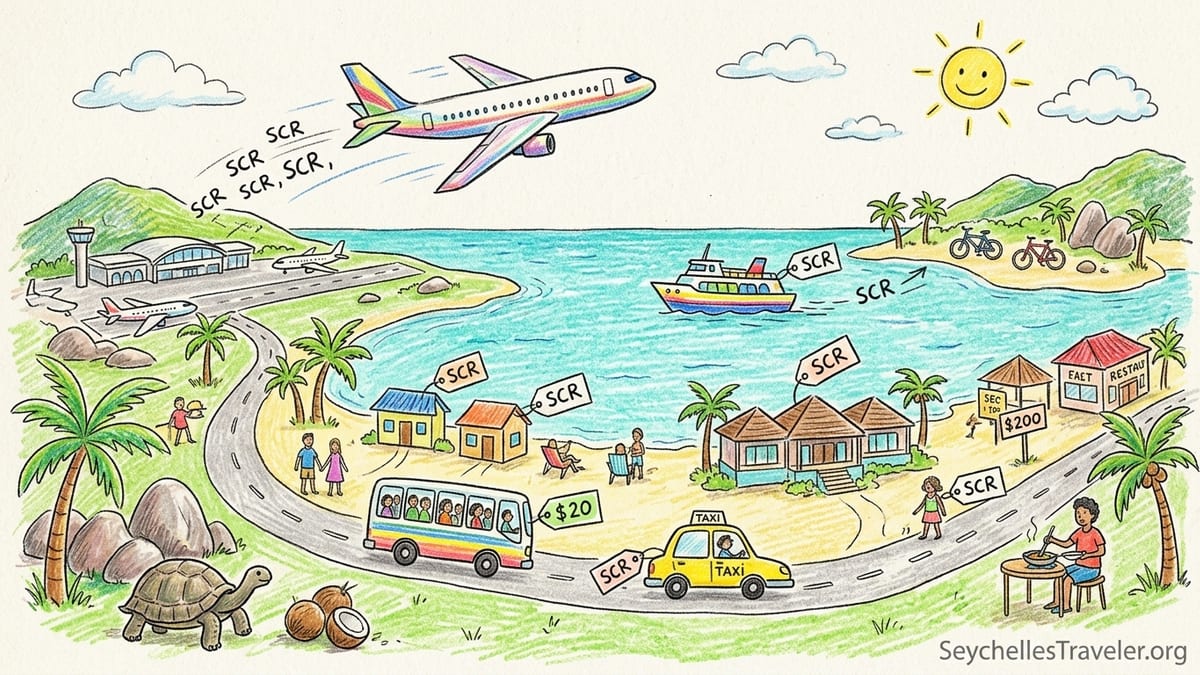
What I Paid To Reach Seychelles
I started tracking costs before I ever saw a palm tree. From Europe in March 2025, my return economy flight to Mahé cost just under 900 euros on a major Gulf carrier, booked about three months in advance with one connection. Checking prices again in October 2026 for similar dates, I consistently see return fares from major European hubs to Mahé between 750 and 1,200 euros in standard economy, with North American departures often running from 1,200 to 1,800 US dollars depending on season and airline. In other words, getting to Seychelles is likely to be your single biggest individual cost line.
On arrival at Seychelles International Airport on Mahé, there was no separate tourism entry fee to pay at the border, only the usual immigration process. The main pre-arrival requirement is now the Seychelles Electronic Border System form, which replaced the old travel authorisation. When I travelled in late 2025, I completed it online before departure at no extra charge beyond my airline ticket. You still need proof of onward travel and accommodation plus basic health insurance, but there is currently no per-night tourist tax collected at the airport. Any environmental or tourism levies are embedded later in hotel bills or local charges.
From the airport into Victoria and the main hotel areas, the first price shock is ground transport. A standard taxi from the airport to Beau Vallon beach in March 2025 cost me 500 Seychelles rupees (SCR) for around 25 minutes, quoted in advance by the driver. When I cross-checked with other travelers on Mahé in mid 2026, most reported airport transfers in the 400 to 600 SCR range for similar distances, with late-night or heavy-luggage rides sometimes a little more. There is a public bus stop near the airport on the main road, and the bus fare for non-card users is officially 12 SCR per ride for adults, but that requires a short walk with luggage and does not run on a custom schedule.
That first taxi set the tone: Seychelles rewards anyone willing to use buses and self-catering, and penalises every private transfer and on-resort indulgence.
Island Hopping: Ferries, Flights And The Hidden Cost Of Moving Too Much
Island hopping in Seychelles is seductive on paper. Mahé, Praslin and La Digue all look close on the map, yet the transfers add up quickly. My main inter-island moves in 2025 were Mahé to Praslin, Praslin to La Digue, and La Digue back to Mahé, all by high-speed ferry. Between 2025 and 2026, adult one-way tickets on the Mahé–Praslin Cat Cocos ferry have typically ranged from roughly 60 to 75 euros equivalent per person in economy, depending on date and availability. When I priced my March 2025 crossing about six weeks ahead, I paid just under 70 euros one way Mahé to Praslin in standard economy including luggage. A fellow traveler I met on Mahé in March 2026 showed me a receipt for 2,500 SCR for a return Mahé–Praslin business class ticket bought directly, which lined up with online quotes at the time.
From Praslin to La Digue, the crossing is shorter but still not cheap. In November 2025 I paid the rupee equivalent of about 18 to 20 euros each way on the Cat Rose ferry, booked locally a couple of days in advance. Prices I checked again in late 2026 for the same route fell mostly in the 20 to 30 euro band for a one-way adult ticket. For a couple moving Mahé–Praslin–La Digue–Mahé within a week, it is very easy to spend the equivalent of 350 to 450 euros just on ferries.
I also priced domestic flights as a comparison. Mahé to Praslin flights with the national carrier usually price out similar to or slightly higher than the ferry when baggage is included, often between 70 and 120 euros per person one way for dates I checked in 2025 and 2026. The upside is a 15-minute flight instead of a one-hour sea crossing, but the downside is fixed schedules and potential baggage caps. In the end, I flew one way in 2025 for about 95 euros and took ferries the rest of the time.
This is where Seychelles surprised me. I had built a budget based on hotel and food prices, and I underestimated ferry and flight costs. Changing islands three or four times in ten days added several hundred euros to my total. When I ran the numbers later, a slower itinerary with two islands instead of three would have saved me a full travel day and at least 200 to 300 euros in transport for two people, without reducing time on beaches or trails.
Sleeping On Mahé, Praslin And La Digue: Hotels Versus Self-Catering
Accommodation varies far more by island and style than by star rating. In May 2025 on Mahé I stayed in a small self-catering apartment near Beau Vallon, booked directly with the owner. The nightly rate for two people was 1,400 SCR without breakfast. In October 2025, when I checked again for high season dates, similar guesthouses in the same area were consistently quoting between 1,300 and 1,800 SCR per night for a studio or small apartment with kitchenette, while larger branded resorts along the same beach easily ran from 4,000 to over 8,000 SCR per night for a double room including breakfast and taxes.
On Praslin in March 2025, I paid 1,600 SCR per night for a self-catering chalet near Cote d’Or beach, again through a local owner. For comparison, I visited friends at a mid-range resort close by whose double room rate for the same week was 4,500 SCR per night including breakfast. We compared bills at check-out: across five nights, my accommodation spend was 8,000 SCR, while theirs came out near 22,500 SCR for the same number of nights in a slightly nicer setting but without a kitchen. Neither rate was promotional; both aligned with what several other properties were charging that month.
La Digue sits in the middle. In November 2025, I paid 1,800 SCR per night for a guesthouse room with a small shared kitchen near La Passe. Rates I checked in mid 2026 for similar rooms on La Digue fell mostly between 1,700 and 2,300 SCR per night, with high-end boutique hotels such as those fronting Anse Source d’Argent’s access points often quoting from 5,000 SCR per night upward. The key saving on La Digue was not just the cheaper rooms compared with top-end Mahé resorts, but also how easy it was to self-cater and cycle everywhere, which cut both food and transport costs.
One unexpected expense bump came from changing hotels too often. Each time I moved properties on the same island, I either paid for a taxi transfer or lost half a day around check-out and check-in. On Mahé in 2025 I shifted from Beau Vallon to the south coast mid-trip. The taxi between the two areas cost 600 SCR, and I effectively lost a beach afternoon waiting for the new room. In hindsight, staying put in a single base on each island, even if that base cost a little more per night, would have reduced total costs and improved the experience.
Eating And Drinking: Self-Catering Versus Resort Restaurants
Food prices were where self-catering made the clearest difference. On Mahé in March 2025, a simple dinner for two at a beachfront hotel restaurant in Beau Vallon cost me just under 1,000 SCR without alcohol: one grilled fish main, one chicken curry, two soft drinks and service. I repeated a similar meal at another resort a few nights later and the bill again came close to 900 SCR for two. Moving to Praslin, a comparable resort restaurant on Cote d’Or charged 450 to 600 SCR for most mains in April 2025, so a basic two-course dinner with a drink for two would rarely come in under 1,200 SCR.
By contrast, when I used the kitchen in my self-catering apartment on Mahé, a grocery run in March 2025 at a well-stocked supermarket near Beau Vallon bought me breakfast and two simple dinners for two for roughly 600 to 700 SCR total. Prices at that time included around 50 to 70 SCR for a local loaf of bread, 35 to 50 SCR for a litre of UHT milk, 60 to 90 SCR for a dozen eggs, and 40 to 60 SCR for a large bunch of bananas. Imported cheese, cold cuts and European brand cereals were noticeably more expensive, but local tuna, rice, lentils and seasonal vegetables were reasonably priced. On La Digue, smaller shops had slightly higher sticker prices and a more limited range, but I was still able to put together breakfast and picnic lunches for two for around 150 to 200 SCR per day in November 2025.
Takeaway and casual creole food sat nicely between these extremes. In Victoria in 2025, I paid 80 to 120 SCR for generous takeaway curry or grilled fish portions packaged in containers, enough for one hungry person per box. On Praslin, small snack bars near the beach sold plates of grilled fish or chicken with rice and salad for 150 to 200 SCR. On La Digue, several roadside grills offered plates in a similar range. Where my resort dinners for two had averaged around 900 to 1,200 SCR without alcohol, my casual lunches and self-catered dinners brought the daily food cost closer to 400 to 600 SCR for two when I paid attention.
Alcohol amplified every bill. A local Seybrew beer in a supermarket typically cost me 35 to 45 SCR in 2025, while the same bottle in a hotel bar ran between 80 and 120 SCR. Imported wine in restaurants started at around 400 SCR for the cheapest bottle and climbed very quickly. It is entirely possible to keep Seychelles relatively affordable by cooking simple meals, buying local snacks and limiting drinks to supermarket purchases on your terrace, but the moment you slide into a pattern of daily resort dinners and sunset cocktails, the food and drink line can easily become your second biggest expense after flights.
Getting Around: Buses, Taxis, Rental Cars And Bicycles
Transport within each island turned out to be just as important to the budget as inter-island ferries. On Mahé, I split my days between buses, taxis and a short car rental. The public bus network is extensive and remarkably affordable: the official single fare has been set at around 12 SCR for non-card users in recent years, the same on weekdays, Sundays and public holidays. In practice in 2025, I paid 12 SCR in cash for each ride. This meant I could cross half the island for the cost of a bottle of water, at the price of sharing space and accepting slower travel times.
Taxis, on the other hand, were where money quietly leaked away. Short hops around Victoria or Beau Vallon in March 2025 usually cost me 150 to 250 SCR. The ride from Beau Vallon to the airport when I left, about 30 minutes with light traffic, came in at 500 SCR. There are no ride-hailing apps in regular use, so haggling a rough price before you get in is essential. On Praslin, single taxi rides from Cote d’Or to the jetty in April 2025 cost me 200 to 250 SCR, and a half-day hire to explore multiple beaches was quoted at 800 to 1,000 SCR.
Car rental proved better value than I expected if shared. On Mahé in May 2025, I paid 800 SCR per day for a small automatic car booked through a local agency including basic insurance, with fuel on top. I drove roughly 120 kilometres in one day of heavy sightseeing and topped up the tank for just under 200 SCR. Talking with other travelers in 2026, most were paying between 800 and 1,000 SCR per day for compact cars on Mahé and Praslin, sometimes slightly less with multi-day discounts. For two or three people, that often works out cheaper than a couple of taxi rides, and far more flexible.
La Digue is a different transport universe. Private cars are heavily restricted, and the primary way to move is still the bicycle. Current public information from local hire shops and tourism listings in 2025 and 2026 places standard bicycle rental around 150 SCR per day for a one-day hire, dropping to about 100 SCR per day if you rent for several days in a row. One operator that I used on La Digue in November 2025 charged me 10 euros per day, which at the time converted to around 150 SCR, for a simple pedal bike with a basket and lights, with a small discount when I extended by a day. Online rate sheets I checked again in September 2026 still show 150 SCR per day as a typical one-day adult bike price, with lower per-day prices for longer rentals.
The savings from bicycles on La Digue were real and immediate. Over three days I spent roughly 450 SCR on bike hire and nothing on taxis, because I did not need any. For comparison, a single short taxi ride on Mahé could run half that amount. Several travelers I met who did not cycle or could not ride ended up paying for electric buggies or more frequent transfers, which bumped up their daily costs significantly. On La Digue, knowing how to ride a bike is almost as good as a discount card.
Beaches, Parks, Boats And Underwater Costs
Many of Seychelles’ beaches are free at the point of entry, but some of the best-known spots and marine areas carry specific fees. Protected-area and park charges are one of the few elements in Seychelles where clear official prices exist. As of late 2026, the Seychelles Parks and Gardens Authority lists entry fees for marine parks and some terrestrial sites for non-residents over 12 years old. Current published rates include 300 SCR per adult for Curieuse Marine Park, 200 SCR for Ste Anne Marine National Park, and 200 SCR for the Baie Ternay and Port Launay marine parks. Other SPGA sites such as the Veuve Reserve on La Digue are listed at 150 SCR for unguided visits and 200 SCR for guided tours for non-citizens, while the Botanical Garden on Mahé carries an entrance fee of 250 SCR per adult.
In practical terms, I saw these fees most clearly on my Curieuse day trip from Praslin in April 2025. I booked a mixed small-group excursion that included hotel pickup, snorkelling at St Pierre islet, a barbecue lunch on Curieuse, free time to see the giant tortoises and a hike across the island. The package price was roughly 1,600 SCR per person, and the 300 SCR Curieuse park fee was listed separately as an additional mandatory payment. When I priced similar tours again in 2026 for high season, most Curieuse plus St Pierre excursions from Praslin fell between about 1,600 and 2,000 SCR per adult, with the 300 SCR park fee still separate or explicitly itemised within the total.
Marine park day trips around Mahé showed a similar pattern. A half-day glass-bottom boat and snorkelling tour into Ste Anne Marine National Park in March 2025 cost me about 1,400 SCR per person including basic equipment. The 200 SCR Ste Anne park fee was charged on top and passed through to the park authority. When I later looked at bare park entry rates in official documents and yachting guides in 2026, Ste Anne, Baie Ternay and similar marine parks consistently listed a 200 SCR landing or entry fee per non-resident adult per visit, which matched my on-the-ground payments.
Scuba diving added another tier of expense. In 2025 on Mahé, a two-tank boat dive with local operators was typically priced between 2,000 and 2,400 SCR per diver including gear, based on quotes I collected while wandering around Beau Vallon. Introductory dives for beginners were usually a little more, while multi-dive packages added small discounts. On La Digue and Praslin, I received quotes in a similar band later that year. Compared with free snorkelling off the beach, which required only a mask set I brought from home, the cost difference was striking: two days of diving could easily match or exceed a week of grocery-based meals for two people.
The surprise here was not that protected areas had fees, but how often they appeared inside otherwise reasonably priced boat tours. It is easy for a couple to book two or three day trips during a one-week stay and add 6,000 to 8,000 SCR to the budget just in excursions and park charges, even before adding any diving. The only way I kept this corner under control was by choosing one premium day trip per island and doing the rest of my snorkelling directly from shore.
Real Daily Costs On Each Island
Putting my receipts together, my real-world daily spending looked very different depending on island, style and how many paid activities I crammed in. On Mahé in March 2025, sharing a self-catering apartment with one other person at 1,400 SCR per night, using buses most days and cooking many meals, our average daily spend per person came in around 900 to 1,100 SCR. That figure folded in accommodation, groceries, occasional restaurant meals, one or two taxis and a handful of low-cost activities. The one day I added a Ste Anne marine park boat trip, my personal total for that day jumped closer to 2,400 SCR including the tour, lunch, and bus fares.
On Praslin in April 2025, daily costs skewed higher for two reasons: more taxis and more excursions. With a 1,600 SCR self-catering chalet split between two people, some restaurant dinners along Cote d’Or and the Curieuse plus St Pierre day trip, my per-person daily average across four nights ended up around 1,500 SCR. The Curieuse day alone pushed my individual total that day near 2,800 SCR once I counted the park fee, snorkeling, tips and a post-trip dinner on the beach.
La Digue was my most affordable stop relative to enjoyment. In November 2025, with a 1,800 SCR guesthouse room shared, a simple bicycle rented at about 150 SCR per day, almost all meals self-catered or taken in small creole takeaways, and only one paid entry to the L’Union Estate area for access to Anse Source d’Argent, I averaged around 900 to 1,000 SCR per person per day across three nights. Most of that total went on the room, food and bike hire. I did not dive on La Digue and used no motorised transport, which kept the numbers low.
None of these figures include international flights, travel insurance or big one-off purchases like new snorkel gear at the airport. They are simply what I saw flowing out of my wallet once I was on the islands. The same destinations could easily have cost double if I had chosen resort hotels, private taxis everywhere and multiple boat days, or half as much if I had stayed even longer in a single self-catering base and skipped most organised excursions.
The Decisions That Make Seychelles Expensive Or Affordable
After two trips, I stopped trying to reduce everything to a universal “Seychelles costs X per day” number. What actually drives the total is a mix of choices in five areas: how often you move islands, whether you stay in self-catering or resorts, how you get around on land, how frequently you eat in hotel restaurants and how many boat-based days you buy.
Island choice and frequency of transfers matter first. A ten-night trip split across Mahé, Praslin and La Digue with three ferry legs is almost guaranteed to involve at least 7,000 to 9,000 SCR in inter-island transport for two people. If you limit yourself to one change, for example five nights on Mahé and five on La Digue, you still see variety but cut the transfer budget and the hassle in half. Each extra hotel change within an island tends to add a taxi fare and a little wasted time, which you could otherwise spend sitting on a free beach.
Accommodation style is the second big lever. On every island I visited between 2025 and 2026, I found clean, friendly self-catering studios in the 1,300 to 1,800 SCR per night range for two people, and mid-range resort rooms on the same coastline in the 4,000 to 6,000 SCR band. Luxury properties soared higher. Over a week, that difference produces an extra 20,000 to 30,000 SCR outlay with no savings elsewhere unless you consider resort breakfasts a substantial offset. Choosing one or two nights in a special-occasion resort at the end of your trip and keeping the rest in self-catering is one compromise that several travellers I met used successfully.
Transport mode and meals are where the genuine savings hide. On Mahé and Praslin, using the public bus for sightseeing days and saving taxis for early flights or late dinners can easily shave several hundred rupees off a day. On La Digue, the bicycle is the default budget hero; 150 SCR for a full day of mobility under your own steam is difficult to beat. Self-catering breakfast and some dinners, backed up with takeaway lunches and local snacks, makes the difference between a 400 SCR food day and a 1,500 SCR one without feeling deprived. Drinking supermarket beer on your veranda rather than ordering rounds at a hotel bar has a similar effect.
Lastly, boat activities and marine parks are the high-impact extras. A single signature excursion to Curieuse, Ste Anne or a full-day island-hopping cruise is usually worth the money for what you see underwater and on remote beaches, especially once you understand that 200 to 300 SCR of the price supports park management. But treating every day like an excursion day can double your on-island budget. On my second trip in late 2025, I consciously limited myself to one premium boat or dive day per island and spent the remaining days snorkelling off public beaches and hiking SPGA trails, some of which carry modest fees of 100 to 250 SCR but no boat costs. The result was a richer overall experience and a more controlled final bill.
FAQ
Q1. How much should I budget per day in Seychelles if I stay in self-catering places?
For a couple in self-catering studios using buses, bicycles on La Digue, cooking some meals and booking only one or two boat trips, a realistic on-island budget often falls somewhere around 900 to 1,500 SCR per person per day, excluding international flights. This allows basic comfort, occasional restaurant meals and a small number of paid activities.
Q2. Why do island transfers in Seychelles feel so expensive?
High-speed ferries and domestic flights serve relatively small passenger numbers across open ocean, which keeps costs elevated. On main routes like Mahé to Praslin, one-way adult ferry tickets frequently run in the equivalent of 60 to 75 euros, and shorter hops between Praslin and La Digue also add up. If you change islands several times in a short trip, these fares quickly become a major budget item.
Q3. Are buses in Seychelles a practical way to save money?
Yes, on Mahé and Praslin the public buses are cheap and cover most populated areas. A single adult fare for non-card users has been around 12 SCR per ride in recent years, which is a fraction of a taxi cost. The trade-offs are slower journeys, crowded buses at peak times and limited luggage space, but for most sightseeing they are very cost-effective.
Q4. How much does it cost to rent a bicycle on La Digue?
Standard adult bicycles on La Digue usually cost about 150 SCR per day for a one-day hire, with some shops offering lower per-day rates around 100 SCR if you rent for several days. This single daily fee often replaces almost all other land transport costs on the island and is one of the most effective savings you can make.
Q5. What are the current park and marine reserve fees for visitors?
As of late 2026, non-resident adults typically pay 300 SCR for Curieuse Marine Park and 200 SCR for Ste Anne, Baie Ternay and similar marine national parks per visit. Other sites such as the Veuve Reserve on La Digue, certain official hiking trails and the Botanical Garden on Mahé also charge entrance fees in the 100 to 250 SCR range. These charges are usually collected by tour operators or at entry points.
Q6. Is scuba diving in Seychelles worth the extra cost?
If you enjoy being underwater, many visitors find Seychelles diving worth the spend, but it is not cheap. Two-tank boat dives with equipment commonly cost between 2,000 and 2,400 SCR per diver. Doing just one or two dive days keeps the overall budget manageable, while heavy diving schedules can rival your accommodation costs.
Q7. Can I keep costs down by visiting only one island?
Staying on a single island, especially Mahé or Praslin, reduces ferry or flight expenses and avoids repeated hotel check-in days. Many travellers happily base themselves on Mahé for a week, using buses or a rental car to explore different beaches and viewpoints. You miss La Digue’s particular charm, but you gain simplicity and save several thousand rupees.
Q8. Are resort restaurants really that much more expensive than local options?
In practice, yes. In recent years, resort dinners for two on popular beaches have often cost around 900 to 1,200 SCR or more without alcohol, while local takeaways and small creole eateries can feed two people for 200 to 400 SCR. Using your kitchenette for breakfast and some dinners, then choosing small local spots for other meals, dramatically reduces daily food spending.
Q9. When do costs in Seychelles tend to spike unexpectedly?
The most common surprises come from underestimating ferry and taxi prices, booking multiple boat tours in a short stay, eating most meals in hotel restaurants and changing hotels or islands too often. Each decision feels minor, but together they can push a planned moderate-budget trip into a high-spend holiday.
Q10. What is the single best way to make a Seychelles trip more affordable without feeling deprived?
The most powerful combination is to stay longer on fewer islands in self-catering accommodation, rely on buses and bicycles where practical, cook some meals and limit yourself to a small number of carefully chosen boat or dive days. This approach preserves the core Seychelles experience of beaches, granite boulders and clear water while keeping your spending under far better control.