


I arrived in Seychelles with a familiar problem: too many beautiful islands and not enough nights. Instead of trying to tick them all off, I focused on staying long enough in a few key places to understand what kind of holiday each island really delivers. After several trips that added up to 5 nights on Mahé, 4 on Praslin, 3 on La Digue and 2 on a smaller private-island resort, I came away with a clear sense that these islands are not interchangeable. The official tourism brochures describe distinct characters for Mahé, Praslin and La Digue, and on the ground those differences feel even stronger in real life.
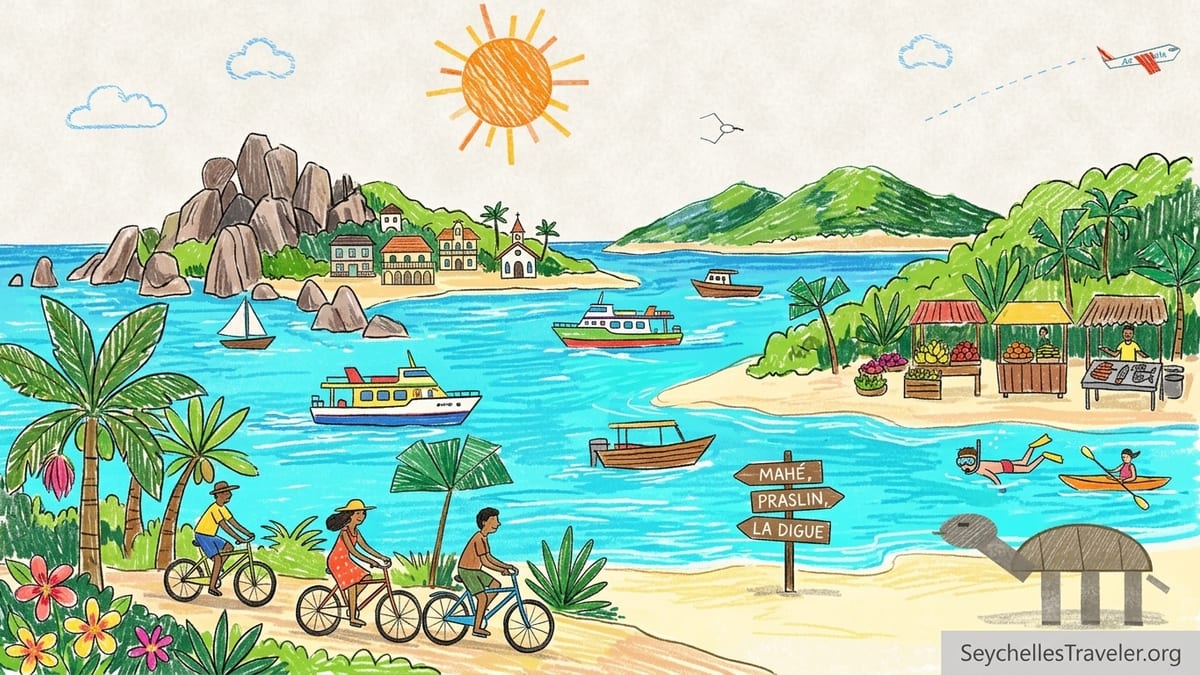
How I Planned My Seychelles Island Hopping
On my first trip I made the classic mistake of wanting to see everything. Seychelles has over 100 islands, but almost every first-time visitor is really choosing between Mahé, Praslin, La Digue and perhaps one smaller private island reached by boat or short flight. The national tourism maps and planning documents treat these three main islands as separate destinations rather than just different hotel zones, and that is exactly how they felt once I arrived.
To avoid turning the holiday into a ferry timetable, I split my time roughly as 5 nights on Mahé, 4 on Praslin, 3 on La Digue and later added 2 nights on a private-island resort. That gave me enough evenings and unplanned afternoons to judge what it is actually like to stay, not just to visit for a few hours. I used the regular Cat Cocos ferries between Mahé and Praslin and Cat Rose between Praslin and La Digue, which usually run at least twice a day in each direction and take about one hour and fifteen minutes respectively. Booking a few weeks ahead kept prices around the equivalent of 50 to 70 euros per person one way in economy on the longer Mahé to Praslin leg, with cheaper, shorter hops between Praslin and La Digue.
For each island, I paid attention to things you only really notice after a couple of nights. How easy was it to get from the jetty or airport to my guesthouse. How far I had to walk for a decent takeaway curry or a sunset drink. Whether I needed a car or a bicycle. How safe it felt returning on foot in the dark. What I actually ended up spending on dinner, drinks and day trips, not just what blogs had promised. By the end I realised that Seychelles is less about finding a single perfect island and more about matching a particular island to the kind of trip you want.
The impressions below are not a complete list of every island, but a personal account of the ones where I slept, swam, waited for the rain to pass and queued for ferries with sandy feet. Your budget and priorities might be different, but the contrasts between Mahé, Praslin, La Digue and a small resort island are likely to feel similar.
Mahé: Variety, Hiking and Real-Life Seychelles
Across two visits I spent a total of 5 nights on Mahé, all on the northern and central parts of the island. That felt about right to get a feel for the capital, the beach scene and the interior mountains. Mahé is the biggest island and home to the international airport, and it genuinely feels like a small country rather than a resort. The colonial-era streets of Victoria, the market, the harbour, schoolchildren in uniform and office workers on lunch break all remind you that Seychelles is a living place, not just a string of beach villas.
Arriving was straightforward. I landed at Seychelles International Airport in the afternoon and was at my guesthouse on Beau Vallon beach in about 25 minutes by taxi. Official figures show hundreds of taxis operating on Mahé, and it certainly felt that way outside the terminal and in Victoria. I paid roughly 400 to 500 Seychelles rupees for that first ride, which is similar to what many visitors report. On later days I used the public buses, which cost only a few rupees per journey but are not air-conditioned and can be crowded. For two people wanting flexibility, renting a small car made sense; daily rates started around the equivalent of 40 to 50 euros when booked in advance, and driving was manageable with basic mountain-road confidence.
Mahé delivered the most varied holiday of all the islands I stayed on. In the same day I could hike a shaded trail in Morne Seychellois National Park in the morning, have grilled fish at a roadside takeaway for around 75 to 100 rupees at lunch, then watch the sunset at Beau Vallon or Anse Royale before dinner. Restaurants ranged from simple takeaways and beach shacks to hotel dining rooms that easily charged 60 to 80 euros for two with drinks. The official cost-of-living data for Mahé suggests around 250 rupees for a basic sit-down meal and more for mid-range, and that lined up quite well with what I paid.
The beaches on Mahé are not always the postcard-perfect granite fantasies, but when they are, they are spectacular. Anse Intendance and Anse Louis felt wild and dramatic, with strong waves and steeper drops, better for experienced swimmers and photo lovers than toddlers. Beau Vallon is broader, more sheltered and lined with small hotels and snack stalls, so it suited sunset swims and casual social evenings. The downside is that Mahé can feel spread out; unless you choose to stay in a compact area like Beau Vallon or central Victoria, having a car makes a big difference to how much you can explore in a few days.
In the evenings, Mahé had the liveliest atmosphere of the islands I stayed on, but it never became a party destination. Beau Vallon had beach bars playing soft music, a weekly evening food market with fresh fish, curries and local desserts, and a mix of tourists and Seychellois families. Victoria had a few casual bars and restaurants where the day’s humidity seemed to melt into cold SeyBrew beers. The trade-off was cost. Mahé felt slightly cheaper than the smaller islands when it came to groceries and takeaways, but hotel bars and smart restaurants easily matched big European-city prices. For a one-island Seychelles trip, though, Mahé is the most practical all-rounder.
Praslin: Beaches, Nature and an Easy Island-Hopping Base
On Praslin I stayed 4 nights in two different areas: one near Cote d’Or on the north coast and another night closer to Grand Anse on the west. That felt like a very comfortable amount of time. Praslin is often described by tourism planners as a focal point for visitor activity in the inner islands, and on the ground it absolutely works as a base. The island is big enough to have different corners, but small enough that you can reach almost anywhere by car within half an hour or so.
Getting to Praslin involved an hour-long Cat Cocos ferry across open water from Mahé. On a calm day it was enjoyable, with views of other inner islands on the horizon. On a windy day I saw more than a few passengers gripping sick bags, so anyone prone to seasickness might prefer to book the short Air Seychelles flight, which usually takes around 15 minutes. The ferry terminal on Praslin is small and friendly, with taxis waiting outside and a modest cluster of shops and snack stalls. I paid around 300 to 400 rupees for a taxi to Cote d’Or, but quickly realised that for more than a couple of days, renting a car again was the most efficient option.
Praslin’s beaches were the ones that made me stop and say, “This is exactly the picture I had of Seychelles.” Anse Lazio on the northwest coast, with its clear water, soft sand and polished boulders, is often called one of the world’s best beaches, and it lived up to the reputation when I visited early in the morning before day-trippers arrived. There were two small restaurants behind the trees, both charging roughly the equivalent of 15 to 25 euros for a main course, which felt reasonable given the location and the lack of other choices. At Cote d’Or, the long sheltered bay offered gentler waves and a sprinkling of dive centres, boat-trip operators and guesthouses, which made it an easy everyday base.
Praslin also delivered the densest nature experience of my trip without requiring hardcore hiking. Vallée de Mai, a UNESCO-listed palm forest in the centre, was an easy half-day trip. I followed the marked trails under the canopy of coco de mer palms and listened to guides explaining the unusual seeds and endemic birds. The entrance fee for foreign visitors ran to the equivalent of a few dozen euros, but it felt like money well spent to support the park. For anyone who likes nature but does not want to scramble up steep peaks in tropical heat, Praslin strikes a good balance.
The downside of Praslin at night was its slightly muted atmosphere. Cote d’Or had a handful of good restaurants and takeaways, where a takeaway curry or grilled fish might cost 100 to 150 rupees and a restaurant meal for two with drinks easily reached 70 to 100 euros. After dinner, though, there was not much to do beyond a stroll on the sand or a drink at a hotel bar. If you want nightlife or even a choice of three or four bars in one street, you will not find it here. What you do get, though, is convenience for island hopping: regular boats to La Digue, organised trips to Curieuse Island to see giant tortoises and snorkel, and excursions that combine Cousin, Curieuse and St Pierre for a day of wildlife and reefs. For travellers keen to sample several smaller islands without packing and unpacking constantly, basing yourself on Praslin for four or five nights makes a lot of sense.
La Digue: Bicycles, Slow Afternoons and Granite Dreams
La Digue is where I exhaled. I spent 3 nights here, which was enough to try different beaches and lose track of my watch, but I could easily have stayed a week. There is no airport, so almost everyone arrives by the 15-minute ferry from Praslin. When I walked off the boat I found no line of rental cars, just bicycle-hire stalls and a few ox carts. Official statistics show that almost no taxis operate here, which matched my impression that La Digue is designed for feet and pedals rather than engines.
My guesthouse was a flat ten-minute walk from the jetty, so I did not bother with a transfer, but I rented a bicycle within an hour of arriving. Prices hovered around the equivalent of 8 to 12 euros per day, with discounts for several days at once. The small road along the coast linked the main village cluster to beaches like Anse Source d’Argent in one direction and the more rugged Grand Anse in the other. Hills were modest but the humidity meant that I appreciated the slower pace; nothing on La Digue feels more than a leisurely ride away, but you arrive with damp clothes and salty skin rather than an air-conditioned chill.
In terms of beaches, La Digue delivered perhaps the most photogenic views of my trip. Anse Source d’Argent, accessible through the grounds of L’Union Estate, framed every classic Seychelles element in one place: clear shallow lagoon, leaning palms, pale sand and smooth grey boulders that looked carved by a sculptor. There is a small entrance fee to reach it via the estate, which also supports the maintenance of historic buildings and tortoise enclosures inside. On the other side of the island, Grand Anse, Petite Anse and Anse Cocos demanded a bit more pedalling and hiking and were wilder, with stronger surf and fewer services. I packed my own water and snacks for those days, as there were only one or two small beach bars at Grand Anse and nothing at all at Anse Cocos when I visited.
The trade-off came with restaurant choice and evening life. Around the jetty there were several guesthouse restaurants and a couple of atmospheric places like simple creole grills and pizzerias. A satisfying plate of fish curry or octopus in coconut sauce cost around 75 to 150 rupees at very simple places, while more polished venues charged closer to 80 to 100 euros for two people with drinks. There was one small takeaway that became my lunch favourite, but by the third night I realised I was rotating through the same few options. After dark, the island felt incredibly safe but very quiet. Most people strolled, ordered one more drink, then went to bed early for dawn swims or bike rides.
La Digue also felt slightly more expensive overall than Mahé, especially once I factored in the higher proportion of my meals taken in hotel restaurants rather than cheap takeaways. Groceries in the small shops cost more and had less variety. That said, the payoff in ambience was huge. If your idea of a holiday is cycling past vanilla vines, parking your bike in the shade of a palm and spending an hour staring at granite boulders and shifting light on the lagoon, La Digue is hard to beat. Just do not come expecting shopping, nightlife or a different restaurant every night for a fortnight.
Smaller Islands: Wildlife, Snorkeling and Seclusion
After experiencing the three main islands I added 2 nights on a smaller private-island resort, reached by a short boat transfer from Praslin. I am deliberately not naming the specific property, as policies, operators and branding change frequently, but the overall feel is similar to a handful of private islands scattered among the Inner Islands that are promoted by the tourism authorities as luxury hideaways. In my case the boat ride took about 20 minutes across calm water, and check-in happened on the open-air jetty with a cool towel and a fruit juice.
The first and most obvious difference was space. Where Mahé and Praslin have busy public beaches, this island had just one resort occupying the entire shoreline. My villa opened directly onto the sand, and I could walk for ten minutes without seeing anyone but a gardener or another guest. The price reflected that privacy. My two-night stay, even with a low-season discount, cost more per night than a full week in a self-catering apartment on Mahé. Meals were either included in a half-board package or charged at rates closer to top-end European hotels, with a simple fish main course easily priced at 40 to 50 euros.
What I really gained here was immediate access to wildlife and snorkeling. The island sat inside a marine protected area, which meant that within a few fin kicks from shore I was drifting over coral heads with angelfish, parrotfish and the occasional reef shark. Kayaks and snorkel gear were usually included in the room rate, and one guided trip to a nearby sandbank with a picnic felt like a highlight of the entire itinerary. On land, giant tortoises wandered the interior and could be visited on short, easy walks. Compared with Vallée de Mai or Morne Seychellois, there was no need to drive, book tours or check bus timetables.
The downsides of this kind of small island are predictable but real. I was completely tied to the resort for food and drink, so there were no cheap takeaways or small grocery shops to trim the budget. Evening atmosphere was limited to the resort bar and perhaps some quiet live music, with most guests in bed early. There was also no chance to interact with Seychellois daily life beyond the staff. Where Mahé’s public buses and Praslin’s local shops gave me a sense of the country, the private island existed almost entirely within the tourism economy. For a short stay focused on snorkeling, honeymoon privacy or a digital detox, it was wonderful, but I would not send a curious first-time visitor here for their entire trip.
In practical terms, I was glad I added this experience after, not before, the larger islands. Two nights felt just right: enough time to settle in, explore the reef, laze under takamaka trees and then leave before the limited dining options and high drink prices began to grate. If you are splitting a honeymoon or special-occasion trip between islands, one compact private island section paired with time on at least one of the main islands gives you the best of both worlds.
Costs, Transport and How Long to Stay on Each Island
Across all the islands, what surprised me most was how consistently high restaurant prices felt once I left basic takeaways behind. Locals and recent visitors report that a simple takeaway meal of rice, curry or grilled fish often costs between 75 and 150 rupees, which matched what I saw on Mahé and La Digue. Sit-down restaurant dinners, especially those connected to hotels, could easily reach 30 euros per person on Mahé and Praslin and 40 to 50 euros or more on La Digue and private islands. With cocktails typically priced in the 10-euro range and fresh juices only slightly less, drinks added up fast.
Transport choices shaped both my budget and how each island felt. On Mahé, I tried all three main options: bus, taxi and rental car. Buses cost very little and run across much of the island, but routes can be confusing to newcomers and schedules are not designed around beach-hopping tourists. Taxis offered comfort but at a price, with cross-island journeys often running into several hundred rupees. Hiring a car gave me independence to chase clear skies and sunset spots, and parking was usually straightforward outside the most popular beaches. On Praslin, having a car mattered even more, because many of the loveliest beaches and trailheads sit away from the denser accommodation clusters. On La Digue, the bicycle genuinely is king; a car would have been pointless and felt out of place.
The ferries themselves became part of the routine. Cat Cocos between Mahé and Praslin took around an hour and ran at least twice daily in both directions when I checked the latest schedules, with some days seeing three sailings. Those prone to seasickness should time their journeys for mornings and avoid the windiest monsoon months if possible. The Cat Rose ferry between Praslin and La Digue was much shorter at around 15 minutes, but I still booked ahead because popular times and holiday periods can fill up. One practical tip is to factor travel days into your island-night calculations; what looks like 3 nights on Praslin can feel like only 2 full days once you account for ferry crossings and packing.
Thinking back, the minimum stays that make sense for most travellers, based on my time, would be at least 3 nights on Mahé, 3 to 4 on Praslin, 2 to 3 on La Digue and 2 on any small private island. Less than that and you risk spending too much of your holiday sitting on ferries or repacking suitcases. More than that and you can start to sink properly into the rhythm of each place, whether that means catching the same bus driver’s smile each morning on Mahé or recognising the same stray dogs lazing near your La Digue bicycle rack.
The Takeaway: Matching Islands to Different Types of Traveller
After staying on Mahé, Praslin, La Digue and a smaller private island, I stopped thinking in terms of “Which is the best island?” and started thinking in terms of “Best for what, and for whom?” Seychelles tourism planners emphasise that the three main islands play different roles, and from a traveller’s point of view that is the strength of the destination. You can design a holiday that feels completely different simply by adjusting how many nights you allocate to each island.
For honeymooners, I would lean towards a split between Praslin or La Digue and a small private island. Four or five nights on Praslin or La Digue gives you astonishing beaches, gentle days out to Curieuse or nearby reefs, and just enough restaurant choice to keep evenings interesting. Add two or three nights on a private island for focused seclusion, barefoot dinners and easy snorkeling, accepting the higher cost in exchange for privacy. Mahé can work for honeymooners who like a bit more life and variety, especially around Beau Vallon, but it does not deliver quite the same cocooned feeling of escape.
Families, especially those with younger children, might feel most comfortable basing themselves on Mahé with perhaps a side trip to Praslin. Mahé offers the widest range of supermarkets, pharmacies and medical facilities, as well as flatter, safer swimming areas at Beau Vallon and some southern beaches on calm days. Renting a car and returning to the same apartment or hotel each night is simpler than moving luggage on and off ferries with tired children. Praslin can be added for its manageable size and family-friendly outings to Vallée de Mai or Curieuse, but La Digue’s bicycle focus and steep, wilder waves at some beaches may require more planning with kids.
Beach-first travellers who picture spending most of their time in the water or under a palm tree should prioritise Praslin and La Digue. Praslin’s Anse Lazio and Anse Georgette, coupled with Cote d’Or’s everyday convenience, give a strong mix of wow-factor scenery and practicality. La Digue delivers the iconic boulders and shallow lagoons that fill Seychelles calendars, but with fewer alternate dining options if the weather turns. Mahé certainly has beautiful beaches, but they are more scattered and often feel like part of a larger, more complex island, which may not suit someone who wants to do little beyond swim and read.
Hikers and independent travellers who like public transport, markets and the sense of a functioning country will probably appreciate Mahé most. The inland trails of Morne Seychellois National Park, the chance to shop in Victoria’s market, and the ability to mix buses, taxis and rental cars give the island a sense of scale and discovery. Adding a few nights on Praslin for Vallée de Mai and some quieter bays rounds out the experience. La Digue still belongs on their list, but more as a slower chapter than a hiking destination, aside from shorter coastal paths to Anse Cocos.
For people with only five days, my honest advice after doing several combinations is to resist the urge to rush. With 5 nights, pick one base. Choose Mahé if you want a snapshot of Seychelles life, several different beaches and easier logistics after your international flight. Choose Praslin if you care more about beaches and nature with one or two boat trips and do not mind a ferry or domestic flight on arrival. La Digue, beautiful as it is, suits a 5-day stay only if you are comfortable with multiple ferry legs and a very quiet rhythm. With 7 days, you can more realistically divide your time; for example, 4 nights on Mahé and 3 on Praslin, or 3 on Praslin and 4 on La Digue. There is no universal winner, only better and worse fits for the kind of Seychelles story you want to tell when you come home.
FAQ
Q1. Is Mahé a good idea if I only have five days in Seychelles?
Yes. With five days, Mahé works very well because you avoid extra ferry or flight connections and still get beaches, hiking, culture and a decent choice of restaurants. You can fill your time with visits to Beau Vallon, Victoria, nearby viewpoints and a couple of south-coast beaches without ever changing hotel.
Q2. How many nights should I spend on Praslin to use it as an island-hopping base?
From my experience, 3 to 4 nights is the sweet spot on Praslin. That gives you time for at least one relaxed beach day, a half-day at Vallée de Mai and another day out by boat to Curieuse or nearby snorkeling spots, with a spare morning or afternoon for Anse Lazio or Cote d’Or without rushing.
Q3. Do I really need a car on Mahé and Praslin?
Not absolutely, but a car made a big difference for me on both islands. Public buses are cheap and cover many routes, yet they are slow and not always timed for beach-hopping. Taxis can become expensive if you use them daily. Hiring a small car let me chase good weather, visit several beaches in one day and return after sunset without worrying about timetables.
Q4. Is La Digue suitable for travellers who do not cycle?
It can be, but you should think carefully. Most visitors get around La Digue by bicycle, and the road network and distances are designed around that. If you are unable or very reluctant to cycle, you can still walk to some beaches and arrange occasional transfers with guesthouses, but you will not have the same freedom as other visitors and may find the island less convenient.
Q5. Which island felt most expensive overall?
The small private island where I stayed for two nights felt most expensive per day, mainly because all meals and drinks were priced at luxury-hotel levels with no cheaper alternatives. Among the main islands, La Digue felt slightly pricier than Mahé and Praslin because I relied more on hotel restaurants and small shops with higher markups and fewer budget-friendly takeaways.
Q6. Where are the best beaches for calm swimming with children?
Beau Vallon on Mahé and Cote d’Or on Praslin both offered relatively gentle slopes and calmer water when I visited, which suited families. Anse Lazio is stunning but can have stronger waves at times, and La Digue’s Grand Anse and nearby bays often had surf that looked better suited to confident swimmers than small children.
Q7. Is it worth adding a small private island if I am already staying on Praslin or La Digue?
If your budget allows and you enjoy snorkeling or seclusion, yes, adding 2 or 3 nights on a private island can feel very special. You gain uncrowded beaches and house-reef snorkeling at your doorstep. Just be aware that you will lose access to local life, inexpensive food and independent restaurant choice while you are there.
Q8. How far in advance should I book ferries between the islands?
I found it sensible to book ferries at least a couple of weeks in advance, especially for Mahé to Praslin and for any travel in school holidays or peak seasons. Last-minute seats do exist, but popular times can sell out and I preferred having confirmed times so I could coordinate hotel check-in and transfers.
Q9. Which island is best if I want some nightlife?
None of the Seychelles islands I stayed on offered true nightlife in the sense of big clubs, but Mahé had the liveliest evenings. Around Beau Vallon and in parts of Victoria you can find beach bars, hotel lounges and a few places with live music or a DJ on certain nights, as well as the evening food market. Praslin and La Digue are much quieter after dinner, with most people turning in early.
Q10. For a first Seychelles trip, is it better to focus on one island or several?
If you have a week or less and prefer a relaxed pace, focusing on one main island, usually Mahé or Praslin, often leads to a better experience than trying to see everything. If you have seven to ten days and enjoy moving around, a combination such as Mahé plus Praslin or Praslin plus La Digue works well. The key is to allow enough nights on each island so it feels like a stay, not just a stopover.