


I arrived in Seychelles assuming the one-hour fast ferry from Mahé to Praslin would be the obvious choice. It was cheaper, simple, and looked straightforward on paper. Halfway through a choppy crossing, watching fellow passengers turn green, I was far less sure. Later in the trip, I took the short Air Seychelles hop between Mahé and Praslin and timed the journey from hotel door to hotel door. The advertised 15-minute flight and 60–75-minute ferry tell only part of the story. What really matters is everything wrapped around those minutes: booking, baggage, transfers and how you feel when you finally walk into your hotel lobby.
How I Ended Up Testing Both Ferry and Flight
My island-hopping plan followed the classic Seychelles triangle: Mahé first, then Praslin, then La Digue. Tourism Seychelles describes this as the core of the national network, with Mahé as the main hub connected to Praslin by both regular air services and high-speed ferries, and Praslin linked to La Digue by boat. That checks out on the ground. Every conversation with hoteliers and taxi drivers circled back to the same two options between Mahé and Praslin: a fast catamaran ferry or the small Air Seychelles plane.
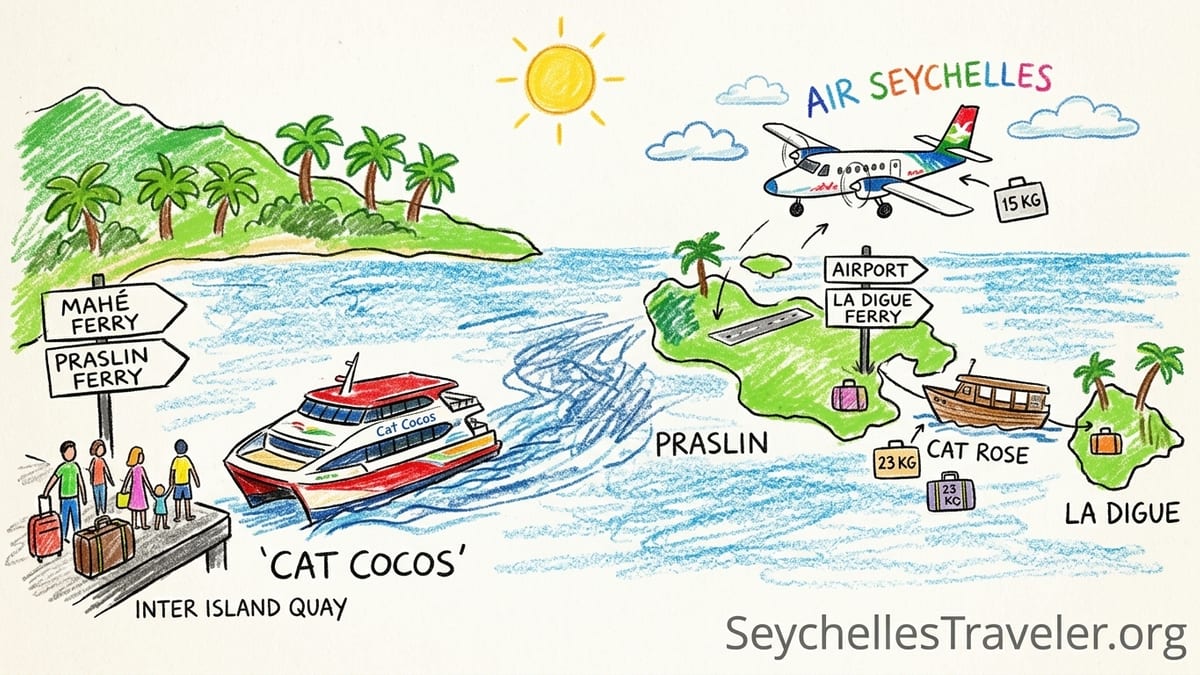
For cost reasons, I booked the ferry from Mahé’s Inter Island Quay to Baie Sainte Anne on Praslin on the way out, with a later domestic flight back from Praslin Island Airport to Mahé at the end of the trip. That gave me one full crossing at sea and one short hop in the air on the same route in the same season, which made the comparison feel fair. I also added the Praslin to La Digue ferry with Cat Rose, because there is no airport on La Digue, so this leg is always by sea.
My outbound crossing from Mahé to Praslin was on a Cat Cocos high-speed catamaran, the main operator on this route. Operators publish a sailing time of about 1 hour to 1 hour 15 minutes between Mahé and Praslin, depending on the departure, with additional time if you continue onward to La Digue. My return leg by air was on an Air Seychelles Twin Otter, the small propeller aircraft that Tourism Seychelles and the Seychelles Airports Authority highlight as the workhorse of the domestic network between Mahé and Praslin.
To keep myself honest, I timed everything from when I left my hotel on one island until I reached my guesthouse on the next. I also noted what I actually paid, how strict the baggage rules felt in real life and how stressful each transfer was. When one side is based on personal experience and the other on research only, I will say so, but here I genuinely used both ferry and domestic flight between Mahé and Praslin.
Booking, Fares and Baggage: Real-World Numbers
On price, the fast ferry was clearly cheaper on my dates. For the Mahé to Praslin leg, I paid the equivalent of about 60 to 70 euros one way in economy class on Cat Cocos, booked around six weeks in advance. That lined up with the price bands shown by booking platforms that aggregate tickets for Cat Cocos and Cat Rose, which list 2026 and 2027 fares in the region of 55 to 75 euros one way for standard passenger seating between Mahé and Praslin in normal season. Business or “coco de mer” style upper-deck tickets were higher but still below the price of most flights I checked for the same day.
For the domestic flight between Praslin and Mahé with Air Seychelles, my one-way fare booked directly through the airline was a little over 140 euros. On other dates during the same month, I routinely saw one-way fares in the 120 to 170 euro range for tourists, depending on time of day and how close to departure I searched. Seychelles residents and some regional agents see lower local fares, but for most international visitors the plane costs roughly double, sometimes more than double, the ferry on this route.
Baggage was where the numbers flipped. On the ferry, I was able to check in a large suitcase around 23 kilograms without surcharge, and carry a small backpack on board. The ferry operators’ conditions confirm that standard tickets include one piece of checked luggage in the region of 23 kilograms plus hand luggage, with extra bags available at a fee per item that is moderate compared with airline excess charges. Nobody weighed my carry-on, and the emphasis was on safe stowage rather than grams.
By contrast, the Air Seychelles domestic baggage rules are stricter. The published allowance on recent domestic baggage tables is typically around 15 kilograms of checked luggage plus 7 kilograms of hand luggage on the Mahé to Praslin route, with excess charged per kilogram, often quoted around the equivalent of about 6 to 7 US dollars per kilo. At the check-in desk, my suitcase was weighed, my carry-on was checked, and I was gently warned that on the way back from Mahé I might need to pay excess if I added souvenirs. Families I spoke to at Praslin airport mentioned that this was the main reason they chose the ferry on at least one leg, because a couple with two big bags each quickly crosses the included limit on the flight.
Departure Points and Check-in: Where the Time Really Goes
The advertised timings say the ferry takes roughly an hour and the plane 15 minutes. In practice, the place where each service leaves from and the required check-in time matter just as much. Every international flight lands at Seychelles International Airport on Mahé’s east coast, a short drive south of the capital Victoria. The domestic terminal for Air Seychelles flights to Praslin sits just a short walk from the international arrivals area. In theory that makes it ideal for connecting straight off a long-haul flight, especially because Tourism Seychelles notes that the island network is designed so travelers can step off an international flight and onto domestic connections without having to cross the island.
The main ferry terminal, however, is in Victoria at the Inter Island Quay. That is roughly a 15 to 20 minute taxi ride from the airport in light traffic, and longer in rush hour. When I arrived on an international flight, by the time I cleared immigration, waited for my checked bags and purchased a local SIM, almost 55 minutes had passed. The taxi to the ferry terminal took another 20 minutes, and ferry check-in for my sailing closed 30 minutes before departure. That left me comfortable time for the afternoon crossing, but it would have been very tight for any sailing within an hour of my scheduled landing.
For the flight, Air Seychelles requested that I check in at least 60 minutes before departure for the domestic sector. Security is significantly lighter than an international flight, but there is still an x-ray scan. Passengers then wait in a small lounge until boarding when ground staff walk the group out to the aircraft. From hotel on Praslin’s Côte d’Or to the little Praslin airport on the west side, the taxi took about 25 minutes, plus that requested 60-minute buffer before my flight back to Mahé. The 15-minute flight itself was so short that there was barely time to look down at the islands and reef before descent.
Door to door, my Praslin to Mahé flight took just under 2 hours: 25 minutes from hotel to Praslin airport, about 50 minutes between arrival and wheels-up when you factor in a short queue, the 15-minute flight itself and roughly 20 minutes from landing on Mahé to stepping into a taxi outside the domestic terminal. My Mahé to Praslin ferry journey from a guesthouse at Anse Royale on Mahé’s south-east coast took around 2 hours 30 minutes door to door: 35 minutes in a taxi to Victoria’s quay in morning traffic, 40 minutes between arrival and boarding, 1 hour 10 minutes crossing on the catamaran and 15 minutes from Baie Sainte Anne to my hotel near Anse Volbert on Praslin.
Sea Conditions, Motion Sickness and Overall Comfort
If you only looked at the clock, the differences would feel modest. The real dividing line appeared when the south-east trade winds picked up. Between roughly May and September, that trade wind season is known locally for making the open water between Mahé and Praslin bumpy. On my outward sailing in July, the crew handed out motion sickness bags before departure, and within 25 minutes of leaving Mahé’s shelter, the bow was rising and falling sharply on the swells. I took travel sickness tablets in advance, sat mid-ship on the lower deck as several Seychelles travel advisors recommend, and felt only mildly queasy. Around me, though, at least a quarter of the passengers were clearly uncomfortable, including one child who spent most of the crossing lying on a bench with a cold cloth.
Ferry booking sites warn that sailings may be delayed or cancelled in strong seas, and that seems realistic. While my catamaran ran to schedule, other travelers I met in La Digue described a morning when several sailings were held back until conditions improved and passengers reshuffled to later departures. If your itinerary hinges on making a specific long-haul flight, these weather-related risks are worth factoring in. The sea crossing itself is scenic when calm, with views of Mahé slipping away and the silhouette of Praslin growing ahead, but very little time is spent near the islands. Most of the hour is in open water where there is nowhere to hide from a rolling swell.
On the plane, the story is almost the opposite. The Air Seychelles Twin Otter I flew in seats around 16 to 18 passengers in a snug cabin. There is no assigned seating, and everyone climbs a short set of steps into the back, walking forward to find a place on either side. The propellers are loud, and the aircraft feels small if you dislike flying, but in calm conditions the short hop was smoother than many medium-haul flights I have taken elsewhere. A few small bumps of turbulence as we left Mahé were brief. Most of the 15 minutes were spent at low altitude where you can see the reefs, sandbanks and small granite islets passing below like a map.
For anyone prone to seasickness, this short flight is almost always the more comfortable option. I spoke with two honeymoon couples who had flown into Praslin within hours of landing in Seychelles precisely because one partner was nervous about boats. Both described the domestic sector as “over quickly” and said the hassle of checking bags again, paying a bit more and walking round from international to domestic was worth it to avoid a rough crossing. Conversely, if you are not a comfortable flyer but cope well with boats, especially if you can choose a morning departure when seas are often calmer, the ferry can feel less claustrophobic than a small propeller aircraft.
Transfers, Hotel Pick-ups and Actual Door-to-Door Time
Travelers often fixate on the published duration of a crossing without weighing what happens at either end. The reality in Seychelles is that both ferry and flight are embedded in a wider network of taxis, buses and private hotel transfers that can subtly tilt the balance. On Mahé and Praslin, the Seychelles Public Transport Corporation runs buses across the islands, and it is possible, in theory, to reach both the ferry quay and the airports by bus. In practice, with luggage in the tropical heat, most visitors opt for taxis or pre-arranged hotel transfers.
On my ferry days, I arranged taxi transfers through my guesthouses. The driver on Mahé collected me from Anse Royale and delivered me to the Inter Island Quay entrance, pointing out the check-in counters for my ferry operator before he left. On Praslin, a hotel shuttle met the ferry and grouped arriving guests by accommodation area. Both rides were predictable, but the key was padding extra time for Mahé’s traffic on weekday mornings when commuters pack the coast road. Several locals advised allowing at least 45 minutes from southern Mahé to the Victoria terminals to avoid stress.
For the flight, my Praslin guesthouse could also arrange a transfer to the island’s small airport, but I opted to book a taxi directly. The drive from Côte d’Or on the north-east coast over the central spine of Praslin to the west-coast airport took around 25 minutes along a narrow, winding road. On arrival at Mahé’s domestic terminal, taxis were waiting, and within five minutes I was in a cab heading to my overnight hotel near Beau Vallon, which took about 25 minutes in mid-afternoon traffic. When I later connected straight from a morning domestic flight to an early afternoon international departure, walking between terminals took less than 10 minutes.
The pattern that emerged was clear. When both ends of your journey involve hotels on the main coasts fairly close to the ferry and airport, the ferry from Mahé to Praslin can take around 2.5 hours door to door, while the flight, with its longer suggested check-in time but much shorter airborne segment, typically took me closer to 2 hours. If you are landing on Mahé on an international overnight flight and want to be on Praslin by lunchtime, the domestic flight is usually the only way to make that feel relaxed, because it avoids the taxi into Victoria and compresses everything into a single hub.
When I Would Pick Ferry vs Flight for Different Travelers
After using both options and cross-checking with up-to-date fares, schedules and baggage rules, my preferences have become very specific depending on who I am traveling with. For couples with light to moderate luggage and a reasonable budget, especially on honeymoon, I would personally choose the domestic flight between Mahé and Praslin at least one way. The scenery from the Twin Otter is a memorable part of the trip, and the comfort on a short flight avoids starting or ending romantic days with a queasy hour on a rough sea. If budget allows, flying in one direction and returning by ferry gives you both experiences without doubling the cost of flying.
For families traveling with children and significant baggage, my own choice tilts strongly toward the ferry, particularly if we are not connecting immediately off an international flight. The inclusive baggage allowance on the ferry is far more generous, and I watched more than one family at Praslin airport argue about unpacking suitcases to shift a few kilos into hand luggage to avoid expensive excess charges. On the ferry, those same bags would likely roll onto the luggage trolley together without drama. The trade-off is the risk of seasickness, so I would time family crossings to calmer months outside the strongest trade winds where possible and opt for morning sailings.
For travelers who know they are prone to motion sickness at sea, I would, however, almost always recommend the flight even if it means trimming the accommodation budget slightly to absorb the higher fare. Several Seychelles travel guides explicitly warn that the Mahé to Praslin crossing can be uncomfortable from June to September, and during my July sailing I saw that first-hand. No scenic ocean view is worth losing half a day of your trip to nausea. Only travelers with an intense fear of flying and a decent stomach for boats should push themselves onto the ferry on choppy days.
For people connecting immediately from an international flight, my own experience and the combined advice of airport staff and Tourism Seychelles sources point clearly toward flying. Landing at Seychelles International Airport, clearing formalities, collecting your checked bags and walking across to the domestic terminal is far less stressful than racing to a ferry check-in cut-off across the island. The domestic network is explicitly designed to align with international arrivals when possible. On the day I arrived, there were several Mahé to Praslin flights spaced within an hour of major long-haul arrivals. If your long-haul is delayed, airline staff can also move you to a slightly later domestic sector if seats are available, which is not as easy with a single daily ferry sailing.
Why Published Travel Times Mislead: The Hidden Friction
Across both modes, the biggest trap for first-time visitors is to plan around the scheduled crossing or flight time as if everything else around it were frictionless. Tourism Seychelles is careful to describe the Mahé to Praslin flight as taking around 15 minutes and the ferry crossing as about an hour, but the same official guides also stress that these are part of a broader transport network with transfers, check-in and baggage handling woven in. The seductive idea that a “15-minute flight” is ten times faster than a “1 hour 15 ferry” is only true if you pretend that getting to the airport takes no time and that you can walk onto the aircraft like a bus.
In real life, the domestic flight between Mahé and Praslin required me to present identification, check in luggage within a specific window, clear a short security queue and walk across the apron to a scheduled boarding time. None of that was especially onerous, but it added up. On the ferry, I checked my bag at the quay and boarded directly, but I still had to arrive at the terminal about 45 minutes earlier than departure, collect my luggage on the other side and wait while it was unloaded with dozens of others. In both cases, ground transfers before and after the crossing took at least as long as the movement between islands.
There is also hidden mental friction. Airports, even small ones, come with a certain administrative hum: screens, queues, announcements and the small anxiety of “will my bag make it.” Ferries shift that anxiety to the sea conditions and the motion of the boat. Standing on Mahé’s quay watching the fast catamaran bob in the swell, I felt mildly nervous despite years of boat travel. On the return flight, my nerves focused on the size of the aircraft rather than the weather. Neither feeling showed up anywhere in the timetables I had scanned while planning the trip at home, yet they strongly shaped my impression of whether each leg felt easy.
For time-sensitive connections, such as flying home on an evening international departure from Mahé, the risk profile also diverges. A domestic flight cancellation can still disrupt a schedule, but airlines and airport staff have more levers to rebook passengers onto later sectors or, in a worst case, reroute them via an overnight stop. A cancelled or heavily delayed ferry, especially the last one of the day, leaves you at the mercy of chartering a private boat or finding an emergency overnight bed, which is not always straightforward in high season. It is no coincidence that many island resorts quietly suggest that guests return to Mahé the day before an early long-haul flight.
The Takeaway
After timing both my Mahé to Praslin ferry and my Praslin to Mahé flight door to door, cross-checking current fares and baggage rules, and talking to other travelers in queues and lounges, my personal verdict is this. If I were traveling as a couple with manageable luggage and a mid-range or higher budget, I would choose the Air Seychelles domestic flight between Mahé and Praslin at least in one direction, especially when connecting from or to an international flight. The slightly higher cost buys genuine comfort, lower seasickness risk and often a shorter, smoother door-to-door journey.
If I were traveling as a family with children, strollers and multiple heavy suitcases, I would lean strongly toward the fast ferry wherever my arrival time allows. The lower fares per person and higher included baggage allowance make the economics compelling, and with smart timing to avoid the roughest months or choosing morning sailings when seas are calmer, the crossing can be made comfortable for most. I would simply avoid scheduling a last ferry of the day before a crucial international flight home.
For travelers who know they are sensitive to motion at sea, the flight is the obvious choice. The short airborne segment, relatively smooth low-altitude hop and lack of rolling swell make it far easier on the body than a one-hour catamaran in trade wind season. On the other hand, nervous flyers who tolerate boats well may prefer the ferry despite the longer exposure to weather, particularly if they can sit low and central on the vessel and travel in calmer months.
Perhaps the most important lesson is that the published travel time is only a headline. Behind those 15 or 75 minutes lies a tangle of transfers, queues, baggage limits, sea states and human nerves. The right choice between Seychelles ferry and flight is not simply the one that looks shorter in a timetable, but the one that, for your specific group, budget and tolerance for waves, will deliver you to your island hotel feeling ready to enjoy the next beach, not to lie down in a dark room. In my own notebook at the end of the trip, I wrote one line that still feels true: For my head and my stomach, I will fly into Praslin and ferry out, as long as the wind lets me.
FAQ
Q1. How long does the ferry from Mahé to Praslin really take door to door?
From a hotel on Mahé’s east or south coast to a hotel on Praslin’s main beach areas, my typical ferry trip took about 2.5 hours door to door. That included a 30 to 40 minute taxi ride to the Victoria ferry terminal, arriving around 45 minutes before departure, a crossing of about 1 hour to 1 hour 15 minutes and a 15 minute transfer on Praslin.
Q2. How long does the domestic flight between Mahé and Praslin take door to door?
The flight itself is around 15 minutes, but once you add a 20 to 30 minute ride to or from each airport and about an hour’s check-in and waiting time, my total door-to-door time usually came in just under 2 hours between comparable hotel locations.
Q3. Which is cheaper right now, the ferry or the flight?
On the dates I checked and traveled, the fast ferry cost roughly 60 to 70 euros one way in standard class between Mahé and Praslin, while Air Seychelles domestic flights on the same route for tourists were typically between 120 and 170 euros one way. Prices do move with season and availability, so check shortly before booking.
Q4. How strict are baggage limits on the flight compared with the ferry?
Air Seychelles domestic flights usually include around 15 kilograms of checked luggage plus 7 kilograms of hand luggage, with excess charged per kilogram. The ferries include a larger checked allowance, often around 23 kilograms plus a cabin bag, and are generally more forgiving on volume, which makes a big difference for families with multiple suitcases.
Q5. How bad is seasickness on the Mahé to Praslin ferry?
In the calmer months, many people feel fine, especially if they sit low and central in the boat. During the south-east trade winds roughly from May to September, the open water can be rough. On my July crossing, the crew handed out sickness bags in advance and a noticeable number of passengers felt unwell, despite the sailing running normally.
Q6. Is the small plane between Mahé and Praslin scary if I do not like flying?
The Twin Otter is a small aircraft and you feel closer to the elements than on a big jet, which can be unsettling for nervous flyers. On my flights in moderate weather, however, the ride was short and relatively smooth, with any bumps over in a minute or two. If your fear of flying is mild and your seasickness is severe, the plane is usually the lesser discomfort.
Q7. What is the best option if I am connecting straight from an international flight?
In my experience, the domestic flight wins in this scenario. You collect your bags, clear immigration and then walk across to the domestic terminal, where there are several flights a day to Praslin. That avoids the extra taxi to Victoria’s quay and the risk of missing a ferry check-in cut-off if your long-haul flight is delayed.
Q8. Can I rely on same-day ferry or flight connections back to Mahé before my international departure?
Many travelers do, but there is always some risk. Domestic flights can be rescheduled if weather or operational issues arise, and airport staff can sometimes move you to a later sector. Ferries are more exposed to sea conditions, and a cancelled or heavily delayed last sailing can leave you stranded. For a very early or very important long-haul departure, I prefer to return to Mahé the day before.
Q9. Which option is better for families with young children?
If your children are not prone to seasickness and you are carrying several large bags, the ferry usually makes more practical and financial sense, especially outside the roughest months. If one child is easily motion sick, the flight may be kinder, but you should factor in the tighter baggage limits and higher cost per seat.
Q10. If I want both the view and the calmer journey, what combination would you recommend?
My own ideal mix is to fly one way between Mahé and Praslin for the reef and island views from the air, then return by ferry in a calmer month or on a morning sailing when the sea is usually kinder. That way you experience both the scenic flight and the open-water crossing while reducing the chances that either journey dominates your memory for the wrong reasons.