


On paper, Seychelles island hopping looks simple: three main islands lined up neatly in the Indian Ocean, all within a short flight or boat ride. In reality, stitching Mahé, Praslin, La Digue and the smaller satellite islands into one coherent journey is a careful exercise in time, weather and energy management. On my last 13-day trip, I set out to test a classic multi-island route and measure, almost with a stopwatch, how much each transfer actually cost in lost beach time and mental bandwidth.
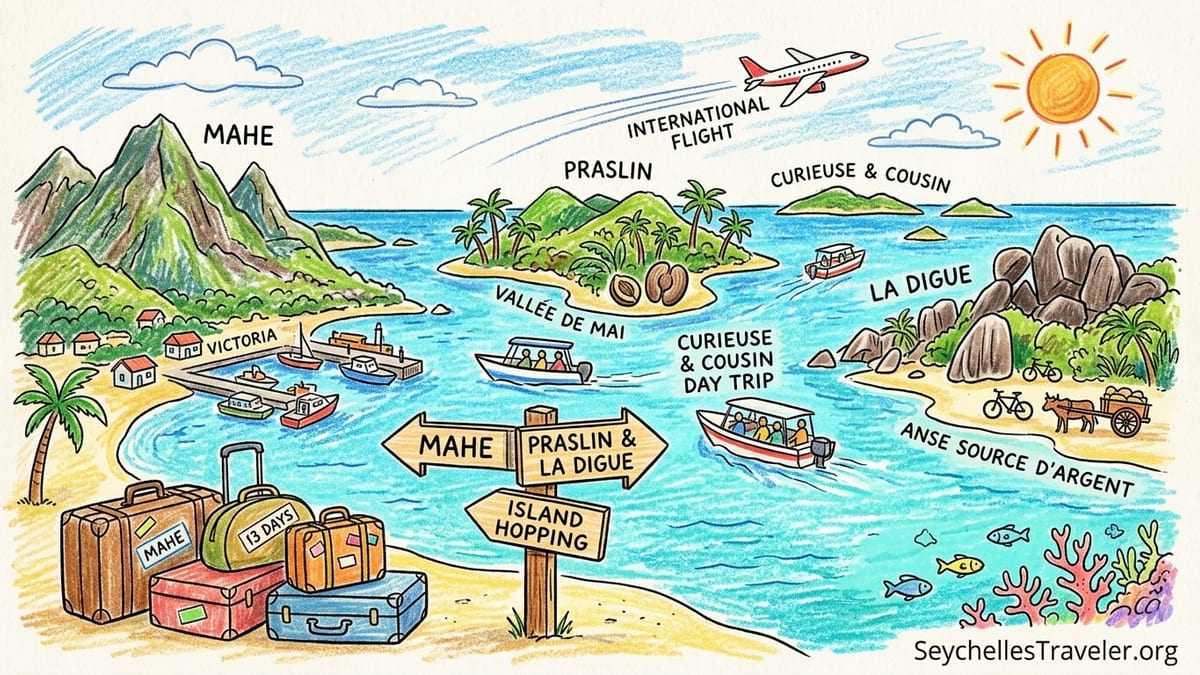
The Route I Took: 13 Days, Three Bases and Four Smaller Islands
For this trip I followed the pattern most first-time visitors end up choosing after talking to Tourism Seychelles and local operators: roughly two weeks split across the three principal islands, with smaller islets visited as day trips. I settled on 13 nights: 4 on Mahé, 5 on Praslin and 4 on La Digue, using Praslin as a launchpad for Curieuse, Cousin and St Pierre, and La Digue as the slow-down finale. That timing sits snugly inside the 10 to 14 day window that Tourism Seychelles and several current island-hopping guides now recommend as the sweet spot for seeing all three main islands without rushing.
The sequence mattered. I started and ended on Mahé because almost every international flight currently lands there at Seychelles International Airport, just outside Victoria. From Mahé I took a fast ferry to Praslin, then a short hop to La Digue, before looping back to Mahé for my homebound flight. This “in a line” routing meant every move pushed me forward instead of ping-ponging back and forth, which reduced both transfer time and seasickness exposure.
Within that framework, I treated smaller islands as seasoning, not additional bases. Curieuse and St Pierre were folded into a single boat excursion from Praslin, while Cousin Island, with its protected bird life, filled another day. That gave me a real-world comparison between making an island a permanent stop on the itinerary and visiting it as a day trip: the former demanded more packing, logistics and weather risk; the latter traded depth for simplicity.
By the end of the 13 days, I had counted six major inter-island transfers and four organised boat outings. I also had a notebook full of boarding times, shuttle rides and damp boarding passes that told a clear story: adding one more island is not simply adding another beach. It is adding a half-day of logistics, another gamble with the wind and another round of unpacking.
Mahé: Hub, First Landing and Last Night Anchor
Mahé is the unavoidable starting point. My international flight landed mid-morning, and thirty minutes after clearing immigration I was in a taxi heading to Beau Vallon on the island’s northwest coast, one of the most popular primary bases for first timers according to recent visitor surveys. The drive took about thirty minutes in light traffic, which meant that even on a travel day I still had a solid afternoon swim and sunset walk.
On Mahé, staying near the ferry terminal in Victoria would have simplified later transfers, but I chose Beau Vallon because the beach is better for easing into the trip and there are more dining options within walking distance. The trade-off was an extra twenty to thirty minutes in a taxi each time I needed to reach the port or airport. In practice, that meant budgeting about an hour from hotel door to port check-in for ferries, or from hotel to airport for a domestic flight, once you factored in loading luggage and inevitable roadworks around Victoria.
Mahé is also where you feel most acutely that Seychelles is not a single resort but an archipelago of distinct regions. The island’s size, mountain spine and traffic around Victoria all make simple day trips more complicated than they appear on a map. For example, my attempt to pair a morning hike in Morne Seychellois National Park with an afternoon beach session at Anse Intendance turned into a five-hour loop of switchbacks, bus delays and a hurried late lunch. By the end of day three I was grateful I had not tried to bounce across to Praslin and back as a day trip, something several online forums and local guides strongly advise against for short stays.
Mahé’s role as hub shaped the bookends of my journey. On my last day, I took an early morning ferry from La Digue back through Praslin to Mahé, then a taxi straight to the airport for an evening long-haul flight. The whole chain took nearly seven hours from first luggage lift to clearing security, even though the actual sea crossing accounted for under two hours of that. Without a final night on Mahé, any delay in the ferry schedule or rough seas would have turned into a very stressful connection. Booking that buffer night on Mahé is one of the few near-universal pieces of advice from both Tourism Seychelles materials and independent trip reports, and in my experience it remains sound.
Mahé to Praslin: Ferries, Flights and How Much Time You Really Lose
The first big logistics question on most itineraries is how to travel between Mahé and Praslin: by fast ferry or a short domestic flight. Recent schedules show Cat Cocos operating several daily fast ferries on the Mahé–Praslin–La Digue axis, with a crossing time of about one hour between Mahé and Praslin in normal sea conditions. Air Seychelles, meanwhile, runs frequent fifteen-minute flights from Mahé to Praslin’s small Iles des Palmes Airport. On paper that sounds like a quick hop, but when you add check-in, security and transfers to and from each airport, the time gap between boat and plane narrows considerably.
For this trip I did one leg each way: ferry Mahé to Praslin, then flight Praslin back to Mahé before my final international departure. The morning Cat Cocos ferry I took required check-in at least forty-five minutes before departure. My hotel in Beau Vallon arranged a shared shuttle that picked me up ninety minutes before sailing. Door to door, the journey from my room key turning in the lock to setting my bag down in my Praslin guesthouse near Cote d’Or Beach took just under three and a half hours.
Sea conditions matter. During the southeast trade winds, which typically run from May to September, several travelers had warned me about rougher crossings and a higher chance of seasickness. On my outbound ferry the swell was moderate. A third of the passengers accepted seasickness bags from the crew, but with tablets and a seat near the center of the vessel, I felt only mildly queasy. The lost time was not in the crossing itself, but in the aftermath. I needed an hour on Praslin simply to sit in the shade, sip water and feel stable again before I could face a bus ride to Anse Lazio.
By contrast, the Air Seychelles hop back to Mahé at the end of the trip was almost turbulence-free and scenic, with sweeping views of the Inner Islands below. However, factoring in the taxi from my La Digue ferry to Praslin Airport, the standard one-hour check-in advised by the airline and the thirty-minute taxi through Mahé traffic to Beau Vallon, the total travel time still came in close to four hours. In both cases I considered the transfer day a half-day written off, with only a late afternoon swim and an easy dinner on either end.
Praslin as a Base: Curieuse, Cousin and St Pierre by Boat
Praslin delivered exactly what its advocates promise: smaller scale than Mahé, less driving, but enough infrastructure to make island hopping feel easy rather than fragile. I stayed at Cote d’Or, within walking distance of restaurants and the pick-up points many excursion operators use. The choice of base proved crucial because almost everything I did off Praslin started in the same ten-minute walking radius: Vallée de Mai minibus tours, snorkeling trips to Curieuse and St Pierre, and conservation visits to Cousin Island.
On my second full day I joined a combined Curieuse and St Pierre outing, a pretty standard excursion offered by several local boat companies. The day started with a hotel pick-up in an open-backed truck at 9:00, followed by a fifteen-minute ride to the small jetty. After a short check-in, we were on the water by 9:45. Curieuse lay in front of us within about twenty minutes of gentle motoring, and we landed on the beach directly without any need for dinghy transfers. From there the rhythm was guided but relaxed: a walk among giant tortoises, a boardwalk trail through mangroves and a grilled fish lunch on the sand.
The afternoon segment at St Pierre was entirely about the water. Our boat dropped anchor a few hundred meters off the granite outcrop, which features prominently in many Seychelles brochures. The snorkeling was good, with healthy coral in patches and a rotating cast of reef fish. Realistically, the entire multi-island day cost me from 9:00 to about 16:30, including pick-up and drop-off. It was a full, satisfying day trip that still left time for a shower and a sunset drink on Cote d’Or, and it offered enough variety in scenery and activities to justify not staying overnight on either Curieuse or St Pierre.
Cousin Island, reached from Praslin by another short boat ride, showed the other side of using Praslin as a base. Landings are tightly regulated because Cousin is a significant bird reserve; boats anchor offshore and visitors transfer to special landing craft. Guided walks follow set routes with naturalists explaining the dense birdlife and conservation work. The whole trip again filled roughly 9:00 to 15:30. In both cases, basing on Praslin kept logistics manageable. My suitcase never left the guesthouse, there were no extra check-ins to worry about, and weather risk could be managed by shifting boat days around within my five-night window.
La Digue: When Staying Overnight Changes Everything
La Digue sits only a fifteen-minute fast ferry ride from Praslin, served by Cat Rose and through-running Cat Cocos services, but it feels like an entirely different country in terms of pace. Bicycles line the jetty, ox carts still trundle along the coastal road and cars remain heavily restricted. Official figures put the island’s area just above ten square kilometers, small enough that moving around by bike is practical for most visitors. On my previous Seychelles visit I had experienced La Digue only as a hurried day trip. This time I checked into a guesthouse for four nights to see how much the experience changed.
The transfer itself was straightforward. From my Cote d’Or hotel on Praslin, a taxi arranged by the owner took twenty minutes to reach the Baie Sainte Anne jetty. Check-in for the Cat Rose crossing opened about thirty minutes before departure. Even with a short queue, I found that from room key to rolling my suitcase off the jetty in La Passe took just under ninety minutes. My guesthouse on La Digue arranged a pickup by golf-cart style buggy, and we reached the property in less than five minutes. From leaving Praslin to taking my first barefoot steps on Anse Severe was around two and a half hours.
On my previous day trip, my ferry arrived mid-morning and departed in the mid-afternoon. The entire day felt like a race against the clock: rent a bike, pedal to L’Union Estate, queue at the entrance, hurry through the vanilla farm, reach Anse Source d’Argent, take the obligatory photos among the granite boulders, then reverse the process, hoping not to miss the last ferry back to Praslin. I spent more time checking the time than listening to the surf.
Staying overnight changed the emotional temperature. I visited Anse Source d’Argent in the late afternoon when most of the day-trippers had gone. The light was softer, the beach much quieter and I could linger without glancing at my watch. Another day I cycled before sunrise to Grand Anse, continued on foot to Petite Anse and Anse Cocos, and watched waves crash on empty sand. That sequence would be almost impossible on a same-day visit, because the hike alone can take several hours and the heat becomes intense by late morning.
This is where the lesson about “another island is not just another beach” crystallised for me. The beaches on La Digue are indeed different in shape and mood from those on Praslin or Mahé, but what really changes is the daily rhythm. Sleeping on the island lets you occupy early mornings and evenings that day trippers never see. It also gives you redundancy. One of my La Digue days was rained out by a passing front. Because I had four nights, that did not matter. If I had scheduled La Digue as a single day dash in the middle of a tight itinerary, the weather would have wiped it out entirely.
Packing, Unpacking and the Real Cost of Each Island Change
Before this trip I thought of each island change primarily in terms of ticket cost and transfer time. By the end of two weeks, the hidden cost that weighed most heavily was packing and unpacking fatigue. With three main bases over 13 nights, I packed my suitcase properly four times: leaving home, moving from Mahé to Praslin, from Praslin to La Digue and from La Digue back to Mahé. That pace, one serious repack every three to four days, felt manageable, even with camera gear and a small snorkel kit.
Each repack consumed about an hour of real time: rinsing and drying swimwear, hunting for chargers, sorting sand out of shoes, double-checking safe boxes and adapting to each new room layout. On a casual beach holiday that might not seem significant, but when paired with early ferry departures and fixed checkout times, it quickly compresses your usable day. On my Mahé to Praslin transfer, for instance, checkout was at 10:00 and the ferry at noon. That meant the packing hour had to happen before breakfast, and beach time was restricted to a final, slightly rushed swim.
Luggage logistics also shape your tolerance for extra islands. I traveled with a medium checked suitcase and a backpack. On ferries, bags are typically stacked in a dedicated luggage area, and while the system worked smoothly, there is always a moment of mild anxiety watching your bag disappear under a pyramid of other suitcases. Flights between Mahé and Praslin on small turboprops have lower baggage allowances, and while Air Seychelles sells extra allowance, it comes at a cost and requires advance planning. Each additional island night would have meant one more set of risk points for delayed or misplaced bags.
By the time I contemplated adding a separate overnight on a private island, the idea of another full unpack, another new shower that might or might not have decent water pressure and another round of figuring out plug placements felt heavier than the literal weight of my bag. That subjective fatigue is rarely foregrounded in glossy brochures, but on the ground it can be the deciding factor between joyfully exploring a new cove and resigning yourself to an early night.
Day Trips Versus Overnight Stays: What Worked and What Did Not
Across the trip I tested both approaches: ticking an island off as a day trip, and committing to it as an overnight base. Some conclusions were immediate. Curieuse, Cousin and St Pierre worked beautifully as day trips from Praslin. They offered discrete experiences, were small enough to explore well in a few hours and had clear start and end points managed by local skippers and guides. The sense of discovery was intact even without sunset and sunrise time on those islands.
La Digue was the opposite. As a day trip from Praslin it had felt like an overcrowded postcard come to life, all lines of rental bikes and queues at the famous boulders. As a four-night stay it became the heart of the journey. I met the same bakery owner each morning, learned the timing of passing rain showers and found near-empty corners even on popular beaches by going early or late. The overnight stay did not simply add more hours; it changed the relationship with the place from consumption to participation.
Mahé sits somewhere between those two extremes. It is logistically possible to treat Mahé as a day trip from Praslin or vice versa, especially if you book the earliest ferry out and the latest back. But every local I spoke to, along with several current trip reports, described it as an exhausting way to experience either island. The range of beaches, viewpoints and inland walks on Mahé means it benefits from at least three solid days, ideally at the start of the trip when you are still fresh from home.
The weather also tipped the scales. On shorter day trips, a rainy morning can wipe out half the experience. On Cousin Island my group lost little to a passing shower because the guided walk kept going under tree cover and the bird activity actually increased. On La Digue, though, one fully wet afternoon would have been devastating if it were my only window. With multiple overnights, I could simply slide my planned Anse Cocos hike by a day and use the rain to rest or wander into small art studios in La Passe.
Time on the Move: How Much of a Transfer Day Is Truly Lost
Before the trip I tried to quantify how much of each transfer day I would “lose” to logistics. After the journey, the numbers on my notepad were remarkably consistent. A typical island change without flight connections swallowed about four to five usable hours. That figure rolled together packing, checkout, transfer to port, the actual crossing, disembarkation, finding the new accommodation and settling in.
For example, my move from Mahé to Praslin started at 8:30, when I began packing properly. By 10:00 I had checked out and loaded into a taxi to Victoria’s Inter Island Quay, arriving at the terminal by 10:30 for the noon ferry. We boarded around 11:30, departed on time and docked at Praslin shortly after 13:00. My guesthouse transfer took thirty minutes, and by 14:00 I was in my new room. That left a few afternoon hours to explore Cote d’Or, but the core of the day had been consumed by the move.
The shortest transfer was Praslin to La Digue, thanks to the fifteen-minute Cat Rose crossing and the compactness of both islands. Even there, by the time I had packed, checked out, taken the taxi to Baie Sainte Anne, queued for boarding, sailed and checked into my La Digue guesthouse, half the day had effectively slipped away. I was on the beach by mid-afternoon, but a full morning of activities would not have been realistic without feeling rushed.
Longer chains amplify this effect. On my departure day from La Digue I had to connect through Praslin and Mahé to reach my international flight. I left my guesthouse at 8:00, boarded the ferry to Praslin at 9:00, connected onto the Air Seychelles flight by late morning and finally cleared international security in Mahé by mid-afternoon. There were breaks to sit and eat, but no real time to swim or explore. The entire day became a corridor rather than a destination.
These examples underline why squeezing four or five bases into a 10-day trip often backfires. If every second or third day contains a four-hour logistics block, the proportion of the holiday spent either on the move or thinking about being on the move climbs uncomfortably high. Two or three bases, on the other hand, allow full, relaxed days between transfer days, and give enough slack to adapt to delayed ferries or sudden squalls.
The Takeaway
Island hopping in Seychelles rewards restraint. On my 13-day journey combining Mahé, Praslin, La Digue and day trips to Curieuse, Cousin and St Pierre, I confirmed what Tourism Seychelles’ 10 to 14 day guideline implies: the limiting factor is not distance but human bandwidth. Ferries and short flights make the geography easy, but every island change introduces half a day of travel, another set of check-ins and a new chance for the weather to reroute your plans.
Mahé works best as both gateway and a genuine destination, with at least three nights to give its beaches and mountain interior a fair hearing. Praslin is an excellent central base, especially around Cote d’Or, with efficient links to Vallée de Mai, Anse Lazio and the nearby satellite islands. La Digue, in my experience, belongs on almost every first-timer’s itinerary, not as a rushed box to tick but as a two to four night stay where bicycles replace cars and the day bends around the tides and light.
Day trips shine when the island is small, the access controlled and the experience clearly defined, as with Cousin’s bird reserve or Curieuse’s tortoises and mangroves. Overnight stays make sense when the island has its own internal rhythm, when sunrise and sunset transform the landscape and when weather or crowds can undermine a single, fixed window. La Digue fell firmly into that second category, and it became the emotional highlight of my trip precisely because I slept there.
If I were planning this itinerary again, I would make only one small adjustment: perhaps trade a night from Mahé to Praslin if I wanted more time in the water and less in the car. What I would not do is add another separate island stay on a tight 10 to 14 day schedule. Based on the fatigue I felt after my third repack, the transfer logs in my notebook and the simple desire to spend more time barefoot and less time queueing, the maximum number of distinct island bases I would personally tolerate on a single Seychelles trip of this length is three.
FAQ
Q1. How many days do I really need for Mahé, Praslin and La Digue?
For a first trip that includes all three main islands, 10 to 14 days works well. That allows at least three nights on each island, plus extra time on the one that appeals most to you.
Q2. Is it better to fly or take the ferry between Mahé and Praslin?
Time-wise they are closer than they appear. The ferry takes about an hour at sea but requires early check-in and port transfers. The Air Seychelles flight is roughly 15 minutes in the air, yet airport transfers and security bring the total close to three or four hours as well. Choose based on budget and seasickness sensitivity.
Q3. Does adding another island just mean more beaches?
No. Each extra island base adds at least half a day of logistics, another packing session and more weather risk. The beaches differ in character, but what changes most is the rhythm of your days and how often you have to move.
Q4. Is La Digue worth more than a day trip?
In my experience, yes. As a day trip it can feel rushed and crowded. Staying two to four nights lets you enjoy early mornings and evenings when the island is quiet and the light is beautiful, and gives you a buffer if one day is rainy.
Q5. Can I visit Curieuse, Cousin and St Pierre without changing hotels?
Yes. Praslin works well as a base for all three. Most boat excursions pick up from popular beaches such as Cote d’Or, run from mid-morning to mid-afternoon and return you to the same hotel in time for sunset.
Q6. How bad is seasickness on the Seychelles ferries?
It depends on the season and your sensitivity. During the windier months the Mahé–Praslin leg can be choppy. Many passengers take seasickness tablets and sit near the center of the boat. If you are very prone to motion sickness, a short flight may be the better option.
Q7. How much of a transfer day should I expect to lose?
Based on timed transfers on this trip, expect four to five usable hours to disappear each time you change islands. That includes packing, checkout, port or airport transfers, the crossing or flight and settling into your new accommodation.
Q8. Is it practical to day trip from Mahé to either Praslin or La Digue?
It is technically possible but rarely relaxing. You will spend a large share of the day in transit, with little room for delays. For most travelers it makes more sense to stay at least two or three nights on the smaller islands instead.
Q9. How many separate island bases would you personally choose on a two-week trip?
On a 10 to 14 day itinerary I would cap it at three bases: Mahé, Praslin and La Digue. Beyond that the cumulative packing, transfers and check-ins start to erode the sense of rest.
Q10. When is the best time of year for island hopping in Seychelles?
Weather patterns shift through the year, with calmer seas often found around the shoulder months between the trade wind seasons. Because ferry conditions and rainfall can change from year to year, it is worth checking recent local reports and planning some flexibility into your schedule.