


On my first afternoon on Alphonse Island, a green turtle surfaced just beyond the drop-off, exhaled in a small gasp of silver bubbles, and slipped back into the Indian Ocean. I was still in my travel clothes, standing on the sand with my bags at my feet, yet the conservation briefing was already in full swing. In the Seychelles outer islands, you do not simply arrive. You are inducted into a living experiment in how far tourism can lean toward protection without breaking the magic that brings people here in the first place.
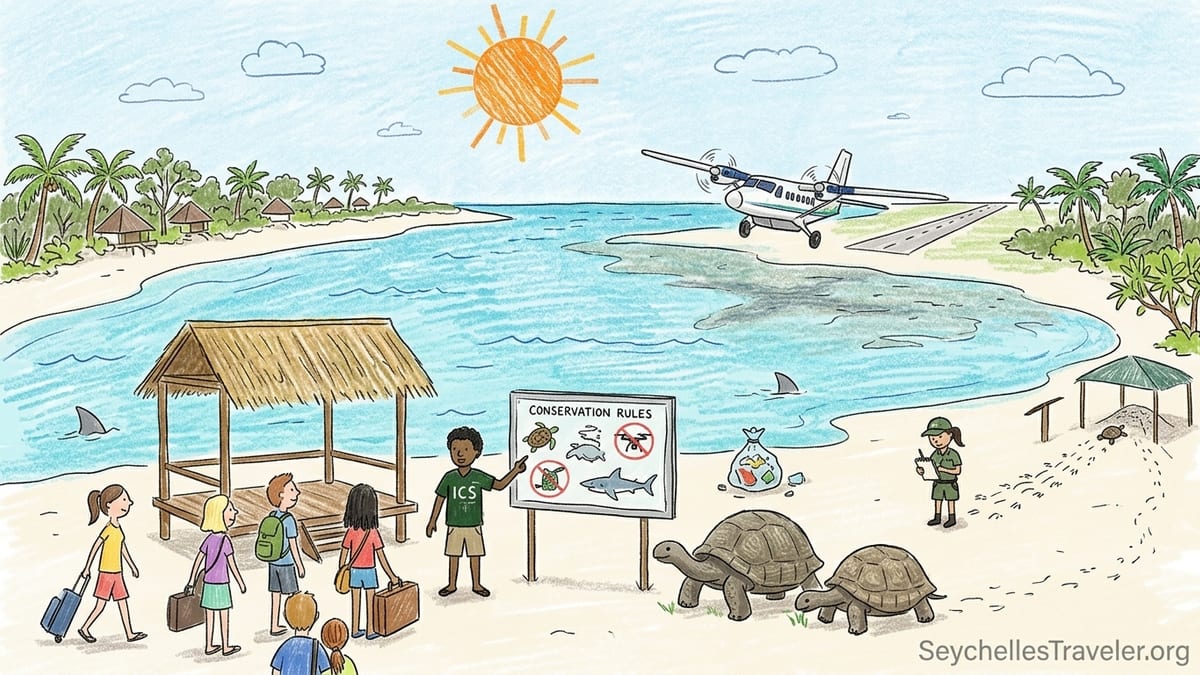
Landing on Alphonse: My First Conservation Briefing
My journey into the outer islands began on Alphonse, a tiny teardrop of sand and coconut palms more than 400 kilometers southwest of Mahé. As the small IDC-operated aircraft banked over the lagoon, the scale of the reef flat below made the resort look almost incidental, a scattering of roofs tucked between forest and sand. Once we rolled to a stop on the airstrip, there was no anonymous transfer bus. A conservation officer from the Island Conservation Society, which has a permanent base on Alphonse, was waiting at the edge of the runway and walked our group straight from plane to briefing deck, before anyone even reached their villas.
That first talk set the tone. We were told that a mandatory conservation donation was included in our stay, channelled to the Alphonse Foundation and Island Conservation Society to fund research, turtle monitoring, seabird work and reef surveys across several outer islands. The figure, quoted at around a couple of hundred US dollars per person for a week, was not a vague “optional extra,” but embedded in the experience. It felt a little like being told there was a resort tax, except this one was earmarked for manta tagging, beach cleans and shark science rather than air conditioning and roads.
Then came the rules. No walking on live coral on the reef flat. No drones without explicit permission from management. No feeding fish, no collecting shells, no handling sea cucumbers or starfish, no touching or riding turtles, rays or sharks. The dive team had its own, more detailed code of conduct, including instructions to secure dangling hoses and camera gear, and to avoid kneeling on the seabed even during training exercises. It was a lot to take in within the first hour ashore, but the message was clear: Alphonse existed for its wildlife before it existed for its guests, and that hierarchy was non-negotiable.
Far from ruining the mood, this upfront honesty nudged my mindset away from “island resort” and toward “field station with comfortable beds.” I was not just here to see wildlife. I was here to fit around an ongoing conservation project, with all its constraints and compromises.
Turtle Patrols at Dawn: What I Actually Saw on the Beaches of Alphonse
The most powerful experience I had on Alphonse started in the dark. I met a conservation ranger outside the small Island Conservation Society office at 5.30 in the morning, when the sand was still cool and the sky traced only the faintest line of silver above the lagoon. Turtle patrols, I learned, happen year-round here, with green and hawksbill turtles nesting on different seasonal peaks. Guests can join as extra eyes and ears, but the rhythm and route are set by the ranger, not holiday preferences.
We began by walking the eastern beaches, a narrow strip where the surf chews at the sand just meters from the tree line. Within 20 minutes the ranger pointed out the unmistakable tractor tracks of a green turtle that had come ashore overnight. The track led up to a broad, disturbed patch of sand just below the casuarina roots. I did not see the turtle herself; she had already returned to the sea hours earlier, but the nest was freshly covered. The ranger recorded GPS coordinates, estimated the clutch success by the shape and depth of the pit, and logged the data in a waterproof notebook. My role was humbler but still oddly satisfying: smoothing the approach track to make it clear if any poacher or predator disturbed the nest later.
Later that same morning, on the western side near the main lodge, I did watch a hawksbill turtle in the water. She was circling just beyond the reef edge, rising every few minutes to breathe in glassy, early-morning light while a pair of blacktip reef sharks ghosted below her. Guided by the ranger’s quiet commentary from the shore, I learned to read her behavior: unhurried, relaxed, clearly not about to nest. It would have been easy to label that as a “nesting turtle sighting” in a more embellished travelogue, but the distinction matters. On Alphonse, the difference between a turtle resting in the lagoon and a turtle nesting on the beach is the difference between a nice encounter and a data point that could feed into years of monitoring work.
The patrols were not stage-managed spectacles. On one day we found no new nests at all, only ghost crabs criss-crossing the beach and the tide erasing yesterday’s lines. On another, I watched the ranger dig into an older nest near the southern tip of the island to assess hatching success. I did not see the hatchlings; they had emerged several nights before, but the ranger carefully counted egg fragments and unhatched shells, explaining how this beach had seen slightly lower success after a recent storm. There was nothing glamorous about standing in a knee-deep hole sifting sandy egg membranes, but this was exactly the kind of work the conservation donation was meant to support.
Walking with Giants: Meeting Aldabra Tortoises on Alphonse
Giant tortoises were my most surprising encounter on Alphonse, because I had mentally reserved them for Aldabra, the famous atoll that lends its name to the species. Yet one of the Island Conservation Society’s long-term projects has been the managed introduction and monitoring of Aldabra giant tortoises on some outer islands, including Alphonse, both to ease pressure on Aldabra and to restore lost ecological functions on islands where tortoises once roamed.
My first sighting was not on some staged feeding lawn, but on a shaded path between my villa and the conservation center. A tortoise roughly the size of a large suitcase was browsing on fallen leaves, its domed shell dappled with late-morning light. There was no handler, no crowd. I simply stopped a few meters away and watched as it extended a surprisingly long neck to reach a fresh hibiscus leaf. Later that day, during a scheduled tortoise monitoring walk with an ICS staff member, I learned that this individual was part of a known cohort, microchipped and occasionally measured to track growth and health.
During the guided session, we visited a more open area near the island’s interior where several tortoises tended to congregate. Here there was structured interaction. The ranger checked identification numbers against a laminated sheet, noted which animals were present, and invited us to feel the difference between the smooth new scutes on younger shells and the more sculpted plates of older individuals. One particularly large male stretched his neck toward us, clearly habituated to people. Guests were allowed to offer a few leaves handed out by the ranger, but only after everyone had washed their hands at a portable station to reduce any risk of introducing pathogens.
This is where conservation rules both enhanced and constrained the experience. There was no climbing on shells, no posing children astride tortoises, no tapping shells for movement. Compared to some wildlife attractions in other parts of the world, it felt almost restrained. Yet that restraint is exactly what made the moments memorable. Watching a tortoise choose to approach or ignore us felt fundamentally different from the performative “encounters” I have seen advertised elsewhere. On the other hand, I did feel a pang of frustration when the session ended abruptly after 45 minutes so the ranger could return to office-based data entry, a reminder that this was scientific work first, visitor activity second.
Reef-Flat Expeditions and the Discipline of Staying Afloat
The inner reef flats of Alphonse are the kind of landscape that looks harmless from the air: a pale, rippled expanse ankle- to waist-deep at low tide, criss-crossed by the shadows of seagrass and coral heads. On my second day I joined a guided reef-flat expedition, an activity led by a marine biologist that combines citizen science with what is, in effect, a long, wet nature walk through the lagoon.
We set out from the dive center in knee-deep water, each of us wearing booties and carrying a small plastic slate and pencil. Before we reached the first patch of coral, the guide stopped us for another micro-briefing. We were to move slowly, shuffle rather than step to avoid suddenly landing on a ray or stonefish, and never use coral to steady ourselves. If we needed to lean or rest, we were to choose bare rock or sand. Our slates held a basic monitoring sheet where we could tally sightings of certain indicator species in seagrass beds, under rocks and around coral bommies, data that would later feed into baseline surveys of the lagoon habitat.
During that two-hour walk I saw more life than on any aquarium dive. Tiny juvenile lemon sharks, no longer than my forearm, flicked away from our shadows near the mangrove edge. I watched a blue-spotted stingray lift out of the sand almost under my toes and cruise into deeper water, its electric-blue spots pulsing against the muted reef. In one sandy runnel a small blacktip reef shark patrolled back and forth, perfectly at home in water that barely reached my thighs. Around isolated coral heads, parrotfish and surgeonfish grazed relentlessly, their beaks rasping audibly in the still air. None of this would have been visible from the comfort of a boat.
Yet the same environment that made these encounters so intimate also made the conservation rules feel strict. We were not allowed to fumble with loose action cameras or phones; anything we brought had to be secured with lanyards. At one point the guide politely but firmly stopped a participant who had drifted toward a patch of branching coral while focusing on a clownfish. Another guest asked if we could free-dive for closer photographs in slightly deeper pools, but the answer was no. The guide explained that even experienced snorkellers tend to stir up sediment, kick coral or linger too close to resting turtles when they start duck-diving in confined flats. Instead, he encouraged us to slow down at the surface, observe behavior and record what we saw.
What could have felt like a list of “no”s instead became a practical lesson in how to be present without intruding. It made me more aware of the space I occupied in the water, of where my fins were, of how much sand my steps raised. Back on the boat, another guest commented that she felt a little controlled, that she would have liked more freedom to explore alone. I understood the feeling, but I also knew that without the guide’s constant reminders, our group of six would almost certainly have done more damage in those two hours than any of us intended.
Beach Cleans, Ghost Gear and the Reality of Ocean Rubbish
The most confronting conservation activity I joined on Alphonse did not involve charismatic wildlife at all. It involved rubbish. Once a week, usually in the cooler late afternoon, the conservation team organized a beach clean on one of the less-walked stretches of coastline, inviting guests to join. The section chosen during my stay ran along the southeastern shore, a place of wind, driftwood and pounding surf that felt a world away from the calm lagoon beach in front of the bar.
Armed with heavy-duty gloves and large woven sacks, we walked along the high-tide line while a staff member logged what we collected. Here, too, citizen science met physical effort. Every item went into a category on a standardized sheet: plastic bottles, fishing line, foam, flip-flops, tangled nets, glass. Within 200 meters my bag was heavy. I remember the moment when I realized that almost none of this rubbish came from the island itself. Labels were in languages from across the Indian Ocean basin. A huge ball of fishing net, so-called ghost gear, took three of us to wrestle out of the wrack line.
There was wildlife among the trash. I saw small ghost crabs darting between bottle caps, and a juvenile black noddy, a type of seabird, picking at a fragment of blue rope that looked unpleasantly like a worm. The conservation officer pointed out how these brightly colored fragments are often ingested by birds and turtles. In that one-hour session we filled an open-top trailer, yet when I looked back along the beach, the line of fresh debris already washed up behind us.
The rules here were simple but strict: wear gloves, do not handle anything that looks like unexploded ordnance or sealed chemical containers, and do not attempt to disentangle any live animal from gear without calling a ranger. I felt no resentment at these restrictions. If anything, I was relieved not to be making judgement calls about hazardous materials. What did chafe a little was the knowledge that our effort, earnest as it was, scratched only at the surface of a global problem. The staff did not sugarcoat this. Back at the conservation center they showed us how the rubbish would be sorted, weighed and recorded, then consolidated for transport back to Mahé on supply ships. Our hour on the beach would contribute a single line to a growing dataset used in regional debris monitoring projects. It was sobering, and it made the sunset cocktail later that evening taste different.
Reef Rules Underwater: Sharks, Rays and the Art of Holding Back
Diving and snorkeling around Alphonse showed me how conservation regulations move from theory into muscle memory. On my first lagoon dive, at a site near the outer edge of the reef known for current-swept coral slopes, the pre-dive briefing felt almost like a condensed marine biology class. The guide talked us through the local shark projects, explaining that Alphonse participates in tagging and tracking studies focused on species like grey reef and silvertip sharks. We might see tagged individuals, he said, but we were not to chase or attempt to read tags under water. Instead, we were encouraged to note distinctive markings or behavior to report later.
During that dive I saw at least six grey reef sharks cruising along the drop-off, keeping a steady distance of maybe ten to fifteen meters from our group. Two eagle rays glided above a plate coral garden, their pale undersides flashing when they banked into the sun. Turtles were plentiful. At one point a hawksbill turtle swam directly toward me along the slope, apparently as interested in me as I was in her. Everything in my diver brain wanted to hold position by gently gripping a dead coral head to frame the perfect photograph, but the briefing floated back to me. I finned backward instead, letting her pass within arm’s reach without changing my depth, conscious of my buoyancy and the free-hanging octopus hose that the guide had double-checked before we entered the water.
There were limitations. The guide refused a request from another diver to descend on a cleaning station where several sharks were circling a coral head, explaining that too many divers crowding the spot could change the sharks’ behavior and derail a monitoring sequence the researchers were trying to document with remote cameras. We hovered higher on the slope instead, looking down on the scene like respectful eavesdroppers. In another moment, a diver in our group who repeatedly drifted too close to a resting green turtle was gently, then firmly, moved back by the guide. On surfacing, the guide explained why that mattered, not as a scolding but as part of the learning curve of diving these reefs.
I did chafe at one policy in particular: the strict limit on night diving during certain months when turtle nesting activity peaks. As someone who loves nocturnal reefs, I had hoped to join at least one night dive on the outer wall. Instead, I settled for a single night snorkel inside the lagoon, tightly timed and limited to a small group, with clear instructions to stay away from known nesting beaches. The logic was impeccable. Lights and surface commotion can disorient nesting females and hatchlings. Still, floating in the black water watching plankton glow under my torch, I felt the trade-off between personal adventure and collective responsibility more keenly than at any other point in the trip.
When Conservation Limits Your Freedom, and When It Sets You Free
Across my time in the outer islands, especially on Alphonse, I kept noticing how conservation rules shaped my days in ways that were both constraining and liberating. Some limitations were logistical. Boat departures around the atoll were timed not only for tides and guest convenience, but also for sensitive windows in seabird breeding cycles and turtle nesting peaks. Certain sandbars and sensitive islets in the neighboring St François Atoll were completely off-limits without a conservation escort. There were days when winds or strong currents triggered a last-minute cancellation of a planned outer reef snorkel, leaving me pacing the shaded paths with unused energy.
There were also social pressures. It is one thing to nod along in a briefing about not touching marine life; it is another to be the person who speaks up when a fellow guest absent-mindedly reaches for a curious batfish under the jetty. The staff encouraged gentle peer reminders, but not everyone appreciates being corrected on holiday. I found myself rehearsing diplomatic phrases in my head while rinsing my mask at the dive center, unsure how far my responsibility extended beyond my own behavior.
Yet the same framework that restricted certain activities also created experiences I could not have had in a more laissez-faire destination. Because access to fragile sandbanks and mangrove channels was controlled, the moments when I did visit them felt both exclusive and ethically grounded. Drifting silently through a mangrove creek with a conservation ranger, watching juvenile fish shelter among roots that are part of a national blue carbon strategy, felt richer precisely because I knew not everyone could come here whenever they pleased. Knowing that my conservation donation fed into national coral reef action plans, not just local marketing, connected my brief visit to something larger than my own memories.
For me, the most important shift was internal. By the end of a week I no longer saw rules like “no flash photography with turtles” or “no walking on the reef crest” as external impositions. They had become part of how I defined a good day in the water. I began to judge my experiences not only by what I saw, but by how lightly I could pass through these ecosystems and what information I could help gather while I was there. I still wanted freedom, but I wanted it within boundaries that gave the place a future.
The Takeaway
Travel to the Seychelles outer islands is expensive, logistically complex and tightly managed. It would be easy to see the conservation framework that governs places like Alphonse simply as another layer of restriction laid over an already remote destination. My time there convinced me of something different. The long dawn turtle walks on Alphonse’s beaches, the slow trudges across the reef flat counting juvenile sharks and rays, the structured encounters with giant tortoises and the sweaty hours hauling ghost nets on the windward shore were not add-ons to a conventional island holiday. They were the backbone of the experience.
There were moments of frustration. I missed out on night dives. I could not wander alone to every sandbar that caught my eye. Drone shots of the atoll’s turquoise geometry were firmly off the table without permits. Yet every time I found myself wishing for a little more personal freedom, I could point to a specific animal, habitat or dataset that benefited from the limit being in place. The hawksbill turtle unbothered by divers because they held their distance. The ghost crabs and noddies that would not be picking plastic from the wrack line after our beach clean. The tortoises whose behavior was shaped by their own curiosity instead of by a constant stream of hands and treats.
If you travel to the outer islands looking for unchecked freedom, you may find the reality uncomfortable. If you come ready to accept that your presence is conditional on accepting rules written for the benefit of turtles, sharks, seabirds and tortoises, you may find something rarer. You may find yourself part of a quiet, ongoing negotiation between luxury and limits, in which the most memorable moments are not the ones arranged purely for your pleasure, but the ones where you fit, respectfully and briefly, into the rhythms of a wilder world.
FAQ
Q1. Can I see sea turtles in the Seychelles outer islands without joining a formal turtle patrol?
Yes. Around islands like Alphonse, green and hawksbill turtles are often visible while snorkeling from the beach or boat, but patrols give deeper insight into nesting and conservation work.
Q2. Are giant tortoises only found on Aldabra Atoll?
No. Aldabra is the stronghold, but managed populations of Aldabra giant tortoises also live on several other islands, including Alphonse, where they are monitored by conservation teams.
Q3. Do conservation rules mean I will have less time in the water?
Not necessarily. You may find certain times of day or specific sites restricted, but operators usually offer a full program of snorkeling, diving and reef walks structured around wildlife needs.
Q4. Are beach cleanups really worth doing during a short holiday?
Yes. A single session can remove large volumes of debris, especially fishing gear, from turtle and seabird nesting beaches, and your efforts also feed into long-term monitoring data.
Q5. Will conservation activities feel like hard work instead of a vacation?
Some activities, such as early-morning turtle patrols or hot beach cleans, are physically effortful, but most guests find that they add meaning rather than subtracting from the sense of escape.
Q6. Can I use a drone to photograph the outer islands?
Drone use is tightly controlled. You generally need prior authorization from island management or national authorities, and many sensitive areas and wildlife colonies are strict no-fly zones.
Q7. How strict are the “no touch” rules for marine life on guided dives and snorkels?
They are taken seriously. Reputable operators brief guests not to touch coral, turtles, rays, sharks or any other wildlife, and guides will intervene if behavior could harm animals or habitats.
Q8. Do I need special fitness to join reef-flat expeditions or turtle walks?
Moderate fitness is enough. Reef-flat walks involve wading on uneven ground in warm water, and turtle patrols can cover several kilometers on soft sand, but guides adjust pace for participants.
Q9. Are children welcome on conservation activities?
Many programs include family-friendly versions of activities such as beach cleans, tortoise walks and short reef explorations, though very early or long patrols may be limited to older guests.
Q10. How can I be a better conservation-minded visitor in the Seychelles outer islands?
Listen to briefings, follow reef and beach rules, minimize plastic use, support operators that fund science and monitoring, and choose low-impact wildlife encounters over staged interactions.