


I did not fly to the Seychelles to be reasonable. I flew to see whether the eye-watering price tags on its private coral islands could possibly be justified once every compulsory tax, transfer and on-island extra was stripped of romance and written down as a line item. What I found, building real quotes in October 2026 and cross-checking with island rate sheets, was that the true cost of "luxury isolation" is far higher than most glossy brochures suggest, but also more complicated: some islands quietly include almost everything, while others weaponise à la carte pricing and transfer fees.
How I Actually Priced These Islands
I started the way a real traveller would: by trying to book. Over one long evening I requested or simulated three-night stays for two adults in March 2027 on Four Seasons Resort Seychelles at Desroches Island, Waldorf Astoria Seychelles Platte Island, Alphonse Island Lodge and Denis Private Island. I pulled headline villa or package prices from official or partner rate sheets, then added what the booking engines and fine print treat as afterthoughts: domestic flights, 15 percent VAT, service charges where listed, and the Seychelles Tourism Environmental Sustainability Levy of 100 Seychellois rupees per eligible guest per night for island resorts. Children aged 12 and under, Seychellois citizens, residents and airline crew are exempt from this levy, but almost all international adult guests pay it.
I should be transparent. I did not complete every stay. On some islands, I stopped at the point where my card details were requested and instead confirmed numbers with rate PDFs or reservations. On others, notably Alphonse, I leaned on their detailed package sheets that set out per-person pricing and inclusions. Where I quote approximate numbers they are based on live or very recent data in October 2026, but availability, seasonality and occasional offers will nudge your own totals up or down.
To keep things comparable, I built working budgets in US dollars using a broad exchange assumption of 1 USD to 14 SCR and 1 EUR to 1.08 USD, close enough for a planning exercise. For each island I created two scenarios: a three-night long weekend and a seven-night stay, both for two adults, including mandatory transfers and levies. Then I built a parallel budget for spending the same amount on Mahé, Praslin or La Digue. The question I wanted to answer was simple: is the isolation premium buying real value or just a more expensive way to swim and eat grilled fish?
The Invisible Cost of Getting There
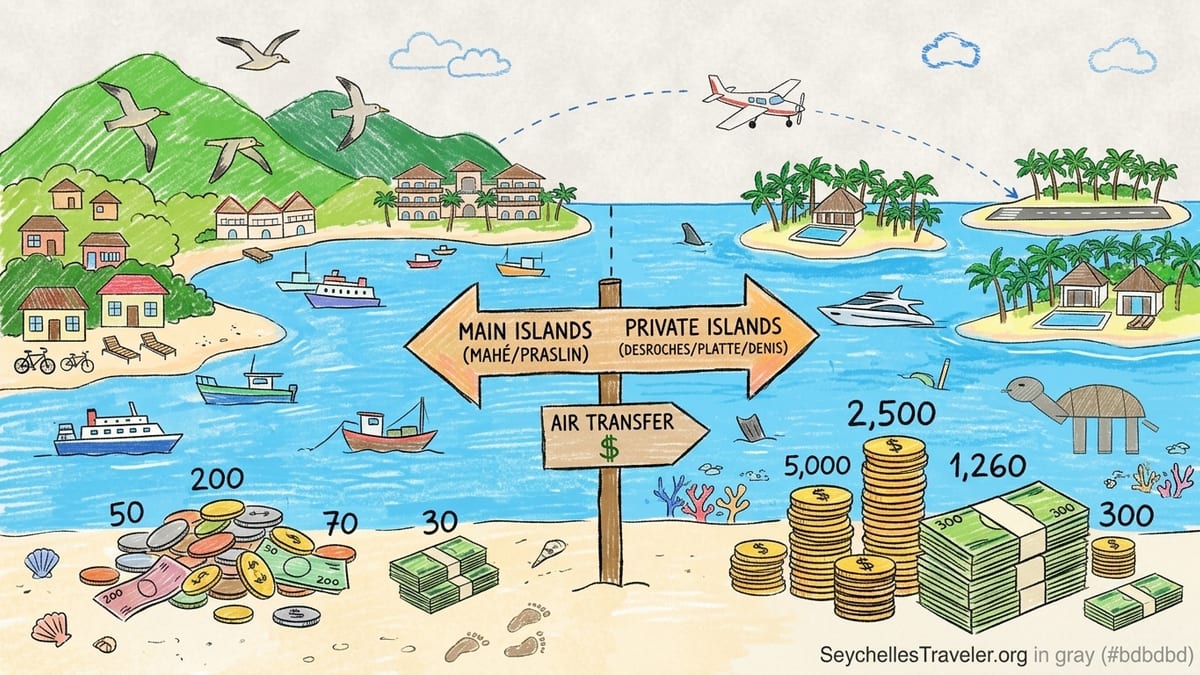
The first shock came before I set foot on any sandbar. Reaching the remote coralline islands almost always means a private or semi-private plane, operated by third parties out of Mahé. At Four Seasons Desroches, return flights on the 35-minute hop from Mahé are currently listed at around 550 euros per adult in the shoulder season from October to December 2026, plus 15 percent VAT. That works out to roughly 630 dollars per person. Two adults are therefore adding about 1,260 dollars simply to get on and off the island, on top of their villa rate.
Waldorf Astoria Seychelles Platte Island is similar but slightly more opaque. The resort is accessible only by private plane on a 25-minute flight from Mahé, and unless you hit a promotion that offers complimentary transfers on stays of five or six nights or more, recent guest reports put the standard return transfer at about 700 euros per adult. Converted and grossed up, this is roughly 1,620 dollars in flights for two adults before you have eaten a single canapé. Promotions that bundle flights can significantly soften this blow, but they are limited to specific travel windows and booking deadlines.
Alphonse Island Lodge presents the costs more straightforwardly because so much is packaged. Their current 3-night Beach Bungalow Leisure Package is published around 4,365 dollars per person sharing outside peak fishing weeks. That price already includes return charter flights from Mahé, full board dining and a long list of activities. A separate nightly rate for Beach Bungalows starts from about 1,490 dollars per person per night on an all-inclusive basis, which, while eye-watering, removes some of the anxiety around every transfer and snack.
Denis Private Island, the outlier of the group, is a small owner-run resort an easy 30-minute flight north of Mahé. Its published nightly rates are on a full-board basis for double occupancy but exclude the air transfer. Recent partner documents for 2026 packages suggest guide prices of about 2,600 pounds sterling per person for seven nights, excluding flights, which points to per-night room rates for two adults in the high hundreds of euros once converted. Return flights are sold separately and priced per person, with an economy of scale if you stay seven nights or more, sometimes including complimentary flights as part of long-stay offers.
Understanding the Seychelles Environmental Levy and Other Taxes
At first glance a few hundred rupees per night does not sound decisive when you are paying thousands. In practice, the Seychelles Tourism Environmental Sustainability Levy adds up quickly on multi-night island itineraries. The official structure that came into effect on 1 August 2023 set the island-resort rate at 100 SCR per eligible guest per night for properties located on islands other than Mahé, Praslin, La Digue or Cerf. In everyday terms that is roughly 7 US dollars per adult per night at recent exchange rates.
Two things matter. First, the levy applies per person, not per room. Second, the exemptions are narrow. Children 12 and under are exempt, as are Seychellois citizens, residents and airline or yacht crew. For almost everyone else flying in from Europe, North America or Asia, the charge appears on the room folio as a nightly line: 100 SCR multiplied by the number of adults and nights. On a seven-night stay for a couple at an island resort this becomes 1,400 SCR, or around 100 dollars. It is not trip-defining on its own, but it interacts with other per-person pricing in subtle ways.
All of the islands in this investigation also apply the national VAT of 15 percent on most services, including domestic flights, many food and beverage items and spa treatments. Some quote prices inclusive of VAT and any service charge, others add them later. Alphonse’s package rates fold everything in and specify that domestic flights and full board are included. Four Seasons Desroches, Denis and Waldorf Astoria Platte typically show base villa rates that include breakfast or full board and all taxes, but then sell domestic air, special excursions and higher-category meal plans on top, usually plus VAT. A 200-dollar snorkeling trip is suddenly 230 dollars once tax and service have been applied.
If you are used to city hotels where taxes are modest, the Seychelles’ layered structure has a conditioning effect. By the time you have absorbed transfer taxes, service charges, VAT and the sustainability levy, a large share of your total is going to the state or to third-party aviation, not to your villa or the reef you came to see.
Why Alphonse’s Per-Person Package Breaks the Comparison
Alphonse Island Lodge exposes a core misunderstanding in online price comparisons. Its Beach Bungalow rates look outrageous in isolation: in 2026, published from 1,490 dollars per person per night on an all-inclusive basis. But that figure is per person, not per bungalow. When you dig into the lodge’s current rate sheet, the three-night Beach Bungalow Leisure Package comes in around 4,365 dollars per person sharing. At first glance, that seems well above the roughly 5,000 to 6,000 dollars you might pay for a three-night entry-level villa at a brand-name private island that quotes rates per room.
The catch is that Alphonse’s 4,365 dollars already includes return charters from Mahé, full board or all-inclusive dining depending on season, non-motorised watersports, guided snorkeling, some scheduled activities, use of snorkel and watersports gear, and even the loan of fly-fishing rods and reels. The only big exclusions are international flights, specialist excursions, alcoholic beverages not listed in the inclusions, and premium fishing or dive packages. The island also publishes longer packages, like a seven-night leisure bundle from about 8,345 dollars per person sharing, which again wraps flights and food into one headline number.
Compare that to a three-night stay for two adults at Four Seasons Desroches or Waldorf Astoria Platte in a base villa. In mid-season, it is not hard to find nightly rates hovering around 2,500 to 3,000 dollars including breakfast for a pool villa. Over three nights your villa might cost around 7,500 to 9,000 dollars plus tax. Add roughly 1,260 dollars in return flights for two to Desroches or 1,620 dollars to Platte, then 100 dollars or so in environmental levy and you are already in the 9,000 to 11,000 dollar bracket for a long weekend, excluding most lunches, dinners, drinks, spa and activities.
With Alphonse’s all-inclusive structure, two adults paying a combined 8,730 dollars for three nights in a Beach Bungalow have a genuinely different cost profile. Transfers and standard activities are covered. Full board is covered. Snorkel trips that cost 150 dollars per person elsewhere may be included or heavily subsidised. The price is punishing, but you are far closer to a closed wallet than you would be on a room-only or breakfast-only private island. This is why treating Alphonse’s per-person price as directly comparable to a per-room villa elsewhere is misleading. One is an entire trip; the other is just the roof over your head.
Building Real Budgets: Three Nights vs Seven Nights
Putting structure around the emotion of sticker shock, I built two sample budgets for two adults on each island, one for three nights and one for seven. These are not precise quotes but realistic working scenarios using current rates and typical spending patterns for travellers who eat on property, book a couple of experiences and drink without going to extremes.
On Four Seasons Desroches, assume an entry villa around 2,700 dollars per night including breakfast in shoulder season. Three nights gives a room subtotal of 8,100 dollars. Add return flights at about 630 dollars per person including VAT, for 1,260 dollars. Plan on a light hotel lunch and proper dinner for two at 300 to 350 dollars per day including drinks, or about 1,000 dollars over three days. Sprinkle in 400 dollars for a simple couple’s spa treatment and one paid activity. The environmental levy adds roughly 50 dollars. Your three-night total is just under 10,800 dollars.
Stretch the same assumptions to seven nights and the compounding effect appears. Villa: 18,900 dollars. Domestic flights are still 1,260 dollars. Dining and drinks at 350 dollars a day climb to 2,450 dollars over the week, even if you occasionally skip lunch. Add three excursions and another spa afternoon for 1,200 dollars. Environmental levy rises to about 100 dollars. The working total hovers around 23,900 dollars for a week for two, excluding international flights.
On Waldorf Astoria Platte, recent guest data and rate searches suggest nightly villa rates often sit in the 2,500 to 3,000 dollar band for base categories, nudging higher in peak periods. Using 2,800 dollars as a working number, three nights cost 8,400 dollars. If you do not benefit from a complimentary-transfer promotion, add 700 euros per person plus VAT, roughly 1,620 dollars for two. Meals and drinks in a luxury brand resort frequently mirror Desroches, so budget another 1,000 dollars over three days. A couple of spa treatments and a private sandbank picnic might easily reach 700 to 900 dollars. The levy adds around 50 dollars. A plausible three-night total is therefore in the 11,500 to 12,000 dollar range.
Alphonse’s all-inclusive package scrambles the maths. The three-night Beach Bungalow Leisure Package for two adults comes to about 8,730 dollars combined. That covers accommodation, full board, domestic flights and a wide suite of non-motorised activities. Add an estimated 100 dollars in levy over three nights and perhaps 500 to 700 dollars for premium alcoholic drinks and one paid specialist excursion not included in the package. A realistic all-in total is perhaps 9,500 dollars for the same three-night period, closing the gap with Desroches and Platte significantly, and in some cases undercutting them once you factor in everything you would have bought separately on the branded islands.
At Denis Private Island, assume a full-board Beach Cottage in 2026 at around 800 to 900 euros per night for two in shoulder season once converted from euro-per-adult guide pricing. Taking a midpoint of 850 euros, or about 920 dollars, three nights are roughly 2,760 dollars. Add domestic flights, often sold around several hundred euros per person return, say 350 euros each, or 760 dollars for two including taxes. With full board, you mostly pay for drinks and extras. Budget 500 to 600 dollars for drinks over three days and 400 dollars for one excursion and a treatment. Levy adds around 50 dollars. The three-night total sits near 4,400 to 4,600 dollars, making Denis feel like a relative bargain in this ultra-remote company, though its villas and facilities are intentionally more understated than the brand-name palaces.
What Happens When Weather or Logistics Go Wrong
Pricing remote islands is not just about numbers on a sunny day. The fine print around deposits, cancellations, minimum stays and weather disruptions is where the real risk of luxury isolation shows itself. All four islands work with fixed domestic flight schedules. Alphonse, for example, has weekly or twice-weekly charters built around specific package durations, with a year-round minimum stay of three nights and seven nights over festive and Easter periods. Waldorf Astoria Platte and Four Seasons Desroches run once-daily scheduled flights in most seasons, meaning you often need to overnight on Mahé either before or after your island stay to mesh with international arrivals.
Deposits for these properties are commonly 25 to 50 percent at booking, rising to 100 percent non-refundable closer to arrival, especially over peak dates in December and January. Flexible policies introduced during 2020 and 2021 have largely tightened again. Some agents can negotiate more generous cancellation terms, but if you book direct you should expect strict windows within which changes incur substantial penalties.
Weather is the wildcard. The small aircraft that service Alphonse, Denis, Desroches and Platte operate under visual flight rules and are subject to the trade winds and tropical squalls that define the Seychelles seasons. Official language on most flight information sheets makes this clear: operations are subject to weather and schedules may change. In practice, this can mean delayed or occasionally cancelled flights. When that happens, your rights are fuzzier than with a major airline. Typically, the resort and its aviation partner will move you to the next available flight at no additional fare, and if the disruption is substantial they may offer a goodwill gesture, but cash refunds or compensation are limited.
The upshot for guests is twofold. First, you should never plan a same-day connection between a long-haul international flight and a remote-island departure, no matter what the brochure implies. Build at least one buffer night on Mahé at the start or end of your trip. Second, you need to value the psychological cost of being tied to once-a-day or once-a-week planes. If poor weather cuts a three-night stay to two, you may still be paying the full package rate and find yourself eating the lost night as a sunk cost.
Is the Isolation Premium Buying Real Value?
With the budgets and risks laid bare, the question becomes more qualitative. Are you actually getting something on a remote coral atoll that you cannot obtain more cheaply on Mahé, Praslin or La Digue? On the positive side, all four islands deliver an intensity of privacy that conventional beachfront hotels cannot. At Four Seasons Desroches and Waldorf Astoria Platte, private-pool villas are widely spaced along miles of beach, with mature vegetation preserving sightlines. At Alphonse and Denis, development is low-rise and limited in scale, with no day-trippers. Night skies feel close enough to touch. You can walk long sections of the shoreline without seeing another guest.
Service on these islands is tight, and in the case of the big brands, highly polished. Pre-arrival teams organise dietary notes and preferences. Concierges remember your sunrise coffee order. At Denis and Alphonse, where the ownership is deeply involved in conservation, there is a sense of being looked after by people who know every turtle that nests on their beach. Dining pushes beyond the standard resort buffet. Denis sources much of its produce from its own farm. Alphonse makes a feature of line-caught fish and offers relaxed family-style island dinners. Desroches and Platte leverage brand-level culinary direction, with multiple outlets and the option of in-villa dining that is difficult to replicate in a small guesthouse.
Conservation access is the other pillar of value. Denis has participated in bird reintroductions and marine-protection work for years, turning the island into a living conservation case study. Alphonse is renowned in specialist fishing and diving circles, with guides who can take you to flats where you might not see another human all day. Platte is surrounded by rich reef systems far from the day-boat dive sites off Mahé. If you are motivated by immersive nature, the chance to snorkel in gin-clear water with minimal boat traffic is hard to price but plainly real.
Yet part of what you pay is still the fact that there is nowhere else to go. Bar prices and excursion tariffs are set in the context of a captive audience. Lunch for two with a couple of drinks on Desroches or Platte can easily reach 150 to 250 dollars, with little ability to walk to a cheaper beach café. Hour-long massages priced upwards of 200 dollars are presented as standard. A two-hour private sandbank picnic might cost 400 dollars or more, before drinks. Isolation is a genuine luxury on these islands, but it is also a mechanism that allows yields per guest to climb well beyond what the headline room rate suggests.
What the Same Money Buys on Mahé, Praslin or La Digue
To test whether the private islands remain defensible, I reallocated some of these sample budgets to the main islands. What could you do with, say, 10,000 to 12,000 dollars for a three-night stay for two? On Mahé, that sum would easily cover a week in a top-tier villa at a flagship resort such as Four Seasons Mahé or another high-end beachfront property, inclusive of half board and airport transfers, plus a rental car, multiple private excursions, a dive package and spa treatments. Daily restaurant prices on Mahé and Praslin are not cheap, but you have options. Casual takeaways can be as low as 80 to 100 SCR per person, while mid-range beachfront dinners with drinks are often in the 50 to 70 pounds per person range. With that flexibility, a substantial chunk of a 10,000-dollar budget remains unspent.
On La Digue, where cars are largely replaced by bicycles, accommodation spans from charming guesthouses at a few hundred dollars per night to boutique hotels. With 12,000 dollars, you could comfortably book ten nights in one of the island’s best-rated small hotels, eat well at local restaurants, hire guides for hikes and boat trips, and still have enough left over to charter a private day boat to neighbouring islands. The experience would be less choreographed than a private island and the beaches busier, but the trade-off is cultural contact and a feeling of moving through a living country rather than a curated bubble.
There is an emotional element too. Spending nearly 25,000 dollars for a week on Desroches or Platte concentrates risk. If you happen to catch a windy or rainy week, you are largely confined to expensive indoor comforts and a limited menu of wet-weather diversions. The same money spread across Mahé, Praslin and La Digue buys you variety. You can chase the best microclimate on a given day, change restaurants and driving routes, and encounter Seychellois daily life in a way that is almost impossible when everything from your breakfast papaya to your evening rum punch is mediated by a single resort.
This is not to say that the remote islands are irrational choices. If your primary goal is secluded rest or a once-in-a-lifetime fishing or diving expedition, the concentration of quality on Alphonse or Denis in particular is compelling. But if you are looking for generalised tropical relaxation, good food and attractive beaches, and you measure value in experiences per dollar rather than square metres of empty sand per person, the main islands start to look like the smarter use of a finite budget.
The Takeaway
After a week of spreadsheets and simulated bookings, I came away with a conflicted view of Seychelles’ private coral islands. Four Seasons Desroches and Waldorf Astoria Platte charge numbers that only make sense if you actively crave brand polish, privacy and curated seclusion, and if you are prepared for a long tail of extras that keep surfacing at checkout. Their nightly villa rates by themselves do not tell the truth; you need to budget transfers, domestic taxes, island levies and on-property pricing that takes full advantage of your captivity.
Alphonse Island Lodge, surprisingly, emerged as the most intellectually defensible of the ultra-remote options, not because it is cheap but because its headline packages acknowledge reality. When a three- or seven-night price per person already includes charter flights, full board and a serious menu of activities, the premium feels more honest. You pay heavily, but you know in advance you will not be signing a credit-card slip for every snorkel or cup of coffee. Denis Private Island sits in a slightly different category again: more old-school and understated, with rates that undercut the global brands while delivering full board, intimacy and a palpable conservation story.
Asked which premium services I would happily pay for again, my answer is clear. I would invest in the domestic flights to reach an island where the reef is genuinely healthy and the conservation work is credible. I would pay for guided snorkeling and specialist diving or fly-fishing excursions run by people who know and care about their waters. I would also spend on a small number of unrepeatable experiences: a turtle-tagging trip, a night walk with a naturalist, or a dawn sandbank picnic that feels like a privilege rather than a product.
What I would resist next time are the lazy luxuries that swell the bill without deepening the experience. I would skip generic spa menus with hotel-city pricing, nightly private in-villa dinners where the view is identical to the communal deck, and branded sundowner rituals that cost four times what the same rum punch and sunset would on La Digue. I would also think twice before paying top-tier cash rates for a logo when an owner-run island like Denis or a well-structured package on Alphonse offers richer substance for less money.
In the end, Seychelles’ private coral islands are not simply overpriced or fairly priced. They are exactly as expensive as the value you place on being cut off from the world, bound to a twice-daily flight, and freed from decisions other than whether to snorkel, sleep or eat. For some travellers, that is worth every last rupee of levy and every hidden transfer fee. For others, the same money buys a far deeper relationship with these islands by trading a little privacy for a lot more freedom.
FAQ
Q1. Are domestic flights to Seychelles private islands included in room rates?
Usually not. On Four Seasons Desroches, Waldorf Astoria Platte and Denis Private Island, domestic flights are typically charged separately per person, sometimes bundled only in special offers. Alphonse Island Lodge is the main exception, as many of its per-person packages include return charter flights from Mahé.
Q2. How much should I budget for domestic flights to Desroches or Platte?
For Desroches, recent fare schedules show around 550 euros per adult return in 2026 shoulder seasons, plus VAT. For Platte, guest reports and documents indicate about 700 euros per adult return when flights are not complimentary. For two adults this adds roughly 1,300 to 1,600 dollars to your total.
Q3. What exactly is the Seychelles Tourism Environmental Sustainability Levy?
It is a per-person, per-night environmental levy introduced in August 2023. For island resorts, the rate is 100 Seychellois rupees per eligible guest per night. Children aged 12 and under, Seychellois citizens, residents and airline or yacht crew are exempt, but most international adult guests will see it as a nightly line on their bill.
Q4. Why are Alphonse Island’s prices shown per person rather than per villa?
Alphonse largely sells all-inclusive per-person packages that bundle accommodation, domestic flights, full board and many activities. Because so much is included, it makes more sense for the lodge to price per guest instead of per bungalow. This structure makes direct comparisons with room-only villa rates on other islands misleading unless you add in all extras there too.
Q5. Are private islands in Seychelles all-inclusive by default?
No. Alphonse Island Lodge leans heavily into all-inclusive packages, and Denis Private Island includes full board. In contrast, Four Seasons Desroches and Waldorf Astoria Platte usually include breakfast or half board as standard, with lunches, many dinners, premium drinks, activities and spa treatments charged separately.
Q6. How do cancellation policies work on these remote islands?
Policies vary by property and season but are generally strict. Deposits of 25 to 50 percent are common at booking, becoming fully non-refundable closer to arrival, especially over festive periods. Changes inside the penalty window often incur significant fees, so comprehensive travel insurance is advisable.
Q7. What happens if bad weather disrupts my island flight?
Domestic flights to islands such as Desroches, Platte, Alphonse and Denis are operated by small aircraft subject to weather and visibility. If a flight is delayed or cancelled, resorts usually rebook you on the next available service without extra fare, but compensation beyond that is limited. You may lose a night on the island or need an unplanned stopover on Mahé at your own cost.
Q8. Is it cheaper to stay on Mahé, Praslin or La Digue instead of a private island?
Almost always, yes. With the amount you might spend on three nights for two on a private island, you could often fund a week or more on the main islands in high-end accommodation, add a rental car, private excursions, restaurant meals and still spend less overall, especially if you mix upscale hotels with smaller guesthouses.
Q9. Which extras on private islands tend to offer the best value?
Guided snorkeling, diving, specialist fly-fishing and conservation-focused activities generally provide strong value because they give you access to pristine reefs, wildlife and expert knowledge that are hard to replicate elsewhere. Well-designed all-inclusive or full-board packages that bundle flights and key activities can also be good value compared with paying à la carte.
Q10. Which luxury add-ons are least worth the money on Seychelles private islands?
Private in-villa dinners that duplicate what you can eat in communal spaces, generic spa treatments priced at global-brand city levels, and branded sundowner or champagne rituals often add little to the core experience while inflating the bill. If you are watching value, these are the first extras to question or skip.