


I thought I had engineered the perfect Indian Ocean escape. In November 2025, I booked a Four Seasons Desroches package that tied neatly into a same-day overnight flight from Mahé back to Europe. The resort’s glossy materials promised a seamless 35-minute hop on an Islands Development Company flight, departing Desroches late morning, connecting comfortably to my early afternoon international departure. Then the reality of outer island logistics intervened. A schedule change pushed the Desroches to Mahé flight 40 minutes later, strong headwinds made the 35-minute hop closer to 50, and a brief runway inspection on Mahé held us on the tarmac. For two tense hours I watched my nonrefundable long-haul ticket teeter on the brink while my checked dive gear sat in a small hold with no possibility of priority offload or through-check. I made my flight by fewer than twenty minutes. Had I missed it, rebooking would have cost more than 900 euros one-way. That morning crystallised a simple resolution: I will never again book a tight international connection off a Seychelles outer island flight.
Why Outer Island Flights Are Not Like Domestic Hops in Europe
The Seychelles outer islands look close on a map, and operators understandably sell the romance of a “short scenic flight” as if it were a casual domestic hop. It is not. These are remote coral islands reached by small aircraft operated by or on behalf of the Islands Development Company, usually with just one scheduled rotation a day and strict weight limitations. Weather, operational checks and runway constraints all bite harder when there is no alternative airport down the road.
Desroches, for example, is linked to Mahé by a dedicated 35-minute flight that usually departs Mahé at 10:30 and returns from Desroches at 11:30, with a stated possibility of a 30-minute discrepancy. Official material explicitly warns that timings may change at short notice and that some guests will need to spend a night on Mahé to make international connections work. The round-trip fare for October to December 2026 is listed at 550 euros per adult before 15 percent VAT, which pushes the cost to more than 630 euros. That is on top of already premium room rates, and crucially, the flight is operated by a third party and not included in the nightly accommodation price.
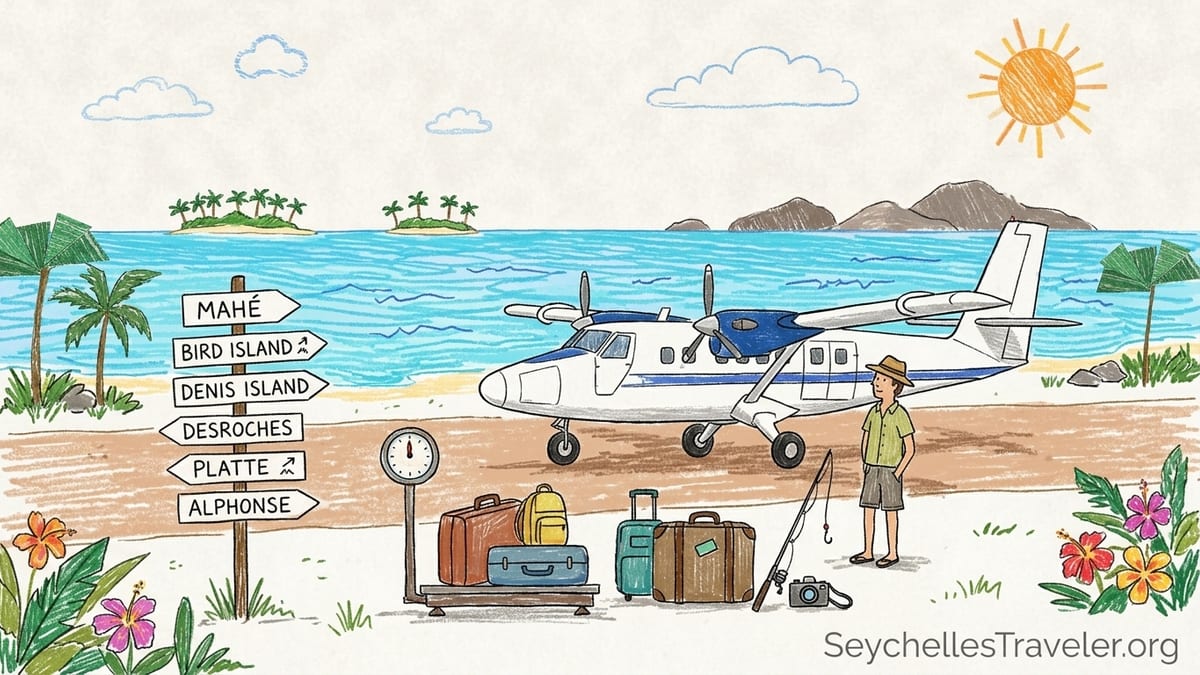
Other outer islands are even less forgiving. Bird Island publishes a simple pattern: a single scheduled flight between Mahé and Bird on Monday and Friday afternoons, around 14:00 ex Mahé and 14:45 back, with a 30-minute flight time. Denis Island operates scheduled services five days a week, currently Tuesday, Thursday, Friday, Saturday and Sunday, typically late morning from Mahé and returning just after noon. Alphonse Atoll and Platte Island are served primarily for lodge guests on narrower timetables, often tied to fixed seven-night fishing or leisure packages rather than daily scheduled services. In every case, a disruption to that small-plane timetable usually means waiting many hours or even until the next operating day, not simply hopping onto an hourly shuttle.
Bird and Denis: Limited Schedules, Strict Baggage and Package Confusion
Bird Island may be only about a hundred kilometres northwest of Mahé, but logistically it might as well be in another country. The island confirms there is a scheduled flight between Bird and Mahé on Monday and Friday afternoons, normally departing Mahé at 14:00 and returning at 14:45. Seats are booked together with your villa reservation, which encourages the assumption that “the logistics are taken care of.” What is easier to miss, buried in FAQ sections, is that the luggage allowance is just 15 kilograms per person, with no possibility to pre-purchase excess. Excess baggage might travel later if space allows, which for a one-week stay can mean your gear arrives a full day or more after you do.
Denis Private Island follows a similar model but with a somewhat more frequent pattern. Once your stay is confirmed, return airfare is automatically reserved with your room reservation. Scheduled flights operate five days per week, currently Tuesday, Thursday, Friday, Saturday and Sunday, usually leaving Mahé at 11:30 and Denis at 12:15, for an approximate 30-minute flight time. The published cost is 600 euros per person return, and, again, that is separate from villa rates. Guests are allowed one piece of checked baggage not exceeding 15 kilograms, plus a small piece of hand luggage up to 7 kilograms. Trolley bags are explicitly not permitted as hand luggage. Large camera cases and rigid sports bags are likely to be checked and strictly weighed.
For a typical long-haul traveler who arrives on an airline ticket that allows at least 23 kilograms of checked baggage, these limits can come as a nasty surprise. International booking flows often highlight “baggage included” or “two checked bags” in big friendly text, only for the fine print on the island side to quietly override everything once you step onto a 16-seat aircraft. If you are carrying a 21-kilogram wheeled suitcase off your intercontinental flight, there is no option to simply pay a standard overweight fee to Bird or Denis. At best your bag might follow on a later flight. At worst you will be repacking on the floor of the domestic terminal, trying to identify which 15 kilograms of your belongings matter most.
Desroches and Platte: Premium Pricing that Hides Fragile Logistics
Desroches Island, home to Four Seasons Resort Seychelles at Desroches Island, may be the most polished and marketed of the outer islands. The resort describes the 35-minute IDC-operated flight as a scenic bridge to a private island world, and it is indeed spectacular when the weather plays along. The reality, however, is that the flight schedule is more fragile than the glossy brochures suggest. While a daily round-trip schedule is currently advertised for large parts of the year, the resort’s own notes caution that flight timing may vary by up to 30 minutes and that flights are subject to weather and operational considerations.
Crucially, the airfare is not bundled into general room rates. Return economy class flights Mahé to Desroches are priced from about 550 euros per adult outside peak festive dates, rising to close to 800 euros around the Christmas and New Year period, before adding 15 percent VAT. For a couple visiting in late 2026, the domestic flights alone will likely add more than 1,200 euros to the bill after tax. Those flights also have weight limits, although Desroches currently permits a more generous 30 kilograms per paying passenger compared with Bird and Denis.
Platte Island, now home to Waldorf Astoria Platte Island, tells a similar story with a slightly different twist. Inter-island transfers operate as a single daily rotation between Mahé and Platte, timed for resort check-in and check-out rather than for international arrivals. Some recent guests have reported return transfer prices around 550 to 700 euros per person, though certain longer stays include complimentary flights for two. Behind the scenes, internal tariff manuals show that many Platte packages advertise “all prices include round-trip flights,” with an excess baggage charge of around 30 euros per kilogram above the base allowance, usually 15 kilograms. Once again, the promotional headline suggests seamless access, but the operational reality is a single daily small aircraft that leaves little room for error.
Alphonse: Lodge-Managed Flights and Gear-Heavy Travelers
Alphonse Atoll, best known as a world-class saltwater fly fishing destination, is in some ways the purest example of lodge-managed aviation. The airstrip slices across the island, and IDC Aviation operates flights that primarily serve Alphonse Island Lodge and associated fly fishing operations. Public information confirms that flights operate between Mahé and Alphonse two to five times per week, often with a pattern of one scheduled flight per week from October through April, supplemented by additional seasonal flights tied directly to lodge check-in days.
Booking an Alphonse package usually means that domestic flights are wrapped into the overall rate or added as a fixed extra, with guests issued flight vouchers after providing their international flight details. That may sound reassuring, but it also encourages travelers to underestimate how vulnerable their broader itinerary is to changes. Check-in luggage is often strictly limited to 15 kilograms per person, with 5 kilograms of carry-on. Specialist operators that sell Alphonse trips warn that there is no option to pay an overweight fee. If the aircraft is full, the plane cannot legally accept more weight, regardless of how much you are willing to pay.
This is particularly problematic because many Alphonse visitors are precisely the kind of travelers who carry weighty gear: fly rods, saltwater reels, heavy-duty wading boots, waterproof camera housings, underwater strobes and laptop-based photo editing setups. It is not difficult to assemble 10 kilograms of fishing and photography equipment before you even account for clothing. When your airline ticket from Europe or North America promises 23 or 30 kilograms of baggage, the disconnect on arrival in Mahé can be severe and expensive. A last-minute decision to leave a fly rod case or protective housing behind because the small-plane check-in agent has no flexibility is not the start anyone imagines for a dream trip that can easily cost five figures.
The Financial Fallout of Tight Connections and Hidden Costs
The most serious cost risk is not an overweight bag fee. It is the cascade of consequences that follow a missed international connection. In my own Desroches experience, the international ticket back to Europe had been booked on a discounted fare basis. Changing it on the day of departure would have meant buying a new one-way ticket that was pricing at more than 900 euros. That would also have stranded me on Mahé without accommodation, because my inter-island flight and resort stay had eaten up my travel budget. The Four Seasons documentation does advise some guests to consider an overnight on Mahé, but the suggestion sits well below the glowing descriptions of effortless transfers, and many agents present it as optional.
If you proactively build in a buffer, new costs appear. A realistic safety margin heading back from an outer island to catch an international flight is at least 24 hours. That usually means one extra hotel night on Mahé, two additional airport transfers and potentially losing part of a prepaid night on the island itself. On Mahé, a mid-range airport-area hotel typically runs between 150 and 300 euros per night for a double room, depending on season. Two private taxi transfers between the international terminal and a south-coast or Beau Vallon hotel add another 60 to 100 euros return, more if arranged via a high-end property.
Now add the risk of prepaid nights. Outer island lodges routinely operate on fully prepaid, strictly cancellable terms. If your conservative plan is to fly back to Mahé a day early from Bird or Denis, you may have to depart the island after breakfast and forfeit that last night altogether. On Denis, for example, where nightly rates can comfortably exceed 1,000 euros in high season, sacrificing a night to protect a 900-euro intercontinental ticket can feel extremely painful. Yet the alternative is to gamble the entire value of your trip on a single small aircraft that cannot legally depart in marginal conditions or with a technical issue unresolved.
Baggage Limits and the Reality for Divers, Photographers and Anglers
The outer island baggage policies are not arbitrary. Small aircraft operating from short coral runways must balance passenger numbers, fuel, crew and cargo with strict weight and balance constraints. That is why 15 kilograms has emerged as a standard checked allowance for Bird and Denis and for specialist fishing flights to Alphonse and other outer atolls, with a bit more leeway for Desroches. Domestic schedules and tariff manuals underline that difference: Denis and Bird are quoted at 15 kilograms, Desroches at 30 kilograms, and standard inter-island services like Mahé to Praslin somewhere in between.
For most light-packers, 15 kilograms of checked baggage plus a modest cabin bag is survivable. For divers, photographers and anglers headed to remote atolls with limited rental options, it is a serious constraint. A single underwater housing and strobe for a full-frame camera can easily weigh 4 to 5 kilograms. Add fins, mask, regulator, BCD and a wetsuit, and a diver’s kit starts to push 10 to 12 kilograms before any clothing. A fly fishing visitor might travel with multiple 9-foot rods in a hard tube, saltwater reels, wading boots and flats boots, fly boxes loaded with heavy hooks and barbless streamers and a wading pack. That hardware weight does not magically disappear because an airstrip is short.
This is where booking flows become particularly misleading. International airlines typically highlight generous allowances in booking engines, and even some island resorts emphasise the fact that they can help arrange sports equipment carriage on long-haul legs. By the time you discover that your outer island flight does not allow you to buy excess in advance or at the counter, you may already have invested thousands in nonrefundable flights and accommodation. Some operators, such as specialist fishing outfitters that sell Alphonse, are admirably blunt: they tell guests that overweight is simply impossible and urge ruthless packing discipline. But generalist tour operators and online booking engines selling Bird, Denis or Platte often bury these constraints in PDF attachments and back-page FAQs.
Why Booking Flows Create a False Sense of Security
Across Bird, Denis, Desroches, Platte and Alphonse, a common pattern emerges. The headline promise is effortless access: “just a short 35-minute flight,” “return airfare automatically reserved with your villa,” “all prices include round-trip flights.” These phrases are not untrue. They are incomplete. They omit the operational fragility, the narrow daily flight windows, the real baggage caps and the way all of this interacts with long-haul schedules that are often locked in months in advance.
What I find especially problematic is the sequencing of information. When you book a stay on Denis, the return flights are automatically added once your room is confirmed, which feels reassuring. Yet the terms and conditions reveal that if you miss your scheduled departure through a delayed inbound international flight or immigration holdup, additional charges will apply for re-scheduling you on the next available Denis flight. Guests are explicitly responsible for the cost of those extra seats. Bird works similarly, quietly flagging that rescheduling or excess baggage is strictly subject to availability and not guaranteed. Alphonse packages arranged by international outfitters talk a lot about “dedicated charters” without always making it clear that short-notice operational changes can ripple across your entire onward itinerary.
I have lost count of how many glossy brochures and booking pages show couples stepping off a turboprop directly onto soft sand with not a hint of luggage in sight. In reality, check-in agents on Mahé are carefully weighing bags, measuring hand luggage and sometimes even asking passengers for their body weight to complete a load sheet that will satisfy regulators. That is the photo that never makes it into the marketing collateral but which should sit front and centre in any serious conversation about connecting outer island flights to long-haul services.
How I Now Schedule My Own Outer Island Trips
After scraping through that nerve-wracking Desroches to Mahé connection, I changed the way I plan Seychelles outer island trips. First, I now insist on at least one full overnight on Mahé before any outbound international departure. If my inter-island flight is scheduled to land at 11:30 on a Monday, I will fly internationally no earlier than midday on Tuesday. That gives me redundancy for weather holds, aircraft issues and schedule shifts. It also reduces the stress of dealing with immigration lines and security screening after arriving on a full small aircraft with a cabin full of equally anxious passengers.
Second, I aim to arrive on Mahé at least a day before any outbound outer island flight. Bird’s Monday and Friday departures at 14:00 sound as though they leave plenty of time after a morning long-haul arrival. They do not if your inbound is late, immigration is slow or your checked bag goes missing. Denis’s 11:30 departure is even tighter. I would now rather land on Mahé the previous afternoon, sleep well, and walk into the domestic terminal check-in with time to weigh and re-pack calmly if necessary. The cost of a mid-range hotel night and a couple of taxi rides is usually far less than the stress and potential rebooking charges of a misconnected inter-island flight.
Third, I pack to the strictest leg, not to the most generous one. If my journey includes 15-kilogram limits on Bird or Denis and 30 kilograms on Desroches, I plan around 15. Excess goes into a separate duffel that can be stored on Mahé with a ground handler or at a hotel if necessary. Divers, photographers and anglers traveling to Alphonse or Platte would do well to think similarly: identify what is absolutely mission-critical and accept that some luxuries and backup items will need to be left in Mahé storage or at home.
The Takeaway
Remote coral islands in the Seychelles are spectacular, and the short flights that get you there can be beautiful in their own right. None of this is an argument against going. It is an argument for treating these small-plane connections with the respect they deserve. Bird’s Monday and Friday flights with a hard 15-kilogram cap, Denis’s five-day schedule with 600-euro return tickets and similar weight limits, Desroches’ 35-minute service at more than 630 euros after tax for adults, Platte’s lodge-centered transfers at around 550 euros return and Alphonse’s lodge-managed charters for gear-heavy anglers all share the same structural vulnerability: one delayed or cancelled flight can topple your carefully tuned international itinerary in minutes.
If I were advising my past self, I would say this. Never book a same-day outer island to long-haul connection, no matter how tidy it looks on paper. Arrive on Mahé at least one day before you fly to Bird, Denis, Desroches, Platte or Alphonse, and stay at least one night on Mahé after you leave them. Budget for an extra 200 to 400 euros in hotel nights and transfers, and factor in the possibility of sacrificing part of a prepaid resort night to protect a far more expensive intercontinental ticket. Most importantly, before buying any international flights, confirm the exact operating days and times of the outer island services, the baggage allowances, whether flights are included or charged separately and what happens, in writing, if your long-haul or small-plane sectors are delayed.
Outer island marketing will continue to sell the fantasy of hopping from a wide-body jet to a barefoot runway in one graceful move. Those of us who have watched the clock in the Mahé domestic terminal, doing the grim arithmetic of minutes versus check-in cutoff times, know better. With a bit more honesty from operators and a lot more caution from travelers, these islands can remain the dream they look like in brochures, rather than the logistical nightmare they can easily become.
FAQ
Q1. Is it safe to book a same-day connection from an outer island to my international flight?
It is technically possible but risky. Schedules for Bird, Denis, Desroches, Platte and Alphonse can change on short notice, and a delay can easily cause you to miss a long-haul departure. Building in at least one overnight on Mahé before flying home is a far safer strategy.
Q2. Are flights to Denis, Bird, Desroches, Platte and Alphonse included in resort prices?
It varies. Denis usually adds a 600-euro return fare per person on top of accommodation. Desroches flights, around 550 euros before VAT on selected dates, are billed separately from Four Seasons room rates. Platte packages sometimes include flights, especially for longer stays, while Bird typically bundles flights with villa bookings. Alphonse lodge packages often incorporate flights, but they are still subject to separate aviation rules and limits.
Q3. What are the typical baggage allowances on these small aircraft?
Bird and Denis generally allow 15 kilograms of checked baggage per person, with a small carry-on allowance and very limited or no ability to pre-purchase excess. Desroches currently permits around 30 kilograms per passenger. Alphonse and some Platte flights usually restrict checked bags to about 15 kilograms and hand luggage to about 5 kilograms.
Q4. Can I pay extra for overweight bags on outer island flights?
Often you cannot. For Bird, Denis and Alphonse, overweight baggage may only be accepted if there is spare capacity, and on some routes there is explicitly no option to pay for guaranteed excess. Platte sometimes charges a fixed per-kilogram excess fee but still depends on aircraft weight limits. Travelers should assume that strict caps may apply regardless of willingness to pay.
Q5. How much extra time should I leave between an outer island flight and an international departure?
A conservative rule is to avoid same-day connections entirely. If that is impossible, you would want at least 6 to 8 hours between the scheduled arrival from the island and your international check-in time, but even that does not protect you from cancellations. An overnight buffer on Mahé remains the most robust approach.
Q6. What happens if my international flight is delayed and I miss my scheduled island transfer?
In most cases, you will need to rebook onto the next available outer island flight at your own expense, if space and operational conditions permit. Denis, for example, notes that guests are responsible for the cost of re-scheduling and any additional seats required. This can add hundreds of euros and may force you to shorten your stay.
Q7. How should divers, photographers and anglers deal with strict baggage limits?
They should plan around the tightest limit on their route, usually 15 kilograms checked. Prioritise essential gear, use lighter alternatives where possible and consider storing nonessential items on Mahé. It is also wise to discuss specific equipment needs with the resort or operator well before travel, as some may offer limited rental or shared gear on site.
Q8. Are outer island flights more prone to weather delays than larger domestic routes?
They can be. Short coral runways, lack of alternative airports nearby and the small size of the aircraft all make these routes more sensitive to wind, rain and visibility conditions. While Seychelles weather is often good, even a brief storm or runway inspection can cause hours of disruption when there is only one flight that day.
Q9. How far in advance should I confirm flight times and baggage rules?
Confirm them before buying your international tickets and again a few weeks before travel. Ask your resort or operator for the current schedule, baggage allowances, inclusion or exclusion of flights in your package and written policies on delays and missed connections. Timetables and rules do evolve, so relying on old information is risky.
Q10. If I build in an extra night on Mahé, where should I stay?
Many travelers choose mid-range guesthouses or hotels within a 20 to 30-minute drive of Seychelles International Airport to keep transfers simple and costs reasonable. Others prefer to use the buffer night to see more of Mahé by staying at Beau Vallon or on the south coast. The key is to pick a property with reliable transfer options and to factor that night into your overall budget from the start.