


I remember the exact moment the postcard image cracked. On 18 March 2025, I slid off a boat into the lagoon on the northwest side of Mahé, near Beau Vallon, expecting the kind of reef I had seen in resort brochures: a technicolour garden beneath glassy blue water. The sea was calm, visibility around 15 metres, the late-morning sun slanting down through 29-degree water that felt more like a bath than the Indian Ocean of my imagination. Within minutes it was obvious something was wrong. Large stretches of the reef were a drab mosaic of rubble and filamentous algae, with only small patches of living branching and boulder corals clinging on between bare, eroded frameworks. A few corals looked unusually pale, but I was careful not to label that bleaching on appearance alone. Whatever the diagnosis, this was not the reef I had been sold.
From Brochure Reef to Broken Reef
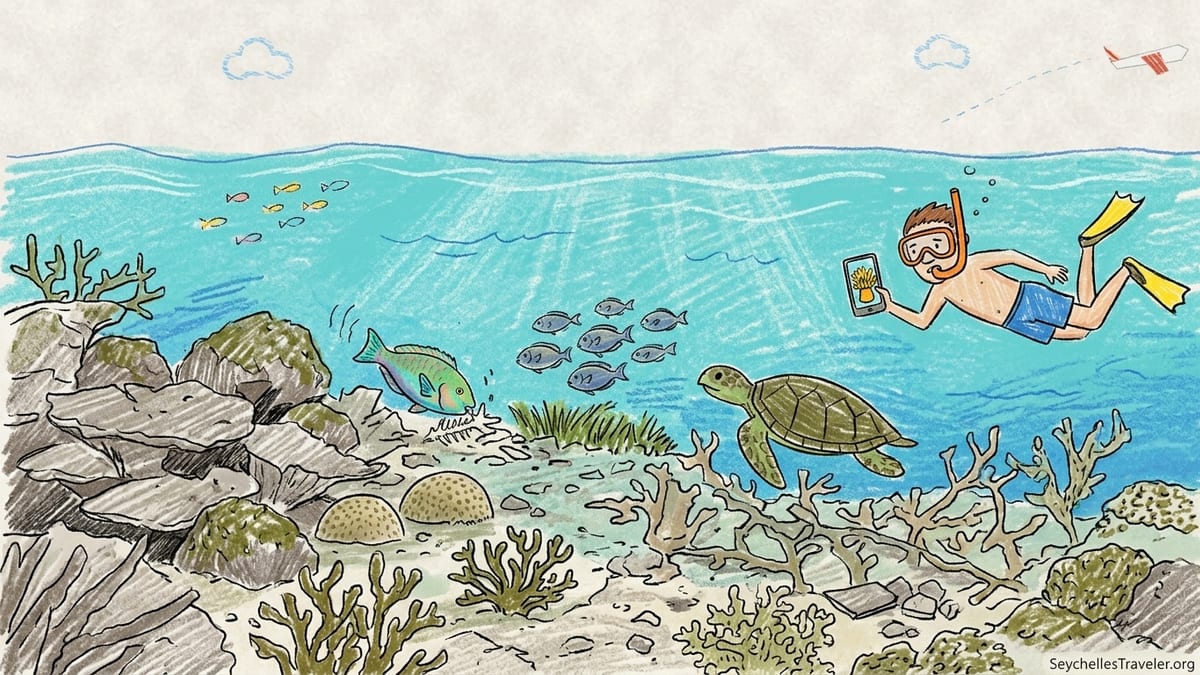
The snorkeling briefing that morning had promised “spectacular coral gardens” and “the healthiest reef in the bay,” language lifted almost word-for-word from glossy marketing copy. Floating over broken plates of Acropora and algae-smothered boulders, I found myself counting live colonies instead of fish: a few small Porites domes here, a clutch of stubborn branching corals there, many surfaces now colonised by turf algae and sponges. Fish life was still present, but patchy. A handful of surgeonfish grazed the algae, a parrotfish scraped half-heartedly at the dead skeleton, and a lone hawksbill turtle cruised by as if to reassure me that some fragments of the idyll remained.
Back on the boat, other guests were enthusiastic. “Amazing corals, so colourful,” one said, showing me a phone picture of a single vivid anemone framed to exclude the metres of dead framework around it. The guide nodded along and emphasised how well “their” reef was doing compared with other places. I realised we had just experienced two very different reefs in the same thirty-minute swim: theirs, built from tight shots and selective memory, and mine, shaped instead by what conservation scientists now say about Seychelles’ coral status after three decades of monitoring.
That monitoring effort culminated in 2026 with the Status and Trend of Seychelles’ Coral Reefs report, led by SeyCCAT and Bee Ecological. Drawing on 3,778 observations from 285 sites between 1994 and 2025, it offers the most complete national picture of reef health the country has ever had. Rather than romantic descriptions, it deals in hard numbers: live coral cover, rubble, macroalgae, and how those have changed through heat waves and storms. It was that report I turned to after my dive day, trying to reconcile my own underwater impressions with the dreamy marketing images that had lured me here.
What I found was sobering. As of 2025, the report estimates Seychelles’ national live hard coral cover at around 14 percent. That single figure has since circulated widely in environmental circles and media summaries, often treated as a simple label for “Seychelles’ reefs.” Yet, like the cropped photos on my fellow snorkeler’s phone, the headline number conceals as much as it reveals.
What the 14 Percent Really Means
The 14 percent live-coral estimate is a national-scale statistic derived from that 32-year, multi-institution dataset. It is an average across inner and outer islands, shallow reef flats and deeper slopes, high-energy and sheltered sites. It reflects what you would see if you could somehow stitch together 285 separate reefs into a single imaginary “national reef” and then measure how much of the seabed is still covered in living hard corals. According to the report’s authors, the figure is based on harmonised survey methods and focuses on sites with enough repeated measurements to show trends rather than one-off snapshots.
Crucially, that 14 percent is not a verdict on any individual reef, island, or resort. It does not tell you what you will see on a specific snorkel at Alphonse, Denis, Desroches or Aldabra, nor does it license anyone to label those sites as “14 percent reefs” without hard, site-level monitoring data. The same national report stresses strong variability: some locations still support reefs with much higher live-coral cover, while others around heavily populated inner islands are dominated by dead framework, rubble and macroalgae. In other words, Seychelles today is a patchwork of survivors, casualties, and recovering reefs, not a uniform 14-percent seascape.
National-scale numbers also flatten the story of time. Before the major 1998 bleaching event linked to a strong El Niño, government reports described many inner-island reefs as having “good live coral cover.” After that heatwave, studies around the central archipelago recorded mean hard-coral cover in the low single digits in the early 2000s, a collapse from which reefs have only partly rebounded. Independent monitoring compiled in the 2026 report shows that between 2023 and 2024 alone, live coral cover across a set of repeatedly surveyed sites fell by roughly 9 percentage points, reflecting the impact of the most recent marine heatwave.
So when a dive brochure assures you that “Seychelles’ reefs are thriving again,” it is worth asking: thriving compared with when, and where, and measured by what? Compared with the devastated early 2000s, many sites certainly look better. Compared with pre-1998 conditions, the national data suggests that Seychelles still lives with a legacy of loss that no camera angle can erase.
Bleaching, Mortality and the Slow Physics of a Reef Collapse
To understand why those numbers matter, it helps to separate a few concepts that are often blurred together in reef tourism language: bleaching, mortality, recovery, and physical damage. Coral bleaching in the scientific sense refers to the breakdown of the partnership between corals and their symbiotic algae under stress. When sea temperatures stay too high for too long, the corals expel or lose these algae, which strips away much of their colour and, more importantly, their main energy supply. Bleaching can be partial or complete, and corals can recover their symbionts if stress abates, or die if it does not.
From a snorkeler’s perspective, this gets tricky. Pale or bright white corals are sometimes bleached, but they can also simply be naturally light-coloured species, recently dead skeletons overgrown by fine algae that is hard to see in bad visibility, or corals reacting to other stressors. Ecologists in Seychelles and beyond caution against diagnosing bleaching from tourist photos alone. Proper assessments rely on repeated visits, species-level identification, and measurements of temperature stress, not just a momentary look at colour.
Mortality is the point of no return. A coral that has lost its symbionts and starved long enough will die, leaving its skeleton behind. At first that skeleton can still resemble a live coral garden, particularly in places where death has been recent and algae has not yet taken over. This is one reason travel photography can be so misleading. A wide-angle image taken over a reef that died a few months ago can still show intricate structures and seemingly intact colonies. Only close inspection reveals the lack of living tissue and the fine film of algae that marks a dead framework.
Over time, waves, storms and bioeroding organisms break down that framework into rubble. In Seychelles’ inner islands, official policy documents have described many shallow reefs as being now dominated by dead corals and depauperate fish communities. Reef flats that once dissipated wave energy as solid ridges become lower, more porous fields of loose blocks and sand. That has implications not just for fish and snorkeling experiences, but for coastal protection and beach stability. Even if water remains clear and blue, the underwater foundation beneath a postcard bay can be quietly unravelling.
Three Heatwaves That Rewrote Seychelles’ Reefs
The 2026 national coral report identifies three major thermal stress events as turning points in Seychelles’ recent reef history: 1998, 2016 and 2024. Each coincided with periods of extended high sea temperatures monitored by systems such as NOAA’s Coral Reef Watch, which tracks heat stress using “Degree Heating Weeks” and alert levels from Watch through to Alert Level 2. These satellite products flagged bleaching-level stress in Seychelles’ region during all three years, and field surveys documented extensive bleaching and mortality, particularly in the inner granitic islands.
The first big hit came in 1998, part of the world’s first recorded global coral bleaching event. In the Western Indian Ocean, including Seychelles, scientists estimate that up to 90 percent of coral cover was lost at some locations during that episode. Local reports describe inner-island reefs shifting from complex coral gardens to low-relief rubble fields within months. Outer islands, further from land-based stressors, fared somewhat better and have since been described as relative refuges, although they too experienced substantial impacts.
The second major stress peak in 2016 occurred during what NOAA labelled the third global bleaching event. Satellite data again registered high accumulated heat stress around Seychelles, and subsequent surveys around tourism sites such as Beau Vallon and North Mahé reported heavy bleaching and coral loss in shallow water. Local partnerships between resorts and conservation groups refer explicitly to 2016 as a catalyst for new reef rehabilitation work, including coral gardening projects aimed at restoring damaged house reefs.
The most recent thermal spike, in 2024, unfolded against a wider backdrop. In April that year, NOAA confirmed the world’s fourth global coral bleaching event, noting bleaching-level heat stress across all major coral reef regions and confirmed bleaching in countries including Seychelles. Coral Reef Watch products indicated periods when Seychelles’ reef areas reached Alert Level 2, associated with a high risk of significant bleaching and potential mortality. The 2026 Seychelles status report links the 2024 heat stress to sharp recorded drops in live coral cover at monitored sites between 2023 and 2024. Yet, crucially, satellite alerts operate at broad spatial scales and indicate stress, not on-the-ground outcomes at every individual reef. Some sites will have bleached severely, others moderately, and some may have escaped the worst if local currents or depth provided relief.
How Independent Science and Resort Narratives Diverge
Sitting in a beachfront bar that evening in Beau Vallon, I flicked through the dive centre’s brochure while toggling between NOAA maps and SeyCCAT reports on my phone. The contrast was instructive. On the wall, a poster for an outer-islands liveaboard trip showed dense branching coral thickets and clouds of fish. In small print it promised “pristine, untouched reefs” around far-flung atolls. On my screen, international and national sources alike stressed that even relatively remote atolls such as those in the Aldabra and Amirantes groups have been exposed to global-scale heatwaves since the late 1990s. They may be in better condition than many inner-island reefs, but “untouched” no longer exists in a warming ocean.
This is where independent monitoring matters. The 2026 national report pools data from government agencies, universities, NGOs and specialist consultancies, all working to common benthic survey standards. It provides trend lines over three decades rather than one good year. It also makes clear that outer islands as a group still support higher average live-coral cover and fish biomass than most inner islands, which is why conservation finance initiatives now prioritise them as climate refugia. But the report does not single out specific private islands or individual resort house reefs with precise coral-cover percentages. Where those numbers exist, they usually live in technical monitoring reports produced by research partners, not in marketing copy.
Resort narratives, by contrast, tend to work at the scale of a photograph. A house reef can be largely degraded but still provide enough photogenic corners for a skilful photographer to build an image library that looks like a continuous coral meadow. Promotional language also leans heavily on relative comparisons: “healthier than other Indian Ocean destinations” or “one of the last intact reef systems.” Without context, these claims are hard for a traveler to meaningfully evaluate. Compared with which sites, surveyed when, using what methods?
None of this means resorts are always unreliable messengers. In Seychelles there is a growing patchwork of genuine science-based partnerships involving hotels, conservation NGOs such as the Marine Conservation Society Seychelles, and island management bodies. Projects range from coral gardening off Beau Vallon and North Mahé to broader monitoring and restoration work around islands like Silhouette, where resorts fund reef surveys and habitat protection. The point is not that tourism operators are inherently misleading, but that their job is to sell holidays, not to write national status reports, and travelers should read their claims with that lens in mind.
Coral Restoration, Research Partnerships and Honest Storytelling
Walking along Beau Vallon beach the day after my snorkel, I met a Seychellois marine biologist working with a local NGO and a mid-range resort. She invited me to visit their small coral nursery, just a few minutes by boat from shore. Suspended PVC frames held fragments of heat-tolerant coral strains that had survived previous bleaching events. The plan was to transplant these onto carefully chosen degraded patches of reef, increasing local live-coral cover and, over time, structural complexity. It was not the sweeping, instant transformation sometimes implied in donor brochures, but a measured, experimental effort grounded in monitoring and adaptive management.
Elsewhere in Seychelles, similar projects link outer-island resorts with conservation foundations. On privately managed islands like Alphonse and Desroches, conservation staff work year-round on seabird, turtle and reef monitoring, funded partly by tourism revenue and supported by national and international grants. Some of these programmes include long-term coral surveys and limited restoration trials, especially in areas heavily affected by 2016 and 2024 bleaching. Yet even here, practitioners I spoke to were careful. Coral gardening can accelerate recovery at specific sites, but it cannot, on its own, offset ongoing marine heatwaves driven by global emissions. Planting fragments into a warming sea without broader change is like replanting saplings in a forest that keeps catching fire.
The best of these partnerships also experiment with a more honest style of communication. One resort-led conservation centre I visited on Praslin displayed side-by-side images of a nearby reef from 1997, 1999, 2018 and 2024, openly showing the collapse, partial recovery, and recent setbacks. Guides explained to guests why some sections now look brown or algae-covered, why live coral counts matter more than the occasional bright fish, and how both national policies and traveler choices feed back into reef futures. Instead of promising untouched paradise, they invited visitors into an unfolding story of loss, resilience and adaptation.
For a traveler, these details can feel granular. But when you compare operators, they tell you who is engaging with independent science, who is funding monitoring that may end up in national datasets, and who is content to use old stock photos and vague promises of “doing our part.” In a country where national live-coral cover hovers around 14 percent and has recently fallen at monitored sites, that distinction matters.
Global Bleaching, NOAA Alerts and What They Can’t Tell You
Any conversation about Seychelles’ reefs in the mid-2020s sits inside a larger global story. NOAA and the International Coral Reef Initiative confirmed in April 2024 that the world had entered its fourth global coral bleaching event, following earlier global-scale episodes in 1998, 2010, and 2014 to 2017. By mid-2025, NOAA’s Coral Reef Watch programme reported that bleaching-level heat stress had affected a large majority of the world’s mapped coral reef area, with mass bleaching documented in scores of countries. Western Indian Ocean nations, including Seychelles, were specifically mentioned among the affected regions.
Coral Reef Watch communicates risk through a scale of alert levels based on satellite-derived sea surface temperatures. In Seychelles’ waters during early 2024, these products moved into the higher alert categories before dropping back down later that year as conditions cooled. At one point, the degree-heating-week metric, which accumulates the intensity and duration of heat stress, indicated values associated with a high risk of widespread bleaching and potential mortality. These alerts are powerful tools for anticipating and responding to marine heatwaves, enabling scientists and managers to mobilise surveys and mitigation where possible.
What they do not do is prove that every individual reef within a country bleached. The satellite grid cells that underpin NOAA products are large compared with the size of a reef, and local factors such as currents, upwelling, shading and depth can dramatically alter the experience of corals within the same cell. Some sites will be hammered, others partially buffered. That nuance is often lost when bleaching maps are shared on social media or picked up by headlines. A red patch over Seychelles on a global heat-stress map means high regional risk and observed bleaching somewhere in the jurisdiction, not a uniform white-out on every snorkel trail.
This matters for travelers because it shapes expectations. Reading about a global bleaching event, you might assume that a trip to Seychelles in 2026 offers nothing but dead reefs. That would be as misleading, in its own way, as the pristine paradise narrative. The reality I saw, and that the national data confirms, is messier: some reefs are badly degraded, some are middling but recovering, some pockets are still lush. What links them all is vulnerability to further heatwaves in a climate that continues to warm. Appreciating that gradient helps avoid both complacency and fatalism.
The Takeaway
By the end of my week in Seychelles, I had snorkeled reefs that felt heartbreakingly damaged and others that still offered glimpses of the underwater cities I had once imagined. I swam over boulder corals slowly reclaiming rubble fields, watched juvenile fish sheltering among the last surviving branching colonies, and drifted across outer-reef slopes where, for now, live coral still dominates. What tied those experiences together was not a single statistic or dramatic photo, but a sense of living inside a fragile interval: a time when reefs are already changed beyond recognition compared with the 1980s, yet still hold enough complexity to be worth fighting for.
For travelers, the lesson is not to avoid Seychelles or other reef destinations entirely, but to approach them with clearer eyes. Be skeptical of marketing phrases like “untouched,” “pristine,” or “one of the last intact reefs on Earth,” especially when they are not accompanied by references to independent monitoring or long-term partnerships with credible conservation bodies. Treat heavily cropped, hyper-saturated coral images as what they usually are: highlights, not averages. Ask operators direct questions about when their reef photos were taken, whether they support scientific surveys, and how their house reef fared in the 2016 and 2024 heat events.
At the same time, recognise that a reef does not need to be perfect to matter. A coral community with modest live cover, patches of algae and signs of past damage can still support important fish populations, protect shorelines from storms and offer rich experiences for visitors willing to slow down and look closely. By choosing guides and resorts that are honest about this reality, that invest in research and restoration, and that place Seychelles’ reefs in the context of global climate pressures, you become part of a different kind of holiday story. It is less glossy, but more truthful, and it gives the remaining corals a better chance of still being there when the postcards of the future are printed.
FAQ
Q1. Did all reefs in Seychelles bleach during the 2024 global event?
Not all reefs experienced the same level of stress. Satellite data and field reports confirm bleaching in Seychelles, but impacts varied widely between sites depending on depth, currents and local conditions.
Q2. What does the national 14 percent live-coral figure actually tell me as a traveler?
It signals that, on average across hundreds of monitored sites, live hard coral now covers only about 14 percent of the seabed. It highlights broad national degradation but does not predict exactly what you will see on any individual snorkel or dive.
Q3. Can I assume that places like Alphonse, Denis, Desroches or Aldabra also have 14 percent live-coral cover?
No. That figure is national and must not be assigned to specific islands or reefs without dedicated, site-level monitoring data. Some sites have higher coral cover, some lower, and some are changing quickly after recent heatwaves.
Q4. How can I tell if marketing photos reflect current reef conditions?
Ask when and where the photos were taken and whether they come from the resort’s own guides or from older stock libraries. Recent images that show wide scenes, including less colourful areas, are usually more representative than tightly cropped shots of a single coral head.
Q5. Are coral restoration projects in Seychelles actually helping the reefs?
They can help at specific sites, especially when they use heat-tolerant corals and are backed by long-term monitoring. However, restoration cannot fully counter repeated marine heatwaves driven by global warming, so it works best alongside emissions cuts and broader conservation measures.
Q6. How do NOAA thermal-stress maps relate to what I will see underwater?
NOAA maps show regional heat stress and bleaching risk at relatively coarse scales. They are excellent warning tools but do not guarantee that every reef in a coloured grid cell bleached, or that all suffered equal damage.
Q7. What questions should I ask a dive centre to gauge how responsible it is?
Ask if they collaborate with local NGOs or scientists, whether their reefs are part of long-term monitoring programmes, how they responded to the 2016 and 2024 heat events, and what guidelines they follow to reduce diver impact on corals.
Q8. Is it still worth visiting Seychelles if many reefs are degraded?
Yes, provided you come with realistic expectations and choose operators engaged in conservation. Even partially degraded reefs can offer valuable wildlife encounters and your visit can support monitoring and protection work.
Q9. How can I avoid contributing to further reef damage when I snorkel or dive?
Use reef-safe sunscreen or cover up with clothing, never touch or stand on corals, keep good buoyancy control, avoid chasing wildlife, and follow the guidance of trained, environmentally focused guides.
Q10. Where can I find independent information about Seychelles’ reef health before booking?
Look for recent national or regional reef status reports, information from recognised conservation organisations active in Seychelles, and updates from scientific programmes that share long-term monitoring results, rather than relying only on marketing materials.