


My doubts about “eco-luxury” in the Seychelles began with a loading icon. One evening in early 2026, I was on a shaky home internet connection trying to price a stay on a remote coral island. The website background showed a green turtle gliding over perfect reef, while a small badge in the corner promised “sustainability certified” and “carbon conscious travel.” Yet as I clicked through the booking engine and the fine print, the numbers that appeared were not environmental metrics but flight timings, villa sizes and all-inclusive fishing packages. The more I compared islands, the more I wondered: were these places really the future of conservation, or had sustainability language become a soft-focus filter over some very hard environmental costs?
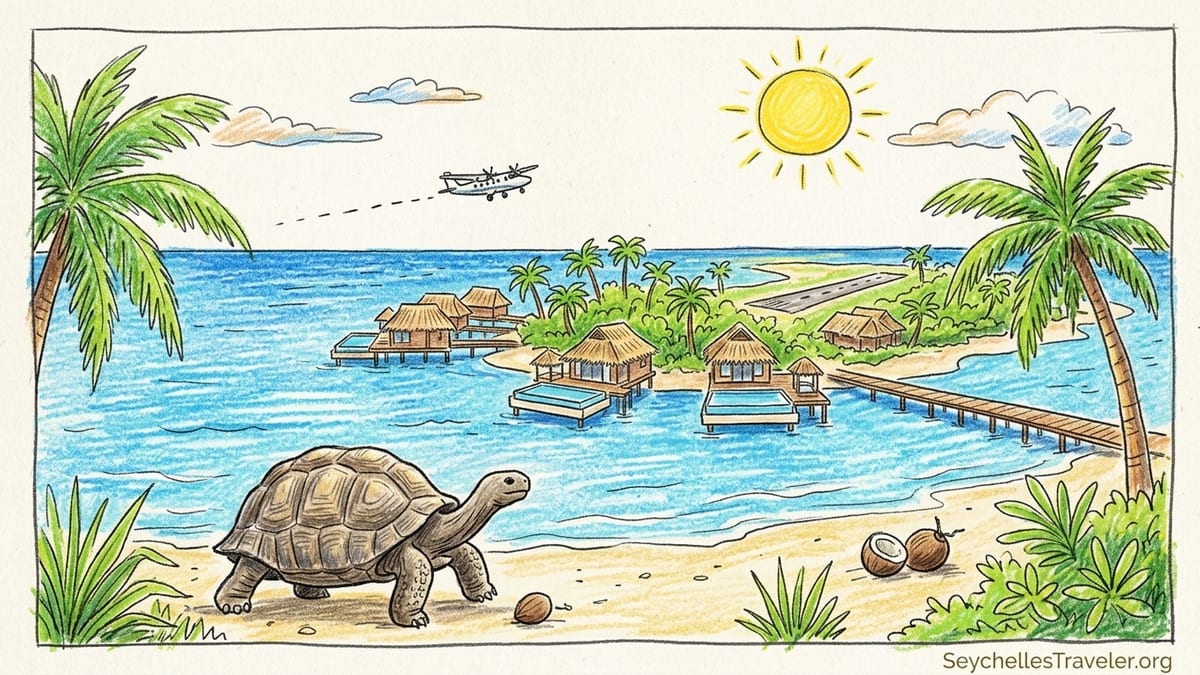
Investigating Ecotourism From Behind a Booking Screen
This is not a story of me sipping cocktails in an infinity pool while counting nesting turtles at dusk. I did not visit every island I discuss here, and I will not pretend otherwise. Instead, this is a first-person investigation built from weeks of booking research, public sustainability reports, interviews with conservationists and government documents. It is, in other words, the view most travelers actually have when deciding whether to spend thousands of dollars on a “conservation-led” private island in the Seychelles.
The pattern first became clear when I opened the sustainability page for Four Seasons Resort Seychelles at Desroches Island. The resort lists a long menu of initiatives, from a 7,000-plus panel solar farm to desalinated and locally bottled drinking water that replaces hundreds of thousands of plastic bottles each year, along with an Island Conservation Society (ICS) tortoise sanctuary and beach cleanups. The language is polished and specific, yet the booking path I followed from the same site quickly flipped back to images of vast villas with private pools, multiple daily flights and multi-course tasting menus flown in from Mahé.
When I cross-checked these pages with independent conservation sources and government marine planning documents, a more complicated picture emerged. Yes, tourism money has supported predator eradication, rare-bird translocations and turtle monitoring on several islands. It has also financed solar plants that reduce diesel use. But the model rests on regular aviation links, resource-hungry luxury infrastructure and fragile coral sand islands already facing sea-level rise. The friction between the sales pitch and the ecological reality is where this story sits.
So I set myself a simple question that is anything but simple to answer: if you book an expensive private island marketed as eco-friendly in the Seychelles, how confident can you be that your money genuinely supports conservation rather than merely branding over its impacts?
The Harsh Physics of Remote Coral Islands
Before looking at individual islands, it helps to understand the physical constraints of the outer Seychelles. These low-lying coral cays and atolls are postcard-beautiful, but from an ecological and logistical perspective they are extraordinarily vulnerable. They have limited or no natural freshwater, meaning that almost all water for guests must be produced through energy-intensive desalination. Their sandy soils make local agriculture challenging, so food is typically flown or shipped in, and waste has to be dealt with on-site or exported at considerable cost.
The reefs that ring islands like Bird, Denis, Desroches, Alphonse, Platte and Cosmoledo are not just snorkeling backdrops. They are living breakwaters that protect the islands from erosion. They are also under pressure from historic coral bleaching events in the Indian Ocean and from warming seas. Any resort that builds jetties, dredges channels for deeper-draft vessels or concentrates boat traffic near reef passes risks adding local stress to a global problem.
Then there is aviation. Most of these islands are accessed by small aircraft from Mahé. The flight from Mahé to Denis or Bird is on the order of 30 to 60 minutes, while Desroches and Alphonse require longer hops. Cosmoledo, near the edge of the Seychelles’ Exclusive Economic Zone, combines flights with boat transfers. Each of these movements burns fuel for the sake of reaching what is marketed as pristine wilderness. Unlike some destinations where visitors can choose trains or ferries, alternative low-carbon access simply does not exist here.
Sea-level rise adds another structural layer of risk. Government climate and biodiversity documents openly describe these outer islands as both biodiversity strongholds and highly exposed to coastal erosion. A resort might install solar panels and ban plastic straws, but if its long-term business plan involves defending a few meters of elevation against an ocean that is slowly rising, its sustainability is at best provisional. The question becomes whether the short- and medium-term conservation gains funded by luxury tourism justify the investment in infrastructure that may be difficult or impossible to withdraw without further damage.
Bird Island: A Pioneering Eco-Lodge Under Pressure
Bird Island sits at the northern edge of the Seychelles Bank and often appears in official tourism promotion as one of the country’s original eco-islands. Conservation here has a long history, including the protection of a huge Sooty Tern colony, monitoring of seabirds in partnership with organisations like Nature Seychelles and ICS, and the protection of hawksbill turtle nesting sites. Government and NGO records note that invasive rats and rabbits have been eradicated, a prerequisite for restoring native bird populations.
The lodge has traditionally been simple by private island standards. Earlier promotional material stressed modest bungalows, no in-room air conditioning and limited Wi-Fi, with the emphasis on birdwatching, turtle encounters and a resident population of giant tortoises. Recreational activities skewed toward walking, snorkeling and low-key guided nature tours rather than motorised excursions or high-end spa packages. When I compared price ranges with other private islands, Bird sat noticeably lower, often competing more with upper-midrange hotels on Mahé than with the ultra-luxury outer-island properties.
Yet even on Bird, sustainability is not effortless. Supplies and fuel still arrive by boat or plane. Desalination plants and generators must run to provide basic services for guests and staff. Conversations with conservationists who have worked in the outer islands underline that monitoring programs are only as sustainable as the revenue streams that support them. When guest numbers drop, research and management budgets are vulnerable, regardless of how strong the ecological values are on paper.
Bird Island shows that an island can prioritise conservation and relatively low-impact tourism, but it also illustrates how dependent these projects are on the very market forces that drive more intensive development elsewhere. It is a fragile equilibrium that could tip either toward deeper protection or toward the lure of bigger villas and higher nightly rates.
Denis and Desroches: Solar Panels, Rare Birds and Private Pools
Further south, Denis Private Island and Desroches Island are often presented as flagship examples of balancing high-end tourism with conservation. Denis has been the site of some of Seychelles’ most celebrated translocations of rare endemic birds. Working with the Green Islands Foundation and other partners, conservation teams have moved species such as the Seychelles fody and Seychelles warbler from other islands to Denis, helping improve their conservation status. Reef research on Denis’ reef flats has contributed to the designation of marine protected areas around the island and to catch-and-release policies for billfish.
Desroches, operated by Four Seasons, combines a major international luxury brand with a locally embedded conservation program. The Island Conservation Society runs a conservation center on the island, with staff involved in turtle monitoring, habitat restoration and education. Four Seasons publicly reports that a significant share of the resort’s electricity comes from an on-island solar farm of over seven thousand panels, that drinking water is produced via desalination and bottled on-site in reusable containers, and that single-use plastic bottles have been eliminated. The resort is certified under the Sustainable Seychelles program, tracks its energy and water use, and supports beach cleanups and a tortoise sanctuary.
This is the part of the story that is easy to like. Tourism dollars underwrite rare-bird conservation, turtle tagging, marine research and renewable energy infrastructure. Guests can, in principle, see where their money goes: a conservation officer explaining turtle nesting data, a field guide discussing seabird numbers, a row of solar panels reducing diesel imports. Compared with a conventional beach resort that publishes no data at all, this looks and feels responsible.
Yet the same booking pages that boast of solar kilowatt-hours also sell multi-bedroom villas with private pools, air-conditioned interiors, plunge pools and in-villa dining. Light aircraft shuttle high-paying guests from Mahé to private airstrips, adding flight legs that would not exist without the resort. The Desroches sustainability management plan itself notes the need to balance guest expectations for comfort with energy and water targets. That tension is built into the business model. When a three-bedroom beach residence with private pool becomes the norm, energy savings from efficient lighting and towel reuse programs start to look marginal.
Alphonse, Cosmoledo and Platte: Conservation Funds Tied to High-Impact Fishing and Flights
Alphonse Island and its satellite atolls such as St François and Bijoutier offer perhaps the most explicit link between ecotourism and conservation finance in the outer Seychelles. The owner-operator, under the Blue Safari Seychelles and Alphonse Fishing Company brands, has helped establish the Alphonse Foundation in partnership with the Island Development Company and the Island Conservation Society. Marketing material and public documents explain that guest levies contribute directly to funding a conservation center and long-term research on seabirds, turtles and reef health.
Cosmoledo, managed by the same group, pushes the model further into the frontier. It is promoted as a remote atoll for world-class fly fishing, with strict catch-and-release rules, limited rod numbers and seasonal operations. Fact sheets state that each guest pays a specific conservation levy that goes to the Alphonse Foundation to fund conservation projects and staff. Government marine spatial planning documents describe Cosmoledo and neighbouring Astove as sustainable-use areas that host both small-scale fisheries and eco-tourism, with Blue Safari operating lodging and fly-fishing activities under a framework that is supposed to limit ecological pressure.
Platte, an outer island where the Island Development Company has worked on both infrastructure and conservation, sits slightly outside the main tourism spotlight but is increasingly mentioned in planning documents and conservation discussions. As with the other outer islands, predator control, seabird monitoring and turtle protection are central themes. Developers and government agencies talk about small-scale, low-density tourism combining with conservation programs led by ICS and similar organisations.
The contradiction is that reaching Alphonse, Cosmoledo or Platte requires not just one but often multiple flight segments, sometimes combined with long boat transfers. Once on site, activities marketed as eco-conscious, such as guided fly fishing over shallow flats, still entail intensive daily boat use, fuel consumption and, inevitably, some level of disturbance to wildlife. Catch-and-release policies, strict gear regulations and research-driven quotas are all valuable, but they do not eliminate the carbon cost of flying a small number of wealthy anglers thousands of kilometres to cast at bonefish and giant trevally in habitats that are also key feeding grounds for turtles and seabirds.
What the Assomption Island Controversy Reveals
In 2026, a different outer island project forced Seychelles to confront these tensions in public. Assomption Island lies roughly 27 kilometres from Aldabra Atoll, a UNESCO World Heritage Site celebrated for its near-pristine ecosystem and its population of Aldabra giant tortoises. For years, campaigners had raised concerns about plans for a luxury hotel and related infrastructure on Assomption, warning that it could threaten Aldabra’s ecological integrity and set a precedent for intensive development in one of the country’s most sensitive marine regions.
In January 2026, the government established a Commission of Inquiry into the lease and proposed development of Assomption. The commission, led by Justice Mathilda Twomey-Woods, held public and private hearings, took evidence from government agencies, the developer, environmental NGOs and scientific experts, and in June 2026 submitted its final report to President Patrick Herminie. The report, later summarised in national media and referenced in a UNESCO statement, concluded that the luxury hotel project had in substance been agreed between the government, the Islands Development Company and the developer before the competitive process designed to test it had properly run its course.
The commission raised concerns about governance, transparency and the adequacy of environmental safeguards surrounding the proposed development. UNESCO, responding to youth petitions and civil society campaigns, noted that Aldabra’s outstanding universal value must be safeguarded and emphasised that any project on Assomption needed to comply with conservation standards. Following the report, the government announced restrictions and further reviews of the project, signalling that it would have to be reassessed in light of the commission’s findings and international conservation obligations.
It is important to stress what Assomption is not. At the time of writing, it is not an operating luxury resort where travelers can book a stay, and it would be inaccurate to portray it as such. Nor did the commission accuse specific individuals of criminal conduct; its focus was on process, oversight and the compatibility of the proposed project with national and international environmental commitments. Yet for anyone weighing the sustainability claims of existing private islands, the Assomption case is a warning. It shows how quickly the language of high-end ecotourism can be attached to developments whose governance and environmental due diligence require independent scrutiny.
Assomption’s proximity to Aldabra also highlights a larger question: at what point does the clustering of multiple resorts, airstrips and marinas around flagship protected areas undermine the very wilderness values those areas embody? When a World Heritage Site becomes a selling point for nearby hotels rather than a boundary to development, travelers need to dig deeper than the marketing slogans.
Following the Money Behind Conservation Claims
After weeks of combing through resort sustainability pages, conservation NGO reports and government planning documents, one basic question remained surprisingly hard to answer: how much guest money actually reaches frontline conservation work on these islands? Many properties state that a portion of revenue or a dedicated levy funds conservation, but very few publish clear, independently verified figures that break this down on an annual basis.
On Alphonse and Cosmoledo, for example, Blue Safari’s material specifies that each guest pays a conservation levy that supports the Alphonse Foundation, which in turn funds research staff, equipment and monitoring programs. That level of detail is more than many resorts offer, but without audited foundation reports or regular public updates, travelers are still left taking much of it on trust. Similarly, Denis and Desroches showcase impressive lists of projects, from rare-bird translocations and turtle monitoring to solar arrays and farm-to-table food production. Yet the exact split between operating costs, shareholder returns and reinvestment in conservation remains opaque from the outside.
I asked several conservation practitioners who have worked in the outer islands what they would most like to see from tourism operators. Their answers converged on transparency: regular public reporting on turtle nesting numbers, seabird colonies and reef condition, but also clear financial reporting on how much money flows from tourism into conservation each year, and how many long-term Seychellois jobs and training opportunities are supported beyond seasonal hospitality roles.
This matters because ecotourism rhetoric can easily outpace reality. A resort can legitimately celebrate eradicating rats, restoring native forest and funding coral research while still locking in a pattern of highly exclusive, high-emission travel available only to a global elite. If that pattern displaces lower-impact community-based tourism or if it pushes development into increasingly fragile outer islands, the net outcome may be less positive than the polished case studies suggest.
None of this erases the fact that without tourism revenue, many conservation projects in Seychelles would struggle. The government’s own biodiversity project lists show how heavily outer-island work has relied on partnerships between NGOs, state entities like the Islands Development Company and, increasingly, private resort operators. The problem is not that tourism funds conservation. The problem is when tourism’s environmental and social costs are hidden behind green branding that offers travelers little way to compare claims and outcomes.
The Takeaway
If you are considering a private island stay in the Seychelles and care about your environmental footprint, you are entering a landscape that is both inspiring and fraught. Islands like Bird, Denis, Desroches, Alphonse, Platte and Cosmoledo host serious conservation work, from predator eradication and rare-bird translocations to turtle monitoring, coral research and renewable energy projects. At the same time, their business models depend on private pools, energy-intensive villas, frequent flights and imported luxuries built on some of the most fragile landforms in the Indian Ocean.
The Assomption Island controversy and the 2026 Commission of Inquiry underline that glossy sustainability narratives can sit atop flawed planning processes and insufficient environmental safeguards. They also show that public scrutiny and international conservation standards still have the power to slow or reshape projects that would place too much pressure on critical ecosystems.
As a traveler, you do not have to solve these systemic contradictions alone, but you can ask better questions. Look for islands that publish clear environmental data on turtle nesting, seabird trends and reef health rather than just photo-rich blog posts. Favour resorts with independent certification schemes that go beyond self-reporting and with conservation partners that have their own reputations to protect. Pay attention to how an island manages freshwater, energy, waste and local food production, and whether it supports on-island scientific staff and long-term training for Seychellois employees.
Most of all, recognise that in a place as exposed as the Seychelles’ outer islands, sustainability is not a static label but a contested, evolving practice. Luxury ecotourism can be a force for good when it is grounded in transparency, humility and science-led limits. It becomes greenwash when it uses conservation as a marketing flourish on projects whose scale and access model fundamentally undermine the ecosystems they claim to protect.
FAQ
Q1. Are Seychelles’ private island resorts genuinely eco-friendly or mostly greenwashing?
Some private islands in Seychelles support serious conservation projects, including predator eradication, rare-bird translocations and turtle monitoring, and a few publish detailed information about solar power, water management and waste reduction. However, many rely on broad sustainability language without transparent data, and almost all depend on emissions-intensive flights and resource-heavy villas, so travelers should treat eco-labels as a starting point for questions, not a guarantee.
Q2. Which Seychelles islands are most associated with conservation-focused tourism?
Bird Island, Denis Private Island, Desroches, Alphonse, Platte and Cosmoledo are frequently cited by tourism authorities and conservation organisations as examples where tourism revenue helps fund initiatives such as seabird restoration, turtle monitoring, solar power plants, coral reef research and sustainable fishing frameworks, though their approaches and transparency levels differ.
Q3. How does flying to remote coral islands affect their overall sustainability?
Reaching outer islands like Desroches, Alphonse or Cosmoledo requires additional domestic flights, and sometimes boat transfers, on top of long-haul travel to Mahé, significantly increasing a trip’s carbon footprint; because there are no realistic low-carbon transport alternatives for these routes, aviation emissions remain a major unresolved contradiction in outer-island ecotourism.
Q4. What kinds of conservation work do private island resorts in Seychelles typically fund?
Resorts and their partner NGOs often invest in eradicating invasive predators such as rats, restoring native vegetation, translocating rare birds to predator-free islands, monitoring turtle nesting and seabird colonies, running coral reef and fish population surveys, operating small farms to reduce imported food and, in some cases, installing solar plants and improving waste management infrastructure.
Q5. What happened with the proposed development on Assomption Island near Aldabra?
In 2026 a Commission of Inquiry examined the lease and proposed luxury tourism development on Assomption Island, close to Aldabra Atoll, and concluded that key agreements had effectively been reached before the intended competitive process was completed; the report raised concerns about governance and environmental safeguards, and the government subsequently announced restrictions and further reviews, so the project is under tighter scrutiny and the island is not operating as a resort.
Q6. How can I tell if a resort’s sustainability claims are credible?
Credible operators usually publish specific environmental data, such as annual turtle nesting figures, seabird counts or solar generation, and have independent certifications or audits, long-term partnerships with recognised conservation organisations, clear policies on fishing and wildlife interaction and transparent explanations of how guest levies or donations are used, rather than relying on vague promises or generic green imagery.
Q7. Do catch-and-release fishing operations like those on Alphonse and Cosmoledo really qualify as ecotourism?
Catch-and-release fly-fishing operations can contribute to conservation by funding research, enforcing strict gear and quota rules and deterring more damaging extractive activities, but they still involve intensive boat use, some level of disturbance to marine life and high carbon emissions from guests’ travel, so their sustainability depends heavily on how carefully they are managed and how transparently impacts and benefits are reported.
Q8. What environmental challenges are unique to low-lying coral islands in Seychelles?
Remote coral islands face acute constraints, including virtually no natural freshwater, highly erodible sandy shorelines, dependence on coral reefs for physical protection, difficulty growing food at scale, expensive and complex waste removal and extreme vulnerability to sea-level rise and storm surges, all of which make permanent luxury infrastructure especially challenging to operate sustainably.
Q9. As a traveler, what concrete criteria should I use when choosing a “sustainable” island stay?
Look for resorts that publish environmental monitoring results, undergo independent sustainability audits, partner with reputable conservation organisations, explain clearly how they manage freshwater, energy and waste, support local employment and training and provide transparent accounting for any conservation levies, so you can see how your spending translates into measurable ecological and community benefits.
Q10. Is it better to avoid private islands altogether if I care about conservation in Seychelles?
Completely avoiding private islands reduces your travel footprint and sends a market signal, but it can also deprive well-run conservation programs of critical funding; a more nuanced approach is to minimise flights, stay longer in fewer places, choose operators that demonstrate transparency and strong conservation partnerships and be prepared to ask questions and support initiatives that prioritise ecological limits over ever-expanding luxury.