


After three separate trips and a lot of sandy laundry, I have learned that the “best beach in Seychelles” depends very much on what you want to do once you drop your towel. Postcard beauty and high‑quality swimming are not the same thing. Some of the most photographed bays are actually quite shallow or rough, while a few quieter, less hyped stretches of sand are where I found the clear, deep water I would happily fly back for. This article compares the Seychelles beaches I personally visited and would still return to, across Mahé, Praslin and La Digue, using the same set of criteria so you can match the right beach to the right day.
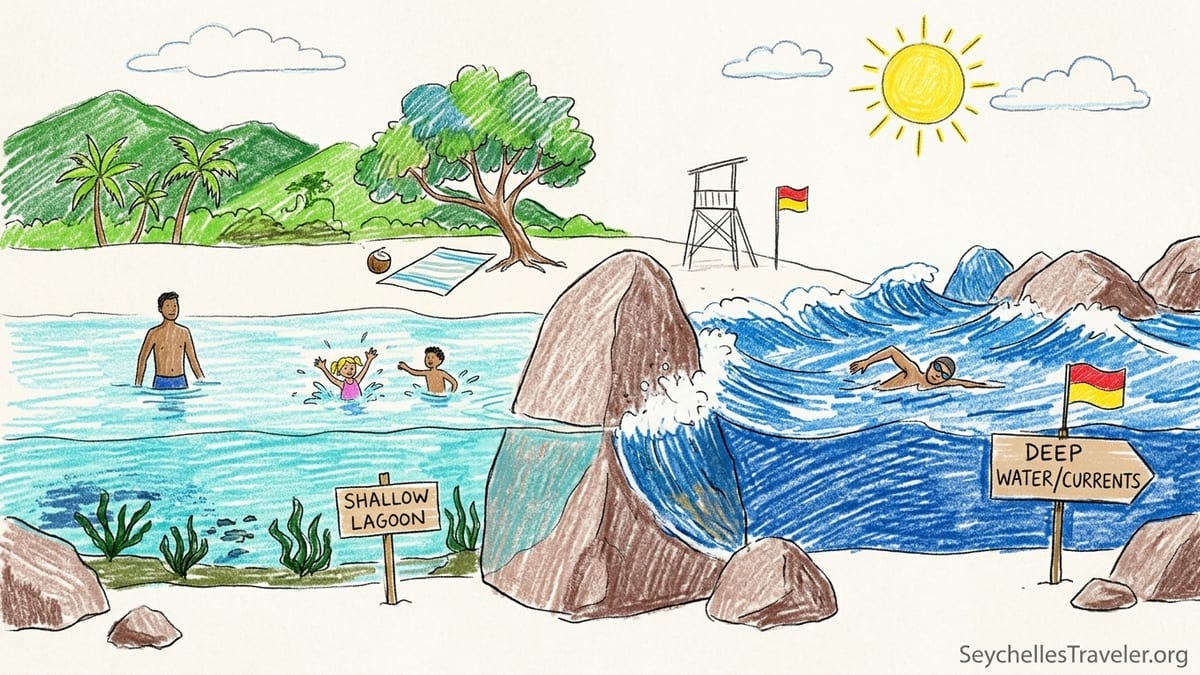
How Seychelles Beaches Really Differ Once You Get In The Water
On paper, many Seychelles beaches sound identical: white sand, granite boulders, turquoise water. In reality, the experience changes a lot once you step off the sand. Some bays have shallow lagoons where the water stays waist‑deep for tens of metres, ideal for nervous swimmers and small children but frustrating if you enjoy proper laps. Others have no protective reef at all, so the sea deepens quickly and the waves can feel like open‑ocean shore break, especially during the northwest monsoon from roughly December to March. I learned quickly that I had to separate beauty from usability.
Local safety information from Tourism Seychelles and the national Beach & Sea Safety Guide repeatedly stresses that currents, wave size and sudden sea‑floor drops are real factors, and that only a handful of beaches have lifeguards on duty. On the main inner islands, lifeguards are typically present at Beau Vallon on Mahé and at Anse Lazio and Côte d’Or on Praslin, while most other bays are unpatrolled. That informed how long I was willing to stay in the water and whether I would recommend a given beach to families or only to confident swimmers.
Seasonal winds also change the mood of a beach. From roughly May to October, the southeast trade winds bring cooler, drier weather but also livelier seas and seaweed accumulation on some south‑facing shores of Mahé and Praslin, a pattern also mentioned in official tourism material. Between November and April, the wind typically shifts to the northwest, softening conditions on those same south coasts but sometimes making the opposite side choppier. Because I visited in both seasons, I experienced some beaches twice in very different states and adjusted my verdicts accordingly.
Finally, practicalities matter. A beach can be magnificent, but if it has no shade from mid‑morning, or the only toilets belong to a restaurant that closes early, I found myself leaving hours before I wanted to. In the sections that follow I focus only on beaches I actually visited on Mahé, Praslin and La Digue, describing access, sand, water depth, waves, currents, snorkeling, shade, facilities, crowds, seaweed and how long I truly wanted to stay once I got there.
Mahé: Swimming Depth Versus Drama
Mahé, the largest island, gave me the widest range of beach personalities in a single day’s drive. Beau Vallon, on the north‑west coast, is the benchmark all‑rounder that Tourism Seychelles itself promotes for safe swimming and water sports. The bay is long and gently curving, with soft sand underfoot and water that deepens gradually rather than dropping away. I found I could swim reasonably close to shore without getting caught in anything more than a mild current. There was a visible lifeguard post, local takeaway stalls selling grilled fish and roti at lunch, several dive and boat tour kiosks and shaded sections under takamaka trees. With that combination, Beau Vallon became a place where I comfortably stayed four to five hours, using a beach bar’s restroom and alternating between the sea and the shade.
The trade‑off at Beau Vallon is crowding. On a sunny Sunday, the atmosphere is closer to a small seaside town than a tropical hideaway. Locals play football, music carries along the sand, and parking behind the beach can be tight by mid‑afternoon. Personally, I liked the energy and the fact that, if a sudden shower arrived, there were cafes within a two‑minute walk. For a honeymoon couple seeking solitude, though, this may feel too busy and commercial, especially compared with what you find on Praslin or La Digue.
On the east and south coasts of Mahé, beaches like Anse Royale and Anse Parnel gave me a very different experience. Anse Royale is a long, village‑backed bay that the national tourism board describes as a spot with calm waters and inshore reefs, and that aligned with what I saw. At mid‑tide in the southeast trade wind season, the lagoon remained relatively sheltered by offshore rock and reef patches. The downside is that the water stayed shallow over sand and seagrass for quite a distance, which is pleasant for paddle‑wading and easy snorkeling but not ideal if you want deep‑water swimming. I was happy to spend around three hours here, making use of the small supermarkets and snack bars along the road, but after a while I wanted either deeper water or a change of scene.
Further south, Anse Intendance showed me the dramatic face of Mahé. This bay is widely praised in travel features for its wild beauty, and it certainly deserves that reputation: a wide crescent of pale sand, dense green hills behind, and the full Indian Ocean in front. There is no fringing reef here, so the water deepens almost immediately. On my visit in the cooler southeast season, strong shore break and clear signs about dangerous currents made it a look‑but‑do‑not‑underestimate place. I limited my time in the water to brief dips up to my waist and stayed on the beach itself for roughly two hours, largely for photography and walking rather than swimming. Shade is limited to the back of the beach in the morning, and there are no formal public facilities, so bring everything you need and be ready to leave when the sun moves overhead.
Praslin: Anse Lazio, Côte d’Or and the Trade Wind Switch
Praslin, the second‑largest island, is where many visitors first grasp that a pretty shore can still be a poor swimming beach. The official tourism board highlights the island for its wide choice of bays, and two of them, Anse Lazio and Côte d’Or (also known as Anse Volbert), became the places I would most readily return to. Anse Lazio, on the northwest tip, is often ranked among the finest beaches in Seychelles. Crucially, it is one of the rare flagship beaches on the inner islands where the water gets deep close to shore, with swimming depth just a few strokes out according to several detailed local guides, which matched my own experience.
Access to Anse Lazio is by car, taxi or bus over a steep ridge road from the rest of Praslin. There are small parking areas at both ends, and I always found a space by arriving either mid‑morning or later in the afternoon, though high season drivers may need patience. The sand itself is powder‑fine with scattered granite boulders at the northern and southern headlands. In calm conditions outside of any swell, the bay feels like an oversized salt‑water pool, but it is still open ocean, and local advice notes that waves can build strongly during the northwest monsoon. Snorkeling was best for me near the northern rocks, in about two to four metres of water, where I saw schools of reef fish and, on one visit, a hawksbill turtle passing close to shore. Shade comes from takamaka trees set back from the waterline; on busy days these spots are quickly claimed. There are at least two casual restaurants and basic facilities behind the beach, which allowed me to stay five to six hours without needing to leave.
I did, however, have a second visit to Anse Lazio when the sea was noticeably rougher and the shore break far stronger. Although lifeguards are sometimes present here, as mentioned in official safety information, they cannot eliminate the risk of rip currents in larger surf. On that day I cut my time in the water down to short swims between the flags and spent more time in the shade. Crowds are another honest drawback. Anse Lazio’s fame and relative accessibility mean that by late morning, especially when cruise excursions are in port, the central part of the bay can feel busy. It is not cramped, but it is far from empty.
Côte d’Or, a long northeast‑facing arc of sand lined with guesthouses, restaurants and small grocery shops, gave me quite a different rhythm. The ocean here stays shallower for longer, and a sandbar effect often means knee‑ to waist‑deep water for many metres. For strong swimmers this will feel less thrilling, but for families and less confident bathers it is close to perfect. The bay is also one of the few on Praslin with lifeguard cover, according to local summaries of the Seychelles Beach & Sea Safety Guide. I found mild longshore currents but nothing that made entry or exit difficult in normal conditions. Snorkeling directly off the sand was limited, with more seagrass than coral, but tour boats leave from this beach to better sites around Curieuse and St Pierre.
In terms of practicality, Côte d’Or is hard to beat. I used the flat coast road for cycling, with bicycle rental shops quoting daily rates in Seychellois rupees that were competitive compared with Mahé. Beachfront cafes made it easy to grab an affordable plate of fish curry or a fresh fruit juice. Shade comes from palms and takamaka trees, though the most comfortable spots in front of hotels are understandably dominated by their guests. I twice spent entire days here, six or seven hours at a stretch, working between laptop time in a cafe and long breaks in the water. The only downside, apart from modest snorkeling, was the occasional presence of seaweed on the high‑tide line during the changeover of trade winds, which local tourism sources acknowledge can affect some coasts more than others.
La Digue: Granite Postcards Versus Real Swimming
La Digue, reached from Praslin by a short inter‑island ferry, feels like a different world the moment you land. Most visitors move around by bicycle, and the beaches are tightly woven into the landscape of granite and coconut plantations. Anse Source d’Argent, on the southwest coast, is the island’s celebrity bay and probably the single most photographed beach in Seychelles. It is accessed on foot or bike through L’Union Estate, which as of late 2026 charges an entry fee for non‑residents, giving you a day‑pass to the old copra mill, vanilla plantation and a string of coves behind the famous boulders.
From a visual point of view, Anse Source d’Argent deserves its reputation: rose‑tinted granite walls, leaning palms and shallow, clear water broken up by sandbars and rock pools. The lagoon here is protected by outer reef and coral, a point mentioned in several official and semi‑official descriptions, which makes the water calm and generally very safe. The compromise is depth. Even at higher tide, I rarely found more than chest‑deep water unless I walked far out toward the break in the reef. This is blissful for floating, for children and for non‑swimmers who want to stand, but it is not an especially satisfying place for long, strong swims. I spent around three to four hours here each visit: long enough to explore different coves, snorkel over patches of coral near the rocks and wait for the changing light, but not a full day because the shallowness became limiting.
Facilities at Anse Source d’Argent are better than at many wild coves. Inside L’Union Estate there are simple cafes and fresh‑juice stalls, and I had no difficulty finding a basic toilet. Shade is generous, between palms and overhanging granite, so I never felt fully exposed even close to midday. Crowds are the main drawback during the high season. Between late morning and mid‑afternoon, the beaches closest to the estate entrance can feel saturated with people on day‑trips from Praslin and Mahé. Walking further south along the sand or following faint paths behind the boulders reduces the density, but the sense of escape is limited.
Elsewhere on La Digue, smaller, less publicised beaches gave me better swimming but also more work. Reaching some of the east‑coast bays involved cycling to the end of the island’s main road and then following forest paths that can become muddy in wet weather. When I reached them, I often found steeper shorelines and more powerful wave action because there was less reef protection. On days with heavier swell, I chose to sit well back from the waterline and treat them as scenic lookouts rather than swim spots. Combined with the lack of facilities, that meant my practical stay time rarely exceeded two to three hours in any one place, and I would not strongly recommend these more remote beaches to families or anyone uncomfortable with variable sea conditions.
Seaweed, Trade Winds and Timing Your Beach Days
One surprise during my island hopping was how much seasonal winds changed not only the waves but also the cleanliness of the sand. Official guidance and local marine reports describe two main wind regimes. From roughly May to October, the cooler southeast trade winds dominate, and both Tourism Seychelles and several environmental studies note that these can push floating seaweed onto the southern and, at times, southeastern shores of Mahé and Praslin. From November to April, the warmer northwest monsoon brings gentler seas to those same coasts but can increase exposure on northern bays instead.
I saw this play out most clearly on Mahé’s southwest and Praslin’s Grand Anse coast. During a June visit, a number of south‑facing beaches had distinctive belts of dried seaweed along the high‑tide line, enough to affect the otherwise postcard‑perfect look but not so thick that they were unusable. The water itself remained clear once I stepped through the first metre or two. On the same trip, north‑west‑facing Anse Lazio was almost entirely free of weed on the sand, which matched local advice that it is more affected by swell than by seaweed in that season.
On a later trip closer to the northwest monsoon period, I noticed the pattern begin to reverse. Mahé’s Beau Vallon and some other north coast bays felt choppier, with more visible wave action and slightly reduced clarity near the shore after windy days, while south and southeast bays became calmer. Seaweed on the tideline was also far less noticeable on the southern beaches than it had been in June. This confirmed for me that in Seychelles, the same beach can feel entirely different depending on the month you visit, and that a disappointing first impression in one season may not be the beach’s fault.
From a planning point of view, I adjusted my days to follow these patterns. In the southeast trade wind months, I tended to favour Beau Vallon, the northwest part of Praslin and the more protected lagoons for swimming, while visiting the south coasts mostly for scenery and short dips. Outside that season, I was more willing to commit a full day to bays like Anse Royale on Mahé or to the less exposed parts of Praslin’s south shore. Because timetables for inter‑island ferries and local buses can change, I always checked current schedules and conditions with my guesthouse before committing to a long cross‑island beach day.
What I Actually Loved And Disliked, Beach By Beach
Looking back at my notes, some patterns emerge in what made a beach somewhere I would return to versus a one‑time photo stop. On Mahé, Beau Vallon earned repeat visits not because it was the wildest or quietest bay, but because the combination of usable depth, lifeguard presence, easy food options and public facilities allowed me to relax for extended periods. The main negatives were noise and crowding, plus fairly average snorkeling just off the sand compared with boat‑access spots. I would still go back without hesitating, especially on a first or last day when I wanted something easy and flexible.
Anse Intendance on Mahé lies at the other end of the spectrum. Its scenery is extraordinary, but constant awareness of waves and currents made it feel like a beach where you never switch off. Access is straightforward by car or taxi, but there is minimal shade in the afternoon and, during my visits, no obvious public restrooms. I would go again at cooler times of day with the specific goal of walking and photography, but I would not plan it as an all‑day swimming stop.
On Praslin, Anse Lazio combined most of what I want from a tropical beach day: deep, clear water within a short swim, attractive granite framing, partial shade, at least basic beach restaurants and, on many days, a balance between liveliness and space to spread out. Honest drawbacks include a steep access road, potentially strong waves in the wrong season and the fact that popular opinion has already discovered it, so solitude is not on offer after mid‑morning. Côte d’Or, meanwhile, grew on me precisely because it is not dramatic. Its easy cycling access, gentle gradient, lifeguard presence and lineup of small shops made it a place I could slip into everyday life. I disliked the occasional bands of seaweed and the lack of standout snorkeling right off the sand, but those felt like small prices for how practical it was.
La Digue’s Anse Source d’Argent sits in a special category. As a landscape, it is among the most striking beaches I have seen anywhere in the world. The shallow lagoon, protected by reef, means that small children can safely play within sight of their parents, and the abundance of shade and on‑site cafes makes it realistic to stay for three to four hours without hardship. Yet if I am honest, I left earlier than I expected each time because the shallow water limited any sustained swimming. I also found the crowds mid‑day tiring, particularly in the first two or three coves after the estate entrance. I would certainly return, but with the mindset of a photographer and tide‑pool wanderer rather than as a swimmer looking to spend all day in the water.
The Takeaway
After island hopping across Mahé, Praslin and La Digue, the beaches I would actively plan entire days around share some clear traits: enough depth close to shore for real swimming, at least some natural shade, basic facilities within a short walk and conditions that remain enjoyable across more than one season. Anse Lazio on Praslin stands out as my top choice for strong swimmers, with Beau Vallon on Mahé a close second thanks to its lifeguard presence and long, gently shelving bay. For snorkeling, shore‑based options like the headlands of Anse Lazio and sections of Anse Royale on Mahé gave me the best balance of access and marine life without needing a boat.
Families with younger children, or adults who prefer to stand rather than swim in depth, will likely appreciate La Digue’s Anse Source d’Argent and Praslin’s Côte d’Or. Both offer shallow lagoons, relatively soft wave action in many conditions and nearby cafes or snack bars. They are, however, more about gentle immersion and sandcastle time than about vigorous swimming or advanced snorkeling. For photography, Anse Source d’Argent and Anse Intendance provide the most dramatic backdrops, while sunset lovers may gravitate toward Beau Vallon on Mahé or the western viewpoint from Anse Lazio on Praslin when the sky cooperates.
If solitude and all‑day relaxing are your main goals, then the equation becomes trickier. On Mahé and Praslin, a truly empty beach often comes with stronger waves, limited facilities or seasonal seaweed. I found that starting early, before 9 am, even at famous beaches made more difference to crowd levels than chasing little‑known coves that turned out to be rough or hard to access. On La Digue, cycling beyond the first obvious bays and being willing to walk a little further rewarded me with quieter spots, but rarely with lifeguarded or fully sheltered water.
Most importantly, recognise that the “best beach” will change with wind, season and your own comfort in the sea. Beauty and swimming quality are two different questions, and a beach that dominates social media may or may not be where you want to spend six hours with your family. Use the patterns I found as a starting point, talk with your guesthouse about current conditions and do not be afraid to swap plans on the day if the sea looks rough or the wind has filled a bay with weed. Seychelles rewards that kind of flexibility, and when you match the right beach to the right moment, it remains one of the most memorable coastal destinations in the world.
FAQ
Q1. Which Seychelles beach did you find best overall for swimming?
For consistently enjoyable swimming with real depth, Anse Lazio on Praslin came out on top, with Beau Vallon on Mahé a close second due to its gentle gradient and lifeguard presence.
Q2. Where did you have the best shore snorkeling without taking a boat trip?
The northern headland of Anse Lazio on Praslin and the reefy sections of Anse Royale on Mahé offered the most rewarding shore snorkeling for me, with accessible depth and noticeable fish life.
Q3. Which beaches would you choose first for families with small children?
Côte d’Or on Praslin and Anse Source d’Argent on La Digue, thanks to their shallow lagoons, relatively calm water in many conditions, easy access to cafes and partial shade, felt most family friendly.
Q4. Are the famous granite beaches actually good for proper swimming?
Not always; Anse Source d’Argent is spectacular for photography and gentle wading, but its lagoon is quite shallow, so strong swimmers may find it less satisfying than deeper bays like Anse Lazio or Beau Vallon.
Q5. How much does seasonal seaweed really affect a beach day?
In the southeast trade wind months from roughly May to October, I saw noticeable belts of seaweed on some south‑facing beaches, which affected the look of the sand but did not usually ruin swimming once I stepped through the first metre or two.
Q6. Is it worth renting a car or bicycle just for the beaches?
On Mahé and Praslin, renting a car made it far easier to reach multiple beaches in one day and react to changing conditions, while on La Digue, having a bicycle was essential for reaching less crowded coves beyond the main village area.
Q7. Which beaches felt most suitable for all‑day relaxing without leaving?
Beau Vallon on Mahé and Côte d’Or on Praslin were my best all‑day choices, thanks to nearby restaurants, small shops, restrooms and enough shade to stay comfortable through midday.
Q8. Where did you find the most photogenic scenery even if the swimming was limited?
Anse Source d’Argent on La Digue and Anse Intendance on Mahé delivered the strongest visual impact, with towering granite and wild surf, even though I treated them more as photography and walking locations than serious swimming spots.
Q9. How early did you need to arrive to avoid crowds at the headline beaches?
Arriving before about 9 am at Anse Lazio, Beau Vallon or Anse Source d’Argent usually gave me at least an hour or two of relatively quiet conditions before tour groups and day‑trippers filled the central sections of the sand.
Q10. If you could only revisit one island for its beaches, which would you pick?
For a balance of deep‑water swimming, family‑friendly options and practical facilities, I would choose Praslin, using Anse Lazio for big swim days and Côte d’Or for easier, slower beach time.