


After two extended trips island-hopping around Seychelles, I came home with more than pretty photos and sand in my suitcase. I came home with a firm opinion: most of us try to do far too much in too few days. On paper, Mahé, Praslin and La Digue sit only an hour or so apart by ferry, and smaller islands look temptingly close on the map. In reality, humidity, rain showers, limited ferry slots and check-in times all conspire to turn "just one more island" into an exhausting game of luggage Tetris. This guide breaks down what I actually did, what felt rushed, and how I would now divide 5, 7, 10 and 14 days so your Seychelles trip feels like a holiday, not a transport puzzle.
The Route I Actually Took, And What Felt Rushed
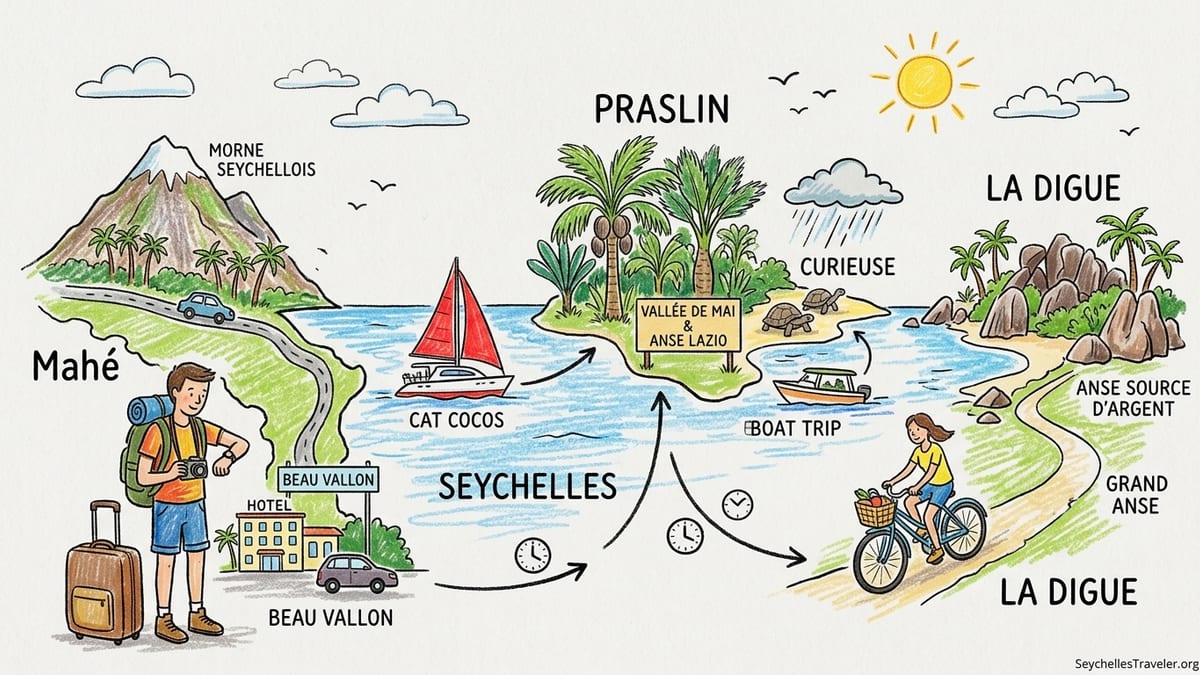
On my most recent trip, I had 11 nights on the ground. Like many first-time visitors, I wanted to "see everything". I ended up with four different hotel bases across the three main islands: Mahé, Praslin, La Digue, then back to Mahé near the airport on the final night. That meant three ferry legs, four hotel check-ins and check-outs, and one rental car return in less than two weeks. None of those moves were individually difficult, but in the heat and humidity they added up.
I began with three nights on Mahé’s Beau Vallon side, using a rental car to explore the west coast beaches like Anse Intendance and Port Glaud. Then I took the Cat Cocos ferry to Praslin, which the operator lists at roughly 1 hour 15 minutes between Mahé and Baie Sainte Anne, plus boarding time. I planned it as a “quick hop” but in practice the transfer swallowed most of the morning: taxi to the jetty, check-in 45 minutes in advance, boarding, sailing, disembarkation, then the short taxi ride to my guesthouse.
On Praslin I booked only two nights, thinking I could squeeze in Anse Lazio, a Vallée de Mai visit and a day-trip to Curieuse Island to see the giant tortoises. The day-trip needed clear-enough seas for the small boats, so when one afternoon brought a heavy but short tropical shower, everything felt tight. I still ticked the boxes, but it meant watching the clock instead of slowing down on Lazio’s sand as the light changed.
La Digue was next, just a 15-minute Cat Cocos or Cat Rose hop from Praslin according to the 2026 schedules, with Baie Sainte Anne as the main launch point. The physical journey was easy, but I had made a classic mistake: I booked only two nights, thinking the island’s small size would keep things simple. In reality, La Digue is where I most wanted to linger. I still remember standing at Anse Source d’Argent at low tide, mentally calculating how much time I needed to cycle back, shower and be ready for the next morning’s ferry. I promised myself I would never again book only one or two nights anywhere in Seychelles unless it was directly tied to a flight or long-haul transfer.
Why Weather Buffers Matter More Than You Think
Seychelles has a tropical, maritime climate with fairly stable temperatures. The Seychelles Meteorological Authority describes a wetter season broadly from around October through March and a drier southeast trade wind season from May to around September, with transitional months in between. Even in the rainy months you still get sunshine, but showers can roll in quickly and last long enough to disrupt a tightly packed day of boat trips or hikes.
October, when many European and North American travelers visit, is a transition month. Official climate guides for Seychelles note that October often has many dry days and warm seas, but it also sits at the point when the northwest monsoon and heavier showers begin to build. Local seasonal bulletins point out that the country is navigating its rainy season in the October to February window in recent years, with increasingly erratic patterns. That means forecasts may show rain icons for many days in a row even though actual conditions still swing between bright sun, short showers and overcast spells.
On both of my trips, rain never wiped out a full day, but it did ruin specific time slots I cared about. A much-anticipated snorkeling excursion from Praslin was postponed due to rougher seas in the morning, and a planned sunset at Anse Intendance on Mahé turned grey and drizzly. Because my schedule was already compressed, rescheduling meant cutting something else. Travelers I spoke with on the ferries had similar experiences, including honeymooners in October who suddenly had a Cat Cocos crossing in lumpy seas instead of the calm postcard ride they expected.
This is why Tourism Seychelles’ current guidance, which encourages 10 to 14 days for experiencing Mahé, Praslin and La Digue without rushing, makes practical sense. Five days can work, but not if you intend to stack in three islands, multiple hotel changes, several full-day excursions and specific sunset plans, all with no slack for weather. A smart itinerary in Seychelles is not about how many islands you can technically stand on; it is about how many you can enjoy without stressing every time a grey cloud appears over Morne Seychellois.
How Travel Days Really Work: Ferries, Flights And Lost Hours
On the map, Mahé, Praslin and La Digue look like neighbors you could drop in on between breakfast and lunch. The domestic flight from Mahé to Praslin is scheduled at around 15 minutes of flying time with Air Seychelles, and Cat Cocos gives crossing durations of about 1 hour 15 minutes between Mahé and Praslin, roughly 15 minutes between Praslin and La Digue, and about 1 hour 45 minutes for Mahé to La Digue when routed via Praslin. In practice, each of these legs consumes more of your day than the headline times suggest.
On ferry days, I found that from the moment I started packing until I was checked into the next hotel and ready to do anything fun, four to five hours had slipped away. That included checkout, taxi to the jetty, ticket check-in and boarding time, the crossing itself, disembarking, waiting for luggage to be unloaded in the ferry terminal, a taxi or pickup on the other side, and check-in formalities at the new property. If the sea is choppy, some travelers also appreciate a half-hour on land just to regain their equilibrium before jumping straight into an activity.
The domestic flight can be faster in door-to-door terms, especially if you connect straight off an international arrival. The Air Seychelles domestic terminal is essentially adjacent to the international one on Mahé, and the airline publishes generous baggage allowances on its website, especially for passengers connecting from long-haul flights. Yet even here, by the time you account for check-in, security, boarding, the flight, baggage reclaim on Praslin, and a taxi to Cote d’Or beach or Baie Sainte Anne, you are again looking at several hours where you are in transit mode rather than holiday mode.
After two trips I adopted a simple rule: if a ferry or flight leg sits in the middle of the day, that day is a travel day, not a sightseeing day. Anything I experience beyond a beach walk or dinner is a bonus. If I absolutely need a big activity, such as a Vallée de Mai visit or a full-day Curieuse boat trip, I now plan it for a non-move day. That mental shift alone makes Seychelles itineraries feel less rushed, because you are no longer pretending you can comfortably cross islands, explore deeply and change hotels in one neat package.
Five Days: Why One Base (Or At Most Two) Is Enough
With five days on the ground, many travelers try to fit Mahé, Praslin and La Digue into a single loop. Having tested both longer and shorter stays, I would argue that in late 2026 this is simply too much. Tourism Seychelles acknowledges that a five-day stay can work, but their recommendations increasingly underline that this is a minimum and that 10 to 14 days is better if you hope to experience all three principal islands in a relaxed way. A five-day trip, especially if you are arriving from Europe, the Middle East or North America, should revolve around one base and, at most, one additional island.
If I had only five full days tomorrow, I would choose Mahé as my single base and accept that this trip is about coastlines, Creole food and day excursions rather than collecting islands. I would stay somewhere like Beau Vallon or the quieter west coast, rent a car for at least two or three days and focus on a handful of highlights: the viewpoint over Port Launay, the beaches at Anse Intendance and Anse Takamaka, and perhaps a leisurely lunch in Victoria and its market. If the budget allows, I might also consider a single day-trip to Praslin and La Digue using the early Cat Cocos departure and late return that sometimes route Mahé–Praslin–La Digue and back in one long arc.
That “two islands in a day” boat loop is technically possible because the high-speed ferries often call at both Praslin and La Digue on the same sailing, usually with a stop at Baie Sainte Anne without changing vessels. However, spending your one Praslin hour rushing to a taxi at Baie Sainte Anne, then sprinting back to make the La Digue connection, does not resemble the slow-breathing rhythm that makes Seychelles special. In wet season months when seas can be lumpier and schedules more weather-dependent, it also introduces risk: a delayed or cancelled sailing can suddenly turn a neat two-island sampler into a scramble to rebook.
If you absolutely must split five days between two islands, I would recommend three nights on Mahé and two on either Praslin or La Digue, with a strict rule that travel days are light. That means no ambitious Curieuse excursion on the afternoon you arrive in Praslin, and no plan to bicycle to every beach on La Digue between hotel check-in and sundown. It is also where rainy-day buffers matter most: a single heavy shower on your only full Praslin day could make Vallée de Mai feel rushed and leave you without time to enjoy Cote d’Or’s bay in decent light.
Seven Days: Two Islands You Can Actually Feel
At seven days, Seychelles starts to breathe. You have enough time for jet lag, one or two weather-interrupted afternoons and at least two full days on each of two islands. Looking back at my 11-night route, the sections that felt best would neatly compress into a Mahé plus La Digue or Mahé plus Praslin combination over a week, provided I did not insist on all three main islands.
If you want beaches, bicycles and a slower rhythm, a week split between Mahé and La Digue works beautifully. You might spend three or four nights on Mahé, renting a car to explore the south and west, then take a mid-morning Cat Cocos sailing via Praslin to La Digue and settle there for three or four nights. Once on La Digue, almost everything runs at bicycle or ox-cart speed. You can spend a morning wandering through L’Union Estate on the way to Anse Source d’Argent, another day cycling to Grand Anse and its dramatic granite coastline, and keep a third flexible for snorkeling or a boat trip to nearby Coco Island if conditions are right.
For travelers more interested in a mix of hiking, iconic beaches and a modest amount of infrastructure such as small supermarkets and restaurants, Mahé plus Praslin is another strong seven-day option. You might structure it as four nights on Mahé and three on Praslin. On Praslin, that gives you time for Vallée de Mai, a full beach day at Anse Lazio and one flex day to either laze on Cote d’Or or slot in a Curieuse excursion. If rain hits that Curieuse window, you still have the option of moving it to your spare day instead of dropping it altogether.
The key with seven days is resisting the temptation to “pop over” to the third main island for just one night. On paper, that might look like one night Mahé, three nights Praslin, three nights La Digue. In person, it feels like you are always asking reception to print another ferry booking. Every time I spoke to travelers on such whirlwind routes, they described at least one regret: the missed sunrise at Anse Lazio, the cancelled boat trip from La Digue due to afternoon squalls, or the final Mahé night spent entirely near the airport with no time left for a last swim.
Ten Days: Mahé, Praslin And La Digue Without White-Knuckle Timing
In my experience, 10 days is the sweet spot where Mahé, Praslin and La Digue all fit without turning your holiday into a spreadsheet. It aligns almost perfectly with what Tourism Seychelles now recommends when travelers ask how long they need to experience all three principal islands without rushing. With 10 full days, you can give each island at least three nights and keep a flex day or two for weather hiccups and slower mornings.
My ideal 10-day version of the route I actually took would begin with three or four nights on Mahé. That leaves room to rent a car and drive the Sans Souci road through Morne Seychellois National Park, spend a long afternoon at Anse Intendance, and keep one day loose for either Victoria’s market or a hotel pool afternoon if you arrive tired. From there, a mid-trip Cat Cocos ferry to Praslin, timed so that you leave after breakfast and arrive in Baie Sainte Anne around lunchtime, sets up a three or four-night stay.
On Praslin, 10 days total means you can now treat Vallée de Mai as a half-day instead of an all-out race, with time to linger on the forest trails among the coco de mer palms, and still have separate days for Anse Lazio and Cote d’Or. Importantly, you also gain a weather buffer for the Curieuse Island excursion. Many of the boats that run this trip are small, and while operators are used to brief showers, choppier seas can make the journey less comfortable or force a change of day.
La Digue fits best at the end of a 10-day trip when you are ready to slow everything down. Three nights is the minimum I now recommend; four is even better. Instead of arriving, cycling straight to Anse Source d’Argent, and then checking the ferry timetable for tomorrow, you can unpack for a proper stay. When an afternoon shower rolled over La Digue on my last visit, the people who looked relaxed were those who simply waited it out in a café with a Seybrew beer or a fresh fruit juice, knowing they had two or three more days ahead. They were not those refreshing the Cat Cocos app to make sure their next transfer still aligned with a packed plan.
Fourteen Days: Adding Smaller-Island Magic And Real Downtime
With 14 days to play with, Seychelles opens up not just in geography but in pace. The same three-island combination that feels tight in 7 days and comfortable in 10 becomes positively unhurried in two weeks. Better yet, you can add a smaller-island experience without sacrificing beach time or weather buffers. For many travelers in 2026, that might mean a couple of nights on a smaller granitic island close to the main group, reached by boat or short flight, or a splurge on one of the private-island resorts that bundle boat transfers, meals and activities.
If I had 14 days to repeat my trip, I would still divide the bulk of my time among Mahé, Praslin and La Digue, but I would avoid more than four separate hotel bases. A pattern like five nights Mahé, four Praslin, three La Digue and two on a smaller island works well, with the last two nights near Mahé or Praslin depending on outbound flight logistics. Those final two nights could be on an island such as Silhouette or Cerf, reached from Mahé by boat, or on a smaller Praslin satellite that you reach as part of a lodge package.
The extra days bring a second crucial benefit: genuine rest days. On a two-week trip, there is far less pressure to assign a “major activity” to every single day. One of my favorite mornings in Seychelles involved doing almost nothing at all: lingering over breakfast, walking the beach, and reading in the shade while watching small fishing skiffs nose out from the bay. With a 14-day itinerary, you can plan unplanned days like this on each island and still enjoy headline excursions such as Curieuse, a La Digue boat trip to Félicité and Coco, or a full-day circuit of Mahé’s west coast.
Rainy-day buffers also become more meaningful across two weeks. Instead of packing all your boat-based activities into one or two narrow windows, you can spread them out and adjust around forecasts that show showers building later in the afternoon, or high humidity periods when a shaded hike through jungle might feel more appealing than a glassy-sea snorkeling day. In a climate where seasonal bulletins talk about increasing variability and erratic rainfall, that kind of built-in flexibility is priceless.
Overbooking Excursions, One-Night Stays And Other Lessons Learned
Perhaps the most common planning mistake I see in Seychelles itineraries is the temptation to pre-book every single excursion in advance. The logic is understandable: boats to Curieuse or island-hopping day trips from La Digue are limited, and in high-demand weeks some departures sell out. However, committing to a rigid roster of excursions also means locking yourself into specific days regardless of sea conditions, your own energy levels, or short-notice weather advisories.
On my first trip, I booked a Curieuse day-trip, a La Digue snorkeling cruise and a guided hike on Mahé before stepping on the plane. Two out of those three days ended up either wet, windy or both. The boat crews were experienced and ran the trips safely, but snorkeling visibility was poorer and one return leg back to Praslin was bumpier than many guests enjoyed. On my second trip, I held back, speaking with local operators a day or two in advance instead. I was still able to secure spots on the excursions I wanted, and I had a better sense of which days looked best.
The other trap is the seductive one-night stay. When I review real visitor itineraries, it is common to see patterns like two nights Mahé, one night Praslin, two nights La Digue, one last night Mahé. After trying something similar in my 11-night route, I can say those single nights rarely justify themselves. By the time you arrive, orient yourself, unpack even a little and find somewhere for dinner, it is already time to think about checkout. If a rainy spell or ferry delay cuts into your arrival window, that single night might collapse into little more than a rushed breakfast.
After my last island-hop, I created a personal rule I now share with readers: in Seychelles, never change islands for just one night unless that night is directly tied to your international flight. If you want to be near the airport on Mahé for a very early departure, a final overnight there makes sense. Anything else probably belongs on your next visit, when you can give that island at least three nights and the respect it deserves.
The Takeaway
Looking back at my own route and overlaying it with what local tourism authorities now recommend, a clear pattern emerges. Five days in Seychelles can be lovely, but they are not suited to a three-island grand tour. Seven days allow a deep, two-island experience. Ten days unlock Mahé, Praslin and La Digue in a way that respects travel times and weather, while 14 days let you add a smaller-island stay and genuine downtime without sacrificing buffers.
Rain, humidity and limited daily boat or flight slots are not inconveniences to be engineered away; they are inherent features of a remote Indian Ocean archipelago. Treating travel days as real travel days, keeping at least one spare day per island for weather and energy, and refusing to change islands for single nights all shift your focus from “how many places can I list” to “how deeply did I experience the ones I reached.”
Ultimately, Seychelles rewards travelers who slow down. The best moments are rarely the ones that were logged into a spreadsheet weeks before departure, but the unplanned swims at empty coves, the conversations with guesthouse owners over grilled fish, and the quiet, hot afternoons when you do nothing more ambitious than watch the trade winds ruffle the palms. Build your itinerary around that feeling, not around how many ferry tickets fit in your pocket, and you are far more likely to leave already dreaming of a return.
My revised rule of thumb is simple. With five days, pick one main base and, at most, a brief taste of a second island. With seven days, plan for two islands properly. With ten days, Mahé, Praslin and La Digue form a realistic triangle. With fourteen days, you can comfortably enjoy those three, include real rainy-day and rest buffers and add a smaller-island stay if your budget allows. Within that framework, the exact beaches and bays you choose are the pleasant details to fill in later, ideally with your feet in Seychellois sand.
FAQ
Q1. Is five days in Seychelles really enough for a first visit?
Five days can work if you focus on one principal island, usually Mahé, and treat a second island as a bonus rather than a must. Trying to fit Mahé, Praslin and La Digue into five days often results in rushed ferry transfers, little weather flexibility and more time packing than relaxing.
Q2. For a seven-day trip, which two islands should I choose?
For a relaxed, beach-focused week, Mahé plus La Digue is a great combination, with Mahé offering variety and La Digue providing slow-paced charm. If you want iconic beaches like Anse Lazio and a national park visit to Vallée de Mai, Mahé plus Praslin is equally strong.
Q3. Does it make sense to visit all three main islands in ten days?
Yes, ten days is usually enough to enjoy Mahé, Praslin and La Digue without feeling frantic, provided you avoid one-night stays and accept that ferry or flight days are largely for travel. A pattern like four nights Mahé, three Praslin and three La Digue tends to work well.
Q4. How important are rainy-day buffers in Seychelles?
Rainy-day buffers are very important because showers and sea conditions can disrupt boat trips, hikes and beach plans, especially from around October to March. Building at least one flexible day per island lets you move key activities like Curieuse excursions or snorkeling trips to better weather windows.
Q5. Should I pre-book all my excursions before arriving?
It is wise to pre-book only the absolute must-do excursions in peak periods and arrange the rest a day or two in advance on the spot. This balance reduces the risk of being locked into poor weather days while still securing spaces on popular trips.
Q6. When is a travel day just a travel day in Seychelles?
Any day that includes an inter-island ferry or flight in the middle of the day should be treated as a travel day, not a full sightseeing day. By the time you check out, transfer, cross, check in again and settle, four or more hours usually pass.
Q7. Is changing hotels for just one night ever worth it?
Changing hotels or islands for one night is rarely worthwhile, because you spend a disproportionate amount of time in transit and logistics. The main exception is a final night near Mahé’s airport to make an early international departure manageable.
Q8. How rough are the ferry crossings between the islands?
The high-speed ferries between Mahé, Praslin and La Digue are generally comfortable, with crossings often around 1 hour 15 minutes between Mahé and Praslin and about 15 minutes between Praslin and La Digue. During wetter or windier periods seas can be choppy, so those prone to motion sickness may want medication and to avoid tightly scheduled activities immediately after arrival.
Q9. Is it better to fly or take the ferry between Mahé and Praslin?
The domestic flight is quicker in air time and can save some minutes overall, especially if you are connecting from an international arrival, while the ferry is often more economical and includes sea views. Your choice may come down to budget, schedule alignment and motion comfort.
Q10. How many islands should I plan for a 14-day Seychelles trip?
For a 14-day trip, focusing on Mahé, Praslin and La Digue plus one smaller-island stay usually offers the best balance between variety and rest. More than four separate bases tends to make the trip feel like a sequence of transfers rather than a holiday.