


On my last trip to Seychelles, I deliberately planned my accommodation around islands rather than individual hotels. I split the stay across three islands over 11 nights: 4 nights on Mahé, 4 on Praslin and 3 on La Digue. I chose mainly self-catering guesthouses with kitchenettes, adding one small resort night to see how it compared. By the end, I knew exactly where island-hopping was worth the packing and ferry queues, and where a single base would have been easier. This guide focuses on that island choice first, then on what type of stay works best in each place, so you can decide when to move, when to day-trip and how to avoid spending your precious holiday time in transit.
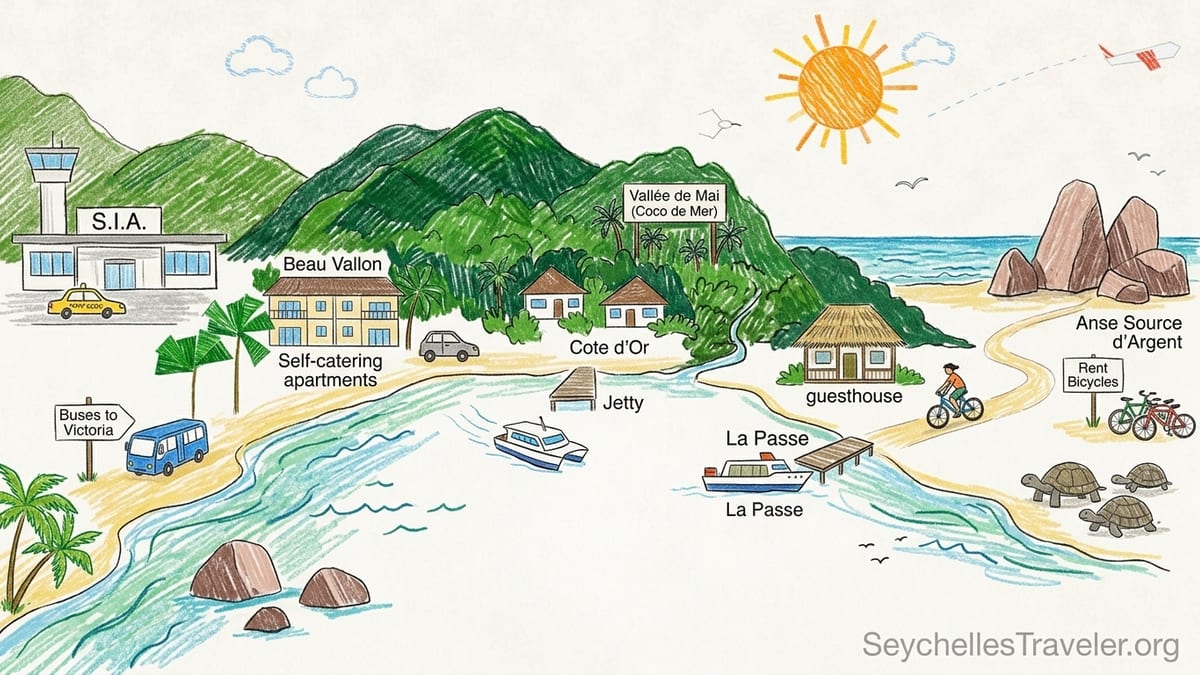
How I Actually Structured My Seychelles Stay
I landed at Seychelles International Airport on Mahé in the early afternoon. The domestic terminal is a short walk from international arrivals, which makes it easy to connect onward, but I wanted to get my bearings first. I booked four nights on Mahé in a self-catering apartment near Beau Vallon, then planned to move on to Praslin and La Digue. It was a classic three-island plan, but I paid close attention to how much effort it took to move and how each base changed my experience.
From the airport at Pointe Larue to Beau Vallon by taxi took around 25 to 35 minutes in normal traffic, crossing the island via Victoria. Beau Vallon sits roughly 8 to 10 kilometres from the airport, depending on your exact route. Public buses serve the area, but with luggage after a long-haul flight I was glad I had pre-booked a car transfer. Once checked in, I could walk barefoot to the water in under two minutes and reach several beachside restaurants, takeaways and a small supermarket in about five minutes. It was immediately clear why Tourism Seychelles describes Beau Vallon as Mahé’s broadest concentration of hotels, restaurants and nightlife.
After Mahé, I took the catamaran ferry from Victoria to Praslin. The sailing is usually quoted at about one hour, but with boarding and luggage handling the whole process took closer to 90 minutes dock to dock. On Praslin I stayed four nights in a self-catering apartment near Cote d’Or (Anse Volbert), which is one of the main beach villages on the island. The drive from the Baie Sainte Anne jetty to Cote d’Or took about 15 minutes by taxi over the hilly interior. I rented a car for two days to reach trailheads and remote beaches, then relied on walking and the public bus the rest of the time.
The final leg was a 15-minute ferry from Praslin’s Baie Sainte Anne jetty to La Digue’s tiny jetty at La Passe. The crossing is short, but you still need to check in and load luggage, so allow at least 45 to 60 minutes in total. La Digue has no airport and only a handful of motor vehicles, so I wheeled my suitcase a few minutes along the waterfront to a small guesthouse and then rented a bicycle. I spent three nights there, long enough to realise that on this island in particular, sleeping over is far better than arriving on the mid-morning ferry and rushing back in the afternoon.
By the time I sailed back to Mahé, I had changed accommodation three times and boarded ferries four times. For 11 nights that felt right at the edge of what was enjoyable. With fewer than seven nights in total, I would now pick two islands at most to avoid spending a full day, in little fragments, on logistics.
Mahé as a Base: Infrastructure, Transport and Nightlife
Mahé is the largest island and home to the international airport, the capital Victoria and about 90 percent of the country’s population. The ring road roughly traces the 60-kilometre coastline, connecting dozens of beaches and coves. For travellers, the key question is whether to base entirely on Mahé and day-trip out, or to treat it as one of several stops. Your answer will depend on how much you value variety versus unpacking only once.
Beau Vallon is Mahé’s classic base for people who want services on the doorstep. It has a broad sweep of sand that is generally calm enough for swimming, several mid-range resorts and many small guesthouses tucked into side streets and low hills behind. From central Beau Vallon you can walk to takeaway stalls, beach bars and simple restaurants offering Creole curries, grilled fish and pizza. Tourism Seychelles highlights Beau Vallon as having the island’s largest cluster of hotels, restaurants and nightlife, and you feel that in the evenings when food trucks set up along the seafront and live music drifts from venues like casual beachfront bars.
Public buses on Mahé reach most corners of the island, with routes radiating from Victoria to Beau Vallon, Port Glaud, Anse Royale and other coastal villages. Schedules are frequent in the daytime but taper in the evening, and visitors often mention that buses stop around early evening on many routes, which affects how far from restaurants you can stay if you do not drive. If you choose a secluded villa above the west coast beaches such as Port Launay or Anse Takamaka, you will usually need a rental car or to rely on taxis and on-site dining. Journeys from Beau Vallon to beaches like Anse Intendance on the south coast take around 50 to 70 minutes by car, depending on traffic and route, because the road crosses the steep, forested interior.
At night, Mahé has more going on than the other islands, but it is still relatively low-key. Outside Beau Vallon and pockets of Victoria, most areas become quiet after dark. Street lighting is limited away from main roads, and many self-catering places sit up small hills or lanes. I found that on nights when I stayed in more isolated accommodation, I preferred cooking in or eating at the property’s small restaurant rather than negotiating dark, winding roads by car. This is one of the biggest reasons to think carefully about your Mahé base: if you want to eat somewhere different every evening without driving, Beau Vallon or another compact beach village will suit you much better than a remote hillside villa.
Praslin: Beach and Nature Base for Island-Hopping
Praslin, about 30 kilometres northeast of Mahé, is Seychelles’ second-largest island. You can fly there in about 15 to 20 minutes on an Air Seychelles domestic flight or take the ferry. The domestic flights operate many times per day, and official information notes that they are timed to connect with international arrivals, often with a 30- to 60-minute transit window. The airport lies on the southwest coast, about 20 to 25 minutes by road from the main Baie Sainte Anne jetty on the east side.
Tourism Seychelles describes Praslin as a central island-hopping base, and that is exactly how it felt. From my guesthouse near Cote d’Or I could walk to the beach in two or three minutes and to several small supermarkets and restaurants in under 10. Boat excursions to Curieuse, St Pierre and Cousin island departed directly from Cote d’Or beach or a short drive away at Baie Sainte Anne. These trips often leave in the morning around 9 or 10 and return by mid-afternoon, which fits naturally within a lazy beach day. If you stay on Mahé and try to visit these same islands as day trips, you add at least an extra hour each way for the inter-island ferry, plus transfer time, which can make for a very long day.
Praslin’s interior is home to Vallée de Mai, a UNESCO World Heritage Site where the endemic coco de mer palm grows wild. From both Cote d’Or and Baie Sainte Anne, the drive up to Vallée de Mai takes around 15 to 20 minutes on a steep but paved road. Public buses run this route as well, though they can be busy with both locals and tourists. I rented a small car for two days at a daily rate that was generally lower than on Mahé, though still a significant portion of the travel budget. With the car I could reach Anse Lazio and Anse Georgette at times when buses were rare and return after sunset without worrying about schedules.
In the evenings, Cote d’Or felt relaxed but not deserted. There were enough restaurants open to choose different places on a three- or four-night stay, and the local takeaway stands served grilled fish and curries at lower prices than hotel restaurants. After about 21:30 the village grew quieter, and by 22:30 most places had closed. Street lighting exists along the main road but is limited in side streets, so walking felt safe but dim. If your ideal evening involves strolling between several bars, Mahé’s Beau Vallon still offers more variety. If you are happy with a low-key dinner and a drink on your terrace, Praslin works very well as a self-contained base.
La Digue: Slow Island Life and Bicycle-Based Stays
La Digue is smaller again and has no airport, no high-rise buildings and very few motor vehicles. To reach it you almost always travel via Praslin, either flying or taking a ferry from Mahé to Praslin, then connecting onto a short 15-minute catamaran from Baie Sainte Anne to La Digue’s La Passe jetty. This adds at least an hour of transfer time to any arrival or departure day, so building a La Digue stay into your itinerary is a conscious commitment.
Tourism Seychelles portrays La Digue as largely bicycle-oriented, and that is exactly how daily life feels. On arrival I wheeled my luggage off the ferry, walked three or four minutes along the seafront past bike rental stands and cafés, then turned inland to my guesthouse. Many accommodations are within a 10-minute walk of the jetty, and nearly all visitors rent bicycles within their first hour. The main road loops around part of the island, with sandy tracks leading off toward beaches and inland homes. Distances are short: from La Passe to Anse Severe is about 10 to 15 minutes by bike, and to the gate of L’Union Estate, for access to Anse Source d’Argent, around 10 minutes in the other direction.
During the day, especially between about 10:00 and 15:00, La Digue fills with day-trippers. Boats arrive from Praslin and Mahé, bicycles clatter past in long lines and the famous granite boulders of Anse Source d’Argent become busy. In the late afternoon, though, the last ferries depart and the island quiets noticeably. Sunset at Anse Severe or on the path above Grand Anse feels almost like a different place once the crowds have gone. That difference is the main reason I believe La Digue is worth sleeping on rather than only visiting for a few hours.
La Digue at night is very quiet. A handful of restaurants and guesthouse dining rooms open for dinner, but there is virtually no nightlife in the sense of late bars or clubs. Street lighting is limited, and many lanes are dark by 21:00. My self-catering studio had a small kitchen and an outdoor seating area, which made it easy to prepare simple meals from groceries bought in the island’s minimarkets. There are fewer supermarkets than on Mahé or Praslin, and selection is more limited, so if you plan to cook extensively, it helps to bring a few dry goods with you from the larger islands.
Because everything is oriented around bicycles, you do not need or use a car on La Digue. That makes it appealing for travellers who want a slower rhythm and a compact base where beaches, cafés and bike rentals are all within five to 15 minutes of each other. It also means that people with mobility issues or who dislike cycling should think carefully. In that case, a hotel with an on-site restaurant and easy beach access may work better than a more distant self-catering cottage that involves bumpy tracks in the dark.
Remote Island Resorts and When to Consider Them
Beyond the three main islands, Seychelles has a constellation of smaller islands that host individual resorts. Some sit a speedboat ride away from Mahé or Praslin, while others require short domestic flights or helicopter transfers. These islands offer high levels of privacy and often include full-board or all-inclusive dining, but they also limit your ability to explore independently.
Travel time is the first consideration. A private island that is 20 to 30 minutes by speedboat from Mahé can still be practical on a shorter trip because you can land at the international airport, transfer by road to a marina and be at the resort in under two hours in good conditions. An island that requires a domestic flight, a smaller aircraft or a helicopter adds several more steps. Each step introduces waiting time, luggage checks and the possibility of weather-related delays. On a five-night itinerary, you may not want to spend a full half-day getting in and out of your island resort.
Daily life on these islands revolves around the resort itself. You often have a beautiful beach at your doorstep, house reef snorkelling and perhaps a small spa or nature trail, but no independent restaurants, supermarkets or bus routes. After dark, the only activity is what the resort organises. For some travellers this is ideal, especially on honeymoons or anniversaries where the goal is to disconnect, dine well and enjoy a private villa. For others, especially people who like to wander through local neighbourhoods, try different cafés and ride public buses, the isolation can begin to feel repetitive after several nights.
If you do choose a remote island resort, it usually makes sense to pair it with at least one of the main islands. That way you can enjoy both the polished, all-inclusive environment and the more local, flexible experiences of Mahé, Praslin or La Digue. From a practical perspective, this also reduces the risk that bad weather on your transfer day disrupts your international flight, because you can return to Mahé one day earlier and spend your final night near the airport or in Victoria.
Self-Catering Versus Hotels and How Location Shapes Your Days
Across Mahé, Praslin and La Digue I stayed almost exclusively in self-catering accommodation: studios or apartments with small kitchens and outdoor terraces. This choice had a big effect on both daily costs and how tied I felt to each specific neighbourhood. Groceries in Seychelles are not cheap, but simple pasta, salads, eggs and grilled fish cost noticeably less when cooked at home than when eaten in hotels every night. A single mid-range restaurant dinner for two, with drinks, can rival a day’s worth of self-catered meals bought from small supermarkets and fresh produce stalls.
On Mahé, self-catering apartments tend to sit slightly inland or up low hills, trading immediate beach frontage for better prices and views. In Beau Vallon I could walk from my hillside studio to the beach in around 10 minutes, stopping at a minimarket along the way. The slope meant that returning after dark without a car involved some steep sections, so I timed dinners to finish before the last of the light faded or chose restaurants on the lower part of the hill. In more remote areas of Mahé, being self-catered without a car can feel restrictive because supermarkets may be several kilometres away and buses limited at night.
On Praslin, self-catering near Cote d’Or worked especially well because the village is compact. I could buy groceries in the morning, have lunch at home and then walk out to a simple beach bar in the evening without worrying about driving after dark. Baie Sainte Anne offers a similar setup near the jetty, though the beachfront is less focused on swimming compared to Cote d’Or. Further-flung beaches such as Grand Anse tend to have fewer independent restaurants within walking distance, which makes on-site dining or a hire car more important if you stay self-catered there.
On La Digue, almost all accommodation feels like a hybrid between guesthouse and self-catering. Many properties provide small kitchenettes, breakfast or half-board options and bicycles for an extra fee. Because the island is car-light and distances are short, I found that self-catering did not restrict me at all. I could cycle to a minimarket in five minutes, pick up supplies and then ride on to the beach. In the evenings I mixed simple cooking with dinners in small restaurants clustered near La Passe and along the main road. Walking or cycling back in the dark felt calm rather than risky, though a headlamp or phone torch was useful on unlit stretches.
The main lesson was that self-catering works best in areas with a cluster of shops and places to eat, or when you are happy to drive. If you prefer not to think about food shopping or transport, then basing in a full-service hotel in Beau Vallon, Cote d’Or or near La Passe can simplify logistics, especially for shorter trips.
Day Trips Versus Sleeping on the Island
One of the most common planning questions is whether you should sleep on each island or simply day-trip from a single base. Official tourism information presents Beau Vallon as Mahé’s main tourism hub, Praslin as an island-hopping base and La Digue as a bicycle-oriented retreat. That suggests that each has a distinct feel worth experiencing for more than a few hours. My experience broadly confirmed this, but the answer changes with your time frame.
La Digue is the clearest case where sleeping on the island is preferable. The mid-day period is dominated by day-trippers, and the best moments often come early or late. Cycling to Anse Source d’Argent right at opening, watching the light change on the granite boulders and then leaving just as the crowds arrive is something you can only do conveniently if you are already on the island. The same is true for sunsets at Anse Severe, evenings when fruit bats wheel overhead and the sudden sense of quiet when the last ferry leaves. A day trip from Praslin gives a good taster, but you will share that experience with many others and spend a significant portion of the day on ferry logistics.
Praslin sits somewhere in the middle. It is possible to visit Vallée de Mai and one of the beaches on a day trip from Mahé by flying in the morning and returning in the evening, or by taking the early ferry. However, that compresses what could be a relaxed exploration into a tight schedule. You will also miss out on island-hopping to nearby Curieuse, Cousin and St Pierre, which typically require at least half a day each. For travellers with seven days or more, I believe that at least three nights on Praslin transforms it from a quick excursion into a true base for nature and beaches.
Mahé, because of the airport and ferry connections, is the natural anchor for almost every Seychelles trip. Technically you can sleep on Praslin or a private island and connect straight to your international flight, but weather or operational delays can make same-day connections stressful. In practice it is often wiser to spend your first or last night on Mahé, even if you devote the bulk of the trip to other islands. That also allows you to enjoy Victoria’s small market, the botanical gardens or a sunset at Beau Vallon without worrying about missing a plane.
Remote island resorts are almost always overnight destinations. While some may offer day passes from Mahé, the cost and logistics usually mean that most visitors either commit several nights or skip them entirely. If your budget and interests align with a private island stay, consider it as a self-contained chapter of your trip rather than as a candidate for day trips.
The Takeaway: Base Strategies for 5, 7, 10 and 14 Days
All of this leads to a key decision: how many bases should you realistically plan, and on which islands, for the time you have. The goal is to minimise repacking and transfers while still capturing the variety that makes Seychelles special.
For a five-day trip, focus on one main base and one short taste of another island. A practical strategy is to spend four nights on Mahé, ideally in or near Beau Vallon for easy access to restaurants and buses, with a single day trip to Praslin and La Digue or to a nearby island excursion. Another option is to fly straight to Praslin after landing on Mahé, spend four nights there as your base for Vallée de Mai and island-hopping, and place your final night on Mahé near the airport. In both cases, adding full nights on a third island tends to fragment such a short stay.
For seven days, two bases start to make sense. One balanced approach is three nights on Mahé and four on Praslin, with a dedicated day trip to La Digue from Praslin if you do not want to move again. If you are particularly drawn to La Digue’s slow pace and bicycle culture, you could reverse this mentality: two nights on Mahé, three on Praslin and two on La Digue, accepting one more ferry day in exchange for sunrise and sunset on its beaches. With a week you can still manage self-catering in compact areas like Beau Vallon, Cote d’Or and La Passe without feeling you spend too much time shopping.
With 10 days, the classic three-island plan I followed becomes attractive. A structure such as three nights on Mahé, four on Praslin and three on La Digue gives each island enough time to feel like a temporary home rather than a quick stop. You can schedule longer excursions from Praslin, give yourself a buffer day at either end of the trip on Mahé for flights and enjoy La Digue without rushing. Self-catering apartments in village settings work very well at this length, because you fall into a natural rhythm of mixing restaurant meals with simple cooking. The main caution is to cluster your ferry days so that you do not punctuate every second day with a move.
On a 14-day trip, you have room for both depth and variety. One effective plan is four nights Mahé, five nights Praslin, three nights La Digue and two nights either back on Mahé or at a remote island resort if budget allows. Alternatively, you could do six nights on Mahé, five on Praslin and three on La Digue, giving yourself more time for Mahé’s many beaches and hikes. At two weeks, moving accommodation three or even four times remains manageable, provided you accept that each transfer day will absorb several hours. This is also the trip length where a short stay on a private island paired with main-island bases feels realistic without crowding the schedule.
Across all timeframes, the most important decision is not the exact property but the island and neighbourhood that will shape your days and nights. Decide first how often you want to pack and how much independence you want through self-catering, then choose islands that match: Mahé for infrastructure and variety, Praslin for beaches and nature with easy boat excursions, La Digue for a slower, bicycle-led rhythm and remote islands for cocooned resort stays. Once that structure is clear, picking the individual hotel, guesthouse or apartment becomes a much easier final step.
FAQ
Q1. Is it better to stay on Mahé or Praslin for a first visit?
For a first visit of five to seven days, Mahé is usually the better single base because it has the international airport, the widest choice of accommodation and more restaurants and services. You can then add at least a day trip or short side stay on Praslin if time allows.
Q2. When is it worth sleeping on La Digue instead of just day-tripping?
La Digue is worth at least one or two nights if you want to enjoy its quieter mornings and evenings, cycle to beaches without rushing for a ferry and experience the island after day-trippers leave.
Q3. How much time should I allow between my international flight and a domestic transfer?
It is sensible to allow at least 60 to 90 minutes between landing at Mahé and any onward ferry or domestic flight, to account for immigration, baggage and the short walk or drive between terminals or port and airport.
Q4. Do I need to rent a car on Mahé and Praslin?
You do not strictly need a car because public buses run on both islands, but a rental car for at least a few days gives you much more flexibility to reach trailheads, remote beaches and restaurants after dark.
Q5. Is self-catering a good idea in Seychelles?
Self-catering works very well in village areas like Beau Vallon, Cote d’Or and La Passe, where small supermarkets and takeaways are nearby. It can feel limiting in remote locations without a car or nearby shops.
Q6. How many islands should I try to include on a one-week trip?
For seven days, most travellers are happiest with two main islands, plus perhaps a day trip to a third. Adding more bases often means spending too much time packing and moving.
Q7. Are remote private island resorts worth the extra transfers?
They can be worthwhile for travellers seeking privacy, full-board dining and a resort-focused stay, especially on longer trips. On shorter itineraries the extra transfer time can eat heavily into beach and exploration time.
Q8. What is nightlife like on the different islands?
Mahé, particularly Beau Vallon and parts of Victoria, has the liveliest evenings, though still relatively low-key. Praslin offers a relaxed restaurant scene, and La Digue is very quiet after dark.
Q9. Is it safe to walk around after dark in beach areas?
Tourist areas are generally calm after dark, but lighting can be limited away from main roads. Many visitors choose to stay within well-lit village centres or rely on taxis and hotel restaurants at night.
Q10. Should I book ferries and domestic flights in advance?
Booking in advance is strongly recommended in busy seasons, especially for the Mahé to Praslin route and the Praslin to La Digue ferries, to secure preferred departure times and avoid long waits.