

The Seychelles outer coral islands are the stuff of castaway fantasies, but choosing between Bird, Denis, Desroches, Platte and Alphonse, with Cosmoledo as an even wilder outpost, is not straightforward. Each island offers a very different style of escape, from barefoot birdwatching lodges and farm-to-table eco retreats to high-design private-pool villas and hardcore fly-fishing camps. This guide compares them side by side, using indicative late-2026 prices, flight costs and mandatory levies to build realistic three-night and seven-night budgets for a couple, and to help you match the right island to your style of travel.
The Coral Island Landscape: What These Seychelles Resorts Really Offer
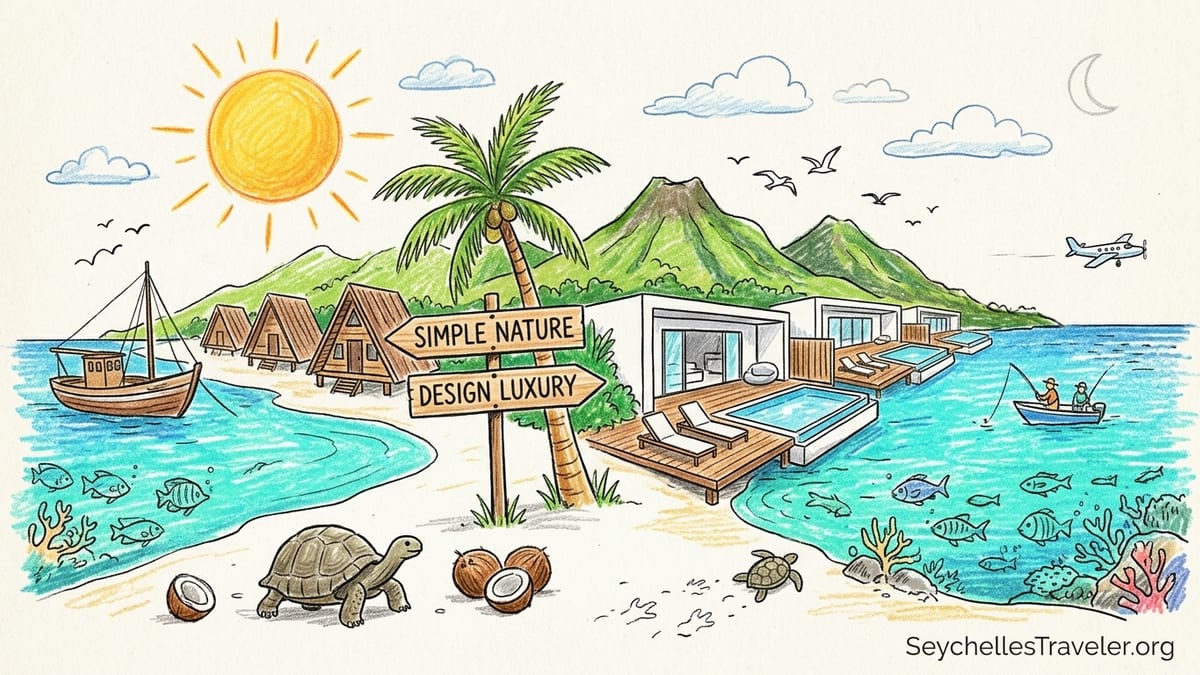
Although they all share white sand, lagoons and intense turquoise water, the Seychelles coral islands in this comparison fall into five distinct personalities. Bird Island Lodge focuses on nature and simplicity, with solar power, open-plan chalets and limited connectivity. Denis Private Island positions itself as a farm-to-table sanctuary with home-grown produce, no in-room Wi-Fi and a deliberate digital detox. Four Seasons Resort Seychelles at Desroches Island brings a classic international luxury brand to a vast sand-fringed atoll, trading on big villas, private pools and an unusually long coastline for walking and cycling. Waldorf Astoria Seychelles Platte Island is the most design-forward, where every villa has a private pool and service is closer to a full-service luxury resort than a rustic lodge. Alphonse Island Lodge, by contrast, is all about marine activities and guided adventure, from bluewater fly-fishing and diving to conservation-led excursions, while Cosmoledo Eco Camp pushes the specialist, expedition side of that even further.
When comparing them, it is essential to consider not just the room rate but also domestic flights, mandatory environmental levies and how inclusive the packages are. Denis and Desroches quote domestic flights separately at around 550 to 600 euros per person return, subject to 15 percent VAT in the case of Desroches. Platte is in the same ballpark for flights, while Alphonse’s lodge packages typically include the charter flight from Mahé. All of these islands fall into the “island resort” category for Seychelles’ Tourism Environmental Sustainability Levy from 1 January 2026, which means a charge of Seychelles rupees 100 per person per night, collected on the island and exempting children aged 12 and under. Because prices fluctuate across seasons and offers, the examples here use conservative, mid-to-high season estimates for stays in October and November 2026, intended to illustrate the cost structure rather than guarantee a specific rate.
Across the board, these islands share one thing in common: they are not last-minute destinations. Seat-controlled domestic flights, luggage limits that can drop to 15 kilograms on smaller aircraft and minimum stays during peak demand mean that early planning is vital, especially if you are combining an island stay with a Mahé or Praslin itinerary. With that context in mind, the following sections look at each island in detail before drawing out who each one suits best.
Bird Island Lodge: Barefoot Nature and Simplicity
Bird Island, at the northern edge of the Seychelles Bank, is famed among ornithologists for the million-plus sooty terns that nest here at the height of the season and for being the first landfall for many Eurasian migrants in October to December. Accommodation is at Bird Island Lodge, a modest eco-lodge that operates a small fleet of bungalows set back from the beach, with solar power, simple furnishings and an emphasis on fresh air rather than air-conditioning. Room categories are typically variations on standard and more spacious bungalows rather than elaborate suites. Most units are fan-cooled, with open verandas and outdoor-style bathrooms that suit the island’s informal, feet-in-the-sand atmosphere.
Rates released for 2025 and 2026 show Bird Island operating on a full-board basis, with breakfast, lunch and dinner included in the nightly rate. Flights from Mahé are arranged with the lodge on scheduled light aircraft to the island’s private airstrip. While current published documents focus on room and board, recent operator quotes suggest that by late 2026, you should budget in the region of 450 to 550 euros per person for return flights from Mahé, on top of the lodge rate, with a luggage allowance typically around 15 kilograms. Because this is a small eco-lodge classed as an island resort under Seychelles regulations, couples in 2026 will also pay the Tourism Environmental Sustainability Levy of SCR 100 per person per night, so SCR 600 over three nights for two adults and SCR 1,400 over seven nights.
For a realistic three-night stay for two in October 2026, using indicative figures, you might see a full-board bungalow priced at about 450 euros per person per night. That would put the accommodation and meals at roughly 2,700 euros for three nights for a couple. Add 1,000 euros for two return domestic flights, around 120 euros equivalent for the environmental levy, plus a modest excursion budget of perhaps 200 euros between you for guided bird walks and boat trips, and the total comes close to 4,000 euros. Over seven nights, a similar couple could expect the lodge element to be around 6,300 euros, domestic flights unchanged at about 1,000 euros, the levy rising to roughly 280 euros equivalent and activities at, say, 400 euros. That produces a working total a little under 8,000 euros for a week, with almost all meals included.
Connectivity on Bird is limited by intent. There is often Wi-Fi only in central areas, sometimes switched off during certain hours to reduce noise and encourage guests to engage with the natural environment. There are no televisions in the bungalows and children’s facilities are informal; the island suits nature-loving families comfortable with unsupervised beach time and simple pastimes rather than kids’ clubs or extensive structured activities. The main beach is wide and sandy, with excellent swimming in calm weather and very good off-the-beach snorkelling when currents allow, but there are no motorised watersports. Conservation underpins the entire operation, from turtle monitoring to bird research, and guests are encouraged to join guided walks rather than undertake intrusive independent exploration.
Denis Private Island: Farm-to-Table Hospitality and Digital Detox
Denis Private Island, about 60 kilometres northeast of Mahé, is a privately run coral island whose owner-family has invested heavily in both conservation and agriculture. The resort offers a range of detached cottages and villas, from Beach Cottages to larger Beachfront Spa Cottages and Family Villas, generally with direct beach access, private gardens and outdoor bathrooms. There are no televisions in the rooms and Wi-Fi is limited to certain public spaces, reinforcing the island’s positioning as a place to disconnect. Much of the produce served in the restaurant comes from the island’s own farm, including eggs, meat, fruit and vegetables, which feeds into its farm-to-table reputation.
Room and board are usually on a full-board basis, covering breakfast, lunch and dinner but not high-end wines or activities such as diving. External tour operators quoting for 2026 list mid-season rates for a Beach Cottage in the second half of the year at approximately 800 to 900 euros per adult per night on full board, depending on the contract. Denis handles flight reservations automatically when you book accommodation, with scheduled flights five days per week. Official information states a return flight cost of 600 euros per person from Mahé including infants under two free of charge, with a baggage allowance of 15 kilograms plus 7 kilograms hand luggage and the note that fares can change without notice.
Working with those figures, a couple booking a three-night October 2026 stay in a Beach Cottage at 850 euros per person per night would be looking at roughly 5,100 euros for accommodation and meals. Domestic flights add 1,200 euros, before any card fees, and the Tourism Environmental Sustainability Levy contributes another SCR 600, which is around 45 euros at current exchange rates. If they plan one or two paid activities such as a guided nature walk and a half-day reef fishing trip, it would be reasonable to set aside a further 300 to 400 euros for the pair, giving a realistic three-night total in the region of 6,700 to 6,800 euros.
Over seven nights in the same period, the lodge element at 850 euros per person per night climbs to approximately 11,900 euros for two adults on full board. Flights remain at about 1,200 euros for the pair, and the levy reaches SCR 1,400 or about 105 euros. Adding a more generous activity and drinks budget of 1,000 euros for a week of guided nature excursions, boat trips and occasional spa treatments would bring the overall seven-night total close to 14,200 euros for a couple. The absence of televisions and in-room Wi-Fi encourages star gazing, board games and conversation; families who value that slow rhythm often rate Denis highly, but those needing constant streaming for teenagers may struggle.
The main beach encircles most of the island, with some sectors more exposed to prevailing trade winds and swell than others. Staff guide guests to the most suitable swimming areas depending on conditions. Snorkelling is usually from boats to protect the reef, while diving is outsourced to a partner dive centre that shares the island’s conservation ethos. There is a small pool, but most guests use the lagoon. Children’s facilities are limited to nature-based experiences and an informal, family-style approach rather than a branded kids’ club. Conservation highlights include translocated populations of endemic birds, giant tortoise monitoring, and turtle nesting protection projects, all of which guests can learn about during their stay.
Four Seasons Desroches: Big Villas, Long Beaches and Branded Luxury
Four Seasons Resort Seychelles at Desroches Island occupies a large sand cay in the outer islands, roughly 35 minutes south of Mahé by domestic flight. Desroches has more than 14 kilometres of beaches, so despite its association with a global luxury brand, it rarely feels crowded. Accommodation comprises spacious villas and suites, most with private pools and some configured as multi-bedroom residences. Even entry-level accommodations are generally villa-style, with indoor-outdoor living spaces, plunge pools and direct access to the beach or gardens. The resort markets itself as a place where couples can hide away in their villas while families and groups enjoy bigger residences with butler service.
Rates for October to December 2026, drawn from Four Seasons’ own booking channels and partner operators, vary significantly by villa category and date, but a reasonable base case for a one-bedroom pool villa on a bed-and-breakfast basis is around 1,800 to 2,000 euros per villa per night for a couple. Domestic flights are quoted separately. Official fare information lists a return Mahé–Desroches–Mahé ticket at 550 euros per adult and 470 euros per child aged 2 to 11 for the period 1 October to 20 December 2026, with infants travelling free, and clarifies that fares are subject to 15 percent local VAT, which brings an adult ticket close to 633 euros inclusive. Luggage allowances are more generous than on the smaller outer-island flights, at around 30 kilograms per paying passenger.
For a three-night stay for two adults in November 2026, assuming a nightly villa rate of 1,900 euros with breakfast, total accommodation would be about 5,700 euros. Two adult flight tickets at 633 euros each come to 1,266 euros. The Tourism Environmental Sustainability Levy at SCR 100 per person per night adds SCR 600, or about 45 euros, and restaurant spending for lunches, dinners and drinks could easily reach 300 to 400 euros per day for a couple, or roughly 1,000 to 1,200 euros over three days. If you add a moderate activity budget of 400 to 500 euros for bike rentals, spa treatments and perhaps a diving or snorkelling excursion, the total three-night cost for a couple would plausibly fall between 8,400 and 8,700 euros.
Stretching to seven nights under the same assumptions, room and breakfast alone rise to 13,300 euros. Flights remain constant at about 1,266 euros for a couple, while the levy climbs to SCR 1,400, close to 105 euros. Food and beverage outlay can be material on a resort that offers several restaurants, beach clubs and room service; allowing 350 euros per day on average would put a week’s F&B at approximately 2,450 euros. Add 800 to 1,000 euros for a fuller slate of activities, spa treatments and perhaps a couple of private experiences, and a realistic seven-night total approaches or slightly exceeds 17,000 euros for two adults.
Where Desroches stands apart is in its mix of privacy and facilities. The resort has a kids’ club, teen hangouts, a dive centre, tennis courts, a main pool, and a choice of restaurants that rotate menus across Seychellois, Mediterranean and pan-Asian influences. Beaches range from calm lagoon sectors suitable for young children to more exposed stretches with good surfing conditions when the swell is right. There is structured snorkelling and diving, but the island is large enough that many guests simply cycle to a new deserted beach each day. Wi-Fi is strong enough for remote work, although the resort’s ambience leans more toward relaxation than productivity.
Waldorf Astoria Platte Island: Private-Pool Villas and Discreet Glamour
Waldorf Astoria Seychelles Platte Island brings a different tone to the coral islands, blending brand-new contemporary design with remote-island seclusion. The resort occupies a small sand cay with a central coconut grove and an airstrip, about a 25-minute flight south of Mahé. All accommodation is villa-based, and every villa includes a private pool, with categories ranging from one-bedroom oceanfront villas to expansive multi-bedroom residences designed for families and small groups. Interiors lean toward muted, sand-and-sea palettes, high-spec bathrooms and floor-to-ceiling glass that frames the lagoon.
The resort positions itself at the very top end of the Seychelles market, and while current contract rates for October 2026 are not all public, early-booking offers and industry feedback suggest that a one-bedroom pool villa in shoulder season is unlikely to fall below 1,700 to 2,000 euros per villa per night on a breakfast-inclusive basis, with some peak dates significantly higher. Official information on the resort’s location and transfers notes that round-trip flights operated by a local airline between Mahé and Platte Island typically cost about 550 euros per adult, with occasional promotions offering complimentary transfers for longer stays and blackout dates over the festive period. Guests share a lounge at Mahé’s domestic terminal before boarding the private flight, and luggage allowances are usually in the 20 to 28 kilogram range.
Using a mid-point of 1,850 euros per night with breakfast, a three-night stay for a couple in late 2026 would start at around 5,550 euros for the villa. Two adult transfer tickets at 550 euros each total 1,100 euros. The Tourism Environmental Sustainability Levy for an island resort adds SCR 600, or about 45 euros, and a realistic allowance for lunches, dinners and drinks at a high-end Waldorf property would start at 350 to 400 euros per day for two, implying 1,100 to 1,200 euros over three days. If you plan to book a couple of spa treatments and a private sandbank picnic or guided snorkelling, a further 500 euros for activities is a cautious estimate. Together, this produces a working three-night total of around 8,300 to 8,500 euros for a couple.
Over seven nights at the same hypothetical nightly rate, accommodation and breakfast would reach 12,950 euros, the flights remain 1,100 euros for two, and the levy climbs to SCR 1,400 or about 105 euros. If you maintain an average daily food and beverage spend of 375 euros, the week’s F&B comes in around 2,625 euros. A more generous activity and spa budget of 1,000 euros for the week would bring the total into the 17,500 to 18,000 euro range. This places Platte firmly in the same pricing bracket as Desroches, but the style of stay is more focused on long, private hours in your own pool villa rather than circulating among multiple restaurants and shared facilities.
Platte’s beaches are a key draw, with soft, powdery sand and a shallow reef shelf that creates luminous turquoise shallows close to shore. Swimming is generally excellent at high tide, though certain sectors of the reef can be exposed at low tide. Snorkelling is often better on boat trips to the outer reef or drop-off, while diving caters to both beginners and more experienced guests through a dedicated marine activities centre. Children’s offerings are bespoke, with family-friendly villas and ad hoc kids’ activities, but the resort does not market itself as a mass-market family hotel. Wi-Fi coverage is complete enough to handle remote work or streaming for those who insist on mixing business with this level of pleasure.
Alphonse Island Lodge and Cosmoledo Eco Camp: Marine Adventure and Specialist Stays
Alphonse Island Lodge is the flagship of the Blue Safari Seychelles portfolio and serves as the main base for serious divers, anglers and ocean-lovers. The lodge sits on the eastern edge of Alphonse, with beach bungalows, beach villas and larger retreats fanning out along a sandy shore. The core accommodation includes Beach Bungalows and Beach Villas, which are fan-cooled with air-conditioned bedrooms, outdoor showers and direct beach access. There is a central pool, bar and open-sided restaurant, but the real action happens on the water. Packages are structured as “Leisure” or fishing-focused options, with full-board dining and a long list of inclusions ranging from non-motorised watersports and snorkelling gear to guided activities.
Published rate sheets for 2025 and 2026 show that, as a benchmark, a seven-night Beach Bungalow Leisure Package for two sharing in 2025 is priced in the area of 8,345 United States dollars per person, including full board and return domestic flights between Mahé and Alphonse. Three-night and four-night packages are also available, typically priced around 4,365 and 5,360 dollars per person respectively at 2025 levels, again including flights, and there are higher figures for Beach Villas and multi-bedroom retreats. While final 2026 numbers may be adjusted, the key structural point is that packages bundle the charter flights and many non-fishing activities with accommodation and meals. Clients pay separately for international flights, alcohol beyond specific house options, specialist excursions, spa treatments, tackle, flies and gratuities.
Using the seven-night Beach Bungalow Leisure Package as a template, a couple visiting in the 2026 season on a similar rate would be looking at a base package cost of around 16,700 dollars for two on full board, inclusive of domestic flights. The Tourism Environmental Sustainability Levy is sometimes itemised separately on Blue Safari documentation; a sample itinerary for a related atoll priced a week’s levy at about 56 dollars per person under earlier regulations, and with the 2026 island-resort rate of SCR 100 per person per night, a couple staying seven nights on Alphonse should anticipate roughly SCR 1,400 in levies, or just over 100 euros at current rates. Additional expenditure will depend heavily on activity choices. A pair of divers adding a few two-tank boat dives and maybe a private excursion might easily add 1,500 dollars to the bill, while serious fly-fishers booking specialist guiding packages will know that their costs can run even higher.
For a shorter, three-night Leisure Package, two adults could expect a combined package price in the vicinity of 8,700 to 9,000 dollars based on current 2025 templates, including flights, meals and a suite of inclusions such as snorkelling trips, selected guided activities and non-motorised watersports. Levies for three nights would be SCR 600, and a conservative 500 to 800 dollars for drinks, spa and any optional excursions is sensible. This positions Alphonse differently to Bird or Denis: there is far more structure and guidance, the lodge is strongly activity-driven, and although you can laze by the pool, the island is particularly attractive to divers, snorkellers and anglers who want to be out on the flats or reefs most days.
Cosmoledo Eco Camp, a much more remote operation within the same marine portfolio, provides a contrasting benchmark. Its tented eco-pods sit on the wild edge of Cosmoledo atoll, and fly-fishing itineraries are typically built as seven-night or longer packages with set departure days. A 2025 sample itinerary highlighted a total package cost that included domestic flights, boat transfers, guiding, accommodation and full board, with a separate line for Seychelles tourism levy of about 56 dollars per person, which will adjust under the 2026 levy framework. Cosmoledo is not a conventional resort: there is no pool, no kids’ club, limited connectivity and little in the way of casual beach holiday infrastructure. Instead, it serves as a specialist option for enthusiasts who value access to remote flats and a near-pristine marine environment over comfort and choice of restaurants.
Comparing Prices, Inclusions and Hidden Costs
Comparing Bird, Denis, Desroches, Platte and Alphonse on price is challenging because they package costs differently and use different currencies. Bird and Denis quote per-person nightly rates, usually including three meals; Desroches and Platte sell per-villa rates on bed and breakfast, with extras for meals and activities; Alphonse and Cosmoledo favour bundled packages that wrap flights, full board and a long list of inclusions into a single per-person price. It is therefore crucial not to line up, for example, an all-inclusive per-person week on Alphonse directly against a room-only villa at Desroches without backing out the cost of meals, drinks and flights.
Using the sample scenarios above for a couple in late 2026, three-night totals including flights, meals or food budgets, mandatory levies and a modest activity allowance cluster roughly as follows. Bird Island Lodge comes out around 4,000 euros for a couple on full board, including an estimated 1,000 euros for flights. Denis Private Island is in the 6,700 to 6,800 euro range for full board, with 1,200 euros of that going to domestic flights. Desroches sits around 8,400 to 8,700 euros, reflecting a higher villa rate and substantial on-site restaurant and activity spending, plus about 1,266 euros in VAT-inclusive flights. Platte’s three-night totals are similar, at around 8,300 to 8,500 euros, with 1,100 euros of that for transfers. Alphonse’s three-night Leisure Package, by contrast, registers as approximately 8,700 to 9,000 dollars including flights and full board, which, once converted, often compares competitively with the villa resorts for clients who plan to be very active in the water.
Over seven nights, the gaps widen. Bird’s indicative total for two is just under 8,000 euros including flights, full board and modest activities. Denis moves up toward 14,200 euros, while Desroches and Platte both land in the 17,000 to 18,000 euro bracket when you account for realistic food and activity spending. Alphonse’s seven-night Leisure Package for two at around 16,700 dollars plus levies and optional extras will often align in real terms with Desroches and Platte, but with more inclusions in the base price, especially for watersports and certain guided activities. Cosmoledo, meanwhile, is unambiguously a specialist purchase, priced for serious anglers and divers and harder to map directly onto a regular beach holiday.
The Flight component is non-negotiable for all of these islands. Denis quotes 600 euros per person return and arranges seats automatically with room bookings. Desroches charges 550 euros per adult return plus 15 percent VAT for selected late-2026 dates, which brings the effective cost above 600 euros. Platte’s published figures also sit around 550 euros return, subject to change and with occasional offers that bundle transfers for longer stays. Alphonse packages fold flights into the per-person rate by design, which makes the headline price look steep but can be more straightforward once you amortise it over the trip. None of these prices include your international flights into the Seychelles.
Finally, the Tourism Environmental Sustainability Levy must be factored into every budget. From 1 January 2026, island resorts are charged at SCR 100 per person per night, with exemptions for children 12 and under, citizens and residents of Seychelles, and airline or yacht crew. For a couple, that means SCR 200 per night, or SCR 600 on a three-night stay and SCR 1,400 over a week. The sums are small compared with the overall bill but significant enough to appear on invoices and sometimes to surprise guests who have not read the fine print.
Who Should Stay Where: Matching Islands to Travelers
For honeymooners seeking privacy, Platte and Desroches stand out. Both offer large villas with private pools, extensive room service menus and the ability to spend days without seeing many other guests. Platte leans toward an intimate, design-centric experience, ideal for couples who want to spend long stretches in their own villa and appreciate high-end finishes. Desroches adds more dining options, a spa and varied beaches, which can be attractive for honeymoons that mix seclusion with occasional social energy. Denis, although less overtly glamorous, can work beautifully for couples who value barefoot romance and a slower, analogue rhythm, particularly if good food and stargazing outweigh the desire for an infinity pool.
Families with younger children or teenagers will find Desroches the most rounded choice thanks to its kids’ club, teen-friendly facilities, large multi-bedroom villas and a long, varied coastline with both calm coves and active beaches. Platte can also work for high-budget families who prioritise villa privacy and are happy with more bespoke, on-request children’s activities rather than a big structured program. Denis suits families who want nature immersion and are comfortable filling days with biking, beach time and informal exploration rather than slide-packed pools. Bird Island is generally better for families with older children or those experienced in off-grid holidays because of its simplicity and lighter set of facilities.
Birdwatchers naturally gravitate to Bird Island, where seasonal seabird colonies and migrant passerines are the main event and the entire lodge is geared toward low-impact wildlife viewing. Denis also has strong ornithological credentials, with translocated populations of Seychelles fodies and warblers and active conservation programs, and can be an excellent second stop on a bird-focused itinerary. Divers and snorkellers who want a mix of easy house reef and more adventurous sites fit best at Alphonse, which combines professional guiding with access to a vast marine area, while Denis and Desroches both offer solid but more conventional diving and snorkelling.
For dedicated fly-fishing and serious bluewater angling, Alphonse and Cosmoledo are in a different category from the rest. Their operations are built around tides, guiding rotations and catch-and-release practices rather than spa schedules. Anglers will see the higher package costs as a function of access to some of the world’s most productive flats. Travelers seeking maximum privacy yet not particularly focused on activities will probably find Platte or a larger villa on Desroches more appropriate, where you can close the gate on your residence and enjoy in-villa dining, private pools and dedicated staff.
Connectivity preferences are another decisive factor. Bird and Denis intentionally limit Wi-Fi and in-room connectivity and make a virtue of being places to unplug; that appeals strongly to some guests and feels like a disadvantage to others. Desroches and Platte provide robust bandwidth and business-class infrastructure, which allows video calls and streaming. Alphonse and Cosmoledo fall somewhere in the middle, with enough connectivity for email in central areas but not the kind of access that supports remote work across multiple time zones.
The Takeaway
Though clustered under the umbrella of Seychelles coral islands, Bird, Denis, Desroches, Platte, Alphonse and Cosmoledo in practice serve quite distinct audiences. Bird Island Lodge is the closest thing to a rustic, low-key hideaway, where the luxury is silence, seabirds and starry skies. Denis Private Island deepens that with polished farm-to-table hospitality, comfortable cottages and a deliberate digital detox, at a cost that reflects its conservation work and remote logistics. Four Seasons Desroches and Waldorf Astoria Platte Island compete at the high end of the villa-and-pool market, where long beaches, private pools, full-service spas and a suite of dining options cater to couples and families willing to invest five-figure sums into a week of far-flung comfort.
Alphonse Island Lodge and Cosmoledo Eco Camp sit apart as marine adventure hubs, designed first for divers and anglers and only second for sunbathers. Their package prices can look steep on paper but make more sense once you factor in domestic flights, guiding and the scarcity of such wild, fish-rich atolls. For travelers who mainly want to read in a hammock and wade in warm water, Bird, Denis, Desroches or Platte will be a better fit. For those for whom a trip is only truly successful if it includes a giant trevally on the fly or drift dives along untouched walls, Alphonse and Cosmoledo justify their specialist focus.
The mandatory Tourism Environmental Sustainability Levy and domestic flight costs are unavoidable features of any outer-island trip in 2026. Budgeting honestly for them, being realistic about daily food and beverage spending in remote resorts and reflecting on how much structure, connectivity and luxury you really want will go a long way to choosing the right island. With that groundwork done, the choice becomes less about finding the objectively “best” coral island resort and more about matching the right island to your own version of paradise.
FAQ
Q1. How far in advance should I book a Seychelles coral island resort for 2026?
For 2026 travel, it is sensible to book at least 9 to 12 months ahead, especially for peak periods between June and October or over Christmas and New Year. Domestic flight seats to islands like Denis, Desroches, Platte and Alphonse are limited and often tied to fixed schedules, so late planners may find that flights rather than rooms are the bottleneck.
Q2. Are domestic flights to Denis, Desroches, Platte and Alphonse included in the room rate?
Denis, Desroches and Platte typically charge domestic flights separately from accommodation, with Denis quoting around 600 euros per person return and Desroches and Platte around 550 euros per person for selected 2026 dates, plus VAT where applicable. Alphonse Island Lodge packages generally include return flights between Mahé and Alphonse in the per-person package price, while Cosmoledo Eco Camp also bundles charter flights and transfers into its specialist itineraries.
Q3. What does the Tourism Environmental Sustainability Levy mean for my budget?
From 1 January 2026, guests at Seychelles island resorts pay a Tourism Environmental Sustainability Levy of SCR 100 per person per night, collected directly by the accommodation. The levy does not apply to children aged 12 and under, Seychelles residents or airline and yacht crew. For a couple staying seven nights on any of the islands in this comparison, the levy adds up to SCR 1,400 in total, which is just over 100 euros at current exchange rates.
Q4. Which island is best for a honeymoon focused on privacy and comfort?
For honeymooners who prioritise private pools, spacious villas and polished service, Waldorf Astoria Platte Island and Four Seasons Resort Seychelles at Desroches Island are the strongest candidates. Both offer one-bedroom villas with private pools, in-villa dining and staff who can arrange secluded experiences such as beach dinners or sandbank picnics. Denis Private Island is also an excellent choice for couples who value barefoot romance and farm-to-table dining more than multiple restaurant options or branded spa menus.
Q5. Is Bird Island Lodge suitable for families with young children?
Bird Island Lodge welcomes families, but its appeal depends on what parents and children enjoy. Facilities are simple, with no formal kids’ club, and the focus is on nature, birdwatching and beach time rather than structured activities. Families comfortable with unplugged days, early nights and a rustic setting often find Bird rewarding, while those expecting multiple pools, children’s menus everywhere and constant entertainment may be better suited to Desroches or Platte.
Q6. Where should divers and snorkellers focus their time?
Alphonse Island Lodge is the standout choice for divers and snorkellers who want a dedicated marine program, with professional guides, regular boat trips and access to a large, relatively untouched marine area. Cosmoledo Eco Camp serves even more specialised needs, especially for experienced guests focused on remote atolls. Denis, Desroches and Platte all offer good quality diving and snorkelling, but they balance these with broader resort offerings and are less single-minded about underwater activities.
Q7. Do any of these islands offer reliable Wi-Fi for remote work?
Desroches and Platte provide the most reliable and widespread Wi-Fi, sufficient for video calls and remote work in villas and public areas. Alphonse has Wi-Fi in central parts of the lodge, but connectivity can be less robust than on the main inner islands. Bird Island and Denis intentionally limit connectivity, sometimes restricting Wi-Fi to reception areas and not providing in-room access at all, which makes them poor choices for guests who must work during their stay.
Q8. How do meal plans differ between the islands?
Bird Island Lodge and Denis Private Island mainly operate on full-board arrangements, meaning breakfast, lunch and dinner are included, though drinks are extra. Alphonse and Cosmoledo packages include full board and, in some cases, selected soft drinks during activities as part of their per-person pricing. Desroches and Platte usually sell accommodation on a bed-and-breakfast basis, leaving guests to pay separately for lunches, dinners and drinks, which can materially increase the final bill.
Q9. Are the coral islands suitable for first-time visitors to Seychelles?
They can be, but many first-time visitors combine them with a stay on Mahé or Praslin to experience a broader slice of Seychelles culture and landscapes. Coral islands like Bird, Denis, Desroches, Platte and Alphonse are excellent for guests who already know they want seclusion and are comfortable committing to fixed domestic flight schedules. Travelers unsure about such remoteness might prefer to start or end with a few nights on the main islands where transport, dining and sightseeing options are more flexible.
Q10. How should I choose between Alphonse Island Lodge and Cosmoledo Eco Camp?
Choose Alphonse Island Lodge if you want a balance of serious marine activities with a more conventional lodge infrastructure that includes a pool, bar and slightly more comfortable rooms. Opt for Cosmoledo Eco Camp if your priority is access to one of the most remote atolls in Seychelles for fly-fishing or dedicated nature watching, and you are comfortable with tented, eco-style accommodation, limited connectivity and a strongly scheduled program built around tides and boat departures.