


The first thing I noticed as our small twin‑otter aircraft dropped onto the grass airstrip of Denis Island was the silence. No jet bridges, no baggage belts, no text messages buzzing in my pocket as I switched my phone off airplane mode. In fact, there was no signal at all. I had come to this private island in Seychelles for three nights, staying in a Beach Cottage on full board. We booked through a specialist Seychelles tour operator at a rate of about 1,050 euros per cottage per night, plus roughly 600 euros per person for the mandatory return flight from Mahé. For two adults, our three‑night stay, including the domestic flights but excluding extras like drinks and activities, came to just under 4,500 euros. With a three‑night minimum stay and a 15 kg checked‑baggage limit on the aircraft, it is a commitment before you even touch the sand. What I wanted to find out was whether Denis Island’s deliberate isolation felt like a rare luxury or simply restrictive.
Arrival on a Runway of Grass
The transfer to Denis Island sets the tone for everything that follows. Scheduled flights run about five days per week, usually on Tuesday, Thursday, Friday, Saturday and Sunday, with a single late‑morning departure from Mahé and a lunchtime return. The flight is short, around 30 minutes, and uses a small twin‑otter style aircraft with around 15 to 19 seats. Before travel, we were asked to provide our body weights and reminded that checked luggage must not exceed 15 kg per person, with soft‑sided bags strongly recommended. Another 7 kg is allowed as hand luggage, but anything beyond that may need to wait for a later flight at extra cost. It is a far cry from rolling a hard suitcase into a big‑box resort, and the limitations immediately make you think about what you genuinely need.
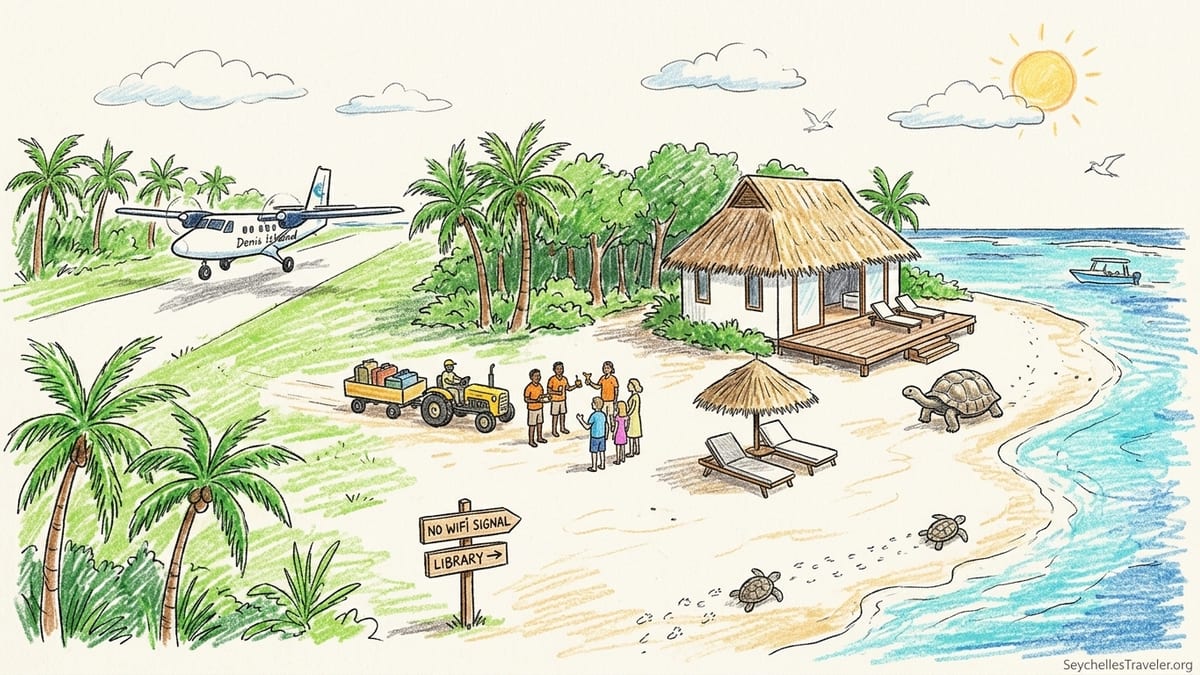
The landing itself feels more safari camp than tropical resort. The aircraft touches down on a grass runway that runs almost the length of the island, with coconut palms framing both sides. There is no terminal; instead, guests are met on the edge of the airstrip by management and staff with cool towels and a welcome drink. Our bags were whisked away on a small tractor and trailer while we climbed into an open buggy for the short ride to the main lodge. Check‑in happened casually in the open‑sided reception, where we signed a registration card, confirmed our return flight time and were given a brief orientation of the island and, crucially, its connectivity policy.
From the very first minutes on island, the absence of mundane travel infrastructure is disorienting in a good way. There are no queues for taxis and no hawkers. Equally, once the plane leaves again, there is also no realistic way to change your mind or pop over to another island for dinner. You are now committed to Denis until the next flight, whatever the weather or your mood decides to do.
Beach Cottage Life: Room, Setting and Service
We had booked a standard Beach Cottage, the entry‑level category that still sits directly on the sand. There are more spacious Deluxe Beach Cottages and private pool villas further along the island, but the basic layout is similar: individual, freestanding cottages tucked into dense greenery, with a short sandy path leading to the beach. Inside, our cottage had a king bed draped with mosquito netting, a small seating area, writing desk, and a generous open‑plan bathroom with indoor shower and an outdoor shower in a private courtyard. Décor was simple but tasteful, with whitewashed walls, high wooden ceilings and polished concrete floors. There was air‑conditioning over the bed, a ceiling fan, minibar, tea and coffee facilities and a small wine chiller.
The real luxury, though, was outside. French doors opened onto a timber deck with loungers and a daybed under a thatched roof, facing a narrow strip of lawn, then casuarina trees and finally a sweep of white sand. It was perhaps twenty paces from our front steps to where the waves broke on the reef‑protected lagoon. Each cottage has a pair of sun loungers and a thatched umbrella on the beach itself, but the vegetation between cottages is thick enough that you rarely see your neighbours. It feels more like staying in a very comfortable beach house than in a conventional resort room.
Service on Denis operates on island time. Staff live on the island in their own village and many have been here for years, so interactions tend to be warm and unhurried rather than choreographed in a corporate way. Our cottage attendant greeted us by name from the second day, remembered how we took our morning coffee and noticed when we preferred our evening turndown earlier so we could shower after sunset walks. When we borrowed bicycles, someone quietly adjusted the saddle heights while we sipped a drink at the bar. At the same time, if you expect instant responses or 24‑hour room service, you will not find it here; after about 10 pm the island is very quiet, and anything you need late at night should probably be requested in advance.
A Daily Rhythm Built Around the Tides
Denis Island encourages you to sink into a routine that follows daylight and tides rather than digital schedules. Most days began around sunrise, when the air was at its coolest and the lagoon at its stillest. I would make a quick coffee in the room, then walk straight from our deck to the beach to watch the first light catch the curve of the reef. On one morning, fresh turtle tracks cut across the sand directly in front of our cottage, the wide tractor‑like trail likely belonging to a nesting green or hawksbill turtle that had come up under cover of darkness to lay her eggs. Details of the turtle monitoring program are displayed in the main lodge, and staff encouraged us to report any tracks or sightings to the resident conservation team, who patrol the beaches during nesting season.
Breakfast is served in the main dining pavilion, usually as a buffet of fruit, pastries and cooked‑to‑order eggs. After that, the day is essentially unstructured. You can borrow snorkel gear and explore the shallows, book a boat snorkelling or diving trip out to the reef, schedule a nature walk with a conservation guide, or simply claim a lounger under the casuarinas and read. There is a small library and lounge near reception, a simple spa cabin for massages, and a modest freshwater pool, though the sea is the real draw. Use of kayaks and some island activities is included; motorised water sports and excursions attract extra charges that are set out clearly at reception.
Evenings tend to revolve around the central bar and dining area. Guests drift in as the light fades, often clutching cameras from sunset strolls along the western beach. On our visit, there was sometimes live music on one night and another night featured a hosted conservation talk, but there was no organised entertainment in the resort‑style sense. Last orders at the bar were around 10:30 pm, after which the island settled into near total quiet. If your idea of a perfect night involves DJ sets, multiple bars or hopping between restaurants, Denis will likely feel too subdued.
Living Without Signal: The Reality of an Offline Island
Denis is very explicit about its digital detox. There is intentionally no mobile phone signal on the island. Guest cottages have no televisions and no in‑room Wi‑Fi, and this is not a case of poor coverage; management have chosen not to install cell towers or wireless routers around the accommodation. Instead, a single Wi‑Fi hotspot is available in the library near reception, where the connection is adequate for checking email or messaging but not especially fast. The message is clear: if an email is not important enough to walk to the library for, it can probably wait.
In practice, this policy had mixed effects on our stay. On the positive side, the absence of background notifications was noticeable almost immediately. There was no habit of reflexively reaching for the phone whenever conversation dipped. On our first afternoon, I left my device in the room and realised, hours later, that I had not checked the time once; meals and the movement of the sun were enough to structure the day. Reading a book on the deck felt deeper without the itch to “just look something up” online. Conversations with staff and other guests were less interrupted, and bedtimes drifted earlier because there was simply less to do with a screen once the sun went down.
However, the lack of connectivity is not universally relaxing. I needed to check in briefly with work and family back home, which required setting aside specific trips to the library and hoping the signal was stable enough. Uploading photos or large files was slow. Because there is no mobile signal at all, two‑factor authentication that relies on SMS codes can be problematic. Coordinating onward travel plans, such as confirming a car hire on Mahé or adjusting a ferry booking for Praslin, became more cumbersome, since it was not possible to simply make a quick call from the beach or browse on a lounger. Guests with elderly relatives or ongoing work responsibilities may find the all‑or‑nothing nature of the blackout more stressful than serene.
It is important to understand that Denis is not simply “bad Wi‑Fi.” It is essentially a digital off‑switch, and that can be either restorative or restrictive depending on your circumstances and expectations. For honeymooners or couples on a once‑in‑a‑lifetime trip who can afford to be truly unreachable for a few days, it is a rare chance to disconnect. For remote workers, parents who need to be on call, or travelers who like to research spontaneously as they go, the rules can feel inflexible. Before you book, it is worth asking yourself not just whether you want a break from your phone, but whether you can realistically be offline.
Farm‑to‑Table in the Middle of the Indian Ocean
One aspect where Denis fully lives up to its marketing is its food philosophy. The island operates as a working farm, with extensive vegetable gardens, fruit orchards, poultry coops and livestock pens behind the scenes. A large proportion of what appears on your plate has been grown or raised on the island itself, from eggs and chicken to pork, herbs, salads and many vegetables, supplemented by fresh fish from controlled local fisheries and imports of items that cannot be produced here.
Breakfasts highlighted this clearly. Omelettes and scrambled eggs were made with yolks from Denis chickens, deep yellow and rich. Fresh papaya, pineapple and mango came from the island orchards when in season. The bread and pastries, while not as elaborate as big city hotel spreads, were baked on site each morning. At lunch, we ate simple salads of just‑picked lettuce and basil, grilled fish caught that morning by local fishermen and served with lime and chilli, and coconut rice infused with herbs from the garden. One day’s menu featured slow‑roasted pork from the island’s own pigs, accompanied by breadfruit chips and a tomato chutney made in‑house.
Dinners were more elaborate, alternating between à la carte and themed buffets. On one evening, there was a Creole night with curries, grilled meats and chutneys; the seafood curry with chunks of red snapper, okra and pumpkin was particularly memorable. Another night, a set menu offered a starter of island‑grown pumpkin soup, followed by grilled chicken with garden vegetables and a coconut pannacotta. Throughout our stay, staff were happy to explain which ingredients came from Denis and which from Mahé or other suppliers. For guests interested in food provenance, guided tours of the farm can be arranged, walking through rows of lettuce, spice plants and orchards while the agricultural team explain how they manage soil, water and pests in such an isolated setting.
The full‑board package covers breakfast, lunch and dinner, but not most drinks or specialty coffees. Wine lists leaned towards European labels with mark‑ups typical for remote island resorts, and cocktails in the bar were priced similarly to high‑end Seychelles hotels on Mahé and Praslin. There is essentially one restaurant, with occasional private dinners on the beach or in your cottage offered at additional cost. If you do not enjoy the day’s menu or theme, there are limited alternative options, although the kitchen can usually accommodate basic dietary needs if notified in advance. For travelers who prize restaurant‑hopping and tasting menus, this single‑outlet structure may feel confining after a couple of days.
Conservation Encounters: Birds, Tortoises and Turtles
Denis has become known in conservation circles for its work restoring a heavily altered coconut plantation into a refuge for native species. In partnership with organisations such as the Green Islands Foundation and Nature Seychelles, the owners have eradicated invasive rats and reintroduced some of Seychelles’ rarest birds, including the Seychelles magpie robin, Seychelles warbler and Seychelles paradise flycatcher. These programs have contributed to improved conservation status for several species and make Denis one of the very few places where all three can potentially be found on a single walk.
Potentially is the key word. During our three‑night stay, I joined a guided nature walk led by a member of the island’s conservation team. We started near the interior forest, where tall takamaka and badamier trees provide habitat for land birds. Over the course of two hours, we saw plenty of Seychelles fodies and Madagascar turtle doves, as well as fairy terns and white‑tailed tropicbirds gliding overhead. The guide pointed out territories where Seychelles magpie robins are usually seen and described how individuals are ringed and monitored, but we did not happen to spot any that morning. A brief glimpse of a small dark bird flitting through the undergrowth may have been a warbler, but not well enough to count as a satisfying sighting. I left with a deeper appreciation for the effort and patience involved in these projects rather than a checklist of rare birds.
Giant Aldabra tortoises are easier to encounter. A semi‑wild population roams near the interior of the island, and several individuals regularly graze near the staff village and farm. Some are estimated to be well over a century old. One afternoon, we came across a pair slowly crossing the sandy track near the chapel, their shells worn and ridged like weathered boulders. The conservation team discourages feeding them inappropriate food; instead, you can listen as staff explain how numbers are monitored and how the island protects younger tortoises from falling coconuts and vehicle traffic.
Denis is also a nesting site for both green and hawksbill turtles. From around October to April, females come ashore to lay eggs, and hatchlings emerge weeks later. The island operates as a protected no‑take zone for many marine species, and there is ongoing turtle monitoring where tracks, nests and emergences are recorded. During our stay in the shoulder of the nesting season, we saw several sets of fresh tracks early in the morning but did not witness an active nesting or hatching event. Staff made clear that these are wild creatures and that disturbing nesting turtles or handling hatchlings is forbidden. If you hope to see such events, it is important to manage expectations; Denis is a good place to increase your chances, not a wildlife show on demand.
Sea, Sand and the Cost of Doing Nothing
Most guests on Denis divide their time between the beach and the lagoon. The island’s shoreline is just over five kilometres long, so you can walk almost the entire circumference in a couple of hours, though some sections are subject to seasonal erosion. The lagoon is shallow in places, with coral heads that make tide awareness important. On calm days, snorkelling from the beach revealed parrotfish, butterflyfish and curious batfish, along with patches of healthy coral and some bleached sections that reflect wider ocean warming challenges. Visibility was good when the wind dropped, but on our second day a brisk breeze stirred up sand and reduced clarity noticeably.
Boat excursions for snorkelling, diving and fishing are available at a supplement. Prices for a half‑day reef snorkelling trip or a two‑tank dive were roughly in line with other upmarket Seychelles operators, reflecting fuel costs and the need to maintain boats in such a remote setting. Bottom‑fishing for red snapper and grouper is an option, with strict size limits and a catch‑and‑release approach for juveniles to align with conservation goals. If your catch meets the island’s criteria, the kitchen can sometimes prepare it for dinner, which makes for a tangible connection between ocean and plate. Weather plays a decisive role in whether boats can go out, particularly in the trade‑wind seasons, and on rough days options shrink to shore‑based activities.
There is no independent dive shop, no local village to wander into, and no alternative beach bars beyond the resort. While activities such as guided nature walks, farm tours and some non‑motorised water sports are included, anything involving boats or specialised gear adds to the bill. Over three nights, with one snorkelling excursion for two, a couple of glasses of wine each evening and a massage, our on‑island extras added close to 600 euros to the original package. Factor in the return flight cost of about 600 euros per adult and a nightly full‑board rate around 1,000 to 1,100 euros for a Beach Cottage, and a realistic three‑night stay for two adults, including flights to Denis, food and a modest number of extras, is likely to fall somewhere between 4,800 and 5,500 euros, depending on season and offers.
Given these costs, some travelers may reasonably ask whether paying a premium for an island where you cannot easily leave for a cheaper meal or a change of scene feels good value. Compared with staying on Mahé or Praslin, where self‑catering apartments and multiple restaurants spread costs and choice, Denis concentrates everything into one place. For those who see this as an advantage, it simplifies life into a single tab. For others, it risks feeling like an expensive bubble from which escape is not straightforward, particularly if the weather turns poor for much of your stay.
The Takeaway
By the end of three nights on Denis Island, I felt genuinely rested in ways that surprised me. Without mobile signal or in‑room internet, the usual drip‑feed of news and obligations stopped. Days oriented around light, tides and meal times instead of calendar alerts. Walking barefoot from cottage to beach to garden to bar with only a book and a hat became normal. The conservation work, from giant tortoises to protected turtles and the possibility of rare bird encounters, added a sense of purpose and integrity that many luxury resorts lack. Eating eggs from hens you passed on your morning bike ride made the often‑overused term “farm‑to‑table” feel immediate.
Yet the very features that make Denis special also define who it is not right for. The isolation is real. Once you have taken that 30‑minute flight and the aircraft has lifted off again, you are committed until the next scheduled service, with no ferries to hop, no taxi ranks and no neighbouring islands to explore for the day. Dining choice is essentially limited to what the kitchen serves, and while the food was consistently good during our stay, picky eaters or those who enjoy culinary variety may find the repetition wearing. Optional activities and drinks add up quickly on top of already high nightly rates and mandatory flight costs.
Connectivity is the dividing line. If you are a traveler who can truly unplug for three or more days, who does not need to respond to work emails, check in daily with family, or research the next leg of your trip in real time, Denis can feel like a genuine escape: a place where you walk under star‑filled skies unpolluted by glow from nearby towns and wake to birdsong instead of phone alarms. If, however, you rely on your phone for practical reasons or peace of mind, the enforced blackout may feel less like freedom and more like a source of background anxiety.
I would recommend Denis Island most strongly to couples, honeymooners and seasoned travelers who have already seen more accessible parts of Seychelles and are seeking a focused, nature‑oriented retreat where conservation and simplicity are part of the appeal. It also suits birders and marine life enthusiasts who understand that sightings are never guaranteed and who appreciate the behind‑the‑scenes work that makes such places possible. Families with very young children, travelers on their first Seychelles trip who want to see several islands, digital‑nomads and those needing regular contact with home might be better served by islands with more flexible connectivity and transport options. Denis is not a generic luxury resort; it is a specific, intentional experience. For the right guest, that experience is priceless. For the wrong one, it may simply feel like an expensive island where the Wi‑Fi is hard to reach.
FAQ
Q1. How long is the flight from Mahé to Denis Island and how often does it operate?
The scenic flight from Mahé to Denis Island takes around 30 minutes. Scheduled services typically operate five days a week, usually on Tuesday, Thursday, Friday, Saturday and Sunday, with one late‑morning departure from Mahé and a lunchtime return, though exact timings can vary slightly by season.
Q2. What are the luggage restrictions for the Denis Island flight?
Guests are usually allowed 15 kg of checked luggage per person in soft‑sided bags, plus about 7 kg of hand luggage. Because the aircraft is small and the airstrip short, these limits are enforced for safety, and excess weight may need to travel on a later flight for an additional fee.
Q3. How much does a three‑night stay for two people on Denis Island cost?
For two adults in an entry‑level Beach Cottage on full board, expect nightly rates in the region of 1,000 to 1,100 euros for the cottage, plus around 600 euros per adult for the mandatory return flight from Mahé. With three nights of accommodation, domestic flights and a modest amount of drinks and activities, a realistic total for two is often between 4,800 and 5,500 euros, depending on season and offers.
Q4. Is there any mobile signal or Wi‑Fi on Denis Island?
There is intentionally no mobile phone signal anywhere on Denis Island and no in‑room Wi‑Fi or televisions. A single Wi‑Fi hotspot is available in the library near reception, suitable for checking email or messaging but not for heavy streaming. If you need constant connectivity, this setup may feel restrictive.
Q5. What is included in the full‑board package and are there multiple restaurants?
The full‑board package covers breakfast, lunch and dinner in the main dining pavilion, often featuring farm‑to‑table ingredients produced on the island. Drinks, premium coffees, many boat excursions and spa treatments cost extra. There is essentially one primary restaurant, with occasional private dinners arranged at a supplement, so dining choice is more limited than at large multi‑restaurant resorts.
Q6. What kind of wildlife and conservation experiences can guests expect?
Denis is involved in significant conservation work, including habitat restoration and reintroductions of rare birds such as the Seychelles magpie robin, Seychelles warbler and Seychelles paradise flycatcher. Guests may join guided nature walks, see giant Aldabra tortoises roaming near the interior, and, in nesting season, observe turtle tracks on the beaches. Sightings of specific rare birds or active turtle nesting events are not guaranteed.
Q7. Are there good snorkelling and diving opportunities around Denis Island?
Yes. The surrounding waters include a protected marine area with coral reefs that offer rewarding snorkelling and diving when conditions are calm. You can snorkel from the beach in suitable tides or book paid boat trips and dives. Visibility and safety are highly weather‑dependent, and some boat activities may be cancelled or rescheduled if seas are rough.
Q8. Is Denis Island suitable for families with children?
Families are welcome, and older children who enjoy nature, wildlife and beach time may love the freedom of the island. However, there is no kids’ club, limited structured entertainment, and no easy way to leave the resort for alternative activities or restaurants. Parents of very young children or teenagers who expect more variety and connectivity should consider carefully whether the island’s quiet, offline nature will suit them.
Q9. Can you easily visit other Seychelles islands from Denis during your stay?
No. Once on Denis, you are essentially committed to staying there until your scheduled return flight. There are no regular ferries or casual day‑trip options to other islands from Denis, and chartering private flights or boats would be very expensive. If you want to explore Mahé, Praslin or La Digue, it is better to build those visits before or after your Denis stay.
Q10. Who is Denis Island best suited for and who might not enjoy it?
Denis is best suited to couples, honeymooners, repeat visitors to Seychelles and nature enthusiasts who can truly disconnect from constant connectivity and appreciate conservation‑focused, slow travel. It may not suit digital‑nomads, travelers who need to be reachable at all times, first‑time visitors who want to hop between islands, or those who prioritise nightlife, multiple dining options and urban conveniences.