


The inner islands of Seychelles are built on some of the oldest granite on earth, and nowhere is that more obvious than along the beaches. Vast boulders rise straight from powdery sand, forming coves, tunnels and tide pools that look almost sculpted. This guide focuses on those granite formations and what they mean in practice for swimming, photography and day-to-day logistics at Seychelles’ signature beaches on Mahé, Praslin, La Digue and nearby granitic islands.
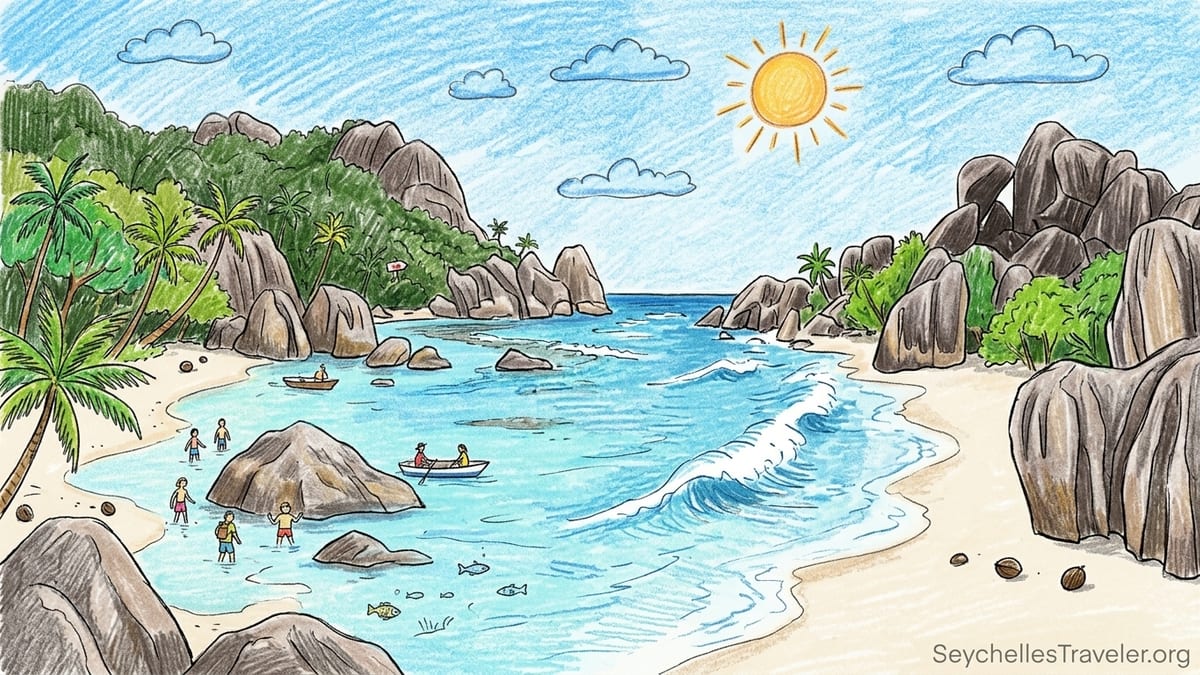
How Seychelles’ Granite Shapes Its Most Famous Beaches
The inner granitic islands of Seychelles, including Mahé, Praslin, La Digue and Silhouette, sit on an exposed continental micro-plate. Their beaches are edged not by lava or coral rubble but by Precambrian granite that has been eroded for tens of millions of years into smooth, rounded blocks and towering slabs. On the coast, this granite often appears as giant boulders that frame bays, trap sand and create shallow lagoons. The result is a series of coves where rock, reef and white sand interact in very specific ways that travelers notice immediately in the water depth, surf and light.
Those granite formations help determine whether a beach is a calm lagoon or an exposed surf bay. Where boulders and offshore reefs form a barrier, such as at Anse Source d’Argent on La Digue, the wave energy is broken before it reaches shore, leaving shallow, glassy pools between rocks. In contrast, beaches like Grand Anse on La Digue or Anse Intendance on Mahé are long arcs of sand with fewer protective boulder fields; they face open ocean and can see strong surf and rip currents, especially during the southeast trade winds season from roughly May to October, when winds are stronger and seas rougher according to Seychelles Meteorological Authority climate guidance.
These rock formations also influence shade, facilities and even access. Many coves are backed by forested granite hills, so takamaka and palm trees lean over the sand in narrow bands. At Anse Major on Mahé, for example, the only way in is a coastal trail that threads across granite slopes before dropping to a boulder-framed bay. On more developed beaches such as Beau Vallon or Anse Royale, roads and guesthouses run close behind the sand, but large boulders still punctuate one or both ends of the bay, creating distinct swimming corners and photogenic viewpoints.
For travelers planning an itinerary, the key is to separate visual drama from swimming suitability and to understand how granite, tides and seasonal winds interact at each specific beach. The following sections compare a dozen of the most important granite boulder beaches, then look at tides and monsoon seasons, before finishing with suggested combinations for each main island.
La Digue’s Classic Granite Showpieces
La Digue is the island most closely associated with Seychelles’ granite fantasy landscapes. Its west and south coasts are a sequence of coves where enormous boulders lean into turquoise shallows. The two best known, Anse Source d’Argent and Grand Anse, show how different granite beaches can feel in the water, even when they share the same stone.
Anse Source d’Argent is often described as the most photographed beach in Seychelles. A chain of sandy coves separated by house-sized granite blocks, it sits behind a protective reef on the southwest coast of La Digue. The boulders are classic Seychelles granite: pale grey, weathered into rounded, almost layered forms with deep grooves and overhangs. At high tide, pools between the rocks become waist deep in places, but much of the lagoon remains shallow; travelers and local guides commonly report that at low tide large sections of the bay drop to ankle or knee depth, with exposed coral heads. That means this beach is superb for wading, floating and photography, yet mediocre for proper swimming. Snorkeling can be charming for confident swimmers who know how to navigate shallow coral without touching it, but you will not find long clear laps here.
Access to Anse Source d’Argent is through L’Union Estate, a historic plantation area that also manages the main route to the beach. As of 2026, foreign visitors pay a day entry fee of around SCR 150 per person at the estate gate, based on recent traveler reports and estate information. The ticket typically allows multiple entries the same day, which is useful if you want to photograph both soft morning light and late-afternoon glow on the boulders. A flat track through coconut palms takes about 10 to 15 minutes on foot or by bicycle to reach the beach. Inside the estate there are simple snack stands, the Old Pier Café near the water, basic toilets and some shaded picnic spots. Shade on the sand itself is modest once the sun climbs, mostly from leaning palms and casuarina trees behind the boulders.
On La Digue’s windward side, Grand Anse and neighboring Petite Anse and Anse Cocos are entirely different. Grand Anse is a wide crescent of sand framed by granite headlands rather than closely packed boulders in the surf. The sand is fine and pale, with a steeper profile where it meets the water. There is usually strong shore break and powerful waves, particularly during the southeast trade wind months when ocean swells arrive directly from the open Indian Ocean. Even at other times of year, local authorities and guides routinely warn that currents can be dangerous here. There is some shade at the landward edge and a small snack kiosk in season, but facilities are limited and there are no lifeguards. It is visually stunning, with long perspectives ideal for photographers, yet visitors who are not very experienced in rough water are often advised to stay in the shallows.
From Grand Anse, a marked trail over granite and forest leads in about 20 to 30 minutes to Petite Anse, and then a little farther to Anse Cocos. These two coves have more pronounced granite formations at their edges and, in the case of Anse Cocos, a sheltered rock pool at the far end where boulders and reef create a calmer, shallower basin that many travelers use for safe bathing even when surf is rough along the open part of the bay. There is no road access and no built facilities beyond occasional informal drink stands, so visitors should bring water, sun protection and sturdy footwear. For photographers, mid to late afternoon often gives warm light on the granite faces, while mornings can be better for cooler, more even tones if you plan to walk back before the hottest part of the day.
Mahé: From Surf Bays to Sheltered Granite Coves
Mahé, the largest island and home to the international airport, offers the widest variety of granite-backed beaches. Several of its signature bays combine easy access and facilities with striking boulder formations. The key names for most visitors are Beau Vallon, Anse Intendance, Anse Takamaka, Anse Royale, Petite Anse and Anse Major, each with a distinct balance of drama and swimmability.
Beau Vallon on the northwest coast is one of the few long, almost uninterrupted sandy beaches in Seychelles. Granite plays more of a framing role here, with clusters of boulders at either end rather than in the middle of the bay. Those rocks still make classic Seychelles images at sunrise and sunset, but the main appeal is a broad, gently shelving sandy bottom. During the calmer northwest monsoon season between roughly November and March, seas are typically relatively flat here compared with the exposed southeastern coasts, making Beau Vallon one of the better options for families and less confident swimmers. The beach has a public road, parking along the back, plenty of guesthouses and hotels just across the street, several small supermarkets, beach shacks and occasional water-sports stands. Shade is available under takamaka and almond trees scattered behind the high-tide line.
Anse Intendance on Mahé’s remote south coast is the visual opposite. The bay is a deep curve of sand with granite headlands and scattered boulders, but no offshore reef protecting it. Photographers love the clean sweep of surf lines and dramatic cloudscapes, especially in the southeast trade wind months when waves can be large. For swimmers, that exposure brings real risk. Local authorities have repeatedly issued warnings about strong currents and steep shore break at Intendance, and resort staff in the area commonly post red flags when conditions are unsafe. There are very limited facilities: a parking area off the main road, a beach access path, some natural shade and, depending on season, a small refreshment stand. It is not usually recommended for young children or anyone unsure in the ocean, but it remains one of Mahé’s most striking granite-framed landscapes.
Anse Takamaka, just to the west, offers a softer experience. Here, granite boulders extend farther into the water, and a reef shelf offshore breaks incoming waves. The sandy bottom near shore is relatively shallow and usually calmer than Intendance, particularly in the southeast season when this more tucked-away bay can feel protected. Takamaka trees lean over the beach giving good natural shade, and small guesthouses and a roadside restaurant sit just above the sand. Parking is typically directly off the coastal road. For snorkeling, the rocky edges of the bay provide interesting fish life in clear conditions, although the coral itself is patchy and swimmers must watch for surge over shallow rock.
On Mahé’s east and southeast coasts, Anse Royale is a long reef-protected stretch of sand with scattered granite boulders and rock outcrops, especially around the Fairyland area at its southern end. The reef here creates a calm lagoon even when the open ocean is rough, something local dive and snorkel operators often highlight. At mid to high tide, the water is deep enough for relaxed swimming over sand, while low tide exposes more rock and seagrass shallows. Facilities include roadside parking, small local restaurants, takeaways and guesthouses across the road. Shade varies, but many sections have overhanging trees that provide comfortable places to spend several hours.
Petite Anse on Mahé, not to be confused with La Digue’s beach of the same name, is nestled in a steep granite bowl on the southwest coast and is fronted by a luxury resort. Access for non-residents sometimes requires checking in with the resort gate and may be limited if occupancy is high, but the beach itself remains public under Seychelles law. Granite boulders flank both ends of the bay and create small snorkel corners, while the center is a clean arc of sand. There is light shore break influenced by seasonal swells. Guests of the resort enjoy full facilities and shade from palms and umbrellas, while day visitors should expect minimal public facilities beyond the natural setting and may be asked to remain in defined areas.
Anse Major sits on the northwest tip of Mahé and is reached either by boat or a roughly one-hour coastal hike from Bel Ombre. The path undulates across exposed granite slabs and through scrub, with panoramic views of boulder points and headlands. The beach itself is a compact bay where large granite blocks scatter both on the sand and into the turquoise water. There is no road and normally no permanent facilities, so visitors must bring water and sun protection. Swimming conditions vary with season and swell direction, but the bay is often calm compared with more open coasts, and there is some basic shade under trees at the back of the sand. For photographers, the lack of buildings and the sense of enclosure by rock make Anse Major feel very wild despite its proximity to the main island’s capital.
Praslin and Satellite Islands: Classic Curves and Tucked Granite Coves
Praslin, the second largest granitic island, is best known for its sweeping bays such as Anse Lazio and Anse Volbert, plus more secluded coves like Anse Georgette and Anse La Farine. Granite is an essential visual element at all of these, but each balances rock, sand and reef differently.
Anse Lazio on the northwest coast regularly appears in lists of the world’s top beaches. Two granite headlands and scattered boulders at each end frame a long curve of fine, pale sand. The central section shelves into clear water without significant rock, making it one of the more satisfying beaches in Seychelles for straightforward swimming when conditions are moderate. During calmer months around the northwest monsoon season, arriving roughly from mid-November to March, visitors often find gentle waves and excellent visibility. In stronger trade wind periods, there can be more shore break, and currents may become challenging near the headlands. Facilities have improved over time and currently include a parking area a short walk from the sand, a couple of beachside restaurants or snack bars and shaded areas under takamaka trees. There are no extensive built shade structures, so carrying a hat or beach umbrella remains wise.
Anse Georgette, on Praslin’s northwestern tip, is smaller, more enclosed and often quieter. There are sheer granite slopes and large boulders on both sides, which concentrate the view and give photographers clean compositions of sand, sea and sky with very little development in frame. The beach is a public one under Seychelles law, but the most practical land access for visitors is via the grounds of the adjacent Constance Lemuria resort. Current practice, confirmed by local tourism businesses, is that non-resident visitors should contact the resort in advance, often 24 to 48 hours before visiting, to request access, and numbers may be limited to avoid crowding. Boats can also land visitors in suitable sea conditions. There are no public facilities on the sand itself; shade is mostly from natural vegetation at the back of the beach. Swimming conditions again depend on swell and season, with a combination of open ocean exposure and some shelter from the bay’s shape.
Anse Volbert, also known as Côte d’Or, lines much of Praslin’s northeast coast. Here the granite influence is more distant, with headlands and inland hills setting a backdrop while most of the beach is broad sand. Offshore, shallow water and fringing reef create extensive turquoise shallows. This is one of the main accommodation and restaurant areas on Praslin, so facilities are extensive: guesthouses, hotels, small shops, boat excursion stands, and several beach bars. The wide, relatively flat sandy bottom makes Anse Volbert attractive for children and casual swimmers when winds are not driving chop directly into the bay. Boats moored offshore and small piers can appear in photographs, so for cleaner granite-focused images, the ends of the bay near the rocky outcrops work better.
Anse La Farine, facing the channel between Praslin and Curieuse, has historically been associated with a now-closed lodge, which means current public access can be more logistically complex. The beach itself is another example of granite hillsides dropping steeply to a narrow band of sand, with dense vegetation behind. There are scattered boulders at the edges and some offshore rock creating small snorkeling corners. Reaching Anse La Farine generally involves a boat transfer from Baie Ste Anne or Anse Volbert, arranged through local skippers or tour operators. Facilities are minimal or absent since the nearby property is not operating as a standard resort as of recent reports, so visitors should treat it as a wild beach excursion with their own supplies.
Beyond Praslin itself, nearby granitic islands such as Silhouette also showcase dramatic granite shorelines. The main beach near La Passe on Silhouette has large boulders at both ends and a steep mountainous backdrop, though fringing reef and seagrass beds can make the nearshore water shallower and less suited to long-distance swimming. Accommodation on Silhouette is currently concentrated in a single large resort area and a small guesthouse village, so facilities cluster there, while other bays around the island remain largely undeveloped and reached by boat or on demanding hiking trails.
Tides, Winds and When These Beaches Feel Their Best
Because many Seychelles beaches sit behind shallow reef shelves and between granite outcrops, tides and seasonal winds have a visible impact on both beauty and swimming conditions. Travelers who understand this can time visits for the experience they want. The Seychelles Meteorological Authority and official climate information describe two main seasonal wind regimes: the northwest monsoon, roughly from mid-November to around March, and the southeast trade wind season, roughly from May through October, with transition periods in between. During the northwest monsoon, winds are generally lighter and seas more settled around many of the main granitic islands; during the southeast season, persistent southeast trade winds bring cooler air but also choppier seas and stronger waves on exposed coasts.
On reef-sheltered granite beaches such as Anse Source d’Argent, Anse Royale or parts of Anse Volbert, tides are often more important than seasonal swell. At low tide, the water can recede over broad reef shelves, leaving ankle-deep pools. Reports from regular visitors and local guides make it clear that at Anse Source d’Argent in particular, large sections become almost unswimmable at the lowest tides, although the exposed rock makes for excellent patterns in photographs and good wading for younger children under close supervision. High tide, by contrast, can bring waist-deep water right up to the boulders and in some cases cover narrow strips of sand, making it possible to float between rocks with only a short walk offshore.
On open granite bays such as Grand Anse, Petite Anse on La Digue, Anse Intendance or even parts of Anse Georgette, waves and currents are driven more by ocean swell and wind than by modest tidal range. During the southeast trade wind months, these south and southeast facing beaches can see strong shore break, pullbacks and rip currents that make them hazardous even for strong swimmers. Signage, resort advisories and local taxi drivers frequently stress this point to new arrivals. In calmer inter-monsoon months and during the lighter northwest monsoon, the same beaches can sometimes feel far more swimmable, though they remain less predictable than reef-sheltered lagoons.
For photography, the interplay of tides and light around granite is crucial. Many serious photographers recommend early morning visits to east-facing granite bays and late afternoon for west-facing ones. At Anse Source d’Argent on La Digue, soft morning light from behind or beside the main lines of boulders gives visible texture to the rock surfaces, while afternoon light warms the sand and brings richer color to the sky over the lagoon. On Mahé’s west coast at Anse Intendance or Petite Anse, the sunset period from roughly 17:30 to 18:30 can produce silhouettes of palm trees against pastel skies, although passing showers are common in both monsoon regimes. Checking tide charts and trying to match mid-tide with your preferred light gives a good compromise between visible granite formations and enough water depth for reflections and swimming.
Access, Fees, Facilities and How Public Beaches Really Work
Seychelles law treats all beaches as public up to the high-tide line, regardless of what type of property sits behind them. In practice, granite coves with forest or resorts directly inland can feel more or less private depending on how you get in. Anse Source d’Argent and Anse Georgette are the two most commonly misunderstood examples, and understanding their current arrangements is important for planning.
To reach Anse Source d’Argent, visitors walk or cycle through L’Union Estate on La Digue. The estate operates as an attraction with a coconut mill, vanilla plantation and giant tortoise enclosures, and it manages the main pathway to the beach. Recent visitor reports from 2026 indicate that foreign adults pay about SCR 150 each at the gate, with payment accepted in rupees and often major foreign currencies by cash or card. The fee usually covers a full day, so you can exit and re-enter if you want to return at a different tide or light. Once inside, the path is flat and shaded, with clear signage to the beach, and bicycle parking areas set back from the sand. Simple drink stalls often appear just behind the first coves, selling items like fresh coconuts or fruit juice.
At Anse Georgette on Praslin, no entrance fee is charged for the beach itself, but access on foot is effectively managed by Constance Lemuria resort, whose golf course and grounds lie behind the bay. The beach is not private and remains public. However, in order to control numbers and protect both the resort’s operations and the environment, visitors who are not staying at the hotel are usually expected to contact the resort in advance by phone or email to request access for a particular day and time window. Some local car hire companies and guesthouses on Praslin remind guests to do this 24 to 48 hours ahead. Failing that, boat excursions from elsewhere on the island sometimes include a drop-off in calm conditions. Once at the sand, there are no public toilets, kiosks or lifeguards, and shade is mainly from trees just behind the upper beach.
On more developed beaches, facilities vary. Beau Vallon on Mahé and Anse Volbert on Praslin function as main tourist hubs, so both offer roadside parking, a range of accommodations, small supermarkets, beach bars and sometimes organized activities such as snorkeling trips or glass-bottom boat tours. Granite is more a scenic frame than a navigation challenge here. At wilder beaches like Anse Major, Grand Anse La Digue or Anse La Farine, the combination of limited shade, no on-site fresh water and potentially long approaches over granite paths means visitors must plan as they would for a short hike: sturdy sandals or shoes, at least a liter of water per person and sun protection that does not rely on built shade.
Parking access also differentiates beaches. On Mahé, Anse Intendance, Anse Takamaka and Anse Royale all have vehicle access points just off the main coastal road, though spaces can be limited at peak times. On La Digue, mechanics are simpler because most visitors move by bicycle; the main limitation is the unpaved, partially sandy stretch through L’Union Estate on the way to Anse Source d’Argent, which can feel slow but is flat. Boat-based access, such as to Anse La Farine or some of Silhouette’s bays, depends heavily on sea conditions and the policies of local skippers, who may adjust landing points if southeast season swells are running.
Comparing Beaches: Swimming, Snorkeling, Photography and More
The table below summarizes how a dozen of the key granite beaches compare in terms of swimming, snorkeling, photography, suitability for couples and children, access, facilities and seasonal exposure. The ratings are broad indications based on typical conditions and current access arrangements, not guarantees on any particular day.
Beach comparison overview (relative ratings): Anse Source d’Argent excels for photography, couples and young children who like shallow water but scores low for serious swimming; access is easy by bicycle and foot once you have entered L’Union Estate, and basic facilities are available, while seasonal exposure is low thanks to the reef. Anse Lazio and Anse Volbert on Praslin rate highly for swimming and general family friendliness, with moderate snorkeling along rocky edges and strong all-round photography potential; both have straightforward road access and good facilities but can see some wave energy in the southeast season.
On Mahé, Beau Vallon is one of the strongest all-rounders for swimming, families and facilities, especially in the calmer northwest monsoon months, though its open, developed frontage makes it less of a pure granite photo icon. Anse Intendance and Grand Anse on La Digue top the list for dramatic surf scenery and couples’ photography but rate low for children and cautious swimmers due to powerful waves and currents when trades are strong. Anse Takamaka and Anse Royale sit in the middle, offering sheltered corners behind granite and reef that make for reliable casual swimming, decent snorkeling around rocks and comfortable shade within easy reach of roadside parking and small restaurants.
More secluded granite coves such as Anse Georgette, Petite Anse on Mahé and Anse Major aim at visitors who value setting over facilities. These beaches usually rate very highly for photography and couples, medium for swimming depending on daily swell, and low for services beyond natural shade. For snorkeling, their rocky edges can provide good fish life and coral patches in the right conditions, but surge and changing visibility mean they are better suited to confident, well-equipped swimmers. In terms of seasonal exposure, northwest-facing bays like Beau Vallon and Anse Lazio are generally calmer in the southeast trade wind months, while south and southeast facing bays such as Intendance, Grand Anse La Digue and parts of Anse Royale feel rougher in that same period and calmer in the northwest monsoon.
Planning Island-by-Island Granite Beach Combinations
For visitors with limited time, pairing beaches on each island makes it easier to see both calm lagoons and dramatic surf. On La Digue, a strong combination is one relaxed day at Anse Source d’Argent and one hiking day linking Grand Anse, Petite Anse and Anse Cocos. The first day emphasizes boulders, shallow turquoise water and slow exploration between coves, ideal for couples and families with younger children. The second day offers wild surf views, long perspectives for photography and, at Anse Cocos’ rock pool, a relatively sheltered place to cool off. Staying in the central or west side of La Digue keeps cycling times manageable: many guesthouses in La Passe offer simple bike rentals that make it easy to reach both L’Union Estate and the Grand Anse trailhead.
On Mahé, one practical pairing focuses on the northwest coast and another on the south. A northwest day might start at Beau Vallon for swimming and shaded time in the water, continue with the coastal hike to Anse Major for granite-dominated scenery, and finish back at Beau Vallon for sunset. Facilities at Beau Vallon mean you can shower, eat and watch evening light on the bay without moving accommodation. A south coast day could combine Anse Intendance’s theatrical surf and granite headlands with swimming and lunch at Anse Takamaka or Anse Royale, where reef-sheltered water is more forgiving. Travelers who enjoy a touch of luxury can add a visit to Petite Anse’s bay, arranging access through the resort gate, and spend a few relaxed hours there before returning to simpler guesthouses elsewhere on the island.
On Praslin, the obvious pairing is Anse Lazio and Anse Volbert, giving you both a relatively wild-feeling but accessible granite-framed bay and a village-backed sandy arc with extensive services. Many visitors choose accommodation near Anse Volbert because of its restaurants and boat trip options, then visit Anse Lazio by rental car or taxi for half or full days. A more specialized combination swaps Anse Volbert for Anse Georgette, giving a quieter, more intimate granite bay if you secure access through Constance Lemuria ahead of time. Those with an appetite for exploration can add a boat trip that lands at an additional granite shore, such as Anse La Farine or one of the smaller island coves, conditions permitting.
For travelers able to add a fourth granitic island, Silhouette or one of the small marine park islands near Mahé can round out the experience. Staying overnight on Silhouette gives access to towering granite peaks and limited but striking beaches, while day trips to marine park islands can highlight how granite continues beneath the surface in the form of underwater boulder gardens for snorkelers. In each case, checking wind direction and recent sea conditions with local operators just before booking will help ensure that landings and snorkeling are pleasant rather than a struggle through chop.
FAQ
Q1. Is Anse Source d’Argent really worth paying the L’Union Estate fee?
The approximate SCR 150 entry fee for foreign visitors gives access not only to Anse Source d’Argent but also to the estate’s historic plantation grounds and giant tortoise pens, and it is valid for the whole day. For travelers interested in photography, the ability to return at both high and low tide, or in different light, usually makes the cost worthwhile. Visitors focused purely on deep-water swimming may prefer to spend more time at beaches like Anse Lazio, Anse Volbert or Beau Vallon instead.
Q2. How dangerous is the surf at Grand Anse on La Digue and Anse Intendance on Mahé?
Both Grand Anse and Anse Intendance are open-ocean bays where there is no reef breaking the full force of incoming swell. During the southeast trade wind season from roughly May to October, waves and rip currents here can be powerful enough that local authorities and resorts regularly advise against swimming beyond the shallows. Even outside that season, conditions are variable and can change quickly. Visitors should take surf flags and local advice seriously and consider these beaches primarily as scenic and photographic destinations rather than safe family swimming spots.
Q3. Can non-guests legally visit Anse Georgette on Praslin?
Yes. All beaches in Seychelles, including Anse Georgette, are public up to the high-tide line. However, the most convenient land access crosses the private grounds of Constance Lemuria resort, and the resort manages that flow for safety and privacy reasons. Non-resident visitors are generally asked to contact the hotel in advance, often 24 to 48 hours ahead, to request access at a specific time, and numbers may be limited. Alternatively, some boat excursions land at Anse Georgette when sea conditions are suitable.
Q4. Which granite beaches are best for children and less confident swimmers?
Beaches with reef-sheltered, shallow lagoons and relatively gentle entries tend to suit families best. On La Digue, Anse Source d’Argent works well at mid to high tide because water stays shallow near shore and waves are tiny, though coral heads mean children should wear protective footwear. On Mahé, Beau Vallon and Anse Royale are common choices for their gradual sandy slopes, mixed shade and nearby facilities. On Praslin, Anse Volbert offers wide, shallow areas and easy access to shops and restaurants. Exposed surf beaches like Grand Anse or Anse Intendance are generally not recommended for young children.
Q5. Where are the strongest granite photography opportunities?
Anse Source d’Argent is unmatched for close-up boulder formations in shallow water, especially in soft morning or late-afternoon light. The trio of Grand Anse, Petite Anse and Anse Cocos on La Digue offer sweeping surf scenes framed by granite headlands. On Mahé, Anse Major and Anse Intendance provide clean, wild compositions, while on Praslin, Anse Lazio and Anse Georgette both deliver classic curves of sand boxed by rock. Photographers who want to avoid crowds often aim for the first two hours after sunrise or the last hour before sunset, adjusting for tide to capture either reflections or exposed rock textures.
Q6. How do tides affect snorkeling on these granite beaches?
At reef-sheltered beaches like Anse Source d’Argent, Anse Royale and parts of Anse Volbert, low tide can make snorkeling awkward and environmentally risky because coral heads sit very close to the surface. Mid to high tide usually offers more comfortable depth while still allowing views of fish around boulders and patch reefs. On open bays such as Anse Lazio, Anse Georgette and Anse Major, tides matter less than swell and wind; visibility and safety are determined more by wave energy and surge along the rocks. It is always important not to stand on or touch living coral and to use reef-safe sunscreen.
Q7. What is the difference between the northwest monsoon and southeast trade wind seasons for beachgoers?
The northwest monsoon, typically from mid-November to around March, brings warmer, more humid air and generally lighter, more variable winds on the main granitic islands. Sea conditions are often calmer, which favors swimming and snorkeling on many beaches, although showers can be frequent. The southeast trade wind season, roughly May through October, is cooler and breezier, with more persistent southeast winds that can create choppy seas and stronger surf on exposed south and southeast facing coasts. Northwest-facing bays such as Beau Vallon and Anse Lazio often feel more sheltered in that period.
Q8. Do I need a car to explore these granite beaches?
On Mahé and Praslin, renting a car for at least a few days makes it much easier to combine several beaches in one outing, especially when chasing particular light or tide conditions. Public buses do reach many coastal areas but can be infrequent and slow, and they may not stop very close to trailheads like the one for Anse Major. On La Digue, almost all visitors rely on bicycles or walking; the island is small, and there are no standard car rentals. For more remote or boat-access beaches such as Anse La Farine or certain coves on Silhouette, arranging a local skipper or joining a small group excursion is essential.
Q9. Are there lifeguards on these beaches?
Lifeguard coverage in Seychelles is limited. Beau Vallon and a few other popular beaches sometimes have lifeguard presence or safety signage, but many of the most famous granite bays, including Anse Lazio, Anse Georgette, Anse Intendance, Grand Anse on La Digue and Anse Major, do not have permanent lifeguards. Travelers need to assess conditions themselves, respect flags and warning signs where present, and be cautious about entering rough water, especially during the southeast trade wind season.
Q10. How can I minimize environmental impact when visiting these granite beaches?
Granite beaches in Seychelles are fragile ecosystems where coastal vegetation, sand stability and shallow coral all interact. Visitors can help by sticking to established paths across dunes and granite, avoiding trampling vegetation that anchors the sand, and never standing on or breaking coral heads. Taking all rubbish away, using refillable water bottles and reef-safe sunscreen, and keeping a respectful distance from wildlife such as nesting turtles and seabirds all help ensure that the granite coves remain as pristine as possible for future travelers and local communities.