


When I first saw the jagged outline of Silhouette Island rising out of the Indian Ocean, it looked almost unreal. I had already spent time on Mahé and day-tripped to busier beaches, but this journey felt different from the moment I checked in at the small Labriz Lounge on the Bel Ombre jetty. I was about to swap convenience for isolation, and I wanted to know whether the price of staying at the newly branded Niva Labriz Seychelles would really be worth it compared with extra time on Praslin or La Digue.
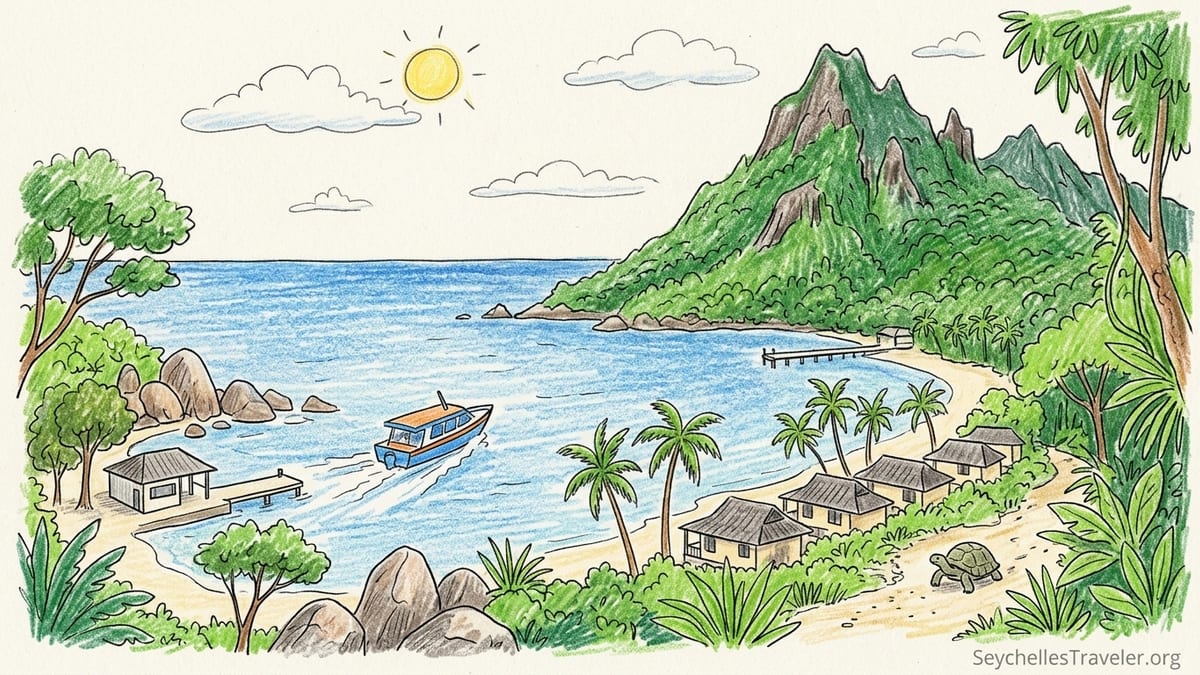
Crossing From Mahé To A Different World
My Silhouette experience began on Mahé’s northwest coast at Bel Ombre, a quiet area that already feels removed from the island’s main bustle. Niva Labriz runs its own boat service from a small terminal often still referred to locally as the Labriz Lounge near Bel Ombre. After a taxi ride from Beau Vallon that cost roughly 250 Seychellois rupees and took about 15 minutes, I checked in for the afternoon crossing. Staff weighed my bags, tagged them for the right villa, and handed me a reusable boarding card along with a cool towel and juice. Even before leaving Mahé, it felt more like checking into a resort than boarding a public ferry.
The scheduled journey to Silhouette takes around 45 minutes by fast boat and is currently priced at approximately 210 euros per adult for a mandatory round-trip transfer when booked with Niva Labriz, with discounts for children and occasional package inclusions. That price stings, especially when you realize you will also pay additional fees if you want to pop back to Mahé for a day. The afternoon I traveled, seas were calm but there was a steady southeast trade wind and passing showers, typical for this part of the Seychelles around May to September. Passengers were advised to take seats toward the stern if prone to motion sickness, and plastic covers were rolled down along the sides once we left the shelter of Mahé’s coastline.
As the boat pulled away from Bel Ombre, Mahé’s granite peaks slid behind us and Silhouette began to dominate the horizon. It is the third-largest granitic island in Seychelles, and from the water it looks like a single, immense mountain punching straight out of the ocean. Dark rainforest covered most slopes, cut by only a few pale scars of rock. There were no obvious roads, no string of guesthouses, just a ribbon of pale sand at La Passe and the low shapes of a few villas. Compared with arriving at Praslin or La Digue by inter-island ferry, where harbors bustle with trucks and bicycles, this felt quietly dramatic and a little intimidating. I understood immediately that staying here would mean committing to the island.
The final approach hugged the east coast, skirting the protected Silhouette Island Marine National Park. The water shifted from deep blue to clear turquoise, and reefs became visible just under the surface. The jetty at La Passe finally came into view, backed by coconut palms and forest, with a handful of buildings: the arrival pavilion for Niva Labriz, a small staff village, and at a distance the separate, far smaller lodge of La Belle Tortue. It was already clear that Niva Labriz dominates the island’s tourism footprint, and that choosing Silhouette almost automatically means choosing this resort.
From Hilton Labriz To Niva Labriz: What Actually Changed
One of the reasons I wanted to stay here was curiosity about the recent rebranding. For years the only resort on Silhouette traded as Hilton Seychelles Labriz Resort & Spa, a key points redemption for loyal Hilton guests. At the end of 2025, that management agreement ended and the property left the Hilton portfolio, reopening under independent management as Niva Labriz Seychelles. Locals I spoke to on Mahé and Silhouette still slip and call it “Hilton” out of habit, but the branding on boats, signage and room materials is now firmly Niva.
The ownership of the resort did not change, which means the physical layout is largely the same: a line of villas running along a more than 2.5 kilometer stretch of beach, backed by forest and mountains, plus a cluster of restaurants, pool, spa and activity center around the central part of La Passe. The major differences I noticed were softer and operational rather than structural: fewer overt corporate touches, a simplified check-in, and new sustainability messaging that built on the resort’s existing Green Globe environmental certification.
That said, one of the practical consequences for travelers is the loss of Hilton Honors benefits and points redemptions. When I priced dates in early 2026, entry-level garden villas commonly started somewhere in the range of 600 to 800 euros per night including breakfast, rising significantly for beachfront or pool villas, and spiking over peak festive periods. Packages sometimes bundle the boat transfer, but on my dates the 210 euro transfer fee was separate. The resort sits squarely in the luxury bracket and shows it in its marketing, but without chain loyalty perks, the question “Is it worth it?” becomes more pointed. My stay was in a Beachfront Villa for three nights on a half board plan, mid-season, at a nightly rate that worked out to just under 1,000 euros once taxes, meals and the boat transfer were factored in.
There is another accommodation choice on the island, La Belle Tortue, a small lodge near the jetty with its own 45 minute shuttle boat from Bel Ombre and slightly different pricing structure. However, the two properties operate entirely independently. Niva Labriz guests use the resort’s own scheduled transfers and facilities, and once you have committed to one, you cannot simply wander between them as if they were parts of the same complex. That separation matters, because when you stay at Niva Labriz you are locked into its ecosystem, especially for dining and excursions.
Inside My Villa: Space, Privacy And Direct Sand Underfoot
After disembarking, I was driven in a battery-powered buggy along a sandy internal lane shaded by takamaka trees and palms. The villas at Niva Labriz are numbered along the beachfront and in gardens behind, with some larger retreats closer to the jungle. Mine was a Beachfront Villa about a ten-minute walk or a short buggy ride from the main pool and restaurants, which turned out to be a sweet spot: far enough to feel secluded, close enough that I did not feel marooned if a tropical shower rolled in.
The villa itself was generously sized, with a high timber ceiling, polished floors and a sliding glass wall facing the sea. There was a large bed, a small sitting area and a desk. Behind the sleeping area, sliding doors opened to an outdoor bathroom courtyard with a deep soaking tub and rain shower screened by high walls and vegetation. Inside, another shower and double vanity made it easy to rinse off without stepping outside in rain. Décor still leaned on the clean, slightly understated tropical style inherited from the Hilton era: neutral tones, dark wood, woven textures, and a few locally inspired artworks.
The real luxury was outside. My terrace had loungers and a hammock shaded by casuarina trees, and beyond that only a few meters of coarse, pale sand separated me from the water. At high tide waves sometimes kissed the line of beach vegetation, while at low tide a broader swathe of sand opened up. I could hear the surf from bed, which I loved. Privacy was better than at many beach resorts because villas are staggered and there is no public path between them and the water. I could see shapes of neighbors through the foliage if I looked, but it never felt exposed. At the same time, this seafront positioning highlights one of Silhouette’s quirks: depending on wind and swell, the water can be choppy with strong shore break, and this is not always a lagoon-like, gently shelving beach where children can safely play unsupervised.
Service in-villa matched expectations for a five-star property but did not feel showy. Housekeeping twice daily kept sand and humidity at bay, and any requests submitted over WhatsApp or via reception were usually answered within a few minutes. When a tropical downpour coincided with my planned hike departure, a buggy appeared unprompted with umbrellas and towels. Small maintenance issues like a sticking terrace door were resolved same day. It did not feel ultra-boutique or ultra-personal, but it did feel well run, which matters more when you cannot simply step outside to another business if something goes wrong.
Eating On An Island With Few Options
Food is where isolation hits most. On Mahé, Praslin or La Digue you can wander to a takeaway, beach bar or small restaurant if a resort menu feels expensive. On Silhouette, there is no village café and no roadside grill to stroll to. Outside Niva Labriz and the separate La Belle Tortue restaurant, there is essentially nowhere to eat. Unless you have booked at the latter, you will almost certainly end up taking most meals at Niva’s restaurants. That reality shapes both budget and experience.
Breakfast was included in my rate and served at the main buffet restaurant near the pool between roughly 7 and 10:30 a.m. The spread was extensive, closer to larger Asian or Middle Eastern resorts than small island boutique hotels. There were fresh tropical fruits, Seychellois curries, made-to-order eggs, pastries and rotating specials. I appreciated the option of eating on the terrace looking over the pool and ocean, with my feet almost in the sand. Quality was consistent across my stay, and staff were quick to offer coffee refills and bring made-to-order dishes. It felt like good value when bundled in the room rate, though paying separately at typical a la carte prices would have added up fast.
Evening dining presented more budget tension. Niva Labriz operates several outlets, but not all are open every night. On my three nights, I rotated between the main buffet with themed nights, a Creole restaurant serving grilled fish and octopus curry, and a beachside bar-restaurant with a narrower menu of burgers, salads and simple seafood dishes. Set menu prices often hovered around 70 to 90 euros per person before drinks, and a simple main course at the bar with a beer or glass of wine could easily run to 40 to 50 euros. Those figures match what other guests reported and align with five-star resort norms, but without cheaper alternatives on the island, they feel heavier.
I chose a half-board package that included breakfast and dinner, which helped make costs more predictable. Lunches, drinks and any special dinners were extra. Over three days, my food and beverage bill for one person, including a couple of cocktails and a bottle of house wine, settled around 250 euros beyond the half-board inclusion. For couples or families, this multiplies quickly. The food itself ranged from good to very good, with some standout local curries and grilled fish fillets caught around Silhouette, but nothing that would on its own justify traveling to this specific island. The point is less culinary revelation and more the setting: eating under stars with the silhouette of the mountain looming behind and the surf in front.
Trails, Humidity And Respecting A Protected Environment
Silhouette is mostly national park, both on land and in the surrounding marine areas. Roughly ninety percent of the island is protected, and it feels that way from the moment you step away from the resort footprint. There are no rental cars, and tracks quickly give way to footpaths that thread between giant granite boulders, pandanus roots and thick stands of palm. Hiking and walking were main reasons I chose Silhouette, and they turned out to be the highlight of my stay, but they also required more respect for conditions than hikes I have done on Praslin or La Digue.
On my first full day, I booked a guided walk organized through the resort to a viewpoint above La Passe. The route followed a combination of old plantation paths and narrow forest track, starting almost at sea level and climbing to roughly 250 to 300 meters. The hike took around 2.5 hours return at a steady but not rushed pace, including breaks. Humidity was intense, and even in partial shade I was drenched within 20 minutes. The guide, a Seychellois who had grown up on Mahé, carried extra water and frequently pointed out endemic plants: tree ferns, palms and several species said to be found only on Silhouette or a handful of other granitic islands. Birdlife was audible more than visible, with calls from Seychelles bulbul and blue pigeon echoing in the canopy.
The next morning I joined a small group for a longer trail toward Grand Barbe on the west coast, again with a local guide arranged through Niva Labriz. Official hiking information produced by Seychelles Parks and Gardens Authority lists a marked route crossing the island to Grand Barbe, but conditions can change with landslides, fallen trees and heavy rain. Our guide made clear from the start that attempting this trail alone was strongly discouraged, and in wet weather it could be closed altogether. We started early, a little after 7 a.m., in order to cross the central ridge before the worst of the heat built. The track climbed more steeply than the previous day, with several sections of uneven rock and muddy roots where hands were useful for balance. We gained roughly 500 meters of elevation over the course of two to three hours before descending toward the wetlands behind Grand Barbe’s beach, which is part of both the terrestrial national park and the wider marine protected system.
I was glad I had sturdier footwear than beach sandals, and equally glad for the guide’s local knowledge when clouds began gathering. In that kind of steep terrain, a tropical downpour can make rock faces slick and streams rise quickly. The return route took us back the same way, and by the time we reached the outskirts of La Passe my legs were tired, my clothes were soaked through with sweat, and my appreciation for Silhouette’s wildness had deepened. This is not an island to treat as a casual beach stroll destination. Trails are beautiful but can be unforgiving, and if you leave marked paths without a guide, you would very quickly find yourself in dense, disorienting forest.
For travelers thinking about exploring beyond the immediate resort area, I strongly recommend booking any hikes through Niva Labriz or licensed guides and being honest about fitness levels. Most guided routes I saw on the activity board ranged between two and six hours, with early starts to avoid midday heat. Even the shorter coastal walk north from the resort to quieter stretches of sand took longer than it looked on the map once humidity and photo stops were factored in. On a map, Silhouette looks small. Underfoot, with air thick as warm soup and inclines steeper than most coastal hills, it feels significantly larger.
Snorkeling, Sea Life And The Limits Of Island Isolation
Given Silhouette’s marine park status, I had high hopes for snorkeling straight from the beach. The reality from the main resort shoreline was mixed. On calm mornings with less wind, visibility in the shallows was decent, and within a short swim I saw healthy patches of coral, clouds of reef fish and the odd turtle gliding across sandy channels. On windier days, however, swell and suspended sand reduced clarity significantly. The resort offers boat-based snorkeling excursions through its dive and activity center, including supervised trips that head to reefs with better visibility and structure than the house reef.
I opted for a half-day snorkeling outing rather than a full scuba dive. Including equipment and boat, it cost a little under 100 euros. The boat headed north along the coast and anchored inside the marine park boundaries above a coral slope. Underwater, life felt abundant but also showed signs of the pressures affecting reefs worldwide: some coral bleaching and broken sections interspersed with healthier growth. It was still a memorable experience, with parrotfish, butterflyfish and a couple of shy reef sharks appearing at the edge of visibility. Guides briefed us carefully about not touching coral, keeping distance from turtles and avoiding standing on reef structures, and they kept a close eye on currents. That level of supervision suited me fine, but self-directed snorkelers used to simply renting gear and wandering off might find it structured.
A gentler, land-based highlight was visiting the area where giant tortoises are kept near the resort. These are not wild, free-roaming animals in a completely natural habitat, but they are part of ongoing breeding and conservation programs connected to Seychelles’ broader effort to protect endemic species. Feeding times were supervised, and staff took time to explain individual animals’ histories to children and adults alike. Combined with the broader island context, it felt more authentic than a simple tourist attraction, though it is still a curated experience rather than a true wilderness encounter.
All of these activities reinforced a simple truth: on Silhouette, almost every experience flows through the resort and its partners. There is no independent dive shop on the beach, no local fisherman casually offering boat trips. That means less choice and often higher prices. It also means better control over environmental impact, which, for an island where around ninety percent of the landmass falls within national park boundaries, is important. As a guest, you trade spontaneity and low-cost improvisation for curated access and conservation-led rules.
The Hidden Frictions: Weather, Transfers And Getting “Stuck”
One aspect that many glossy brochures gloss over is just how dependent Silhouette is on weather and the scheduled boat. During my stay, I watched one afternoon departure canceled because wind picked up and whitecaps built beyond a level the operator was comfortable with. Guests who had planned to leave then were shifted to a later crossing, and those connecting to evening flights from Mahé had to scramble to adjust transfers. Staff handled rebookings professionally, but the incident illustrated a key risk: unlike ferries between Mahé, Praslin and La Digue, which have multiple daily options with different operators, Silhouette’s connection is essentially tied to Niva Labriz’s boats and, for La Belle Tortue guests, that lodge’s smaller shuttle.
If you think you might want to leave early because of weather, mood or budget, this limited transport flexibility matters. Schedules can change seasonally, but during my visit there were usually two main crossings per day between Bel Ombre and Silhouette, with the possibility of extra trips for a fee. Going back to Mahé for a day of sightseeing and returning in the evening was possible, but at an added cost of around 50 euros per person per leg, on top of the main round-trip fee. For a couple, that made a spontaneous market visit on Mahé an expensive proposition. Taxis on Mahé, once you got there, added to the bill.
Within Silhouette, there is no public transport in the usual sense. Distances are walkable along the coastal path between the jetty and most parts of Niva Labriz, but high humidity and sudden rain showers make buggies appealing, especially at night. These are complimentary within reason, but you do sometimes need to wait. If you are used to stepping outside a city hotel and hailing a taxi within minutes, adjusting to this slower, more scheduled rhythm takes some mental recalibration.
Being “stuck” also applies emotionally. By my third evening, I felt a slight cabin fever, even though the setting remained gorgeous. The same internal paths, the same few restaurants, the same stretch of sand and the same faces at breakfast every morning. I could easily imagine some guests reveling in that contained world, but I could also understand why others on weeklong stays begin to crave a different café or the simple spontaneity of renting a bicycle on La Digue. Silhouette is variety-poor but intensity-rich: if you love its combination of mountain, forest and sea, it can be blissful. If you do not, there is nowhere else to go until your boat date arrives.
The Cost Equation: Two Nights Versus A Longer Stay
To decide whether Niva Labriz was worth it, I sat down after my trip and compared my three-night Silhouette stay with what the same money might have bought on Praslin or La Digue. For clarity, I will sketch out an approximate cost breakdown for a notional two-night and four-night stay at Niva Labriz for two adults, based on what I paid and what I observed in early 2026, keeping in mind that real prices will shift with season and offers.
For two nights, assuming a mid-range Beachfront Villa at around 750 euros per night including breakfast, you are looking at 1,500 euros for accommodation. Add the mandatory round-trip boat transfer at roughly 210 euros per adult, so 420 euros, and a half-board dinner supplement of around 70 to 90 euros per person per night. Taking 80 euros as a middle figure, that is 320 euros for two people over two nights. Throw in modest bar drinks and one simple lunch at, say, 120 euros total, and the baseline for a short taste of Silhouette lands somewhere in the vicinity of 2,360 euros before any paid activities like guided hikes or snorkeling. Sign up for one guided hike and a snorkeling trip and you could easily nudge the total past 2,600 euros.
Stretching to four nights, costs do not double exactly because the transfer fee stays fixed, but they still escalate quickly. Four nights at the same rate would be about 3,000 euros, plus 420 euros for transfers, plus 640 euros for half-board dinners. Add a few simple lunches and drinks, and you are realistically in the 4,100 to 4,300 euro range for two, before excursions. Include a couple of guided hikes and a snorkeling outing or spa treatment, and a four-night stay for two can approach or exceed 4,500 euros. In return you get more time to explore trails, sink into a slower rhythm and spread fixed transport costs over more nights, but you also commit more of your Seychelles budget to a single, all-encompassing resort.
Now picture applying those sums to Praslin and La Digue. On those islands, comfortable guesthouses and mid-range hotels can often be found for 150 to 300 euros per night, with local takeaways and small restaurants serving creole dishes for under 15 to 20 euros per person, and car or bicycle rentals offering independent exploration. With a 2,600 euro budget, two people could potentially fund several additional nights split between Praslin’s Anse Lazio and La Digue’s Anse Source d’Argent, plus inter-island ferries and excursions like a Curieuse Island turtle trip. The trade-off is that you would not have Silhouette’s intense sense of isolation and the convenience of a self-contained, polished resort.
For me, the sweet spot looked like two or three nights on Silhouette embedded within a broader Seychelles itinerary. Long enough to experience the boat transfer, the sense of remoteness, one substantial hike and some time on that empty-feeling beach. Short enough that cost and variety limitations did not begin to grate. Had I stayed a full week, I suspect I would have grown restless and uncomfortably aware of how much of my overall Seychelles budget was tied to a single, beautiful but bounded place.
The Takeaway
Silhouette Island delivered exactly what its outline on the horizon had promised: a wilder, steeper, more self-contained world than Mahé, Praslin or La Digue. Staying at Niva Labriz Seychelles amplified that impression. The resort’s villas sit between mountain and sea with very little human sprawl in between, and the national park status of most of the island means that when you step off the internal paths and onto a trail, you quickly enter real forest, not landscaped greenery.
Was staying at Niva Labriz “worth it”? For me, yes, with reservations. The beachfront villa, the quiet nights broken only by surf, and the demanding but rewarding rainforest hikes made my three-night stay feel special in a way that is hard to replicate on busier islands. I valued the chance to see one of Seychelles’ least developed granitic islands without needing complex logistics, and I appreciated the resort’s efforts, however imperfect, to manage tourism within a fragile environment. At the same time, the mandatory boat fee, high dining costs, dependence on a single operator and limited variety of experiences make Silhouette a destination that can quickly devour a budget without necessarily delivering more “value” than extra time elsewhere.
In terms of who will appreciate Silhouette most, I would recommend Niva Labriz to travelers who prioritize nature, seclusion and being unplugged from everyday choices. Hikers who are comfortable with heat and humidity, couples who like the idea of long walks on a mostly empty beach and late-night swims in relative solitude, and repeat Seychelles visitors looking for a contrasting chapter to previous Mahé or Praslin trips are all good candidates. It is less ideal for those who crave restaurant-hopping, nightlife, easy day trips, or very young families who need shallow, consistently calm water and multiple backup options when weather turns foul.
If I were planning my itinerary again, would I choose Silhouette over extra nights on Praslin or La Digue? I would, but only for a short stay. I would still give the bulk of my time to the more varied mix of Praslin’s beaches and La Digue’s bicycle-friendly lanes, then carve out two or three nights at Niva Labriz as a deliberate, high-cost, high-impact finale. Silhouette, for me, is not the Seychelles in miniature. It is an intense side note: remote, green, cloud-snagged and a little demanding. Embraced on its own terms and for the right length of time, it can be unforgettable.
FAQ
Q1. How long does the boat from Mahé to Silhouette Island take, and how much does it cost?
The resort-operated fast boat from Bel Ombre on Mahé to Silhouette usually takes about 45 minutes. For Niva Labriz guests, a mandatory round-trip transfer is typically charged at around 210 euros per adult, with lower prices for children and occasional package deals that include the transfer. Schedules and prices can change, so it is important to confirm exact costs when booking.
Q2. What is the main difference between the old Hilton Seychelles Labriz and the current Niva Labriz Seychelles?
The core physical resort is essentially the same, with similar villas, layout and beach access. The major change is management and branding: the property left the Hilton group at the end of 2025 and now operates independently as Niva Labriz Seychelles. That means there are no Hilton Honors points or elite benefits, and policies, pricing and certain service aspects are now set by the new management, not by Hilton corporate.
Q3. Is Niva Labriz the same as La Belle Tortue on Silhouette?
No. Niva Labriz and La Belle Tortue are separate properties. Niva Labriz is a larger five-star resort spread along a long stretch of beach with multiple restaurants and extensive facilities. La Belle Tortue is a smaller lodge near the jetty with its own boat and pricing structure. Guests at one do not automatically have access to the other’s facilities, and each handles its own transfers and reservations.
Q4. Are there cheaper food options on Silhouette Island outside the resort?
Outside of the resort restaurants at Niva Labriz and the dining room at La Belle Tortue, there are effectively no independent restaurants, takeaways or supermarkets on Silhouette open to visitors. This means that if you stay at Niva Labriz, you should budget to eat most meals at the resort, whether through a half-board plan or paying a la carte. Bringing a few snacks from Mahé can help, but it is not a substitute for full meals.
Q5. How difficult are the hikes on Silhouette, and do I need a guide?
Many hikes on Silhouette are steeper, longer and more humid than casual coastal walks on the other inner islands. Trails that cross the island or climb into higher terrain can involve several hundred meters of elevation gain, slippery rocks and dense forest. For major routes, especially to the west coast or over central ridges, a local guide is strongly recommended and, for some trails, effectively essential. Attempting remote or unmarked paths without guidance is not advisable.
Q6. Is the beach at Niva Labriz suitable for children and non-swimmers?
The main beach in front of Niva Labriz is beautiful and long, but conditions vary with wind and swell. At times the shore break can be strong and currents noticeable, which is not ideal for very young children or weak swimmers. On calmer days, the shallows are more forgiving, but parents should still supervise closely and consider using the resort pool as a safer alternative for small children when the ocean looks rough.
Q7. Can I do a day trip to Silhouette without staying overnight at Niva Labriz?
Day visits are possible but more complicated than day-tripping between Mahé, Praslin and La Digue. You generally need to arrange space on a resort boat or with La Belle Tortue in advance, and there may be minimum spend requirements or specific day-visitor packages. Availability can be limited, and independent last-minute travel without a resort or lodge connection is not guaranteed.
Q8. What happens if bad weather cancels the boat when I need to catch a flight?
If rough seas or storms force the resort to cancel or delay a boat, departures are usually rescheduled to the next safe window. Niva Labriz staff help rebook onward taxis and, where necessary, assist guests with airline changes, but they cannot override weather. To reduce risk, it is wise not to plan the last boat from Silhouette to line up too tightly with an international departure from Mahé and to allow a buffer of several hours.
Q9. How many nights do you recommend on Silhouette within a Seychelles itinerary?
Based on my experience, two to three nights on Silhouette works well for many travelers. That gives enough time to enjoy the boat journey, relax on the quiet beach and complete at least one substantial hike or snorkeling trip, without committing so much budget and time that you miss out on the wider variety of experiences available on Praslin or La Digue.
Q10. Who is Silhouette Island best suited for, and who might be happier staying elsewhere?
Silhouette is best suited to travelers who value seclusion, nature and hiking, and who are comfortable trading dining variety and spontaneity for a more contained, immersive island experience. It may feel restrictive or expensive for those who enjoy exploring many local restaurants, nightlife, easy inter-island hops and independent transport. In those cases, focusing on Mahé, Praslin and La Digue, with perhaps a short visit to Silhouette, can provide a better balance.