


The first thing that hit me at the Copolia trailhead was not the view, but the air. It felt like stepping into a warm, wet blanket. At 8:15 in the morning on Mahé’s Sans Souci Road, the sky over Victoria was still a washed-out blue, but under the canopy the humidity was thick enough to taste. A rooster called from somewhere down the slope, a bus sighed away from the nearby stop, and suddenly the postcard beaches of Seychelles felt very far away. I was here for something different: to find out what Mahé’s mountains and rainforests were really like, beyond the brochures and beyond the sand.
Arriving at Copolia: First Steps Into Mahé’s Mountain Heart
I started the Copolia hike from Victoria with a rented compact car, collected the previous afternoon from a small local agency near the inter-island quay. Taxis on Mahé can easily cost the equivalent of a day’s car rental, and I wanted the freedom to start early. I left Victoria a little after 7:45 a.m., driving inland on the sinuous Sans Souci Road as it climbed away from the capital. Within ten minutes the city noise faded behind me and the forest pressed in, thick and glossy on both sides of the tarmac.
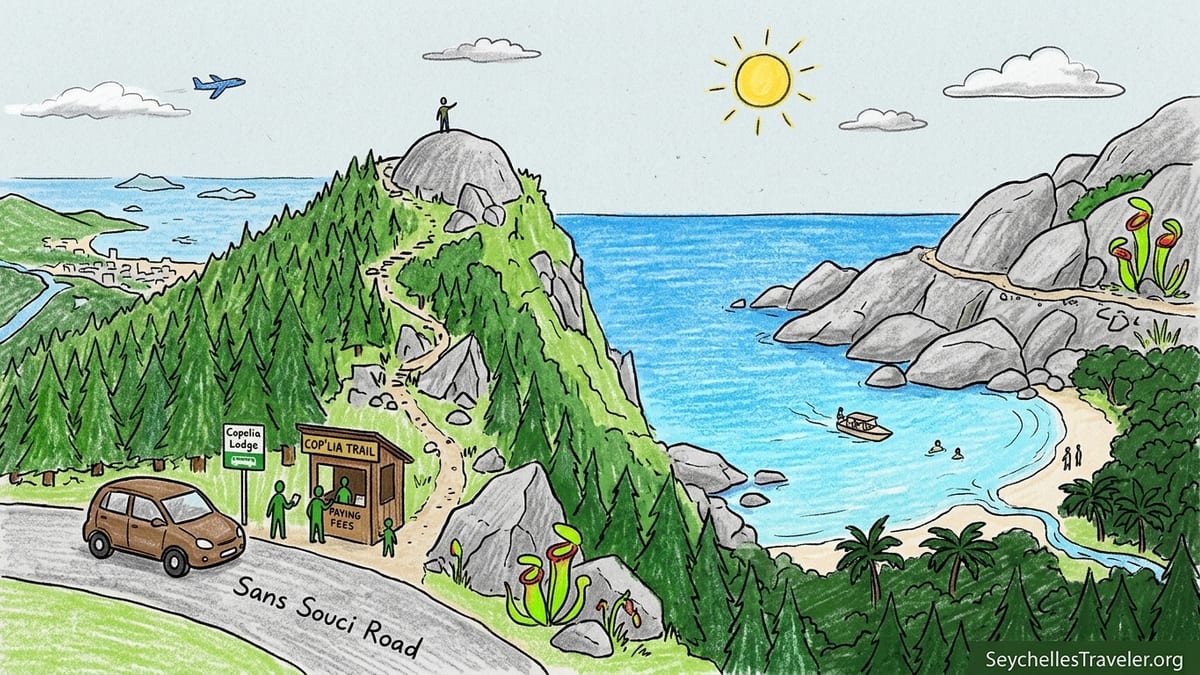
The trailhead appeared more suddenly than I expected, opposite the Copolia Lodge area and just after a bus stop where the local Route 12 buses set down hikers. There is a simple Seychelles Parks and Gardens Authority booth at the entrance, shaded by trees. I parked in one of the informal roadside spaces a few metres uphill, easing the car tight against the bank to leave room for buses and locals. A staff member at the booth collected the entry fee of SCR 100 in cash for non-residents over 12 and handed me a small ticket, reminding me that closing time for the trail was mid-afternoon.
Even in the parking area the air felt dense. The night’s rain had stopped, but beads of water still clung to every leaf. I pulled on trail shoes with decent grip, a light T-shirt and running shorts, and shouldered a small daypack: two litres of water, basic first aid, a rain jacket, and a dry bag for my phone. Looking at the narrow path disappearing into the forest, I realised how different this day would be from the lazy hours I had spent on Beau Vallon’s broad sands.
With expectations of an “easy” viewpoint hike in around an hour, I stepped under the first trees and the forest swallowed the road noise behind me.
Inside the Copolia Forest: Roots, Granitic Slabs and Endemic Green
The Copolia Nature Trail begins innocently, with a gently climbing dirt path that threads between cinnamon trees and secondary growth. Within minutes, though, the island’s true character starts to show. Exposed roots knot the trail, forming natural steps slick with last night’s moisture. Granite boulders push through the soil like grey whales breaking the surface. The forest is dense, but not silent. Seychelles bulbuls rasp from the branches, and every so often a gecko flashes across the path like a small green comet.
The humidity makes the climb feel tougher than the raw numbers suggest. The official guides describe Copolia as roughly two kilometres each way, and that sounds modest on paper. In reality, the combination of steep sections, tangled roots and the sticky coastal air means you work for the views. I found myself stopping more often than I normally would, less from lack of fitness and more to cool down. Each pause brought something new into focus: the smell of crushed cinnamon leaf underfoot, a tiny land snail on the underside of a fern, a spider’s web catching the weak shafts of morning light.
Higher up, the forest begins to change character. The trees thin slightly and more endemic vegetation appears, including small palms and tough, scrubby plants adapted to the shallow, acidic soils that sit over the granite. In one clearing I noticed pitcher plants hugging the rock, their pale green cups beaded with rainwater, insect traps waiting patiently. As the gradient kicked up, the trail became a series of rough, natural staircases. Wooden reinforcement and occasional steps added by the park authority helped where erosion had bitten into the hillside, but the surface was still deeply rooted and irregular.
Just below the summit, the first open granite slabs announce the transition from forest to glacis, the exposed granitic domes that give Mahé its distinctive skyline. The trees fall away, replaced by low shrubs and hardy grasses, and the air suddenly moves again. I could feel the breeze drying the sweat on my neck as the trail emerged onto the final rocky platforms that make Copolia so famous.
On the Copolia Summit: Clouds, Coastlines and the Edge of Mahé
Reaching the main viewpoint took me just under one hour at a steady, not rushed pace, including several short breathers to drink water and let sweat cool. The effort was instantly justified. Copolia’s summit is not a single peak, but a series of rounded granite domes dusted with wiry vegetation. Between them, the land falls away in steep, forested slopes towards the coast. Straight ahead, Victoria spread beneath a thin haze, and beyond it the pale-blue shallows of Sainte Anne Marine National Park were studded with islands like Cerf and Sainte Anne itself.
The weather, typically fickle in Mahé’s interior, reminded me that this is real mountain country, not a theme park. As I walked across the granite to find a spot to sit, a bank of cloud rolled up from the west, cooling the air in seconds. For a moment, the view ahead faded into white. It was disorienting to hear the muffled rumble of traffic from far below without seeing the town. Then, as quickly as it arrived, the cloud thinned and the panorama returned, now with stronger contrasts as sun and shadow moved over the bay.
The granite itself deserved as much attention as the view. Smooth but not polished, it offered good grip while dry, but darker patches showed where it held moisture and could easily become treacherous after heavy rain. I tested each stride carefully near the steeper edges, aware that a slip here would have serious consequences. In some shallow depressions, tiny pockets of soil supported miniature gardens of moss, sedges and more pitcher plants, their throats glowing almost fluorescent in the broken light.
I stayed on the summit for about half an hour, watching small planes arc in towards Seychelles International Airport, trying to trace the curves of the coastal roads far below, and simply listening to the wind. When I finally headed down, the descent took slightly less time than the climb, but it was harder on the knees and far more slippery in the shaded sections. By the time I stepped back onto Sans Souci Road, the air felt hotter and heavier, and the idea of another climb that same day was laughable. Copolia had been short in distance, but rich in effort and experience.
From Road to Sea: Reaching the Anse Major Trailhead
I left Anse Major for another day, and that turned out to be the right choice. Copolia is a vertical hike through rainforest to a panoramic viewpoint. Anse Major is horizontal by comparison, but the heat and exposure can be just as demanding. For this second hike I was staying near Beau Vallon, Mahé’s classic crescent of sand and guesthouses, which made logistics straightforward. Instead of driving myself, I opted to use the local bus into town the previous afternoon to understand the route, but on hike day I again chose the rental car for flexibility on timing.
From Beau Vallon I followed the coastal road north, passing small shops, takeaway stalls and guesthouses. The paved road gradually narrowed and the houses thinned out. The official starting point for Anse Major is now clearly marked, with a Seychelles Parks and Gardens Authority booth and parking area at the end of the public road above Bel Ombre. I arrived around 8:30 a.m., a little later than I managed at Copolia, and the sun already felt more aggressive without the buffer of mountain cloud.
At the ticket booth I paid the SCR 150 entrance fee in cash, again applicable to non-residents above 12. Several small hiking groups were arranging themselves nearby, some with local guides, others setting off independently. A guide offered his services, explaining that he included the trail ticket and could also arrange a boat pick-up from the beach for the return journey, but I decided to walk both ways and keep the day unstructured.
The trail begins behind the booth, climbing briefly through forest. The contrast with Copolia is immediate. Where Copolia’s air is cool and enclosed, Anse Major feels closer to the sea even at the first steps, with gaps in the foliage letting in glimpses of bright water and the smell of salt on the breeze.
Walking the Anse Major Trail: Forest Shade to Exposed Granite
The path to Anse Major is often described as an “easy coastal walk,” but that sells it short. It is not technically difficult, and there are no long, brutal climbs, yet it demands attention and a reasonable level of fitness, especially in the heat of the day. From the forested start, the trail weaves out onto the flank of the hillside, alternating between pockets of shade and open stretches of granite above the sea.
Under the trees, the track is mostly dirt and leaf litter, with the same tangle of roots I had met on Copolia, though this time on shorter, rolling gradients. In these shaded sections the air felt thick and almost windless, and mosquitoes appeared if I stopped too long. I was glad I had applied insect repellent at the car and carried a small bottle to top up. The moment the trail burst back into the open onto the granitic slabs, the environment flipped. The sea suddenly filled my peripheral vision, a blue so bright it felt unreal, and a welcome breeze cut across the hillside.
These exposed sections are the essence of Anse Major. The path crosses sloping granite with the slope falling away steeply towards the water, sometimes with only sparse shrubs between you and the drop. In dry conditions the rock offers solid friction, but fine gravel and sand gather in places, and in the back of my mind I imagined how different this would feel in a sudden shower. This is not the place to hike in flat beach sandals. Closed shoes or sturdy hiking sandals with real tread make a tangible difference to both confidence and safety.
The trail undulates in and out of small gullies, occasionally passing low stone walls and relics of old settlements. At one point I stopped at a viewpoint where the coastline unfolded in both directions, curving away towards Bel Ombre on one side and towards twin headlands on the other. The soundtrack here was pure ocean: waves booming against rocks far below, away from the more subdued hiss of surf on the broad beaches near Beau Vallon.
Arriving at Anse Major: A Beach Earned on Foot
From the ticket booth to the beach took me about 55 minutes of moderate walking with several photo stops and water breaks. Faster hikers might cover it in 40 minutes, but rushing would mean missing the many small details that make the trail special. The final approach drops more decisively through forest, with the faint metallic rattle of a small stream in the background. Then, suddenly, the trees part and Anse Major appears, a perfect arc of pale sand framed by granite headlands and turquoise water.
What makes Anse Major so satisfying is the sense that you have earned it. There is no public road, and while boat taxis from Beau Vallon do shuttle visitors to and from the cove, arriving on foot delivers a much stronger connection between mountain and sea. A few other hikers were already there, some setting up under the sparse shade of takamaka trees, others wading out to test the temperature of the water. There are no formal facilities on the beach itself beyond a few rustic picnic spots, so anything you want for the day you must carry in.
I dropped my pack near a boulder and stepped into the sea. The water was warm enough to be immediately comfortable, but still refreshing after the hot walk. Looking back from waist-deep in the bay, the contrast with Copolia struck me. On Copolia I had looked down at Mahé from above, tracing the coast with my eyes. At Anse Major I was at sea level, but the same granitic spine towered behind the beach, closing the scene and reminding me that even on a “beach day,” the mountains are never far away.
Some visitors arrange a boat transfer back to Beau Vallon, which can be especially attractive in the afternoon when the sun is at its harshest and the thought of the return hike under that glare can be daunting. I chose to walk back, setting off just after noon and paying for my decision with significantly more sweat. The return took slightly longer than the approach, partly due to the heat and partly because I gave way frequently on the narrower sections to groups who had sensibly started earlier.
Morne Seychellois: A Different Category of Hiking
Standing on Copolia, it is tempting to look across the ridgeline towards Morne Seychellois, Mahé’s highest point at around 905 metres, and imagine “tacking it on” as a more ambitious extension. That idea evaporated when I started talking to local guides and reading the official information. Morne Seychellois is not a casual add-on. It is a demanding, separate undertaking that the Seychelles Parks and Gardens Authority classifies among its most challenging official trails.
Unlike Copolia and Anse Major, which independent hikers can tackle with sensible precautions, Morne Seychellois requires a licensed guide and carries a higher trail fee of SCR 250 for non-residents. The route involves steeper terrain, sections with ropes and ladders, and more sustained exposure to the weather of the central ridge. Distances listed by various operators can sound short in kilometres, but the vertical gain and the nature of the terrain mean hours of sustained effort. Several guides described it to me as a “full commitment morning” at minimum, with some parties turning back before the summit if conditions worsen.
Hearing those accounts helped me frame my own hikes. Copolia gave me a taste of the interior, with an accessible but still demanding path and a clear, maintained route. Anse Major connected that same granitic geology to the sea in a way that no road can match. Morne Seychellois belongs to a different mental category: a serious mountain day that rewards experienced hikers prepared for mud, steep pulls, and the possibility that clouds may erase the view even after all the effort.
I chose not to attempt Morne Seychellois on this trip, and that decision felt right. Instead, I let these more moderate but still satisfying hikes be my introduction to Mahé’s wild side, while respecting that the island has a wilder, more demanding heart for another visit.
Guided vs Independent Hiking: Costs, Context and Confidence
On both Copolia and Anse Major I met hikers with guides and others who, like me, had chosen to go independently. On Copolia, a pair of visitors from Europe were accompanied by a local guide who pointed out endemic plants along the way, naming species and explaining how the forest had changed over time as invasive cinnamon spread. On Anse Major, a small group walked with a guide who had organised their entry tickets and would later coordinate a boat pick-up from the beach, combining the hike with snorkelling.
The official trail fees themselves are clear and posted by the Seychelles Parks and Gardens Authority: SCR 100 for Copolia, SCR 150 for Anse Major and SCR 250 for Morne Seychellois for non-residents above 12. Guides are an additional cost, set by the operator or individual guide, and can increase the per-person price significantly. However, in return they often include transport from your hotel, trail tickets, and in some cases food or a beach barbecue at the end of the walk.
For relatively straightforward routes like Copolia and Anse Major, independent hiking made sense to me. The trails are well established, signposted at key junctions, and heavily used during daylight hours. As long as I started early, carried adequate water, respected the weather, and told someone where I was going, I felt comfortable without a guide. On Copolia I saw several families with older children hiking independently and enjoying the sense of discovery at their own pace.
That said, I also saw the advantages of having a guide, especially for those less confident on uneven terrain or less familiar with tropical mountain conditions. A guide can judge when afternoon storms are building, adapt the pace, provide a local safety net if something goes wrong, and add layers of natural and cultural interpretation that you might otherwise miss. For more serious routes such as Morne Seychellois, the requirement for a licensed guide is not bureaucratic fussiness but a reflection of genuine risk in a steep, remote environment with quickly changing weather.
Practical Lessons: Shade, Water, Footwear and Afternoon Risks
Two hikes were enough to teach me some firm practical lessons. The first is that shade is both friend and trap. On Copolia, the forest canopy kept the sun off my skin but turned the trail into a warm, enclosed tunnel where sweat had nowhere to go. On Anse Major, the alternation between deep shade and blazing granite was visually dramatic but physically draining. Planning to be on the most exposed sections in the early morning made both hikes more comfortable. On the days I walked, clouds built reliably over the interior by mid-afternoon, bringing showers that would have made the rocks more slippery and the roots in the forest treacherous.
Water consumption surprised me. For Copolia, which took around two and a half hours door to door including summit time, I drank a little over one and a half litres and was glad to have brought a full two-litre supply. For Anse Major I carried two and a half litres to account for the lack of shade on the slabs and the extra time spent on the beach before hiking back, and I drained almost all of it by the time I reached the car. There are no reliable water sources on either trail, and buying drinks at the nearest shops involves a detour by road, so carrying more than you think you need is wise.
Footwear made a visible difference among hikers I met. Those in simple flip-flops or flat beach sandals moved cautiously, especially on the rooted sections of Copolia and the sloping granite of Anse Major. In contrast, light hiking shoes or trail-running shoes with real tread allowed people to move more naturally and reduced the risk of slips. The granite is forgiving when dry, but any patch of damp lichen or a thin layer of sand can transform it into a skating rink. After one brief shower on the Anse Major trail, I watched a hiker in smooth-soled trainers struggle to keep her footing on a modest incline that I could manage comfortably with my trail shoes.
Insects were less of a problem than I had feared, but when they appeared, they did so decisively. Still air in shaded gullies and sections near small streams attracted mosquitoes, mainly on Anse Major. A single morning without repellent left me dotted with bites around my ankles. Sun protection was at least as important, especially for Anse Major’s coastal exposure. A wide-brimmed hat and high-factor sunscreen turned out to be not accessories but essentials.
The Takeaway
Before this trip, my mental image of Mahé was all about beaches: Beau Vallon at sunset, tiny coves of white sand, palms leaning over clear water. Hiking Copolia and Anse Major rewired that picture. Copolia showed me an island that rises steeply from the sea, clothed in dense forest and anchored on hulking granite. Anse Major demonstrated how those same rocks meet the ocean in abrupt, beautiful ways that no coastal road can fully reveal.
In terms of value for money, both trails delivered more than their modest official fees suggest. Copolia’s SCR 100 ticket opened up one of the finest balcony views imaginable, looking across Victoria and the marine park islands. The experience felt almost disproportionate to the cost, especially compared to more expensive, shorter attractions elsewhere in the tropics. Anse Major’s SCR 150 bought a half-day adventure that blended hiking and beach time into a single, coherent experience, plus the intangible satisfaction of arriving at a remote cove on foot.
If I had to choose one trail that delivered the strongest overall experience, I would give a narrow edge to Copolia. The combination of immersive forest, tangible physical effort, and then the sudden explosion of panoramic views over both rainforest and reef felt like a complete story in itself. It captured Mahé’s vertical drama in a way that will stay with me for years. Anse Major, though, came a very close second, and on another day, in different weather, I might well reverse that verdict.
What I underestimated most was not the distance or the steepness, but the cumulative impact of humidity, sun and slippery surfaces. Seychelles is not a place where you can judge a hike solely by its length on a map. Planning around the heat of the day, carrying more water than your instincts suggest, choosing sensible footwear, and being realistic about your pace and energy levels make the difference between a memorable rainforest adventure and an exhausting slog. Treat Mahé’s mountains with the same respect you instinctively grant its ocean, and they will reward you just as richly.
FAQ
Q1. Do I need a guide for the Copolia and Anse Major trails?
For Copolia and Anse Major, most reasonably fit visitors can hike independently if they start early, carry enough water, and are comfortable on uneven terrain. The routes are established and see regular traffic. However, a guide can add safety, local knowledge and logistics help, while for Morne Seychellois a licensed guide is compulsory.
Q2. What are the current official trail fees on Mahé?
As of late 2026, the Seychelles Parks and Gardens Authority lists Copolia at SCR 100, Anse Major at SCR 150 and Morne Seychellois at SCR 250 for non-residents above 12 years of age, payable at official ticket booths or via authorised operators.
Q3. How long do the Copolia and Anse Major hikes take?
Most hikers complete Copolia in about two to three hours return, including time at the summit. Anse Major typically takes around 45 to 60 minutes each way between the ticket booth and the beach, not counting time spent swimming or relaxing before the return or a boat transfer.
Q4. What sort of footwear is best for these trails?
Light hiking shoes or trail-running shoes with good grip work best. The Copolia trail has steep, rooted sections that become slick when wet, and the Anse Major trail crosses sloping granite where flat-soled sandals or flip-flops can be unsafe, especially after rain.
Q5. Is there shade on the trails, or will I be in full sun?
Copolia is largely shaded under forest canopy, with exposure mainly on the upper granite slabs near the summit. Anse Major alternates between pockets of deep shade in forested gullies and fully exposed sections of coastal granite where sun and heat are intense, particularly late in the morning and afternoon.
Q6. Can I reach the trailheads by public bus instead of renting a car?
Yes, both trailheads are accessible by local buses from Victoria and Beau Vallon, though schedules can change and buses may be crowded. Many visitors still prefer a rental car or taxi for an early start, more flexible timing and easier access back to accommodation after a tiring hike.
Q7. What are the main safety risks when hiking on Mahé?
The biggest risks are heat and dehydration, slippery roots and granite after rain, and losing daylight if you start too late. Afternoon showers can quickly make surfaces hazardous, and clouds can reduce visibility at higher viewpoints. Inform someone of your plan, carry enough water and avoid beginning a hike if there is thunder or unstable weather building.
Q8. Are insects a serious problem on these hikes?
Insects are present but usually manageable. Mosquitoes can be bothersome in still, shaded sections and near small streams, particularly on the Anse Major trail. Applying repellent to ankles, legs and arms, and avoiding long pauses in damp gullies, helps keep bites to a minimum.
Q9. Is it possible to swim at the end of the Anse Major trail?
Yes, Anse Major ends at a secluded beach where many hikers swim or snorkel when sea and swell conditions are calm. There are no lifeguards or formal facilities, so you must assess conditions yourself, watch currents and avoid entering the water during strong swell or rough weather.
Q10. How does Morne Seychellois compare to Copolia and Anse Major?
Morne Seychellois is significantly more demanding, with steeper gradients, rougher terrain and a longer, more committing route to the island’s highest summit. A licensed guide is mandatory and the trail fee is higher. Copolia and Anse Major provide accessible introductions to Mahé’s interior, while Morne Seychellois is better suited to experienced hikers prepared for a more strenuous mountain day.