


The clank of the ferry ramp dropping onto the concrete at La Passe was my first real sound of La Digue. After the engine noise of the crossing from Praslin, the island felt strangely quiet. No line of taxis, no rumble of buses, just a handful of electric buggies, a patient ox cart and, everywhere I looked, bicycles. Within minutes of stepping onto the jetty I had a key in my hand, a slightly battered bike beside me and the feeling that, for at least a couple of days, this small Seychellois island would shrink to the size of whatever distance I could pedal.
Rolling Out of La Passe: First Impressions on Two Wheels
As I walked off the Cat Cocos-style inter-island ferry at La Passe, the heat wrapped around me like a damp blanket. The Indian Ocean lay flat and bright on one side, and on the other a low strip of village clustered under coconut palms. There were no car horns and no diesel fumes. Instead, the soundtrack was a soft chorus of bike bells, the creak of old chains and the scrape of tires on concrete.
A loose line of bicycle vendors had already formed along the short lane that links the jetty to the rest of the village. Men and women in flip-flops leaned on handlebars, calling out simple questions: “You need bike? How many days?” There were dozens of bikes in different states of wear, from shiny step-through frames to visibly tired mountain bikes with flowered baskets. The scene felt chaotic for a moment, but also oddly relaxed. No one pushed, no one shouted. I picked a spot of shade, dropped my backpack and tried to take it in properly: the tiny church steeple in the distance, the bright blue and white boats moored in the bay, the massive granite spine of the island rising straight up behind the houses.
With no buses on La Digue and only a handful of licensed taxis and club cars, almost everyone arriving at the jetty makes the same decision I did and turns to the bikes. Luggage disappears on electric buggies or is heaved onto ox carts; people wobble off on slightly too-big frames. Within ten minutes of docking, most new arrivals are already part of the steady, circular motion that defines the island.
The heat hit hardest when I stopped moving. It was late morning, and the sun already had weight. Even in that first hour, I understood why people talk about starting early and taking long, lazy breaks in the shade. On La Digue, the bike is freedom, but the climate decides the rhythm.
Finding a Bicycle in La Passe: Prices, Condition and That First Wobble
I rented my bicycle from a small operation just off the main lane in La Passe, a few minutes’ walk from the jetty, close to a minimarket near Anse Réunion. The sign was hand-painted, the yard full of bikes in rows. When I asked about the price, the owner quoted 150 Seychellois rupees per day, which lined up neatly with the 10 euros a day I had seen mentioned by recent visitors. We settled on two days, paid in cash and he immediately knocked a little off, bringing the daily rate down closer to 125 rupees.
The bike itself was a classic La Digue machine. It had a low step-through frame, a wire basket on the front and a simple back-pedal coaster brake. The paint was faded and the saddle had clearly seen a lot of tropical sun, but the tires looked sound and the chain had at least a veneer of oil. There were no gears. I tested the brakes by rolling back and forth in the yard; they grabbed a bit abruptly, but they worked. A basic cable lock was included without my asking, already looped around the frame, which turned out to be essential once I started leaving the bike at beach access paths.
When I explained that I had a small suitcase as well as a daypack, the owner waved away my concern. A younger relative appeared with an electric club car, loaded my case into the back, and promised to meet me directly at my guesthouse near Anse Réunion. The luggage transfer was included in the rental price. That simple service made an enormous difference. It meant that the first few minutes of cycling on La Digue were simple: just me, a daypack in the basket and a short ride along the waterfront rather than an awkward balancing act with a suitcase bungee-corded to the rear rack.
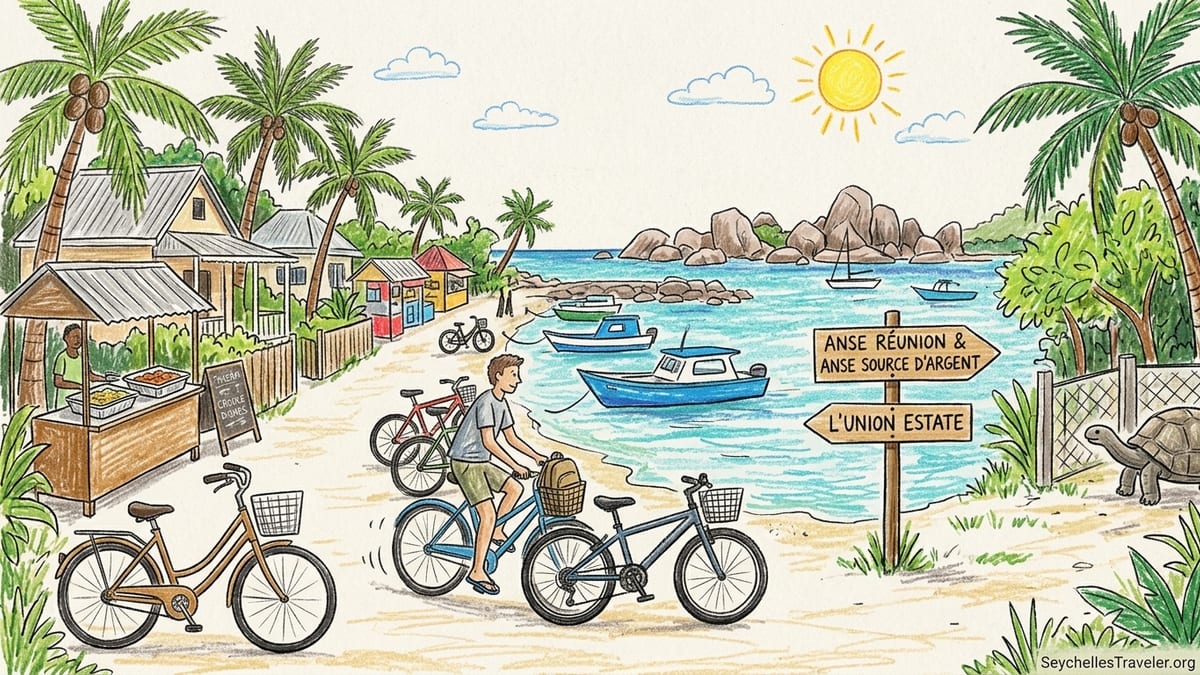
Riding out of the yard, I joined the easy flow of island traffic. That first stretch from La Passe towards Anse Réunion is flat and forgiving, the road a strip of pale concrete with sandy edges. On one side were small grocery shops, takeaway counters selling Creole dishes in foil containers and houses shaded by frangipani and palms. On the other side, when the buildings broke, the sea flashed turquoise between the trunks. The speed limit felt self-imposed. Between pedestrians, bikes, the occasional ox cart and one or two club cars, nobody moved fast. I relaxed my shoulders, stopped overthinking the brakes and let the island set the pace.
South Through Anse Réunion and Into L’Union Estate
My first target was L’Union Estate, both for its history and because it is the only official access point to Anse Source d’Argent. From La Passe the road hugs the coast past Anse Réunion, a shallow, palm-fringed bay where boats anchor close to shore. The ride took less than ten minutes at an unhurried pace. I passed brightly painted guesthouses with corrugated roofs, a few small hotels tucked back from the water and one or two snack shacks advertising grilled fish, octopus curry and fruit smoothies in English and French.
The entrance to L’Union Estate arrived almost abruptly, marked by a simple gate and a parking area where a scatter of bicycles were already leaning against fences and trees. A guard in a small booth checked my arrival. For foreign visitors the entrance fee to the estate is 150 rupees per person, valid for the day, with tickets bought after late afternoon rolling over to the next day. I paid in cash, tucked the paper ticket into my bag and pushed my bike through the gate. Motor vehicles stop at the entrance, which instantly reduces the noise and makes the plantation lanes feel more like a park than a traffic route.
Inside, the first impression was of space and shade. Gravel tracks threaded between towering coconut palms, their dry fronds rustling overhead. To one side a traditional Copra mill and an old plantation house preserved the island’s past as a working coconut and vanilla estate. I rode slowly, partly out of respect for the more fragile surface and partly because every few metres something invited a closer look: a small Creole-style cottage on coral stone foundations, a patch of bright-green vanilla vines trained along wooden supports, chickens scratching in the sandy soil.
Near the centre of the estate I left the bike in a rough parking area under trees and walked over to the enclosure holding Aldabra giant tortoises. Even before I saw them, I heard the low scrape of shell against rock and the soft clack of beaks on vegetation. A cluster of enormous, slow bodies moved with deliberate purpose through the shade, folds of skin hanging from their necks like ancient maps. Children pointed and laughed quietly; adults fell silent or whispered. I stayed for a while, then backtracked to the bike, following signs towards “Beach” that led deeper into the coconut groves and towards the sea.
First Look at Anse Source d’Argent: Light, Tide and Swimming
The sandy path from the heart of L’Union Estate to Anse Source d’Argent wound through low scrub and under leaning palms. Bicycles began to appear in clusters, propped against trunks, lashed to makeshift stands or simply dropped on the sand. I followed suit, looping my lock through the frame and a low branch more out of habit than fear, and walked the last few metres.
The first glimpse of the beach felt like a magazine spread brought to life. Smooth grey granite boulders framed strips of pale sand, with shallow turquoise water lapping at their bases. The granite looked almost sculpted, but the shapes were entirely natural, the result of millennia of weathering on these rare mid-ocean granite islands. Behind the beach, coconut palms leaned at improbable angles, their roots gripping sand and rock.
When I arrived, the tide was on its way in but still relatively low. The water stayed ankle to knee-deep for a long way out, broken by patches of darker seagrass and occasional stones. It was perfect for wading and safe for nervous swimmers, but not deep enough for a proper, head-under crawl. I floated on my back instead, watching thin clouds drift behind the jagged profile of the boulders. The shallowness made the water warmer than I expected, almost like a bath in the afternoon sun.
Later that day, after wandering further along the path past fruit stands and a beach bar, I returned close to high tide. The difference was striking. The strips of dry sand had narrowed, and in some places waves washed almost right up to the boulders. The colour of the lagoon shifted from pale turquoise to a slightly deeper blue-green, and in the sandy channels between rocks the water was finally deep enough for short, satisfying swims. I had to be careful of my footing when getting in and out, with submerged stones and occasional bits of coral underfoot, but once afloat I could swim gently while still always able to stand. For me, that high-tide window was the most comfortable and rewarding time to be in the water at Anse Source d’Argent.
North Along the Coast: Anse Severe and Anse Patates by Bike
The next morning I turned my wheels north from La Passe, aiming first for Anse Severe and then the smaller Anse Patates. The road here feels subtly different. Leaving the cluster of shops and takeaways behind, the buildings thin out and the island narrows. On one side, low walls and hedges separate the road from small houses and guesthouses; on the other, the sea is often visible just a few metres away, broken only by trees and the occasional rock barrier.
The gradient between La Passe and Anse Severe is gentle, with only small rises that most riders manage without dismounting. The concrete surface is mostly good, although here and there sand drifts across the edges and creates soft patches that can catch an inattentive front wheel. Traffic becomes even quieter the further you ride. I found myself pedalling mostly in companionable silence, occasionally passing another cyclist with a nod or moving around a slow ox cart laden with supplies. It was easy to imagine the island before tourism, when bicycles and ox carts were almost the only options.
At Anse Severe I pulled off the main road into a sandy clearing shaded by trees. A loose cluster of bikes leaned at every angle, but there was still space to park. I chose a trunk, looped my lock and walked the short path to the beach. The bay curves in a protective arc, with granite boulders at each end and a mix of sand and rock underfoot in the shallows. The water felt cooler than at Anse Source d’Argent, and there was a bit more depth even at mid-tide, which made swimming easier. Snorkellers drifted not far from shore, following the darker patches of reef. Behind the beach, a couple of simple stands sold fresh fruit juice and grilled fish, and a small snack bar offered Creole plates. I sat in the shade with a passion fruit juice, watching the light shift on the water and grateful that my bike was waiting only a few steps away when I was ready to move on.
From Anse Severe to Anse Patates the road begins to climb more noticeably. The island’s granite backbone presses closer to the coast, and the strip of flat land narrows into short ramps and curves. My single-speed bike coped, but I did not pretend to be heroic about it. On one steeper section I simply swung a leg off and pushed, sharing the slope with another rider doing the same. The reward came at the top, where the road dropped gently into a tight bend beside Anse Patates, a small, photogenic beach squeezed between rocks and a low retaining wall.
Climbing to the Wild Side: Grand Anse, Petite Anse and Anse Cocos
La Digue’s eastern and southern beaches are a different proposition. From La Passe, the route to Grand Anse begins much like the ride to L’Union Estate, but soon diverts inland and upwards. The road surface alternates between concrete and compacted earth. The first half of the climb is manageable in the saddle with determination; the latter slopes pushed the limits of my single-speed and my comfort. Several times I chose to dismount and walk the steepest stretches, pushing the bike while looking up at the thick, glossy rainforest that crowds the road.
The benefit of travelling by bicycle rather than taxi or tour buggy was obvious here. Every time the forest opened for a moment I could stop where I liked, not bound to viewpoints or schedules. I paused to listen to invisible birds calling from deep in the foliage, to feel the temperature drop a fraction in the shade and to drink water without feeling I was holding anyone up. The few club-car taxis that passed did so slowly and with care, leaving me space. The island’s small size and limited motor traffic meant I never felt pushed off the road.
The descent towards Grand Anse arrived suddenly. One last rise, a corner and then, ahead, a long curve of bright sand and heavy surf rolling in from the open Indian Ocean. The bike parking area sits just behind the beach, a simple edge of sand where rows of bicycles lean on their stands or on each other. I added mine to the line and walked over the final dune. Grand Anse is beautiful in a way that feels wilder than the sheltered beaches on the western side. The waves hit with more force, and warning signs remind visitors that currents can be strong and swimming dangerous, especially in certain seasons. I limited myself to paddling at the edge and sitting under a takamaka tree, watching spray leap from boulders at the far end of the bay.
From Grand Anse, footpaths lead to Petite Anse and Anse Cocos. I left the bike at Grand Anse and continued on foot, following a rocky path over low headlands and through thickets. Here, the freedom of the bicycle became the freedom of walking, with no need to think about gradients or road surfaces. Returning later, however, I was very aware that the climb out from Grand Anse back towards La Passe began immediately. This time I knew what to expect. I accepted from the first bend that I would be walking a part of it, pushing the bike slowly back up through the forest. The ride down the other side, once gravity shifted in my favour again, was a cool, fast glide that felt like a reward for the sweat.
Living with Imperfections: Heat, Rain, Old Bikes and Island Practicalities
My bike on La Digue was not perfect. The saddle squeaked with every pedal stroke, and on the second afternoon the chain slipped once when I pushed too hard setting off from a junction. It caught again immediately, and a quick check back at the rental yard that evening confirmed there was no serious problem, but it was a useful reminder that these machines work hard every day. I met other travellers who had requested a swap because of soft tires or squeaky brakes. On an island where most visitors ride, the better shops seemed willing to exchange a bike without much debate if something was clearly off.
The weather also played its part. One short, intense shower swept over in the late afternoon as I was riding back from Anse Severe. Within minutes the warm road turned slick, and sandy sections became briefly treacherous. I took it as a sign to seek shelter at a small takeaway where locals queued for fish curry and rice in plastic containers. I parked my bike under the overhang, flipped the kickstand down and joined the line. By the time I had eaten, the road was already drying, leaving only damp patches under trees and a sky washed clean for sunset. If I had been in a taxi or a guided golf cart, I might have missed that impromptu meal and conversation with the woman ladling curry who asked, with a smile, whether I had “survived the hills yet.”
Lighting was one thing I did not want to test. My rental came with a small front light and a red rear reflector, but they were more token gestures than reliable illumination. Locals warned that while the main stretches between La Passe and L’Union Estate or Anse Severe have some ambient light from houses and guesthouses, the darker inland sections quickly feel very black after sunset. I took that seriously and planned my rides so that I was always back near my guesthouse or at least off the steeper inland sections before the light went completely. The island felt safe, but potholes and stray crabs are easier to avoid when you can see them.
Food-wise, cycling opened up more options. At lunchtime I stopped at small snack bars near Anse Réunion and along the road to L’Union Estate, eating grilled fish with rice and lentils for the equivalent of a modest restaurant starter back home. Fresh fruit stands inside and near L’Union Estate sold coconuts hacked open with a machete and smoothies blended from mango, pineapple and passion fruit. With a bike, it was easy to carry a takeaway box or a couple of samosas back to the beach, turning any shaded patch into a picnic spot.
Cycling vs Taxis and Tours: Freedom in First Gear
On La Digue, visitors who do not cycle can rely on a small fleet of golf-cart style taxis and ox carts, often arranged through hotels. I met one couple at Grand Anse who had hired a buggy for a half-day island tour, partly because one of them was not comfortable on a bike. Their driver waited in the shade while they explored, ready to ferry them back over the hill. The convenience was obvious, but so was the cost, which ran into thousands of rupees for a few hours according to the quotes they mentioned. Guided club-car tours and day trips that include transfers exist too, mostly aimed at cruise passengers or those on tight schedules.
Having spent two days on a bicycle, I would still choose pedals over passenger seats for La Digue. The island’s compact size means that from La Passe you can reach L’Union Estate or Anse Severe in about fifteen minutes of easy riding, and even the inland climb towards Grand Anse is more about short, intense sections than sustained mountain passes. Moving under my own power changed how I read the landscape. I noticed the gradual shift from tight clusters of shops around La Passe to the looser scattering of houses near Anse Réunion, and then to the mixed inland forest along the Grand Anse road. I could stop to admire a particularly tangled cluster of granite boulders shining after rain, or to photograph a traditional wooden house with its steep roof and pastel shutters.
There is also something quietly satisfying about joining the local rhythm. Schoolchildren pedalled in uniforms, often two to a bike, chatting and laughing. Elderly islanders moved slowly along the verges, carrying shopping or simply strolling. A few times, when the road narrowed, a club car or ox cart fell in gently behind me rather than trying to squeeze past, waiting until the way opened to move on. In those moments the island’s low-speed philosophy became very clear. Here, the bicycle is not just a tourist novelty; it is the baseline of daily life.
One-Day Dash or Slow Two-Day Circuit: How Long to Stay
By the end of my second full day on La Digue, I understood why so many travellers who attempt a day trip end up wishing for more time. It is physically possible to land on the morning ferry, rent a bike, visit L’Union Estate and Anse Source d’Argent, ride up to Anse Severe and maybe even squeeze in Grand Anse before returning to La Passe for the last boat. It would tick the boxes. But the experience would be compressed into a series of arrivals and departures, with little room for the idle pauses that made the island feel human rather than just photogenic.
If I had only one day, I would start as early as possible. From the jetty I would rent a bike immediately, drop any larger bag at a guesthouse or luggage storage if available, then ride first to L’Union Estate. I would spend the morning wandering through the plantation, visiting the giant tortoises and reaching Anse Source d’Argent in time to explore at mid to high tide for better swimming. Lunch could be a simple Creole plate inside the estate or a snack brought from La Passe. In the afternoon I would ride north to Anse Severe for swimming and a juice in the shade, perhaps pushing on to the viewpoint above Anse Patates if my legs still felt fresh, before returning to the jetty with a margin of safety.
With two days, the island changes character. On my slower schedule, I dedicated one day largely to the western and northern side: La Passe, Anse Réunion, L’Union Estate and Anse Source d’Argent, followed by an unhurried ride to Anse Severe for late-afternoon light and a gentle cycle back at sunset. The second day was for the inland climb and the wilder beaches of the east and south, with time to recover in between. This pacing left room for small detours, like stopping at a roadside stand because the smell of frying breadfruit was irresistible, or chatting with a shopkeeper about the most reliable place to change a large banknote.
My favourite beach by the end was Anse Severe. Anse Source d’Argent was as beautiful as its reputation, and its shifting character with the tide fascinated me. Grand Anse stirred something wilder. But Anse Severe offered a balance that felt closest to the way I like to travel: enough depth for real swimming at mid-tide, a scattering of people without feeling crowded, shade that did not require renting a chair and easy bike access without steep climbs. Watching the sun drop behind the silhouettes of distant islands from Anse Severe after coasting there on my own bike, knowing that my guesthouse and a hot shower were a short, flat ride away, I realised how quickly La Digue had ceased to be an abstract dream destination and become a place I did not want to leave.
The Takeaway
Exploring La Digue by bicycle is not complicated, and that is its greatest strength. You arrive at La Passe jetty with the rest of the ferry passengers, choose a bike from one of the many small rental yards for roughly the cost of two coffees back home, and within minutes the whole island is accessible at human speed. The roads are short, the hills are real but manageable, and the rewards at the end of each stretch of concrete or packed earth are granite-framed beaches and glimpses of a coastal village life that still beats at a slow, confident pace.
There are trade-offs. The heat can drain your energy by midday, old bikes develop squeaks and the inland road towards Grand Anse will almost certainly tempt you to walk at some point. Rain showers can flash through, and lighting after dark is unreliable enough that it makes sense to plan days around the sun rather than nightlife. But each of those inconveniences feels small when set against the autonomy that the bicycle brings and the ease with which it allows you to stop, look and listen.
Compared with taxis or guided buggy tours, cycling offers more than just savings. It offers the simple pleasure of movement, the quiet pride of cresting a small hill under your own steam and the intimacy of noticing small details, from the scent of vanilla vines in L’Union Estate to the clatter of a tortoise shell on stone. It makes lazing at Anse Source d’Argent after timing your visit to the high tide feel earned, and turns a sunset juice at Anse Severe into a small, daily ritual.
For me, the clearest lesson of my La Digue bicycle adventure is that staying at least one or two nights amplifies everything good about the island. A day trip can show you the highlights. A slower, pedal-powered stay lets the place sink in. When my time finally came to wheel my slightly battered bike back to the rental yard and walk once more towards the ferry, I understood why so many people look back at La Digue not just as a postcard-perfect stop, but as the island they quietly dream about returning to.
FAQ
Q1. Do I need to book a bicycle on La Digue in advance?
In my experience, advance booking was not necessary. When I arrived at La Passe several rental yards had plenty of bikes available, and I was able to choose one and be on the road within minutes. During very busy holiday periods it may be worth asking your guesthouse to reserve one, but on regular days walking up worked perfectly.
Q2. How much does bicycle rental cost on La Digue?
I paid 150 Seychellois rupees per day for a standard single-speed bike, with a small discount for a multi-day rental that brought the daily rate closer to 125 rupees. Other travellers I met reported similar prices or the equivalent of about 10 euros per day, depending on the shop and season.
Q3. Is cycling on La Digue suitable for beginners?
For most people who can balance and pedal, yes. The stretches between La Passe, Anse Réunion, L’Union Estate and Anse Severe are mostly flat with good concrete surfaces. The inland road to Grand Anse is noticeably steeper, and many riders, including me, walk parts of it. Taking your time, using a comfortable bike and planning rests in the heat make a big difference.
Q4. Do I need a bike lock, and is theft a problem?
My rental included a simple cable lock, and I used it whenever I left the bike at beach access paths or outside shops. I did not experience or hear about theft personally, but locking the bike felt like sensible basic security, especially at popular spots such as Anse Source d’Argent and Anse Severe where many similar bikes are parked together.
Q5. Can I comfortably swim at Anse Source d’Argent?
Swimming at Anse Source d’Argent depends heavily on the tide. When I visited, low tide meant very shallow water that was better for wading and floating, while the period around high tide offered enough depth in sandy channels between rocks for relaxed, chest-deep swimming, though I was still able to stand when needed.
Q6. How challenging is the ride to Grand Anse?
The ride to Grand Anse involves the steepest gradients I encountered on La Digue. On a single-speed bike I could manage parts of it in the saddle but chose to walk several of the sharper inclines. The road surface switches between concrete and compacted earth, but traffic is light, and the effort is rewarded by views of lush forest and the dramatic coastline at the far side.
Q7. Is it safe to ride a bicycle on La Digue after dark?
I chose not to ride far after dark. My bike’s lights were minimal, and inland stretches in particular become very dark once the sun sets. Around La Passe and Anse Réunion there is some ambient light from houses and guesthouses, but for comfort and safety I planned my cycling so that any longer rides or hilly sections were finished by dusk.
Q8. How does cycling compare with using taxis or guided tours on La Digue?
Cycling gave me more freedom to stop, explore and set my own pace, at a fraction of the cost of taxis or guided buggy tours. Taxis and tours are useful for travellers who cannot or do not want to ride, but they are more expensive and follow fixed routes and schedules. On a bike I could pause for photos, food or swims wherever something caught my eye.
Q9. How many days should I spend cycling on La Digue?
It is possible to cover the main highlights in a single long day, but I found that staying two nights and having at least two full days on the island created a much more relaxed experience. One day allowed me to focus on L’Union Estate and Anse Source d’Argent, and the other on Anse Severe, Anse Patates and the ride to Grand Anse, without feeling rushed.
Q10. Which beach was your personal favourite to reach by bicycle?
Anse Severe became my favourite. The ride from La Passe is short and mostly flat, the bike parking is easy, and the bay offers deeper water for proper swimming, natural shade and a quieter atmosphere than some of the busier spots, all reached within about fifteen minutes of gentle pedalling from the jetty.