


I spent three weeks in Seychelles moving between Mahé, Praslin and La Digue with one priority in mind: to see what really waits underwater. I packed my own mask and fins, booked several different marine-park boat trips, and spent long hours finning straight out from the sand at places like Port Launay, Anse Lazio and Anse Source d’Argent. What follows is a synthesis of those real sessions in the water, backed up by current park rules and prices checked again before writing. Wildlife is described only where I genuinely saw it with my own eyes, and I distinguish clearly between snorkeling off the beach and paid excursions that did, or did not, add value.
Understanding Seychelles Marine Parks and Current Fees
Before getting in the water, it is worth understanding how Seychelles manages its reefs and how much you will pay to see them. The Seychelles Parks and Gardens Authority (SPGA) oversees several key marine national parks, including Curieuse, Ste Anne, Baie Ternay, Port Launay and Ile Cocos. As of October 2026, the SPGA’s published visitor fee guide confirms that non-resident visitors aged 12 and over pay SCR 300 per person to enter Curieuse Marine National Park, and SCR 200 per person for Ste Anne, Baie Ternay / Port Launay and Ile Cocos. I double-checked these figures against the SPGA’s current ticketing pages and downloadable fee tables before finishing this article.
Practically, this means that whenever you join a boat tour into one of these parks, part of your excursion price should cover the relevant park ticket. Reputable operators on Praslin and La Digue, for example, either include the Curieuse or Ile Cocos fee in the advertised price or collect the park fee in cash on arrival at the island jetty. You can also purchase e-tickets directly from SPGA, which some yacht charter companies require for their guests when anchoring overnight inside a marine park.
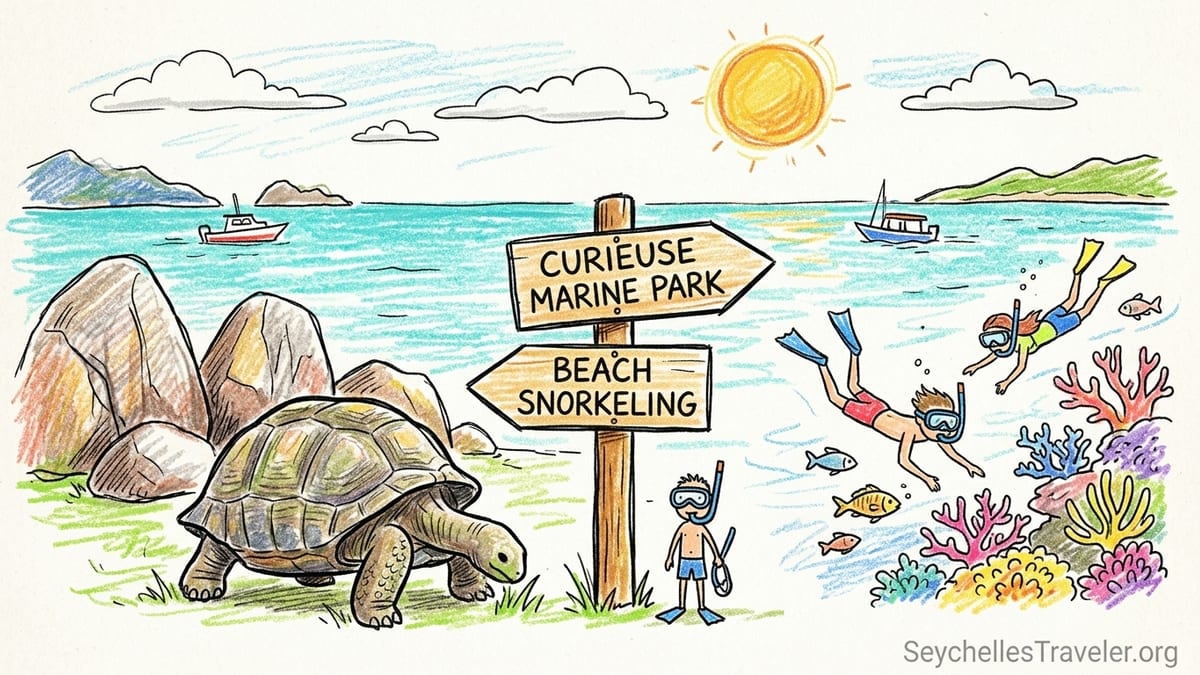
Curieuse in particular offers more than just reefs. My day there included a guided walk across the island’s mangrove boardwalk, time among the Aldabra giant tortoises near Baie Laraie, and a barbecue on the beach at Anse José, with snorkeling stops in between. The entrance fee covers the island itself and its surrounding waters, while nearby St Pierre is reached by a short boat ride and normally counted as a separate snorkeling stop within the same excursion.
For Ste Anne, Baie Ternay, Port Launay and Ile Cocos, the park ticket covers the marine environment and any island landing points designated by SPGA. Local boat skippers are aware of the boundaries and usually brief guests on where snorkeling is allowed and where sensitive restoration zones require extra caution or a complete no-entry rule.
Snorkeling Straight From the Beach: Mahé, Praslin and La Digue
Beach access snorkeling in Seychelles can be rewarding, especially if you know which shores have reef within comfortable swimming distance. On Mahé, my most productive shore sessions were in the Port Launay Marine National Park on the northwest coast and at Anse Royale on the southeast. At Port Launay, I entered from the public beach near the end of the road, swimming out over seagrass and sand before reaching scattered coral outcrops. Visibility on two separate mornings in the southeast trade-wind season was around 10 to 12 meters, with only a light surface chop. Currents inside the bay were gentle, no more than a slow drift parallel to the shore.
The coral structure close to the beach at Port Launay showed clear signs of past bleaching, with many sections reduced to low, pale rubble. However, on both visits I still found pockets of living hard coral slightly farther out, including table and branching forms at around 3 to 5 meters depth. Fish life was modest but steady: clouds of small damselfish and fusiliers, a few parrotfish grazing noisily on the rock, and a smattering of wrasse and butterflyfish. I did not encounter turtles or sharks here, and it would be inaccurate to suggest this bay guarantees charismatic megafauna on every swim.
On Praslin, Anse Lazio and Côte d’Or each offered contrasting shore snorkeling. At Anse Lazio, I entered from the righthand side facing the sea and hugged the granite boulders. The first 20 to 30 meters are mostly sand, then rocks and coral heads start to appear. Depth stayed under 4 meters in most of the area I explored. On a calm mid-morning, visibility reached 15 meters and there was almost no detectable current, which made this a very relaxed snorkel. Hard coral cover was patchy, and some table corals were clearly damaged, but a belt of healthier coral around the outer rocks supported more fish than the central bay. Here I observed schools of yellow goatfish and blue-green chromis, several Moorish idols and a few juvenile sweetlips hiding under ledges.
Côte d’Or, by contrast, is a long, shallow bay with a sandy bottom and scattered rock patches. From the public beach near Anse Volbert, I had to fin a good 150 to 200 meters to find any concentrated coral. Even then, the coral heads were isolated and the fish life thin. On a windy afternoon the visibility dropped to about 6 meters, with enough surface chop that I had to keep checking my position relative to the beach. For my own trip, this spot was more about the view than the snorkeling quality.
On La Digue, Anse Source d’Argent is famous for its granite boulders and shallow lagoon. Snorkeling here is easiest at mid to high tide. Entering from the sandy gaps between rocks, I drifted over a seagrass bed dotted with low coral and rock. Maximum depth in the area I swam was around 2 meters. Visibility was about 8 to 10 meters under a bright midday sun, but the lagoon felt a little stirred up by waves breaking on the outer reef. Coral cover was low and patchy, although I did see several healthy boulder corals supporting small schools of sergeant majors and juvenile parrotfish. Again, no turtles or rays appeared during my sessions, and I would characterise this as a scenic but not outstanding snorkel in pure reef terms.
Marine Parks from a Boat: Curieuse, St Pierre and Ile Cocos
The most memorable snorkeling I did in Seychelles came from boat trips into the marine parks. Around Praslin and La Digue, I booked three different excursions: a full-day Curieuse and St Pierre trip from Côte d’Or, a half-day Ile Cocos circuit from La Digue, and another mixed-islet trip that combined snorkel stops with beach time. All three included park entry fees in the overall price, which in 2024 and 2025 typically ranged from about SCR 1,200 to SCR 1,800 per adult for Curieuse plus St Pierre, and around SCR 800 to SCR 1,200 for shorter Ile Cocos or Coco / Félicité / Sister Islands runs, depending on operator and inclusions like barbecues.
My Curieuse excursion departed from the small pier near Côte d’Or mid-morning. The operator used a covered fibreglass boat equipped with ladders and spare snorkel sets. Their equipment was serviceable rather than premium: silicone masks, basic open-heel fins and short-sleeve buoyancy vests. I chose to stick with my own gear after checking that their rental masks had some scratches and slightly tired straps, although plenty of guests seemed content to use them. Our first in-water stop was not at Curieuse itself but at a reef patch in the channel between Praslin and the island, just outside the mooring line for larger boats.
Here the seabed dropped quickly from 2 to about 8 meters, with scattered granite boulders draped in coral. Visibility on that day was around 15 to 18 meters, helped by the fact that the wind had been light for several days. There was a gentle but noticeable current running along the channel that meant I was steadily carried away from the boat if I stopped finning. The skipper briefed us to stay within sight and picked a line that allowed us to drift slowly back towards the boat as he repositioned. Coral condition at this site was clearly better than what I had seen right off Côte d’Or: larger plates of hard coral, including some impressive table forms, and more continuous coverage along the upper boulders.
St Pierre, reached after lunch, offered more vertical structure. The islet rises sharply from the sea, and underwater the granite continues as steep slopes and ridges. We moored on the leeward side and slid in from the stern. Depth under the boat was about 10 meters, dropping beyond 15 meters a little farther out. I stayed mostly in the 3 to 8 meter zone circling the islet. Coral here showed mixed health: some large boulder corals looked robust, while other areas were clearly impacted by past bleaching, with dead branches overgrown by algae. Fish life, however, was markedly richer than any of my beach snorkels. I swam through tight clouds of anthias, watched a school of bigeye trevally patrol the mid-water, and shared a boulder with a resting trumpetfish. There was a constant sense of movement around the rock, which made this stop feel vibrant even without headline encounters like turtles or sharks.
The Ile Cocos marine park, accessed from La Digue’s small jetty near La Passe, delivered another level of underwater architecture. My half-day trip used a smaller open boat with a canopy and again offered masks and fins that were adequate but not pristine. The three tiny islets of the park rise together from a shallow plateau before dropping into deeper blue water. We anchored on the edge of this plateau. At the first site, depth ranged from 3 to 6 meters over a mix of granite ridges and coral. Visibility on that morning sat around 20 meters, with almost no current. Coral cover was still not what seasoned divers might call pristine, but I found more intact coral gardens here than at St Pierre, including fields of branching coral where hundreds of fish wove in and out.
On my second Ile Cocos stop, closer to the drop-off, I spent twenty minutes circling a series of coral heads that reached up from about 12 meters to within 4 meters of the surface. Here, the fish density rivalled some of the better reefs I have seen in the western Indian Ocean. Snappers, surgeonfish, butterflyfish and two different species of parrotfish were present in visible numbers. I also watched a pair of batfish hover beside a cleaning station on the outer side of a boulder. The guide had mentioned that turtles are regularly seen in this park, but during my visit none appeared. It is important to say that clearly: this was my experience on a particular day, and while the habitat obviously supports turtles, your own sightings will depend on timing, luck and how many boats are present.
Comparing Boat Excursions and Independent Beach Snorkeling
If you are trying to decide whether to pay for a boat trip or simply swim out from the sand, it helps to compare what you actually get in the water. Across Mahé, Praslin and La Digue, the pattern on my trip was consistent. Shore snorkels were logistically easy and cheap, but usually involved a longer surface swim over sand or seagrass before you reached any real structure. The coral near popular beaches tended to be more damaged and the fish life less concentrated. Conditions close to the beach were also more exposed to stirred-up sand in wind and wave, so visibility dropped quickly when the weather turned.
The marine-park excursions, in contrast, positioned the boat directly over or beside deeper reef structures. At Curieuse, St Pierre and Ile Cocos we anchored where coral heads rose from deeper water and where the fish clearly congregated. The skippers adjusted to wind and current so that we could drift rather than fight the water, and they chose sites that remained clear even when surf built on the outer reef. On average, visibility on my boat trips was 5 to 8 meters better than on the majority of my shore snorkels, especially during the southeast trade-wind months.
Cost is of course a factor. Shore snorkeling is essentially free once you have reached the beach, provided you bring or rent basic equipment. Mask, snorkel and fins hired from beach kiosks or guesthouses on Mahé or Praslin typically ran in the region of SCR 150 to 250 per day when I checked locally, with quality varying from almost new sets to heavily used plastic with fogging lenses. Boat excursions that included marine-park tickets, lunch and multiple snorkel stops ranged from roughly SCR 800 for simple half-day trips to around SCR 1,800 or more for full days with barbecues and several islands.
From a pure underwater perspective, the boat trips I joined to Curieuse and in particular to Ile Cocos delivered consistently better coral and denser fish life than I ever found close to the sand at main tourist beaches. If you are a confident swimmer who values richer reef scenes and can budget for at least one marine-park excursion, my personal conclusion is that Ile Cocos from La Digue offered the best return on cost versus underwater quality, followed closely by the Curieuse plus St Pierre circuit from Praslin. Shore snorkeling still has its charm, especially at quieter times of day, but in my own logbook the marine-park days stand out.
Dive Experiences: Depth, Visibility and Currents
Although Seychelles is often discussed as a snorkel destination, it also offers rewarding diving, especially around the granite islands where boulders create dramatic underwater topography. I completed several guided dives with a Mahé-based operator that regularly visits sites near Baie Ternay and the outer edges of Ste Anne Marine National Park. The shop operated from Beau Vallon and ran a rigid inflatable boat equipped with oxygen kit, radio and standard rental gear. Their equipment quality was solid: recent-model BCDs, well-maintained regulators and 3 mm shorties suitable for water temperatures around 27 to 29 degrees Celsius.
One two-tank morning took us close to the boundary of Baie Ternay Marine National Park. The first dive descended along a granite slope that begun in about 5 meters and stepped down to a sandy bottom near 26 meters. We levelled off at 20 meters, spending most of the dive between 14 and 22 meters. Visibility was 15 to 18 meters horizontally, with a light current that pushed us gently along the contour. Coral cover on the deeper slope was moderate, with large boulder corals and patches of soft coral among the granite. I observed several small schools of snapper, along with individual groupers tucked into crevices. No larger pelagic species appeared during this dive, and there were no shark or ray encounters to report.
The second dive, shallower at a maximum depth of 16 meters, followed a series of large boulders topped with coral heads. Here the effect of past bleaching events was evident in the broken, pale coral on some ridges, yet alongside this I saw new growth and healthier patches supporting schooling reef fish. The guide carefully kept us away from particularly fragile areas that SPGA and local operators are monitoring. Compared to the snorkeling sites, the dive locations felt wilder and less visited, with no other boats in sight that morning.
Diving around Ste Anne Marine National Park brought a slightly different character. On a separate day we explored a site of scattered coral bommies rising from a sandy plateau between 12 and 20 meters. Visibility dropped slightly to around 12 to 14 meters due to recent wind and swell. Currents were variable, with some sections of the dive requiring more effort to hold position. Coral condition swung from degraded patches to colourful clusters, and fish life mirrored that variability: long quiet stretches followed by bursts of activity around healthier bommies.
From a budget standpoint, two-tank boat dives with reputable operators on Mahé in 2024 and 2025 were typically priced in the region of SCR 1,800 to 2,500 per person, including tanks, weights and full equipment hire but excluding any certification courses. Given those prices and the moderate but not spectacular coral condition I encountered, I would recommend diving in Seychelles if you already enjoy the sport and are curious about the granite seascapes, rather than choosing Seychelles primarily as a world-class coral-dive destination.
Marine Life: What I Actually Saw Underwater
There is a temptation with tropical destinations to list a catalogue of iconic species as if they were guaranteed sightings. That does not reflect my experience in Seychelles. Across multiple weeks and many hours in the water, I consistently observed certain fish families, occasionally encountered more unusual characters, and did not see several species often mentioned in marketing material.
On almost every snorkel, whether from shore or boat, I saw sergeant majors and other damselfish, fusiliers, parrotfish in various sizes, and wrasse flickering across the reef. Butterflyfish and angelfish appeared frequently at Curieuse, St Pierre and Ile Cocos, especially around better-preserved coral heads. Small schools of goatfish trailed across sandy patches both at Anse Lazio and inside Ste Anne Marine National Park during my dives. In the shallows off Anse Source d’Argent and Port Launay, juvenile fish sheltered in seagrass and around isolated rocks in such numbers that the water sometimes shimmered with silver.
Less common but still repeated sightings included trumpetfish hovering vertically beside coral, batfish at one Ile Cocos cleaning station, and a few robust groupers deep among the granite boulders at Baie Ternay. I also encountered several octopus, usually spotted first by a change in texture or colour as they tried to match a rock. These octopus encounters became easier once I learned to slow down and scan each boulder carefully instead of finning constantly.
What I did not see are just as important to mention. During all my snorkeling sessions in the Curieuse, St Pierre and Ile Cocos marine parks, I did not personally see any turtles or reef sharks, even though I know from local guides and other visitors’ reports that both species do occur in these waters. Likewise, I did not encounter manta rays or whale sharks in Seychelles on this trip, and none of my dive logs include shark sightings of any kind. That does not mean such encounters never happen, only that they are far from guaranteed and should not be promised lightly.
Coral condition overall ranged from heavily degraded in shallow, heavily visited areas to encouragingly healthy in deeper or more remote sections of the parks. The clearest example came at Ile Cocos, where outer coral heads showed richer structure and colour than the rubble closer to shore. Around Mahé’s Port Launay, shallower patches near the beach displayed significant bleaching scarring, while slightly deeper ridges improved. For travellers, this means adjusting expectations: Seychelles offers beautiful underwater landscapes and interesting life, but the reefs tell a story of stress and slow recovery rather than untouched perfection.
Which Paid Excursions Truly Added Value
Looking back on my logbook and costs, not every paid excursion delivered the same return. Some boat trips simply transported us to crowded sandbanks with average snorkeling, while others opened up reefs that justified every rupee. Because marine conditions and group dynamics change, I will focus on the structure of each outing and how it compared to what I could reach on my own.
The Curieuse plus St Pierre day from Praslin was a clear net positive. The combination of island experiences on Curieuse, including the tortoise sanctuary and mangrove walk, with two solid snorkeling stops in the surrounding lagoon and at St Pierre, felt like good value given the SCR 300 park fee and the typical excursion price bracket. Crucially, the operator chose sites I could not have reached safely or conveniently as an independent swimmer from shore. The depths of 5 to 10 meters, the channel currents and the distance from any beach all made a boat essential.
The half-day Ile Cocos trip from La Digue provided the single best snorkel sessions of my time in Seychelles. The reef structures, visibility and fish density at the sites we visited were a material step up from Anse Source d’Argent or Anse Severe beach snorkels. Given that Ile Cocos Marine National Park currently charges SCR 200 per adult non-resident and that boats need to navigate reef and mooring fields to position safely, this is not an area you can reasonably access without a licensed operator. In my judgement, this excursion offered the highest underwater value per rupee spent.
By contrast, one mixed-islet tour that combined a short snorkel stop with extended beach time felt less rewarding underwater. The single snorkel site was chosen mainly for its sheltered anchorage near a sandy cove rather than for reef quality, and the coral proved sparse and washed out compared with Curieuse or Ile Cocos. While the beach barbecue and scenery were pleasant, a traveller primarily interested in marine life would, in my view, be better served by a more snorkel-focused itinerary.
If your budget only allows for one or two paid marine excursions, my experience-based recommendation is to prioritise a dedicated reef trip to Ile Cocos from La Digue and a combined Curieuse plus St Pierre trip from Praslin. On Mahé, focus your spending on a reputable dive or snorkel operator that accesses the outer edges of Baie Ternay or Ste Anne, rather than spending repeatedly on shorter boat rides to reefs you could almost as easily reach by swimming from the beach.
The Takeaway
Snorkeling and diving in Seychelles delivered a nuanced picture. From the sand at Port Launay, Anse Lazio or Anse Source d’Argent, I enjoyed easy entries, warm water and gentle conditions on many days, but I also had to work harder to find concentrated reef and dense fish life. Long surface swims over sand and seagrass were common, and coral near popular beaches showed the scars of past bleaching and daily pressure.
Marine-park excursions into Curieuse, St Pierre and especially Ile Cocos changed the equation. With a boat placing us directly over granite ridges and deeper coral heads, visibility improved, fish life intensified and coral health generally looked better, particularly away from the shallowest zones. These outings carried real costs once park fees and operator margins were included, but in my own case they produced the most memorable underwater hours of the trip. Among them, Ile Cocos from La Digue and Curieuse plus St Pierre from Praslin stood out as the excursions that genuinely added value beyond what beach access alone could offer.
Diving added depth and drama around Mahé’s granite slopes, yet it also confirmed that Seychelles is a destination of mixed coral health rather than uniform splendour. For certified divers, the granite topography, relaxed water temperatures and relatively light currents make for enjoyable, if not world-beating, dives. For snorkelers, the key act is choosing at least one carefully selected marine-park boat trip, packing or renting decent equipment, and tempering expectations with the knowledge that real wildlife sightings cannot be guaranteed on any given day.
Above all, what I learned underwater in Seychelles is that the beauty of these islands now includes the story of how their reefs are managed. Park fees, mooring rules and the choices made by local operators all shape what you see beneath the surface. Approaching each swim or dive with realistic expectations and respect for fragile coral gives you the best chance of experiencing the archipelago’s marine life as it is today, rather than as a postcard memory from the past.
FAQ
Q1. How much do Seychelles marine parks currently charge for entry?
As of October 2026, SPGA lists Curieuse Marine National Park at SCR 300 per non-resident visitor aged 12 and over, and Ste Anne, Baie Ternay / Port Launay and Ile Cocos at SCR 200 per non-resident visitor aged 12 and over. These figures should always be checked again directly with SPGA before you travel, as fees can change.
Q2. Is snorkeling from the beach in Seychelles worth it if I skip boat excursions?
Yes, but with caveats. From beaches like Port Launay on Mahé and Anse Lazio on Praslin, I found pleasant snorkeling with moderate coral and regular reef fish, though often after a longer surface swim. The richest coral and densest fish life I encountered were still on marine-park boat trips, so beach-only snorkeling is enjoyable but not a full substitute.
Q3. Which Seychelles boat excursion gave you the best underwater experience?
My half-day Ile Cocos Marine National Park trip from La Digue offered the best combination of coral structure, visibility and fish density, clearly surpassing anything I reached independently from the beach. The Curieuse plus St Pierre day from Praslin was a close second and added worthwhile land experiences with giant tortoises and mangroves.
Q4. Do I need my own snorkel gear or can I rely on tour operators?
Most operators supplied functional masks, snorkels and fins, but many sets showed signs of heavy use such as scratched lenses and tired straps. I was more comfortable using my own mask and snorkel on every trip, and I would recommend bringing at least those two items if luggage allows, especially if you plan to snorkel from the beach on multiple days.
Q5. How good is underwater visibility in Seychelles?
On my trip, shore snorkels often had 8 to 12 meters of visibility, occasionally more on calm mornings. Boat trips into Curieuse, St Pierre and Ile Cocos frequently delivered 15 to 20 meters of visibility when winds were light. Stronger trade winds and nearby surf quickly reduced clarity, particularly close to sandy beaches.
Q6. Are there strong currents at Seychelles snorkeling and dive sites?
Most of my sessions involved light to moderate currents. Inside bays like Port Launay and Anse Lazio, I rarely had to work hard against the water. In channel areas around Curieuse and at some dive sites near Baie Ternay and Ste Anne, the current was strong enough that the skipper or dive guide planned drifts and briefed us carefully, but conditions remained manageable for reasonably confident swimmers.
Q7. What marine life did you personally see in Seychelles?
Regular sightings included sergeant majors, fusiliers, parrotfish, various wrasse, butterflyfish, goatfish and the occasional grouper, trumpetfish, batfish and octopus. I did not personally see turtles, sharks, manta rays or whale sharks on this trip, even though they are present in Seychelles waters and are sometimes seen by other visitors.
Q8. Is diving in Seychelles worth the cost compared to snorkeling?
For existing divers, the granite topography, easy water temperatures and relatively light currents make Seychelles dives enjoyable. My two-tank days around Baie Ternay and Ste Anne offered interesting boulder formations and moderate fish life but did not match the coral richness of some other Indian Ocean destinations. If you are mainly a snorkeler, a well-chosen marine-park snorkel trip may give you better value than learning to dive solely for Seychelles.
Q9. How should I choose a snorkel or dive operator in Seychelles?
I looked for operators who were transparent about including SPGA park fees, limited group sizes, provided safety briefings and carried oxygen and radios on board. Talking directly with dive shops or boat kiosks on Mahé, Praslin and La Digue, and checking how they discuss reef protection and no-touch policies, helped me identify those taking both safety and conservation seriously.
Q10. When is the best time of year for snorkeling and diving in Seychelles?
Conditions vary across the year, but I found that periods of lighter wind between the stronger Southeast and Northwest trade seasons tended to bring calmer seas and clearer water. Because patterns can shift, it is important to ask local operators shortly before your trip which coasts are most sheltered at that moment and to plan boat excursions for days with the most favourable forecasts.