

I landed in Seychelles expecting a glossy postcard of overwater villas, flat postcard seas and a simple hop between perfect beaches. Instead, ten nights of island hopping across Mahé, Praslin and La Digue turned into a much richer lesson in how different each island feels, how quickly conditions change with wind and season, and how real Seychellois life quietly carries on behind the scenes of luxury resorts. This is what I wish I had known before touching down at Seychelles International Airport.
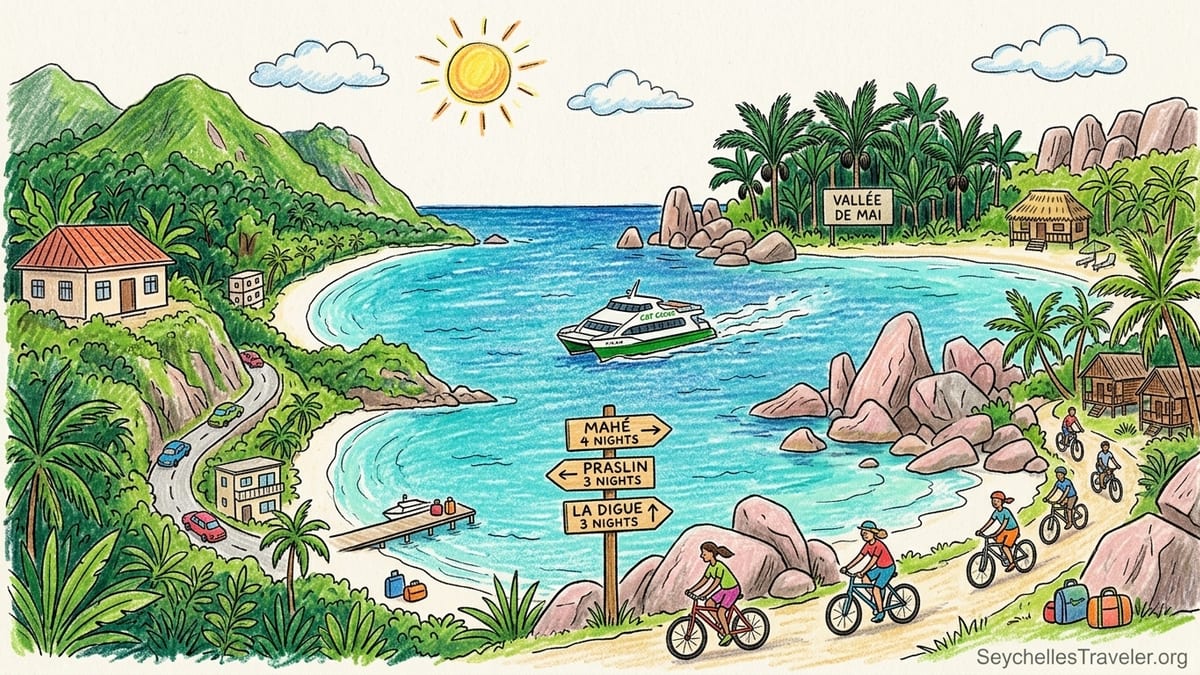
My Real Itinerary: 10 Nights Across Three Islands
My trip began at Seychelles International Airport on Mahé with a late-morning arrival from the Gulf. I had ten nights total booked: four on Mahé, three on Praslin and three on La Digue. I split my stays between a simple self-catering apartment in the residential area of Bel Ombre on Mahé, a small guesthouse near Côte d’Or Beach on Praslin, and a family-run chalet ten minutes by bicycle from the jetty on La Digue. I chose this mix to keep costs reasonable while still sampling different sides of island life. It turned out to be one of the best decisions of the trip.
For transport, I booked the fast Cat Cocos ferry from Mahé’s Inter Island Quay to Praslin, then another Cat Cocos sailing onward to La Digue. On the way back I took a short early-morning leg with Cat Rose from La Digue to Praslin, then the main Cat Cocos service to Mahé. Recent schedules show two to three ferries most days between Mahé and Praslin, plus onward connections to La Digue, which makes independent island hopping very feasible if you are prepared for some swell and spray. I opted against the 15-minute Air Seychelles domestic flight between Mahé and Praslin, although the small Twin Otter aircraft and scenic views are appealing for travelers who are short on time or prone to seasickness.
On paper, I expected Seychelles to be one giant high-end beach resort: calm turquoise water everywhere, identical white sand bays, and not much to do beyond snorkeling and drinking rum under a palm tree. Moving from island to island quickly corrected that impression. Mahé felt like a real, lived-in country with busy roads, government offices and school traffic. Praslin downshifted the pace but added a backbone of granite hills and forest. La Digue, with its bicycles and lack of cars, was closer to the barefoot fantasy I had imagined, but even there the daily rhythm was more about school runs and grocery deliveries than infinity pools.
Looking back, my biggest structural mistake was trying to see three islands in ten nights. The constant packing, early check-outs, and ferry logistics burned more daylight hours than I expected. If I had a do-over, I would spend at least five nights on Mahé, three on Praslin, and save La Digue for a dedicated second trip, or add it only if I had two full weeks.
Mahé: More Than Just an Arrival Island
Mahé is often dismissed as the place you land before heading somewhere “more beautiful,” and I fell into that trap when planning. On my first drive from the airport to Bel Ombre, though, I realized Mahé is the backbone of the country rather than an inconvenient gateway. The main roads are narrow, windy and surprisingly steep, clinging to hillsides where jungle drops to the sea. Buses grind up sharp switchbacks and slip down toward villages of concrete houses painted in soft pastels. It feels closer to a mountainous tropical island than a flat atoll.
The level of development surprised me. Around Victoria and the east coast there are supermarkets, banks, government buildings, and rush-hour traffic. At 8 a.m. the road from Beau Vallon toward town can back up with commuters, and drivers are assertive on blind curves. I initially imagined I could cross half the island in twenty minutes. In reality, a drive from Bel Ombre to the hike at Copolia or to the airport can easily take 40 to 50 minutes once you factor in hills, buses stopping frequently and occasional roadworks.
Mahé is also where Seychelles’ granite mountains and national parks are most visible. More than 20 percent of the island is protected within Morne Seychellois National Park, which rises above 900 meters. Several official trails such as Copolia and Anse Major now require a ticket for non-residents, with entry fees in the range of about 150 to 250 Seychellois rupees depending on the trail, payable by card either online or at checkpoints. Trails are open during daylight hours only, and some, including the Morne Seychellois summit route, have shorter operating windows in the morning. These rules are strictly enforced, so starting a hike late in the afternoon is not an option.
Evenings on Mahé were much quieter than I expected. In Bel Ombre, small corner shops closed early and by 9 p.m. the only sound was surf and the occasional car. Beau Vallon, one of the main tourism hubs, offered a handful of open restaurants and takeaways, but this is not a place for bar-hopping into the night. That slower, family-oriented pace runs through the whole country and is something first-time visitors should build into their expectations.
Praslin: Slower Rhythm, Granite Valleys and Seasonal Surprises
Praslin, the second-largest island, felt like taking a deep breath after Mahé. The ferry from Mahé pulled into Baie Sainte Anne after about an hour, passing smaller islands and occasionally rocking in open water. I arrived late afternoon and caught the island bus toward Côte d’Or, a ride that cost only a few rupees but took nearly half an hour as the bus crawled up hills, paused for schoolchildren and squeezed past oncoming traffic. Compared with Mahé, the road network is simpler and the pace far less hurried.
I quickly noticed the island’s structure: a ridge of granite hills down the center, with short roads dropping to different bays. The famous Vallée de Mai Nature Reserve sits in a deep valley of endemic coco de mer palms and ebony trees. Non-resident entry costs several hundred rupees and tickets are checked at the gate. Walking under the enormous palm fronds, listening to black parrots and rustling fruit bats, felt completely different from the beach postcard image of Seychelles. It also explained why many locals on Praslin are more concerned with forest conservation and endemic species than with tourism numbers alone.
My main mistake on Praslin was choosing my accommodation on the wrong side of the island for the season. I visited during the southeast trade winds, which typically run from around May to September. At this time, many beaches on the southeast and east coasts can be choppier with more seaweed pushed ashore. I booked near Côte d’Or on the northeast, assuming its popularity meant perfect conditions year-round. Instead I arrived to find long strips of seagrass and moderate chop on some days. In contrast, when I visited Anse Lazio on the northwest, the water was calmer and clearer, with less seaweed on the sand. Local guesthouse owners repeatedly explained that the “right” side of the island changes with the monsoon, and that conditions can vary significantly even between bays only a few kilometers apart.
Prices on Praslin also highlighted the benefit of self-catering. A simple dinner of grilled fish and rice at a beachside restaurant near Côte d’Or cost the equivalent of several hundred rupees, similar to mid-range European prices. A grocery run to one of the island’s larger supermarkets, stocking up on eggs, fruit, bread and bottled water, kept breakfast and some lunches very affordable. Local brands of tuna, lentils and long-life milk filled most aisles, a reminder that supplies must be shipped in regularly from Mahé or imported.
La Digue: Bicycles, Early Nights and Famous Beaches That Are Not Always Swimmable
La Digue is the island that most closely matched my original fantasy. The ferry transfer from Praslin takes about 15 minutes, and as you approach the jetty you see a cluster of houses and guesthouses tucked between granite boulders and palm trees. There are only a handful of motor vehicles, mostly for deliveries and essential services. Almost every visitor and many locals get around by bicycle, which you can rent from small shops near the jetty for a daily rate payable in cash or card.
My favorite morning ritual was rolling along the coastal road just after sunrise. Schoolchildren cycled in uniforms, delivery carts rattled past with crates of vegetables, and fishermen sorted their catch on the beach. By 10 a.m. the temperature and humidity ramped up, and short, sharp tropical showers became part of the daily pattern. Rain often passed in 15 to 20 minutes, but it was heavy enough to soak clothes and reduce visibility. I learned to keep a lightweight rain jacket and dry bag in my basket instead of assuming every day would be cloudless.
La Digue is home to Anse Source d’Argent, one of the most photographed beaches in the world. Access is through L’Union Estate, a former coconut plantation and vanilla farm. Visitors pay an entrance fee at the gate, priced in euros or rupees, to access the entire estate including the path to the beach. The first afternoon I visited, the tide was high, the waves choppy and narrow strips of sand were packed with selfie sticks. Swimming was possible but not ideal, with rocks and seagrass underfoot. On a second early-morning visit at lower tide, the water glassed off, sandbars appeared and the granite boulders glowed pink in soft light. The experience felt like a different beach entirely. That contrast drove home a key lesson: even the most famous beaches here are not guaranteed to be idyllic at every hour.
Nightlife on La Digue was almost non-existent in the off-peak period of my visit. Most restaurants closed between 9 and 9:30 p.m., and some were closed several nights a week. After dark, the island became very quiet, with only the sound of waves and occasional bicycle bells. If you associate “island holiday” with late-night beach bars, you may find the early evenings here surprisingly subdued. For me, it encouraged early nights and sunrise starts, which matched the natural rhythm of heat and light.
Weather, Humidity and Seasonal Conditions
Seychelles sits just south of the equator, which means high humidity and warm temperatures year-round. During my stay daytime highs hovered around the high twenties Celsius, with humidity often above 75 percent. Walking from a cool ferry cabin into the open air felt like stepping into a warm, damp blanket. Simple tasks such as carrying luggage a few hundred meters along the jetty became unexpectedly tiring. Air conditioning in rooms was not a luxury but a basic requirement for a good night’s sleep.
The islands experience two main seasonal patterns. The northwest monsoon, roughly from November to April, brings warmer, more humid air and calmer seas on the northwest coasts, but can also coincide with heavier rain showers. The southeast trade winds, roughly May to September, bring slightly cooler, breezier conditions and rougher seas on southeast-facing shores. I visited in the latter period, and it affected almost every beach choice. Some days Beau Vallon on Mahé and Anse Lazio on Praslin were calm with gentle waves, while more exposed bays on other coasts saw stronger surf and more floating seaweed.
Tropical rain was a constant character rather than a rare event. Showers could arrive with little warning, especially in the afternoons when heat built over the granite hills. On Mahé, dark clouds often clung to Morne Seychellois even while Beau Vallon stayed partly sunny. Hiking trails like Copolia became slick and muddy within minutes of a downpour, and visibility on ridgelines dropped quickly. On La Digue and Praslin, morning blue skies sometimes gave way to short but intense squalls that cleared just as fast, leaving hot steam rising from damp roads. Planning each day with this variability in mind taught me to avoid long exposed walks in the middle of the day and to bring dry bags for electronics whenever I boarded a boat.
Seaweed and seagrass were another seasonal reality. Local tourism boards and hosts spoke openly about “seaweed season,” when wind and current push mats of floating vegetation onto certain beaches. Instead of being a sign of neglect, these deposits are part of the natural marine ecosystem. They can, however, change the feel of a beach overnight. On one day, Anse Volbert on Praslin felt ideal for long walks and swimming. Two days later, after a wind shift, large swathes of the shoreline were lined with brown seaweed and the smell of decaying plant matter was noticeable in the heat. In practice, this meant checking conditions locally each morning rather than relying on photos taken in another season.
Logistics: Travel Authorisation, Ferries, Flights and Fees
Since 2023, Seychelles requires all visitors to obtain a Seychelles Travel Authorisation through the country’s Electronic Border System before travel. This is an Electronic Travel Authorisation, sometimes called an ETA, that must be approved prior to boarding your flight. Official information states that applications can be made within 30 days of arrival and should be submitted at least a few days before departure to allow for processing. The authorisation is verified at airline check-in and again on arrival, and is a prerequisite for receiving the free Visitor’s Permit at immigration.
The application is completed online or via the official e-border app and requires basic personal information, travel dates, proof of onward or return travel, and accommodation details. There is a fee that varies slightly depending on processing speed. Payment is made digitally, and approval is usually granted within about 24 hours, although the government recommends allowing up to 72 hours before departure in case of delays. I completed mine three weeks before my flight, received confirmation the same day, and airline staff checked the QR code at the boarding gate in my departure country.
For moving between islands, travelers can choose between ferries and domestic flights. The Cat Cocos fast ferry connects Mahé, Praslin and La Digue, with current published timetables showing several sailings a day on the Mahé–Praslin route and at least one daily service that continues to or from La Digue on most days. A separate operator, often branded as Cat Rose or Inter Island Ferry, shuttles between Praslin and La Digue with additional short crossings. In practice, this means you can usually find a morning and afternoon sailing that fits your itinerary, but crossings can sell out in peak holiday periods and during public holidays, so advance booking is wise.
Air Seychelles operates domestic flights between Mahé and Praslin from the small domestic terminal adjacent to the international arrivals hall. Recent schedules and airport information indicate multiple flights a day, with flying time around 15 minutes plus boarding. Fares are generally higher than ferry tickets but competitive when booked in advance. The experience is very different from the ferry: you check in bags, go through security and board a small Twin Otter aircraft where almost every seat feels like a window. For travelers prone to seasickness or visiting in windier months, this can be a more comfortable if less flexible option.
Protected-area and trail fees are also an important part of budgeting. The Seychelles Parks and Gardens Authority lists specific prices for nature trails and marine parks online, and non-residents are required to purchase tickets in advance or at designated points. On Mahé, popular trails such as Anse Major and Copolia carry entrance fees in the low hundreds of rupees, while marine national parks such as Sainte Anne or Curieuse charge by person or by vessel for day visits or overnight moorings. On La Digue, entry to L’Union Estate, which provides access to Anse Source d’Argent, is charged per person with rates easily confirmed locally or via tour operators. All of these fees help fund trail maintenance, conservation projects and facilities, and are routinely checked by wardens on site.
Food, Creole Culture and the Cost of Daily Life
One of the most rewarding parts of island hopping was discovering how everyday Seychellois life fits around tourism. On Mahé I regularly shared bus rides with schoolchildren and office workers carrying packed lunches, not honeymooners with beach bags. In Victoria’s market, stallholders sold local fruits like golden pineapples and jackfruit, alongside fish laid out on ice, while nearby counters stocked Indian spices and Chinese sauces that reflect the islands’ mixed heritage. Conversations slipped easily between Creole, English and French.
Creole food centers on what the sea and small plots of land can provide. Typical takeaway counters, known simply as “takeaways,” serve grilled or curried fish, octopus curry, chicken stews and lentils with rice, often for significantly less than a sit-down restaurant meal. On Mahé, a generous lunch box from a small roadside takeaway could cost a fraction of what I paid for grilled tuna at a beach restaurant on Praslin. Soda and local beer added a modest amount to the bill, while imported wine and spirits quickly lifted costs. In self-catering apartments, cooking simple dinners with market fish and rice was economical and felt more connected to local life than eating at resort buffets.
Grocery prices reflect the reality of island logistics. In larger supermarkets on Mahé, imported cereals, cheeses and branded snacks often cost more than equivalent items in Europe, while local staples like rice, flour and tinned fish were more affordable. On Praslin and La Digue the selection narrowed and prices ticked up again, particularly for fresh produce and dairy. Many visitors were filling baskets with basics and planning breakfasts and some dinners at home, then eating out selectively. It is not a cheap destination, but with planning and a willingness to eat like a local at least some of the time, daily food costs can be managed.
Beyond food, Creole culture appeared in music, language, and everyday routines rather than staged performances. On Sunday mornings church bells rang in village centers, and the roads were notably quieter until midday. Public holidays brought small parades and closures that affected ferry timetables and shop opening hours. Even on La Digue, where guesthouses line the main road from the jetty, families hung laundry in gardens, children played football on dusty fields, and fishermen mended nets in the afternoon shade. Tourism is vital to the economy, but it clearly nests within a broader sense of community that does not exist purely for visitors’ entertainment.
Mistakes I Made and How to Avoid Them
The most expensive mistake I made was changing islands too often in a short stay. With only ten nights, three separate hotel moves plus four ferry legs meant I spent almost two full days packing, checking out, waiting at jetties and transiting. Each move also came with hidden costs such as taxi transfers to and from ferry terminals and occasional late check-out fees. If you have a similar length of stay, strongly consider focusing on two islands instead of three, or planning your route so that you minimize backtracking.
Choosing the wrong side of Praslin for the season was another lesson. During the southeast trade winds, several guesthouse owners recommended staying along the northwest coast, where beaches like Anse Lazio and Anse Boudin can be more sheltered. I booked in the northeast without understanding this nuance and then had to rely on bus rides or rental cars to reach calmer bays. Before booking, ask hosts directly which coastline they suggest for your travel months and how seaweed and wind usually affect nearby beaches.
I also assumed every famous beach would be perfect for swimming at any time of day. In reality, tides, currents and underwater topography differ widely. Anse Source d’Argent turned rocky and shallow at low tide, with patches of coral and seagrass exposed. Beau Vallon was often safe and pleasant, but on one windy day lifeguards advised caution near a rip channel where waves broke unevenly. Some postcard bays had strong shore breaks when swells wrapped around headlands. Taking local advice each morning and watching how and where residents enter the water became more reliable than trusting online images.
Finally, I underestimated how early the islands go quiet. On several nights I walked out around 8:45 p.m. looking for a late dinner, only to find kitchens already closed or nearly finished service. Grocery runs after dark were also limited. A better approach is to align with local rhythms: shop in the afternoon, plan dinners between 6 and 8 p.m., and treat the late evening as time for stargazing or early sleep rather than nightlife. This is particularly true on La Digue and in residential areas of Mahé and Praslin.
The Takeaway
Island hopping through Seychelles taught me that this archipelago is not a single homogeneous resort but a small, mountainous country spread across the sea. Mahé brings granite peaks, busy roads and government life. Praslin offers slower rhythms, palm forests and seasonal contrasts between coastlines. La Digue distills a quieter, bicycle-based existence that winds down shortly after sunset. Across them all, humidity, sudden tropical rain, shifting seaweed and carefully managed national parks shape what each day looks like in practice.
If you are planning your own trip, start with the non-negotiables. Apply for the Seychelles Travel Authorisation within the 30-day window before arrival, double-check ferry or flight schedules between the islands you want to visit, and factor in protected-area and trail fees. Then, choose islands and coastlines based not only on famous photographs but on seasonal wind patterns and your tolerance for movement and logistics. Give Mahé more time than it gets in many itineraries, and do not be afraid to spend half your stay in a single well-chosen bay.
Most of all, arrive ready to adapt. Conditions on the ground change quickly. A beach might be seaweed-strewn one day and pristine the next. A hiking trail might close temporarily after heavy rain. A favorite takeaway might shut early for a family event. The reward for embracing that flexibility is access to a Seychelles that goes far beyond the brochure: granite summits draped in cloud, quiet village roads, Creole kitchens, and a daily life that continues at its own pace, regardless of how many honeymoon packages are sold overseas.
FAQ
Q1. Do I need a visa to visit Seychelles?
Most travelers do not need a traditional visa, but you must obtain an approved Seychelles Travel Authorisation (an Electronic Travel Authorisation) before departure in order to receive a Visitor’s Permit on arrival.
Q2. When should I apply for the Seychelles Travel Authorisation?
Official guidance allows applications within 30 days before arrival, and it is sensible to apply several days before your flight to allow time for processing and any follow-up questions.
Q3. Is it better to take the ferry or fly between Mahé and Praslin?
The ferry is usually cheaper and offers scenic views but can be bumpy in windy months, while the short Air Seychelles flight costs more but avoids seasickness and saves some time.
Q4. How many islands should I visit on a 7 to 10 night trip?
For a week to ten days, most travelers are better off choosing two islands, for example Mahé and either Praslin or La Digue, to avoid spending too much time packing and in transit.
Q5. Are the famous beaches always good for swimming?
No, conditions vary with tides, wind and swell, so even renowned spots like Anse Source d’Argent or Anse Lazio can sometimes be choppy, shallow at low tide or affected by seaweed.
Q6. How expensive is food in Seychelles?
Restaurant meals are often priced similarly to mid-range European destinations, but takeaway Creole food and self-catering with groceries from local shops can significantly reduce daily costs.
Q7. Do I need a car on Mahé and Praslin?
A rental car offers flexibility on both islands because roads are hilly and buses can be slow, although confident travelers on a budget can rely on the public bus network combined with occasional taxis.
Q8. Is La Digue suitable for travelers who like nightlife?
La Digue is very quiet after dark, with most restaurants closing by around 9 p.m., so it suits travelers who prefer early nights, sunrise starts and relaxed evenings rather than bars and clubs.
Q9. What should I pack for the weather?
Light, breathable clothing, a good sun hat, reef-safe sunscreen, sturdy sandals or shoes for hiking, and a light rain jacket or poncho for sudden tropical showers are all useful.
Q10. Are hiking and national parks easy to access?
Many official trails and marine parks are straightforward to reach from main roads or by boat, but non-residents must pay entry fees and observe opening hours, so checking current conditions locally is essential.