


The Seychelles marketing promise of “perfect year-round weather” hides a far more nuanced reality once you are actually on Mahé, Praslin and La Digue with a beach bag instead of a brochure. Across several trips that landed in late April, early May and late October, I saw the same coves change from glassy swimming pools to frothy washing machines within a day, watched seaweed march from one coastline to another, and learned which months I would happily repeat for beaches, snorkeling and hiking, and which periods I would approach more cautiously.
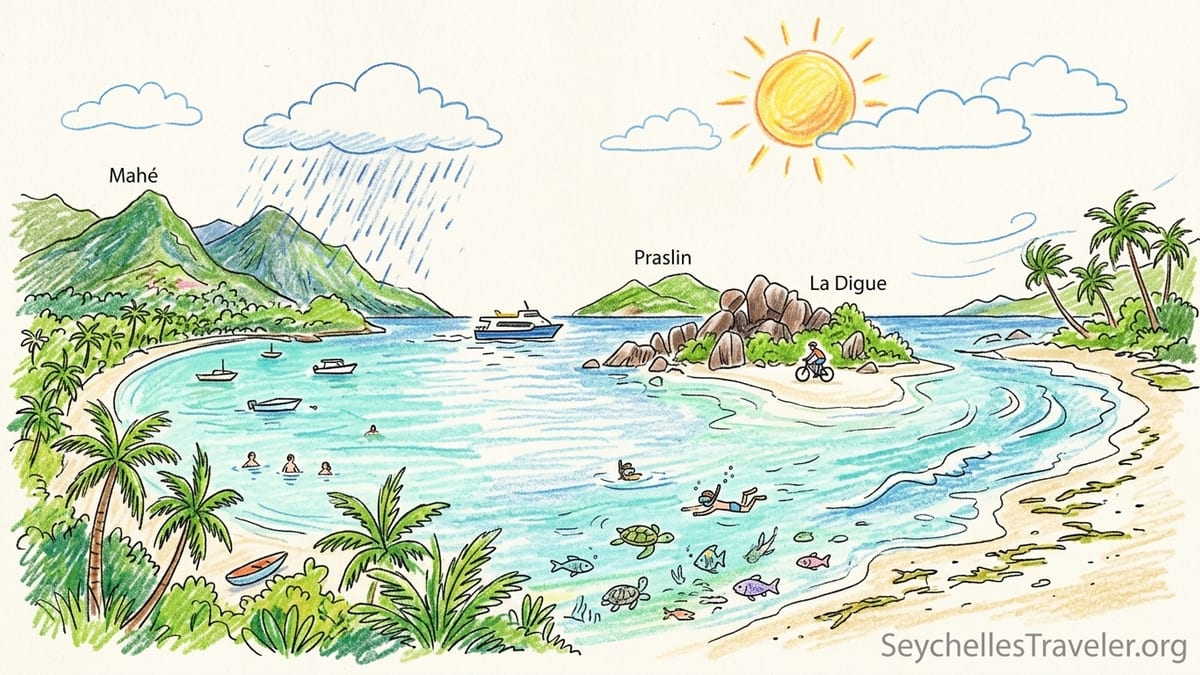
How My Trips Fit Into the Seychelles Weather Calendar
Tourism Seychelles highlights April, May, October and November as sweet-spot transition months between the northwest monsoon and the southeast trade winds. December to April is warmer and wetter, with January and February usually the wettest, while May to October is cooler, drier and windier under the southeast trades. My own experience slots neatly into that framework, but with plenty of on-the-ground nuance.
I have personally visited Seychelles in late April, early May and late October, all on the inner islands of Mahé, Praslin and La Digue. That means I have lived through the tail end of the northwest monsoon sliding into the inter-monsoon calm, and then the shoulder between the southeast trades and the build-up to the rains. I have not stayed in June to September, nor right in the heart of the January–February downpours, so comments on those periods come from local operators, ferry staff and divers I spoke to, supported by current seasonal guidance rather than first-hand experience.
Across those three trips, I split time quite evenly: on Mahé I based myself once near Beau Vallon on the northwest coast and once around Anse Royale and the quieter south. On Praslin I stayed on Anse Volbert (Côte d’Or) and close to Anse Lazio. On La Digue I used guesthouses within cycling distance of Anse Source d’Argent, Grand Anse and Anse Severe. This gave me a front-row seat to how quickly conditions shift on different coasts when wind and currents change direction.
What follows is less about abstract averages and more about how often it rained on my breakfast, how choppy the Cat Cocos ferry felt on specific crossings, how much seaweed I kicked through on particular beaches, and which months I would now choose for calm-water swimming, snorkeling visibility, hiking and better value.
Late April: Warm, Calm and Surprisingly Humid
My late April stays on Mahé and Praslin felt like the Seychelles brochure come to life, with a few caveats. Air temperatures hovered around 30 degrees Celsius in the daytime and stayed sticky at night. Humidity was noticeably high; stepping out of an air-conditioned room in Beau Vallon felt like walking into a bathroom after a hot shower. That humidity, however, came with mostly calm winds and some of the clearest, flattest sea I have seen in the islands.
In Beau Vallon in late April, the bay was typically glassy in the morning and only lightly rippled in the afternoon. I could float on my back and stare up at the ridgeline above Victoria without any sense of drift. On Praslin’s Anse Volbert a few days later, the water was so still that local operators parked their glass-bottom boats just offshore like cars in a lot; snorkeling off the beach meant sliding into warm, pale-turquoise water with very little surface chop.
Rain in late April arrived as short, heavy showers rather than all-day gray. On several mornings I woke to clear skies, only for a dark cloud to snag briefly on Mahé’s interior mountains around lunchtime and dump rain over a single valley while neighboring bays stayed in sunshine. On one day at Anse Royale, the beach was bright until about 3 p.m., when a sharp 20-minute downpour swept in from the interior. By 4 p.m. the sand was steaming gently, and the sea had cleared again. The key impression was how localized and fast-changing the weather could be around the mountainous spine of Mahé.
Seaweed in late April barely registered on the beaches I used. At Beau Vallon there were occasional thin lines of dry weed at the high-tide mark, easily stepped over and not affecting swimming. On Anse Volbert, I noticed a scattering of brown weed fragments in the shallows on one afternoon after a breezier night, but it was nothing like the thick mats that travelers sometimes picture. For my own swims and photos, seaweed played no material role at this time of year.
Early May: The First Taste of the Southeast Trades
Returning in early May, I could feel that the season was tipping. On Mahé’s east and southeast coasts, particularly around Anse Royale and further south towards Anse Intendance, the wind had picked up slightly compared to late April. It was not yet the full force of the southeast trade winds often mentioned in guides, but afternoons came with a more consistent onshore breeze and a visible increase in wave energy on exposed stretches.
Swimming at Anse Royale in early May was still very enjoyable, but it required a little more awareness. In the lee of the offshore reef, the water stayed relatively calm and waist-deep, with soft sand underfoot. Once I ventured closer to the reef edge, however, I felt a stronger pull from the sets pushing across the coral. Snorkeling visibility remained decent on calm mornings but degraded more quickly after lunch as surface chop increased and suspended sand clouded the shallows.
Seaweed remained a background detail rather than a trip-defining problem during my early May stays. On Mahé’s southern beaches like Anse Takamaka and the area near Baie Lazare, I saw fresh weed lines appearing that had not been present in late April. They were patchy rather than continuous, and resorts with beachfront access often raked a clear corridor early in the morning. On Praslin, at Anse Volbert and Anse Lazio, the sand was largely clean. Any weed present was thin and localized, not enough to change my plans or push me to choose a different beach.
Rain in early May felt slightly less frequent than in late April, but when showers came, they still built quickly over the interior. On one day while staying near Baie Lazare, the morning dawned hazy and bright. By noon a solid cloud bank formed over the Morne Seychellois range, and a distinct curtain of rain marched down towards the west coast. Our beach stayed dry, yet I could see the neighboring bay disappear behind a gray veil for about half an hour before clearing again. This hyper-local pattern is worth remembering if you plan hiking or photography: checking the sky over the central mountains tells you more than glancing at a day-long forecast.
Late October: Softer Light, Changing Winds and Clearer Seas
My late October trips brought some of my favorite overall conditions, especially for snorkeling and photography. By this point, the southeast trades were losing strength, and the sea was slowly calming on coasts that had been livelier in the preceding months. On Mahé’s northwest, Beau Vallon returned to its calm persona with gentle lapping waves and hazy, golden sunsets. The air stayed warm and humid, but the constant strong breeze of peak trade-wind season was gone.
On Praslin in late October, I split time between Anse Volbert and days out to Anse Lazio and La Digue. The water clarity was the standout difference. Snorkeling off Anse Volbert in the morning, I could see coral heads and schools of fish across several meters with very little particulate in the water. Boat trips to nearby St Pierre islet and Curieuse Island were comfortable; although the sea was not as flat as in April, the motion was a slow, regular swell rather than choppy slap. Friends who are mildly prone to seasickness managed these late October crossings with basic precautions like sitting outside and looking at the horizon.
Rain in late October was sporadic but sometimes heavy. I experienced several days of bright, nearly cloudless mornings followed by dramatic afternoon buildups over the main islands. One afternoon on La Digue, a towering bank of cloud stacked up behind the island’s granite peaks around 2 p.m., releasing a solid 40-minute downpour that sent cyclists running for cover under takamaka trees. By 4 p.m., I was back in the water at Anse Severe under clear skies. The speed of these changes underlined how small the islands are and how quickly systems move through.
Seaweed in late October again did not materially affect the beaches I visited. At Anse Volbert and Anse Lazio on Praslin, the sand was largely weed-free, with just occasional patches of drift material at the high tide line. On La Digue’s Anse Source d’Argent, the lagoon behind the reef was clean enough for long, waist-deep wades between granite boulders. Grand Anse on La Digue, though, reminded me that swell patterns matter more than weed here: waves were powerful and dumping even in this calmer shoulder month, which made it a place to watch the surf rather than swim long distances.
Wind, Waves and Ferries: How Comfortable Were the Crossings?
Ferry comfort is a recurring concern for Seychelles visitors, and my experiences reflect how much timing matters. The main Cat Cocos catamaran between Mahé and Praslin runs year-round and generally sticks to its timetable. In late April, my crossing from Mahé to Praslin was a textbook smooth ride: moderate swell, gentle pitching, and plenty of passengers strolling between indoor and outdoor decks. The 60 to 70 minutes passed quickly, and few people seemed uncomfortable.
In early May, on the other hand, the return trip to Mahé was noticeably livelier. The southeast trade winds were starting to establish, and a stiff breeze blew along the route. The catamaran handled it without drama, but the bow slapped into more oncoming chop, and I saw more passengers reach for sick bags, especially those seated in the forward cabin. Sitting towards the rear of the vessel and keeping a steady gaze on the horizon helped, but anyone highly sensitive to motion would likely have preferred a short domestic flight instead.
In late October, crossings felt closer to my April experience, though slightly more variable. My Praslin to La Digue ferry on a smaller inter-island boat was calm and almost lake-like one morning. Two days later, returning in the late afternoon after weather had brewed over Mahé, the same route produced enough pitching that several children clung nervously to their parents. Locals treated it as routine, but it highlighted how small weather shifts can amplify motion on even short hops between islands.
If you know you suffer badly from seasickness and must travel during the stronger southeast trade period from about June to September, local advice and current guidance strongly suggest considering the 15-minute domestic flights between Mahé and Praslin instead of the catamaran, then using the shorter Praslin–La Digue ferry leg. Based on my shoulder-season crossings, I would personally pick late April or late October again for the flattest seas and most comfortable boat travel.
Snorkeling, Diving and Water Clarity Across My Months
For snorkeling and diving, the classic advice about shoulder seasons lining up with the best visibility largely matched what I saw on the water. In late April, off Mahé’s northwest and southwest coasts, visibility was very good, especially on mornings before any convective showers kicked off. At Beau Vallon I joined a half-day boat trip to nearby reefs. Underwater, the water column was bright and clear; I could see reef fish at depth with little backscatter from suspended sand. Closer to shore near Anse Royale, the lagoon remained enjoyable, but visibility sometimes dropped after mid-afternoon showers stirred up the shallows.
Early May brought a subtle change. On a guided snorkel near Anse Intendance, surface chop increased slightly compared to late April, and the guide chose more sheltered spots tucked behind headlands. Underwater, we still enjoyed good clarity, but fine particles became more noticeable, especially nearer the surface. Local dive staff mentioned they considered June to August “hit or miss” for visibility on more exposed sites when the southeast trades blow hardest, though I did not personally test those months.
My late October snorkeling on Praslin and La Digue stands out as the best overall combination of calm and clarity. On a trip from Anse Volbert to St Pierre, I spent long sessions hovering over coral with excellent horizontal visibility, able to follow turtles across several body lengths. The sea felt slightly less hot than in April, which made long snorkel sessions more comfortable. Afternoon visibility stayed better for longer, as winds were lighter and fewer showers washed extra sediment off the steep island slopes.
For diving, operators on both Mahé and Praslin I spoke to favored April, May, October and November for consistent conditions. They cited April in particular as a calm-water month with excellent underwater visibility, but with higher humidity and a greater chance of short, heavy showers topside. Based on what I experienced at the surface and in snorkeling depth, if my primary goal were clear water for underwater photography, I would choose late April or late October again, with a slight personal preference for October for the more comfortable air temperatures during surface intervals.
Beach Time, Hiking and Value: What I Would Choose Next Time
For pure beach lounging and gentle swimming, late April delivered the most classically “tropical postcard” conditions for me. Beau Vallon’s water was so calm some mornings that paddleboards hardly left a wake. On La Digue in late October, Anse Source d’Argent was equally idyllic at low tide, but the humidity felt more manageable and time on the sand more comfortable, especially in the shade of takamaka trees. If I had to recommend a single window for travelers who care most about easy swimming and lazing in warm, flat water, I would point them to the back half of April or the last two weeks of October.
For hiking, particularly routes such as Morne Blanc on Mahé or the trails above Anse Major, my experience nudges me away from the stickiest part of the northwest monsoon. Climbing through the forest in late April was beautiful but extremely sweaty; the air felt saturated, and brief showers turned rocks slick in minutes. By late October the air was still humid but marginally fresher, and breezes along ridgelines took the edge off the heat. I would happily plan more hiking days in late October or early November rather than peak wet-season months like January or February, which local operators describe as wetter and heavier.
For quieter travel and better value, my late April and late October trips both fell outside Christmas, Easter and the core European school-holiday summer. While Seychelles is never truly cheap, I found slightly more flexibility in guesthouse availability and occasional promotional rates in these shoulder periods, especially on La Digue and in smaller properties on Mahé’s south coast. Restaurant reservations were easier to secure, and popular sites such as Anse Lazio felt busy but not overwhelmed.
Balancing all of these factors, my personal timing choices for a return would be: late April if I wanted the calmest-feeling water and did not mind high humidity, late October if I wanted a small drop in stickiness with still-excellent snorkeling conditions, and early May only if my schedule required it, accepting slightly more wind and livelier seas. For June to September or December to February, I would only book after weighing sea conditions, rain patterns and my own aversion to rough crossings, drawing on local advice rather than assuming “year-round paradise” covers all priorities.
What I Did Not Experience First-Hand and How I Approached It
I have not personally visited Seychelles in the heart of the southeast trade season from June to September, nor in the peak of the northwest monsoon rains in January and February. However, these periods matter for planning, so I made a point of discussing them with people who experience them yearly, then cross-checking that with current seasonal descriptions offered by tourism bodies and local operators.
On multiple early May visits, staff at Mahé and Praslin guesthouses described June to August as noticeably windier, with rougher seas on south- and east-facing beaches and more frequent seaweed accumulation on exposed coasts, especially on southern Mahé and Praslin’s south and east. They highlighted that sheltered beaches on the opposite coasts, such as Beau Vallon or the northwest-facing coves of Praslin like Anse Lazio, remained attractive even when the trades were up. That matched written guidance that treats seaweed not as an island-wide issue but a matter of choosing your coastline according to the season.
For January and February, the consensus from locals I spoke to was that these months brought the heaviest, most frequent rains and very high humidity, with more overcast days compared to my mostly bright late April and late October stays. Trails could become muddier, and some smaller roads and paths might need more care after heavy overnight downpours. At the same time, temperatures stayed warm, and the sea often remained swimmable when conditions allowed, especially on coasts sheltered from the prevailing wind.
Because I have not walked those beaches or taken ferries in those exact months, I avoid presenting personal judgments about how enjoyable they would be. Instead, I treat them as options that suit certain priorities. A traveler who values slightly cooler air and does not mind wind or occasional rough crossings might enjoy June or July for surfing-style wave watching and fewer mosquitoes. Someone chasing the lushest greenery and dramatic tropical downpours might accept the risk of heavier rain in January for that atmosphere. My own preferences, though, keep circling back to the calmer, transitional windows I have actually tested.
If and when I do visit Seychelles in mid-winter trades or peak monsoon, I will pay special attention to whether the forecasts and general advice match the lived reality on specific beaches and ferries, in the same way that these late April, early May and late October trips have already complicated the easy “any month is perfect” narrative.
The Takeaway
Across my visits, the best time to visit Seychelles has proven to be less a single month and more a question of matching your priorities to the seasonal character of the islands. Late April gave me the calmest seas and most brochure-like beach days, at the cost of very high humidity and occasional short, heavy showers that arrived with little warning over the mountains. Early May introduced a noticeable uptick in wind and livelier seas on exposed coasts, yet still kept rain mostly in short bursts and left many sheltered bays comfortable for swimming and snorkeling.
Late October offered a particularly appealing balance: softer light, excellent water clarity for snorkeling, manageable humidity for hiking, and enough breeze to feel comfortable without the relentless push of the peak southeast trades. Seaweed never became more than a minor visual detail in any of the months I personally experienced; at most it formed modest drift lines on certain beaches without limiting where I swam or how I used the shore.
If I were planning my own return trip focused on beaches and snorkeling, I would target late April or late October again. For a hiking-heavy itinerary, I would lean towards late October or early November to reduce some of the humidity and avoid the heaviest rains. For quieter travel and slightly better value, I would keep steering clear of Christmas and European school holidays and look for gaps in April, May or October where flights and guesthouses are under less pressure.
Most importantly, I would build flexibility into my day-to-day plans, accepting that around these steep, mountainous islands, weather can swivel between full sun and hard rain in under an hour. With that mindset, the Seychelles’ much-promoted “year-round” appeal becomes accurate for the right kind of traveler: not someone expecting identical conditions every day, but someone ready to adapt, switch beaches with the wind, and let the islands’ quick-changing moods shape the trip.
FAQ
Q1. What month felt best overall on my Seychelles trips?
For my mix of beaches, snorkeling and some hiking, late October felt best overall, with warm air, excellent water clarity and manageable humidity without constant strong wind.
Q2. Did seaweed ever ruin a beach day for me?
No. Across late April, early May and late October, seaweed appeared only as light drift lines on some beaches and never forced me to change islands or skip a planned swim.
Q3. When did I find the calmest sea for swimming and ferries?
Late April gave me the flattest seas, both on beaches like Beau Vallon and on the Mahé–Praslin ferry. Late October was slightly more variable but still generally comfortable.
Q4. Which month felt most humid during my stays?
Late April felt the most humid, with sticky nights and the sense of stepping into a warm, damp room when leaving air-conditioned spaces, even though winds were light and seas calm.
Q5. How often did it rain during my trips?
In late April and early May it rained in short, sometimes intense showers on several days a week, usually for 20 to 40 minutes. In late October I saw fewer showers but some heavier downpours.
Q6. Was snorkeling visibility consistently good?
Yes in late April and late October, especially on morning boat trips. Early May remained good, but surface chop and suspended particles increased slightly near exposed reefs.
Q7. Are June to September or January to February bad times to visit?
Not necessarily, but I did not experience them first-hand. Locals described June to September as windier and rougher at sea, and January to February as wetter and more humid.
Q8. Which months would I pick next time for hiking?
I would choose late October or early November because trails are drier than in peak rainy months, yet temperatures and humidity feel a touch less oppressive than in late April.
Q9. How did the mountainous islands affect weather changes?
The central mountains on Mahé in particular caused weather to change quickly, with clouds building and releasing short, heavy showers over one valley while neighboring bays stayed sunny.
Q10. What timing would I recommend for better value and fewer crowds?
Late April, early May and late October all felt quieter than Christmas or major European holidays, with more guesthouse availability and a calmer atmosphere on popular beaches.