

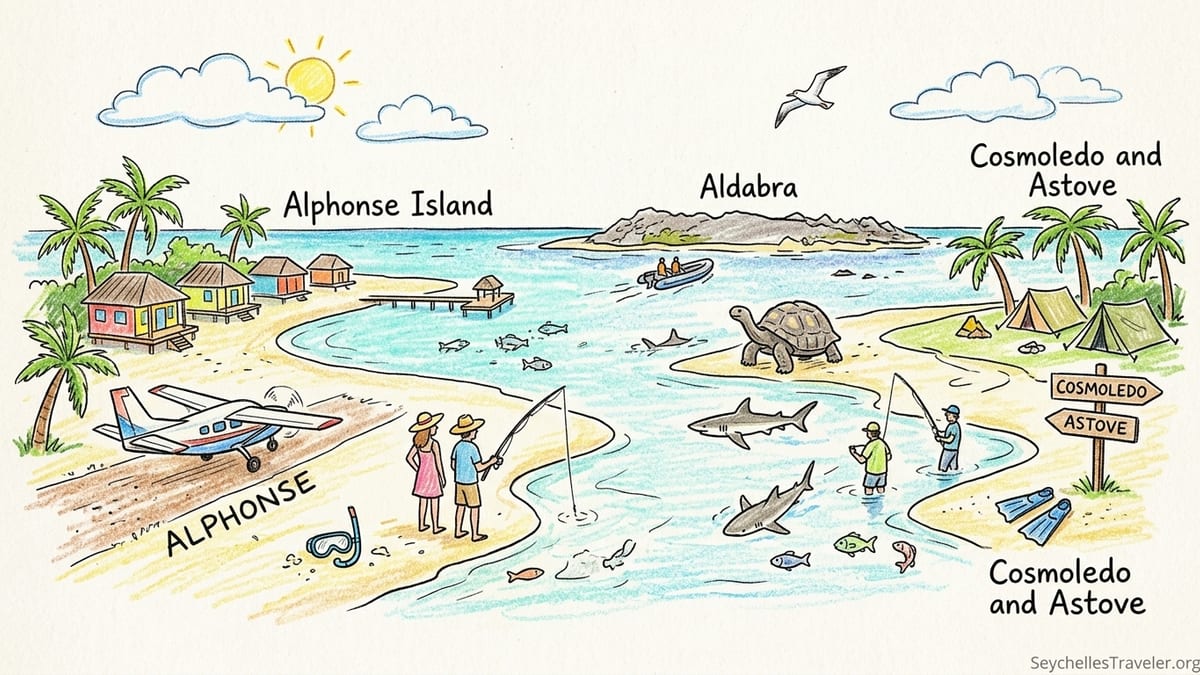
When I first started plotting a trip to the Seychelles Outer Islands, the map looked like a tempting scatter of emerald rings on a deep-blue canvas. In reality, those dots are separated by hours of flying, serious money, and some of the most tightly controlled conservation rules in the Indian Ocean. On my most recent journeys I focused on a handful of atolls I could actually reach and experience properly: Alphonse, Desroches, Aldabra, and, on a specialist fly-fishing and diving trip, Cosmoledo and Astove. What follows is not a catalogue of all 72 Outer Islands, but a first-person account of the specific islands where I actually set foot, slept, and snorkelled, and which of them I would choose again for different kinds of travelers.
Understanding the Outer Islands: Distance, Cost and Reality Check
Before I ever saw a palm tree in the Outer Islands, I spent a lot of time looking at flight schedules. Tourism Seychelles describes the Amirantes, including Alphonse and Desroches, as the closest Outer Islands to Mahé, roughly 200 kilometres southwest. That sounds near on a map. In practice, it meant charter-style turboprop flights, strict luggage limits, and prices that quickly broke out of “treat” territory into “investment” territory. From Mahé, my flight to Alphonse took about an hour on a small aircraft. Getting to Desroches was slightly easier, with around a 35-minute domestic hop to the island’s own runway. Compared with that, Aldabra sits in another league of remoteness, around 1,000 kilometres from Mahé. Reaching it required a liveaboard expedition vessel and careful coordination with the Seychelles Islands Foundation, which tightly controls access to the atoll.
On the ground, or rather on the sand, the Outer Islands feel very different from the granitic Inner Islands like Mahé, Praslin or La Digue. There are no mountains or jungle-clad peaks. Instead you get long, low coral islands fringed by sand flats and clear lagoons. Infrastructure is minimal. On smaller atolls such as Cosmoledo and Astove, the lodge or eco camp is essentially the only development, and it exists largely to support fly fishing and diving. On Aldabra, there is no conventional tourist accommodation at all, only very limited guest housing at the research station for approved expeditions, and most visitors sleep on their vessel.
Costs varied widely but none of these islands were inexpensive. For context, my domestic return flight from Mahé to Desroches as part of a Four Seasons package priced out in the low four figures in US dollars for two people, on top of already high nightly villa rates. On Alphonse, the flight plus full-board stay packaged with activities such as guided fly fishing quickly moved into the level of a serious once-in-a-decade splurge. Aldabra layered on additional expenses: liveaboard charter, fuel, permits and an environmental impact fee charged per person per day by the Seychelles Islands Foundation. Cosmoledo and Astove, sold as specialist Blue Safari or Alphonse Fishing Company trips, were similar: week-long packages for anglers and divers that cost as much as a business-class ticket halfway around the world.
This might sound discouraging, but it set the frame for how I evaluated each island. At these price points, “nice beach” was not enough. I wanted to know which islands truly justified their cost in terms of remoteness, marine life, guiding, food and how it all felt once the sun went down. The following sections break down my own stays and which travel “products” each island excels at.
Alphonse Island: My Choice for Resort-Based Remote Atoll Life
Alphonse was my first real taste of the Seychelles Outer Islands and, to date, still the one that best balances a feeling of expedition with the comforts of a proper resort. I flew in on the weekly charter from Mahé, a roughly one-hour hop that already felt like a filter. By the time we landed on the airstrip, everyone on the plane had a reason to be there: mostly divers, fly fishers, and a few non-fishing partners along for the ride. I stayed five nights, which felt like a minimum to justify both the cost and the infrequent flights.
The accommodation on Alphonse centered around beach bungalows and villas set just back from a powdery white shoreline. My bungalow was spacious rather than ultra-glamorous, with polished concrete floors, a generous bathroom and an outdoor shower. There was reliable air conditioning and decent Wi-Fi in the main areas, but the overall feel was more “serious island lodge” than champagne-and-butler indulgence. I woke each morning, stepped off my veranda, and had my toes in the sand in under ten seconds. Meals were taken at a central restaurant and bar, where buffets leaned heavily toward fresh grilled fish, salads and curries. One evening there was a barefoot barbecue on the beach, with lanterns in the palm trees and a table full of whole snapper and jobfish still tasting of the ocean.
Activities on Alphonse were the real reason to come. During my stay I mixed two guided fly fishing days on the flats with snorkeling and one boat dive. The guiding operation was one of the most professional I have experienced, with seasoned South African and Seychellois guides who rotated through guests so you benefited from different styles. Wading the turquoise flats, I saw bonefish in big schools, triggerfish tailing in skinny water, and more giant trevally than I was psychologically prepared for. One afternoon we encountered a school of milkfish feeding on the surface, and the boat exploded into motion as the guides started rigging specialist tackle. Underwater, on the reef edge, I logged reef sharks, large groupers, swirling jacks, clouds of anthias and at least one curious turtle on almost every dive or snorkel.
After sunset, Alphonse settled into a relaxed, almost camp-like social rhythm. Most people congregated at the bar, nursing cold Seybrew beers or rum cocktails while swapping stories of missed strikes and landed fish. Guide involvement did not end on the flats. They often joined for dinner and were happy to talk about the atoll’s birdlife, reef health and the realities of running a low-impact operation in such a remote location. There was no nightlife in the conventional sense. Entertainment was conversation, stars, and the occasional impromptu guitar. For me, it was exactly right: sociable if you wanted it, quiet if you slipped back to your bungalow to listen to the surf. Alphonse justified its cost if, and only if, you actually used what it offered: full days of fishing, diving or sensory-overload snorkeling. For an active couple or solo traveler who cares more about flats and reefs than high-thread-count sheets, this is the island I would choose again.
Desroches: The Accessible Private Island Holiday
Desroches, by contrast, is where I went to see if a luxury private island resort could deliver real Outer Islands atmosphere without sacrificing comfort. I stayed four nights at the Four Seasons Resort Seychelles at Desroches Island, long enough to settle into the rhythm of the place but short enough that the high nightly rates did not demolish my annual travel budget. Getting there was notably smoother than reaching Alphonse. After arriving on Mahé, I was met by Four Seasons staff, checked in for the 35-minute domestic flight, and landed on Desroches’ own airstrip within an hour of boarding. Moving from plane to villa took less time than many city airport taxi rides.
My villa on Desroches felt like the archetype of modern Indian Ocean luxury. It had its own plunge pool, a stretch of mostly private beach, and an indoor-outdoor bathroom that framed the palm trees like a subtropical painting. Service details were on another level compared with the fishing-focused lodges: little buggies materialized when I looked vaguely like I might want a lift, and staff learned my coffee order within a day. Food quality matched the room rates. There were several dining venues, and dinner one night included perfectly seared local tuna, another a homemade curry spread that easily rivaled good city restaurants. It was very different from the communal single-dining-room feel on Alphonse or Astove.
Yet Desroches is still an Outer Island, and the activities reminded me of that. I spent one morning cycling along sandy tracks, passing tortoises lumbering through the underbrush and pausing at empty beaches where there was no one in sight in either direction. Guided snorkeling off the reef revealed healthy coral gardens and a good variety of reef fish. The dive centre offered boat dives on drop-offs and walls, and a number of guests I spoke with raved about seeing sharks and rays on a single morning outing. There was also the chance, at additional cost, to join fly fishing excursions to the nearby Poivre Atoll, which bridged the gap between “spa guest” and “serious angler.” I did not fish from Desroches, but the presence of that option reinforced that this was a resort that understood its location.
After dark, Desroches felt more refined than wild. There was soft lighting along sandy paths, cocktails by the bar, and the possibility of private beach dinners if you wanted to lean into the honeymoon atmosphere. Families gathered around villa pools. Couples drifted back to their rooms after late desserts rather than early-morning tide briefings. This is where I would send someone who wants an Outer Islands address but prefers spa treatments, kids club and a wine list to the camaraderie of a fishing lodge. The island absolutely justifies its high price for honeymooners and luxury travelers who will use the bikes, the dive centre and the space to do very little. If your primary goal is flats fishing from dawn to dusk, Desroches is a comfortable but arguably less focused base than Alphonse or the more specialist atolls.
Aldabra: A Strictly Controlled Conservation Expedition
My visit to Aldabra remains one of the most memorable travel experiences I have had anywhere, and also the most logistically complex in the Seychelles. Aldabra is managed as a strict nature reserve and UNESCO World Heritage Site, with the Seychelles Islands Foundation carefully regulating all access. I joined a small-ship expedition that included Aldabra on an itinerary of remote islands. We slept on board the vessel, and spent three full days anchored off the atoll, shuttling ashore by zodiac under the supervision of SIF rangers and guides. Before departure, the operator secured the necessary permissions and we were briefed on the site’s tourism regulations, including where we could land, how close we could approach wildlife, and what was completely off limits.
Aldabra is not a resort product in any sense. There are no sun loungers, no cocktails by a pool, and no choice of restaurants. Instead, we visited the research station, walked carefully marked paths, and crossed beaches that were alive with giant tortoises. On our first morning, within minutes of stepping ashore, I saw my first wild Aldabra giant tortoise, then another, and quickly lost count. We watched them grazing in the scrub and lumbering along paths beaten into the soil by decades of slow traffic. The rangers emphasized that these animals had been on the brink of serious decline in the past, and that strict protections had allowed their population to recover.
On the marine side, Aldabra felt like a glimpse of what much of the Indian Ocean might once have been. Snorkeling in the channels and along the reef edge, I saw blacktip reef sharks, large bumphead parrotfish, clouds of snapper and fusiliers, turtles and rays. Tidal currents were fierce, so we entered and exited the water under close supervision, often drift-snorkeling through channels with the zodiacs shadowing us. Inside the lagoon, visits were limited to specific zones. Outside these, the regulations were clear: no access, no exceptions. It was a constant reminder that we were guests in a working conservation area, not customers at a resort.
Evenings on the expedition vessel were simple but satisfying. Meals were served family-style, and much of the conversation revolved around what we had just seen and what the scientists on board were studying. Rangers sometimes joined us to explain ongoing monitoring projects or threats such as invasive species and plastic debris washing up from far beyond Seychelles waters. The cost of including Aldabra on an itinerary was substantial, especially once you factored in the environmental impact fees charged per person per day to support conservation work. I left convinced that it was worth it only for travelers who care deeply about wildlife and are content with basic liveaboard comforts, early nights and strict rules. As a conservation and wildlife expedition, however, Aldabra is on a completely different level from any other island I visited.
Cosmoledo and Astove: Specialist Trips for Fly Fishers and Serious Divers
Cosmoledo and Astove entered my Seychelles story as a package. I joined a specialist Blue Safari itinerary that combined several days on Astove with time at the eco camp on Cosmoledo, accessed via charter flights and boat transfers from Mahé. The whole trip lasted a week on the islands, plus travel days on either side. From the first briefing at the small domestic terminal on Mahé, it was clear that these atolls cater primarily to one audience: experienced saltwater fly fishers who dream in giant trevally and bonefish.
Astove’s lodge was rustic but comfortable, with individual rooms clustered around a central dining area. Electricity was limited at certain hours and water was used carefully, a constant reminder of how little infrastructure exists this far south. Days started early with coffee, a quick breakfast and then loading skiffs for a full day on the flats and reef edge. The main event was wading the lagoon and surf zones, looking for GTs, bonefish, triggers and bluefin trevally. I saw sharks almost every day, along with turtle tracks on the beach and large grouper holding under ledges. On one memorable afternoon, we ended the fishing early to dive the famous Astove Wall, a near-vertical drop where the shallow reef gives way to deep blue water. The transition from hard corals and reef fish to open water and pelagic species in just a few fin kicks was dramatic and slightly intimidating.
Cosmoledo, reached by small aircraft to nearby Astove and then by boat transfer, took the remoteness up another notch. The eco camp where I stayed consisted of a handful of well-fitted tents on Wizard Island, with proper beds, air conditioning and outdoor showers but a very light physical footprint. Power was again managed carefully, and Wi-Fi, while available in the main area, was limited enough that checking emails felt faintly absurd. The daily routine mirrored Astove: breakfast, long days out on the flats with highly experienced guides, packed lunches on sandbars, and returns timed with the fading light. Cosmoledo’s fish populations felt even wilder. We saw large schools of bonefish, innumerable GTs patrolling the edges, milkfish, and big snapper and grouper on the reef. For non-angling moments, snorkeling revealed unspoiled coral gardens and high chances of shark encounters that the dive team briefed with care.
After sunset on both Astove and Cosmoledo, life contracted to the camp or lodge. There were no alternative restaurants, no bars beyond the small in-house options, and no entertainment besides conversation, trip planning and a sometimes-wobbly satellite connection for weather updates. Meals were hearty and satisfying, with an emphasis on fresh fish and sides that restored calories lost to sun and salt. Guides joined dinner and talked openly about sustainability, catch-and-release practices and the need to keep guest numbers limited if the fisheries are to remain healthy. These trips justified their cost for a narrow but passionate audience: anglers who measure value in shots at GTs and time on pristine flats, and divers who want to be among the very few people exploring relatively undocumented sites. For a casual snorkeler or someone who primarily wants spa days and variety, the remoteness would likely feel more like limitation than privilege.
How the Islands Compared: Remoteness, Comfort and What Nights Felt Like
Looking back across these islands side by side, what struck me most was how different they felt after sunset. On Desroches, evenings tasted of polished hospitality: a cocktail menu, options for where to eat, children being shepherded back to villas and the low hum of generators hidden behind landscaping. I could sit with a glass of wine, talk about diving, and still feel very aware that I was in a five-star bubble. On Alphonse, nights were more communal and focused. People filtered to the same bar and the same tables, and every conversation sooner or later returned to tides, tackle and which flat to fish the next morning. The darkness beyond the pool of light felt more like genuine wilderness.
Aldabra was altogether different. Nights belonged to the expedition ship and the wind. After dinner, there might be a short lecture in the lounge or an informal Q&A with a scientist, but by 10 p.m. most passengers had drifted off to their cabins. There was no wandering off after dark, no late-night beach walks, because access was constrained by both safety and regulations. On Cosmoledo and Astove, the evenings were a blend of camaraderie and exhaustion. Guests compared notes over simple but generous dinners, sorted gear for the next day, and were in bed by 9:30 p.m. Without streetlights, the sky felt almost overwhelming, with more stars than I have seen anywhere else in Seychelles.
In terms of remoteness, Aldabra, Cosmoledo and Astove clearly sat at the far end of the scale. They required multiple travel legs, strict coordination, and a tolerance for limited communications. Alphonse occupied an appealing middle ground: far enough to feel like an expedition, but with just enough structure and schedule that you could plan around the weekly flights. Desroches, although technically remote, felt almost easy thanks to daily flights and the Four Seasons handling logistical details. For many travelers, that ease will be decisive. For others, the very fact that Cosmoledo or Aldabra are hard to reach is the main attraction.
Comfort levels trended in the opposite direction. Desroches came closest to a classic luxury island, with private pools, high-end dining and polished service. Alphonse offered a comfortable, well-run lodge atmosphere rather than unrestrained luxury, but it never felt rough. Astove and Cosmoledo were intentionally simple, channeling investment into guiding and boats rather than marble bathrooms. Aldabra, by design, prioritized conservation infrastructure and scientific work over visitor comfort. If you need turn-down service and a spa, Aldabra, Astove and Cosmoledo are not the right choice. If you are happy with clean rooms, good food and world-class nature, they fit beautifully.
The Takeaway
After visiting these Outer Islands, I stopped thinking of them as competing products and started seeing them as answers to different questions. If a friend told me they wanted a remote luxury escape where they could dip into nature without giving up private pools and refined dining, I would point them toward Desroches. The 35-minute flight from Mahé, the well-developed villas and the range of activities make it a very comfortable first step into the Outer Islands. It is not the wildest place I visited, but it is the one that best balances ease, seclusion and classic resort comforts.
If someone’s priority was diving and a more active, lodge-style environment, with good but not over-the-top luxury, I would steer them to Alphonse. Five to seven nights there gives enough time for multiple dive days, fly fishing if you want it, and long snorkel sessions on the reefs. It works particularly well for couples where one partner fishes or dives intensely and the other prefers snorkeling, cycling or simply reading by the beach with occasional forays into the lagoon.
For fly fishers and serious divers looking for the most intense, species-rich environment they can access in Seychelles, Cosmoledo and Astove are the answer. These are true specialist trips that revolve around tides, boats and highly experienced guides. The costs are high and the comforts straightforward, but the payoff is time on unpressured flats, reefs that still feel exploratory, and a sense of being among a very small number of people to experience these atolls each year. In my own mental filing cabinet, I label these as “lifetime trips” rather than annual holidays.
Finally, for conservation and wildlife expedition travel, Aldabra stands apart. It is not a place to go lightly, given the environmental impact and the resources required to reach it, but for travelers who prioritise seeing intact ecosystems, giant tortoises in their stronghold, and reefs that are monitored more than they are marketed, it is extraordinary. Photography-focused travelers will find compelling subjects almost everywhere in the Outer Islands, from tortoises and turtles to aerial shots of reef rings, but the best match for pure photography, in my experience, is a hybrid itinerary that includes both a comfortable base like Desroches or Alphonse and a more demanding segment such as Aldabra or Cosmoledo. There is no universal “best” Outer Island in Seychelles. There is only the island that best matches your appetite for comfort, remoteness, wildlife and cost. Having visited these particular atolls, these are the ones I would choose again, for the right trip and the right traveler.
FAQ
Q1. How long should I stay on an Outer Island to make the trip worthwhile?
For Alphonse and Desroches, I found four to seven nights ideal, mainly because of the time and cost of flights from Mahé. For more remote, specialist trips to Cosmoledo or Astove, a full week on the atoll is standard and makes sense given the logistics. Aldabra is usually visited for two to three days as part of a longer expedition cruise rather than as a standalone stay.
Q2. Which Outer Island is best for a classic luxury escape?
Based on my own stays, Desroches delivered the most traditional luxury experience, with villa pools, a choice of restaurants, a spa and easy access from Mahé. It still feels secluded and wild around the edges, but day to day you are in a polished, full-service resort environment.
Q3. Where should divers focus if they want the best reef experiences?
If diving is your main priority and you also value comfort, Alphonse is a strong option, with healthy reefs, sharks, rays and good professional guiding. For very experienced divers willing to accept simpler accommodation and more complex logistics, Astove and Cosmoledo offer some of the most dramatic walls and least-dived reefs I have seen in Seychelles.
Q4. Are these islands suitable for non-fishing partners or families?
Desroches is the most family-friendly, with bikes, safe swimming areas, kids facilities and varied dining. Alphonse works well for mixed groups where some fish or dive and others prefer snorkeling and beach time. Astove and Cosmoledo are best for travelers who are fully committed to fishing or diving, and Aldabra is generally appropriate only for adults comfortable with basic expedition conditions and strict rules.
Q5. How difficult is it to arrange a visit to Aldabra?
Reaching Aldabra is significantly more complex than booking a resort stay. You typically need to join a specialist expedition cruise or charter that has secured permits from the Seychelles Islands Foundation and other authorities. Visitor numbers are limited, activities are tightly controlled, and plans can change due to weather or conservation needs.
Q6. What kind of marine life did you actually see on these trips?
Across the atolls I visited, I saw bonefish, giant trevally, triggerfish and milkfish on the flats, plus reef sharks, large groupers, jacks, turtles and rays on the reefs. At Aldabra there were also dense schools of bumphead parrotfish and frequent turtle encounters. Exact sightings vary by season and conditions, but these were consistent highlights during my stays.
Q7. Do I need to be an experienced angler or diver to enjoy the Outer Islands?
You do not need to fish or dive to enjoy Desroches, where there are plenty of non-technical activities such as cycling and snorkeling. On Alphonse, having at least an interest in snorkeling, birding or casual fishing helps justify the cost. For Astove and Cosmoledo, I would strongly recommend prior experience in saltwater fly fishing or advanced diving, as the trips are designed around those pursuits.
Q8. How expensive are these trips in real terms?
Prices change regularly, but in broad terms my Outer Islands stays cost more per night than high-end resorts on Mahé or Praslin. Flights from Mahé to Desroches and Alphonse added a noticeable premium, and week-long specialist packages for Cosmoledo, Astove or expeditions including Aldabra moved into “big trip” territory. Anyone considering these islands should plan for a significant budget and check current package rates before committing.
Q9. What kind of traveler will feel disappointed by the Outer Islands?
Travelers who want nightlife, shopping, multiple restaurant options and spontaneous island-hopping may find the Outer Islands too quiet and constrained. Once you are on Alphonse, Desroches, Astove, Cosmoledo or near Aldabra, you stay within that environment, with limited or no independent movement. If freedom to roam or a busy social scene matters most, the Inner Islands are a better match.
Q10. How should I choose between these islands for photography?
For a balance of comfort and strong photographic opportunities, Desroches and Alphonse are excellent starting points, offering beaches, reefs and wildlife while still allowing time to edit and rest. For more dramatic wildlife and seascapes, Aldabra and Cosmoledo provide extraordinary subjects, from tortoises and turtle nesting beaches to remote reef systems, but they demand more of you in terms of logistics and conditions.