


When I first landed on Mahé, weaving through Victoria’s traffic to a full-sized supermarket before driving myself to a guesthouse, Seychelles felt surprisingly accessible. Ferries shuttled people to Praslin and La Digue, buses ran on set timetables, and every beach day could end with a different Creole takeaway. Later, planning a stay on Alphonse Atoll in the Outer Islands, I realised I was looking at a fundamentally different kind of trip: no public ferries, no outside restaurants, and activities coordinated almost entirely by one operator. Having now experienced the Inner Islands on the ground and researched the logistics and realities of the Outer Islands in detail, the contrast is stark. This article unpacks what changed most between the two experiences, and which side works best for different types of travellers.
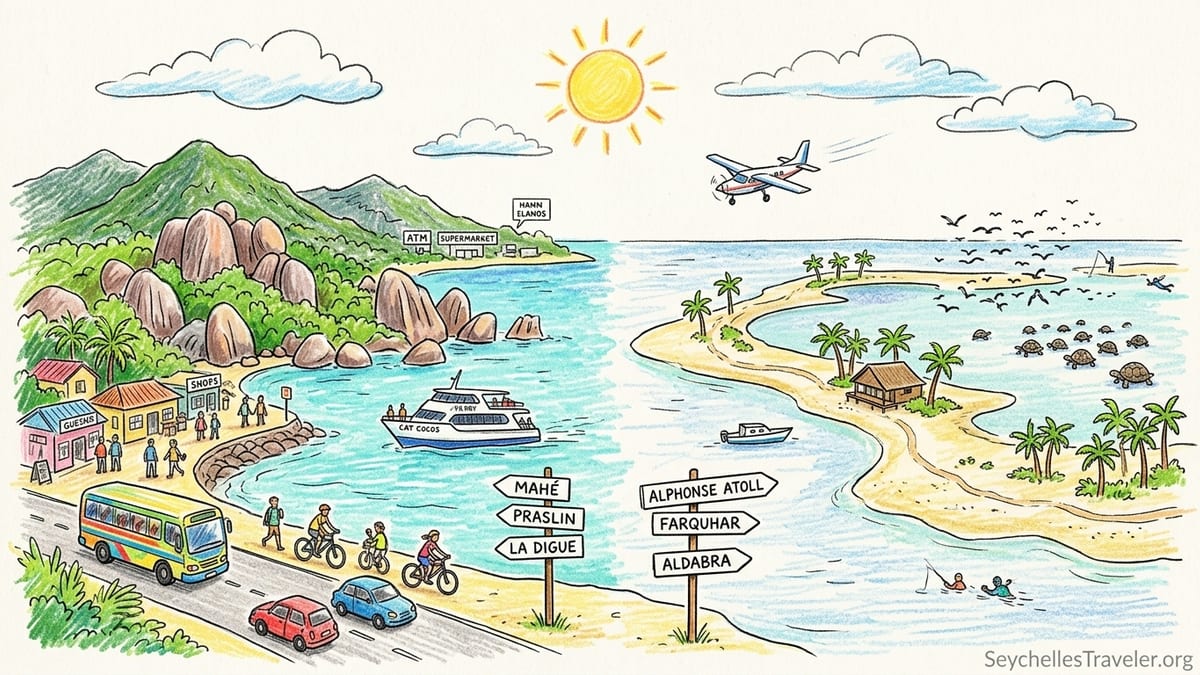
Inner vs Outer Islands: How Seychelles Is Structurally Split
Seychelles tourism is built on two very different geographical foundations. The Inner Islands are the granitic core of the country, centred on Mahé, Praslin and La Digue, with their satellite islets. This is where almost all Seychellois live and where the tourism network is densest: paved roads, public buses, multiple ferry operators, guesthouses, resorts, self-catering apartments and a real choice of restaurants and shops.
The Outer Islands are something else entirely. Official tourism information describes them as 70-plus low-lying coral islands and atolls scattered roughly 230 to more than 1,000 kilometres from Mahé in groups like the Amirantes, Alphonse, Farquhar and Aldabra. There are no towns, almost no permanent civilian communities, and only a handful of islands are open to regular tourists, usually through a single lodge or liveaboard vessel.
On the Inner Islands, I could wake up on Mahé, decide over breakfast whether to hike the Copolia trail, snorkel at Port Launay or catch a mid-morning Cat Cocos ferry to Praslin, and be eating grilled fish at a beach takeaway on Cote d’Or that evening. On an Outer Island such as Alphonse Atoll or Farquhar, that kind of spontaneity gives way to pre-arranged charter flights, full-board packages, and a tightly coordinated daily rhythm built around tides, diving schedules and conservation rules.
This structural split is the key lens for understanding every other difference: infrastructure, transport, accommodation, cost, culture and even how isolated your trip feels. The Inner Islands work like a compact, tropical mini-country. The Outer Islands feel like tiny expedition outposts set in an immense empty ocean.
Getting There and Around: Ferries vs Charter Flights
On the Inner Islands, movement feels refreshingly simple. Fast ferries like Cat Cocos and Cat Rose shuttle several times a day between Mahé, Praslin and La Digue. In 2026, a one-way Mahé–Praslin ticket on Cat Cocos in economy class typically starts in the region of 60 to 80 euros per adult, with the crossing taking about an hour. From Praslin, the short hop to La Digue is around 15 minutes on Cat Rose or a Cat Cocos through-service, and tickets can be less than 20 euros one way. I booked online, walked onto the quay in Victoria with a printed ticket, and joined a mix of tourists and Seychellois commuters.
Once ashore, I could hire a compact car on Mahé or Praslin for roughly 40 to 60 euros per day depending on season, or rely on local buses that cost only a small number of Seychellois rupees per ride. On La Digue, almost everyone gets around by bicycle, and I rented one within ten minutes of stepping off the ferry. This web of ferries, buses and rental cars made island hopping feel almost casual, closer to moving between small Mediterranean islands than flying into an isolated atoll in the middle of the Indian Ocean.
Reaching the Outer Islands, by contrast, usually means committing to a scheduled charter flight out of Mahé. For Alphonse Atoll, for example, guests generally book a package that includes return flights on small aircraft taking about 50 minutes each way, often bundled with accommodation, meals and activities. Seats are limited and flights tend to operate only on specific days of the week, which immediately locks in your itinerary. You cannot wake up on Mahé and simply decide to “pop over” to Alphonse or Farquhar the next day on a public ferry, because such ferries do not exist.
Once on an Outer Island, there is no rental car counter, no bus stop and usually no road network beyond a few sandy tracks. Movement is by bicycle or on foot around the tiny island, and by lodge skiff or dive boat further afield. Rather than reading a ferry timetable, you read the tide chart and the activity board in the lodge lounge. It transforms transport from a public service you tap into on the Inner Islands into a private logistical backbone controlled by a single operator on the Outer Islands.
Infrastructure and Everyday Practicalities: Supermarkets, ATMs and Connectivity
One of the most tangible differences I felt was how easy it was to take care of everyday needs on the Inner Islands. On Mahé, I shopped at the STC Hypermarket outside Victoria, a full-sized grocery store with aisles of fresh produce, local spices, imported dairy, bakery items and even familiar international brands. Smaller supermarkets and corner shops dotted Beau Vallon, Anse Royale and Anse a la Mouche. On Praslin’s Cote d’Or and Baie Sainte Anne, and on La Digue near the jetty, I found minimarkets where I could buy water, fruit, sunscreen and snacks within a five-minute walk of the beach.
There were ATMs in Victoria and Beau Vallon on Mahé, at Baie Sainte Anne and Grand Anse on Praslin, and close to the La Digue jetty. When my phone data ran low, I topped up a local SIM at a petrol station kiosk. Power cuts did happen, but they were short and the next café along the road usually had the lights back on if my guesthouse did not. This safety net of options made independent travel straightforward: forget to buy snacks, and you could stop at the next shop; need cash, and another bank branch waited in the next village.
On an Outer Island, the absence of this safety net becomes a defining feature of the experience. There is typically no supermarket at all, only a small storeroom where the lodge keeps supplies brought in by boat or plane. If you forgot your reef-safe sunscreen or your preferred brand of baby formula, there is rarely anywhere to buy it. You depend on what you packed and what the lodge has in limited back-up stock. ATMs are generally absent, and you settle everything through the lodge account, which is later charged to your card.
Connectivity is also different. Around Mahé and Praslin, I had 4G coverage in most settled areas, losing signal mainly on the more remote hiking trails or tucked-away coves. On the Outer Islands, connectivity may be restricted to a single Wi-Fi hotspot near reception with bandwidth carefully managed, or in some cases to satellite internet that is patchy and best reserved for essential messages. The result is not only a practical constraint but a psychological one: on the Inner Islands, you always feel a short taxi ride from town; on the Outer Islands, the rest of the world recedes to a distant background hum.
Accommodation and Food: Choice vs Curated Packages
My Inner Islands stays ranged from a family-run guesthouse on Mahé’s west coast to a mid-range hotel on Praslin and a self-catering apartment on La Digue. Nightly rates varied widely, from under 100 euros for basic self-catering in low season to several hundred euros for beachfront resorts. Crucially, I could choose my own rhythm: cooking breakfast in my apartment, then walking to a takeaway like Gala Takeaway on La Digue for grilled fish and lentils, and trying a different restaurant each night. If a place was full or not to my taste, another option was usually a short walk or drive away.
This variety fostered an easy independence. I could wander into Victoria’s market to buy fresh tuna, limes and chillies, chat with the vendor in a mix of French and English, and cook dinner myself. On Praslin, I might have curry at a guesthouse restaurant one night, then eat at a more upscale hotel the next. Dietary preferences felt manageable because I could shop myself and mix restaurant meals with self-catering. Families could rent villas with kitchens and spread out without being tied to a dining room schedule.
Outer Islands accommodation sits at the opposite end of the spectrum. Islands such as Alphonse, Farquhar or Cosmoledo are normally home to a single lodge or resort, often with a strong focus on fly-fishing or diving. Stays are usually sold on a full-board or all-inclusive basis, with set meal times in a common dining area. There is no “alternative restaurant” down the road if you do not like the menu. The chef can often accommodate allergies and preferences, and the food is typically very good, but the choice is internal to the lodge, not across a neighbourhood of independent eateries.
The financial structure reflects this. Instead of paying night by night and picking up snacks from a supermarket, you commit to a package that might cost several thousand euros per person for a week, bundling flights, accommodation, meals and core activities. A glass of wine at sunset or an extra dive is recorded against your room rather than paid in cash at a beachfront kiosk. For travellers used to wandering out to dinner and discovering a new café each evening on Mahé, the Outer Islands feel highly curated, almost like being on a small expedition cruise that happens to be stationary.
Beaches, Reefs and Wildlife: Accessibility vs Immersion
The Inner Islands showcase some of the most photogenic beaches I have ever seen. Anse Lazio on Praslin, with its smooth granite boulders and turquoise arc of sand, was as striking in reality as in the brochures. Anse Source d’Argent on La Digue, reached by bicycle through a vanilla plantation, felt like a film set, albeit one shared with plenty of other visitors. I could swim off Beau Vallon at sunset, join a snorkelling tour to Sainte Anne Marine Park or Curieuse Island, and still be back in time for a takeaway dinner.
Reef quality around the Inner Islands is a mixed picture. I joined boat trips where coral gardens were vibrant, with clouds of reef fish and the occasional turtle, and others where coral bleaching and storm damage were obvious, with large areas of dead, pale coral. That variability is typical of reefs accessible to high visitor numbers and close to the main population centres. Nevertheless, the ease of access was remarkable; within a short drive and boat ride from my guesthouse, I could be drifting over coral or visiting a turtle nesting beach on Curieuse.
The Outer Islands, by nearly all accounts from operators and visiting divers, are where Seychelles’ marine life feels truly immersive. Atolls like Alphonse and Cosmoledo sit far from any urban runoff or heavy boat traffic, and divers report large schools of fish, healthier coral structures in many sites, and more frequent encounters with pelagics such as dogtooth tuna or reef sharks. Bird colonies on islands like Aldabra are on a completely different scale from anything I saw on Mahé or Praslin, and Aldabra’s population of giant tortoises is measured in the tens of thousands rather than the small, managed groups you meet on Curieuse or in botanical gardens.
The flip side is that this immersion is highly structured. On the Inner Islands, I could grab my mask, walk down to a beach like Anse Severe and snorkel right off the sand at my own pace. On an Outer Island, reef access is generally through guided boat excursions or shore entries supervised by the lodge, with set departure times and mandatory safety briefings. Wildlife experiences may be governed by strict conservation rules that dictate where you can walk, when you can approach a nesting area and how often certain sites can be visited. It is deeper immersion, but less individually flexible.
Cultural Interaction and Sense of Place
Some of my favourite Inner Islands moments had little to do with beaches. On Mahé, I wandered through Victoria’s Sir Selwyn Selwyn Clarke market on a Saturday morning, squeezing past locals buying fish, breadfruit and coconut, and listening to vendors chat in Creole. A bus ride from Anse Royale back to Victoria turned into a casual language lesson, with fellow passengers laughing as I tried to pronounce place names correctly. On La Digue, I chatted with a bicycle rental owner about how tourism had changed the island, and on Praslin I bought home-made chilli sauce from a roadside stand and ended up talking about recipes for ten minutes.
This urban and village Creole culture is essentially an Inner Islands phenomenon. Victoria, however small by global standards, is still a real capital with schools, government offices, churches and football pitches. Island life on Praslin and La Digue moves at its own pace, but it is still life, not a resort bubble. You see schoolchildren in uniform at the bus stop, men repairing fishing nets under a takamaka tree, and families picnicking on Sundays. Independent travellers can dip into this daily rhythm simply by using public transport, shopping at local markets and staying in guesthouses.
The Outer Islands, by contrast, largely lack this layer of lived-in culture. There are no towns, no separate residential districts and often only a very small population of staff and conservation workers. Guests interact mainly with lodge employees and guides, many of whom are Seychellois, but the interaction is mediated by the resort setting and usually centred on activities such as diving briefings or nature walks. You do not wander into a corner shop that serves both locals and visitors because there is no corner shop.
That does not mean there is no sense of place. In the Outer Islands, the “culture” is as much ecological as human: seabird colonies wheeling over the lagoon, the rhythm of tides determining work schedules, and strict environmental briefings replacing city tours. Yet if your priority is to understand Seychellois daily life, the Inner Islands are where that happens. The Outer Islands excel instead at offering a feeling of detachment from human landscapes altogether.
Cost, Flexibility and Family Suitability
Financially, I found the Inner Islands to offer a wide range of options. A couple could keep costs contained by renting a simple apartment on Mahé or La Digue for under 100 euros per night in low season, using supermarkets for most meals, and relying on buses and bikes. At the other end of the spectrum, luxury resorts in Beau Vallon or Baie Lazare can reach several hundred euros per night, and fine-dining restaurants price accordingly. Crucially, though, I could adjust spending day by day: a picnic lunch from the market one day, a more expensive waterfront dinner the next.
The Outer Islands tend toward a narrower and higher band of costs. Because logistics are complex and visitor numbers low, per-night rates that include charter flights, full-board meals and guided activities typically run into four figures in euros per person in high season. There are few opportunities to “self-cater” or drop down a price tier mid-trip, and once you are there, switching islands is limited by the scheduled flight days and available seats. The cost structure reflects an expedition-style product rather than a flexible beach holiday.
In terms of flexibility, the Inner Islands clearly win. I changed my plans on Mahé several times based on weather: swapping a planned hike for a beach day when clouds rolled in over the mountains, or extending my stay on La Digue by a night after finding a last-minute ferry ticket and guesthouse room. Itineraries can be reshuffled on the fly, ferries rebooked, and car rentals shortened or extended. Families can react to tired children or sudden rainstorms with relative ease.
Outer Island stays, in contrast, require committing to fixed arrival and departure dates and pre-booked activity packages. This can work very well for families with older children or teenagers who love water sports and are comfortable following a structured routine, but it may be less suitable for families with toddlers who need playgrounds, shade, and quick exits from activities when moods shift. On the Inner Islands, I saw many families happily spending entire days at shallow beaches like Anse Gouvernement or Anse Severe, retreating to their self-catering apartment when nap time arrived, something harder to replicate on a tightly scheduled Outer Island lodge program.
How Isolated Does It Really Feel?
Even on busy Beau Vallon beach at sunset, Seychelles never felt crowded in the way some Mediterranean or Caribbean hot spots can. Yet there was always a background awareness that I was connected to the wider world. I could see planes coming and going from Mahé’s airport, hear music from beach bars, check ferry timetables on my phone and decide to change islands within 24 hours. The Inner Islands delivered seclusion on specific beaches and trails, but not existential remoteness.
The Outer Islands, by design, amplify that sense of remoteness. Once your charter aircraft leaves Mahé and the last peaks of the Inner Islands sink below the horizon, there are no other landmasses in sight, only turquoise shallows and deep blue ocean. On islands where guest numbers might be measured in a few dozen at most, you may walk along a sandspit for an hour without seeing another person. Night skies are darker, with far less light pollution, and the soundscape at night is wind, waves and bird calls rather than traffic or music from a nearby bar.
This isolation has emotional weight. Some travellers find it blissfully liberating, a rare chance to disconnect and focus entirely on sea, sky and reef. Others may feel slightly trapped by the lack of independent options, particularly if weather turns poor and boat trips are cancelled for a day or two. On the Inner Islands, a rainy morning meant visiting a craft market or driving to a different coast; on an Outer Island, it might mean reading in the lounge and waiting for the next gap in the weather because there is nowhere else to go.
The absence of urban Creole culture on the Outer Islands also contributes to a more “placeless” sensation for some visitors. Without towns, markets or churches, the islands can feel less distinctly Seychellois and more like generic tropical outposts, differentiated mainly by their reefs and birds rather than by human history. For those seeking pure nature, that can be a positive; for others, it may feel like a missing piece.
Which Side Is Best for You?
Matching the right part of Seychelles to the right traveller is less about ranking Inner versus Outer Islands and more about clarifying your priorities. For honeymooners, the Inner Islands already offer an excellent balance. Couples can combine a few nights at a luxury resort on Mahé or Praslin with a more relaxed stay on La Digue, where days revolve around bicycles and beach-hopping. Romantic dinners can be either white-tablecloth affairs or simple Creole takeaways eaten on the sand at sunset. If budget allows and the couple values exclusivity above all else, adding an Outer Island lodge for part of the trip can create an unforgettable finale, but it is not necessary for a romantic experience.
Families, especially those with younger children, are likely to be more comfortable on the Inner Islands. The availability of self-catering apartments, easy beach access, short ferry hops and the possibility of quieter days at shaded beaches make parenting simpler. A family can stock up at a supermarket, cook for picky eaters, and structure days around naps and early bedtimes without worrying about missing a scheduled dive or boat trip. An Outer Island stay may work well for families with older, water-obsessed kids who are happy on boats and can appreciate longer snorkelling or fishing outings.
Independent travellers, backpackers and those who enjoy building their own itineraries will almost certainly get more satisfaction from the Inner Islands. Being able to rent a car, hop on public buses, negotiate with guesthouse owners and discover new beaches and viewpoints on a whim aligns perfectly with a do-it-yourself travel style. The Outer Islands, by contrast, suit travellers who are comfortable handing over logistical control to one operator in exchange for deeper access to remote reefs and ecosystems.
Divers and serious snorkellers face the biggest trade-off. The Inner Islands provide easier, cheaper access to a good range of dive sites and marine parks, with day boats leaving from Mahé, Praslin and La Digue. For many, that level of quality will be more than sufficient, especially when balanced with cultural experiences ashore. The Outer Islands, however, are widely regarded as offering some of the country’s most pristine and varied diving, with healthier coral in many areas and higher chances of seeing larger marine life. For committed divers who can afford it, at least one Outer Island trip can feel like a pinnacle experience, but the cost and fixed schedules mean it makes sense mainly as a focused, single-purpose journey rather than a casual add-on.
The Takeaway
After moving freely between Mahé, Praslin and La Digue, then delving deeply into what it takes to reach and stay on the Outer Islands, my main conclusion is that Seychelles offers two distinct but complementary ways of being in the same country. The Inner Islands are a lived-in, culturally rich archipelago scaled for independent travel, where you can mix market mornings with reef afternoons and change plans as weather and whim dictate. The Outer Islands function more like remote research stations that also happen to be small, high-end resorts, trading choice and spontaneity for immersion in some of the Indian Ocean’s most remote coral ecosystems.
If this is your first visit to Seychelles, or if you value local interaction, flexibility and a range of budgets, the Inner Islands are the natural starting point and may be all you ever need. If you are a repeat visitor, a committed diver, or someone seeking a once-in-a-decade sense of remoteness where there truly is no supermarket, no alternative restaurant and no rental car, then a carefully planned Outer Island stay can redefine what “going to the beach” means.
In the end, the real magic of Seychelles lies in having both options. Few destinations allow you to buy fresh tuna in a busy capital market one week and cast a line into a silent lagoon hundreds of kilometres from the nearest town the next. Understanding the structural split between Inner and Outer Islands helps you decide which version of paradise you want to step into, and how far from the everyday world you are ready to go.
FAQ
Q1. Are the Outer Islands of Seychelles suitable for a first-time visitor?
For most first-time visitors, the Inner Islands are a better starting point, because transport, costs and activities are easier to manage and you experience more local culture.
Q2. How far in advance should I book an Outer Islands trip?
Because charter flights and lodge capacity are limited, it is sensible to start planning several months ahead, especially for popular diving and fishing seasons.
Q3. Can I visit the Outer Islands on a day trip from Mahé?
No, the distances involved and the lack of public transport mean at least one overnight stay is required, and access is usually arranged as part of a package.
Q4. Is it possible to combine Inner and Outer Islands in one itinerary?
Yes, many travellers spend time on Mahé, Praslin or La Digue before or after an Outer Island stay, but the charter flight schedules will largely dictate how you arrange the sequence.
Q5. Do I need a rental car on the Inner Islands?
You do not strictly need one, as buses and taxis exist, but on Mahé and Praslin a small rental car makes reaching beaches and trailheads much easier, especially with luggage or children.
Q6. Are supermarkets and ATMs available on all Inner Islands?
Mahé and Praslin have several supermarkets and bank machines, while La Digue has smaller minimarkets and at least one ATM near the jetty, though it is wise not to rely on a single machine.
Q7. How do costs compare between Inner and Outer Islands?
Inner Island trips can be tailored from budget to luxury, with flexible daily spending, whereas Outer Islands are generally sold as higher-priced packages that include flights, accommodation and meals.
Q8. Which side is better for serious diving?
The Inner Islands offer convenient, good-quality diving with many operators, but the Outer Islands are often regarded as having more pristine reefs and bigger marine life, at a higher overall cost.
Q9. Is Seychelles safe for independent travellers on the Inner Islands?
My experience was that the Inner Islands felt generally safe, especially compared with many urban destinations, though normal precautions with belongings and after dark are still advisable.
Q10. Do I miss out if I only visit the Inner Islands?
No. The Inner Islands already deliver world-class beaches, accessible reefs and authentic Seychellois culture; the Outer Islands are best seen as an optional, more remote layer for those with the time and budget.