


Most travelers arrive in Seychelles dreaming of white sand and turquoise water on Mahé, Praslin and La Digue. Then they see a photograph of Alphonse or Aldabra and start wondering: can I add one of the remote Outer Islands without turning my holiday into a logistical marathon? After several trips built around the granite Inner Islands, I finally planned an itinerary that added an Outer Island stay to a two-week journey. It worked beautifully, but only because the rest of the trip bent around the fixed charter flights, minimum stays and connection buffers that come with heading far off the Seychelles plateau.
Starting Point: My Actual Outer Islands Itinerary
My first serious Outer Islands trip began in the most conventional way: an overnight flight from Europe into Mahé, followed by a few land-based days on the Inner Islands. I spent three nights on Mahé to shake off jet lag and get a feel for the granitic side of Seychelles, then moved for four nights to La Digue and Praslin using the regular fast ferries that link the Inner Islands. Only after that did I fly back to Mahé and pivot to the Outer Islands with a charter flight to Alphonse.
The Outer Island segment itself was a three-night stay at Alphonse Island Resort, which is the practical minimum most operators will sell outside absolute peak periods. Recent package descriptions and specialist tour operators describe three nights as the standard minimum, with some festive or high-demand dates stretching that to seven nights. Because flights to the island are on set days rather than daily shuttles, I had to match my Inner Islands routing around the one weekly flight that actually went when I needed it.
That pattern shaped the whole itinerary. The week looked like this in practice: Mahé on arrival, a few days split between La Digue and Praslin, back to Mahé the day before the Alphonse departure, three nights on Alphonse, then another night back on Mahé before the international flight home. The Outer Island was not a side trip tacked onto a normal three-island loop. It was the anchor around which I had to slide every Inner Island stop backward or forward by a day to match flight days, minimum nights and connection buffers.
Planning it this way is not optional in Seychelles. The ferries between Mahé, Praslin and La Digue behave like a commuter network, but Alphonse and Aldabra sit in a different universe, with restricted access, limited flights or ship departures and strict conservation rules. Any realistic itinerary has to start with the remote segment, then decide where Mahé and the Inner Islands fit around it, especially if you have only seven or ten days on the ground.
Why Outer Islands Cannot Be Treated Like Simple Island Hops
The first trap many travelers fall into is assuming they can hop between Mahé and the outer atolls the same way they move between Praslin and La Digue. On the Inner Islands, you can book a morning ferry from Mahé to Praslin, grab an afternoon sailing to La Digue, and still have time for a swim before sunset. That rhythm simply does not exist once you leave the shallow Seychelles Bank and head for the coralline Outer Islands.
Alphonse, for example, sits roughly 400 kilometers southwest of Mahé. There is a small airstrip, but scheduled access is limited. Public information on the airfield notes that from around October to April there is typically one scheduled flight per week connecting Mahé and Alphonse, with extra flights sometimes added for resort traffic in high season. Those flights are usually packaged privately within resort stays rather than sold as standalone air tickets that you reshuffle at will.
Aldabra, which lies even farther out, raises the logistical stakes again. The Seychelles Islands Foundation manages the atoll as a strictly controlled nature reserve and states plainly that it does not run tourist trips. Instead, access is usually through liveaboard expedition vessels or occasional small-ship cruises that secure permits and schedule their own landings. Guidance from the foundation and specialist operators makes clear that visitors should allow several days for any visit because of the distances involved and the need to time landings with tides and weather. There is no such thing as a one-day or two-day Mahé excursion to Aldabra in the way travelers picture “day trips” to Curieuse or Moyenne.
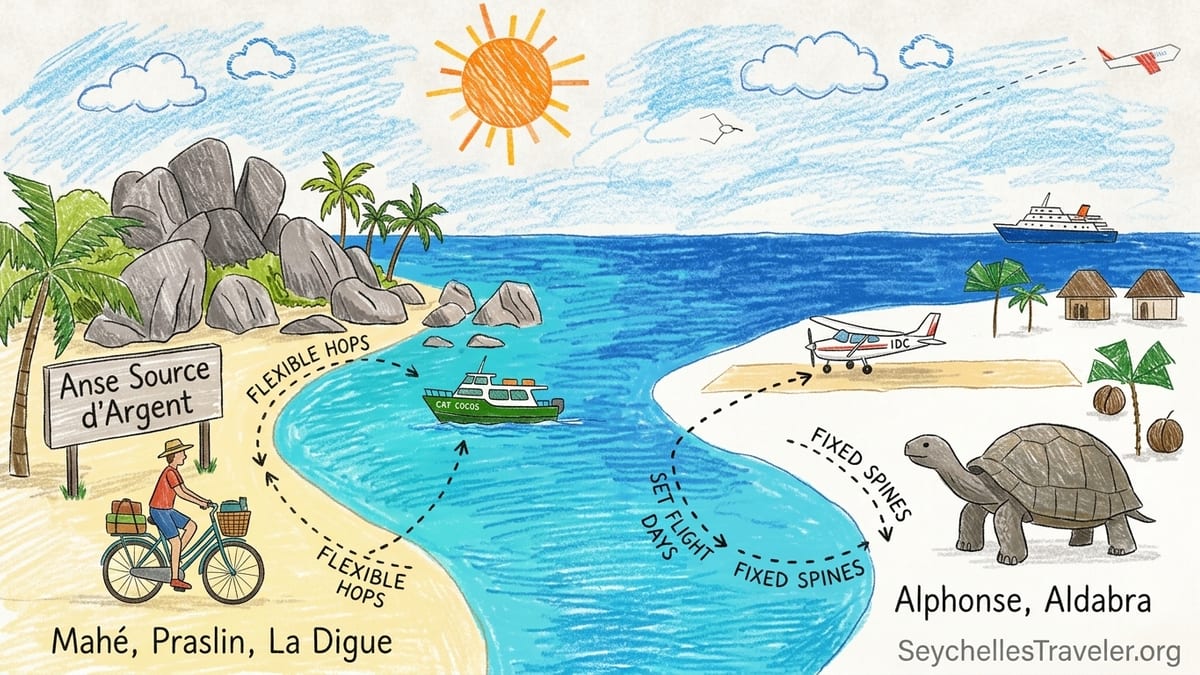
The result is that you cannot draw a neat circle on the map and imagine a loop like Mahé – Alphonse – Cosmoledo – Aldabra – Mahé in a week or ten days using routine public transport. Outer Islands itineraries are built around fixed charter flights and multi-day liveaboards, not flexible hop-on, hop-off ferries. Any plan that shows you casually stepping off one atoll onto another the next morning is almost certainly fictional.
Seven Days: Choosing Between Inner Islands or One Outer Island Focus
With only seven days in Seychelles, most travelers need to choose between a classic Inner Islands holiday or a focused Outer Island stay with Mahé as a staging point. Trying to do both usually leaves you counting hours instead of sunsets. In my own planning, I tested a series of seven-night models and found that the only ones that made sense involved either staying entirely on Mahé, Praslin and La Digue, or centering the week on Alphonse and sacrificing the Inner Islands loop.
One realistic seven-night pattern is Mahé, Praslin and La Digue only. You fly into Mahé, spend three or four nights exploring the main island and nearby marine park islets such as St Anne or Moyenne on day trips, then move by ferry to either Praslin or La Digue for the remaining nights. This lets you adjust for wind and sea conditions, which can affect ferries in July and August, and gives you flexibility to react to rain showers at short notice. It also avoids the hard constraints of charter flights and minimum stays.
The second realistic seven-night pattern puts Alphonse or another reasonably accessible Outer Island at the heart of the trip, with Mahé playing a purely functional role. In practical terms you would fly into Mahé, overnight there, fly to Alphonse for the resort’s three-night minimum, then return to Mahé for two or three nights before flying home. On some flight patterns you might be able to keep the Mahé buffer nights down to one at each end, but you should not assume that your intercontinental carrier and the Alphonse charter will always line up neatly.
Because resort prices on Alphonse can easily run to several thousand euros for a three-night stay including flights from Mahé, travelers with one week to spare need to weigh whether that cost makes sense when they will see very little of the rest of Seychelles. For keen anglers or divers who are specifically targeting Alphonse’s flats and reefs, the answer may be yes. For first-time visitors who want palm-framed granite boulders and multiple islands, sticking to Mahé, Praslin and La Digue is usually the more rewarding seven-day plan.
Ten Days: Combining Inner Islands with a Short Outer Island Stay
With ten days, it becomes more realistic to weave a short Outer Island stay into a broader Seychelles itinerary, provided that you treat the remote segment as the fixed spine of the trip. This is roughly how I structured my own ten-day pattern: I started by confirming the outbound and return charter days to Alphonse, then dropped Mahé, La Digue and Praslin around those anchors like pieces of a puzzle.
A concrete example might look like this. Suppose the resort confirms a Friday charter from Mahé to Alphonse and a Monday return, and enforces a three-night minimum. You could land in Mahé on a Wednesday evening, sleep near the international airport, then take a morning ferry to La Digue via Praslin on Thursday. Two nights there gives you one full day to explore Anse Source d’Argent by bike. On Saturday morning you work your way back to Mahé, overnight there, then catch the Monday charter to Alphonse for three nights, returning Thursday and flying home on Friday after another Mahé buffer night.
This pattern is tight but workable because each segment respects the fixed elements. The Alphonse flights happen on set days, the Mahé buffers cushion your international connections, and your Inner Island hops fit in the gaps. You do not attempt to squeeze in an extra island just because a map makes it look close. If the resort tells you that flights only run, for example, on Tuesdays and Saturdays for your dates, then your Inner Island plan has to slide accordingly even if that means skipping one beach you were excited about.
Ten days is also the point where early-morning and late-evening arrivals or departures start to matter. If your long-haul flight lands in Mahé at 7:00 in the morning on a day that the outer-island charter leaves at 10:00, it is tempting to try to connect directly. In practice, many operators will advise against this, pointing to the risk of missed bags, minor aircraft delays or weather that can ground small planes more easily than widebody jets. A cautious ten-day itinerary will still keep at least one night in Mahé before and after the remote segment, even if the timetable looks perfect on paper.
Fourteen Days and Beyond: Room for Mahé, Inner Islands and an Atoll
Once you reach fourteen days on the ground, the Outer Islands begin to feel far more accessible. You can still only move on the days when flights or ships run, but you have enough slack to absorb delays, bad weather and the occasional changed departure without sacrificing everything else. This was the context for my own Outer Island trip: two weeks in Seychelles, with the Alphonse segment stitched into the middle and the Inner Islands acting as bookends.
One way to picture a two-week trip is to divide it into three blocks of roughly four or five nights. You might spend the first four nights on Mahé, renting a car to explore the coastline at your own pace and taking a day trip to Sainte Anne Marine National Park. The next four or five nights might be your outer-atoll window: three nights on Alphonse plus a night in Mahé before and after. The final four or five nights can then be dedicated to Praslin and La Digue, traveling by ferry once the outer-island segment is done and dusted.
This structure gives you essential flexibility. If the outbound Alphonse charter is delayed by a day due to weather, you can spend the unexpected extra night on Mahé and still keep your La Digue and Praslin ferries later in the trip. If the return flight from Alphonse comes back on schedule but sea conditions are rough, you can push your Inner Island ferry by a day without missing your international flight home. With only ten days or less, you may not have that luxury.
Aldabra and the far western atolls normally require even more time. Liveaboard itineraries that include Aldabra, Cosmoledo or Astove are frequently scheduled for ten to fourteen days just for the boat segment itself. Operators and independent guides point out that a realistic minimum for an Aldabra-focused charter can be around two weeks in the islands overall once you include sailing days from and back to Mahé or another embarkation port. Add in at least one buffer night before and after the cruise, and your total time commitment quickly approaches three weeks if you also want Mahé or Praslin time on land.
Flight Days, Minimum Stays and Why Your Calendar Must Bend
The biggest single difference between planning an Inner Islands hop and an Outer Island extension is that you do not get to choose your days freely. Outer Island resorts and liveaboards tell you which days are possible. Your job is to work around that. Alphonse is a classic example. The small airstrip can handle only limited traffic, and resort descriptions today show packages built around specific charter days from Mahé, particularly in the main October to April season when there is typically one scheduled flight per week.
Those charters usually bundle the cost of the flight into the resort package and apply a minimum stay. Pricing examples from specialist agencies list a three-night minimum for most dates, rising to seven nights around Christmas and New Year. That means you cannot fly in for one romantic night on Alphonse after a week on La Digue and then ferry back to Praslin the next morning. The minimum stay alone forces you to carve at least three days out of your schedule, and the fixed flight day controls exactly when those days fall.
Aldabra magnifies this pattern. There is no resort air shuttle at all. Instead, small expedition ships and dive liveaboards publish a handful of departures each season, each with its own routing and duration. An Aldabra cruise might, for instance, sail from Mahé or another island, spend one or two days in transit, then anchor near the research station on Picard Island while Seychelles Islands Foundation staff guide you ashore. The atoll’s tourism information explains that because of the distance involved and the need to coordinate with tides, visitors should plan several days for any visit and expect that plans can change at short notice.
All of this means that you should open your calendar for the entire trip and treat the Outer Island segment as if it were an immovable business meeting. Once you know that the Alphonse charter you want leaves on a Friday and returns Monday, or that the Aldabra liveaboard you are eyeing departs on a particular Wednesday, you can begin filling in Mahé, Praslin and La Digue around those dates. If the dates do not marry up with your holiday allowance, it may be better to postpone the Outer Islands to a future trip rather than compromise both experiences.
Weather, Baggage and What Happens When Plans Change
Outer Island itineraries come with more weather and baggage sensitivity than a simple week on Mahé. The Seychelles dry trade-wind season from roughly May to September brings cooler air and generally calmer temperatures, but can also mean stronger winds and rougher seas in exposed channels. In the wetter period from about November to March, cyclonic systems further afield can send long swells and unsettled weather even when skies above you look benign. Resort operators on atolls such as Alphonse build these patterns into their typical operating months and may, for example, run more flights between October and April when sea conditions are friendlier for fishing and diving.
Baggage allowances are another practical constraint. Inter-island carriers serving routes like Mahé to Alphonse typically operate small aircraft with stricter weight limits than long-haul airlines. While exact allowances vary by operator and contract, it is common to see checked baggage limits significantly below what your international ticket allowed you to carry. National carriers publish general baggage rules that show, for example, 7 kilograms of standard cabin baggage and varying checked allowances by fare, and resort documents often warn guests that heavy camera gear or dive equipment may need to be pre-declared or sent as cargo.
Because of these limits, I packed my Outer Island segment as though I were going on a bush plane in East Africa. Large wheeled suitcases stayed in storage on Mahé, with the resort helping to arrange secure left luggage near the international airport. I flew out with a soft duffel bag, a small camera kit and essentials only. For a seven or ten-day trip that mixes Inner and Outer Islands, it makes sense to plan your wardrobe and gear in two layers: one light kit for the charter flights, and a slightly larger set you use only on Mahé and the Inner Islands.
Unplanned changes are not theoretical. Small aircraft can be grounded for visibility, crosswinds or runway issues that barely affect jetliners. Liveaboards heading for Aldabra may need to adjust their sailing schedule for swell, sometimes shifting a landing by a tide cycle or more. A solid itinerary has explicit Plan B options: an extra hotel night on Mahé near the airport; flexible Inner Island bookings that can be shifted a day earlier or later; travel insurance and airline tickets that can absorb a minor date change without exorbitant penalties. When I planned my own Alphonse trip, I treated my final Mahé buffer night as non-negotiable even though the schedule suggested that I could have caught my European connection the same evening.
Why Aldabra Planning Sits on a Different Scale
Aldabra occupies a unique place in Seychelles travel. It is both a UNESCO World Heritage Site and a super-remote atoll managed for research and conservation first, tourism a distant second. The Seychelles Islands Foundation, which runs the atoll, notes that access is tightly controlled and that SIF itself does not organize tourist visits. Instead, visitors typically arrive on liveaboard vessels or small cruise ships that have obtained permits and arranged for SIF staff to guide landings.
Official and operator guidance emphasizes that Aldabra is not a simple excursion from Mahé. The atoll lies more than a thousand kilometers from the main Inner Islands, and reaching it usually involves at least a couple of days of sailing each way. Tourism material aimed at prospective visitors stresses that it is advisable to allow several days to visit the atoll properly, both to appreciate its wildlife and to accommodate the long passages and potential weather delays. In other words, even the shortest serious itineraries to Aldabra are on a different scale from a three-night resort stay on Alphonse.
Cost also reflects that scale. Recent surveys of expedition offerings that include Aldabra, Assumption and neighboring atolls suggest per-person package prices in the low to mid five-figure US dollar range for ten to fourteen-day voyages, depending on vessel, cabin category and season. On top of that sit conservation impact fees payable to SIF, which are typically calculated per person per day to support the atoll’s management and research activities. When you add international flights to Mahé and overnight stays before and after the cruise, the total budget quickly eclipses that of even a generous two-week Inner Islands holiday staying in upscale guesthouses.
For most travelers, that makes Aldabra a once-in-a-lifetime project rather than an add-on to a first Seychelles trip. It rewards those who can dedicate two or three weeks and a significant budget, and who are comfortable with a very different style of travel: extended time at sea, rigid permit conditions, limited landing sites and strict rules on where you can walk, when and with whom. Treating it as simply “another island” to be folded into a standard Mahé, Praslin and La Digue loop is likely to end in frustration or unrealistic expectations.
The Takeaway: When an Outer Island Extension Really Helps
After bending my own itinerary around Alphonse and spending time digging through the realities of Aldabra logistics, I have come to a simple rule of thumb. An Outer Islands extension improves a Seychelles trip when it matches a clear priority and you can give it enough time, money and flexibility to respect its constraints. It makes the trip worse when it is squeezed into too few days, forces you to chase connections and leaves you anxious about missed flights or blown budgets.
For seven days on the ground, I now advise friends to choose. Either commit to an Outer Island such as Alphonse, accept that Mahé will be little more than a staging ground and budget for a premium resort package, or embrace the Inner Islands and enjoy Mahé, Praslin and La Digue without looking longingly at distant atolls. Trying to split the difference usually shortchanges both sides. You rush through Mahé, barely see Praslin, and still end up watching the clock on your remote island instead of settling into its rhythms.
With ten days, a three-night Alphonse stay plus a modest Inner Islands component can work well, as long as you are disciplined about buffer nights and realistic about how much you can cover. You set the Outer Island charter dates first, then drop Mahé, Praslin or La Digue into the spaces around them. If the puzzle pieces do not fit without forcing brutal early mornings or eliminating recovery time after long flights, that is usually a sign to postpone the remote segment or extend the trip.
Once you reach fourteen days or more, the picture changes dramatically. You have room for a genuine Mahé experience, several days across Praslin and La Digue and a three or even four-night Outer Island stay, plus the essential buffer nights to absorb small disruptions. At two to three weeks and with a high budget, Aldabra comes into view as a serious possibility, not because the logistics become easy, but because you finally have enough time and resources to treat it on its own terms.
FAQ
Q1. Can I visit Alphonse Island as a day trip from Mahé?
In practice, no. Access to Alphonse relies on limited charter flights linked to resort stays, and current packages are built around a minimum of three nights on the island. There are no routine daily shuttles that would allow a simple there-and-back excursion in one day.
Q2. How many days do I realistically need for Aldabra?
You should think in terms of several days just for the Aldabra segment itself, typically within a ten to fourteen-day liveaboard itinerary that also covers sailing time to and from the atoll. Once you add buffer nights on Mahé and any Inner Island time, the total usually approaches two to three weeks.
Q3. Is seven days enough to combine Mahé, Praslin, La Digue and an Outer Island?
Seven days is usually too short to do all of that without turning the trip into a race. Most travelers will either spend the week entirely among the Inner Islands or make one Outer Island such as Alphonse the centerpiece, using Mahé only as a staging point before and after the charter flights.
Q4. How strict are baggage limits on Outer Island flights?
Flights to remote airstrips typically use small aircraft with stricter baggage weights than long-haul airlines. Exact allowances depend on the operator and contract, but you should plan for lighter checked bags and smaller cabin items, and consider leaving heavy or non-essential luggage in secure storage on Mahé during the Outer Island segment.
Q5. Do I need buffer nights in Mahé before and after an Outer Island stay?
Yes, at least one night before and one night after are strongly recommended. Weather, technical issues or schedule changes can disrupt small-plane flights or liveaboards more easily than major international services, and buffer nights help protect your long-haul connections from knock-on delays.
Q6. What happens if my Outer Island flight is delayed or canceled?
If a charter flight to or from an island like Alphonse is delayed, the resort and operator will usually re-accommodate you on Mahé or extend or shorten your island stay as conditions allow. This can cascade into changes for ferries or hotel nights on the Inner Islands, which is why flexible bookings and travel insurance are important.
Q7. Is it worth paying Outer Island prices if I mainly want beaches and relaxation?
If your priority is simply beautiful beaches and a relaxed pace, you may find that Mahé, Praslin and La Digue already deliver everything you want at a lower overall cost. Outer Islands such as Alphonse or Aldabra make more sense when you specifically value their remoteness, specialist diving, fishing or wildlife, and are prepared for higher prices and more complex logistics.
Q8. How far in advance should I book an Aldabra trip?
Aldabra departures are limited, subject to strict permits and often sell out early, so planning a year or more in advance is common. This lead time allows operators to secure permissions, coordinate with the Seychelles Islands Foundation and confirm ship schedules around tides and weather windows.
Q9. Can I add Cosmoledo or Astove to a standard Alphonse holiday?
Not casually. While some liveaboards and specialist expeditions combine Alphonse, Cosmoledo and Astove in one itinerary, this is usually organized as a dedicated multi-day charter rather than a bolt-on to a typical resort package. Combining them usually demands more time and budget than a short Alphonse stay alone.
Q10. How do I decide if an Outer Island extension is right for my trip?
Start with your total days and budget, then ask whether you are willing to build the whole itinerary around a fixed Outer Island segment and accept higher costs, stricter schedules and potential weather disruptions. If the answer is yes and you have at least ten to fourteen days, an Outer Island can elevate your Seychelles trip. If not, focusing on the Inner Islands will usually deliver a richer and more relaxed experience.