


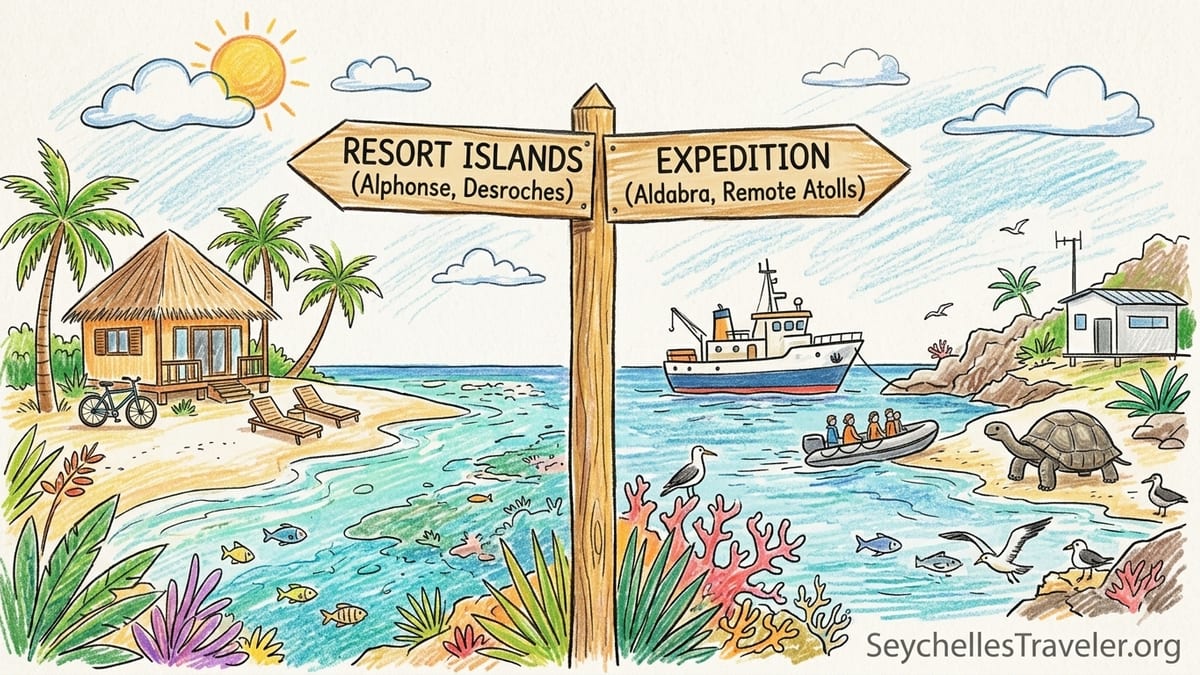
On my last trip to the Seychelles I had to make one of the most consequential choices of the whole journey: should I base myself on a private resort island in the Outer Islands, or join an expedition vessel heading into the far reaches around Aldabra? This was not a simple matter of picking a nice beach or a handy neighborhood on Mahé. Out here, your accommodation is your entire world. In the end, I chose a resort stay on Alphonse Island first, followed by a shorter, ship-based expedition that included Aldabra. Experiencing both back-to-back made it very clear that where you sleep in the Outer Islands will define what you see, how you move, what you eat, and even how you cope when the weather refuses to cooperate.
Why Outer Islands Accommodation Is a Completely Different Decision
The Seychelles tourism board’s updated overview in August 2026 makes one thing very clear: when it comes to the Outer Islands, Alphonse and Desroches are currently the only two islands with established visitor accommodation. Everything else, including dream names like Aldabra, remains substantially less developed, with no conventional hotels or guesthouses at all. This is the opposite of choosing between areas like Beau Vallon, Eden Island or Anse Royale on Mahé, where you can treat your hotel as just one part of a larger network of beaches, restaurants and day trips.
In the Outer Islands, there is no such network. On Alphonse, the lodge and villas are the island. On Desroches, the resort effectively is the settlement. On Aldabra, the Seychelles Islands Foundation confirms that there is no tourist accommodation, only a scientific research station for staff, and visitors must arrange ship-based lodging on the vessel that brings them. Your room choice is also your transport strategy, dining plan, and activity schedule wrapped into one.
This is why I decided to split my time. I wanted the comfort, air-conditioning and easy logistics of a resort island for part of the trip, and the raw immersion of a small expedition vessel to reach Aldabra, where landings are tightly regulated and visitors are guided at all times. Seeing both sides highlighted just how much your base dictates not only your comfort level, but what you can realistically do in a week.
For anyone planning their first Outer Islands foray, it helps to think less in terms of “which hotel” and more in terms of “which way of traveling.” You are essentially deciding between a self-contained resort island experience, and a mobile, expedition-style trip that uses a boat as a floating lodge. Each comes with specific trade-offs in comfort, cost control, flexibility and access.
Alphonse Island: A Resort That Feels Like a Tiny Village
I started on Alphonse, part of the Alphonse Group about 400 kilometers southwest of Mahé. Tourism Seychelles describes the Outer Islands as places where an overnight stay is essential, and Alphonse illustrates that perfectly. Once you board the domestic flight on Mahé, usually organized by the island’s operator, you are effectively committing to live within a small, coral atoll community where everything is within cycling distance.
Accommodation here centers on beach bungalows and villas arranged along the eastern shore. My bungalow came with proper air-conditioning, a large ceiling fan, plenty of charging points for cameras and dive computers, and a shaded veranda that looked onto the sand. Wi-Fi reached the room, good enough for messages and occasional photo uploads, so it never felt completely cut off. Housekeeping ran a daily service, with optional laundry that could be added to the package or paid per bag, something worth clarifying when you book because longer stays can generate a lot of salty, sandy clothing.
The island runs on a full-board model for leisure guests, with some fishing and specialist packages adding even more. My nightly rate included three meals at the central restaurant, drinking water, coffee and tea, and a selection of non-motorized activities. Considering there is nowhere else to eat on Alphonse, this did not feel restrictive so much as logical. Dinner buffets mixed grills, Creole curries and salads with occasional themed nights, and the bar offered cocktails and wine by the glass. Alcohol, unless clearly included on specific packages, is usually extra, so you will want to budget realistically if sundowners are part of the dream.
What makes Alphonse feel like more than just a resort is its activity infrastructure. The same team that runs the dive center arranges snorkeling, guided nature walks, turtle and birdwatching, and lagoon excursions. Bicycles are issued to guests and quickly become your main transport on the sandy roads. Kayaks and stand-up paddleboards are on the beach. Boat trips to nearby St François atoll take you into stingray-filled flats and turtle-rich channels. When a windy front canceled one of my snorkeling outings, the staff immediately rebooked it for the following morning and suggested a mangrove paddle instead. Because all operations are in-house, weather disruptions are handled with an eye to filling your time rather than simply canceling and refunding.
Living with Full Board and Island Logistics on Alphonse
The full-board pricing on Alphonse may look steep when you first see it in US dollars, particularly once you add domestic flights from Mahé. In practice, being on a small island with no restaurants, shops or independent tour desks means that an inclusive structure actually protects you from cost creep. I rarely saw a bill during my stay except when adding a spa treatment or a bottle of wine. Filtered water was available in large dispensers, encouraging refills rather than plastic bottles, and soft drinks with meals were reasonably priced given the remoteness.
Transfers are a crucial part of the Alphonse equation. Packages normally include the return domestic flight and boat transfers where needed, and you will be given strict baggage limits, often around 20 kilograms plus hand luggage, due to the aircraft size. In my case the same ground team that met me on Mahé checked my bags straight through to the island plane and handled the return check-in as well. When a brief rain squall delayed departure by an hour, guests simply waited in the lounge and arrival times on Alphonse were adjusted accordingly. It felt less like a commercial airline delay and more like a community charter operating around the weather.
Another underappreciated detail is how much island operations take care of the small frictions. Laundry is available, which makes packing lighter easier. Wi-Fi is centralized but functional. Air-conditioning runs reliably on solar-supported power. The activity team keeps a constant eye on tides and conditions, adjusting dive sites and sandbank picnics as needed. When tides were too low for boats to cross certain channels, the plan changed to shoreline walks where we watched nurse sharks and rays in the shallows instead of trying to push an unrealistic schedule.
This level of coordination is what you give up if you try to assemble a completely independent stay in the Outer Islands, which at present is not really possible outside Alphonse and Desroches. For travelers who want clear pricing and predictable comfort, Alphonse’s model can feel less restrictive than liberating, provided you are happy to accept the island’s rhythm.
Desroches Island: High-End Resort Comfort at the Edge of the Map
Desroches, sitting in the Amirantes group, is the other Outer Island singled out by Tourism Seychelles as offering visitor accommodation. Here, the flagship property is a high-end resort that wraps nearly the entire island. The experience is more polished than Alphonse, but the underlying principle is the same: once you land on the private airstrip, the resort is your world.
My villa on Desroches looked like something out of a glossy magazine, with a private plunge pool, shaded deck, and direct access to the sand through a corridor of coastal vegetation. Inside, the room had powerful air-conditioning, ceiling fans, and floor-to-ceiling glass that could be opened at cooler times of day. The bathroom was semi-open with both indoor and outdoor showers, and there was ample wardrobe space for dive gear and formal resort wear. In-villa Wi-Fi was strong enough for video calls, although the real luxury here was being able to turn everything off and listen to the surf and cicadas instead.
The resort’s dining approach is slightly more flexible than Alphonse. Standard rates usually include breakfast, with half-board and occasionally all-inclusive options available. A press release from the resort notes that Desroches is among a small group of properties in the brand’s portfolio that can be booked with all-inclusive food and beverage, something many guests discuss when weighing up costs. Half-board, which added dinner at most of the restaurants, felt like a reasonable compromise for me since there are no independent eateries on the island but I did not need cocktails and wines bundled into a fixed daily rate.
Activities on Desroches include diving, snorkeling, guided cycling tours, wellness programs, and nature walks focused on its wildlife and turtle nesting. Bicycles were waiting at my villa on arrival, and they quickly became my preferred way to explore the palm groves and beaches dotted with hammocks and small recreation “shacks” offering masks, fins and kayaks. Boat trips head out to drop-offs and reefs around the island, and I joined a sunset cruise where we watched spinner dolphins bow-ride in the golden light. When trade-wind swell made the outer reef too stirred-up for snorkeling one morning, the dive center shifted guests to a calmer lagoon site and rescheduled more ambitious dives later in the week.
Although Desroches feels like an elevated, design-conscious resort, you are still dealing with a tiny community on a coral island. Everything that happens, from laundry and housekeeping to bar stock and dive cylinder fills, is part of a tightly managed logistics chain stretching back to Mahé. That reality explains the pricing, but it also means the resort is experienced at smoothing out disruptions. A brief power cut one evening had staff circulating with lanterns and updates within minutes, and the villas’ air-conditioning restarted automatically, preserving that crucial climate-controlled sleep in the tropics.
When Resort Islands Are the Right Choice
Based on my back-to-back stays, resort islands like Alphonse and Desroches suit travelers who want a contained, comfortable version of the Outer Islands: lots of sand and sea, plenty of activities, but with hotel-style structure. If your priority is a spacious villa with air-conditioning, a private plunge pool, curated dining, and on-demand laundry and Wi-Fi, then a resort island is the more natural fit. You wake up, look at the board of activities, and let the staff worry about tides, boat permits and fuel supplies.
Full-board or half-board pricing, which can initially seem eye-watering, begins to make sense on islands where there are no independent restaurants or grocery stores. You are effectively paying in advance for meals that would otherwise be marked up as room charges. On Alphonse, for example, three meals a day, water and coffee, and a rotation of included excursions created a rhythm where almost everything I wanted was available without constantly signing bills. On Desroches, half-board covered the main meals and left drinks and extras as a controllable variable.
Resort islands also reduce uncertainty about what happens when nature intervenes. In the changeable equatorial weather of the Seychelles, squalls can ground aircraft or shut down boat channels for hours. Both Alphonse and Desroches have clear procedures for delayed flights and canceled excursions. When my domestic flight to Desroches was pushed back due to a passing squall line, the resort simply shifted my spa appointment and dinner reservation, and the in-villa team adjusted turndown times accordingly. In a place where you cannot just “go into town” to kill time, that sort of in-house flexibility becomes a major advantage.
There are trade-offs. Outside the resort perimeter there is usually little in the way of local village life or independent businesses. If you crave interaction with everyday Seychelles, you are better off building time on Mahé, Praslin or La Digue into your itinerary. But for many visitors the resort islands provide the archetypal Outer Islands fantasy: cycling along palm-lined runways, snorkeling with turtles, and coming back to a cooled villa and multi-course dinner beneath a sky full of southern stars.
Aldabra and the Expedition Alternative: When Your Boat Is Your Lodge
At the other extreme sits Aldabra, the UNESCO World Heritage atoll that many consider the crown jewel of the Seychelles. The Seychelles Islands Foundation, which manages Aldabra, states plainly that it provides no tourist accommodation. There is a research station for scientists and staff, but no hotel or guesthouse. Anyone who wants to visit must do so by ship, either on a specialist expedition cruise or a private yacht with prior permission and permits.
I joined a small expedition vessel operating a loop that included Aldabra, Assumption and several other remote islets. Cabins were compact but air-conditioned, with ensuite bathrooms and daily housekeeping. There was no laundry service for guests on my particular sailing, though some longer itineraries on similar vessels offer pay-per-bag washing. Wi-Fi was extremely limited and only intermittently available via satellite, which meant the boat’s lounge library and top-deck stargazing became the evening entertainment. Meals were served family-style three times a day, with coffee, tea and water available throughout; soft drinks and alcohol could be purchased at the bar.
On an Aldabra expedition, your room is less important than the platform the boat provides. Zodiacs shuttled passengers ashore under strict SIF guidelines. Landings were tide-dependent and carefully timed so that we could cross giant tortoise trails, mangrove channels and bird colonies without causing damage. If wind or swell made one landing site unsafe, the expedition leader and SIF ranger worked together to choose another section of coast or shift the schedule. Sometimes that meant an afternoon kayaking the inner lagoon instead of a planned walk on the reef edge.
Because all guests and crew live on the same vessel, weather disruptions felt like part of a shared adventure rather than a service failure. When strong winds one day prevented any landing at all, the crew turned it into a ship-based natural history program, with lectures on coral ecology and a documentary screening in the lounge. The chef shifted to slower-cooked dishes suited to the swell. No one was marching to restaurant reservations or spa appointments; instead, the entire itinerary flexed around what the atoll and the ocean allowed.
There is no question that expedition-style trips demand more tolerance for discomfort and unpredictability. Cabins are smaller than resort villas, and ship stabilizers cannot erase all motion. You must accept luggage restrictions on domestic flights and tender transfers, and you will almost certainly go days with only patchy connectivity. But in return you gain access to islands like Aldabra that simply cannot be experienced from a resort base, and you share the trip with fellow travelers who have actively chosen this rugged, conservation-focused way of visiting.
How Inclusions, Activities and Weather Shape Your Decision
Comparing my days on Alphonse and Desroches with those on the expedition vessel highlighted three practical dimensions that should guide any Outer Islands accommodation choice: inclusions, activities, and weather flexibility. First, inclusions. On the resort islands, full-board or half-board packages clearly list what is covered. It is usually room, meals, some non-motorized activities, and sometimes scheduled group outings such as reef snorkeling. Alcohol, spa treatments, specialist diving and private boat charters tend to be extra. On the ship, the fare wrapped almost everything into one number: cabin, meals, zodiac excursions, briefings and most landings, with only bar drinks and optional tips standing apart.
Second, activities. On Alphonse and Desroches, the activity menu includes nature walks, snorkeling, diving, cycling, and sometimes fishing, all from a fixed base. You return to the same bed each night and gradually build an intimate portrait of one island and its surrounding reefs. On the expedition vessel, each day brings a different lagoon, sandbar or reef, at the cost of repeating pre-landing briefings and sterilizing shoes to meet biosecurity rules. Instead of developing a deep familiarity with one island, you collect a series of intense snapshots across a whole region.
Third, weather. Resorts can usually shuffle indoor and outdoor options and reschedule boat-based activities for later in your stay. If the sea is rough one day, you might join a cooking class, spa treatment or yoga session instead. On the expedition leg, the captain and expedition leader had to think in terms of entire routes. If bad weather threatened, they altered the course, sometimes reversing the order of island visits or skipping the most exposed atoll on safety grounds. Guests needed to accept that not every advertised landing was guaranteed. What you gain is a team deeply experienced in reading forecasts and local conditions, and a ship able to move away from poor weather faster than a fixed resort.
When you overlay those three factors with your own priorities, the decision becomes clearer. If you value a predictable structure, longer showers, and stable power and Wi-Fi, then Alphonse or Desroches on a board basis that fits your budget is likely the right call. If you are driven by the idea of reaching Aldabra and its giant tortoises, and are willing to trade space and connectivity for that access, then a ship-based expedition is the only realistic way to do it.
The Takeaway
Choosing where to stay in the Outer Islands of Seychelles is not like deciding between two coastal towns or a pair of resorts on Mahé. With Alphonse and Desroches currently standing as the main islands offering visitor accommodation, the rest of the Outer Islands remain a realm where you sleep either in a cabin on a ship or not at all. That underlying geography and infrastructure mean your accommodation choice is, in effect, your trip choice.
If you can picture yourself happiest cycling along palm-fringed tracks to a cooled villa, stepping into a structured program of dives, snorkels and guided walks, and sitting down each evening to full-board meals without ever seeing a bill, then a resort island such as Alphonse or Desroches will feel like the ultimate castaway indulgence. The full-board or half-board pricing that seems high on paper begins to look like sensible simplicity once you realize there is nowhere else to eat or shop.
On the other hand, if your dream involves standing on Aldabra’s fossilized reef with giant tortoises shuffling past, exploring mangrove channels and remote sandbars under strict conservation rules, and sharing the rhythm of the voyage with a small community of fellow travelers and crew, then a specialist expedition is the way forward. You will trade villa space and stable Wi-Fi for the ability to wake up in a different lagoon every morning, guided by teams who work year after year under the Seychelles Islands Foundation’s regulations.
In my own case, starting with Alphonse gave me a gentle, luxurious immersion and time to reset to island speed. Following that with a shorter expedition to Aldabra meant I arrived onboard already in tune with the climate and the ocean, ready for dawn zodiac rides and erratic satellite signals. If your budget and time allow, that combination offers the best of both worlds. If you must choose one, be honest about your comfort thresholds, your appetite for unpredictability, and how central Aldabra itself is to your dream. In the Outer Islands, more than almost anywhere else, your bed decides your story.
FAQ
Q1. Can I visit the Outer Islands of Seychelles on day trips from Mahé?
Day trips are practical to some inner islands, but the true Outer Islands such as Alphonse and Desroches require at least an overnight stay due to distance and flight schedules.
Q2. Are there any budget accommodation options in the Outer Islands?
There are currently no guesthouses or hostels in the main Outer Islands that accept visitors. Accommodation is limited to higher-end lodges and resort villas or cabins on expedition vessels.
Q3. Do I need to book full board on Alphonse or Desroches?
On Alphonse, full board is effectively standard because there are no independent restaurants. On Desroches you can often choose between breakfast-only, half-board or all-inclusive packages depending on how much you plan to eat and drink on-site.
Q4. Is there Wi-Fi in the Outer Islands?
Resort islands like Alphonse and Desroches provide Wi-Fi in public areas and villas, good enough for emails and basic browsing. Expedition vessels usually have limited or pay-per-use satellite connections that are more suitable for short messages than heavy use.
Q5. How are transfers to Alphonse and Desroches arranged?
Transfers are typically organized by the lodge or resort and involve domestic flights from Mahé on scheduled or chartered services. These are often bundled into package prices, with baggage limits that guests must respect due to aircraft size.
Q6. Can I stay overnight on Aldabra itself?
No. The Seychelles Islands Foundation does not provide tourist accommodation on Aldabra. Visitors stay on expedition ships or yachts and make guided landings during the day under strict regulations.
Q7. What happens if bad weather cancels my planned activities?
On resort islands, staff usually reschedule boat-based excursions and offer alternative activities like lagoon snorkeling, cycling or spa treatments. On expeditions, the captain and expedition leader may reroute the ship or adjust the landing schedule, potentially skipping some sites for safety.
Q8. Is air-conditioning standard in Outer Islands accommodation?
High-end resorts on Alphonse and Desroches offer air-conditioned villas and bungalows. Expedition ships usually have air-conditioned cabins, although power management can vary, especially on smaller vessels.
Q9. Are meals on ships as varied as on the resort islands?
Shipboard meals are hearty and communal, with set menus and buffets rather than multiple restaurant choices. Resort islands offer more varied dining with separate venues, à la carte options and themed nights, though all food is still limited by what can be brought in.
Q10. Who should choose a resort island and who should choose an expedition?
Resort islands suit travelers who prioritize comfort, space, structured activities and stable services. Expeditions suit those focused on reaching remote atolls like Aldabra, comfortable with smaller cabins, limited Wi-Fi and flexible itineraries shaped by weather and conservation rules.