


The outer coral islands of Seychelles offer some of the Indian Ocean’s most atmospheric underwater experiences, from gentle lagoon snorkelling off a beach villa to advanced wall dives on remote atolls several hundred kilometres from Mahé. Choosing between Denis, Desroches, Alphonse and the far-flung atolls is less about which reef is “best” and more about matching conditions, logistics and your skills to the right island. This guide sets out what is currently available to visitors, how the environments differ, and what to expect both in the water and in your wallet.
Understanding Seychelles Coral Islands and Atolls
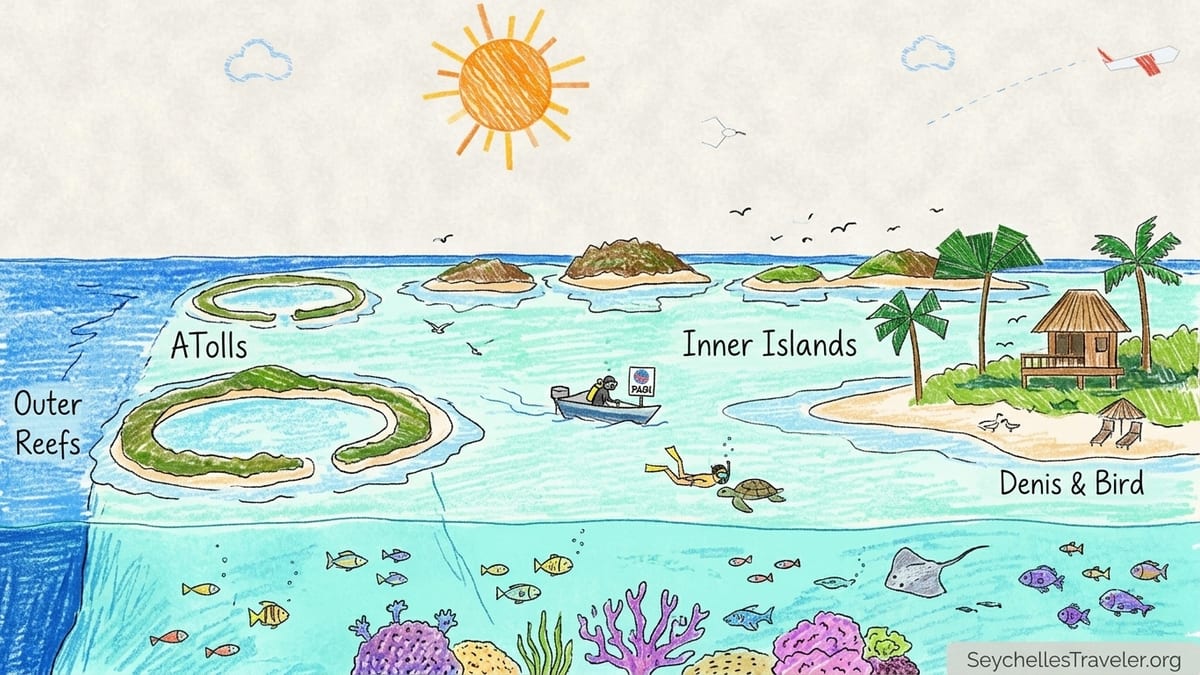
Unlike the famous granitic islands of Mahé and La Digue, the coral islands of Seychelles sit on low-lying limestone or reef platforms, often surrounded by shallow lagoons and steep outer walls that drop quickly into the Indian Ocean. Bird and Denis mark the northern edge of the Seychelles Bank. Denis lies about 60 kilometres north of Mahé on a shallow coral platform, with its lagoon and adjacent reef forming part of the continental shelf edge, which then falls away into deep water. Bird Island occupies a similar position on the same bank, again with shallow reef flats close to shore but deep water within relatively short boat range.
Further south and west are the truly remote atoll groups. Desroches is part of the Amirantes, a long, narrow sand cay ringed by fringing reef and dramatic drop-offs known collectively as the Desroches Drop, where the shallow reef rim meets ocean depths. Even more isolated are the Alphonse Group and the distant atolls of Astove, Farquhar and Cosmoledo. These are classic ring-shaped atolls with inner lagoons, passes and steep outer walls, often closer to deep pelagic waters than to any other inhabited island. Reaching them requires dedicated flights and liveaboard-style resort logistics.
For visitors, this geography matters. Islands on the Seychelles Bank, such as Denis and Bird, lend themselves to shorter, less expensive stays that still offer good snorkelling and boat diving, while outer atolls like Alphonse or Farquhar feel like mini expeditions. There is no shore diving culture comparable to some other destinations; almost all scuba diving here is boat-based, and outer-atoll operations are tightly organised around tides, currents and safety in a very remote setting.
The legal and conservation framework is also strict. Some of the outer atolls that divers may read about in fishing magazines or older trip reports are within protected areas or have restricted access. Visitor activities are generally limited to operations that have formal agreements with government and conservation partners, so the practical question becomes not only “where is the reef?” but “where is a resort and dive operator currently authorised to take guests?”
Weather, Monsoons and When to Dive
Diving and snorkelling conditions around Seychelles are strongly influenced by monsoonal winds rather than dramatic temperature swings. The Seychelles Meteorological Authority and government climate guides describe two main wind regimes. From roughly mid November to mid March, the northwest monsoon brings warmer, more humid weather with lighter, variable winds but also a higher chance of heavy showers. From late May to October, the southeast trade winds dominate, bringing cooler, drier air and stronger, more persistent winds that can create choppier seas, particularly in July and August.
Between these phases, usually in April and again in October to early November, lie calmer inter monsoon periods. Official climate guides describe April as a month of light and variable winds with especially pleasant sea conditions, and similar language is used for the October transition. These shoulder periods often provide some of the best underwater visibility, because surface chop is limited and sediment tends to settle. At the same time, heat and humidity can feel intense on land, especially in April, so many divers plan early-morning dives and spend midday hours in the shade.
On the islands themselves, these seasonal patterns translate into practical considerations. On Desroches and Alphonse, the southeast trades can bring strong cross-winds and swell onto certain reef edges, limiting access to some outer wall sites or making long skiff rides uncomfortable, while sheltered sides of the islands may remain suitable for lagoon snorkelling. During the northwest monsoon, lagoons on west-facing shores can be clearer and calmer, but long wet spells and thunderstorms can affect flight schedules to and from the outer islands. Operators adjust daily, using marine forecasts from the Seychelles Meteorological Authority and local experience to decide whether to run outer-atoll trips, shift to leeward reefs, or keep activities inside lagoons.
For planning purposes, many dive travellers target March to early May and late September to November for a balance of manageable seas and good visibility. However, conditions increasingly vary year to year, and even within a week in October you might see everything from glassy calm days to several days of heavy rain and gusty winds. Anyone booking a dedicated outer-atoll diving trip should accept a degree of weather risk and allow contingency days, especially if they want to attempt specific sites like deep passes or distant seamounts.
Resort-Based Diving on Denis, Bird and Desroches
Denis and Bird represent the more accessible end of Seychelles coral-island experiences. Denis Private Island operates as a single-resort island, and while detailed, publicly listed dive price sheets are less common than for some larger brands, the resort has historically offered guided boat dives on nearby reefs and along the shelf edge, together with house-reef snorkelling directly in front of the main beach. Independent snorkelling guides highlight a house reef just off the main resort area as the best spot, accessible from the beach at high tide, with patch reefs and bommies in swimmable depths. Visitors have reported seeing reef fish, occasional reef sharks, turtles and skunk clownfish here, always as possibilities rather than certainties.
Bird Island, while primarily marketed for birdwatching and beaches, similarly offers lagoon and reef-edge snorkelling. The reef flat is tidal and can be very shallow at low tide, making timing crucial to avoid contact with coral. Both Denis and Bird rely on simple, small-scale marine activities rather than high-volume dive centres. Equipment quality and availability can change as management and supply chains evolve, so guests who are particular about their mask or fins frequently bring their own, renting only heavier items such as buoyancy compensators and regulators if diving is offered during their stay.
Desroches sits further along the spectrum toward a fully developed resort-based dive destination. The Four Seasons Resort Desroches Island works with the Blue Safari team to operate a PADI dive centre with around 18 named dive sites in the surrounding area, including caves, canyons and walls along the Desroches Drop. Current published tariffs from the resort list single-boat dives at about 180 euros, double-tank trips around 280 euros, with 5-dive packages around 700 euros and 10-dive packages around 1,300 euros, including standard equipment. Entry-level experiences such as “Bubble Maker” for children, refreshers and Discover Scuba Diving typically range from roughly 140 to 250 euros, while full Open Water, Advanced and Rescue Diver courses sit in the mid to high hundreds of euros.
At Desroches, certified divers usually join small-group boat dives guided by PADI professionals, following depth and time limits agreed during the briefing. Many sites along the Desroches Drop start on a reef top between roughly 12 and 18 metres, before falling away much deeper. Guides may keep groups on the upper portion of the wall or along adjacent plateaus, often with a maximum depth in the 25 to 30 metre range for Advanced Open Water divers, and shallower for those with basic Open Water certification. Stronger currents and blue-water conditions sometimes occur on the outer wall, so comfortable buoyancy control and previous boat-diving experience are recommended.
Alphonse and St François: Outer-Atoll Adventures
Alphonse Island offers an interesting mid-point between a resort holiday and a remote atoll expedition. The island operates as a dedicated lodge with its own PADI dive centre, Blue Safari Alphonse, which also supports activities at several other outer islands under the same brand. The dive centre on Alphonse provides maintained rental equipment, purpose-built dive boats and add-ons such as camera gear rental for underwater photographers. Divers staying on Alphonse can explore the fringing reef around the island itself, with a mix of gentle coral slopes and small walls, as well as join excursions into the adjacent St François atoll when marine-park regulations and weather conditions allow.
St François lies only a short boat ride from Alphonse, across a shallow channel. Conservation management is handled through partnerships such as the Island Conservation Society and the island’s own foundation, and current visitor access focuses on low-impact, guided activities like fly-fishing on the flats, sandbank walks, birding and tightly controlled snorkelling sessions. Among the memorable experiences are guided shallow-lagoon snorkels on the inner flats, where guests drift or wade in waist-deep water over seagrass beds and patch reefs under ranger supervision. Because the atoll has strong tidal currents, operators choose specific windows when flows are manageable and visibility is acceptable.
On the outer walls of Alphonse and, in some cases, passes connected to St François, divers encounter more challenging conditions. Drift dives along the outer reef typically follow the prevailing current, with the boat deploying divers up-current and picking them up down-current. Depending on the season, currents can be strong and surface chop significant, and at times operators may restrict such dives to those with at least Advanced Open Water certification and a minimum logbook record of recent dives. While marketing images often show dense shoals of fish and charismatic megafauna, guides are careful to describe turtles, rays, reef sharks or pelagics only as possible encounters, never guaranteed sightings on a given dive.
Pricing on Alphonse is generally in line with high-end Indian Ocean dive resorts. While specific current figures for individual dives can vary from season to season, guests should budget for multi-dive packages in a similar ballpark to Desroches or higher, particularly when factoring in the cost of charter flights from Mahé to Alphonse and the all-inclusive lodge model. Trips into St François for snorkelling or combined snorkel and sandbank excursions are often sold as half- or full-day experiences including guiding, safety boat, basic equipment and refreshments, sometimes bundled into stay packages rather than itemised individually.
Remote Expeditions: Astove, Farquhar and Cosmoledo
Astove, Farquhar and Cosmoledo represent the outer edge of Seychelles diving travel, both geographically and in terms of commitment required. These atolls sit many hundreds of kilometres from Mahé, reachable only by scheduled charter flights and dedicated vessels arranged by specialist operators. Various fishing-focused lodges and expeditions have operated on these atolls in recent years, sometimes in partnership with the same brands that run Alphonse and Desroches, but access has fluctuated with cyclone damage, conservation decisions and infrastructure projects.
As of late 2026, visitors can generally only access Astove, Farquhar and Cosmoledo on tightly defined seasonal packages that combine fly-fishing, limited diving and snorkelling, and conservation levies. Individual, ad hoc day trips for casual snorkellers are not available. When diving is offered, the style is fully expeditionary: long days on small boats, very limited medical infrastructure, and dives on steep outer walls exposed to oceanic swell and strong currents. Operators typically require at least Advanced Open Water certification, valid dive insurance and evidence of recent dives in similar conditions. Depths, while manageable, often edge toward the 25 to 30 metre mark on the most interesting terraces, with blue water dropping to hundreds of metres just beyond.
Given the isolation, emergency evacuation from these atolls can involve multiple aircraft legs and long flight times, especially in poor weather. This significantly raises the bar for participant suitability. These trips are poorly suited to beginners, infrequent holiday divers or anyone who is not comfortable managing their buoyancy and gas use in moving water. Non-divers who join fishing packages might enjoy beach walks and shallow, guide-led lagoon snorkelling when conditions are calm, but operators tend to err on the side of caution. In some cases, conservation zoning or temporary closures after storm events can further restrict in-water activities, so travellers considering these atolls should seek the latest written confirmation from the operator on what is currently permitted during their intended season.
Costs for remote atolls are among the highest in Seychelles marine tourism. While public price lists shift year by year, week-long expedition packages can easily reach figures comparable to or exceeding top-level liveaboards in the Red Sea or Maldives once internal flights, conservation fees and tips are included. In exchange, guests typically receive very small group sizes, access to minimally dived reefs and a strong conservation component, with biologists or conservation officers often present at briefings and on some excursions.
Reef Types, Depths and Typical Marine Life
Seychelles’ coral islands encompass several distinct underwater environments, each favouring different activities and experience levels. Shallow lagoon snorkelling is found in protected bays and inner atolls, where water might be one to three metres deep at high tide over sand, seagrass and scattered coral heads. Examples include the house-reef zones off Denis and parts of the inner flats of St François, where guided snorkels allow guests to float in calm, sunlit water with easy access back to the boat or shore. These areas are ideal for beginners, though timing with tide and sun is vital to avoid strong flows or poor visibility.
Fringing reefs form a more continuous barrier around islands like Desroches and Alphonse. On the ocean-facing side, these reefs often start close to the beach and gently descend to about 10 to 18 metres before encountering a distinct break where the seabed falls away. On Desroches, this feature is dramatic enough to have acquired its own name, the Desroches Drop. Divers may start a dive on the shallow terrace, exploring coral gardens and reef crests in 5 to 15 metres of water, before following the guide along the lip of the drop-off, watching the blue water fall away below.
Beyond the drop-offs lie deep offshore walls and seamounts. Here, currents and oceanic influences increase. Drift diving is common on exposed sections, such as certain walls around the Alphonse and St François outer reef or passes at more remote atolls. Divers descend to a planned depth, often between 18 and 30 metres depending on training and conditions, and then drift with the current while maintaining proximity to the reef for reference. These environments can attract schooling fish and, at times, pelagic species in the blue. Guides will mention possibilities that might include reef sharks, turtles, barracuda or rays, but responsible operators do not promise specific encounters on a given dive.
Coral condition varies not only between islands but also between sites and depths on the same reef. Independent monitoring and traveller reports describe a mixed picture. Some shallow fringing sections show signs of past bleaching events and storm damage, with patches of rubble and macroalgae interspersed with recovering corals. Other zones, particularly on outer walls with good flushing, appear healthier, with branching and plate corals, sponges and gorgonians. Denis and parts of the Alphonse Group are often cited by independent snorkelling and diving observers as having relatively good coral cover compared with more heavily visited inner-island sites, but such assessments remain qualitative and site-specific rather than formal statistics.
Beginners, Non-Swimmers and Safety Considerations
For beginners and non-swimmers, the most suitable options among Seychelles’ coral islands are those with resort-based, sheltered snorkelling and tightly controlled introductory dive experiences. Denis and Bird offer the simplest approach: guests can start with mask-and-snorkel sessions in very shallow water right off the beach, staying in depths where they can stand, under the watch of beach staff or a private guide if arranged. Some travellers choose to practice first in the resort pool to become comfortable breathing through a snorkel or regulator before entering the sea.
On Desroches, the presence of a full-service PADI dive centre significantly widens the menu for beginners. Children from about 8 years old can join shallow “bubble” experiences in the pool. Adults who have never dived before can enrol in a Discover Scuba Diving programme, which typically includes pool skills followed by a single supervised open-water dive to a limited depth, often around 10 to 12 metres, with a maximum of two participants per instructor. Basic snorkelling tours by boat may take guests to more sheltered parts of the reef, where guides stay close with flotation aids. For nervous swimmers, it is often possible to use life vests or pool noodles, although this should be discussed in advance.
By contrast, the remote atolls of Astove, Farquhar and Cosmoledo are generally unsuitable for non-swimmers and first-time snorkellers. Currents can be strong even in shallow water, tidal ranges significant, and boat rides long, with limited options to return to shelter quickly if someone becomes anxious or unwell. Medical facilities are basic, and evacuation to Mahé, let alone a hospital outside Seychelles, takes time and favourable weather. Operators normally advise that participants should be confident swimmers, comfortable floating in deep water without a life vest and able to climb ladders on pitching boats. Even on Alphonse and St François, non-swimmers are better served by staying close to the main island and participating in supervised, shallow activities rather than joining trips to exposed channels or walls.
Across all islands, safety briefings cover standard topics such as currents, boat procedures and marine-life etiquette. Guests are advised not to touch corals or marine animals, not to chase turtles or rays, and to maintain respectful distances from any reef sharks encountered. While significant incidents are rare, minor injuries from urchin spines or coral cuts can become problematic in the tropics. Wearing thin-soled reef shoes during shallow entries, a full rash vest or wetsuit for sun and abrasion protection, and listening closely to guide instructions all reduce risk.
Comparing Islands: Experiences, Skills and Costs
The following narrative comparison brings together key aspects for the main coral islands and atolls where visitor activities are currently authorised through resort or expedition operations. It focuses on Bird, Denis, Desroches, Platte, Alphonse, St François, Astove, Farquhar and Cosmoledo, highlighting their character rather than attempting an exhaustive technical table.
Bird and Denis occupy the accessible, lower-cost end relative to the remote atolls. Their best activity is relaxed snorkelling on house reefs and, where available, a small number of local boat dives. Required experience is low; confident swimming and basic snorkel comfort suffice. Access involves a short domestic flight from Mahé followed by a beach landing or airstrip transfer. Once on the island, most snorkelling is self-guided from shore, with equipment sometimes available for rent or complimentary use. Approximate incremental costs are therefore modest compared with the room rate, though any organised dive boat trips or private guiding will add a noticeable, if still contained, extra.
Desroches and Platte sit in a middle category. Desroches offers structured, guided diving with professional staff, package pricing and a clear progression of training. Desroches Drop serves as a signature wall-diving experience that remains accessible to reasonably experienced recreational divers. Required experience ranges from absolute beginner for pool-based or shallow intro activities through to Advanced Open Water for some outer-wall and drift dives. Access is via a scheduled or charter flight from Mahé to a concrete runway, integrated into the Four Seasons resort transfer system. Dive costs are clearly published, with single dives around 180 euros and multi-dive packages offering better per-dive value, though overall spend remains firmly in premium-resort territory.
Alphonse and St François combine resort comfort with outer-atoll adventure. Lagoon snorkelling and some inner-reef dives near Alphonse can be suitable for less experienced divers under careful supervision, but the most memorable diving tends to occur on outer walls and channels where currents and exposure call for solid skills. Internal flights from Mahé to Alphonse are usually arranged as part of a weekly or half-weekly rotation; guests typically stay for set durations. Costs for diving, guided snorkelling and conservation levies sit on top of a high nightly rate or package price, putting Alphonse beyond many casual travellers’ budgets but still below the most expensive expeditionary atolls.
Astove, Farquhar and Cosmoledo occupy the most advanced and costly tier. Here, the “best activity” for many guests is a blend of technical flats fishing and exploratory diving or snorkelling on rarely visited reefs. Required experience is high: solid open-ocean boat comfort, Advanced certification, recent logbook activity and strong situational awareness underwater. Access involves charter flights and, in some cases, transfers by vessel from nearby airstrips. Approximate costs for a week including flights, accommodation, guiding and levies typically reach into high four or five figures in major currencies. Inclusions might feature all meals, a set number of guided dives, daily flats excursions and conservation presentations, while alcoholic drinks, certain gear rentals and gratuities are extra.
The Takeaway
Choosing the best snorkelling or diving destination among Seychelles’ coral islands depends primarily on your experience level, budget, and appetite for remoteness. Beginners, families and non-swimmers will be happiest on resort-based islands with sheltered lagoons and professional dive centres ready to tailor gentle experiences. Denis and Bird offer that in a simple, nature-focused package, while Desroches adds the structure and reassurance of a fully equipped PADI centre with clear training and depth limits.
Underwater photographers and keen intermediate divers looking for varied topography, camera-support facilities and a blend of easy and challenging dives might gravitate toward Alphonse. The combination of inner-reef macro opportunities, outer-wall drift dives and tightly supervised St François snorkelling can provide both diversity and the kind of logistical backing, including camera-rental options, that make a dedicated photo trip viable.
Experienced divers seeking expeditionary thrills, empty horizons and the chance of encounters with pelagic species in deep blue water may consider Astove, Farquhar or Cosmoledo. Yet these atolls demand a clear-eyed acceptance of strong currents, isolation and evacuation difficulty. They are not destinations to tick off casually at the end of a beach holiday, but serious trips that require advance training, robust insurance and realistic expectations about weather and daily flexibility.
For travellers wanting a shorter or less expensive coral-island experience, Denis and Bird, or a few carefully chosen days diving on Desroches tacked onto a wider Seychelles itinerary, offer an appealing compromise. You can sleep in comfort, swim off white-sand beaches and explore living coral reefs on the edge of the Indian Ocean’s continental shelf without chartering a plane to the far frontier. Whichever island you choose, aligning your skills, expectations and timing with the realities of Seychelles’ monsoons and remote geography will reward you with more relaxed, safer and ultimately more memorable time in the water.
FAQ
Q1. Do I need to be a certified diver to enjoy Seychelles’ coral islands?
Non-divers can still enjoy these islands through snorkelling, guided lagoon swims and glassy-house-reef explorations, especially on Denis, Bird and Desroches. Certification is only required for scuba diving, and many resorts offer introductory courses if you want to qualify during your stay.
Q2. Which coral island is best for complete beginners or non-swimmers?
Resort-based islands with calm, shallow water are most suitable. Denis and Bird allow easy shore snorkelling in waist-deep water, and Desroches adds structured pool training and closely supervised boat snorkelling. Remote atolls like Astove, Farquhar and Cosmoledo are generally not appropriate for non-swimmers.
Q3. How do monsoon seasons affect snorkelling and diving conditions?
The northwest monsoon from about mid November to mid March brings warmer, wetter weather with lighter winds, while the southeast trades from late May to October bring stronger winds and choppier seas. Calmer inter-monsoon periods in April and around October often offer the best combination of manageable waves and good visibility, although conditions vary year to year.
Q4. What certification level is recommended for diving Desroches Drop and Alphonse’s outer walls?
Advanced Open Water or equivalent is strongly recommended for outer walls, drifts and deeper sections, along with recent experience in boat and current diving. Open Water divers can still enjoy many shallower reef sites but may face stricter depth limits and site choices.
Q5. Are there medical facilities on the outer coral islands?
Resort islands typically have basic first-aid and oxygen, sometimes with a nurse or doctor on call, but no full hospitals. Remote atolls rely on evacuation to Mahé for serious issues, which can be delayed by weather or aircraft availability. Divers should carry comprehensive insurance that covers remote evacuation.
Q6. Can children participate in diving or snorkelling activities?
Yes, within limits. Many resort dive centres on Desroches and similar islands offer pool-based bubble sessions for children around 8 years and older, and simple snorkelling in shallow water with flotation aids. Depth, duration and conditions are adapted to age and comfort, and parental supervision is required.
Q7. What kind of marine life can I hope to see on these coral islands?
Depending on site and season, you may encounter a mix of reef fish, hard and soft corals, crustaceans and invertebrates. Possible, though never guaranteed, sightings include reef sharks, turtles, rays and various pelagic fish. Guides will brief you on typical species for each site.
Q8. Is rental dive equipment reliable, or should I bring my own?
Well-established operators on Desroches and Alphonse maintain modern rental gear, and some even offer camera equipment rental. However, many experienced visitors bring their own mask, snorkel and sometimes regulators or computers for comfort and familiarity, renting only heavier items such as tanks and buoyancy compensators.
Q9. How far in advance should I book remote atoll trips like Astove or Cosmoledo?
Spaces on these expeditions are limited and scheduled for specific seasons, so booking many months, and often a year, in advance is advisable. This allows time to secure flights, complete any recommended training and confirm which activities and sites will be available during your specific week.
Q10. Are these coral islands suitable for a short, budget-conscious stay?
Remote atolls are inherently expensive due to flights and logistics. For shorter or more budget-aware trips, consider Denis, Bird or a limited number of dive days on Desroches added to a broader Seychelles itinerary. You will still experience healthy reefs and Indian Ocean scenery without committing to a full expedition package.