


The propellers started spinning just as the cabin door clicked shut in Mahé’s tiny domestic terminal. Thirty-five minutes later, our plane dropped out of the clouds onto a strip of concrete barely wider than the palm trees hugging its sides. This was Desroches Island, home to a single resort run by Four Seasons and marketed as a barefoot castaway fantasy with nine miles of pristine coastline. I spent five nights here in October, staying in a one-bedroom pool villa and using the resort’s own transfer flights, and came away with a more nuanced view of what remote luxury really means in the Seychelles.
Getting to a One-Resort Island
Desroches is not the kind of place you tack on casually at the end of a Seychelles itinerary. It starts with the domestic hop from Mahé. From Seychelles International Airport’s domestic terminal, I checked in for a Four Seasons–arranged flight on a small twin‑prop aircraft. The resort quotes a travel time of around 35 minutes from Mahé to Desroches, which matched my experience almost to the minute, including a low, scenic pass over the coral atoll before we lined up with the runway.
Our flight operated as a shared charter specifically for resort guests. Current return fares that the resort works with for the October 1 to December 20, 2026 window are around 550 euros per adult before 15 percent VAT, including a luggage allowance in the region of 30 kilograms per passenger. That puts the round‑trip flight at roughly 630 euros per person once the tax is added, a significant fixed cost on top of already premium room rates, and an immediate introduction to the financial reality of small‑island logistics.
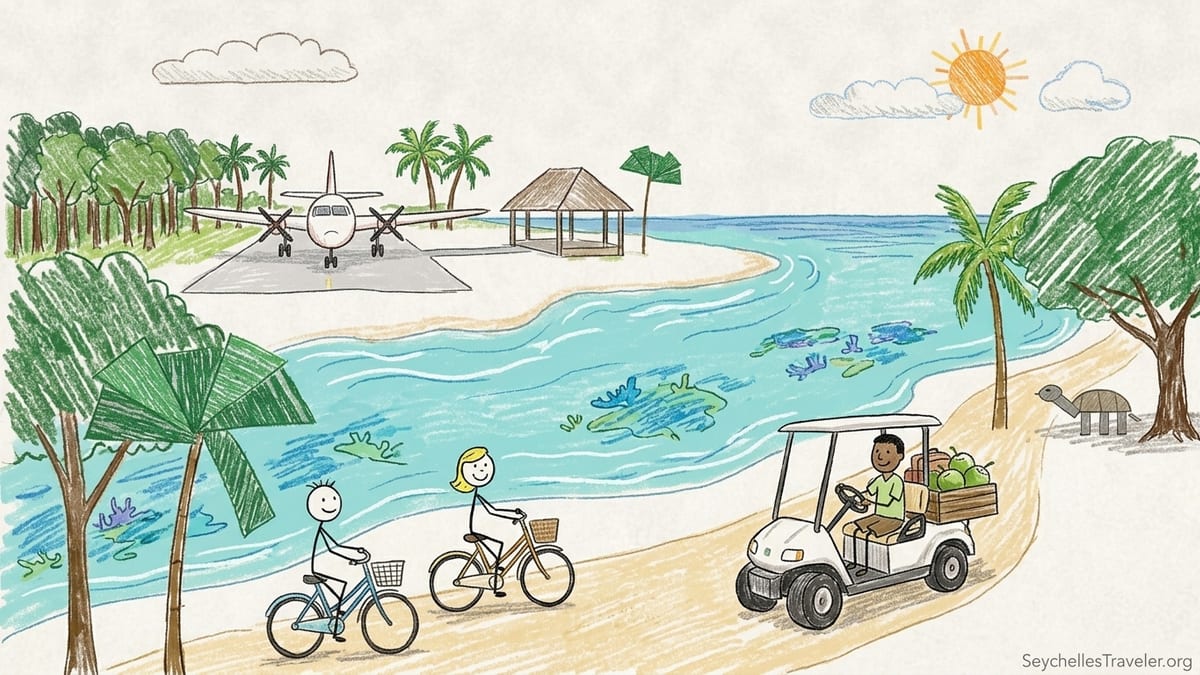
Landing on Desroches was one of the more memorable arrivals I have had. There is a narrow concrete runway, a simple open‑air arrival hut and a line of golf carts and bicycles waiting under the trees. There is no town, no independent taxi and no alternative hotel. Four Seasons staff met us directly off the plane, loaded our luggage onto a buggy and handed out chilled towels and coconut water. From touchdown to being driven away took about ten minutes, largely because there are no formalities beyond matching your name to a clipboard.
The drive from the airstrip to the main resort area is short but sets the tone. Sandy tracks cut through thick coconut and takamaka forest, with occasional glimpses of surf on one side and the flat calm of the lagoon on the other. It feels off‑grid in a way that many “private islands” do not, yet it is instantly clear that everything here, from the runway to the desalination plant and solar farm, exists solely to support a single high‑end resort.
Checking In and First Impressions of the Villa
Check‑in happens at an open‑sided lounge near the main pool rather than at a conventional front desk. After the welcome drink and a brief explanation of the island, I was introduced to a dedicated “experience maker,” essentially a concierge who communicates via WhatsApp and organizes everything from bikes to spa appointments. The formalities were quick, but the amount of information was not. In the first 20 minutes I learned about bike rules, restaurant opening hours, turtle nesting guidelines, the presence of a conservation center and the fact that there is no shop beyond a small boutique and deli.
I had booked a One‑Bedroom Pool Villa, which in October sat in the midrange of the resort’s categories between the Sunset Beach Suites and the larger multi‑bedroom residences. For five nights including breakfast, the cash rate was in the region of 3,000 to 3,500 euros per night before taxes and fees, depending on the exact offer. Combined with the flights, that pushed the baseline for two adults well into five figures for less than a week, even before food and activities. Transfers were not included in my particular package, which is a detail worth watching on promotions, as bundles that include flights appear intermittently but are not guaranteed.
The villa itself was outstanding in space and design. Behind a simple wooden gate, a sandy path led to a large deck with a private pool, shaded daybed and outdoor dining area. Glass doors opened into a high‑ceilinged bedroom with a king bed, sofa and desk, while the back of the villa held a dressing room and expansive bathroom. The overall aesthetic was bleached wood, neutral fabrics and polished concrete, which felt more like a contemporary beach house than a typical resort suite.
Private Pool, Outdoor Shower and Beach Access
Outdoor space is where Desroches villas shine, and it was where I spent most of my time. The private pool was larger than plunge size, long enough for short laps and deep enough to feel like more than a decorative basin. There was a mix of sun and shade through the day, thanks to the surrounding palms, which made it possible to stay outside even in the heat of the afternoon. At night the pool area was lit softly enough that the stars dominated, something that is hard to find in more built‑up parts of the Seychelles.
The outdoor shower became a daily ritual. Enclosed by a high wall but open to the sky, it was set in a small garden of ferns and lava rock. Rinsing off salt under warm water while fruit bats circled overhead at dusk is the sort of small sensual moment that stays with you longer than the more curated “wow” elements. There was also an indoor rain shower and deep soaking tub, but I used them rarely; the point of a place like this is to be outside as much as possible.
Beach access was via a short, sandy path over a low dune. In practical terms this meant a one‑minute walk from bed to water. However, the character of the beach behind my villa was not what the brochures might lead you to assume. The resort advertises roughly nine miles of coastline around the island, which is technically accurate, but the stretch in front of my villa had noticeable shore break at higher tides and patches of dead coral underfoot. Swimming was comfortable at mid to high tide when the waves settled, but this was not a postcard‑calm lagoon every hour of the day.
The resort provides beach chairs and simple umbrellas near the main areas, but at the villa we relied on natural shade and the occasional portable umbrella delivered on request. Privacy was good; I saw only a handful of other guests walk by each day, and most stayed closer to the central facilities. That sense of being almost alone on a long beach is a genuine luxury. Still, travelers should be aware that “beachfront” can mean anything from bathtub‑calm curls of sand to more exposed, surf‑washed stretches that require some care when swimming.
Daily Rhythm: Restaurants, Food and the Cost of Being Captive
Daily life on Desroches fell quickly into a pattern: sunrise walk or cycle, long breakfast at Claudine, a few hours of work or reading, water activity or spa in the afternoon and dinner at one of the three main dining venues. With no town or alternative eateries on the island, every meal came from the resort’s kitchens. Breakfast was included in my rate, which softened the blow. The buffet at Claudine ranged from fresh fruit and Seychellois curries to eggs cooked à la minute and pastries. Quality was consistently high, and the oceanfront setting was lovely, but if you are here for more than a few days the rotation becomes familiar.
For lunch and dinner, the island’s culinary life revolves around Claudine, the more relaxed deli and sushi outlet and the grill and bar near the pool and beach. Menus are priced in Seychelles rupees and are subject to a 10 percent service charge and 15 percent VAT. A main course at dinner, such as seafood linguine or grilled local fish, tended to land in the range that translates to roughly 40 to 50 US dollars before service and tax, once conversions are done. Starters like yellowfin sashimi or heart of palm salad typically fell somewhere in the equivalent of 20 to 30 US dollars.
Alcohol is a major budget line. A glass of wine in the house selection hovered around 18 to 22 US dollars once charges were included, while cocktails were often a little higher. There is an all‑inclusive option that bundles meals and a defined list of drinks, but the premium over a bed‑and‑breakfast package for a couple can easily reach several hundred US dollars per night. Whether that makes sense depends entirely on your drinking habits and how often you plan to eat three‑course meals in the resort’s restaurants instead of keeping lunches very light.
The lack of alternatives is the key reality check. On an island like Mahé, if resort prices feel steep you can dine at beach shacks or local takeaways. On Desroches, there is no such safety valve. You can ask the kitchen to send simple dishes to your villa, and the deli sells snacks, but everything is still coming through the same supply chain. In budgeting terms, I found that two people sharing breakfast, a modest shared lunch and a full dinner with one drink each could easily spend 250 to 350 US dollars per day on food and beverages, before any special experiences like private barbecues or sandbank picnics.
Cycling the Island and Discovering Which Beaches Really Work
Each villa comes with bicycles, and cycling became my favorite part of the stay. Desroches is flat, laced with sandy tracks that cut through coconut groves and pandanus thickets. In theory you can circumnavigate the island, but in practice some sections felt too soft or overgrown for comfortable riding. In the cooler early mornings I would pedal out with a water bottle and reef‑safe sunscreen, aiming for a different section of coast each day.
On the western side I found some of the most appealing swimming beaches. Here the reef shelters the shore from prevailing swell, and the water settled into a lagoon‑like calm at mid‑tide. One cove in particular, about a ten‑minute ride from the main resort area, had powder‑soft sand, waist‑deep water and enough natural shade from leaning takamaka trees to string up a towel and stay for hours. There were no loungers or permanent facilities, but this was part of the charm; it felt like borrowing a private strip of shoreline.
The southern and southeastern coasts were wilder. The nine miles of coastline include long, straight stretches of sand where surf pounds directly onto the beach. Here the waves were stronger, the currents more obvious and the nearshore seabed a mix of sand and coral rubble. Beautiful to walk, photograph and feel small in front of, but not where I was comfortable doing long, relaxed swims. Shade was patchier too, often set back behind a low foredune, which made these sections better for short explorations than long lounging sessions in the heat of the day.
The northern reaches of the island, accessibly only by a longer ride on softer sand, delivered the most privacy. I spent an afternoon on a beach where in several hours I saw no one else at all. The water here alternated between calm and lumpy depending on the tide and wind, and there were no facilities beyond the footprint of a small, discreet helipad further inland. It drove home a simple point: having nine miles of coastline does not mean you have nine miles of interchangeable, swim‑friendly, shaded beach. Conditions vary dramatically, and the resort’s romantic language occasionally blurs those distinctions. If you are not an especially strong swimmer, it is worth asking staff which zones are safest and most suitable for your comfort level on any given day.
Snorkeling, Marine Life and the Desroches Drop
I snorkeled directly from the beach in front of my villa on several mornings. Visibility varied with the tides, but when the water cleared I found modest coral heads, schools of small reef fish and the occasional ray cruising over the sand. It was pleasant rather than spectacular. The shallow areas near shore bear the signs of wear common to many resort house reefs: patches of broken coral, some algal growth and a few brighter, healthier heads in the slightly deeper sections. You can see interesting marine life within a short fin of your villa, but if you have dived or snorkeled world‑class reefs elsewhere you may find the easily accessible house reef attractive rather than transformative.
The real underwater highlight of Desroches, which I did not personally dive on this trip, is the Desroches Drop, a dramatic wall where the plateau of the atoll falls away into deep blue open water. Researching it through the resort’s dive center and independent operators revealed vertical coral‑covered walls, pelagic sightings and the chance of encounters with species like barracuda, tuna and reef sharks. The drop‑off is one of the reasons the island is popular with dedicated divers; it offers advanced profiles that are difficult to replicate around the granitic inner islands.
For non‑divers, the resort runs boat snorkel trips out to healthier parts of the reef crest and outer plateau. Prices vary a little by season and group size, but a typical half‑day guided snorkeling trip for two guests was quoted to me in the region of 150 to 250 US dollars per person once taxes were accounted for. Kayaks and stand‑up paddleboards were complimentary from the main beach center, and I spent several calm afternoons paddling over seagrass meadows where green turtles surfaced within a few meters of my board.
Surfing exists on Desroches, but it is a niche activity here. The outer reef picks up swell, and knowledgeable staff can point more experienced surfers toward suitable breaks, but there is no resident surf school of the kind you might find in more wave‑centric destinations. The bottom line for water activities is that there is plenty to do, and the quality can be excellent if conditions line up, but the most exceptional experiences often incur additional per‑person charges, which add up quickly on top of room and board.
Meeting the Giant Tortoises: Conservation, Not a Petting Zoo
One afternoon, I cycled inland to the island’s conservation center and tortoise sanctuary. This is run in partnership with conservation groups, and the tone is notably different from touristy “animal encounters” elsewhere. The sanctuary holds Aldabra giant tortoises, part of a broader effort in the outer islands to restore populations and protect habitat rather than simply display animals for entertainment.
On arrival, there was no crowd, no scheduled show, just a low enclosure with tortoises lumbering slowly between patches of shade. A conservation staff member offered to explain the project and talk through how the tortoises were introduced, how their grazing shapes vegetation and how the island manages nesting turtles and birdlife more broadly. Guests are allowed to enter under supervision, but the emphasis is on observation and respect. You are encouraged to keep a distance, avoid loud noise and absolutely not to sit on or climb the animals.
What struck me most was how low‑key the experience felt compared with the resort’s glossy imagery of adults and children posing next to enormous tortoises. In person it is quieter and slower, and the most moving moment for me was simply watching an older tortoise methodically work its way through a patch of native grass as the conservationist described how long it had taken to rebuild the population after years of disturbance. The visit is complimentary, though the center welcomes donations that feed back into habitat management and monitoring.
This focus on conservation threads subtly through much of life on Desroches. Guests pay a modest per‑night conservation or environmental levy that the island directs into infrastructure like the solar farm, waste management and habitat restoration. The amounts are small on a nightly basis, but across thousands of guest nights they fund systems that make it possible for a luxury resort to operate in a fragile atoll ecosystem with less impact than older island models that relied heavily on diesel and minimal waste treatment.
Being Dependent on One Resort for Everything
Desroches feels like a dream for the first couple of days. The empty paths, the fact that you can cycle to beaches with no one on them, the ease with which the resort staff make things happen. Over time, the absence of alternatives shows its other side. If you want to leave the island before your scheduled flight, you cannot simply walk to a ferry; you rely entirely on the resort and its aviation partners. If a particular restaurant theme night does not appeal, there is no outside bistro to escape to. If you need something as mundane as sunscreen or paracetamol, you buy it at boutique prices or wait until you are back on Mahé.
The dependence extends to activities. Kayaks and bikes are included, but anything that requires a boat, guide or specialized equipment carries a fee that the resort sets. On a three‑night stay, this feels like part of a curated vacation. On a week‑long stay, especially for guests who are restless or budget‑conscious even within the luxury bracket, it can start to feel like a gilded version of being captive. This has nothing to do with how charming and capable the staff are, and everything to do with the structural reality of a one‑operator island.
The economic side also intersects with timing. Between October 1 and December 20, room rates are often lower than in peak festive weeks, but the fixed cost of flights and the elasticity of food and activity pricing do not change much. In my five nights I found that incidentals, including food, drinks, one snorkel excursion and a couple of spa treatments, added roughly 40 to 50 percent on top of the base accommodation and transfer costs for two people. That ratio may be higher still for guests who lean heavily into premium wine and private experiences.
There are upsides to this dependence. Safety and coordination, for one: the resort knows who is on the island at any given moment, and logistics from arrival to departure are tightly choreographed. Environmental management is simpler with a single operator than it would be with multiple independent guesthouses and businesses. But anyone considering Desroches needs to be comfortable with trading independence and variety for seclusion, ease and a consistent aesthetic.
How Long to Stay and What Feels Worth the Premium
At the end of my stay, I tallied the main costs. Five nights in a one‑bedroom pool villa on a bed‑and‑breakfast basis in the shoulder season, plus return flights from Mahé at about 550 euros per adult before VAT, environmental and conservation levies charged per person per night, food and beverages and a handful of activities and spa sessions, took the total to a level that would easily fund a longer trip across several islands staying in high‑quality but less exclusive properties. Desroches is undeniably expensive, but the question is less “Is it overpriced?” and more “What are you buying that you cannot get elsewhere?”
For me, the pieces that felt worth the premium were the space and seclusion of the villa, the quality of service and the feeling of waking up on an island where the only vehicles are resort buggies and staff bicycles. The night skies, unpolluted by other settlements, and the ability to cycle to a deserted beach in twenty minutes were luxuries I could not easily replicate on Mahé or Praslin. The conservation work and serious approach to tortoise and turtle protection also made the resort feel less extractive than some isolated island properties.
On the other hand, some elements felt less justifiable. The food was very good but not dramatically better than what I have eaten at high‑end resorts on better‑connected islands for lower prices. The dependence on the resort for every activity, combined with per‑person pricing that quickly multiplies for families or groups, made some experiences feel like optional extras bolted onto an already significant base fare. And the idea of nine miles of perfect, swimmable beach gave way in reality to a patchwork of sublime coves, rugged surf beaches and stretches that were more suited to walking than swimming.
If you are deciding how many nights to book, my recommendation from experience and observation would be three to five nights for most travelers. Three nights works well if you are pairing Desroches with time on Mahé or another island and want an intense but contained private‑island interlude. Five nights allows you to settle into the island’s rhythm without too much repetition, especially if you enjoy diving or long, aimless cycles. Seven nights or more starts to feel viable mainly for couples or families who are certain they are content with a slow routine of pool, beach, books and occasional activities, and who are comfortable with the cumulative cost of food and excursions.
The Takeaway
Desroches Island and the Four Seasons resort that occupies it deliver much of what the marketing promises: powdery sand, a sense of remoteness, villas with serious wow factor and the chance to cycle to beaches where your footprints are the only ones in the morning. The 35‑minute flight from Mahé feels like a threshold between the busy inner islands and a quieter, more elemental landscape. Service is polished but warm, and the overall design is refined without lapsing into ostentation.
The reality, though, is more complex than the brochure dream. Nine miles of coast do not equal nine miles of serene bathing beaches. The ocean here is alive and changeable, and some of the most beautiful stretches are not the safest or most comfortable for casual swimmers. The island’s complete dependence on a single resort means spectacular convenience but also a lack of choice, especially around dining and activities. The financial commitment is heavy, driven not only by room rates but also by the unavoidable cost of flights and the compounded effect of high food and beverage prices with service charges and taxes.
For travelers who value privacy, space and a strong sense of place, and who understand ahead of time the budget implications of a remote private‑island resort, Desroches can absolutely be worth three to five nights. It excels as part of a wider Seychelles itinerary where you also experience local life, independent restaurants and more varied landscapes elsewhere. As a stand‑alone, week‑long destination, it suits a narrower band of travelers: those who see the absence of alternatives not as a limitation but as a feature, and who are happy to pay a steep premium for the privilege of being gloriously, deliberately far from anywhere else.
FAQ
Q1. How long is the flight from Mahé to Desroches Island?
The resort‑arranged domestic flight takes about 35 minutes from Mahé’s domestic terminal to Desroches, not including check‑in time at the airport.
Q2. How much do return flights to Desroches cost?
For travel between October 1 and December 20, 2026, return flights are priced at about 550 euros per adult before 15 percent VAT, which brings the total close to 630 euros per person.
Q3. Are transfers included in the room rate at Four Seasons Desroches?
Transfers are not automatically included in every rate. Some promotional offers occasionally bundle flights, but many packages charge the domestic flights separately.
Q4. Is every beach on Desroches good for swimming?
No. While the island has around nine miles of coastline, some sections are lagoon‑calm and ideal for swimming, while others are exposed with strong surf and currents.
Q5. What is the food and drink budget I should plan for?
For two adults, a realistic daily budget for lunch, dinner and a modest number of drinks is around 250 to 350 US dollars, with costs rising if you order premium wines or private dining.
Q6. Is Desroches suitable for non‑divers?
Yes. There is plenty to do for non‑divers, including cycling, kayaking, stand‑up paddleboarding, spa treatments and beach time, although some boat excursions cost extra.
Q7. Can I see giant tortoises on Desroches?
Yes. There is a tortoise sanctuary linked to the island’s conservation program where you can observe Aldabra giant tortoises and learn about habitat restoration.
Q8. How long should I stay on Desroches Island?
For most travelers, three to five nights strikes a good balance between enjoying the island’s seclusion and avoiding repetition or budget fatigue.
Q9. Are there any extra environmental or conservation levies?
In addition to room rates and taxes, guests pay per‑person, per‑night levies that support environmental management and conservation projects on Desroches and in Seychelles.
Q10. Is Desroches a good choice for families?
Families who enjoy nature, space and a slower pace often love it, but parents should budget carefully, as food, activities and flights for multiple people add significantly to the total cost.