


Aldabra Atoll in the far southwest of Seychelles is one of the wildest places on Earth that ordinary travelers can still visit, but only with careful planning, serious budgets and strict respect for conservation rules. More than 1,000 kilometers from Mahé, with no airstrip, harbor, hotel or casual day trips, Aldabra is not a detour from a beach holiday. It is a true expedition that demands advance permits, an authorized vessel and a clear understanding of what is and is not realistically possible.
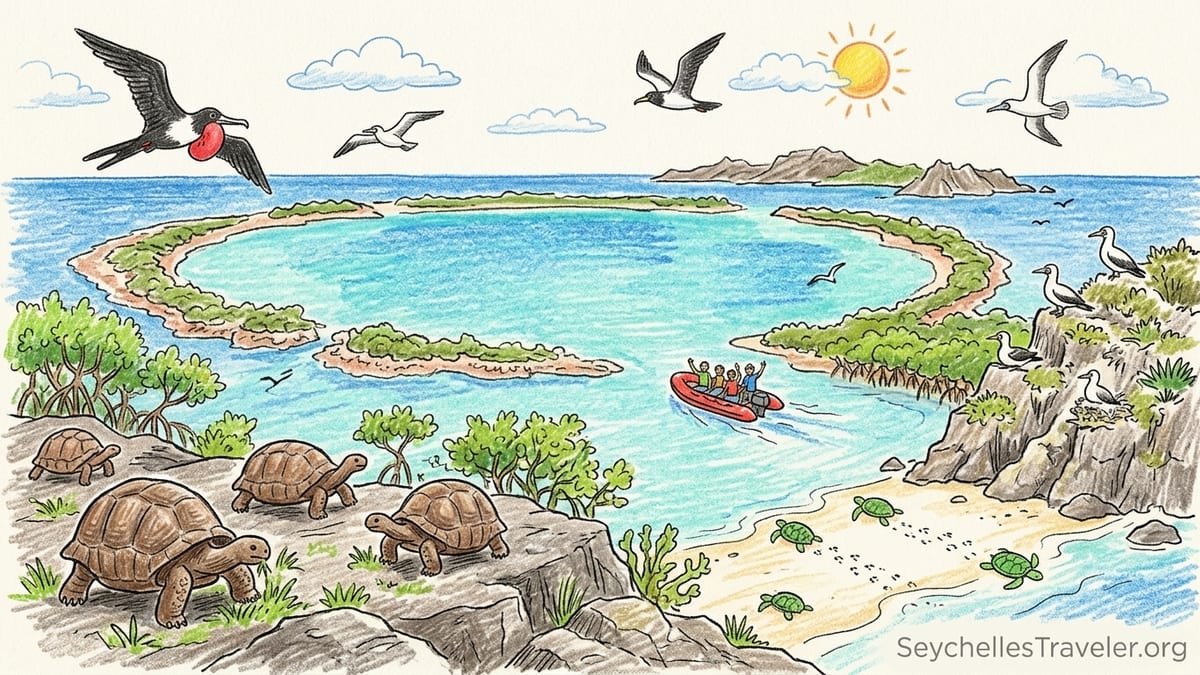
Aldabra at a Glance: UNESCO Giant of the Indian Ocean
Aldabra Atoll has been a UNESCO World Heritage Site since 1982 and is widely regarded as one of the best preserved raised coral atolls on the planet. It lies in the outermost reaches of Seychelles, more than 1,000 kilometers southwest of Mahé and closer to the African mainland than to the main granitic islands. Its isolation, combined with rigorous protection by the Seychelles Islands Foundation, has allowed Aldabra to remain remarkably intact as a living laboratory of island evolution.
The atoll itself is a massive ring of fossilized coral, enclosing a lagoon roughly 34 kilometers long. Instead of palm-fringed beaches and resorts, visitors find jagged limestone, tidal channels that roar like rivers, and a vast interior lagoon that drains and refills with spectacular force. Aldabra is not a single island but a group of four main islands forming the atoll rim around the lagoon.
One of Aldabra’s most extraordinary claims to fame is its population of wild Aldabra giant tortoises. Estimates vary, but there are believed to be well over 100,000 animals, far more than on any other island group. Visitors walking the sandy tracks of Picard Island are often astonished to find tortoises almost everywhere: in open scrub, under mangroves, even ambling near the research station buildings.
The four principal islands are Grande Terre, Picard, Malabar and Polymnie. They surround the lagoon in a broken ring punctuated by deep passes that funnel tides in and out. Picard on the northwest rim hosts the small research station and is the only part of Aldabra where tourism landings are routinely authorized. Grande Terre on the eastern side is the largest island, while Malabar and Polymnie help complete the atoll’s circle of raised coral rock and coastal habitats.
Wildlife, Seabirds and Turtle Nesting
Aldabra’s isolation has produced a remarkable level of endemism. Several species occur nowhere else, including the Aldabra rail, often cited as the last surviving flightless bird in the Indian Ocean. The islands support distinctive populations of Aldabra drongo, white-throated rail, various skinks and geckos, and unique plant communities adapted to salt, wind and harsh limestone terrain.
The atoll is also globally significant for seabirds. Colonies of frigatebirds, boobies, tropicbirds and terns nest on the islands and forage over the surrounding sea. The channels and outer reefs support manta rays, sharks and abundant reef fish. Many visitors experience Aldabra primarily from Zodiacs, drifting near feeding turtles or snorkelling in clear, fish-filled water under the watchful eye of SIF guides.
Nesting turtles are another major draw. Green turtles nest in significant numbers on certain beaches, and hawksbills occur in the waters and at some nesting sites. On longer expeditions during the right season, guests may see tracks and nests on remote beaches or even witness an emergence of hatchlings if weather, tides and timing align. As with all wildlife encounters at Aldabra, such moments are governed by strict rules designed to avoid disturbance.
Mangrove forests fringe parts of the lagoon shore, providing nurseries for fish and roosts for birds. At low tide during a supervised walk, travelers might see juvenile sharks patrolling the shallows, crabs scuttling over the mud and tortoises grazing surprisingly close to saline water. The sense is always of a functioning wild ecosystem where humans are temporary, tightly controlled visitors rather than dominant residents.
Why Access Is So Restricted
Aldabra is both a UNESCO World Heritage Site and a Special Reserve under Seychelles law. The atoll is managed by the Seychelles Islands Foundation, which maintains a permanent research station but no tourist infrastructure in the usual sense. There is no airstrip, no harbor, no jetty that cruise passengers can simply disembark onto, and no hotel or guesthouse offering overnight stays to leisure travelers.
All access is by sea, using vessels that can safely anchor offshore and deploy rigid inflatables or Zodiacs for landings and lagoon exploration. Swell, surf and tide conditions mean that even with experienced captains and local pilots, landings are sometimes impossible. The lagoon itself is subject to strong tidal flows, and navigation requires expertise and favorable conditions.
Because the ecosystems are so fragile, every visitor and ship must be specifically authorized. SIF does not sell tourist packages or run its own cruises. Instead, it controls access through permits and impact fees and by requiring that all visitor activities are closely supervised by SIF staff or pre-approved, Aldabra-experienced guides. Unauthorised vessels are not allowed to anchor in Aldabra waters or land anywhere on the atoll, and the Seychelles authorities support SIF in enforcing these rules.
For ordinary travelers, this means that there is no casual or last-minute way to “drop in” on Aldabra from Mahé. You cannot book a scheduled domestic flight, step ashore and arrange a day tour. You must either join an expedition cruise or liveaboard whose itinerary includes Aldabra with confirmed permissions, or charter an appropriate vessel and obtain your own authorizations in advance.
How You Can Actually Get There
There are three broad ways that non-scientist travelers currently reach Aldabra. The first is to join a small expedition cruise that has negotiated landing rights with SIF as part of an outer islands itinerary. These voyages are usually marketed specifically mentioning Aldabra in their title or day-by-day plan and are targeted at naturalists, divers and adventurous travelers rather than mainstream cruise passengers.
The second route is via a diving or nature liveaboard that includes Aldabra on longer expeditions through the outer islands. For example, Seychelles-based liveaboard operators have offered 9 to 14 night itineraries that combine outer islands such as Astove and Cosmoledo with several days at or around Aldabra. These trips typically embark or disembark closer to the outer islands rather than shuttling back and forth to Mahé during the cruise.
The third route is to organize a private charter, usually a yacht or expedition motor vessel with ocean-going range and appropriate safety equipment. In that case, the vessel owner or manager must apply directly to SIF and the Seychelles Ports Authority for permission, pay impact fees and comply with Aldabra tourism regulations. This option is logistically complex and financially significant but is used occasionally by private yacht owners or specialized charter groups.
In all three cases, it is essential to distinguish between an “outer islands” Seychelles cruise and one that truly includes Aldabra. Many shorter trips visit outer groups like Amirantes or Alphonse without going the extra distance to the Aldabra Group. When considering any itinerary, read the day-by-day route and look specifically for references to Aldabra Atoll, Picard Island or Assomption and for explicit mention of SIF-supervised landings or lagoon exploration.
Assomption Island’s Role as a Gateway
Assomption Island lies roughly 30 kilometers south of Aldabra and often features in discussions about access to the atoll. Unlike Aldabra, Assomption has a concrete runway and a small settlement, currently hosting Seychelles Defence Forces personnel and a Seychelles Coast Guard station. Small charter aircraft can land here by prior arrangement, and the island can serve as a logistical staging point for vessels heading to Aldabra.
For travelers, it is important to understand that reaching Assomption does not automatically grant the right to visit Aldabra. Permissions, fees and supervision requirements for Aldabra are entirely separate and remain under the direct control of SIF. A ship can be cleared by customs and immigration at Assomption, but it still needs Aldabra-specific authorization before it may enter Aldabra’s waters, anchor or land passengers.
In practice, some expedition cruises and liveaboards arrange charter flights for their guests between Mahé and Assomption at the start or end of an itinerary, reducing the time spent repositioning the vessel. Others sail all the way from Mahé. Either way, the actual visits to Aldabra still depend on tide, weather and SIF approval, and cannot be guaranteed even when the voyage is marketed around the atoll.
If you are considering a trip that mentions Assomption, ask the operator exactly how they handle transfers, what permissions are in place for Aldabra itself, and what contingency plans exist if sea conditions or permits prevent landings. Clarifying these details before booking is critical to avoid disappointment.
Permits, SIF Impact Fees and Commercial Photography
Every person stepping ashore at Aldabra, including vessel crew, is subject to a daily impact fee collected by the Seychelles Islands Foundation. At the time of writing, SIF lists the impact fee as 250 US dollars per person per day for visitors and crew. This fee is intended to cover the environmental cost of visits and to help fund conservation and research operations on the atoll.
From a traveler’s perspective, this impact fee is usually wrapped into the overall cost of an expedition cruise or charter, along with port fees, fuel, guiding and onboard accommodation. It is important, however, to confirm explicitly whether the SIF impact fee is included in your quoted package price, how many days of impact fees the operator has budgeted for, and what happens if additional days at Aldabra are possible or required due to weather.
Separate from the per person daily impact fees, SIF applies additional charges for professional photography and filming. Journalists, documentary crews and commercial photographers must obtain written permission in advance and pay a one-off filming and photography fee in addition to the standard impact fees. This is arranged directly with SIF or through your vessel operator. Recreational photographers using consumer cameras for personal use are typically covered under the normal visitor regulations, but any intention to sell footage, shoot for a brand or publish commercially should be declared well ahead of time.
Vessels themselves also require authorization. Captains must complete a clearance request process, provide port clearance documents and agree to abide by Aldabra’s tourism regulations, which cover where vessels may anchor, how Zodiacs may be used, and where landings are permitted. Fishing is prohibited within a buffer zone around the atoll, and collecting shells, coral or biological specimens is not allowed. Guides are required to keep visitors on designated paths and within sight, and SIF staff retain the right to cancel or modify activities if conservation concerns arise.
Biosecurity, Visitor Conduct and Safety
Aldabra’s largely intact ecology depends on keeping invasive species out. For that reason, biosecurity is taken very seriously. Visitors are expected to wear freshly laundered clothing and clean footwear with mud and seeds removed before landing. Luggage, camera bags and any other gear that goes ashore should be checked for soil, plant material or small animals that could be accidentally introduced.
On some expeditions, operators provide a final gear-cleaning session onboard before the first landing, with staff inspecting boot treads and Velcro fastenings and using brushes or disinfectant if needed. Guests may be advised not to consume certain fruits with easily spread seeds shortly before visiting sensitive islands. The aim is to minimize the risk that seeds, insects or pathogens end up in this pristine environment.
Once ashore, visitor conduct is tightly regulated. Groups are kept small and must remain on marked trails or within boundaries set by their guides. Approaches to wildlife are controlled, with minimum distances enforced for tortoises, seabirds and turtles. Noise is kept low, drones are prohibited or tightly regulated, and it is forbidden to remove any natural material or leave any litter. All rubbish generated by visiting vessels must be removed and taken away from the atoll.
Medical and safety considerations are crucial. Aldabra is extremely remote, with only basic medical facilities at the research station. There is no hospital, and serious cases require medical evacuation by vessel or, if possible, aircraft to another island or Mahé. Sea and weather conditions can delay evacuation and there is no guarantee of rapid rescue. Comprehensive travel insurance that specifically covers expedition cruising, remote evacuation and medical emergencies in Seychelles waters is strongly recommended and often mandated by reputable operators.
Seasonal Sea Conditions and Itinerary Realities
Aldabra is exposed to open ocean swells and subject to seasonal monsoon patterns. The main expedition season typically clusters around the calmer inter-monsoon and transition periods when sea conditions are more favorable for long crossings and Zodiac operations. Even during these windows, conditions can change quickly, and swell or wind may make certain landings unsafe.
Travelers should understand that on genuine expeditions, itineraries are always provisional. Operators may advertise several potential days at Aldabra, but the ship’s captain and SIF staff have the final say on where and when landings occur. It is possible to reach the atoll and still be unable to land on Picard due to surf. In such cases, operators may substitute more sheltered Zodiac cruises along the reef or inside channels, or divert to other islands in the Aldabra Group.
Short authorized stops by larger ships are usually limited to a few hours of tightly managed activity, often a single landing or Zodiac cruise combined with interpretation from guides. Longer expeditions with several planned days at or around Aldabra have more flexibility to wait out weather, adjust landing times to tides, and balance activities between snorkeling, walking and wildlife observation.
When comparing options, ask prospective operators how many actual full days they budget at Aldabra, what their historical landing success has been in recent seasons, and how transparent they are in reporting changes. Responsible companies are candid that Aldabra can never be guaranteed and will emphasize the expedition nature of the trip rather than promising specific landings regardless of conditions.
Realistic Cost Framework: What an Expedition Really Costs
Because SIF publishes the impact fee but not commercial package prices, the most practical way to understand costs is to look at recent quotations from expedition and liveaboard operators serving Aldabra. These operators generally price in US dollars or euros and bundle SIF fees, vessel operating costs, guiding and onboard services into per person rates.
For small-ship expedition cruises that include several days around Aldabra as part of a longer Seychelles outer islands itinerary, recent published rates for shared cabins commonly start in the low to mid five figures per person, depending on cabin category and length. A two-week naturalist expedition that sails from Mahé, visits outer islands such as Astove or Cosmoledo and aims for multiple days at Aldabra can easily run to several thousand dollars per person even in the most economical cabins, with premium cabins costing more.
Dedicated diving or nature liveaboards based in Seychelles that schedule Aldabra expeditions quote similar magnitudes when all costs are included. Per person prices for 9 to 14 night Aldabra-focused departures often cluster in the same broad band as high-end liveaboard trips in other remote ocean regions, with additional charter or positioning costs for flights to or from staging points like Assomption sometimes added on top.
Private yacht or full-vessel charters are in a different financial category. Chartering a suitable expedition-capable vessel for an Aldabra voyage involves daily rates that can be well into four or even five figures per day for the entire vessel, before SIF impact fees, fuel surcharges, port fees and any charter flights. On a small vessel with, for example, a dozen guests, the per person share over a two-week charter can rapidly exceed the cost of scheduled berth-based expeditions.
Across all formats, the SIF impact fee of 250 US dollars per person per day is only one component. Onboard accommodation, crew salaries, fuel for long ocean transits, Zodiac operations, guides and naturalists, and any charter flights or hotel nights in Mahé or elsewhere add substantially to the total. As a rough guide, serious travelers should expect Aldabra-focused expeditions to cost considerably more than a standard Seychelles island-hopping holiday and to budget on a scale similar to other remote expedition destinations such as the Galapagos, Arctic or Antarctica.
Step-by-Step: Permits and Booking Checklist
Planning an Aldabra expedition begins with choosing the right vessel and operator. First, decide whether you want to join a scheduled expedition cruise or liveaboard, or assemble a private charter. For most individuals and small groups, joining a scheduled departure is both simpler and more economical. Once you have an operator in mind, check that Aldabra is clearly specified in the itinerary for your chosen departure and that the company has recent experience obtaining SIF permissions.
Next, confirm exactly what is included in your quoted price. Ask the operator to break out or at least clearly confirm inclusion of the SIF impact fees for the number of days they plan at Aldabra, port charges, any domestic charter flights, transfers and any additional conservation levies. Clarify cancellation terms, especially in relation to force majeure and itinerary changes where landings at Aldabra prove impossible despite the ship’s best efforts.
At the same time, ensure that the vessel’s permits and clearances are in hand. Reputable operators will handle the SIF vessel authorization process, Seychelles Ports Authority requirements and customs and immigration logistics on your behalf. If you are responsible for a private yacht, you or your captain will need to apply directly for Aldabra clearance well in advance and coordinate inspections and paperwork, potentially including arrangements for customs officials to travel to outlying islands like Assomption.
Finally, address personal preparation. Purchase travel insurance that explicitly covers expedition cruising in Seychelles, medical evacuation from remote islands and any planned activities such as diving or snorkeling. Discuss any medical conditions with your operator, as some may require a doctor’s letter for remote voyages. Follow all pre-departure biosecurity instructions you receive, including cleaning footwear and gear, and be ready for flexible plans once aboard. Mentally framing the voyage as an expedition, not a fixed-schedule cruise, is one of the most important steps you can take.
The Takeaway
Visiting Aldabra Atoll is not like adding an extra island to a Seychelles beach itinerary. It is a remote, tightly regulated World Heritage expedition that demands serious commitment of time, money and preparation. There is no simple way to day-trip from Mahé, no resort to check into, and no guarantee that every planned landing will happen. For those who make the journey with the right expectations, however, Aldabra offers one of the most powerful wilderness experiences available in the Indian Ocean.
Ordinary travelers can reach Aldabra only by travelling as part of an authorized expedition cruise, liveaboard or yacht with SIF permission, paying daily impact fees and accepting strict limits on their movements and activities. In return, they gain a brief, carefully managed window into a functioning ecosystem of giant tortoises, nesting seabirds and turtle beaches, largely free of invasive species and mass tourism.
If your travel ambitions lean toward genuine expeditions rather than conventional holidays, Aldabra deserves a place on your long-term plan. Give yourself at least a year of lead time to research operators, compare itineraries, budget realistically and secure the right permits and insurance. Approach the journey with humility, flexibility and respect for the rules, and you will be well placed to appreciate why Aldabra sits at the pinnacle of Indian Ocean natural heritage.
FAQ
Q1. Can I visit Aldabra on a day trip from Mahé?
There are no day trips from Mahé to Aldabra. The atoll lies over 1,000 kilometers away, has no airstrip or tourist infrastructure, and access is strictly controlled. You must join an expedition cruise or charter vessel with prior permission.
Q2. What is the current SIF impact fee to visit Aldabra?
The Seychelles Islands Foundation currently charges an impact fee of 250 US dollars per person per day, including vessel crew. This is separate from your cruise fare, charter rate, fuel or accommodation costs.
Q3. Does reaching Assomption Island mean I automatically have permission to go to Aldabra?
No. Assomption can act as a logistical gateway with an airstrip and customs presence, but Aldabra has its own permits and regulations. Separate authorization from SIF is required to enter Aldabra waters, anchor or land passengers.
Q4. Are there any hotels or guesthouses on Aldabra?
No. Aldabra has no tourist accommodation at all. The only permanent facilities are the research and management station on Picard Island. Visitors sleep on their vessel, whether that is an expedition ship, liveaboard or charter yacht.
Q5. How long should I plan to spend at Aldabra on an expedition?
Many expeditions aim for two to four days at or around Aldabra within a longer 9 to 14 night voyage. This allows some flexibility for weather and tides and gives a reasonable chance of multiple landings and lagoon activities.
Q6. What kind of fitness level do I need to visit Aldabra?
Most activities involve embarking and disembarking Zodiacs, walking on uneven terrain and coping with heat and sun. You do not need to be an athlete, but good mobility, balance and tolerance for outdoor conditions are important.
Q7. Can I fly my drone or conduct commercial filming on Aldabra?
Drones and commercial filming are tightly restricted. You must obtain written permission in advance, comply with Aldabra drone and filming regulations and pay additional photography or filming fees on top of standard impact fees.
Q8. What kind of insurance should I have for an Aldabra expedition?
You should carry comprehensive travel insurance that covers expedition cruising in Seychelles, emergency medical treatment, medical evacuation from remote islands, trip cancellation and any planned activities such as scuba diving.
Q9. Is it possible to organize a private yacht trip to Aldabra?
Yes, but it is complex and expensive. The yacht must be ocean-capable, and the owner or captain must obtain SIF and Seychelles Ports Authority permissions, pay impact fees and follow strict tourism and biosecurity regulations.
Q10. When is the best time of year to visit Aldabra?
Most expeditions schedule Aldabra visits during calmer inter-monsoon or transition periods, when sea conditions are more favorable for long crossings and Zodiac operations. Exact timing depends on the operator’s schedule and weather patterns.