


When the small plane dipped toward a strip of green in the middle of the Indian Ocean, I realised Bird Island was going to feel very different from Mahé. After a week among granite peaks, traffic and Creole restaurants on the main island, the sight of a single grass airstrip, a necklace of blinding white sand and a huge dark cloud of birds hanging over the northern tip felt like stepping into another country entirely.
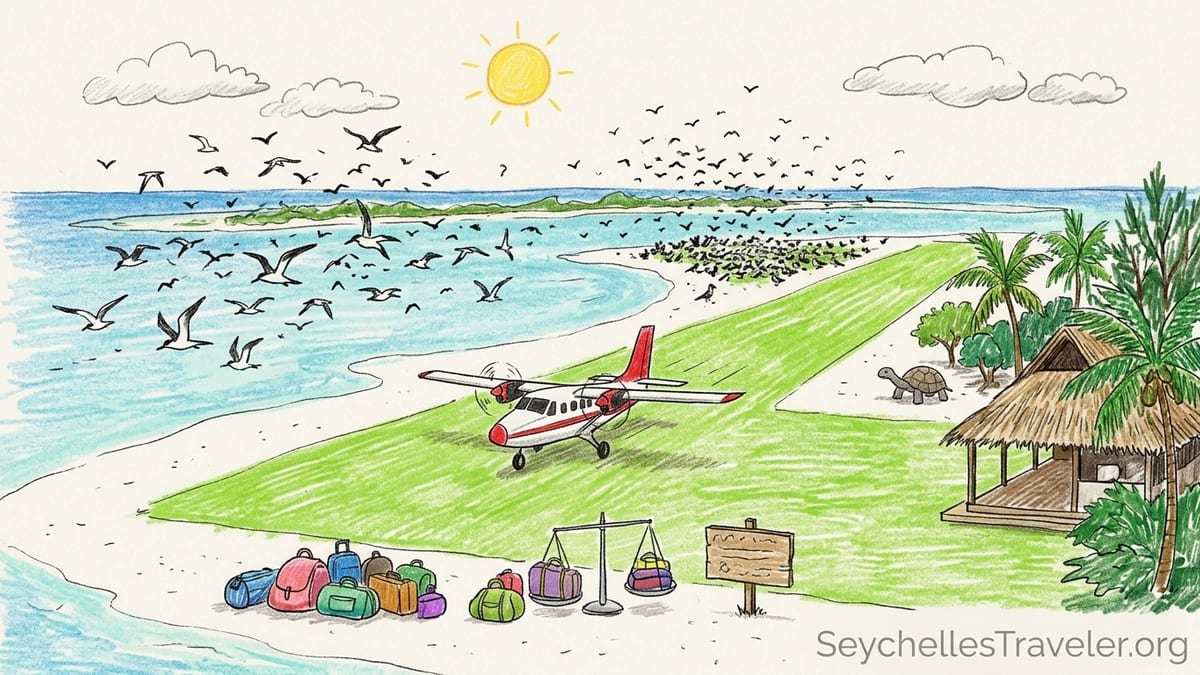
Getting There: A Grass Airstrip and a Weight Limit
My stay on Bird Island ran from 16 to 19 June 2026, which is firmly within the main sooty tern breeding season. I booked three nights at Bird Island Lodge on a full board basis, plus return flights from Mahé on the lodge’s charter service. At the time of booking in early 2026, the lodge’s rack rates for a standard chalet in June were quoted at the equivalent of roughly 400 to 450 US dollars per person per night on full board, depending on exchange rate and seasonal specials. That included three meals a day but not drinks or flights.
The lodge arranged return flights using the island’s private grass airstrip, with services operating on scheduled days. Current information when I travelled indicated flights on two set days per week, typically Mondays and Fridays, operated by small aircraft chartered from Zil Air or Air Seychelles, with occasional extra rotations if demand was high. Tickets were quoted separately from accommodation and came to just under 300 US dollars per person for the Mahé to Bird Island return sector on my dates.
The flight itself took about 30 minutes from Mahé’s domestic terminal. There was a strict 15 kilogram checked baggage allowance, plus a small carry-on, which forced some careful packing. Soft bags were preferred, both for weight distribution and storage in the tiny luggage hold. The check-in staff weighed everything, including camera gear and snorkelling masks, and made it clear that excess baggage might be refused or charged at a significant premium. For anyone used to the generous luggage limits of long-haul flights, this constraint is real and affects what you bring.
Once airborne, the difference from island-hopping ferries was immediate. Mahé’s steep green spine dropped away and the sea opened into a flat pane of bright turquoise. Bird Island appeared almost suddenly, a low ring of white sand with a scattering of casuarina and coconut trees. The pilot made a single low pass to check wind and runway. Landing on the grass strip felt surprisingly smooth, but the experience was intensely intimate: propellers spinning just metres away, the scent of cut grass as we rolled to a stop, and no terminal building in sight, just a cluster of lodge vehicles waiting at the edge of the field.
First Impressions of a Coral Cay
Stepping out of the aircraft, the contrast with Mahé’s granitic bulk was immediate. Bird Island is a classic coral cay, low and almost perfectly flat, surrounded by a shallow lagoon that glows aquamarine. There are no mountains, no interior roads, no villages. The highest point on the island barely rises above a line of scrub and ironwood trees. The soundscape is also entirely different. Instead of the rumble of traffic or music from beach bars, you hear wind in the foliage, the surf on the outer reef and, in season, an almost constant crackle of seabird calls in the distance.
Staff met our small group at the airstrip with chilled towels and fruit juice, then walked us the short distance to the lodge. There are no cars for guests, only a couple of utility vehicles for logistics and maintenance. The main lodge building sits a short stroll from the runway, shaded by trees and open on all sides to the sea breeze. On arrival we were given a straightforward orientation: meal times, basic safety notes, a request not to wander into the fenced sooty tern colony without a guide, and advice to keep doors closed at night to discourage inquisitive geckos and insects.
What struck me first was the scale. The entire island is around 1.5 square kilometres, so you can walk around it in an hour or two at a gentle pace. Yet it does not feel cramped. Because there is only one accommodation operation and guest numbers are capped at a few dozen people, long stretches of beach remained completely empty during my stay. Coming from larger islands like Praslin or La Digue, with their roads, shops and boat traffic, Bird Island felt like a tiny, self-contained world where human presence is peripheral to the needs of birds and turtles.
The atmosphere was also quietly practical, rather than luxurious. This is a place designed around conservation and simplicity rather than glossy resort aesthetics. The managers were present in person to explain how power is generated, why water use is carefully monitored and what wildlife research was happening that week. For anyone who equates Seychelles with polished infinity pools and cocktail menus, Bird Island is almost a corrective. It shows what the archipelago looked and sounded like before high-end tourism took off.
Bird Island Lodge: Simple Chalets at the Edge of the Beach
My accommodation was one of the lodge’s standard beach chalets, arranged in a loose arc behind a line of vegetation. From the outside they are plain, rendered bungalows on short stilts, painted in neutral tones with corrugated roofs. Inside, the design is simple and robust rather than Instagram-friendly. There was a large, firm double bed with mosquito net, concrete floors that were easy to sweep of sand, a ceiling fan, open shelves and a basic but clean bathroom with solar-heated shower.
The villas are naturally ventilated, relying on louvred windows and the sea breeze. During my June stay, with the southeast trade winds established, this worked well. Even at night, with the windows partly closed to keep insects out, the fan and the breeze kept the room comfortable. There is no air conditioning, which some travellers might miss in the hotter, calmer months around March and April. Furnishings are minimal: a desk, a couple of chairs, a wardrobe and a small terrace area with outdoor seating. It felt closer to a well-kept field research station than a conventional Indian Ocean resort.
Privacy is good rather than absolute. Each chalet is separated by vegetation, and I could not see into my neighbours’ units from my veranda, but you are close enough to hear muffled conversation or the sound of someone returning late from the bar. Crucially, however, the beach access felt private. A short sandy path led through low shrubs directly onto a broad curve of white sand where I rarely saw more than one or two other guests at a time. The fact that the villas sit slightly set back from the shoreline also protects them from salt spray and storm surges.
Electricity runs on a combination of solar and generator power. During my stay, power was available 24 hours, but guests were asked to keep energy use moderate. There are no high-wattage appliances in the rooms. Outlets are sufficient to charge cameras and phones, but hairdryers and similar devices are discouraged. Internet access was available in the main lodge area via a shared Wi-Fi connection, but it was slow and occasionally dropped out, especially in the evenings when several people were online. In the chalets, there was effectively no usable connection. If you need to upload large files, stream video or work remotely, Bird Island will be frustrating. For emails and basic messaging, with patience, it was manageable.
Daily Rhythm: Eat, Walk, Watch, Repeat
Bird Island Lodge operates on a full board basis, and the dining experience reflects the island’s remoteness. Meals are served buffet-style in a central open-sided dining room. Breakfast included simple fare: fresh fruit, bread, jams, eggs cooked to order and sometimes pancakes, with coffee and tea. Lunches and dinners leaned heavily on Creole-influenced dishes: grilled fish caught locally, rice, lentils, salads, occasional chicken or beef, and a dessert such as fruit salad or cake. The food was wholesome and filling rather than elaborate.
There is limited choice at each meal. Typically there were two or three hot options, not the expansive spreads found on larger resorts. If you have strict dietary requirements, advance communication is essential. During my visit, staff did their best to accommodate a vegetarian couple with extra salads and vegetable curries, but options remained repetitive after a few days. Drinks, including bottled water, soft drinks, beer and wine, were charged separately, and there is no on-island shop to provide alternatives. The remoteness and small scale mean resupply is infrequent and menus reflect what can be stored and prepared efficiently.
A typical day settled quickly into a pattern. Sunrise walks on the beach to look for turtle tracks or waders were followed by breakfast, then either a guided conservation walk or independent exploration along one of the sandy paths that cross the island. Midday was for snorkelling on the leeward side, when the tide and light were favourable. Afternoons often meant a nap, time with a bird guidebook on the veranda, or chatting with the island’s conservation staff. After sunset, the main activity was simply watching the sky fill with stars. There is no formal entertainment programme, no organised evening shows and no pool. If you crave nightlife or structured activities, you will not find them here.
This slow rhythm can feel either deeply restorative or, for some, a touch claustrophobic. By the third day I understood why many guests opt for three or four nights rather than a full week. The island is small, and while wildlife encounters evolve from hour to hour, the physical landscape remains familiar. For me, three nights felt about right: long enough to tune into the island’s pace without growing restless. Those who thrive on solitude and repetition could easily stay longer, but travellers who like variety in dining, shopping or social options may be better served combining Bird Island with more dynamic bases on Mahé or La Digue.
The Sooty Tern Spectacle: A Living Cloud
The defining experience of Bird Island in season is the sooty tern colony at its northern end. During my mid-June stay, the colony was at a dramatic stage of the breeding cycle. Sooty terns begin to hover over Bird Island from March, building in numbers through April as they establish nesting territories on the ground. Eggs are largely laid in June, with hatching following later that month and into July, and most chicks fledging by late October, when the vast majority of birds leave the island.
Arriving in June meant the colony was dense and active. The first approach was guided, with one of the conservation team leading us along a sandy track to a fenced viewpoint to minimise disturbance. Even before we reached the boundary, the sound hit us: a layered roar of calls, like static from an old radio turned up too loud, constant and strangely hypnotic. Above us, tens of thousands of birds wheeled and crossed in the air, while on the ground the nesting area formed a tightly packed mosaic of black and white bodies, each adult fiercely guarding a shallow scrape in the coral sand.
In some parts of the colony, the first chicks had already hatched, small grey bundles pressed low under their parents. Adults swapped incubation duties with rapid, noisy exchanges, lifting briefly to reveal eggs before settling back down. Occasionally a bird would rise and scream in protest as a neighbour strayed too close. Frigatebirds cruised overhead, looking for chances to steal fish from returning terns. The conservation warden explained how the colony has expanded over decades, following habitat management that removed coconut plantations and restored open ground, and how researchers monitor breeding success and adult survival.
The experience is powerful but not subtle. The noise is immense, and the smell of guano and fish is strong. This is not a tranquil bird hide; it is a living factory of energy, movement and sound. Photography is rewarding, with dense flocks in the air and intimate views of nesting behaviour, but the harsh mid-day light on the pale coral substrate can be challenging. Early morning and late afternoon visits offer warmer light and slightly cooler temperatures, though visits are timed to respect the birds’ needs and avoid excessive human presence. If your primary interest is seeing this spectacle, planning a visit between late May and August offers the richest mix of incubation and chick-rearing.
Other Wildlife Encounters: Turtles, Noddies and Tortoises
Although the sooty terns dominate in season, Bird Island’s appeal extends beyond a single species. During my stay, I joined a short conservation walk that traced the island’s turtle monitoring work. Green turtles nest here year-round, with a peak from around June to September, while critically endangered hawksbill turtles nest more heavily from about October to February. In mid-June we did not witness a nesting female, but we saw several fresh green turtle tracks and body pits on the eastern beaches from night-time visits. Staff explained how they tag nesting females, record clutch data and protect vulnerable nests from erosion.
On the island’s interior paths, I encountered both brown and lesser noddies roosting in the trees, especially toward late afternoon. The lesser noddies, slightly smaller and darker than the brown noddies, were gathering for their own breeding efforts as the southeast season advanced. White terns drifted silently over the clearings, seemingly suspended on invisible strings. Over the central clearings, a few white-tailed tropicbirds circled before plunging seaward to fish, their long tail streamers catching the light. None of these species were present in the overwhelming numbers of the sooty terns, but the chance to observe them at close range on an island virtually free of mammalian predators felt like a privilege.
Bird Island is also known for its population of giant land tortoises, descendants of individuals translocated decades ago. Several roam freely near the lodge, browsing on low vegetation or resting in the shade. One particularly massive tortoise, known by staff as Esmeralda, is often described as the island’s elder statesman. Although the lore around precise ages is difficult to verify, meeting these animals at eye level, without barriers or crowds, is memorable. The lodge discourages guests from feeding them inappropriate foods, but supervised, respectful interaction is encouraged.
Along the shore, especially at lower tides, I saw a modest selection of migratory waders picking at the tideline, although June is outside the main passage period. Commoner residents and non-breeding visitors, like ruddy turnstones and whimbrels, patrolled the beaches, a reminder that Bird Island also serves as a crucial rest stop for birds moving between continents when the northern winter returns later in the year.
Beaches, Snorkelling and Photography Conditions
The beaches on Bird Island are deceptively simple: arcs of fine white coral sand backed by low vegetation and framed by shallow reef. The lack of development means there are no sun loungers, artificial shade structures or watersports huts. During my visit, the southeast trade winds meant that the eastern and southern shores were breezier, with more wave action and some suspended sand in the water. The western side, in the lee of the wind, offered calmer conditions for swimming and snorkelling.
Snorkelling off the main beach near the lodge was possible at mid to high tide, when coral heads were safely below fin level. Visibility in June was good, though not as crystal-clear as in the doldrum months around April. I encountered healthy patches of hard coral, mixed with some areas showing past bleaching, and a typical suite of reef fish for inner Seychelles reefs: surgeonfish, parrotfish, damselfish, butterflyfish and the occasional turtle cruising past. There is no dive centre or motorised watersports operation on the island, so all snorkelling is unguided and shore-based. This keeps the reef quiet but also means you need to be comfortable with basic water safety and currents.
For photography, the combination of bright sand, reflective water and black-and-white birds is both a blessing and a challenge. A mid-range zoom lens around 70–200 mm on a crop-sensor body allowed for close framing of birds in flight without intruding on the colony. A wider lens was ideal for capturing the scale of flocks against the horizon or storm clouds building to the south. Strong sunlight in the middle of the day required careful exposure to retain detail in the birds’ plumage, and shooting early or late produced more balanced images.
The evenings offered quietly spectacular light. As the sun sank behind the western reef, the sky often turned a subtle mix of apricot and pale mauve, with the surf catching the last glints. With no artificial light pollution, long exposures of the night sky revealed the Milky Way arching over the island, though wind and airborne salt required frequent cleaning of lenses and filters. Tripods were practical to bring despite the luggage limit, but I was glad I had selected a lightweight travel model rather than a heavy professional rig.
Challenges: Noise, Insects, Limited Choice and Isolation
For all its beauty, Bird Island is not an unqualified idyll. The very features that make it a remarkable wildlife destination also present real challenges. Foremost among these, in season, is noise. The combined calls of hundreds of thousands of sooty terns form a near-constant backdrop, especially if your chalet is on the side of the island closest to the colony. During the day, the sound is part of the island’s character. At night, when the colony remains active and birds continue to come and go from feeding forays, the high-pitched chattering can penetrate closed shutters and even earplugs. I found it manageable and oddly soothing after the first night, but lighter sleepers might struggle.
Insects are another reality. Being a vegetated coral cay in the tropics, Bird Island has mosquitoes, sandflies and a variety of other small biting insects. The lodge provides basic mosquito nets over the beds, and housekeeping ensured mine was intact and properly tucked in each evening. However, I still received a handful of bites on ankles and forearms, particularly around dusk when sitting outside. Strong repellent, light long-sleeved shirts and loose trousers in the evenings made a noticeable difference. For those prone to strong reactions to bites, this aspect deserves serious consideration.
Food choice, as noted, is limited. Over three nights, I encountered variations on a theme of rice, fish and salads at most main meals. While well-prepared, the repetition could become monotonous over a longer stay. There are no alternative restaurants or snack bars, and no way to pop to a shop for variety. Alcohol options are similarly modest: a basic selection of beers, house wine and a few spirits. Prices reflect the cost of transport and storage on such a remote island, and bills can add up quickly if you drink with every meal.
The island’s isolation also has medical implications. There is basic first aid capacity on site and staff are trained for common issues such as minor injuries, dehydration or simple infections, but there is no resident doctor or full clinic. In an emergency, evacuation by air back to Mahé would be required, subject to aircraft availability and weather conditions. Travellers with serious medical conditions should discuss their plans with a physician in advance and consider whether the limited medical infrastructure aligns with their comfort level.
Costs, Value and Who Bird Island Suits
When I added up the cost of my three-night stay, Bird Island was a significant but targeted splurge. Using mid-2026 rates, three nights in a standard chalet in June on full board came to approximately 1,200 to 1,350 US dollars per person, based on two people sharing. Adding the return island flights at around 300 US dollars per person, plus drinks and incidental expenses, the total for three nights approached 1,600 to 1,800 US dollars per person. A four-night stay would increase this proportionally, but per-night flight cost becomes more palatable as you spread that fixed element over additional days.
Assessing value depends heavily on expectations. Compared with high-end resorts on Mahé or private islands with private pools and extensive facilities, the physical comfort level at Bird Island is modest. There are no spas, no air-conditioned suites, no multiple à la carte restaurants. What you are paying for instead is access to a remote, intensively protected ecosystem with very low visitor numbers. The price includes supporting ongoing seabird and turtle conservation, habitat management and the logistical challenge of maintaining a small, largely self-sufficient community on a coral cay.
Bird Island is particularly well suited to travellers who prioritise wildlife over luxury: birders, nature photographers, conservation-minded visitors and families with older children interested in the natural world. It is less appropriate for those seeking classic honeymoon trappings such as private plunge pools, room service and curated romantic experiences, unless they explicitly want a more rustic, back-to-nature setting. It is also not ideal for anyone needing continuous, reliable internet connectivity or varied social scenes.
For me, the value lay in the intensity of the experiences. Watching a million seabirds wheel over the northern horizon, tracing fresh turtle tracks at dawn, and walking entire beaches without seeing another person felt like a rare privilege. That said, I would hesitate to recommend more than four nights for travellers with only a passing interest in wildlife. For them, a shorter stay folded into a broader Seychelles itinerary would likely strike a better balance between adventure and comfort.
The Takeaway
By the time I boarded the small aircraft to return to Mahé, Bird Island had firmly established itself as a highlight of my Seychelles journey, precisely because it refused to behave like a standard tropical resort. The flat horizon of the coral cay, the constant surf on the outer reef and the living storm of sooty terns created a sense of stepping outside the usual rhythms of everyday travel. Life here is structured around tides, wind directions and breeding cycles rather than restaurant reservations or spa appointments.
If I were to return, I would again choose the sooty tern season, ideally from late June to early August, when the colony is full of both incubating adults and growing chicks. The bird spectacle feels at its most three-dimensional then, and the southeast trades help keep temperatures reasonable in the simple, naturally ventilated chalets. For a different emphasis, a visit around October to early December would shift attention toward migratory waders and hawksbill turtles, with fewer terns and a quieter soundscape.
Bird Island is not for everyone. Those who dislike heat, insects, simple food, ambient noise or limited connectivity may find the experience more trial than treat. Travellers with complex medical needs should think carefully about the implications of being a short flight but a long logistical step away from full hospital care. However, for anyone willing to trade polished finishes for genuine immersion in a thriving seabird colony and turtle nesting ground, Bird Island offers something increasingly rare in modern tourism: time spent as a respectful guest in a place where humans are clearly outnumbered, and where nature still leads.
FAQ
Q1. How long does it take to reach Bird Island from Mahé?
Flight time on the lodge-arranged light aircraft is around 30 minutes from Mahé’s domestic airport to Bird Island’s grass airstrip, plus brief ground handling on each end.
Q2. How much does a stay on Bird Island typically cost?
In 2026, full board rates in the main season were roughly 400 to 450 US dollars per person per night for a standard chalet, with return flights from Mahé adding about 300 US dollars per person, excluding drinks and extras.
Q3. What is the best time to visit for the sooty tern colony?
Sooty terns start gathering from March, establish territories through April and May, lay most eggs in June and fledge chicks through about late October, so late May to August gives the most intense colony activity.
Q4. Are there strict baggage limits on the Bird Island flights?
Yes. The light aircraft usually enforce a 15 kilogram checked baggage allowance per person, plus a small carry-on, and excess luggage may be refused or incur extra charges.
Q5. What are the chalets at Bird Island Lodge like?
The chalets are simple, clean and naturally ventilated bungalows with fans, mosquito nets and private bathrooms, but no air conditioning or luxury fittings.
Q6. Is there reliable internet on Bird Island?
Wi-Fi is generally limited to the main lodge area, with slow speeds and occasional dropouts, and there is usually little or no usable connection in the chalets.
Q7. What wildlife can I expect to see besides sooty terns?
Depending on season, you may encounter noddies, white terns, tropicbirds, green and hawksbill turtles, migratory waders and free-roaming giant tortoises around the lodge.
Q8. Are there medical facilities on the island?
Only basic first aid is available on Bird Island; serious issues require evacuation by air to Mahé, so travellers with major health concerns should assess the risks carefully.
Q9. Is Bird Island suitable for young children?
Nature-loving families with patient, older children often enjoy the island, but limited entertainment, strong sun, insects and the remoteness may be challenging for very young or restless kids.
Q10. Who should probably avoid Bird Island?
Travellers wanting luxury facilities, varied dining, strong internet, nightlife or easy access to full medical care may be better choosing larger Seychellois islands or resort-style properties.