

The phrase “Seychelles islands” usually conjures visions of giant granite boulders, lush jungle and coves like Anse Source d’Argent. Yet some of the country’s most remarkable landscapes are not granitic at all but coral: low sand cays, reef-fringed platforms and raised limestone atolls scattered across a vast area of the Indian Ocean. Understanding which of these coral islands you can realistically visit, and how, is essential if you are planning a trip beyond Mahé, Praslin and La Digue.
Inner vs Outer Islands: Clearing Up a Common Myth
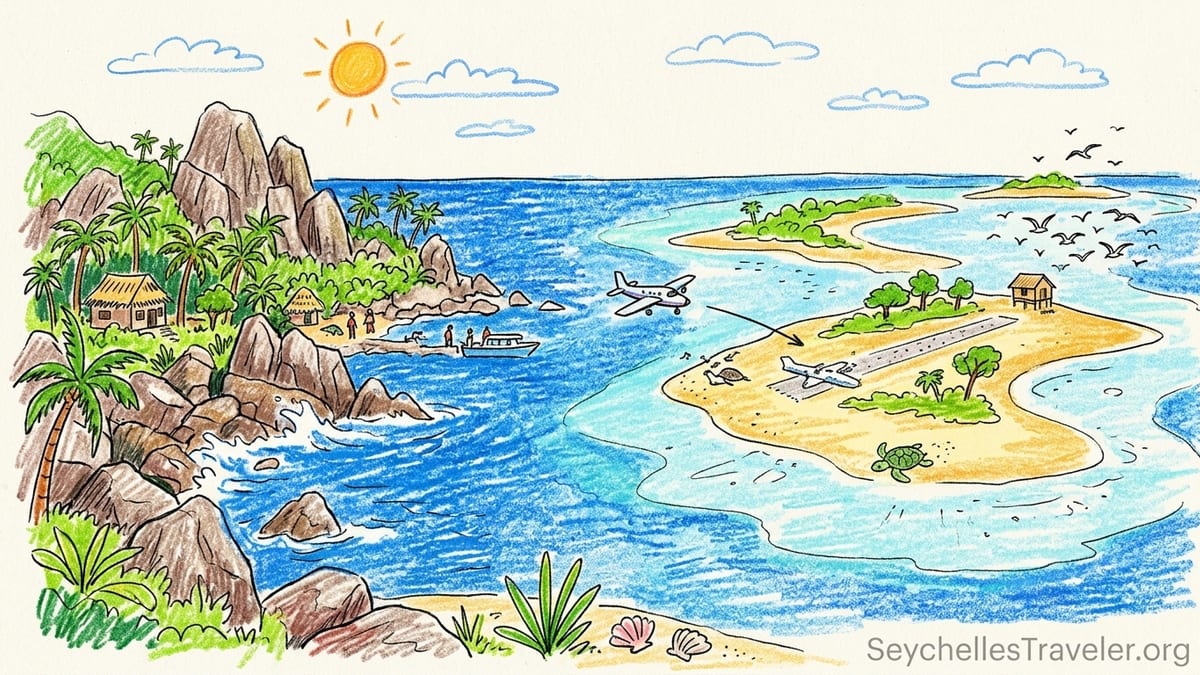
A surprising number of guidebooks still describe all of the Inner Islands of Seychelles as granitic. In reality, two of the most accessible coral islands in the country, Bird Island and Denis Island, sit on the Seychelles Bank and are administratively classed as Inner Islands, even though they are true coralline sand cays. The rest of Seychelles’ coral islands lie mostly in the distant Outer Islands, arranged in small groups and atolls spread hundreds of kilometres from Mahé.
The key distinction is geological rather than purely geographic. Granitic islands such as Mahé and La Digue are fragments of ancient continental crust, rising steeply from deep water. Coralline islands form from coral growth and the accumulation or uplift of calcium carbonate. For travellers, this usually translates into very different scenery and experiences: flatter islands with encircling reefs, long sand flats, fewer freshwater streams and far fewer permanent settlements.
Because of their remoteness and fragile ecosystems, most coral islands are tightly controlled. Access is often limited to guests of a single resort, fishing lodge or eco camp, and transport is arranged through that operator using small domestic aircraft or chartered flights from Mahé. Some of the most pristine atolls, including Aldabra, can only be visited on expedition vessels or with explicit conservation authorization. There are no public ferries connecting Mahé to any of the coral island groups.
When planning your trip, it helps to think in terms of island types. Coral cays such as Bird, Denis or Desroches are low sand islands resting on a reef platform. Low reef islands such as Alphonse or Farquhar combine small islands with extensive surrounding flats that are exposed at low tide. Raised limestone atolls such as Aldabra and parts of Cosmoledo are fossilised reefs heaved above sea level, with sheer coral cliffs, inner lagoons and complex channels that can be difficult to navigate even for experienced expedition crews.
Bird and Denis: Coralline Inner Islands within Reach
Bird Island lies roughly 100 kilometres north of Mahé, right on the northern edge of the Seychelles Bank. It is a classic coral sand cay fringed by shallow reef and famous for its birdlife. Huge numbers of sooty terns nest here mid year, and the island’s position means it is often the first landfall for migratory birds arriving from Eurasia towards the end of the year. Green turtles nest on its beaches, and there is excellent snorkelling on the house reef in calm conditions.
Bird currently offers a small self-catering private island set-up with a handful of chalet-style villas rather than a conventional full-service resort. Stays are usually several nights, booked in advance directly with the island’s management. There is a short coral airstrip and historically there have been scheduled flights from Mahé, operated in cooperation with resort bookings, though availability can vary from season to season. Private yacht charters also visit, subject to the island’s permission and strict environmental rules. Non-staying day visitors from Mahé are generally not practical because of flight logistics and the conservation focus.
Denis Island sits about 95 to 100 kilometres north of Mahé, also on the Seychelles Bank. It is entirely coralline, with a ring of beaches and interior forest that has been extensively restored for native birds. Conservation projects here have successfully introduced species such as Seychelles fodies and warblers from other islands, and guests can often join guided walks to learn about habitat restoration and see rare species in relative comfort. Diving and snorkelling focus on the outer reefs, where drop-offs hold reef sharks, rays and large schools of fish.
As a private island with a single small resort, Denis is accessible only to overnight guests. Access is by domestic flight from Mahé’s domestic terminal, usually around 25 to 30 minutes, on aircraft operated in partnership with the island. When you book accommodation, the resort typically arranges your connecting flight, and luggage allowances on these small planes are lower than on international services. There are no independent guesthouses, no camping and no casual visiting from passing ferries. For many couples and nature-minded travellers, however, Denis offers one of the easiest ways to experience a coralline island without venturing far into the Outer Islands.
The Amirantes: Desroches, D’Arros, Poivre and St Joseph
The Amirantes are the closest of the Outer Island groups to Mahé, strung out in a shallow arc southwest of the main granitic islands. Desroches, around 230 kilometres from Mahé, is often the entry point for travellers. This long, narrow sand cay is home to Four Seasons Resort Seychelles at Desroches Island, a high-end private island resort with villas and suites tucked just behind the tree line. The island’s long beaches and extensive reef flats are important habitats for green and hawksbill turtles, and the resort operates guided dives and conservation activities for guests.
Reaching Desroches involves a domestic flight of roughly 35 minutes from Mahé, departing from the domestic terminal. Seats are booked through the resort, and flights are timed to connect with international arrivals where possible. Independent visitors cannot simply buy a seat and wander around the island; access is limited to resort guests and authorised personnel, and there is no separate village with alternative accommodation. Strict nesting turtle protections and beach driving rules apply, which the resort staff enforce through their internal conservation team.
Further along the Amirantes bank, D’Arros, Poivre and St Joseph are also low coral islands, but they are very different from a visitor’s point of view. D’Arros, around 250 to 260 kilometres from Mahé, is privately owned and managed as a conservation area with research facilities. It has an airstrip and a long history of scientific work on sharks, rays and reef ecology. There is no regular tourism, no public accommodation and any visit requires high-level permission for research, media or conservation purposes. For most travellers, D’Arros is a name encountered in scientific articles rather than a realistic destination to book.
Poivre and St Joseph atolls are also managed through the Islands Development Company and conservation partners. They are known for rich marine life and shallow flats that appeal to specialist fly-fishing operations, as well as for their birdlife and turtles. At the time of writing, there is no mainstream resort infrastructure open to general holidaymakers on these atolls. Access tends to be by chartered aircraft or boat arranged for scientific expeditions, conservation crews or very small-scale special-interest groups. If you see them mentioned in older brochures as future resort sites, treat that information with caution and seek direct, up-to-date clarification before making plans.
Southern Coral Group and Platte: Coral Wilderness Meets New Luxury
South of the Inner Islands, the Southern Coral Group includes Platte Island and Coëtivy, among other low platforms and banks. Platte lies around 130 kilometres south of Mahé, on the edge of deep ocean where manta rays, turtles and pelagic fish are regularly seen. For years it was a remote island with limited infrastructure, visited mainly by researchers and small charter vessels. That picture has changed significantly with the opening of Waldorf Astoria Seychelles Platte Island, a high-end international-branded resort built around lagoon-facing villas and private pools.
The Waldorf Astoria resort has an airstrip that allows direct flights from Mahé, operated in cooperation with the hotel. Travel reports indicate that transfer packages sometimes include flights for longer stays, while shorter bookings may pay a separate per-person transfer fee that can run to several hundred euros per traveller. Flights take roughly 25 to 40 minutes depending on aircraft and routing. Just like Desroches or Denis, Platte is not somewhere you can show up independently; the resort arranges access, and there is no village jetty or budget guesthouse. The surrounding waters are protected for turtles and other marine life, and the resort works with conservation partners to limit light and disturbance on nesting beaches.
Coëtivy lies further southeast of Mahé and has a long history as a plantation and aquaculture site. It is flat, coralline and fringed by a broad reef, but it has never developed as a mainstream tourist destination. Access is restricted and usually tied to governmental projects, research or local operations arranged through the Islands Development Company. While rumours of future tourism developments occasionally surface, at the time of writing there is no regular resort that international visitors can book online in the way they would for Desroches or Platte. Any travel here would be part of a chartered or work-related trip, with permits arranged in advance.
For most travellers interested in the Southern Coral Group, Platte is the realistic option. It combines the convenience of a branded luxury resort with access to coral habitats such as seagrass meadows frequented by turtles and rays, shallow snorkelling sites and offshore dive spots where sharks and schooling fish may be seen. It is very much a fly-in, fly-out private island experience rather than an expedition setting, which makes it appealing for couples wanting exclusivity but less attractive if your main goal is a rugged, research-style adventure.
Alphonse Group: Alphonse, St François and Bijoutier
The Alphonse Group, roughly 400 kilometres southwest of Mahé, is among the best known coral destinations in Seychelles for both divers and serious fly anglers. The main island, Alphonse, is a small coral island with an airstrip and lagoon, supporting a single lodge-style resort often associated with the Blue Safari Seychelles operation. Nearby lie the uninhabited sand islands of St François and Bijoutier, surrounded by extensive sand flats, channels and reef drop-offs rich in marine life.
From a practical perspective, Alphonse is one of the more accessible Outer Islands, but it still requires commitment. Guests fly from Mahé on weekly or twice-weekly charter flights lasting about an hour, organized in tandem with resort bookings. There is no scheduled public service that you can book separately from accommodation, and baggage limits are usually lower than on flights to Praslin or Mahé inter-island routes. On arrival, guests are transferred by golf cart or small vehicles to the lodge. It feels closer to a barefoot fishing lodge combined with a dive base than a typical multi-restaurant resort, though the comfort level is high.
St François and Bijoutier are reached from Alphonse by boat, usually as part of guided excursions for snorkelling, diving, birdwatching or fly-fishing. Their broad tidal flats are renowned for species such as bonefish, giant trevally and permit, which attract anglers from around the world. Conservation measures control how many rods can be active and which areas can be waded on a given tide, and large sections of the atoll remain untouched on any particular day. Snorkellers and divers often encounter turtles, rays and large schools of reef fish over the reef edges, with visibility that can rival better known atolls in the Maldives.
Accommodation in the Alphonse Group is clearly in the specialist lodge category rather than mainstream private-island resort. Packages tend to be sold in week-long blocks including flights, accommodation, meals and guided activities, particularly in fly-fishing season. Independent backpacker-style travel is not supported. If you are primarily a diver, wildlife photographer or angler looking for an intensive experience on a remote atoll, Alphonse makes logistical sense. For honeymooners who mainly want spa treatments and dine-around restaurant options, it may feel too focused on ocean activities.
Farquhar Group: Farquhar, and Nearby Fly-Fishing Atolls
Even further south and west lies the Farquhar Group, a collection of low coral islands and atolls nearer the Equator. Farquhar Atoll itself sits roughly 700 kilometres from Mahé and feels distinctly remote. It consists of a broken ring of islands surrounding a large inner lagoon, with channels that support strong currents and significant fish life. Parts of the atoll have experienced storm damage in past cyclones, but coral recovery and seagrass fields continue to support turtles, rays and reef fish.
Visitor access to Farquhar is limited and specialized. Travel is usually via charter flight from Mahé, often routed in combination with other Outer Islands and organised through a small number of fishing and eco-tourism operators. Accommodation has historically taken the form of simple but comfortable fishing lodges or guesthouses used primarily by fly anglers, along with staff housing for the Islands Development Company. There are no independent restaurants, shops or alternative hotels, and no possibility of day-tripping from the Inner Islands. Permits and conservation conditions, such as catch-and-release rules and strict limits on where boats can anchor, are part of every visit.
From a natural history point of view, Farquhar appeals most to specialist travellers: anglers targeting species like milkfish or giant trevally on the flats, divers interested in big pelagic encounters and expedition-minded photographers keen to capture the sculpted wreckage of storms on outer reef slopes. Casual beach holidaymakers rarely make it here because of the expense and complexity of access. Prices for full lodge packages, including flights from Mahé, can run into several thousand dollars per person for a week, similar to top-end fishing lodges in places like the Seychelles’ own Alphonse or remote Pacific atolls.
Neighbouring atolls used by similar operations, such as nearby Providence or certain banks on the same chain, follow the same pattern: restricted specialist access, no independent tourism, and logistics handled entirely by operators who combine air charters and liveaboard-style motherships. If you are considering a trip of this type, it is important to work with an operator who can provide up-to-date information on conservation regulations, bag limits and any new closures that may be in place.
Cosmoledo, Astove and Assomption: Expedition-Style Coral Atolls
On the outer reaches of Seychelles’ territory, the atolls of Cosmoledo and Astove, along with nearby Assomption, represent the frontier of coral island travel in the country. Cosmoledo is a large, almost circular atoll with deep channels and extensive flats, known for remarkable fish biomass and for its populations of seabirds and turtles. Historically overexploited in some respects, it remains one of the richest marine environments in the region. Astove is a raised coral island with a narrow lagoon and steep outer walls that descend quickly into deep water, offering dramatic diving conditions.
Cosmoledo Eco Camp, located on Wizard Island, is a small, low-impact camp made up of a handful of custom-designed eco pods and a central tented dining area set directly on the sand. It is intentionally temporary and modular, limiting permanent infrastructure on the atoll while allowing small groups to stay for focused fly-fishing and nature itineraries. Access involves at least one domestic or charter flight from Mahé to a staging island such as Astove or Alphonse, followed by a further flight or boat transfer to Cosmoledo. The total travel time can be several hours, and departures are tightly linked to weekly package schedules. There is no possibility to buy a one-way ticket and arrive outside of these logistics.
Astove has a similar expedition character. Visitors stay in a small lodge or camp facility used primarily by anglers and divers, with groups arriving by charter flight from Mahé as part of multi-island packages. The surrounding waters are known for drop-offs where sharks and large pelagic species are encountered, but conditions can be challenging, with currents and occasionally rough seas. On land, the vegetation is low and salt-tolerant, and parts of the coastline are limestone cliffs rather than wide beaches.
Assomption, which lies closer to Aldabra, is currently more of a logistical support island than a tourism destination in its own right. It has an airstrip used by supply and charter flights and has been the subject of environmental and infrastructural discussions in recent years. At present, there is no mainstream tourist accommodation or simple way for independent travellers to stay on Assomption. Any visit would be arranged through government or conservation bodies or as part of a very specialised charter. Travellers should be cautious about outdated online references that suggest easy tourist stays here.
Cosmoledo and Astove are excellent examples of the difference between resort travel and expedition travel in Seychelles’ coral islands. Nights are spent in eco pods or lodge rooms designed for anglers, not marble-clad suites, and days revolve around tides, wind conditions and conservation rules. Anyone planning a visit should be comfortable with small aircraft, boat transfers, strict catch-and-release policies and schedules that can shift if weather affects flights.
Aldabra: Protected Atoll, Strict Access
Aldabra Atoll, a raised limestone atoll in the far southwest of Seychelles and a UNESCO World Heritage Site, is often called the “Galapagos of the Indian Ocean” for its immense population of giant tortoises and relatively untouched ecosystems. It lies more than 1,000 kilometres from Mahé. The atoll consists of a ring of islands surrounding a large inner lagoon, with very narrow channels that create powerful tidal currents. The islands support tens of thousands of giant tortoises, significant seabird colonies and a remarkable variety of fish, sharks and rays in the adjoining waters.
Unlike islands such as Desroches or Denis, Aldabra does not have a standard resort and cannot be visited by booking a hotel room and a domestic flight. The atoll is managed by the Seychelles Islands Foundation primarily for conservation and research. There is a small research station with staff accommodation but no tourist hotel. Visitor numbers are strictly controlled, and most tourists who see Aldabra do so as part of an expedition cruise, usually on small ships that obtain prior permission and land passengers at specific points for guided walks and zodiac excursions.
Some high-end liveaboard vessels that operate as dive cruises in the outer Seychelles occasionally include Aldabra in their itineraries during suitable seasons. These trips tend to be costly, often comparable to or more expensive than a week at a top-end private island resort, but they provide unparalleled access to the atoll’s lagoon, outer walls and channels under the supervision of experienced guides and scientists. Landings can be cancelled or curtailed if weather or conservation concerns require it, and activities take place entirely under the direction of the Seychelles Islands Foundation staff.
For independent travellers, the most realistic way to plan a visit to Aldabra is to watch for confirmed expedition cruise departures rather than trying to arrange a private yacht or flight. Even yachts that reach the atoll are obliged to comply with strict permitting and quarantine rules, including biosecurity checks to prevent invasive species. In practical terms, Aldabra is a once-in-a-lifetime expedition destination for committed wildlife travellers, divers and conservation-minded visitors rather than an add-on to a beach holiday in Mahé.
How to Choose the Right Coral Island for Your Trip
With so many small groups and atolls, it can be difficult to decide which coral island is right for you. One useful approach is to match islands to traveller profiles. Couples looking for a private-island feel with comfortable villas and relatively straightforward access often focus on Denis, Bird, Desroches or Platte, all of which can be reached on flights of around half an hour from Mahé and have structured transfer services included or arranged through the resort. These options feel remote yet remain within the realm of ordinary leisure travel, with spas, good food and guided snorkelling trips forming the backbone of a stay.
Dedicated divers, wildlife travellers and photographers who want more time on reefs and flats often look to the Alphonse Group, Cosmoledo, Astove or expedition cruises that include Aldabra. Here, daily life follows the tides rather than restaurant reservation times, and itineraries are built around dawn departures in skiffs, multi-dive days and evening briefings about reef conditions or bird counts. Accommodation ranges from comfortable lodge rooms to eco pods with sand floors underfoot, and reliable wifi or in-room entertainment is usually low on the priority list compared with access to manta cleaning stations or nesting turtle beaches.
Anglers, especially those interested in saltwater fly-fishing, find some of the world’s most sought-after flats on St François, Cosmoledo, Farquhar and related atolls. Trips are typically sold as all-inclusive packages with guides, skiffs and limited rod numbers to protect fish stocks. Spaces in prime weeks can sell out many months, even a year or more, in advance, similar to top-tier river lodges in places like Patagonia or Alaska. For these travellers, comfort is important, but equal weight is given to guide quality, skiff access to remote flats and the operator’s conservation track record.
In contrast, luxury visitors whose priority is a high-end resort experience with private pools, branded spa treatments and polished dining might compare Four Seasons Desroches and Waldorf Astoria Platte with upscale granitic island resorts on Mahé, Praslin or Silhouette. Both Desroches and Platte combine coral island scenery with international hotel services, making them natural choices for honeymooners or anniversary trips where the island’s wildness is a bonus rather than the main focus. These stays can also be paired with time on Mahé or Praslin to balance seclusion with broader sightseeing.
Comparison Table: Matching Islands to Traveller Types
The following simplified comparison can help you narrow options once you have a sense of your priorities. It is based on current patterns of access and infrastructure and may evolve as new projects appear or conservation rules change.
For couples seeking seclusion with comfort, Bird, Denis, Desroches and Platte all work well. Bird and Denis feel more intimate and nature-focused, with smaller guest numbers and strong conservation stories, while Desroches and Platte add the amenities of international luxury brands, multiple dining venues and more elaborate spas. All of these islands require pre-booked flights from Mahé that are tied to accommodation, and last-minute changes can be difficult, so building in a buffer night on Mahé before and after is often wise.
Divers and wildlife travellers will find the richest coral-focused experiences at Alphonse, St François, Cosmoledo, Astove and Aldabra via expedition cruises. Alphonse combines comfortable lodge life with daily boats to outstanding dive and snorkel sites, suitable for those who want an intensive marine experience but prefer sleeping on land. Cosmoledo, Astove and Aldabra are more remote again, and best suited to experienced travellers who are comfortable with unpredictability in schedules and conditions.
For anglers, the stand-out names are Alphonse and St François, Farquhar, Cosmoledo and Astove, with specialist lodges or eco camps acting as the base for guided flats and blue-water fishing. Luxury visitors who are not anglers typically gravitate to Desroches and Platte instead. First-time coral island visitors with limited time might start with Denis or Desroches, which require only a short hop from Mahé and offer a gentle introduction to coral environments. Repeat visitors or expedition-minded travellers can then consider stepping up to Alphonse or Cosmoledo, building in the necessary travel days and budget.
FAQ
Q1. Are all of Seychelles’ Inner Islands granitic?
Not all of them. While most Inner Islands like Mahé and La Digue are granitic, Bird Island and Denis Island are coralline sand cays that sit on the Seychelles Bank but are still classed administratively as Inner Islands.
Q2. Can I visit Bird Island or Denis Island on a day trip from Mahé?
In practice, no. Both islands require flights that are coordinated with overnight accommodation bookings, and there are no public ferries or simple day-trip packages. Stays are generally sold as multi-night private island experiences.
Q3. How do I reach Desroches Island from Mahé?
You fly from Mahé’s domestic terminal on a short flight of around 35 minutes arranged through Four Seasons Resort at Desroches. Only resort guests and authorised personnel use this service, and seats are tied to room reservations rather than sold as stand-alone tickets.
Q4. What is the difference between a private island resort and a fishing lodge in Seychelles?
A private island resort, such as those on Desroches or Platte, focuses on broad leisure amenities like spas, multiple restaurants and general beach relaxation. A fishing lodge or eco camp, such as on Alphonse or Cosmoledo, is primarily geared to specific activities like fly-fishing or diving, with simple, functional accommodation and daily guided outings forming the core of the experience.
Q5. Is Platte Island now open to ordinary tourists?
Yes, in the sense that Waldorf Astoria Seychelles Platte Island accepts international leisure bookings and provides scheduled private flights from Mahé for its guests. However, access is still restricted to resort guests, with no public ferry or alternative accommodation.
Q6. How can I visit Aldabra Atoll as a tourist?
Most visitors reach Aldabra on expedition or dive cruises that have obtained prior permission from the Seychelles Islands Foundation. There is no hotel on the atoll, no regular flight service for tourists and no way to visit on a casual day trip from Mahé.
Q7. Which coral islands are best for first-time visitors to Seychelles?
For a first coral island experience, Denis, Bird, Desroches or Platte are good choices. They combine accessible flight times from Mahé with comfortable accommodation, guided nature activities and clear booking procedures through established resorts.
Q8. Are there budget options on Seychelles’ coral islands?
True low-budget options are limited, because almost all accessible coral islands are single-resort or lodge destinations that require charter flights. Travellers on tighter budgets often experience reefs and coral habitats instead through day trips and snorkelling from Mahé, Praslin or La Digue.
Q9. Do I need special permits to fish or dive on Outer Island atolls?
When you book with a lodge, eco camp or liveaboard, necessary permits are usually organised on your behalf and built into the package price. Independent fishing and diving without an operator is not practical and often not allowed, especially on sensitive atolls.
Q10. How far in advance should I book a coral island trip in Seychelles?
For popular resorts like Desroches or Platte, booking several months in advance is sensible, especially for high season. Specialist fishing or diving packages to Alphonse, Farquhar, Cosmoledo or Aldabra-linked cruises can sell out a year or more ahead in prime weeks, so early planning is strongly recommended.