


The turboprop banked left and suddenly Alphonse Island filled the window, a thin green comma of land ringed by white sand and impossible shades of turquoise. I had seven nights booked with Blue Safari Seychelles, six full days of guided fly-fishing on the flats of Alphonse and St François, and a credit card still smoking from committing to a package that cost more than my first car. This was the trip I had been saving for, talking about and quietly fearing would never quite live up to its price tag.
How I Booked It, What I Paid and When I Went
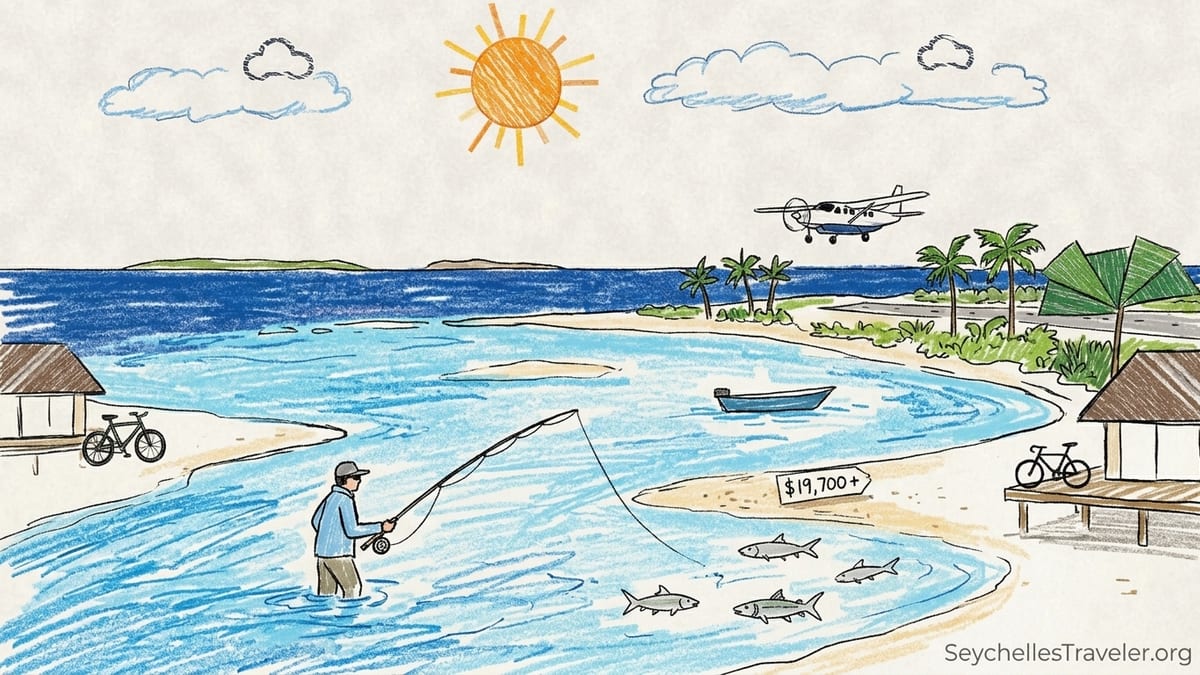
I travelled in late March 2026, at the tail end of the main Alphonse season, when water temperatures are still comfortable and the southeast trade winds have not yet settled in. I booked directly through a specialist fishing travel agent who works with Blue Safari, on their standard seven-night, six-fishing-day fly-fishing package, with single-occupancy accommodation and a dedicated single skiff upgrade. In total, my fishing package, conservation levies and domestic flights from Mahé to Alphonse came to a little over 19,700 US dollars for one angler.
The core of that cost was the Blue Safari fishing package itself. Current published rates for 2026 from several specialist outfitters show that a single-occupancy Beach Bungalow package with shared skiff on Alphonse starts from about 15,280 US dollars per person for seven nights and six guided days. This includes the return charter flights between Mahé and Alphonse, all meals, laundry, most drinks, six days of guided fly-fishing with two anglers per guide and skiff, loaner rods and reels, non-motorised activities, snorkelling equipment and VAT. On top of that, Blue Safari charges an environmental and conservation levy of around 266 US dollars per angler for the week, itemised separately.
I chose to add the single-skiff supplement, which is widely advertised at roughly 4,500 US dollars per week, or about 750 dollars per day, when available. That pushed my fishing package into the region of 19,780 dollars before I had even bought a fly or set foot on Mahé. International flights from my home in the United States to Seychelles added another 2,000 dollars in economy class, plus an overnight stop in Mahé each way. By the time I checked in at the tiny domestic terminal for the hour-long flight to Alphonse, my total outlay was uncomfortably close to 22,000 dollars for a single-angler trip.
For accommodation, I picked a Beach Bungalow rather than the larger and more expensive Beach Villas. These stand-alone bungalows are the “standard” fishing rooms: simple, air conditioned and a short walk or bike ride from the fishing centre and restaurant. The package covered seven nights on Alphonse, six full fishing days based out of St François, and the charter flights that link the island to Mahé once a week. In other words, once the seaplane touched down on the lagoon, I was committed to seven days and nights of whatever the atoll chose to give me.
The Journey from Mahé and First Impressions of a Fishing Factory
The adventure really started at Mahé’s domestic terminal. Blue Safari staff weighed our bags carefully, tagging rod tubes and duffel bags, and reminded us of the strict luggage limits on the charter. The aircraft was a twin-engine turboprop operated by the islands’ internal carrier, with about twenty passengers made up of anglers, non-fishing partners and a couple with small children heading out simply for the beach and snorkeling.
An hour after leaving Mahé we were descending over an empty Indian Ocean, with nothing but coral heads and a ring of surf visible until Alphonse appeared. On landing, we taxied past palm trees almost brushing the wingtips and rolled to a stop on a strip that felt only marginally wider than the aircraft. The welcome was efficient rather than theatrical. We were handed cold towels, coconut water and a briefing about tides, boat schedules and the house rule that flip-flops did not belong in the dining area at dinner. The emphasis was on practicalities, not pampering.
The fishing centre sits a short walk from the runway, a low building that smells of salt, sunscreen and the faint tang of fly line dressing. Inside, racks of 8, 9 and 12-weight rods waited for those using the complimentary loaners. Guides moved quietly among guests, checking knots, swapping out cracked fly lines and gently talking down those who had arrived with 10-pound tippet for fish that routinely pull 150 meters of backing. When my bags arrived on the back of a golf cart, I unpacked three rods of my own: an 8-weight for bonefish, a 9-weight for triggers and light trevally, and a 12-weight for giant trevally.
That first evening, after a quick exploratory wade on the ocean side of Alphonse, we sat through the main orientation session. The head guide walked us through tide charts, explained how we would transfer each morning by mothership to the St François atoll, and laid out the non-negotiables of the operation: barbless hooks, strict catch and release, no fishing without a guide on St François and a hard “lines up” time in the afternoon. It was clear that this was not a casual DIY fishery but a tightly managed program built around protecting a remarkably productive but fragile atoll.
A Typical Day: Dawn Starts, Skiff Rides and Life Around the Flats
The fishing days fell into a predictable rhythm. My alarm sounded at 5:15 a.m., followed by a strong coffee and an early breakfast at the central restaurant. By 6:15 the anglers gathered at the fishing centre where guides were already rigging leaders and stacking skiffs on trailers for the short tow down to the harbour. On my first morning, my guide, a South African with a decade of Seychelles seasons behind him, suggested 16-pound fluorocarbon for bonefish, 20- and 25-pound for triggers and up to 130-pound for giant trevally bite tippets.
By 7:00 we were on board the larger transfer vessel for the run across to St François, about 40 minutes of low conversation, coffee refills and last-minute fly box edits as the light grew. The arrival at the atoll each morning never got old: the silhouette of St François, then the skeleton of a disused lighthouse, and finally the flats themselves appearing in different moods as the tide moved. Some mornings we stepped off into shin-deep glass, other days into thigh-deep milky water pushed by a stiff breeze.
From the mothership we transferred to the skiffs in pairs, except that I was alone with my guide on a single skiff. That meant we could tailor each day to tides and targets without having to compromise with another angler’s preferences. Most mornings started with a wade on a classic bonefish flat as the tide fell. The guides read these tides with an ease that only comes from hundreds of days on the water. One glance at a cut in the reef or a colour change and they could tell you how fast the water would drain and where the bonefish traffic would concentrate.
Lunch was nearly always a simple affair eaten under the shade of the skiff canopy or on sandbars, often what Blue Safari calls a “flats lunch,” with coolboxes transferred from the mothership. The afternoons shifted focus according to light and tide. We might motor to a coral finger flat to look for tailing triggerfish, or stake out a turtle grass bay for the sudden appearance of a black shape that could be a giant trevally or a big bluefin. Lines up came around 4:00 p.m., with a run back to the mothership, a quiet boat ride to Alphonse and a late-afternoon shower before drinks and dinner under the stars.
Bonefish, Giant Trevally and the Fish I Actually Saw
Alphonse and St François are marketed as multi-species fisheries where you can, in theory, catch everything from bonefish and giant trevally to milkfish and permit on the same trip. The reality, at least on my week, was more focused. Weather, tides and my own casting limitations shaped what we targeted, and the fish I actually saw formed a narrower but still thrilling list.
Bonefish were the dependable constant. On falling tides over bright sand, we often stood in one spot as squads of three to ten fish ghosted past every few minutes, classic cruising bonefish between three and six pounds with the odd larger fish mixed in. Over six days I landed somewhere between thirty and forty bonefish, with my best day producing 14 landed and several more lost. The guides handled them quickly, keeping them in the water, removing barbless hooks with forceps and sending them on their way within seconds. Many of these fish were hooked within twenty meters of my feet, making the first blistering run all the more startling.
Giant trevally were a different story. I saw fewer than ten legitimate GT shots all week. On the second day, wading a turtle-backed flat barely covered in water, my guide suddenly stiffened and pointed at what looked like a dark coral head moving across the sand. It was a GT of about 80 centimetres, cruising fast and shallow. I made one cast with the 12-weight, dropped the fly too close, and the fish flared, turned and vanished into deeper water. On day four, a pair of smaller GTs rushed a school of mullet close to the shore of St François, but by the time I swapped rods they were already out of range. I never did connect with a giant trevally on this trip, and I left with a healthy respect for why the species retains almost mythical status among visiting anglers.
Permit and milkfish were present but not prominent in my week. We saw a handful of permit on one calm morning, ghostly sickle tails on the edge of a bonefish flat. By the time I changed to a crab fly they had melted away. Milkfish showed themselves as distant boils offshore, tight packs slurping plankton in blue water beyond the reef edge. A few boats in our group focused on them and at least one angler hooked and lost a milkfish after a long fight, but with limited time and a long wish list I chose not to dedicate a full session to them. My species list instead filled out with bluefin trevally, small groupers along drop-offs and a single moustache triggerfish, landed after two failed hook sets and several moments where the fish simply tailed on the fly without committing.
The Physical Reality: Wading, Wind and Long Days on the Water
On paper, six days of guided fishing on tropical flats sounds like a gentle, almost lazy holiday. In practice, wading the flats of St François for eight or nine hours a day is a physical experience that felt closer to an endurance event. The guides do their best to pace things and to use the skiffs to reduce unnecessary walking, but there is no escaping the fact that you spend long hours on your feet in warm water, often in a steady breeze and always under a strong equatorial sun.
On some sessions we waded from the skiff with water around mid-calf, stepping carefully over firm sand and occasional coral heads. On others, especially when we fished outer edges or channels, water was at mid-thigh or higher, and each step required concentration to avoid holes or sharp coral. My legs ached each evening, and by the third day small blisters on my heels and toes reminded me of every extra hundred meters we walked chasing a school of bonefish that always seemed just out of casting range.
The wind is a constant factor in this fishery. Even in late March, when the strongest trade winds had not yet set in, we saw several days with 15 to 20 knots of breeze. Casting a weighted shrimp pattern on an 8-weight into that wind, or dropping a large baitfish pattern for GTs across it, demanded a compact, efficient cast and a willingness to accept that some presentations would simply fall short. I watched more than one visiting angler arrive with a beautiful long casting stroke honed on trout rivers at home, only to spend the first two days battling tailing loops and wind knots until they learned to generate tight loops and higher line speed.
Long sleeves, sun gloves, buff, hat and sunglasses were not optional. Even with high-SPF sunscreen reapplied at lunch, my cheeks and the tops of my hands burned slightly on day one. The lodge provides drinking water and encourages refills, and guides constantly remind you to drink. On a couple of afternoons, I realised I had barely spoken for an hour, my focus narrowed to the simple act of scanning water and moving slowly forward in line with the guide’s quiet commands. It was as mentally tiring as it was physical, a sustained period of intense concentration broken only by the explosive release of a take and run.
Guides, Catch and Release and How the Fishery Is Protected
Blue Safari and the Alphonse Fishing Company operate the atoll under a conservation-first model that is obvious from the moment you step into the fishing centre. There are no fish hanging from scales, no grip-and-grin posters of dead trophies. The daily briefing boards talk about tides and targets, but they also reference turtle nesting areas, bird colonies and zones where skiffs are not allowed to run their engines.
Every fish we targeted was handled as catch and release. Bonefish were never lifted higher than a few centimetres above the water for a quick photograph, and most of mine were simply unhooked without leaving the water at all. Giant trevally, on the boats where they were landed, were cradled briefly alongside the skiff for a photo before being revived and released. The guides cut leaders close to the hook when deep on smaller reef species rather than risk damage by digging them out. There was a noticeable culture of respect for the fish that felt more like a shared value than a rule imposed for marketing purposes.
The protection extends to the habitat. The guides fiercely policed where boots landed. Walking on live coral was corrected instantly and politely. Skiffs used designated run lines across the lagoon to avoid scarring sensitive areas, and engines were cut well before we stepped out to wade. Only a limited number of anglers can fish St François at any one time, restricted by lodge capacity and guide numbers, and there are rest days where certain flats are not fished at all. The weekly conservation levy that appears on your invoice is explained as helping fund research and monitoring on the atoll, including tagging projects and habitat surveys.
This structure comes at a cost. There is no unguided fishing allowed on St François, and only limited DIY options on Alphonse itself, mostly around the home flats within sight of the lodge. For some anglers used to wandering wherever they like, the constant guide presence may feel restrictive. I found the opposite. Having a professional next to me, explaining why a certain flat needed a rest day or how a turtle grass bed protected juvenile fish, made each session feel like a field class in how a coral atoll works.
Shared Skiff vs Single Skiff: Where the Money Really Goes
Before my trip I agonised over whether to pay for the single skiff option. The standard arrangement in the current Blue Safari packages, as offered by multiple agents, is two anglers per guide and skiff on St François, built into that 15,280 dollar baseline package. The single skiff supplement pushes the per-angler price for the week to around 19,780 dollars, which is a substantial jump for the privilege of having a guide and boat to yourself.
On the water, the difference is more than just personal space. With two anglers sharing a skiff, you alternate shots at fish, swap positions on the bow and inevitably compromise on target species if you have different priorities. On a single skiff, every decision flows from your own goals and abilities. On my week, that meant spending extra hours quietly working on my permit presentation without feeling guilty that a boat partner might prefer to chase bonefish, or dedicating an entire tide to a single long wade for one good GT shot.
The guides also adjust their teaching style. One-on-one, mine had the time to dissect my casting and strip striking in a way that would be hard in a shared setting. We spent a full session on day two doing nothing but practicing quick-fire twenty-meter casts at imaginary GTs, line coiled at my feet, rod tucked under my arm between shots. I am convinced that without that, I would have squandered even more of the few giant trevally chances I saw.
From a value perspective, the equation is nuanced. If you divide the single skiff supplement by six fishing days, you are paying around 750 dollars per day for the extra exclusivity and flexibility. For some anglers that will feel extravagant. For others, especially those travelling halfway around the world for what might be a once-in-a-lifetime trip, it will seem like an essential investment in maximising limited time. In hindsight, I do not regret paying it, but I would say that anglers on a tighter budget, or those who enjoy the camaraderie and shared learning of fishing with a partner, will find plenty of value in the standard shared skiff arrangement.
Gear, Rentals, Meals and Life Off the Water
One of the advantages of Alphonse is that you can arrive with minimal gear and still be fully equipped to fish. Blue Safari includes loaner fly rods and reels in the package cost, both for flats and bluewater, although flies, leaders and other tackle are extra. On my week, bonefish flies in the fishing centre ran at Seychelles resort prices, so I was glad I had arrived with a box of proven patterns: Gotchas, Christmas Island Specials, small shrimp patterns with medium chain eyes in sizes 4 to 8. For GTs, I brought a selection of large brush flies and baitfish imitations on strong 4/0 and 6/0 hooks, matched to a 12-weight line.
Lines matter in the heat. Tropical-weight floating lines on the 8 and 9-weights and a floating line with a strong core on the 12-weight were essential. Anything designed for temperate climates tends to wilt in the equatorial sun, becoming sticky on the deck. Leaders ran from 12- to 20-pound fluorocarbon for bonefish, up to 25- or 30-pound for triggers and small trevally, and heavy monofilament bite tippets of 100 to 130 pounds for GTs. The fishing centre carried all of this, but at import-and-island-inflated prices.
Back at the lodge, life off the water felt relaxed without losing the focus on fishing. Meals were generous and varied, leaning on Indian Ocean seafood, fresh salads and curries. Breakfasts included eggs made to order, fruit and strong coffee. Lunch, usually taken as a picnic on the flats, arrived in coolboxes with sandwiches, grilled chicken, salads and fruit. Dinners alternated between plated three-course meals and themed buffets, with a mixture of local Creole dishes and more familiar international options.
Outside fishing hours, most movement on the island is by bicycle. Each bungalow comes with a bike, and pedalling under palms along sandy paths to the bar or dive centre quickly became part of the charm of the week. Non-fishing activities included snorkeling on nearby reefs, stand-up paddleboarding in the lagoon and a pool that saw steady use in the afternoons. I took one un-guided snorkeling session on a no-fishing afternoon and drifted above turtles and reef sharks in water as clear as any I have seen.
Weather, Tough Days and When the Fish Do Not Show
Not every day looked like a glossy brochure. Late March can be a transitional period between weather patterns, and we experienced two days with heavy cloud cover that made spotting fish extremely difficult. On those mornings, even my experienced guide struggled to see bonefish until they were within a few rod lengths, and the normal rhythm of spotting, setting up a shot and casting dissolved into reactive, rushed swings in poor light.
On day three, a stiff crosswind and grey sky combined to create probably the most humbling fishing day I have had on saltwater flats. We concentrated on a narrow channel where bonefish were funneled on the falling tide, but casts that would have been routine in calm conditions suddenly felt marginal. Wind blew the line off course, presentations landed heavy, and I missed or spooked more fish than I hooked. I ended the day with just three bonefish landed, several pulled hooks and a mild sense of embarrassment at how quickly conditions had exposed the weaknesses in my casting.
There were also simply slower windows. One afternoon on the ocean side of St François we hunted triggers for nearly four hours on what should have been a prime low tide. I saw perhaps ten tailing fish, cast to four of them and hooked none. A combination of picky fish, imperfect presentations and the innate difficulty of the species meant I finished the session with nothing but a couple of follows and a vivid memory of neon-yellow tails waving above coral patches.
Physically, I also felt the accumulation. By day five, my lower back and shoulders were tight from a week of double-hauling in wind and standing on uneven ground. Hydration and rest helped, but there is no ignoring the fact that a full Alphonse fishing week is demanding. This is not a resort where you fish a gentle half-day and lounge by the pool for the rest. If you want to make the most of the cost, you will likely push yourself through full days on the flats, and that has consequences for energy levels and morale when weather or fish behaviour do not cooperate.
The Takeaway
When I boarded the charter back to Mahé after seven nights and six full days on the flats, the question I had been asking myself all week crystallised: was it worth it. On one level, the sheer numbers are hard to ignore. More than 19,700 dollars for the week on Alphonse, close to 22,000 once international flights and stopovers are included, is an extraordinary amount of money for a single angler. With that same budget, you could fish several high-quality saltwater destinations closer to home over multiple seasons.
Yet value is not only about cost per fish or cost per day. It is about the combination of environment, species, guiding, comfort and the sense of being briefly embedded in a functioning conservation model that actually seems to work. On my week, I experienced bonefishing that was as good as anything I have seen, a realistic if ultimately unfulfilled shot at giant trevally, regular encounters with triggers and bluefin trevally, and long days in a place where the edge of the flats felt like the edge of the world. I watched turtles nesting, rays crossing channels in formation and reef sharks patrolling drop-offs in water so clear that depth became a challenge to judge.
For highly motivated, moderately experienced saltwater anglers who have already fished more accessible flats in places like the Bahamas, Mexico or Belize and who can afford the cost without jeopardising other responsibilities, an Alphonse week with Blue Safari can feel justified. The combination of professional guiding, carefully managed access to a remote atoll and a lodge that genuinely understands anglers makes for an experience that is hard to replicate elsewhere.
For less experienced fly fishers or those new to saltwater, I would sound a note of caution. The learning curve on Alphonse is steep, the casting demands are real and the environment is unforgiving of bad habits. You can certainly learn here, and the guides are patient teachers, but given the stakes, many beginners might be better served by cutting their teeth on a more accessible and affordable destination first. A week chasing bonefish on easier Caribbean flats at a fraction of the price will expose your weaknesses in casting, line management and fish handling without the pressure that comes from knowing each shot in Seychelles carries a high financial weight.
I left Alphonse tired, slightly windburned, and without the giant trevally hero shot I had imagined. Yet I also left with a deeper understanding of what it takes to manage a remote atoll, a new respect for bonefish and triggerfish, and an appreciation for how a high price can, at least in part, reflect the true cost of doing conservation-minded fishing in the middle of the Indian Ocean. For me, this once-in-a-decade trip felt worth it. Whether it is right for you will depend on your skills, your budget and how much you value standing on a bright sand flat, a thousand miles from the nearest continent, waiting for a dark shape to emerge from the blue.
FAQ
Q1. How much did your Alphonse Island fly-fishing trip actually cost?
My seven-night, six-fishing-day package with Blue Safari, including a single skiff supplement and conservation levy, came to a little over 19,700 US dollars before international flights and Mahé stopovers.
Q2. What is included in a typical Blue Safari seven-night fly-fishing package?
The current standard package usually includes seven nights’ accommodation, six days of guided fly-fishing on a shared skiff, all meals, most drinks, return charter flights between Mahé and Alphonse, laundry, non-motorised activities, loaner rods and reels, snorkelling equipment and VAT, with a separate conservation levy added.
Q3. Is the single skiff upgrade on Alphonse worth the extra cost?
The single skiff supplement is roughly 4,500 US dollars per week, which buys you one-on-one guiding, full control of the daily plan and every shot at fish. I found it worthwhile, but anglers on tighter budgets or those who enjoy shared-boat camaraderie will do well on the standard shared skiff option.
Q4. How physically demanding is a week of wading the flats on Alphonse and St François?
It is demanding. Expect long days on your feet, often in wind and strong sun, with wading in water from ankle to thigh deep over uneven ground. Good fitness, broken-in boots and diligent sun protection make a big difference.
Q5. What species did you actually see and catch during your week?
I landed several dozen bonefish up to around six pounds, a handful of bluefin trevally and one moustache triggerfish. I had multiple sightings and a few shots at giant trevally but did not land one, and only brief encounters with permit and milkfish.
Q6. Can beginners or less experienced fly anglers enjoy Alphonse, or is it only for experts?
Beginners can learn a lot here and the guides are patient, but the casting demands and high cost mean it is a better fit for anglers with at least some saltwater experience. Many newer anglers may be better starting on more forgiving and less expensive flats closer to home.
Q7. Do you need to bring your own gear, or is rental equipment good enough?
The lodge includes loaner rods and reels in the package and they are perfectly fishable. I preferred my own rods and lines but would be comfortable relying on the lodge gear and buying or bringing flies, leaders and other terminal tackle.
Q8. What are the non-fishing activities like for partners or rest days?
Non-anglers can snorkel, dive, paddleboard, cycle around the island, relax by the pool or on the beach and join guided nature walks. The island is small but offers enough variety to keep most partners content for a week.
Q9. How strictly is catch and release enforced on Alphonse and St François?
Catch and release is taken very seriously. All target species on the flats are released, hooks are barbless, handling time is minimized and guides actively police both fish care and where guests can wade or run skiffs.
Q10. In hindsight, would you recommend Alphonse Island to other travelling anglers?
Yes, with caveats. It is an exceptional but very expensive and demanding destination. For experienced, committed saltwater anglers who understand the costs and challenges, it can be unforgettable. For newer anglers or those on limited budgets, more accessible flats fisheries may be a better first step.