


Few destinations pack as much wildlife into such a small footprint as the inner islands of Seychelles. Within a short boat ride of Praslin and La Digue you can walk among free-roaming Aldabra giant tortoises, cross boardwalks through mangroves, watch tropicbirds wheel over sea cliffs, and snorkel above coral gardens where turtles graze. This guide compares the three standout wildlife islands Curieuse, Cousin and Aride, explains how they differ from La Digue’s Veuve Special Reserve, Praslin’s palm forests and nearby marine parks, and helps you choose the most worthwhile nature excursions for your time and budget.
Understanding Seychelles’ Protected Islands and Marine Parks
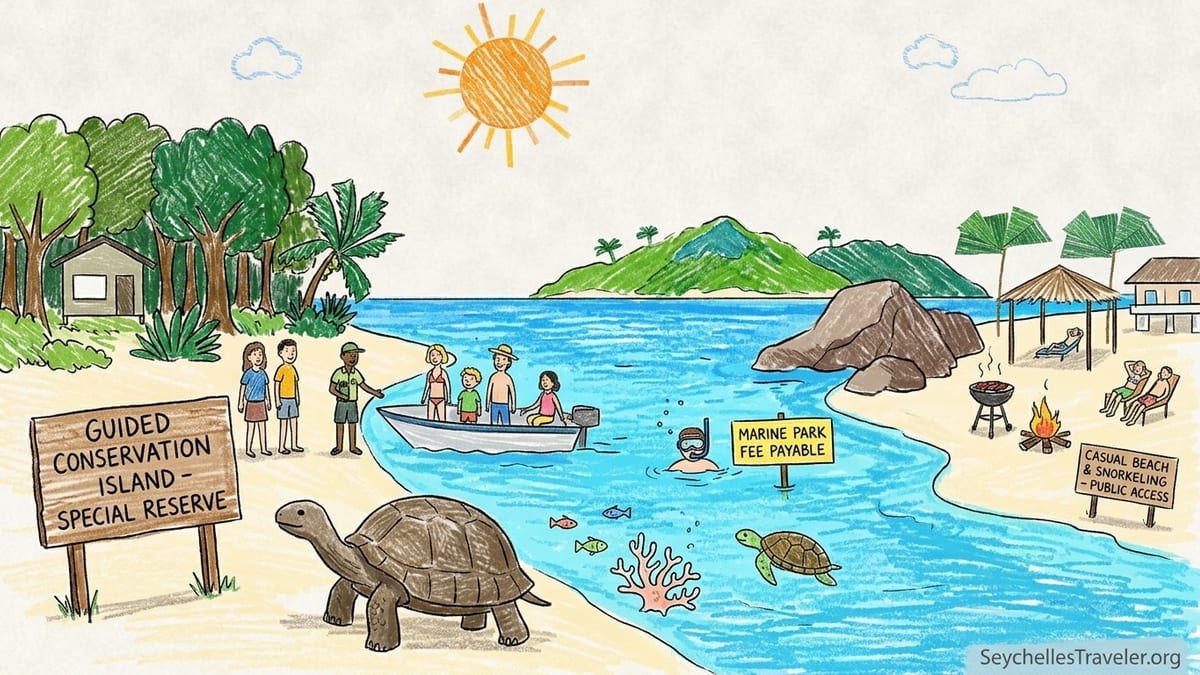
Protected areas in Seychelles fall into several categories that matter directly to visitors. Marine national parks such as Curieuse and Sainte Anne protect underwater habitats and surrounding islands; you pay a per-person park fee to enter, and tourism focuses on low-impact snorkeling, swimming and beach time. Special nature reserves such as Cousin and Aride place conservation first and tourism a clear second. Access is tightly controlled, group sizes are limited and you may only visit with trained guides under set rules. Finally, there are privately owned or government-leased resort islands where overnight guests stay in hotels or villas while conservation happens largely in the background.
These distinctions help explain why you can wander relatively freely across much of Curieuse’s main trail network, but must follow a fixed route and schedule on Cousin and usually on Aride. They also affect pricing. As of late 2026, the Seychelles Parks and Gardens Authority lists non-resident adults paying around SCR 300 per day ticket for Curieuse Marine National Park, while marine parks such as Sainte Anne, Baie Ternay and Île Cocos are set at about SCR 200 per non-resident adult. Boat transfers are separate and typically handled by excursion companies or charter skippers, who either include the park fee in your quote or ask you to pay it on arrival by card.
Special reserves such as Cousin and Aride are usually run by conservation NGOs rather than the parks authority. They set higher conservation-based visit charges to fund wardens, monitoring and research. Separately, terrestrial sites such as La Digue’s Veuve Special Reserve are managed by the parks authority but have their own entrance fees, currently around SCR 150 for an unguided visit by non-resident adults or SCR 200 for a guided walk. None of these protected areas offer regular tourist accommodation on site, so visits are almost always day trips from Praslin, La Digue or Mahé.
For travelers this structure means that “wildlife island day trip” can mean very different things in practice. A Curieuse excursion might combine casual beach barbecues, wandering among semi-habituated tortoises and snorkeling at St Pierre, while a Cousin visit runs as a tightly managed conservation experience where you arrive and leave at fixed times and explore only in the company of a guide. Matching your expectations to the protection category is the first step to choosing the right outing.
Curieuse: Giant Tortoises, Mangroves and Easy Wildlife for All
Curieuse sits just north of Praslin and is one of the most popular wildlife excursions in Seychelles for good reason. Designated as a marine national park in 1979, it protects around 15 square kilometres of sea and land and shelters a free-roaming population of Aldabra giant tortoises. More than 300 individuals live on the island, many clustered near the ranger station at Baie Laraie where day boats usually land. Watching them lumber between shade trees or wallow in shallow water gives visitors, including children, an unusually intimate look at these long-lived reptiles without visiting remote Aldabra Atoll itself.
From Baie Laraie a marked nature trail crosses the island to Anse José, passing through coastal forest and a boardwalk built over mangroves. This raised path is one of Curieuse’s highlights, letting you look down into root tangles alive with crabs and small fish while scanning the trees for herons and kingfishers. Interpretation signs explain how mangroves protect coastlines from erosion and provide nursery habitat for reef species you may later see while snorkeling. Near Anse José the former doctor’s house recalls the island’s time as a leper colony; today it functions as a small museum about Curieuse’s human and natural history.
Most Curieuse day trips from Praslin also include snorkeling at nearby St Pierre Islet, a small rock and palm outcrop surrounded by clear shallows. This is classic inner-island snorkeling territory, with mixed hard corals, reef fish such as sergeant majors and parrotfish, and occasional sightings of green or hawksbill turtles. As of 2026, mainstream excursion operators from Côte d’Or and Baie Sainte Anne commonly price Curieuse plus St Pierre tours for adults in the broad range of roughly SCR 1,600 to 2,000, including barbecue lunch and boat transfers, with the SCR 300 park fee either itemised separately or already factored into the total.
One advantage of Curieuse is that much of its wildlife is present year-round. Tortoises are not seasonal, the mangroves remain busy in all months and reef snorkelling is possible in most weather, though visibility improves outside heavy swell or storms. Seasonal elements still matter. Hawksbill turtles nest on some Curieuse beaches primarily between about October and early March, and the parks authority marks certain nesting trails as restricted or only accessible with rangers at that time. If you visit then, you may see tracks or hatchling signs on the sand, but you should expect some beaches to be off-limits to protect nests.
Cousin: Conservation-First Island for Seabirds and Turtles
Cousin Island, southwest of Praslin, is a textbook example of a special nature reserve where conservation dictates how tourism works. Once a coconut plantation, it was purchased in the 1960s to save the critically endangered Seychelles warbler. Since then, restoration and strict protection have transformed Cousin into an important refuge for endemic forest birds and an internationally significant seabird and turtle nesting site. It is legally designated as a Special Reserve, and its surrounding waters out to 400 metres from the shore are also protected.
The Seychelles warbler remains one of Cousin’s stars. Guided walks through restored native woodland often give visitors a chance to see warblers flitting through branches at close range, along with other endemics such as the Seychelles magpie-robin, Seychelles fody and Seychelles sunbird. The island also supports dense seabird colonies, with noddies, tropicbirds and terns filling the air and perching in low trees, particularly during the main breeding season. On the beaches, hawksbill turtles nest in globally important numbers, making Cousin one of the key sites for this species in the western Indian Ocean.
Because of this concentration of vulnerable wildlife, independent wandering is not allowed. Day visits operate as tightly structured guided conservation tours from Praslin. Typically boats depart from Cote d’Or or Baie Sainte Anne on selected mornings, transfer guests onto smaller island-owned boats or through wet landings, and then follow a set route under the supervision of trained wardens. Visitor numbers are capped, and trips may be cancelled in poor sea conditions or during periods when sensitive research work takes priority. As of 2026, published information and tour operator briefings indicate that conservation visit fees for eligible non-resident adults are in the region of SCR 600 per person, excluding the cost of getting from Praslin to the island.
Seasonality matters more on Cousin than on Curieuse. Seabird presence peaks around the main breeding periods, and hawksbill turtle nesting is most active between roughly October and February, with hatchlings emerging weeks later. Outside these windows Cousin is still rich in land birds and coastal life, but visitors focused on nesting turtles or dense seabird activity will find the experience more rewarding if they schedule trips for prime months. Regardless of timing, expect to walk under shaded but sometimes humid forest, over uneven trails with roots and low branches, so closed shoes and a reasonable level of mobility are essential.
Aride: Seabird Stronghold with Strict Landing Rules
Aride, north of Praslin, holds some of the largest and least disturbed seabird colonies in Seychelles. It is also a Special Reserve under national law, with penalties for harming or disturbing its wildlife and strict controls on access. More than a million seabirds are estimated to breed here in peak seasons, including the world’s largest colony of lesser noddies, major populations of tropical shearwaters and significant numbers of roseate terns. Like Cousin, Aride also supports endemic land birds in restored native forest, including the Seychelles warbler and Seychelles magpie-robin.
The physical character of Aride shapes how visits work. The island has only one beach, facing south. During the southeast trade winds, roughly June to September, swell can make landings difficult or impossible. At other times boats can usually put visitors ashore through a controlled landing operation managed by island staff. Many excursions are arranged directly with the reserve’s managing organisation or specialist local operators, typically as half- or full-day trips from Praslin with fixed group sizes and clear booking conditions.
Once on Aride, visitors are led by guides along defined trails through native woodland and out to viewpoints above dramatic sea cliffs. The density of seabirds can be overwhelming in the best possible way. Frigatebirds and tropicbirds spiral over the headlands, noddies perch on low branches, and wedge-tailed shearwaters call from burrows beneath your feet. With no resident tourist infrastructure, there are no cafés or shops. Day trips usually include drinking water and sometimes a simple packed lunch, but you should confirm inclusions at booking and carry what you need.
Aride’s wildlife is strongly seasonal, so timing matters. Most seabird species have distinct breeding periods when numbers on the island surge, routes are noisier and the air is busier with birds shuttling to and from feeding grounds. Outside these periods, visitor walks feel wilder and quieter, with more emphasis on land birds and botany than dense nesting colonies. Because Aride is a special reserve, landing fees and conservation charges are managed separately from the marine national park system, and visitors should expect pricing to be higher than standard park tickets. Exact current rates are usually communicated at the time of enquiry or booking.
La Digue’s Veuve Special Reserve and Praslin’s Palm Forests
While Curieuse, Cousin and Aride dominate conversations about wildlife islands, La Digue and Praslin themselves hold key pieces of Seychelles’ natural puzzle. On La Digue, the Veuve Special Reserve at Anse Réunion protects about 21 hectares of lowland woodland and marsh, the main breeding and feeding habitat for the Seychelles black paradise flycatcher, locally called the veuve. This glossy black bird with long tail streamers was once critically endangered and confined almost entirely to La Digue; the reserve was established to safeguard it.
Today visitors can wander along simple forest paths inside the reserve and, with the help of staff, look and listen for flycatchers as they feed and nest in takamaka and badamier trees. Other residents include Seychelles bulbuls, sunbirds and small freshwater terrapins in the ponds. According to the Seychelles Parks and Gardens Authority’s visitor information, opening hours typically run from morning to mid-afternoon on weekdays and shorter hours on Saturdays, with no routine Sunday opening. Current entrance charges for non-resident adults are around SCR 150 for unguided entry or SCR 200 for a guided visit, with children under 12 often entering free. Payment on site is by card, and advance online ticketing is encouraged.
On Praslin, the island’s palm forests showcase another side of Seychelles biodiversity: towering coco de mer palms and mixed broadleaf forest. Vallée de Mai, a UNESCO-listed site in the island’s centre, is the most famous example, with marked trails looping through a primordial-feeling valley where male and female coco de mer trees grow naturally. Some Curieuse marketing highlights that it is the only other place, besides Praslin, where coco de mer palms occur naturally, so combining an island day trip with a visit to Vallée de Mai gives a broader understanding of the species’ story.
For many travelers, Veuve Reserve and Vallée de Mai complement the wilder experiences on Curieuse, Cousin and Aride. They offer easier access, shorter visits that fit into half a day, and more predictable walking conditions. Wildlife is also somewhat less seasonal; while nesting peaks still occur, flycatchers and palm-dwelling birds can be seen year-round, and the coco de mer forest is impressive in any month. Because both sites are on inhabited islands with regular public transport or hire bikes, there are no boat-transfer costs, and entrance fees are clearly posted at ticket offices and on official information boards.
Sainte Anne Marine National Park and Responsible Île Cocos Snorkeling
Marine parks around Mahé and Praslin round out Seychelles’ wildlife offerings with a stronger emphasis on underwater life. Sainte Anne Marine National Park, just off Mahé, was one of the first of its kind in the Indian Ocean. Today its sheltered reefs and seagrass meadows offer accessible snorkeling where visitors may see reef fish, rays and sometimes turtles in relatively shallow water. The Seychelles Parks and Gardens Authority’s published guides for 2026 list non-resident adult entry at around SCR 200 per day ticket for Sainte Anne, with boat operators from Mahé’s east coast quoting packages that fold this fee into a half- or full-day excursion price.
North of Praslin and La Digue, Île Cocos Marine National Park protects a cluster of tiny islets and surrounding reefs that have become a signature snorkeling destination. Boats depart from both islands for two- to four-hour trips that focus almost entirely on time in the water. Recent yachting and travel cost guides describe Île Cocos park tickets at roughly SCR 200 per non-resident adult, with excursion prices for mixed-group outings broadly between about SCR 800 and 1,200 per person depending on duration, inclusions and operator. Because the site is compact and fragile, some skippers now rotate moorings and limit passenger numbers to reduce pressure on the reef.
Ethical snorkeling behaviour is critical in these compact marine parks. Coral is easily damaged by fin kicks or standing, so good operators brief guests to keep horizontal in the water and never to touch the reef. Feeding fish, chasing turtles or surrounding rays for photographs is discouraged or explicitly prohibited, both by operators and by park regulations. Many tours now provide or recommend use of reef-safe sunscreen and encourage guests to wear rash vests or long-sleeved swimsuits to cut down on chemical load in the water.
If you are comparing marine-focused trips with the more terrestrial experiences of Curieuse, Cousin and Aride, be honest about your preferences and swimming confidence. Sainte Anne and Île Cocos excursions can be extremely rewarding for snorkelers but may feel limited if you want long walks or land-based birdwatching. Conversely, if you already plan to visit Curieuse or Cousin, which include good snorkeling stops, you may not need a separate Île Cocos trip unless you are particularly keen on multiple reef sites.
Costs, Logistics and How the Main Wildlife Islands Compare
To help you balance wildlife priorities, budgets and logistics, the following comparison outlines typical characteristics of the key sites. Exact arrangements vary by operator and season, but broad patterns are consistent across 2024 to 2026.
Curieuse stands out for ease and variety. Boat trips from Praslin’s Côte d’Or or Baie Sainte Anne usually take 20 to 30 minutes each way. On the island, the main trail between Baie Laraie and Anse José takes one to two hours at a leisurely pace, with plenty of time to pause for tortoises and mangroves. Total excursion duration is commonly six to seven hours including snorkeling at St Pierre and a barbecue lunch. Terrain is mostly moderate, with some roots and short uphill sections that most reasonably fit visitors can manage. Minimum outlay for a non-resident adult in 2026 typically combines the SCR 300 park fee with excursion costs starting around SCR 1,600, though low season promos and barebones transfers can be cheaper.
Cousin trips tend to run shorter but are more tightly scripted. Transfers from Praslin take approximately 15 to 25 minutes, but group sizes are small and landings may involve stepping from a larger boat into a reserve-operated craft or a wet beach arrival. On-island walks usually last two to three hours with scheduled start and finish times to avoid stressing wildlife. Underfoot conditions can be more uneven than Curieuse, and humidity within the forest adds to perceived exertion, so the difficulty is moderate despite relatively short distances. Conservation visit charges for eligible non-resident adults are around SCR 600, and commercial operators then add their own boat-transfer markup and any guiding margins on top.
Aride is logistically the most sensitive. Sea conditions dictate whether landings are possible, particularly during the southeast trades. Excursions often run only on specific days of the week, with minimum participant numbers and weather calls taken by island staff. If your schedule is tight, you may need flexibility or backup plans. Walking routes include some steeper sections to reach viewpoints and can feel more strenuous in heat, so Aride suits reasonably fit hikers. Prices are shaped by transport distances, small group capacities and conservation costs; while exact figures change, you should expect a per-person spend higher than Cousin once boat transfers are included.
For La Digue’s Veuve Reserve and Praslin’s Vallée de Mai, logistics are simpler. You walk or cycle from your accommodation or bus stop and pay entrance at the gate. For Veuve, that currently means around SCR 150 to enter self-guided or SCR 200 for a guided visit, while Vallée de Mai has its own posted tariffs. Visit lengths are flexible; many travelers spend one to two hours in each site. Sainte Anne and Île Cocos excursions resemble the Curieuse model but with lower park fees of about SCR 200 rather than 300, and shorter overall durations if you choose half-day snorkeling runs.
Photography policies are broadly welcoming across these sites provided visitors respect distance limits and avoid flash around sensitive wildlife. On Cousin and Aride guides may ask you to hold back at certain nest sites or to keep lenses pointed away from specific research areas. Tripods are seldom practical on island trails, so plan for handheld shots with moderate zoom lenses and weather protection. In all cases, drones are either banned or heavily restricted by both park rules and Seychelles aviation regulations, so you should not expect to fly them during standard nature excursions.
Ethical Wildlife Encounters: Tortoises, Birds and Marine Life
Most Seychelles wildlife sites are managed with strict codes of conduct, but individual behaviour still matters enormously. On Curieuse, where Aldabra giant tortoises roam freely near visitor areas, the temptation to pose for close-up selfies or to feed them is strong. Park signage and rangers are clear that tortoises should not be ridden, harassed or given human food. The best practice is to stay low, let the animal approach or move past in its own time, and keep hands away from mouths. If a tortoise shows signs of stress such as rapid head movements or withdrawal into its shell, give it more space.
On Cousin and Aride, the main sensitivities involve nesting birds and burrowing seabirds. Trails are designed to keep visitors off fragile root systems and away from burrows, but inexperienced travelers sometimes step off paths for a better angle or lean on branches holding nests. Guides will usually correct this, but it is better to assume that any low vegetation may conceal eggs or chicks and to keep feet firmly on marked routes. Avoid using flash around birds at close range, particularly underground burrow species or nocturnal visitors, as this can disrupt their behaviour.
In marine parks, ethical behaviour starts before you enter the water. Reef-safe sunscreen, snug masks that reduce the need to adjust straps underwater and properly fitted fins all help minimize accidental coral contact. Once snorkeling, give turtles and rays at least several body lengths of space and never attempt to hold onto them or block their path for photographs. If a turtle surfaces near you, keep still and let it choose its route. Boat operators should brief guests not to throw food scraps overboard in the parks or to drop anchor directly on reefs; if you see this happening, raising the issue politely can sometimes prompt crews to use mooring buoys instead.
Responsible photography choices reinforce these ethics. Long lenses allow you to frame tight shots of birds on Aride’s cliffs without edging too close to fragile ledges. Underwater action cameras on short poles can capture excellent turtle footage without forcing snorkelers to dive down and chase animals. Sharing images responsibly, with captions that highlight conservation messages rather than purely performative poses, helps shift expectations for future visitors.
Recommendations by Traveler Type
For turtle lovers, Curieuse and Cousin offer complementary experiences. Curieuse provides reliable close encounters with Aldabra giant tortoises year-round, plus a chance of seeing feeding turtles while snorkeling at St Pierre or on the park’s reefs. Between roughly October and March, hawksbill nesting on Curieuse adds another layer, although beaches may be restricted. Cousin focuses more on wild hawksbill nesting and hatchlings rather than resident tortoises. If you can time your visit for the main nesting season and secure a guided conservation tour, Cousin is arguably the stronger choice for those passionate about turtle conservation stories.
Bird photographers are likely to rank Aride and Cousin as must-visits, with Curieuse a secondary option. Aride’s combination of sheer numbers and dramatic cliff viewpoints creates opportunities for wide, dynamic seabird scenes, while Cousin excels at intimate shots of forest endemics such as the Seychelles warbler and magpie-robin. La Digue’s Veuve Reserve adds the chance to photograph the black paradise flycatcher against a forest backdrop, often at relatively close range with guidance from staff who know current nest trees. Bringing a mid-range telephoto lens in the 200 to 400 millimetre equivalent range strikes a good balance between reach and portability on the islands’ uneven trails.
Families and casual nature enthusiasts often find Curieuse the most satisfying all-round day out. The combination of short boat rides, free-roaming tortoises, a manageable island hike, beach time and snorkeling at St Pierre delivers variety without excessive strain. Barbecue lunches on the sand and opportunities for children to ask rangers questions about tortoise ages or tag numbers keep engagement high. For families staying on La Digue, a shorter walk in Veuve Reserve combined with beach time at Anse Source d’Argent can be an easier half-day alternative or complement to longer boat excursions.
Snorkelers who like long sessions in the water should weigh Curieuse plus St Pierre against dedicated marine park trips to Sainte Anne or Île Cocos. Curieuse excursions typically include one or two snorkeling stops, but not always prolonged ones, because time is also allotted to walking and tortoise encounters. Île Cocos and Sainte Anne tours, by contrast, may spend most of their schedule over reefs, with multiple drops and drift snorkels if conditions suit. If your priority is colourful coral and fish with minimal time on land, a dedicated marine park outing may be the best use of a free half-day.
For travelers who can afford only one organized nature excursion, Curieuse from Praslin is usually the most versatile choice. It combines signature Seychelles experiences giant tortoises, mangroves, coastal forest walking and accessible snorkeling in a single package, with clear, fixed park fees and many operators to choose from. If you are deeply interested in seabirds or conservation science and can be flexible on dates, substituting Cousin or Aride may be more rewarding, but for a broad audience Curieuse offers the most balanced wildlife introduction to the archipelago.
The Takeaway
Seychelles’ inner islands distil the archipelago’s natural riches into a compact area that visitors can reach with short boat rides from Praslin, La Digue and Mahé. Curieuse, Cousin and Aride each tell a different part of the story. Curieuse is the accessible, family-friendly face of wild Seychelles, where giant tortoises share space with mangroves and beaches in an easygoing marine national park. Cousin and Aride embody conservation-first island management, limiting access to safeguard rare birds, turtles and restored forests while still welcoming small numbers of respectful visitors.
Layered around them, La Digue’s Veuve Special Reserve protects one of the archipelago’s rarest land birds, Praslin’s palm forests preserve the unique coco de mer ecosystem, and marine parks such as Sainte Anne and Île Cocos showcase reefs and seagrass meadows that sustain much of the region’s biodiversity. Understanding the differences between marine national parks, special nature reserves and resort islands helps set realistic expectations for walking freedom, group sizes, costs and photographic opportunities.
Whichever combination you choose, building your itinerary around one or two well-chosen nature excursions rather than trying to do everything in a rush tends to yield richer experiences. Booking with reputable operators, checking whether quoted prices include or exclude park fees, and following local guidance on ethical wildlife encounters all help ensure that your time among Seychelles’ tortoises, birds and reefs supports the conservation work that keeps these islands special.
FAQ
Q1. How much does it cost to visit Curieuse Island in 2026?
For non-resident adults, the Seychelles Parks and Gardens Authority lists Curieuse Marine National Park entry at about SCR 300 per person, with boat excursions from Praslin commonly starting around SCR 1,600 per adult on top of that, depending on inclusions.
Q2. Can I explore Cousin Island on my own without a guide?
No. Cousin is a Special Reserve managed for conservation, and all visits are guided. Independent roaming is not allowed; you join a structured tour with island staff leading fixed routes to protect birds and turtles.
Q3. When is the best time to see turtles in Seychelles?
Hawksbill turtles nest mainly between about October and February on several islands, including Cousin and Curieuse, though exact timing varies by year. Giant Aldabra tortoises on Curieuse can be seen year-round because they live on the island permanently.
Q4. Is Aride suitable for travelers with limited mobility?
Aride involves wet landings and uneven trails with some steeper sections to reach viewpoints, so it is better suited to visitors with moderate fitness and good balance. Those with limited mobility may find Curieuse’s main trail and boardwalk or La Digue’s Veuve Reserve easier options.
Q5. Do tour prices for Curieuse and Île Cocos include park fees?
Some operators bundle marine park tickets into the total price, while others list them separately and have you pay by card on arrival. It is important to check your confirmation; if Curieuse’s SCR 300 or Île Cocos’ roughly SCR 200 fee is not mentioned, assume it will be added.
Q6. Can children visit Veuve Special Reserve on La Digue?
Yes. Families regularly visit Veuve Reserve, and current information indicates that children under 12 are often admitted free while adults pay around SCR 150 unguided or SCR 200 guided. Exact conditions can change, so confirm locally before visiting.
Q7. What should I wear and bring on a Curieuse day trip?
Lightweight clothing, a hat, reef-safe sunscreen, sturdy sandals or trainers for the island hike, and swim gear for snorkeling are recommended. Many tours include lunch and water, but carrying an extra refillable bottle and a dry bag for cameras is sensible.
Q8. Are drones allowed over wildlife islands and marine parks?
In practice, drones are either banned or heavily restricted over Curieuse, Cousin, Aride and the main marine parks because of safety and wildlife disturbance concerns. You should not expect to use a drone on standard excursions and risk fines if you fly without permission.
Q9. How far in advance should I book Cousin or Aride tours?
Because visitor numbers are limited and weather can disrupt landings, it is wise to book at least several days ahead in high season and to stay flexible with dates. Day-before bookings are sometimes possible, but not guaranteed, especially for small-group Aride trips.
Q10. If I can only afford one organized wildlife excursion, which should I pick?
For most travelers, Curieuse plus St Pierre from Praslin is the best single choice, offering giant tortoises, mangroves, a manageable hike, beach time and snorkeling in one outing. Dedicated birdwatchers or conservation enthusiasts with flexible schedules may instead prioritise Cousin or Aride.