

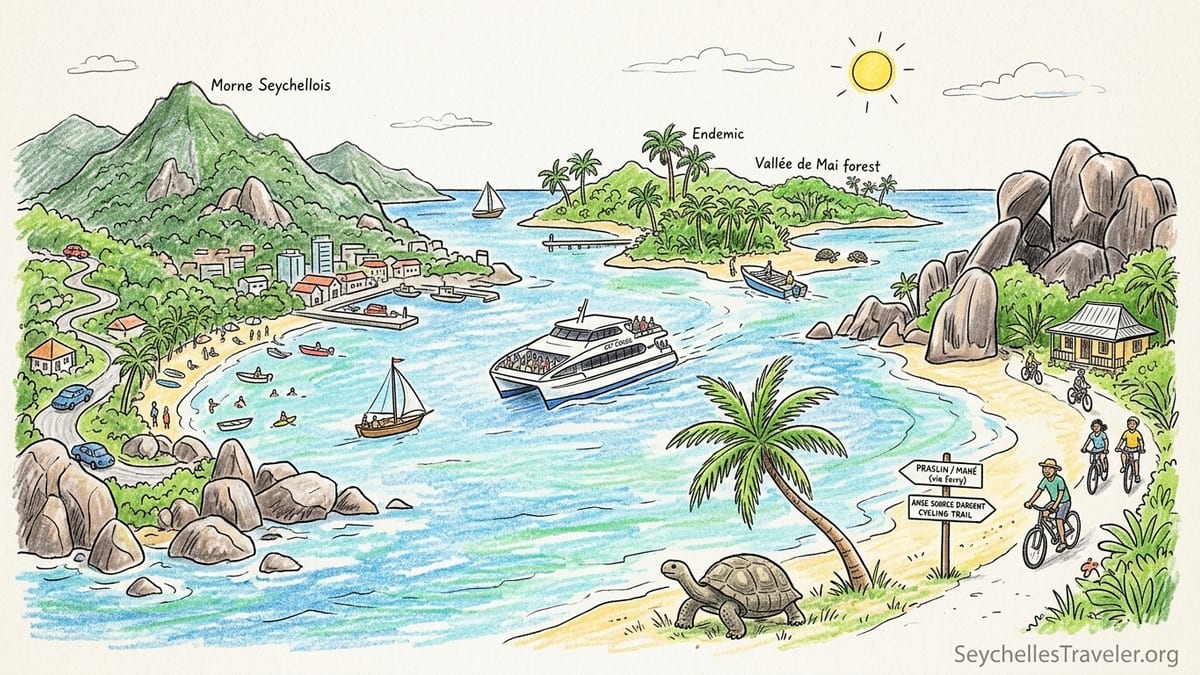
The inner granitic islands of Seychelles are the country’s postcard image: sculpted granite peaks, jungly interiors and lagoons in improbable shades of turquoise. Officially, Tourism Seychelles recognises 43 Inner Islands in total, of which 41 are granitic and two are coralline (Bird and Denis). In other words, not every Inner Island is made of granite, and not every granite island works in the same way for visitors. This guide focuses on the main granitic hubs of Mahé, Praslin, La Digue and Silhouette, then looks at the smaller granitic satellites around them to help you decide which islands to visit and how to combine them.
Understanding the Granitic Inner Islands
The granitic Seychelles sit on the Seychelles Bank, a shallow plateau in the middle of the Indian Ocean. They are fragments of ancient continental crust rather than volcanic islands, which is why they rise steeply out of the sea in sculpted granite domes. Within the official classification of 43 Inner Islands, 41 are of this granitic type and two, Bird and Denis, are low-lying coralline sand cays that happen to sit close enough to be grouped with the Inner Islands. The Outer Islands, much further away, are all coralline and visited mostly by divers and fly-in guests, so they fall outside this practical island-hopping guide.
Most travellers experience the granitic Seychelles through four main bases: Mahé, Praslin, La Digue and Silhouette. Around them are smaller conservation islands such as Curieuse, Cousin, Aride and Cousine, and a handful of high-end private-island resorts including North Island, Frégate, Félicité (home to Six Senses Zil Pasyon), and the little islands inside Sainte Anne Marine National Park off Mahé. Understanding how these categories differ is key. Some islands are inhabited, with regular ferries, buses, shops and a full range of accommodation. Others are strictly protected, visited only on guided day trips with limited landing numbers. A third group consists of private resorts where you can stay, but only as a guest on package-style rates.
For most visitors, the biggest practical distinctions are transport and cost. Inter-island ferries run mainly between Mahé, Praslin and La Digue. Cat Cocos operates the main high-speed catamarans connecting Mahé with Praslin and continuing on to La Digue, with several sailings a day between Mahé and Praslin and at least one direct Mahé to La Digue service on peak days. Cat Rose (Inter Island Ferry) runs frequent 15-minute crossings between Praslin’s Baie Sainte Anne and La Digue’s jetty, adding more departures to the day. Air Seychelles flies multiple short hops daily between Mahé and Praslin, which take about 15 minutes and can be paired with scenic-flight options but are subject to weather and aircraft capacity.
Prices fluctuate with exchange rates and seasons, but as a general, recent example, online bookings for Cat Cocos economy seats from Mahé to Praslin often start in the region of 55 to 65 euros per adult one way, with Mahé to La Digue costing more. Domestic flights between Mahé and Praslin can be comparably priced to the ferry for non-residents, although residents sometimes benefit from special fares. Travellers on a tight budget may therefore limit island-hopping and focus on one or two bases, while those planning a once-in-a-lifetime trip might combine a couple of main islands with a night or two on a private island.
Mahé: Big Island Variety and the Capital Victoria
Mahé is the largest and most populated island of Seychelles, home to the international airport, the compact capital Victoria and a ring of roads that curl around forested granite slopes. Landscapes are varied, from the bustle of the east-coast airport area and port to quiet coves on the west coast and wild viewpoints in Morne Seychellois National Park. The island is deeply granitic, with peaks over 900 metres, and heavy rainforest on its upper slopes. This mix makes Mahé feel more like a small country than a single resort island.
Beach-wise, Mahé offers range rather than just one archetype. On the west coast, Beau Vallon is the busiest and most resort-developed bay, with a long sandy beach, lifeguards, watersports stands, small guesthouses and larger hotels. Farther south, Anse Intendance and Anse Takamaka feel wilder, with stronger surf in some seasons, while Port Launay on the northwest is more sheltered. Travellers with a rental car can work through a different bay each day, including less-known stretches like Anse à la Mouche or Anse Soleil. This is one of Mahé’s key advantages over smaller islands: you are unlikely to get bored of the coastline on a week-long stay.
Mahé’s core attraction beyond the beaches is Morne Seychellois National Park, which blankets the mountainous spine of the island. Trails like the Morne Blanc hike or Copolia offer half-day walks through misty forest with viewpoints over the coast and islands. Guided hikes can be arranged through local operators and often cost in the region of 40 to 80 euros per person depending on group size and difficulty, including transport. Many travellers also visit the tea factory above Port Glaud, the Jardin Du Roi spice garden in the south, or undertake a day trip by boat to Sainte Anne Marine National Park for snorkelling.
Accommodation on Mahé ranges from simple self-catering apartments around Beau Vallon and Anse Royale to five-star resorts on private peninsulas. It is the easiest island for travellers who like independence: there is a local bus network, rental cars, supermarkets and a range of restaurants from inexpensive takeaways selling Creole curries and grilled fish to high-end hotel dining rooms. A small car typically costs a moderate daily rate plus fuel, while bus fares are low but buses can be crowded and schedules irregular at night. For most visitors who want both beaches and some sense of local life, Mahé works well for at least four to five nights, and longer for those using it as a base for day trips to nearby marine parks.
Praslin: Island-hopping Hub and Palm Forests
Praslin is the second-largest granitic island and the main stepping stone between Mahé and La Digue. It feels smaller and sleepier than Mahé but more developed than La Digue, with two main beach areas, Cote d’Or (Anse Volbert) on the north coast and Grand Anse on the south. Inland, granite ridges are less imposing than on Mahé, but the interior hides one of Seychelles’ most famous natural attractions: the Vallée de Mai.
The Vallée de Mai Nature Reserve is a UNESCO World Heritage Site, a dense palm forest where the endemic coco de mer palm forms a shaded canopy. Entry prices for non-residents have risen over the years, and recent examples show adult tickets costing a noticeable amount in euro terms, with additional fees for guided tours. For travellers looking for a less crowded but still impressive experience, the Fond Ferdinand reserve on the island’s southeast offers guided hikes among coco de mer and other endemic species at a generally lower price and with more viewpoint-based walking. Many visitors with two full days on Praslin choose to visit both, perhaps Vallée de Mai independently on one morning and Fond Ferdinand on a guided tour another day.
Praslin’s beaches are some of Seychelles’ most photogenic. Anse Lazio, on the northwest tip, regularly features in global beach rankings for its combination of granite boulders, clear water and backing forest. There are beachside restaurants and limited parking, and the road in can be steep in sections, so some travellers hire taxis or join excursions. Anse Georgette, near one of the island’s luxury resorts, can be reached by scenic coastal trail with prior arrangement via the resort or local guides, and rewards the effort with a relatively undeveloped bay. Around Cote d’Or, a long sweep of sand faces a shallow lagoon dotted with small islets, ideal for kayaking and stand-up paddleboarding.
Accommodation on Praslin ranges from small family-run guesthouses and self-catering bungalows set back from the beach to high-end resorts with spa facilities and private pool villas. Dining options cluster around Cote d’Or, where you can walk between Creole restaurants, pizzerias and beach bars. Car hire is common for visitors who want to explore beaches independently, though some prefer to rely on taxis and boat excursions. Ferries connect Praslin back to Mahé and forward to La Digue, and the island has Seychelles’ main domestic airport for flights to Mahé. For most travellers, Praslin works well for three to four nights, especially when combined with day trips to nearby smaller islands.
La Digue: Laid-back Cycling and Iconic Granite
La Digue is smaller and more intimate than Mahé or Praslin. There is only one small landing area for ferries, no airport and just a handful of motor vehicles, mostly taxis and hotel pickups. The island’s compact scale and low-traffic roads make it ideal for bicycles, which are the default mode of transport for visitors and many locals. Most guesthouses and hotels either include bicycles or rent them for a modest daily fee, and bike hire shops sit just behind the jetty.
La Digue’s landscape is dominated by a central granite hill mass with pockets of forest, fringed by a narrow band of settlement along the west and south coasts. The east side of the island is more exposed to the ocean and has fewer beaches safe for swimming. The poster-child attraction is Anse Source d’Argent on the southwest, within the L’Union Estate heritage area, where giant granite boulders frame shallow lagoons of clear water. Entry to L’Union Estate for non-residents requires a paid day ticket, which includes access to the coconut mill, vanilla plantation remnants and the beach path that reaches Source d’Argent. Many visitors rent a bike in the morning, stop at shops for picnic supplies and spend several hours exploring these coves at different tides.
Other notable beaches on La Digue include Anse Severe, a short cycle north of the jetty, which has simple beach bars and is often good for sunset, and Anse Patates, with more dramatic rock formations but less space at high tide. For strong hikers, the trails to Anse Cocos, Grand Anse and Petite Anse on the southeast offer wilder surf beaches with limited shelter. These walks are best undertaken in good weather and mid-tide, as paths include steep sections and can be slippery after rain. Guided hiking to viewpoints such as Nid d’Aigle above La Passe is available through local guides.
Accommodation on La Digue is dominated by guesthouses, boutique hotels and self-catering apartments, many family run. There is one larger upscale resort on its own section of coastline, but the general feel is village-like rather than resort-dominated. Dining options include Creole takeaways, cafes near the jetty and more formal hotel restaurants. Because the island is small, many travellers stay three nights and feel they have explored well, though photographers and hikers may happily stretch to five nights, using La Digue as a slower-paced break within a longer Seychelles itinerary.
Silhouette: Rainforest, Seclusion and Niva Labriz Seychelles
Silhouette Island, visible as a dark mountain on the horizon northwest of Mahé, is the third-largest granitic island but has a very different feel from Mahé or Praslin. Most of the island is protected as a national park, with steep granite peaks rising sharply from the ocean and cloaked in thick rainforest. There are no roads across the island and no airport. Instead, visitors arrive by boat transfer from Mahé, sometimes supplemented by helicopter services for private charters.
For many years, the main resort on Silhouette operated as Hilton Seychelles Labriz Resort & Spa, but at the end of 2025 the property left the Hilton portfolio. It has since been reintroduced as Niva Labriz Seychelles, under new management, with the same basic footprint of villas set along the coast between granite boulders and jungle. Independent guesthouses exist in the historic La Passe village, but capacity is small compared with Niva Labriz. The result is an island that feels like a hybrid of remote national park and single-resort destination.
Silhouette’s beaches are framed by towering granite and rainforest, with the main resort bay offering long walks on pale sand and panoramic sunsets over the ocean. Away from the developed coastal strip, hiking trails lead into the interior, including routes to the old village of Grand Barbe on the west coast, though some paths are long and require a good level of fitness and a guide organised through resort staff or local operators. Given the protected status of the island, activities often focus on guided nature walks, snorkelling in the surrounding marine park, diving trips and low-impact kayaking.
Because access to Silhouette is more limited and dining options outside the main resort are minimal, staying here works best for travellers comfortable with a semi-inclusive environment and higher daily spend. Boat transfers from Mahé are generally aligned with resort check-in and check-out times, and can be affected by sea conditions. Many visitors combine three or four nights on Silhouette with time on Mahé or Praslin, using Silhouette as the secluded, nature-focused chapter of their trip.
Smaller Granitic Islands: Excursions and Private Paradises
Clustered around Praslin and La Digue are several smaller granitic islands that add wildlife, conservation and luxury elements to a granitic island trip. Curieuse, just north of Praslin, is a former leper colony now managed as a national park with a population of Aldabra giant tortoises roaming free. Day trips from Cote d’Or typically include a beach landing, short mangrove walk between Baie Laraie and Anse St Jose, time with the tortoises and a beach barbecue. Prices vary by operator and inclusions, but recent examples often fall somewhere between a basic snorkelling-and-landing trip and a more comfortable full-day tour with lunch and drinks. There is simple overnight accommodation for researchers and limited visitors, but most travellers experience Curieuse as a day excursion.
Even more tightly protected are Cousin, Cousine and Aride. Cousin Island is a renowned nature reserve, with strictly controlled visiting hours and limited daily numbers. Boats from Praslin drop guests just offshore, then rangers manage landings in small craft to protect nesting seabirds and coastal habitat. Guided walks focus on endemic birds and conservation projects, and visitors are typically expected to stay for a set half-day slot. Aride, farther north, also emphasises seabird colonies and endemic flora. Cousine has, in past years, combined conservation work with very low-density high-end accommodation, but access and operating concepts can change, so travellers should check current arrangements with specialist tour operators or directly with island management when planning.
On the luxury side, Frégate and North Island are small granitic islands developed primarily as private-island resorts with a strong emphasis on privacy and conservation. Stays are usually sold on an all-inclusive or nearly all-inclusive basis with return transfers from Mahé by helicopter or boat bundled into the package. Nightly rates for two adults on such islands can easily run into four-figure euro sums, placing them firmly in special-occasion territory. Félicité, home to the Six Senses Zil Pasyon resort, sits a short boat ride from La Digue and combines private pool villas with dramatic granite scenery. For non-guests, access to these islands is very restricted or not available at all, so they should be seen more as alternative bases rather than excursion targets.
Closer to Mahé, Sainte Anne Marine National Park includes several granitic islets such as Sainte Anne, Cerf and Moyenne. Cerf and Sainte Anne host small hotels and guesthouses that can be reached by short boat transfers from Mahé, appealing to travellers who want to be near the main island but sleep in a quieter setting. Moyenne is better known as a small privately owned island with trails, tortoises and folklore, visited as part of day tours from Mahé that combine beach time and snorkelling at sandbars. Such tours, sold through DMCs and local agencies, usually include transfers, park entry fees and a barbecue lunch, with prices per adult spending a full day on the water sitting above typical half-day excursion rates.
Transport, Costs and How to Choose Your Islands
When comparing Mahé, Praslin, La Digue and Silhouette, it helps to think in categories: beach variety, hiking, wildlife, restaurant scene, self-catering options, luxury choice, ease of transport and overall cost. Mahé scores highest on variety and infrastructure. It has the most beaches, the most trailheads in Morne Seychellois National Park, the largest choice of restaurants and supermarkets and the widest range of prices from simple guesthouses to five-star resorts. It also benefits from having both the international and domestic airports and the main ferry pier, so onward logistics are straightforward.
Praslin sits in the middle. Its beaches compete strongly on quality despite the island’s modest size, and the presence of Vallée de Mai and Fond Ferdinand gives it an edge for endemic plant life. As a hub for excursions to Curieuse, Cousin, Cousine and Aride, it is also the best base for keen birdwatchers and those looking for tortoise encounters without flying to the remote Outer Islands. The restaurant scene is smaller than Mahé’s but still varied around Cote d’Or, and there are multiple supermarkets and bakeries for self-caterers. Both ferries and flights connect Praslin to Mahé, and the short Cat Rose crossings make La Digue an easy side trip or twin base.
La Digue excels on atmosphere rather than infrastructure. Beach quality is outstanding in the southwest, and cycling along narrow coastal lanes gives it a slow-travel feel that many visitors highlight as the most memorable part of their Seychelles trip. Hiking is more limited and often steeper and rougher than Praslin’s interior walks, but the island packs several excellent viewpoints and wild beaches into a small footprint. Dining options skew towards small restaurants and takeaways, and self-catering apartments are common, making it easier to manage costs if you are comfortable cooking some meals. Ferries from Praslin are frequent, but reaching La Digue from Mahé always involves either a connection via Praslin or a Cat Cocos sailing that calls at both islands on one route.
Silhouette is the outlier. It offers strong hiking and a sense of rainforest wilderness along with an expansive main beach, but choices in restaurants and self-catering are minimal, and transport is entirely by arranged boat or helicopter. Daily costs are higher, though once you factor in half-board or full-board meal plans at Niva Labriz Seychelles and the limited need for local transport, some travellers find the premium manageable for a shorter stay. For most visitors, Silhouette works as a nature-focused extension rather than a first island, partly because you need to time arrivals and departures to fixed boat schedules from Mahé.
Although exact prices should always be confirmed at the time of booking, a few patterns are clear. Cat Cocos ferry tickets for non-residents cost significantly more than local bus fares and represent a noticeable fraction of a daily travel budget, especially for families. Cat Rose crossings are shorter and usually cheaper, but still a meaningful line item. Domestic flights with Air Seychelles tend to be priced at a premium compared with ferries but offer speed and comfort. Private boat transfers to small islands and private-island resorts add another step up in cost, and scenic helicopter charters sit at the top end. In practice, many visitors keep to ferries between Mahé, Praslin and La Digue, use shared or prebooked road transfers between airport, jetties and hotels, and choose only one or two organised boat excursions to keep budgets under control.
Quick Comparison Table: Which Island Fits Which Traveller
Because travellers value different things, the following comparison summarises relative strengths. It is indicative rather than scientific, based on current conditions and typical visitor experiences.
For beach quality, Mahé offers the greatest number and variety of beaches, Praslin combines top-tier bays like Anse Lazio with more sheltered family-friendly options, La Digue concentrates its most famous scenery at Anse Source d’Argent and the southeast surf beaches, and Silhouette provides one long, often uncrowded strand in a wilder setting. If you want to visit several different beaches without repeating, Mahé and Praslin are best. If you prefer to settle into two or three emblematic bays and explore on foot or by bike, La Digue stands out.
For hiking, Mahé and Silhouette lead. Mahé’s Morne Seychellois National Park offers multiple signed routes of varying lengths, from short view hikes to longer ridge walks. Silhouette’s trails are fewer but more immersive, crossing genuinely wild interior slopes. Praslin’s main walks focus on forest and viewpoints in Vallée de Mai and Fond Ferdinand rather than long-distance hiking, and La Digue’s trails are shorter but often steeper to reach remote beaches or viewpoints. Wildlife and conservation experiences cluster around Praslin, due to the day trips to Curieuse, Cousin, Cousine and Aride, while marine parks off Mahé offer good snorkelling and tortoise sightings on islands like Moyenne.
Restaurants and self-catering options are most abundant on Mahé, followed by Praslin, then La Digue. Silhouette trails behind in pure choice but compensates with inclusive resort dining. In terms of luxury, Mahé and Praslin each host several high-end resorts, while La Digue has a more modest but still comfortable range and a couple of upscale options. Silhouette, along with private islands such as North Island, Frégate and Félicité, sits at the luxury end of the spectrum. Total trip cost is usually lowest for visitors basing themselves on one island and using local buses and takeaways, typically Mahé or Praslin, and highest for those combining multiple ferries, domestic flights, and nights on private islands or Silhouette.
Viewed in a decision table sense, a beach-focused, budget-conscious couple might score Mahé highest for value and variety, add La Digue for two nights of cycling, and skip pricier private islands. A wildlife enthusiast with moderate budget flexibility could give top marks to Praslin as a base for Vallée de Mai, Fond Ferdinand and bird islands, with a side stay on La Digue. A honeymooning pair seeking seclusion and high-end service might prioritise Silhouette with Niva Labriz Seychelles or a private island, with shorter time on Mahé for flights and a taste of local life.
Suggested Island Combinations by Trip Length
Without turning this guide into a day-by-day itinerary, it is useful to outline strong combinations for typical trip lengths. These suggestions assume an international arrival and departure through Mahé and focus on the granitic inner islands only.
For about five days, combining Mahé and La Digue works well. You might spend three nights on Mahé, exploring Morne Seychellois viewpoints, Beau Vallon and one or two southern beaches, then take Cat Cocos to Praslin and connect onwards to La Digue for two nights of cycling, Anse Source d’Argent and perhaps a short hike to Grand Anse. This keeps ferry legs to a minimum and limits check-in and check-out days.
For seven days, Mahé plus Praslin plus a La Digue day trip is efficient. Four nights on Mahé provide time for Victoria, the tea factory hills and a Sainte Anne Marine National Park excursion, while three nights on Praslin allow for Vallée de Mai, Anse Lazio and a full-day excursion touching Curieuse for tortoises and snorkelling. A day trip from Praslin to La Digue via the Cat Rose ferries gives a taste of cycling and Anse Source d’Argent without requiring another accommodation change.
For ten days, many travellers opt for a triangle of Mahé, Praslin and La Digue, roughly three nights on each plus one night flex depending on flight times. This allows for a slower pace on La Digue, perhaps with an early-morning photography session at Anse Source d’Argent, extra time on Praslin for Fond Ferdinand or a conservation island visit, and an additional beach day on Mahé’s west coast. Those keen on hiking might allocate more nights to Mahé, while those focused on wildlife could add an extra night on Praslin instead.
For about fourteen days, you can add Silhouette or a private island stay to the above triangle. For example, start with three nights on Mahé to recover from flights and arrange any onward tickets, transfer to Praslin for four nights of beaches and nature reserves, take Cat Rose to La Digue for three nights of cycling and relaxed evenings near the jetty, then return to Mahé for a boat across to Silhouette for four nights at Niva Labriz Seychelles. Alternatively, substitute Silhouette with a shorter but more expensive stay on a private island such as Félicité or Frégate if budget allows. In both cases, aim to place the more secluded island at the end of the trip so that any weather-related delays affect your outbound leg less critically than your international arrival.
The Takeaway
The granitic Inner Islands of Seychelles are varied enough that no single island suits every traveller. Mahé offers the richest combination of beaches, hiking, food and local culture, and it inevitably frames any trip thanks to its airport and ferry port. Praslin adds world-class palm forests and easy access to conservation islands, making it the logical second base for many visitors. La Digue trades choice for charm, focusing visitors into a small area of cycling lanes and granite coves that often becomes the emotional highlight of a journey. Silhouette, and the nearby constellation of private-island resorts, bring rainforest remoteness and high-end escapism into the mix.
Choosing the right combination depends on how you balance variety against simplicity, and adventure against budget. A shorter stay might call for just Mahé and one other island, while a two-week holiday can stretch to three or four bases. With ferries such as Cat Cocos and Cat Rose and domestic flights on Air Seychelles handling the hops between islands, you can shape Seychelles to fit your own travel style, whether that means self-catering and bus rides between village shops and hidden bays, or seamless transfers and villa plunge pools on a granite headland.
FAQ
Q1. How many granitic Inner Islands does Seychelles have and are they all the same?
The Inner Islands group comprises 43 islands in total, of which 41 are granitic and two, Bird and Denis, are coralline. Within the granitic group, islands vary widely in size, development and access, from populous Mahé to uninhabited conservation islands visited only on guided day trips.
Q2. What is the easiest way to travel between Mahé, Praslin and La Digue?
The main option is Cat Cocos high-speed ferries between Mahé and Praslin, with some sailings continuing to La Digue. Cat Rose operates additional short ferries between Praslin and La Digue. Air Seychelles offers domestic flights between Mahé and Praslin, which are faster but do not reach La Digue directly.
Q3. Should I book inter-island ferries and flights in advance?
Yes, for high season and to secure preferred times, prebooking is sensible. Cat Cocos and Air Seychelles show real-time availability online, and some departures sell out, especially around weekends and local holidays. Cat Rose crossings are more flexible but can also be busy at peak times.
Q4. Is Mahé worth staying on, or should I go straight to the smaller islands?
Mahé is worth at least a few nights for most travellers. It has the widest choice of accommodation and restaurants, the capital Victoria, Morne Seychellois National Park for hiking and a ring of very different beaches. Skipping it entirely means missing much of the country’s everyday life.
Q5. How many days do I need on Praslin and La Digue?
On Praslin, three to four nights allows time for Vallée de Mai, Fond Ferdinand, Anse Lazio and at least one boat excursion. On La Digue, two to three nights lets you enjoy cycling, Anse Source d’Argent and some quieter beaches without rushing, though keen photographers and walkers may enjoy staying longer.
Q6. What kind of traveller is Silhouette Island best suited for?
Silhouette suits travellers who value seclusion, rainforest hiking and a semi-inclusive resort environment over independent restaurant-hopping. With Niva Labriz Seychelles as the main accommodation and limited other services, it is ideal for couples and nature lovers comfortable with a higher daily budget.
Q7. Can I visit conservation islands like Curieuse, Cousin or Aride independently?
Access to these islands is tightly managed to protect wildlife. Visitors normally join organised boat trips from Praslin that include permits and guiding. Landings are controlled by rangers, and overnight stays, where allowed, are extremely limited and generally arranged through specialist operators.
Q8. Are the private islands like North Island and Frégate open for day visits?
Generally no. Private islands such as North Island, Frégate and Félicité (with Six Senses) are run as standalone luxury resorts. Access is reserved for staying guests, whose packages include helicopter or boat transfers. They function as alternative bases rather than excursion spots.
Q9. Is Seychelles suitable for self-catering and budget-conscious travel?
Within reason. Mahé, Praslin and La Digue all have self-catering apartments, small supermarkets and local takeaways, which help manage costs. Ferries, domestic flights and some excursions remain relatively expensive, so focusing on fewer islands and using buses where practical keeps budgets in check.
Q10. When is the best time to plan island-hopping in Seychelles?
Seychelles is a year-round destination, but conditions vary with the trade winds. Many travellers prefer the calmer transition periods around April to early June and September to November, when seas can be smoother for ferries and snorkelling and humidity is often more comfortable.