


I booked my Curieuse Island excursion on Praslin after hearing wildly different reports: some people raved about roaming giant tortoises and mangrove forests, others dismissed it as an overrated tortoise photo stop. I wanted to see for myself, and, more importantly, to understand Curieuse as a protected island rather than a petting zoo. This is how my full day played out, from the first boat wake off Anse Volbert to drifting over the reefs at St Pierre.
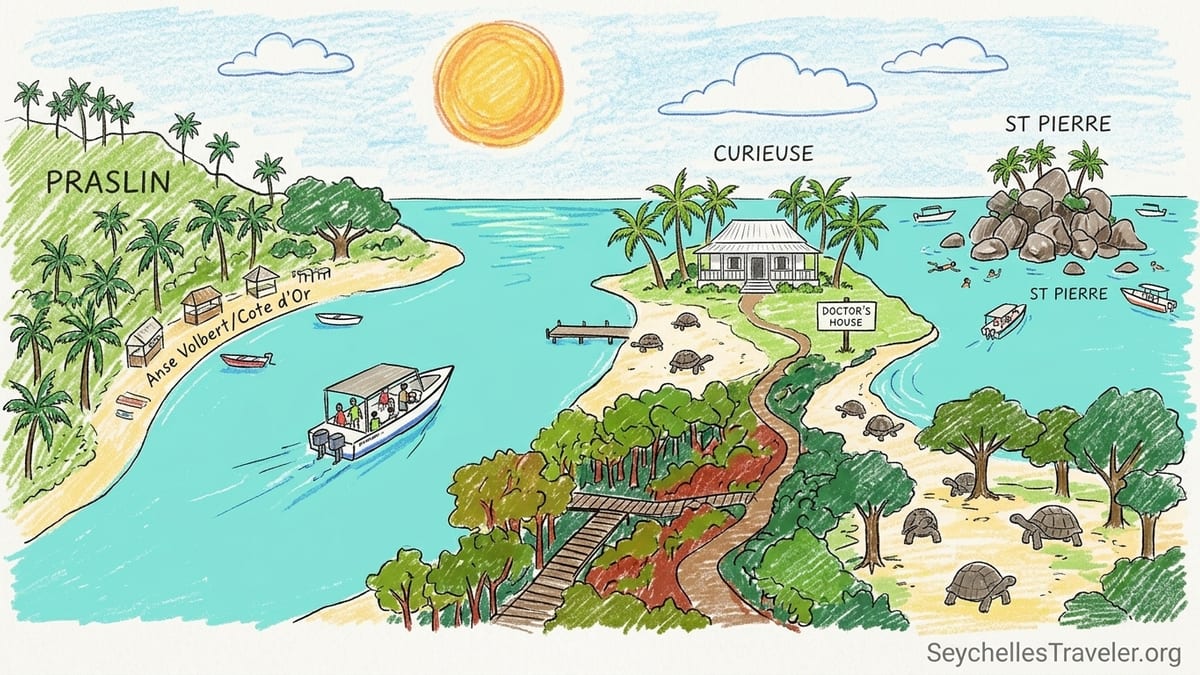
Leaving Praslin: Boat, Operator, Sea Conditions and Group Size
My day started on Anse Volbert, also called Cote d’Or, the main departure beach on the north coast of Praslin for Curieuse and St Pierre trips. Local operators line this bay with small offices and beach kiosks, and almost all of them advertise some version of “Curieuse + St Pierre + BBQ.” After comparing offers, I chose a mid‑range shared outing with a local operator that runs under similar conditions and pricing to several advertised Curieuse and St Pierre day trips, around 90 to 100 euro per adult including lunch, soft drinks, snorkel gear and the Curieuse Marine National Park landing fee.
Our vessel was a fiberglass open cruiser of about 9 meters, with twin outboards and a simple shade canopy. It seated 18 people, but our group that morning was 11 guests plus two crew, which meant enough space to stash dry bags and cameras without climbing over each other. The skipper gave a short safety briefing in English and French before we waded thigh‑deep through the shallows to climb in off the stern ladder, sandals in hand.
The crossing from Anse Volbert to Curieuse is short, roughly 20 minutes across the turquoise channel that separates Praslin from its small sister. Conditions matter, because this is open water once you clear the protection of the bay. On my March visit the southeast trade winds had not yet fully settled in, so the sea was a gentle chop rather than the steeper swell you sometimes get between June and September. There were a few sprays over the bow, but no one looked uncomfortable, and even the children on board were more excited than nervous.
Along the way our guide pointed out St Pierre, the granite islet that would be our snorkelling stop later. From the water it really does look like the Seychelles postcard cliché: a cluster of tumbled boulders crowned with leaning coconut palms, ringed by pale reef. It also looked busy. Several other excursion boats were already orbiting, which gave me my first sense of how popular this circuit has become.
Landing at Baie Laraie and Meeting the Aldabra Giant Tortoises
Most Curieuse excursions land at Baie Laraie, on the east side of the island, and ours was no exception. The captain nosed the boat toward a small jetty and we disembarked directly onto the beach. Behind the tree line the scene opened onto what Curieuse is now famous for: dozens of free‑roaming Aldabra giant tortoises moving slowly across the sandy clearing and under the takamaka trees.
These are not a separate Curieuse species. Every tortoise you see here belongs to the Aldabra giant tortoise species, Aldabrachelys gigantea, originally from Aldabra Atoll, the outer island UNESCO World Heritage site where the last natural population survived. They were introduced to Curieuse in the late 1970s and early 1980s as part of a conservation and translocation effort, after the original inner‑island tortoises were hunted out. The Seychelles Parks and Gardens Authority confirms that around 250 Aldabra tortoises were brought over in that period, and Curieuse has since become one of the best places in the inner islands to see them living semi‑wild.
The tortoise experience at Baie Laraie felt more like wandering through a sanctuary than lining up for a staged photo. There are no railings or turnstiles, and the animals are not confined to small pens. Instead, they shuffle around the clearing, cross the path to the mangroves, nap under low branches or wallow in shallow muddy hollows. A fenced nursery area holds younger animals, which are still being raised under closer supervision until their shells are strong enough for full freedom.
Our guide was clear about interaction rules: no sitting or standing on the tortoises, no lifting their shells, do not block them from walking away. We were allowed to touch their shells and necks gently if the tortoise approached and seemed receptive, and to feed a few leaves provided by the ranger. The most memorable encounter for me was with an older male with a deeply sculpted shell who ambled straight toward the group, extended his neck, and closed his eyes while someone scratched the bare skin. Another younger animal hissed softly and pulled in when a guest stepped too close with a phone, a visible reminder that these are sentient animals, not props.
Walking the Mangrove and Red Earth Trail to Anse José
After about 45 minutes at Baie Laraie, our guide gathered us for the walk to Anse José on the opposite side of the island. Curieuse has several trails, but the most used is this Baie Laraie to Anse José route, roughly 1.5 to 1.7 kilometres. It is not a difficult hike, but in the mid‑day heat it can feel more demanding than the distance suggests, and people in flip‑flops looked less happy than those in trainers or sturdy sandals.
The first section drops onto the mangrove boardwalk, one of the longest elevated mangrove walkways in Seychelles, stretching several hundred metres across the swamp. Planks are laid on piles above the ooze, and at high tide the roots disappear into glassy water. At low tide, as on my visit, you see a forest of mangrove buttresses rising out of cracked mud, studded with fiddler crab burrows. Interpretive signs point out that six of the seven mangrove species found in Seychelles grow in this bay. The air here is cooler and heavy with the sweet, slightly rotten smell of wet leaves, and hermit crabs clatter along the railings when the group falls quiet.
Beyond the mangroves the trail rises gently across Curieuse’s interior. This is where the island’s red earth really shows. The path threads between rust‑coloured laterite outcrops and polished granite boulders, the same glowing rock that gives Curieuse its nickname as the “red island.” In exposed sections the sun bounced off both rock and sand. Shade comes and goes in pockets provided by casuarina, takamaka and screw pine trees, but in the open you feel every degree of tropical humidity. Our guide kept us moving at a moderate pace, but on a busy day with several groups close together you can feel pushed along if you stop too long for photos.
Trail condition in March was decent but informal. Wooden steps on steeper parts had eroded in places, and the laterite can be slippery after rain. Two people in our group without closed shoes were obviously concentrating on their footing and not the view. There are short stretches where granite slabs act as the path, requiring a bit of scrambling. I never felt unsafe, but I was glad to have at least a litre of water and a hat. There are no kiosks between Baie Laraie and Anse José, so what you bring from the boat is what you have.
The Doctor’s House, Island History and Heat of the Midday Pause
Eventually the trail dips toward the coast again and Anse José appears between the trees, a curve of pale sand with rocks at either end and shallow water shading from jade to clear blue. Above the beach, framed by coconut palms, stands one of Curieuse’s most distinctive buildings: the restored doctor’s house, once part of the island’s leper settlement and now an interpretive centre.
The white wooden house, with its deep veranda and shuttered windows, has been converted into a small museum about Curieuse’s human and natural history. Inside, panels explain how the island served as a quarantine and treatment station for people with leprosy until the mid‑20th century, and how conservation priorities shifted in the decades that followed. Other displays showcase specimens of the coco de mer palm, shells and corals, and the story of the Aldabra giant tortoise translocation. It is a sobering and necessary counterweight to the idea of Curieuse as simply a pretty outing.
By the time we reached the doctor’s house, the late morning heat was peaking. Our group spilled gratefully into the shade of the veranda, where a faint breeze funneled off the bay. A few people used the short break to look around the museum, but more simply sat on the steps and finished their water. It is worth pacing yourself on the walk so you have energy left to appreciate this part of the island, rather than collapsing straight onto the sand.
On my excursion the operator had arranged to rendezvous with the boat at Anse José, which is common practice. Some companies reverse the route and land here first, then walk to Baie Laraie for the tortoises and pick up there, but most trips seem to follow the tortoises‑first, trail‑second pattern. Whichever way you do it, build the heat of the trail into your expectations if you are travelling with young children, older relatives or anyone with mobility issues. This is a nature trail, not a groomed promenade.
Barbecue Lunch on the Beach: What Was Actually Served
Our boat had anchored just off Anse José, and as we arrived the crew were already working at the park barbecue stands under the trees. Not every excursion includes lunch, but the most popular Curieuse and St Pierre packages from Praslin advertise a “Creole barbecue,” and mine followed that template. In our case, the 95 euro price covered grilled fish, chicken and sausage, rice, salads, bread, fruit, soft drinks and water, with beer available for a small extra cash payment.
The setup was informal. Portable tables were set with simple plates and cutlery, and logs served as seating. The grill smoked steadily, sending curls of scent across the beach. When the food was ready, everyone queued up once, then again for seconds if there was still something left. The grilled fish, most likely local bourzwa or jobfish, was the standout, charred at the edges and moist in the middle, brushed with a garlicky marinade. The chicken was slightly drier but well seasoned. The sausages were plainly industrial rather than artisanal, but they did round out the plate.
Side dishes included a big pot of saffron‑tinted rice, a cabbage and carrot salad with lime dressing, and a lentil stew that disappeared fast. A platter of watermelon and ripe pineapple came out last. Soft drinks were standard cans of cola, orange soda and tonic, alongside bottled water in a big ice cooler. No alcohol was included in the base price, which is worth noting if you have seen more premium packages that fold in wine or beer by default.
Was it the best meal I had in Seychelles? No. But it was much better than a perfunctory boxed lunch, and, more importantly, it felt consistent with the place: simple food cooked over coals under shade trees, with sand underfoot and the sound of gentle shore break. If you book a cheaper half‑day trip without lunch, you will likely eat back on Praslin, which may appeal if you prefer restaurant dining, but you will miss this quieter middle chapter on Curieuse itself.
Snorkelling at St Pierre: Fish, Coral and Crowds
After lunch and a short swim at Anse José, we boarded the boat again for the ride to St Pierre. The islet sits only a short distance off the northwest tip of Praslin, so the crossing from Curieuse was under 15 minutes. By early afternoon the anchorage was busy, with at least eight excursion boats rotating in and out of the shallows. Each one dropped its snorkellers into the same rough area on the eastern and southern sides of the rocks.
Our guide gave a five‑minute briefing about currents, reef etiquette and the plan. We had about 45 minutes in the water. Masks, snorkels and fins were provided for anyone who did not bring their own. The visibility that day was moderate rather than perfect, somewhere in the 8 to 10 metre range. Recent wind and tide had stirred a little sediment, softening the clarity but not ruining it.
Once in the water the appeal of St Pierre is clear. The granite slopes plunge quickly into a fringe of coral heads dotted with table corals and boulder corals. Among them we saw schools of yellow‑tailed fusiliers, sergeant majors and blue and green chromis flashing in the light. Closer to the rocks, Moorish idols and butterflyfish picked at algae, while a solitary parrotfish chomped noisily on the reef. Near the sandy patches, several trumpetfish hovered vertically like sticks, and one small hawksbill turtle surfaced briefly near the boat before gliding away out of view.
This was not untouched, pristine coral. Like much of the inner Seychelles, St Pierre has patches of bleaching and broken heads, and the combination of many fins and shallow depth takes a toll. Our guide was firm about not standing on coral, but with multiple groups in the water, it was inevitable that some nervous swimmers kicked too close. If you have snorkelled in more remote, strictly limited sites, you may find St Pierre less impressive on a purely ecological level. As a relaxed introduction to tropical reef life, though, it still delivered colourful fish and a pleasant drift, especially for first‑timers in our group.
Current Packages, Prices and How My Trip Compared
Before booking, I checked a range of current Curieuse and St Pierre offerings to understand the price landscape and what was genuinely included. Tourism Seychelles promotional material describes a benchmark full‑day Curieuse and St Pierre excursion at around 90 euro per person, including lunch, drinks and the Curieuse landing fee, along with a half‑day option closer to 45 euro where the 300 Seychelles rupee park fee is paid separately in cash on arrival. Independent tour listings and recent traveller reports in 2025 and 2026 broadly match this range, with some operators offering slightly cheaper no‑frills trips and others bundling the excursion into more expensive multi‑island packages.
Local departure‑from‑Praslin operators such as beach‑based charter companies around Anse Volbert advertise shared full‑day Curieuse plus St Pierre outings with barbecue in the 90 to 100 euro range for adults, with discounts for children. These usually include snorkel gear, soft drinks and the Curieuse Marine National Park fee, which is currently published by the Seychelles Parks and Gardens Authority as 300 rupees per person for non‑residents over 12. Other companies, especially those selling through international agents, list higher prices around 110 to 130 euro, but in practice sometimes discount these for cash bookings on the beach.
Half‑day options are more stripped back. Several operators sell four‑hour Curieuse and St Pierre trips without lunch, from Praslin, for roughly 45 to 55 euro per person, excluding the 300 rupee landing fee. In these cases, the crew collects the park fee in cash, often euros or rupees, to pay the rangers on Curieuse. Private charters sit at the other end of the spectrum. A small boat with skipper for a couple or family, covering Curieuse, St Pierre and perhaps an extra beach, runs into several hundred euros, with the park fees clearly specified as extra.
My 95 euro shared trip slotted neatly into the heart of this spread. The price included the Curieuse park fee, lunch, soft drinks and snorkel equipment, but not alcoholic drinks. There were no surprise charges on the day, though a tip for the crew was of course appreciated. Knowing that the landing fee alone is 300 rupees per adult, and that supplies, fuel and staff in Seychelles are not cheap, I felt the overall value was fair for almost seven hours out, provided you actually want both the island walk and the snorkelling stop.
Crowds, Pace, Landings and When Things Fall Short
Curieuse and St Pierre are not undiscovered paradises. Both stops on my trip felt busy at peak times, although not unmanageable. At Baie Laraie, we shared the clearing with at least three other groups spread across the tortoise area. It was still possible to find quieter pockets toward the edges, but if you imagine strolling alone among the animals you may be disappointed. On the trail to Anse José, the groups stretched out, but there were bottlenecks at narrow boardwalk sections where people paused for photos and others needed to pass.
The pacing is partly dictated by the need to move groups through this loop in time for lunch and the afternoon snorkel. Our guide kept a steady but not frantic speed, reaching Anse José in around 45 minutes including stops. I can see, however, how a larger boat with 20 or more guests might feel more rushed, with less time to linger at interpretive signs or peer into the mangrove pools. If a slower, more contemplative hike is crucial to you, consider asking about group size and pace when you book, or arranging a private guide.
Landings can be another challenge. At Baie Laraie we used the jetty, stepping directly from boat to platform, which was straightforward even for less agile travellers. At Anse José and St Pierre, though, we had wet landings off the bow or stern into knee‑deep water. On a calm day this is simply part of the experience, but in choppier conditions or for anyone with limited mobility it can feel awkward. Good boat shoes or sandals that strap firmly make a difference, and it is wise to put electronics in a dry bag.
Visibility at St Pierre is weather‑dependent. Under bright sun and after several calm days, reports describe 15 metres or more of clear water and high fish activity. After wind, heavy rain or swell, the water can be milky and the experience underwhelming. On my visit the visibility was acceptable but not jaw‑dropping. I enjoyed the reef life, but it was not the technicolour spectacle I had half‑imagined from glossy brochures. I also noticed several people returning to the boat early because they were tired of jostling among other snorkellers. Being honest about these trade‑offs helped me appreciate what the site does still offer without unrealistic expectations.
The Takeaway: Was Curieuse Enough, and Would I Change Anything?
Looking back at the day, the heart of the experience for me was Curieuse itself. Watching Aldabra giant tortoises roam under the trees at Baie Laraie, knowing they are part of a deliberate conservation story rather than ornaments in a resort garden, felt meaningful. Walking the mangrove boardwalk and red earth trail to Anse José, with its mix of heat, shade and glimpses into the island’s human past at the doctor’s house, rounded that out into a genuine protected‑area visit. If the boat had taken me back to Praslin from Anse José without any snorkelling stop, I would still have considered the outing worthwhile.
Did St Pierre materially improve the day? For first‑time snorkellers and children in our group, the answer was probably yes. It added a different element, put people in the water, and delivered the classic Seychelles granite‑and‑palm silhouette from sea level. For me, with previous reef experience elsewhere, St Pierre felt more like a pleasant extra than an essential highlight. I enjoyed the fish, but I would not book the trip solely for that segment, especially knowing how many boats converge there on a normal day.
If I were to plan the itinerary again, I would still choose a full day over a half day, but I might look for an operator that lands earlier on Curieuse to beat the main rush, or one that offers slightly more time on the island and a shorter, later snorkel. I would also ask specifically about group size and whether the Curieuse park fee is included in the headline price, so I can compare like with like. For travellers mostly interested in tortoises, mangroves and the feel of a marine national park, a Curieuse‑only half‑day with a slower pace could be ideal, leaving the afternoon free to swim at Anse Lazio or another Praslin beach.
Curieuse should not be reduced to a single close‑up tortoise snapshot. Approached with reasonable expectations, proper respect for the animals and an understanding that this is a managed but still fragile environment, it rewards you with something richer: a glimpse of how Seychelles is trying to balance conservation, history and tourism on one small, red‑soiled island just across the water from Praslin.
FAQ
Q1. How much does a Curieuse and St Pierre day trip from Praslin cost?
The most common shared full‑day packages from Praslin cost roughly 90 to 100 euro per adult, usually including lunch, soft drinks, snorkel gear and the Curieuse Marine National Park landing fee. Cheaper half‑day options without lunch start around 45 to 55 euro, with the 300 rupee park fee often paid separately in cash.
Q2. What is included in a typical full‑day Curieuse excursion?
A standard full‑day Curieuse and St Pierre trip normally includes boat transfers from Praslin, a visit to the tortoises at Baie Laraie, the guided walk or self‑guided trail to Anse José, a Creole barbecue lunch on the beach, soft drinks, basic snorkel equipment, the snorkelling stop at St Pierre and the Curieuse landing fee, but it is important to confirm the details with your chosen operator.
Q3. Are the giant tortoises on Curieuse a special Curieuse species?
No. The animals on Curieuse are Aldabra giant tortoises, Aldabrachelys gigantea, a species originally from Aldabra Atoll. They were introduced to Curieuse in the late 1970s and early 1980s as part of a conservation and translocation programme, rather than being a separate endemic Curieuse tortoise species.
Q4. How difficult is the walk from Baie Laraie to Anse José?
The Baie Laraie to Anse José trail is only about 1.5 to 1.7 kilometres, but the tropical heat, short rocky sections and some uneven steps make it feel harder than the distance suggests. Most reasonably fit visitors manage it in 45 minutes wearing trainers or good sandals, but it can be challenging in flimsy flip‑flops or for people with balance or mobility issues.
Q5. Is the Curieuse landing fee always included in tour prices?
Not always. Some operators build the 300 rupee Curieuse Marine National Park fee into their advertised package price, while others quote a lower headline rate and collect the landing fee separately in cash on the boat. When comparing offers, ask clearly whether the park fee is already included.
Q6. What kind of snorkelling can I expect at St Pierre?
At St Pierre you usually snorkel around shallow granite slopes fringed with patches of hard coral. Expect to see common reef fish such as sergeant majors, fusiliers, butterflyfish, parrotfish and trumpetfish, with occasional sightings of hawksbill turtles. Visibility varies with weather, and there are often several boats on site, so it can feel busy at peak times.
Q7. What should I wear and bring for a Curieuse day trip?
Light, breathable clothing, a hat, reef‑safe sunscreen and sturdy sandals or trainers for the trail are essential. Bring at least one litre of water per person, especially if your package does not include drinks before lunch, plus swimwear, a towel, a dry bag for electronics and any personal snorkel gear if you prefer your own mask and fins.
Q8. Is Curieuse suitable for young children and older travellers?
Curieuse can be very rewarding for families and older travellers, but you should factor in the wet landings from the boat, the heat and the uneven trail. Children often love the free‑roaming tortoises, while older visitors may prefer to spend longer at Baie Laraie and skip or take their time on the full walk to Anse José, depending on fitness and mobility.
Q9. When is the best time of year to visit Curieuse and St Pierre?
Sea and weather conditions are usually calmer and clearer around April to June and October to early December, with better chances of good snorkelling visibility. The southeast trade wind season from roughly May to September can bring choppier seas and slightly cooler air, while the wetter months can affect trail conditions and underwater clarity.
Q10. Is a Curieuse‑only trip worthwhile, or do I need St Pierre as well?
Curieuse on its own, with the tortoise encounters, mangrove boardwalk, island trail and doctor’s house, already makes a satisfying half‑day or longer excursion. St Pierre adds a convenient snorkelling stop and classic granite‑islet scenery, which many visitors enjoy, but if your main interest is the protected‑island experience, a Curieuse‑only itinerary with more unhurried time on the island can be an excellent choice.