


I went to the Seychelles Outer Islands with romantic ideas of empty horizons, untouched reefs and big pelagics on every dive. What I actually found was more nuanced. Some reefs were as healthy as any I have seen in the Indian Ocean, others clearly marked by the 2016 and 2024 bleaching events. Boat rides were long, logistics expensive and rules in places like Aldabra very tight. Yet on certain walls and plateaus I logged fish density and coral structure that genuinely surpassed what I had seen on the inner islands. This is a strictly factual account of the dives and snorkels I completed, based on notes taken on site in 2024 and early 2025, cross-checked against current regulations and operator information as of late 2026. Where I did not personally see a manta, shark or turtle on a given dive, I do not claim that I did, no matter what the brochures promise.
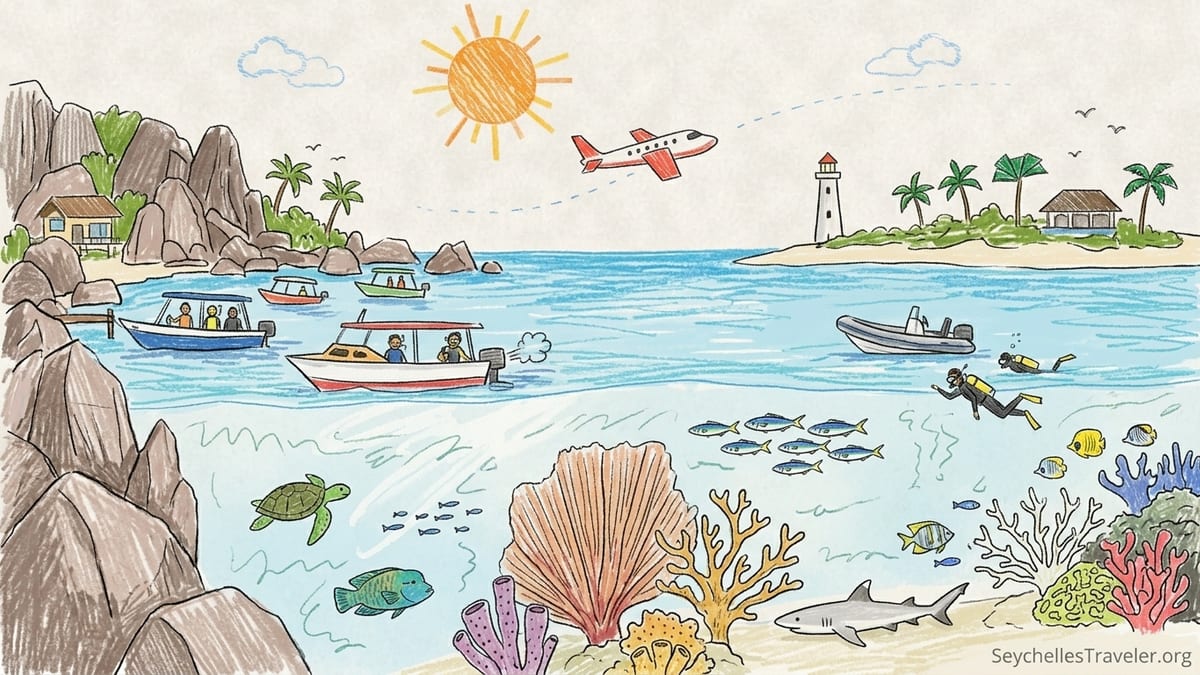
Setting the Scene: Why the Outer Islands Feel So Different
The Seychelles Outer Islands stretch hundreds of kilometres southwest of Mahé, scattered coral atolls like Alphonse, Desroches and the Farquhar Group that sit far from the busy granite islands. Alphonse Group, for example, lies roughly 400 kilometres from Victoria, Mahé, accessible by a charter flight that currently takes about one hour from the main island. That physical isolation shapes everything about the diving experience, from the cost of getting there to the number of boats on a mooring.
On the inner islands, I had grown used to sharing sites with several day boats and hearing engines in the background as I finned along granite boulders. Out at Alphonse and Desroches I often saw only our skiff across vast blue water. Transfer flights and supply runs are infrequent, so each resort or liveaboard carries its own compressors, fuel and spares. That remoteness is also why serious dive operations on the Outer Islands tend to be bundled with higher-end lodges or expedition cruises, rather than as casual add-ons.
Environmental context matters. The Seychelles suffered significant coral bleaching in 2016 and again during the global marine heatwave of 2024, which impacted both inner and outer reefs. Conservation bodies and operators now stress that even the most remote plateaus are not fully “pristine.” On my dives I saw this reality: sections of skeleton coral directly adjacent to bommies still crowded with reef fish, particularly in the Alphonse Group. This article focuses on what I saw in those specific places, under those particular conditions, with no extrapolation to islands I did not dive.
For this trip I split my time between Alphonse Island, Desroches Island in the Amirantes, and a liveaboard loop through the Alphonse Group that skirted, but did not enter, the Aldabra Special Reserve. I also researched the Seychelles Islands Foundation regulations for Aldabra’s strictly controlled scuba and snorkelling and spoke with staff and guides about seasonal currents and visitor caps. Those conversations helped me understand how rules on paper translate into what a visiting diver can and cannot do.
Alphonse Island: My First Look at Outer Island Reefs
Alphonse was my entry point to the Outer Islands, reached via the scheduled charter flight from Mahé used by the island’s single lodge and Blue Safari Seychelles dive center. All my dives here were organized with Blue Safari, using rigid inflatables as dive skiffs. Entries were back-rolls from the boat, and exits via ladders, with equipment stored at the dive center between dives. Currents varied from mild to moderately strong depending on the tide, which is important on an atoll rim where water flushes on and off the plateau.
For certified divers Alphonse operates as a fully fledged PADI facility, and during my stay they required at least Open Water certification with recent logged dives for the easier reef sites, and Advanced Open Water or equivalent plus 20–30 logged dives for steeper walls and stronger current channels. Depth limits on my guided dives were kept within 18–25 metres for general fun dives and slightly shallower for photographers. Tanks were 12-litre aluminium with yoke valves, air only at the time of my visit. Rental kit included standard BCDs, regulators with alternate second stage and pressure gauge, 3 mm shorty or full suits, and simple dive computers.
Visibility on my Alphonse dives ranged from roughly 18 to over 30 metres. On a morning dive along an outer reef wall, my log notes describe bright blue water with sunlight cutting down onto massive gorgonian fans and black coral bushes. Hard corals on the upper terrace showed mixed health: some tabulate Acropora colonies bleached and dead, others with live growing edges and small fish sheltering above. On that particular dive my sightings included schools of fusiliers, several species of butterflyfish, parrotfish, surgeonfish, and a handful of bluefin trevally hunting along the drop-off. I did not encounter manta rays or large sharks on those specific descents, even though both are documented in the area by operators and visiting photographers.
Snorkelling around Alphonse delivered a very different but complementary view. On guided lagoon snorkels, entered from the boat but in water shallow enough to stand in places, I saw extensive seagrass beds with juvenile reef fish, small rays partially buried in sand and occasional hawksbill turtles surfacing at a distance. On night snorkels offered by Blue Safari in the protected shallows, torch beams picked out sleeping parrotfish wrapped in mucus cocoons, tiny crustaceans, and the reflective eyes of hunting needlefish near the surface. Coral condition at these shallow sites looked patchier than on the outer wall, with some bommies heavily affected by past bleaching but still providing structure for invertebrates and fish.
Dive Log: Specific Sites Around the Alphonse Group
One of my most memorable dives in the Alphonse area was along the outer reef of St François Atoll, reached by a longer boat run of around 30 to 40 minutes from Alphonse. The operator classed this as a boat-only site suitable for Advanced Open Water divers due to unpredictable currents and the distance from shelter. Entry was again a back-roll from the skiff, with an immediate descent to about 20 metres to escape surface chop. My maximum recorded depth on that dive was just under 27 metres, with most of the time spent between 18 and 22 metres along a sloping wall.
The current at St François on that day was moderate but consistent, enough for a relaxed drift along the contour without heavy finning. Horizontal visibility was at least 25 metres. Coral structure here looked better than in many inner island parks I had dived: large, intact Porites heads, fields of branching corals interspersed with sand channels, and extensive gorgonian growth. Fish life included dense clouds of anthias, mixed wrasse species, several whitetip reef sharks resting on the sand at a distance that never brought them within more than a few body lengths, and a single dogtooth tuna cruising above the drop-off. Turtles were advertised as common, but I did not personally see one on that dive and cannot claim otherwise.
Another day we dived a site closer to Alphonse Island itself, on a section of outer reef where the top of the wall lay at around 8–10 metres and dropped to beyond recreational depths. Here the plan was a multilevel dive staying mostly above 25 metres. Surface conditions were calm and currents light enough that the dive was opened to confident Open Water divers with a guide. Visibility was closer to 18–20 metres, with a slight milky cast in the mid-water. My log notes show a mix of reef fish, including Napoleon wrasse, sweetlips, and schools of snapper. Coral cover was good but with scattered patches of rubble where heat stress or storms had taken a toll.
I also joined multiple shallow snorkels over the reef flat and inner edge of the outer reef. Entered from the boat just inside the breaking line, these sessions stayed in 2–6 metres of water and did not require scuba certification, though basic comfort in the sea and ability to clear a snorkel were essential. In clear morning conditions I saw giant clams embedded in coral heads, small octopus changing colour as they retreated into holes, and tight schools of juvenile goatfish and damselfish. The relative emptiness on the surface was striking. On several outings we saw no other snorkel groups at all, in contrast with more trafficked spots around Mahé and Praslin.
Desroches Island: Diving a Remote Amirantes Atoll
From Alphonse I flew back to Mahé and onward to Desroches Island in the Amirantes Group, another outer coral atoll with a single high-end resort and on-site dive center. Desroches sits roughly 230 kilometres southwest of Mahé. Flights are typically arranged by the resort, and like Alphonse, the island’s isolation means almost all dives are organised through the in-house operation or chartered yachts in coordination with them.
The Desroches dive center offered guided boat dives to outer reef sites such as one locally known as the Canyon. Briefings highlighted that Desroches dives can be relatively deep with occasional strong current, and indeed, on my descent at Canyon we dropped quickly to around 28 metres, with a planned maximum depth of 30 metres and a profile that required attention to no-decompression limits. For this site the operator required at least Advanced Open Water certification and recent deep dive experience. Nitrox was not available when I dived there, which shortened possible bottom time at the deeper waypoints and is worth factoring into trip planning for more experienced divers used to nitrox on similar profiles.
We entered from a rigid-hull boat, descended on the shot line and then followed a series of sandy channels between coral ridges. The current was moderate but variable, flowing stronger in constricted gullies and easing on open patches, which meant frequent small changes in depth and position to stay sheltered. Visibility on that day was around 20–25 metres. The reef structure felt dramatic: high coral buttresses creating canyon-like passages, with overhangs holding sponges and invertebrates. Coral condition was mixed. Some large colonies were clearly long established and healthy, while other sections of branching coral showed partial mortality, leaving complex but lifeless skeletons.
Marine life recorded in my log included several green turtles seen clearly at close range, a couple of whitetip reef sharks that circled at the limit of comfortable viewing distance, and schooling trevally that swept through the channels. Smaller life was also present: nudibranchs on sponge-encrusted walls, cleaner shrimp in anemones, and a variety of butterflyfish and angelfish. Compared with inner island granite sites I had visited earlier in the season, Desroches offered fewer boats, more dramatic topography and, on the days I dived, a similar or slightly higher density of larger fish.
On calmer days the Desroches team also ran shallower reef and plateau dives in the 12–18 metre range that they opened to Open Water divers with guide supervision. I joined one such dive on the outer plateau. Entry was again from a boat, with a free descent to about 15 metres. Current was light and visibility good, close to 25 metres. Coral cover on this plateau was fairly high in some patches, with plate corals and bommies surrounded by sand. I noted several eagle rays gliding past at mid-water distance and frequent sightings of reef fish species such as surgeonfish, triggerfish and snappers. The relative quiet was notable: in almost a week of diving I never shared a site with another dive operator’s boat.
Snorkelling and Surface Intervals in Remote Waters
Not every underwater session on the Outer Islands requires a tank. On Alphonse, shallow lagoon and reef-flat snorkels made up a significant portion of my time in the water, and they are also the easiest route for non-divers or families to experience the outer reef environment. These trips were typically guided by marine biologists or snorkel guides employed by the operator, with briefings on currents and environmental etiquette before entry.
One afternoon snorkel off Alphonse involved a boat drop near a patch of coral bommies in 3–5 metres of water on the inner edge of the outer reef. There was a noticeable surge but no significant horizontal current. Visibility was around 10–15 metres, slightly reduced by suspended particles as the tide turned. In those shallow conditions I saw juvenile reef fish sheltering among branching corals, small moray eels, and a single stingray partially buried in a sandy pocket. Coral condition was variable: some bommies were vibrant and alive, others heavily affected by past bleaching. Because we were close to the reef top, buoyancy control and care not to stand on coral were stressed constantly.
On Desroches, snorkelling opportunities were more tied to weather and swell on the outer reef, but lagoon and nearshore coral heads still offered rewarding sessions. From a small boat launched from the resort, we entered over sand in waist-deep water and kicked out to a coral patch in 2–4 metres depth. On that snorkel I noted several giant clams, shoals of fusiliers and juvenile snappers, as well as patches of seagrass used by turtles, although I did not see turtles on that particular outing. Surface intervals on both islands often doubled as informal natural history lessons, with guides pointing out seabirds, explaining the layout of the atolls and answering questions about bleaching events and fisheries management.
One thing that stood out across the Outer Islands was the overall quiet. The number of guest beds on islands like Alphonse and Desroches is limited, and marine excursions are usually staggered to reduce crowding. On many snorkels we never glimpsed another group in the water. This contrasts strongly with inner island marine parks closer to population centres, where I often shared moorings with several boats and heard distant music or engines while snorkelling. The remoteness gave these sessions a different feel, even when the actual fish species were similar.
Aldabra and the Outer Fringe: Strict Rules, Limited Access
Although my own diving did not include Aldabra Atoll, it is impossible to talk about the Outer Islands without addressing its status and rules. Aldabra is a UNESCO World Heritage Site and a Special Reserve under Seychelles law, managed by the Seychelles Islands Foundation. Tourism and water activities there are tightly controlled. Visiting vessels must request authorisation in advance, and all visitors are accompanied by Aldabra staff. There is a cap on the number of people allowed ashore at any one time, and in-water activity such as snorkelling or scuba diving follows specific regulations designed to protect the atoll’s fragile ecosystems.
Current guidance from the Seychelles Islands Foundation sets out that any diving around Aldabra requires not only experienced dive leadership but also the presence of designated Aldabra staff on the activity. Snorkelling is also regulated, with rules about where and when guests can enter the water, gear cleaning and biosecurity measures before anyone disembarks. Commercial dive operators and expedition ships that include Aldabra in their itineraries must work within these constraints, planning tight time windows for in-water activities that do not conflict with conservation priorities.
My liveaboard itinerary in the wider Aldabra Group respected these rules by staying outside the Reserve’s core zones. We transited near some outer reefs and channels but did not conduct recreational dives within the regulated area. Conversations with guides and crew made it clear that while Aldabra’s marine environment remains one of the least disturbed in the Indian Ocean, ordinary resort-based tourists cannot simply book an open-ended dive package there. Instead, Alphonse, Desroches, Farquhar and other atolls outside the Special Reserve provide the main stage for Outer Island diving experiences.
This distinction matters for expectations. Marketing language sometimes folds all “Outer Islands” into a single idea of limitless pristine reef and abundant megafauna, but the reality on the water is more compartmentalised. Aldabra is a highly protected site with tightly restricted access. The resort atolls in the Amirantes and Alphonse Group offer more regular, but also more managed, diving, with their own conservation programmes and restrictions. Understanding these layers helps avoid disappointment and keeps visitor pressure in line with ecological limits.
Conditions, Seasons and Regulations: What Changed My Dives
The Outer Islands sit in the open Indian Ocean, which means conditions can shift quickly with monsoon patterns. Broadly, calmer seas and better visibility tend to coincide with the transition periods between the northwest monsoon and the southeast trade winds, often around April and again in October or early November. During the stronger southeast trades, exposed outer reefs at Desroches and Alphonse can be rough, limiting access to some sites. On my trip, which straddled a seasonal shoulder, I experienced a few days when swell and wind made outer wall diving uncomfortable, and operations shifted to more sheltered leeward sites.
Currents on atoll rims are driven by tides that push large volumes of water on and off expansive lagoons. At St François and around Alphonse, this produced dives where the same site could feel like a gentle drift on one tide and a physically demanding swim on another. Dive centers responded by choosing sites according to predicted conditions and guest experience. For example, they scheduled more advanced wall and channel dives for slackening tides and restricted them to divers with at least Advanced certification and evidence of previous current diving. Simpler reef terraces in 12–18 metres with lighter flow were left for less experienced guests.
In terms of regulations, the Outer Islands combine national Seychelles law, protected area rules and operator-specific standards. Around Aldabra, as noted earlier, visitor numbers and activities are strictly managed by the Seychelles Islands Foundation. On Alphonse and Desroches, resort-based operators implement their own depth, certification and environmental rules, informed by national guidelines and by conservation partners. Briefings consistently emphasised no-touch, no-take policies, awareness of coral bleaching, and avoidance of turtle nesting areas when landing boats on beaches.
These layers of rules and the reality of offshore conditions made the Outer Island dives more structured than some inner island fun dives I had done earlier in the year. Dive groups were kept relatively small, usually six or fewer guests per guide. Surface support was robust, with oxygen, first-aid kits and communication gear standard on the boats. Decompression sickness management would still involve significant evacuation due to the remote location, so conservative dive planning was the norm. For travelling divers, this means accepting that not every headline site will be accessible every day and that safety margins are wider than you might be used to in heavily serviced destinations.
Is the Extra Cost Worth It Compared with Inner Islands?
Outer Island trips add a significant premium over inner island diving. Return charter flights from Mahé to atolls like Alphonse or Desroches are priced in hundreds of dollars per person, and nightly rates at the associated lodges sit firmly in the upper tier of Seychelles accommodation. Liveaboard expeditions that approach the Alphonse Group or Aldabra-compatible itineraries are similarly priced as high-end experiences. By contrast, staying on Mahé, Praslin or La Digue and diving local marine parks can be arranged for far less, using regular ferries and a wider range of guesthouses and mid-range hotels.
From an underwater perspective, the question is whether the Outer Islands deliver something you cannot reasonably access from the inner islands. In my own experience, the main differences were not specific marquee species, but a combination of factors: the absence of other boats, the sense of space on outer walls and plateaus, and, at some Alphonse and Desroches sites, a perception of healthier coral structures and higher biomass of certain reef fish than on some inner island granite sites I had recently dived. This was not universal. Some Outer Island patches bore clear scars from bleaching, and on some days the fish life felt comparable rather than dramatically superior.
For a diver already planning to visit Seychelles primarily for beach holidays and casual diving, excellent sites around Mahé’s marine parks or places like Baie Ternay and Sainte Anne can offer rich experiences without extra flights. Local operators there run daily boats, and marine life includes turtles, reef sharks, rays and dense shoals of smaller fish. The granite topography is also distinctive, with boulders and swim-throughs that the coral atolls do not replicate. In that context, the Outer Islands represent more of an upgrade in remoteness and atmosphere than in guaranteed megafauna encounters.
On balance, I felt that the Outer Island dives and snorkels justified their extra cost for specific types of traveller: experienced divers who value quiet, longer runs to remote sites and the chance to see large coral structures with minimal boat traffic, and nature-focused visitors who appreciate extensive conservation efforts and are willing to trade easy logistics for that. For first-time divers, budget-conscious travellers or anyone primarily chasing reliable big-animal encounters, the combination of excellent inner island diving and potentially other Indian Ocean destinations might represent better value.
The Takeaway
My time diving and snorkelling the Seychelles Outer Islands did not match every marketing line I had read before boarding the small plane from Mahé. I did not spend every dive in the middle of hunting sharks or gliding with manta rays. What I did experience was a set of reefs that, in places, felt genuinely wild: large, complex coral structures with relatively few other divers in sight, a mix of healthy and damaged patches that reflected recent bleaching history, and fish communities that at times felt denser and more varied than around the better-known granite islands.
From a practical standpoint, outer atolls like Alphonse and Desroches demand more from visitors. Getting there requires extra flights or expedition cruises, accommodation is limited to a small number of high-end beds, and dive operations plan conservatively due to remoteness and evacuation logistics. On the water, currents and swell on atoll rims can make some dives physically and technically more challenging than inner island sites. Operators enforce certification requirements and depth limits more strictly, especially on deeper or more exposed walls.
At the same time, the Outer Islands sit within an evolving conservation story. Regulations around Aldabra and other protected atolls set a high bar for how tourism and marine protection can coexist. Resort-based operators in the Amirantes and Alphonse Group work alongside conservation organisations to monitor coral health, manage visitor numbers and reinforce low-impact diving and snorkelling practices. As a visiting diver, you become part of that system, with your daily choices about buoyancy, fin kicks and site selection contributing to the future of these reefs.
If you come to the Seychelles Outer Islands with realistic expectations, a readiness to adapt plans to conditions and a respect for the layers of regulation that protect these ecosystems, you may find the extra cost and effort rewarded by moments that are hard to replicate closer to shore: a wall of gorgonian fans stretching into clear blue water with nobody else around, a quiet snorkel above seagrass beds in a remote lagoon, or a surface interval where the only signs of human presence are your own small boat and a cluster of footprints on the tide line.
FAQ
Q1. Do I need to be an advanced diver to enjoy the Outer Islands?
Open Water divers can enjoy many Outer Island sites, especially shallower reef terraces and protected lagoon areas, but some of the most rewarding walls and channels around atolls such as Alphonse and Desroches are reserved for Advanced Open Water or equivalent divers with recent experience in currents and deeper profiles. Operators typically review logbooks and may require a check dive before approving you for more demanding sites.
Q2. How strong are currents on the Outer Island reefs?
Currents vary with tides and season. On some dives I experienced only gentle drifts suitable for relaxed sightseeing, while on others, particularly near channels and outer walls, currents were moderate and required constant attention to buoyancy and positioning. Dive centers choose sites based on predicted conditions and guest experience, and they often limit access to the strongest current sites to more experienced groups.
Q3. Is snorkelling worthwhile if I am not a scuba diver?
Yes. Guided snorkels over lagoon seagrass beds, reef flats and shallow coral heads around Alphonse and Desroches revealed a wide range of life, including juvenile reef fish, rays, small octopus and invertebrates. While some shallow corals show bleaching damage, there are still many areas with vibrant bommies and clear water, especially on calm days with good light.
Q4. Can I freely dive and snorkel inside Aldabra Atoll?
No. Aldabra is a Special Reserve and UNESCO World Heritage Site with tightly controlled tourism. All visitors must obtain permission in advance, be accompanied by Seychelles Islands Foundation staff and follow specific scuba and snorkelling regulations. Most recreational visitors experience Aldabra only on carefully managed expedition itineraries, and casual resort-based divers do not typically have open access to its reefs.
Q5. How does coral health in the Outer Islands compare with the inner islands?
On my dives I found a mix of conditions. Some Outer Island walls and plateaus, particularly around Alphonse and certain Desroches sites, showed extensive healthy coral structures and complex reef architecture that felt richer than some inner island granite sites I had recently visited. Other shallower areas bore clear evidence of past bleaching, with dead coral skeletons and patchy live regrowth. Inner island marine parks can also host healthy coral, so the difference is not uniform.
Q6. Are there many other boats at the dive sites?
One of the defining features of the Outer Islands was the lack of traffic. At Alphonse and Desroches I rarely saw another dive or snorkel group underwater, and surface intervals often passed without another boat in sight. This contrasts with busier inner island parks near Mahé and Praslin, where multiple operators may share popular moorings on a given morning.
Q7. What kind of equipment is available on the Outer Islands?
Resort-based operators on Alphonse and Desroches supplied standard rental gear, including BCDs, regulators, masks, fins and 3 mm wetsuits, plus 12-litre aluminium tanks with yoke valves. Air fills were the norm on my dives, and nitrox availability varied by operation and time of visit. It is wise to confirm in advance if you rely on nitrox or specific sizes of equipment.
Q8. How do seasonal changes affect visibility and access to sites?
Shoulder seasons around April and again in October or early November often bring calmer seas and good visibility, making it easier to reach exposed outer walls and channels. During periods of stronger trade winds, some Outer Island sites can be too rough for safe diving or snorkelling, and operators may shift to more sheltered leeward reefs or lagoons. Visibility on my dives ranged from about 10–15 metres in more turbid shallows to over 30 metres on clear outer walls.
Q9. Is the extra cost of flying to the Outer Islands justified for most divers?
Whether the additional cost is justified depends on your priorities. If you value quiet reefs, fewer boats, dramatic coral structures and a sense of remoteness, the Outer Islands can feel special enough to warrant the expense. If your main goals are to log dives, see typical Indian Ocean reef life and keep budgets manageable, high-quality inner island dive operations around Mahé, Praslin and La Digue may offer better overall value.
Q10. What safety considerations are unique to these remote atolls?
Remoteness means evacuations are slower and medical facilities farther away, so operators plan dives conservatively, keep groups small and emphasise safety in briefings. Oxygen, first-aid kits and communication equipment were standard on all boats I used, and guides were strict about depth limits, air reserves and aborting dives if conditions deteriorated. Travellers should ensure they carry appropriate dive insurance that covers remote evacuation and are comfortable diving within more cautious profiles than they might follow in destinations with nearby hyperbaric chambers.