

I thought I knew Seychelles after a week split between Mahé and La Digue. Markets, beach bars, day trips to little granitic islets that rose like dragon’s teeth from a turquoise sea. Then I boarded a small twin‑engine plane at Mahé’s domestic terminal and flew 35 minutes southwest to Desroches Island. For four nights I stayed at the Four Seasons Resort Desroches Island, using the resort’s charter operated with Islands Development Company, subject to a strict checked‑luggage allowance of around 15 kilograms plus a small cabin bag. A few seasons earlier I had also spent a week on Alphonse Island with Blue Safari, arriving on a similar charter flight. I went expecting an easy bolt‑on to a classic Seychelles holiday. What I found was a completely different kind of journey: isolated, weather‑dependent, tightly managed by lodge and conservation rules, and far more powerful than anything I had imagined back in the bustle of Victoria.
Leaving the Inner Islands Behind
The difference began before I even left Mahé. For both Desroches and Alphonse, check‑in took place at the domestic terminal of Seychelles International Airport, but instead of a lively queue of commuters and Praslin weekenders there were just a handful of guests and resort staff weighing soft‑sided duffels. On the Desroches flight, our aircraft seated roughly 15 passengers, with a total baggage limit that meant the ground crew weighed every piece and tagged anything rigid or oversize as a potential problem. Guests with hard‑shell suitcases were quietly asked to repack into loaned soft bags. It was immediately clear that this was not a hop‑on‑hop‑off shuttle; if the plane could not take your weight or your luggage, nothing else would be flying later that day.
Once airborne, the Inner Islands fell away quickly. The granitic peaks of Mahé shrank into a dark smudge under the wing, and there were long stretches where there was nothing but open ocean. Approaching Desroches, the pilot dipped the wing to show us the island: an almost perfect oval of green ringed by a thin line of white sand and a broad, pale‑turquoise reef flat, sharply dropping to deep cobalt outside the lagoon. On Alphonse, the view was even starker, with the distinct teardrop‑shaped atoll and its encircling reef revealed like a diagram from a geology textbook. There were no other islands on the horizon, no ferries, no container ships, just a coral speck in the middle of a vast Indian Ocean.
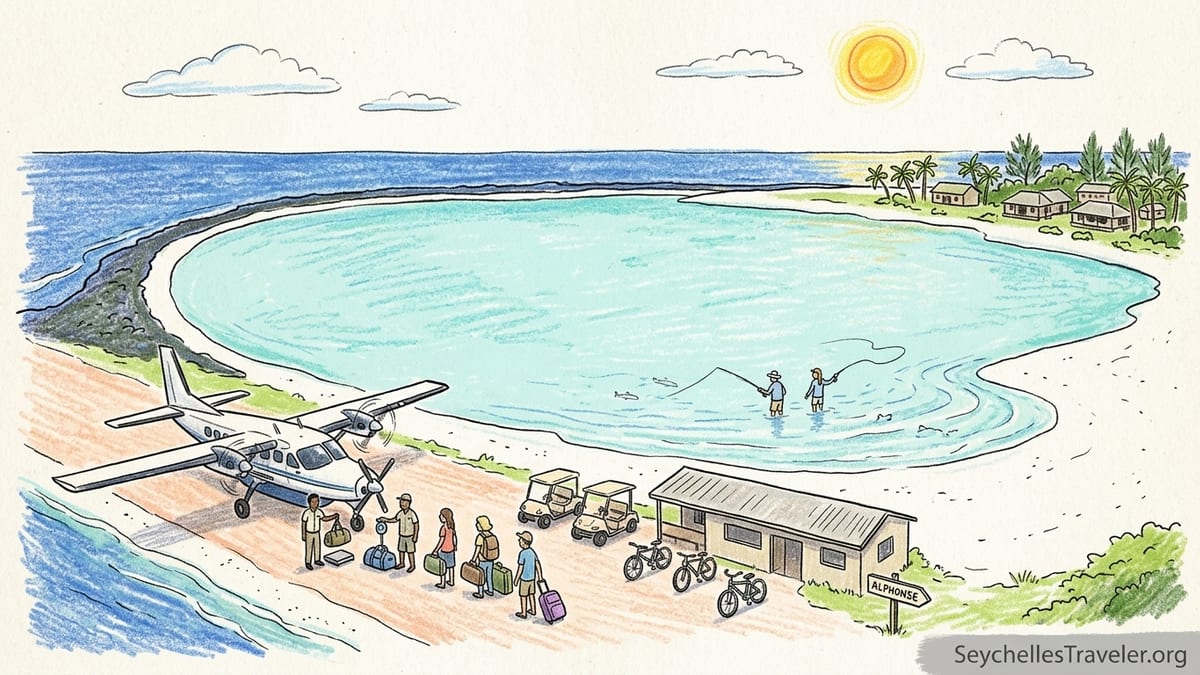
Landing was equally different from the Inner Islands experience. Instead of rolling up to a proper terminal, we taxied along a simple coral‑sand runway with the ocean visible on both sides. At Desroches, there is an official airport but arrivals still feel informal: a low building, golf carts instead of taxis, resort staff lining up with cool towels instead of a baggage carousel. At Alphonse, you step directly from the plane into the humid island air, greeted by Blue Safari’s team and conservation staff, with the only vehicles in sight being tractors, utility buggies and bicycles.
Most of all, I realized my mistake in assuming the Outer Islands were a casual add‑on to Mahé. Flight schedules are limited and tightly linked to resort operations. Desroches typically has one scheduled charter per day with some peak‑season days offering two, but flights can be consolidated or rescheduled based on demand and operational needs. Alphonse has set changeover days tied to week‑long stays. When I first tried to connect my international flight the same evening as my return from Alphonse, the agent immediately advised against it, pointing out that delays due to weather or operational reasons were not rare and would be at my own risk. I ended up booking an overnight on Mahé both before and after, a decision that proved very wise when a crosswind on departure day forced our Alphonse plane to circle and wait for conditions to settle.
Life on a True Coral Island
The fundamental shock of the Outer Islands is the absence of everything you associate with a typical tropical destination town. There are no independent restaurants, no supermarkets, no roadside fruit stalls, no queues of rental cars, no ATMs, and no evening promenade of visitors wandering between bars. On Desroches, the Four Seasons resort is effectively the entire tourism infrastructure, surrounded by undeveloped coastline and a small settlement of staff and conservation workers. On Alphonse, Blue Safari’s lodge, dive center and fly‑fishing operation share space with Island Conservation Society staff and a minimal island village. Once you arrive, that is the universe you inhabit.
The sensory experience is correspondingly intense. The lagoon at Desroches shifts through a precise color palette during the day: a pale, milky aquamarine over the inner sandbar at low tide, blending into glass‑clear turquoise above the patch reefs, then a sudden ink‑blue where the reef wall drops away. At Alphonse, the tidal flats extend for hundreds of meters, so at mid‑tide you wade ankle‑deep across rippled white sand while bonefish ghost past your calves like moving shadows. The edge of the drop‑off is visible even from shore, a thin dark ribbon where the ocean seems to fall out from under itself.
Nights on the Outer Islands are another world. Without towns or highways, the darkness is almost absolute once you leave the resort pathways. On Desroches, the only fixed lights at night are along the main lodge, a few path markers and the faint glow from private villas tucked under the casuarina trees. Walk twenty meters onto the beach, turn off your torch and the Milky Way becomes a bright smear overhead, while the soundscape is reduced to surf on the outer reef and palm crowns hissing in the trade wind. On Alphonse, seabird calls add another layer: sooty terns and noddies chattering through much of the night in nesting season, along with the occasional rustle of a crab lifting itself over coral rubble.
The absence of traffic might be the most striking contrast with Mahé. There are no buses, no car horns, no motorbikes racing the coastal road. Movement on Desroches is mostly by bicycle and electric buggy. On Alphonse, almost everything happens on foot or by bike, with an occasional tractor rumbling past to haul a boat. That change in scale rewires your day. The five‑minute drive from resort to dive jetty replaces the 45‑minute taxi across Mahé, and “going out” in the evening becomes a two‑minute cycle along a sandy path past land‑crab burrows and roosting herons.
Being Completely Dependent on Your Lodge and the Weather
The biggest mental adjustment in the Outer Islands is surrendering control. On Mahé or Praslin, if a tour is cancelled you can simply book another operator, rent a car or go snorkel at a different beach. On Desroches and Alphonse, the lodge is often the only provider of activities, boats, guides and gear. If the dive boat does not go out because of swell on the reef pass, there is no alternative dive shop waiting around the corner. If high wind shuts down fishing on the flats, there is no competitor offering a last‑minute charter from the next bay. Your experience is shaped by that single operator’s safety calls and logistics.
This dependence interacts with weather and seasonality in very real ways. Outer Islands operations run on carefully planned seasons, with certain atolls such as Cosmoledo and Astove only open to guests in specific months when sea conditions are considered safe enough for regular flights and boating. Blue Safari’s current schedules, for example, show set windows each year for its remote fly‑fishing and eco‑lodge operations, typically concentrating visitor trips between late October and April. Outside these windows, many of these islands simply do not take tourists. Even at Desroches, which operates year‑round, the prevailing southeast trade wind from around May to September makes some sides of the island rougher, with stronger currents and limited boat access, while the calmer northwest monsoon months bring heavier humidity and increased rain but easier ocean conditions.
Meals also follow the lodge’s rhythms rather than your whims. On Desroches, menus are generous and fairly varied, with several dining outlets, but they are still part of a closed system: everything has been flown in on the same small planes that brought you. On Alphonse, half‑board or full‑board is the norm and meals are usually taken communally at set times, with a single daily menu featuring local fish, Creole dishes and international staples. You cannot decide at 21:00 that you would rather try a different restaurant, nor can you walk to a takeaway for cheap snacks. When I craved an ice‑cold ginger beer late one afternoon on Alphonse, the only option was to wait for the bar to reopen after staff changeover.
This closed system has cost implications that often surprise first‑time visitors. Small‑plane charters are significantly more expensive per kilometer than ferries or domestic flights to Inner Islands. Return flights to Desroches currently price in the hundreds of euros per adult, depending on season, and week‑long packages to Alphonse, Farquhar or Cosmoledo often cost as much as a multi‑week holiday in other Indian Ocean destinations. Activities, from guided snorkel trips to blue‑water fishing, are priced to reflect that every liter of fuel and piece of equipment has been shipped or flown out from Mahé. I underestimated this on my first Outer Islands trip, budgeting as if I were simply extending my Mahé stay, and ended up trimming back on optional extras like a second blue‑water fishing day and a private conservation tour.
Conservation Rules and What You Cannot Do
Another essential difference between the Inner and Outer Islands is how conservation frameworks are woven into daily life. Many Outer Islands fall within designated protected areas or are managed in partnership with the Island Conservation Society, which maintains research centers on islands such as Alphonse, Desroches, Farquhar, Astove and Cosmoledo. These teams collect data on nesting seabirds, sea turtles and reef health, and their recommendations directly influence what guests can and cannot do. It is common to find entire beaches temporarily closed or partially restricted during peak turtle nesting or hatching periods, with staff carefully monitoring and guiding any visitor interactions.
In practical terms, this means you cannot simply wander wherever you like with a drone or go fishing off any bit of shoreline that looks appealing. Catch‑and‑release rules are strict for many sports‑fishing targets, and certain sensitive species and habitats are entirely off‑limits. Guided access is often the only way to visit outer sandbars, bird islets or reef passes. When I joined a conservation walk on Desroches, we were required to stay behind a line in the sand demarcated by rangers to avoid crushing shearwater burrows hidden under the vegetation. On Alphonse, wading on the flats without a guide was heavily discouraged in key areas, both for safety and to minimize disturbance to rays, sharks and feeding turtles.
Regulations also extend to seemingly small things. Nighttime turtle patrols are often strictly limited to guests on officially organized activities, with staff controlling light use so that torches do not disorient nesting females. Some Outer Islands have complete bans on harvesting shells or corals, backed by national legislation, and there are tight controls on any kind of souvenir collection. Plastic reduction policies can be more rigorously enforced than on the Inner Islands, with refillable glass bottles standard and single‑use plastics largely absent from guest areas.
These rules can feel restrictive if you arrive expecting the laissez‑faire beach culture of places like Beau Vallon. There is no popping a beach umbrella wherever you fancy if that location coincides with a monitored tern colony. Yet the payoff is profound. Watching hundreds of frigatebirds wheel and shearwaters skim the wave faces at Astove’s reef edge, or standing on Desroches’ west coast at dusk while a hawksbill turtle drags herself up the beach under a blaze of stars, you understand why the regulations exist. The Outer Islands feel like a living conservation laboratory where tourism is carefully tolerated rather than automatically welcomed.
Connectivity, Isolation and the Psychology of No Escape
Mobile coverage and internet access form another fault line between Inner and Outer Islands. On Mahé, Praslin and La Digue, you can usually rely on 4G data and a range of Wi‑Fi equipped cafes and guesthouses. On Desroches, connectivity exists but is centralized and sometimes bandwidth‑limited. The resort provides Wi‑Fi in villas and main areas, but speeds can vary, and most back‑of‑house staff rely on specific spots for a decent signal. Alphonse’s lodge also offers Wi‑Fi in key communal zones, yet it is clearly not designed for heavy streaming or remote working. Out on the flats or walking the back side of the island, your phone is often reduced to a camera and flashlight, with no functional network.
This partial disconnection has subtle psychological effects. Knowing that there is no other island to ferry to, no nearby town with its own hotels, can amplify both the sense of freedom and the feeling of being trapped. When a squall settled over Alphonse for 36 hours and the wind pinned palm fronds flat, the normally cheerful bar felt more like the common room of a remote research station. We could not simply take a day trip elsewhere; there was nowhere else accessible without a boat in unsafe seas. Likewise, when a guest’s luggage missed the flight to Desroches due to an issue at Mahé, the reality was harsh: the next scheduled service was the only realistic chance of seeing that bag again for several days, and there were no clothing shops on island in the meantime.
The lack of alternative services becomes most tangible around basic comforts. If you are unhappy with your room, there is unlikely to be another hotel to move to. If you develop a craving for a specific snack or drink not stocked by the resort, you simply go without. When a couple on my Desroches flight realized they had not packed any reef‑safe sunscreen for their children, the resort boutique was their only option and the price per bottle reflected the cost of flying goods thousands of kilometers. There was no option to walk into town for a cheaper alternative. These realities make pre‑departure packing lists and expectations significantly more important than for an Inner Islands break.
On the positive side, this isolation intensifies small joys. Watching ghost crabs work the tideline after dinner, listening to the wind rise in the casuarina trees, or cycling to a western beach to sit alone with the sound of the outer reef becomes your evening “entertainment.” With no traffic hum or city glow, you become acutely aware of every rustle in the undergrowth, every wave breaking on the bommies, every shift in wind direction. It feels less like staying at a resort and more like being temporarily folded into a self‑contained island ecosystem.
Practical Lessons and Common Mistakes
My most useful Outer Islands lessons were born from mistakes. The first was assuming I could treat Desroches as a simple extension night after Mahé. When I initially booked, I tried to line up my return Desroches flight with a same‑day overnight flight back to Europe. On paper, the timings just about worked. In reality, both Four Seasons and the flight operator strongly recommended arriving on Mahé at least one day before any long‑haul connection, warning that last‑minute schedule changes or weather delays could easily cause missed flights, with any additional costs falling on me. Having already seen light aircraft on Alphonse grounded for several hours due to crosswinds, I changed my plans, added a Mahé buffer night and slept much better for it.
Luggage was my second miscalculation. Outer Islands flights typically favor soft bags and impose tight weight limits not just for passenger convenience but for aircraft performance on short coral runways. On my Alphonse trip I arrived with a semi‑rigid roller bag at the domestic terminal, only to be told that it would at best be loaded last and at worst left behind if the plane reached its weight limit. I spent an anxious half hour at the check‑in counter transferring essentials into a borrowed soft duffel while keeping one eye on the baggage scale. On Desroches I came prepared, with a 70‑liter soft duffel and a compact camera backpack, which made the weighing process smoother and left me comfortably under the allowance.
The third lesson was financial. I had read about Outer Islands activity costs but underestimated how quickly they add up in a closed market where everything is imported. At Alphonse, each guided flats session, offshore blue‑water day or specialty dive carried a premium price that reflected not just guide expertise but the logistics of running boats, fuel, maintenance and conservation programs from such a remote location. On Desroches, private experiences like sandbank picnics, conservation‑led turtle walks and sunset cruises were priced in line with high‑end Indian Ocean resorts. Concrete numbers shift seasonally, but expecting blue‑water fishing, advanced diving or bespoke excursions to cost several hundred euros per person per day is more realistic than thinking in terms of casual day‑trip prices from Mahé.
The final category of mistakes involved bringing the wrong equipment and expectations. Hard suitcases, heavy tripods, non‑reef‑safe sunscreen, drones without prior permission and rigid footwear all caused problems for various guests I met. Outer Islands life favors packable gear: soft bags, lightweight sandals, closed shoes that can get wet, polarized sunglasses, and clothing that dries fast in humid air. Power outlets and voltage on Desroches match Mahé, but on some more remote atolls generator capacity can be limited, so packing fewer gadgets makes sense. Perhaps more importantly, Outer Islands reward travelers who arrive not with a checklist of must‑do items but with a willingness to let weather, tides and conservation priorities shape each day.
The Takeaway
What, then, is fundamentally different about visiting Seychelles’ Outer Islands rather than the Inner Islands? On the surface it is a matter of geography. The Outer Islands are low coral atolls scattered far beyond the shallow Seychelles Bank, hundreds of kilometers from Mahé, where infrastructure is sparse and access is by small aircraft on limited schedules. Yet the deeper distinction lies in mindset. The Inner Islands offer variety and choice: multiple restaurants, public beaches, bus routes, independent tour operators and the ability to improvise your holiday on the fly. The Outer Islands strip that away and replace it with immersion and constraint.
On Desroches, Alphonse, Farquhar, Astove or Cosmoledo, you are not passing through a destination so much as submitting to a micro‑world. The lagoon colors, the absolute night skies, the racket of tern colonies and the relentless wind in trade‑wind season become main characters in your trip. Meals happen when and where the lodge decides, activities follow the judgment of a single operator, and conservation rules decide which beaches and flats are available each day. If your plane cannot leave, you stay. If the wind is too strong, you wait. If turtles are nesting, you walk around their stretch of beach instead of across it.
This might sound limiting, but for many travelers it is exactly why the Outer Islands remain unforgettable. The very absence of choice sharpens your attention to what is in front of you. A single snorkeling session along a coral drop‑off alive with sharks and rays, or an hour sitting in complete darkness under a sky so bright it feels close enough to touch, can outweigh a week of more conventional sightseeing. For those accustomed to frictionless tourism, the Outer Islands can be confronting. For those who accept their terms, they offer one of the Indian Ocean’s last, fragile experiences of true, inhabited wilderness.
FAQ
Q1. Which Seychelles Outer Islands currently accept leisure visitors?
Several Outer Islands accept visitors through specific resorts or operators. Desroches Island hosts the Four Seasons Resort Desroches Island. Alphonse Island operates as a lodge with Blue Safari. Other atolls such as Farquhar, Cosmoledo and Astove are open in defined seasons, mostly via organized packages that often focus on fly‑fishing, diving or eco‑tourism. Access and availability can change, so travelers should check current schedules and permissions before planning.
Q2. How do you get from Mahé to the Outer Islands?
Access is almost always by small aircraft from the domestic terminal at Seychelles International Airport on Mahé. Desroches is typically reached by a charter flight of about 35 minutes. Alphonse and other more remote atolls involve longer flights, often combined with set changeover days. There are no regular public ferries to these islands, and boat transfers are usually reserved for specialized expeditions or inter‑island logistics.
Q3. How many days should I plan for an Outer Islands stay?
Given the cost, remoteness and limited flight schedules, a minimum of four nights on Desroches and a full week on islands like Alphonse, Farquhar or Cosmoledo is sensible. This allows buffer time for weather disruptions and enough days to experience varied activities such as diving, snorkeling, guided walks and conservation encounters. Short two‑night stays are possible on some islands but can feel rushed and vulnerable to delays.
Q4. How strict are luggage restrictions on Outer Islands flights?
Luggage restrictions are taken seriously because small aircraft operate from relatively short runways and must balance passenger and cargo weight carefully. Soft‑sided bags are strongly preferred, and combined checked allowances commonly fall around 15 to 20 kilograms per person plus a small cabin item. Oversized or hard‑shell suitcases may be refused or sent on a later flight if weight limits are reached, so repacking into soft luggage before reaching the domestic terminal is wise.
Q5. Is there mobile coverage and Wi‑Fi on the Outer Islands?
Limited connectivity is available on most Outer Islands that host resorts. Desroches and Alphonse provide Wi‑Fi in key areas and in many guest accommodations, and there is usually some mobile signal near main buildings. Coverage can be patchy away from central zones, and speeds are not designed for bandwidth‑heavy tasks such as constant video calls. Travelers should expect to be partly offline, particularly during outings and on more remote atolls.
Q6. How expensive are activities compared to Mahé and Praslin?
Activities on the Outer Islands usually cost more than similar excursions from the Inner Islands. Charter flights, imported fuel and the logistics of running boats and gear from remote bases all contribute to higher prices. Guided dives, flats fishing sessions and blue‑water trips are often priced in the hundreds of euros per person or per boat day, depending on the activity and season. Budgeting generously for experiences is more realistic than assuming Inner Islands day‑trip rates.
Q7. Can I explore Outer Islands independently by walking or cycling?
There is some scope for independent exploration on islands like Desroches and Alphonse, particularly along marked cycling paths and designated beach sections. However, many sensitive habitats, bird islets and reef flats are accessible only with guides, and certain zones may be closed during nesting or restoration periods. Visitors should expect to follow clear rules and respect temporary restrictions that prioritize conservation and safety.
Q8. Are Outer Islands suitable for families with children?
Outer Islands can be rewarding for families who value nature, wildlife and quiet time together. Wide beaches, shallow lagoons and close‑up encounters with turtles, birds and reef life can be memorable for children. At the same time, the lack of alternative dining options, shops and entertainment, alongside strict conservation rules and weather dependence, may challenge families who prefer flexible schedules and varied distractions. Choosing a resort with family facilities and discussing expectations in advance is important.
Q9. What is the best time of year to visit the Outer Islands?
The best time depends on your priorities. Many operators focus their main visitor seasons for remote atolls between late October and April, when sea conditions are typically more favorable for boating and water activities. Desroches operates year‑round, with the southeast trade wind months bringing cooler, windier weather and rougher seas on some coasts, and the northwest monsoon months offering calmer seas but more humidity and showers. Checking your chosen island’s current seasonal schedule is essential.
Q10. How do conservation rules affect a typical Outer Islands holiday?
Conservation rules shape almost every aspect of an Outer Islands stay. They influence where and when you can walk on beaches, how close you can approach wildlife, which fishing practices are permitted and where activities occur. Guests may find sections of coastline temporarily closed, need to join guided activities to access flats or bird islets, and follow strict no‑take and no‑touch policies for marine life and shells. These measures can limit spontaneity but also protect the wild character that makes the Outer Islands special in the first place.