


On 15 September 2026 at 2:30 p.m., under a hazy 30°C sky with light south-easterly wind and mid-falling tide, I finally rolled my rental bike up to the gate of L’Union Estate on La Digue. I paid the SCR 150 foreign-visitor entrance fee by card, passed through the turnstile with my paper wristband, and expected the world’s most beautiful beach to be waiting just beyond the palm trees. Instead, I spent the next three hours picking my way through a shoulder-to-shoulder crowd and a lagoon that was mostly ankle to knee deep, wondering if I had just paid to walk around inside a tourism myth.
The First Glimpse: From Postcard Fantasy To Crowded Reality
There is no free public path to Anse Source d’Argent. Every visitor passes through L’Union Estate, the historic coconut and vanilla plantation that controls land access to the beach and charges foreign visitors SCR 150 for a day pass. At the gate, the fee feels reasonable for somewhere that appears on glossy magazine covers and desktop wallpapers, often described as the world’s most beautiful beach. It is only when you reach the sand and look for a place to swim that the calculation becomes more complicated.
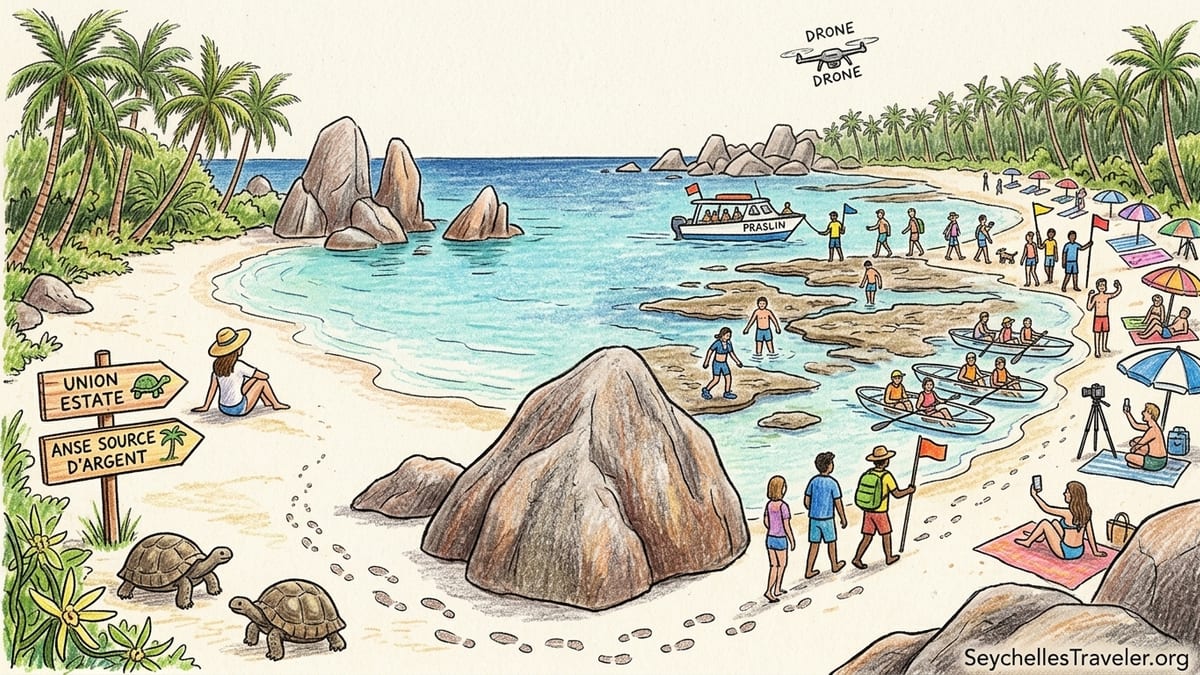
That afternoon, the tide had already pulled back, exposing broad plates of coral rock across the lagoon. Instead of a clear turquoise swimming pool, much of the water between the famous granite boulders was barely calf deep. Children splashed happily, but adults mostly waded, hunched over to avoid scraping their feet, or gave up and sat in warm, still puddles. The scene bore little resemblance to the deep, sparkling lagoons usually shown in travel brochures.
The crowds were just as jarring. Long lines of day-trippers from Praslin shuffled along the sand, herded by guides holding colored flags. Transparent kayaks nose-to-tailed along the shoreline paused every few meters so their passengers could photograph the same boulder formations. Drone operators called instructions over the sound of small generators. Stepping around tripods and selfie poses became part of every walk to the water. It was difficult to square this with the solitary palm-fringed coves that dominate social media.
Walking back up the beach, I caught myself thinking about the price again. SCR 150 is not outrageous in itself, especially compared with long-haul flights and guesthouse rates, but it changes expectations. You are no longer stumbling upon a wild beach at the end of a jungle trail. You have bought a ticket to a curated experience, one that often privileges the camera lens over the swimmer in the water.
Why The Photos Look So Perfect
Anse Source d’Argent is visually famous for a reason. On the southwest coast of La Digue, the shoreline curves into a sequence of coves framed by enormous granite boulders, smoothed and sculpted over time into organic shapes. Behind them, pale sand slips under leaning coconut palms and takamaka trees, and in front lies a shallow reef lagoon where water can shift from milky turquoise to luminous blue in a single morning.
Photographers know how to work these elements. Most iconic images are shot at mid to high tide, when the lagoon is full enough to hide the coral plates and rock ledges under a uniform sheet of water. Long lenses compress the distance between boulders and horizon so that the beach looks more isolated than it feels on the ground. Drone shots from above flatten the scene into abstract geometry: dark granite, pale sand, a brushstroke of reef, and then deep Indian Ocean beyond.
Composition choices also disguise the busyness. A palm frond in the foreground, a kayak gliding through empty water, or a model standing alone at the waterline can all be captured if the photographer crops out the tour groups standing just beyond the frame. Early morning and late afternoon, when the light is softer and colors turn pastel, usually coincide with fewer people in specific coves, so well-planned images seem to promise a serenity that most midday visitors never find.
The result is a beach that works spectacularly well in two dimensions. Every ingredient of the tropical fantasy appears on cue: sculpted granite, powdery sand, palms, and a sheltered lagoon that, from a distance, could be any swimmer’s dream. The problem is that Anse Source d’Argent functions quite differently when you step into the water instead of just photographing it.
A Beautiful Beach, But Is It A Good Swimming Beach?
The same reef that creates Anse Source d’Argent’s postcard lagoon also limits its usefulness as a place to actually swim. This is a shallow-reef beach, with an offshore barrier that blocks ocean swell and leaves a calm inner lagoon. At high tide, the water can reach waist to chest depth in some channels, enough for relaxed floating and short laps along the reef edge. At low tide, large stretches of the lagoon shrink to wading depth, leaving exposed coral heads and rock plates under just a few inches of water.
On my visit, I watched several newcomers step into the lagoon expecting a classic Maldivian-style experience, only to stop abruptly when their shins brushed coral. Many turned back to fetch reef shoes from their bags. Others tried to push farther out, only to find the water growing shallower, not deeper, as they walked across the flats. A couple from Germany joked that they had paid to bathe in a children’s paddling pool surrounded by granite cliffs.
Swimming is still possible, but it requires timing and awareness. Local guides and water-sports staff frequently recommend planning visits around mid or rising tide if you care more about swimming than photography. At those times, depth increases enough to clear the reef heads while still keeping the lagoon protected and mostly wave-free. Outside this window, snorkeling and swimming can feel more like careful maneuvering between coral patches than the carefree immersion suggested in glossy images.
For families with young children or non-swimmers, the shallow water can be an advantage. Toddlers can splash safely under close supervision, and nervous adults appreciate the ability to stand almost anywhere. But if your idea of a beach day involves long, refreshing swims in cool, shoulder-deep water, Anse Source d’Argent will probably fall short unless you plan your day precisely around the tide tables and accept that your swimming area will be limited.
Understanding The SCR 150 Estate Fee And What You Actually Get
The SCR 150 foreign-visitor charge at L’Union Estate is more than just a beach toll, though it often feels like one. According to the estate’s own information, that entrance fee buys a one-day pass to the entire heritage park, valid from 6 a.m. to 6 p.m. The rules include an important nuance. If you purchase your ticket after 4:30 p.m., it remains valid for the following day, effectively giving you access across two calendar days within the estate’s 6 a.m. to 6 p.m. operating hours.
The pass covers several attractions beyond Anse Source d’Argent itself. You can walk around the old plantation house and grounds, see a traditional copra mill and kiln, and wander through rows of vanilla vines that trace the estate’s agricultural history. There is a fenced area with Aldabra giant tortoises, which many visitors linger over longer than expected, and a small cemetery dating back to early settlers on La Digue. More recently, a rum showroom and tasting space has been added in and around the plantation buildings, reflecting how the estate is being repurposed for tourism.
These elements matter because they influence whether the entrance fee feels justified. If you arrive in the morning, spend an hour cycling and walking through the estate, stop to watch tortoises and explore the historic buildings, and then head to the beach for a couple of well-timed swims at higher tide, the SCR 150 starts to resemble a day at a combined heritage park and coastal reserve. If you arrive in the early afternoon at low tide, march straight to Anse Source d’Argent, find a crowded, shallow lagoon and little shade, and leave after two hours of frustration, the same fee can feel like poor value.
Importantly, the pass allows multiple entries on the same day. Many La Digue guesthouses sit within a 10 to 15 minute cycle of the estate. Some visitors choose to ride down for sunrise, leave around midday for lunch and a siesta, then return later in the afternoon when the light softens and the heat eases. If you used the after-4:30 p.m. trick, you might see the beach at near-empty sunrise conditions the next morning without paying again, a detail that goes unmentioned at the gate unless you ask.
Getting There By Bike, Walking Through The Estate And Finding Space
Reaching L’Union Estate is part of the Anse Source d’Argent ritual. From the jetty at La Passe, rental bikes cluster in front of small shops and guesthouses, with daily rates commonly advertised in the SCR 150 to 200 range depending on condition and duration. Many visitors pick the first bike available and pedal south in the afternoon heat, past takeaway stands and small supermarkets, joining an informal procession of wobbling tourists, dive staff and schoolchildren on the island’s single coastal road.
The ride to the estate gate takes around 10 to 15 minutes at a moderate pace, but in the middle of the day it can feel longer. Humidity builds, and the lack of hills does not fully compensate for the sun. On popular days, bikes already line the grass and sand verge near the entrance, locked in improvised clusters. Inside the estate, you cycle past old coconut groves, granite outcrops and the occasional ox cart, sharing the dirt track with electric buggies bringing resort guests and supply trucks heading toward beach kiosks.
Once you park near the seafront, the final approach to Anse Source d’Argent is on foot. A sandy path leads past snack stalls selling fresh juices, grilled fish and coconut water, and then splits into smaller trails threading between boulders and palms. Here, the disconnect between images and reality becomes most obvious. Where the photographs show empty, curving sands, you may instead encounter clusters of people squeezed into each cove, towels overlapping and tripods tucked into any gap between tree roots and rocks.
Finding personal space depends on how far you are willing to walk. The first few coves tend to be the most crowded, since organized tours and day-trippers are often short on time and stop at the first classic vista. If you continue along the shoreline, stepping through shallow water and scrambling briefly over smaller boulders, you can reach quieter pockets where tour groups rarely linger. Even there, it is rare to be completely alone in the middle of the day, but you may gain a few more square meters of sand and a greater sense of separation from the crowds.
Low Tide, Shallow Water And Why Timing Matters So Much
All shallow-reef beaches are shaped by tide cycles, but at Anse Source d’Argent the difference between high and low water is particularly stark. At low tide, large parts of the inner lagoon become too shallow for satisfying swimming. Coral and rock ledges appear just below the surface or break through entirely, creating irregular channels of slightly deeper water that are difficult to navigate without careful footwork. The sun warms these remaining pools quickly, so they feel more like a tepid bath than a refreshing dip.
On my afternoon visit, I tried to follow a narrow finger of deeper water toward the reef, only to find it pinched into knee-deep flats after a few dozen meters. A snorkeler beside me lifted his fins and walked awkwardly over exposed coral, apologizing to the reef with each step. Another visitor slipped, scraping a shin on a rock plate that had been invisible from shore. No lifeguards patrol these shallows, so the burden of caution rests entirely on swimmers and parents.
At higher tide, everything transforms. The same guides who warn about ankle-deep water in the afternoon quietly nudge guests toward morning visits when the tide fills the lagoon. Snorkeling sites that were dry rock are suddenly accessible. You can float over coral heads without touching them, and short swims parallel to the reef become possible. Photographers relish these moments because the water color intensifies and the boundary between sand and sea blurs into the creamy turquoise that adorns so many advertising campaigns.
The challenge is that few ticket buyers at the estate gate see any tide information before paying. There is no prominent board explaining that the lagoon may be largely unswimmable for several hours each day, or that arriving an hour earlier or later could completely change their experience. Anse Source d’Argent can be both magical and underwhelming. Which version you meet depends less on subjective opinion and more on where the tide happens to be when you walk through the palms.
How Tours, Kayaks And Photographers Shape The Beach
The most famous boulders at Anse Source d’Argent act like magnets. Organized excursions from Praslin and Mahé, half-day La Digue tours, and transparent kayak operators all converge on the same coves, usually between late morning and mid-afternoon. Guides lead groups directly to one or two classic photo spots, give 20 to 40 minutes of free time, then shepherd everyone back toward waiting bikes or boats.
Transparent kayak tours, often departing from near the estate’s shoreline, add another layer of activity. Prices quoted on recent brochures and boards along the sand tend to cluster around SCR 400 to 600 per hour for a two-person clear kayak, with higher rates for guided photo sessions that include drone shots and posed images near rock formations with names like Shark Rock or Kissing Rocks. These tours are visually impressive and give access to angles that shore-based visitors never see, but they also concentrate yet more people into the narrow channels between boulders.
Professional and semi-professional photographers, including those shooting honeymoon and wedding sessions, occupy many of the same pockets of beach. Assistants hold reflectors, couples change outfits under sarongs held up as impromptu curtains, and sequences of carefully choreographed poses play out inches from where independent travelers are simply trying to reach the water. To the photographers’ credit, they often work quickly and use tight framing to avoid recording the chaos, but their presence makes the beach feel more like an outdoor studio than a natural refuge.
None of this is inherently negative if you come primarily for images. You might join a kayak shoot, pay for a mini photo session, then retreat content with a memory card full of luminous scenes. The problem arises when visitors arrive expecting an uncrowded, low-key swimming beach and discover that the practical center of Anse Source d’Argent has been reorganized around photography and short-stay tours rather than the simple act of spending a quiet day by the sea.
Comparing Prices And Swimming To La Digue’s Free Beaches
Understanding whether Anse Source d’Argent is overrated requires comparing it with other La Digue beaches that do not charge an access fee. To the north, Anse Severe and Anse Patates are both free to enter and sit within easy cycling distance of the jetty. At Anse Severe, you will usually find a handful of snack trucks or simple beach bars selling fresh fruit juices, crepes and grilled skewers at prices that often undercut the refreshments inside L’Union Estate. Kayak rentals, where available, may be offered at comparable prices, but you are not paying SCR 150 simply to reach the sand.
Anse Patates, a small cove framed by rocks, offers deeper water closer to shore than Anse Source d’Argent at low to mid tide. Swimmers there talk about diving into clear blue water without picking their path over coral flats, accepting that the beach itself is small and can fill quickly. There are fewer structured activities, no ticket gates and a general feeling that the sea belongs more to swimmers than to photographers.
On the south-east side of the island, Grand Anse presents a completely different trade-off. Access is again free, and the long arc of pale sand and powerful surf provide some of La Digue’s most dramatic scenery. This is not a lagoon beach; waves can be strong and currents unpredictable, which means swimming here is often restricted to confident swimmers staying close to shore under favorable conditions. For many people, Grand Anse is a place to walk, picnic, and feel the scale of the Indian Ocean rather than to float lazily in calm water.
From Grand Anse, footpaths lead to Petite Anse and Anse Cocos, two beaches repeatedly praised by regular visitors for their balance of scenery and more enjoyable swimming. Anse Cocos in particular features a natural rock pool at one end where waves are filtered into a semi-enclosed basin, giving chest-deep water with far fewer coral hazards than Anse Source d’Argent at low or mid tide. There is no formal entrance fee, no estate wristband, and refreshments come from simple stands or coolers carried by small vendors, if at all. You trade the convenience of a snack bar and a well-swept heritage path for a short hike and a greater feeling of discovery.
When you look at how much usable swimming you get for the money, the contrast sharpens. At Anse Severe, Patates, Grand Anse and Anse Cocos, any limitations tend to be natural: waves, currents, or the size of the beach. At Anse Source d’Argent, the limitations are a mix of natural conditions and human management. The lagoon’s shallowness is not the estate’s fault, but the decision to gate access, charge a fixed fee and market the beach heavily shapes who appears on the sand and what they come to do. As a swimmer, you pay upfront and then hope the tide and crowds cooperate.
The Takeaway
So is Anse Source d’Argent overrated? For me, on that particular September afternoon with a mid-falling tide, a packed shoreline and water barely to my knees, the answer was yes. The gap between the famous photographs and the on-the-ground experience was simply too wide. I had paid for a day pass, navigated heat and crowds, and ended up feeling like a background extra in someone else’s photo shoot, shuffling around a lagoon better suited to wading than swimming.
That does not mean the beach is a fraud. At certain times of day and tide, Anse Source d’Argent lives up to its reputation. Arrive just after sunrise when the gate opens at 6 a.m., or catch a well-timed late-afternoon high tide, and you may find softer light, fewer groups and a lagoon deep enough for gentle floating over coral gardens. Use the after-4:30 p.m. ticket rule to span two days and you could see both golden-hour calm and midday spectacle without paying twice.
However, if your priority on La Digue is swimming rather than photography, I would not dedicate an entire day to Anse Source d’Argent. A concentrated visit of two or three hours, carefully planned around tide charts and light, is likely to deliver the best balance of value and experience. Spend the rest of your time at free-access beaches that better reward spontaneous swims, like Anse Patates for instant depth, Anse Severe for easy access and casual snacks, or Anse Cocos if you are willing to hike for a rock pool that feels more like a natural spa than a theme-park lagoon.
If your visit to La Digue is short and you are deciding whether to skip Anse Source d’Argent entirely, ask yourself what matters most. If you care about capturing the classic Seychelles image and do not mind crowds, the estate fee and shallow water are acceptable costs for standing, however briefly, inside a global postcard. If you crave long, frustration-free swims and the feeling of stumbling upon something half-hidden, it is entirely reasonable to let the world’s most photographed beach stay in your screensaver folder and build your La Digue memories somewhere else.
FAQ
Q1. How much does it cost to visit Anse Source d’Argent as a foreign visitor?
The current published entrance fee for foreign visitors to L’Union Estate, which you must pass through to reach Anse Source d’Argent, is approximately SCR 150 per person for a day pass.
Q2. What are the official opening hours for L’Union Estate and Anse Source d’Argent?
L’Union Estate states that it is open daily from 6 a.m. to 6 p.m., including weekends and public holidays, and beach access follows those same hours.
Q3. Is it true that tickets bought after 4:30 p.m. are valid the next day?
Yes. According to estate information, tickets purchased after 4:30 p.m. remain valid for entry the following day within normal 6 a.m. to 6 p.m. operating hours.
Q4. Is Anse Source d’Argent good for swimming?
Swimming can be pleasant around mid or higher tide, when the lagoon is deeper, but at low tide much of the bay becomes ankle to knee deep and better suited to wading than proper swimming.
Q5. Why is Anse Source d’Argent considered one of the world’s most beautiful beaches?
Its fame comes from the dramatic combination of huge granite boulders, pale sand, leaning palms and a shallow turquoise lagoon, which photograph exceptionally well from the ground and the air.
Q6. Are there cheaper alternatives on La Digue without an entrance fee?
Yes. Beaches such as Anse Severe, Anse Patates, Grand Anse and Anse Cocos do not charge an access fee and often offer better or deeper swimming conditions, though each has its own safety considerations.
Q7. How crowded does Anse Source d’Argent get during the day?
It can become very crowded between late morning and mid-afternoon, when Praslin day-trippers, organized tours, transparent kayaks and photo sessions all converge around the most iconic boulders.
Q8. What does the L’Union Estate ticket include besides beach access?
The pass covers the plantation grounds, historic plantation house, copra mill and kiln, vanilla plantings, Aldabra tortoise enclosure, small cemetery and newer attractions such as a rum showroom, in addition to access to Anse Source d’Argent.
Q9. How do refreshment and kayak prices compare with other La Digue beaches?
Inside the estate, drink and food prices are generally similar to or slightly higher than casual stands at free beaches, and transparent kayak rentals are often in the mid-hundreds of rupees per hour, which is comparable to or higher than small-scale rentals elsewhere on the island.
Q10. Should I plan a full day at Anse Source d’Argent or just a short visit?
For most travelers, a shorter, well-timed visit of two or three hours focused on photography and a quick swim makes more sense than a full beach day, with the rest of the time better spent exploring La Digue’s free-access beaches.