


On a humid September morning in 2025, I boarded the Cat Cocos high-speed ferry from Mahé to Praslin with the same glossy expectations many visitors bring to the Seychelles. My ticket was for the economy main cabin, booked at 56 euros one way, the headline fare most booking sites still advertise for this crossing. The sea outside Inter Island Quay in Victoria looked calm enough, dotted with charter yachts and fishing boats, and I had convinced myself that one hour on a modern catamaran would be the simplest way to start a week of island hopping to Praslin and La Digue. By the time we reached Baie Sainte Anne, I understood how naïve that assumption was, both in terms of comfort and the true cost of moving between these postcard islands.
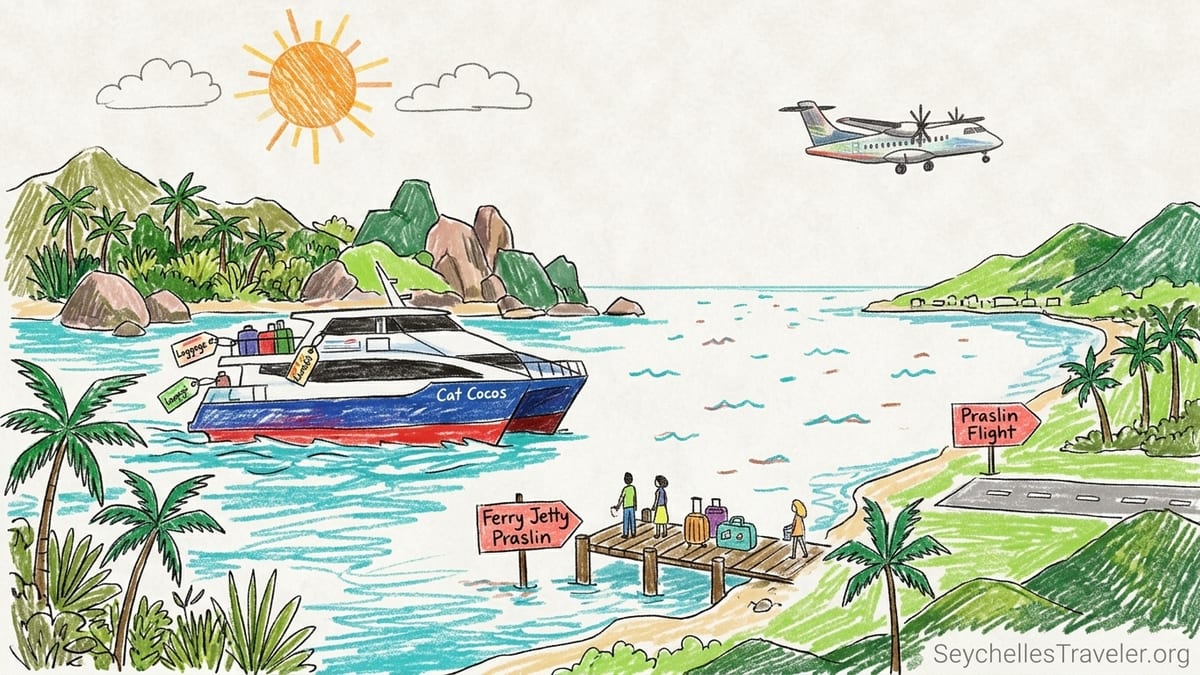
Reconstructing a Real Crossing: Mahé to Praslin in Economy
The Cat Cocos ferry I took from Mahé’s Inter Island Quay to Praslin’s Baie Sainte Anne was one of the standard morning departures that underpin most itineraries. Cat Cocos is the main operator on the Mahé–Praslin–La Digue route, with published one-way starting fares around 56 euros for the Mahé–Praslin economy main cabin and 68 euros for Mahé–La Digue, and around 15 euros for the shorter Praslin–La Digue leg. Those numbers sound manageable in isolation. They do not tell you how easily the experience can sour if conditions, timing or luggage misalign with your expectations.
Boarding began around forty minutes before departure. Passengers queued along the jetty, luggage tagged and stacked on open trolleys that porters wheeled towards the stern. Check in was efficient but brisk. Once suitcases disappeared onto the trolley, you effectively surrendered control until the other end. On my sailing the sea state was described as slight to moderate. From the quay the water looked almost flat, but out beyond Saint Anne Marine National Park the catamaran began to rise and fall in long, slow movements that quickly separated confident sailors from those gripping sick bags.
Inside economy, seating was aircraft-style, with rows of fabric seats and narrow aisles. The air conditioning was working but uneven. Some rows were in a chilly draught, others noticeably warm. Windows were tinted and salty spray soon blurred the views, undercutting the idea that this is a scenic cruise rather than a pure transfer. Ventilation relied on the closed system of the cabin; you could not open a window if you started to feel queasy. For some passengers, the only relief was to step outside briefly on the stern deck, which staff allowed in small numbers when conditions permitted.
Disembarkation in Praslin highlighted another overlooked stress point: luggage retrieval. Bags were unloaded onto the quay in several heaps, and passengers clustered around trying to spot their cases. There were no belts or carousels, just a scramble of tags and colored straps in the heat. It worked, but it felt far from the premium tropical experience many brochures still sell. That first crossing set the tone for the rest of my island-hopping week and raised a question I kept returning to. Why are travelers paying airline-level prices for what can be, at best, a functional and sometimes uncomfortable ride.
Short Hop vs Open Ocean: Why Routes Feel Radically Different
On paper, hopping from Praslin to La Digue looks like a non-event. The fast ferries operated by Cat Cocos and Cat Rose cover the distance in around fifteen minutes. Prices of about 15 euros for an adult one way make this the budget segment of Seychelles sea travel. When I took this crossing later in the week, the contrast with Mahé–Praslin was immediate. Boarding was simpler, luggage stayed in a small forward area, and passengers were on and off the boat before anyone had time to open a book, let alone feel unwell.
The crucial difference is geography. Mahé to Praslin is an open-ocean route that crosses the Seychelles Plateau, with journeys of about one hour depending on vessel and sea state. Even in generally calm seasons, conditions can range from smooth to quite choppy. Traveler reports from recent years describe everything from glassy, motionless water where people sprawled on seats as if on a bus, to crossings where crew handed out sick bags in bulk and several passengers were visibly ill. By contrast, Praslin to La Digue remains relatively sheltered between islands, which is why many visitors recall it as an easy shuttle rather than a serious sea trip.
This difference matters because many new visitors assume that if they handled Praslin–La Digue without a problem, Mahé–Praslin will feel similar. The reality can be far rougher. Online discussions among recent travelers are full of comments like “Praslin to La Digue was quick and fine, but Mahé to La Digue was very choppy” or “happy we had a calm day for Mahé–Praslin after reading all the horror stories.” Those are not scientific samples, but they highlight the range of experiences and the risk of extrapolating the shortest route to all others.
It also explains why some local agents quietly suggest considering the short Mahé–Praslin flight, particularly if you know you are prone to seasickness or visiting during a windier period. Sea conditions can vary by month and by day, and no operator can guarantee a smooth ride. What you can control is how many long open-ocean legs you build into your itinerary and how tightly you schedule them around tight connections.
The Real Price of Island Hopping Once Everything Is Counted
Headline fares for Seychelles ferries do not look outrageous in isolation, especially compared with long-haul flights. Where they become confronting is in combination and once you add the invisible transfers that join flight, jetty and hotel. Using current starting fares, a simple Mahé–Praslin–La Digue–Mahé loop for two adults already climbs fast, even before you set foot in a taxi.
Begin with Mahé to Praslin. At 56 euros per adult, one way in economy main cabin, two tickets cost 112 euros. From Praslin to La Digue, at 15 euros per adult, you add 30 euros. To return from La Digue to Mahé on a through ferry, most itineraries price this at the Mahé–La Digue rate, around 68 euros per adult for the direct combination of La Digue to Praslin plus Praslin to Mahé. That is another 136 euros for two people. The pure ferry component of this loop therefore comes to roughly 278 euros for a couple, all one-way segments combined.
Factor in the obligatory port taxes listed by some booking agents: around 2 euros per adult per journey on the main routes and about 1 euro on Praslin–La Digue. That might add approximately 10 to 12 euros across the same loop. We are now in the region of 290 euros purely on scheduled ferries and port fees for two adults completing a very typical three-island route.
Then come the connectors. From Seychelles International Airport to the ferry terminal near Victoria, official taxi fare tables and recent traveler reports suggest prices around 400 to 500 Seychellois rupees one way for a standard car, which converts to somewhere in the 25 to 35 euro range depending on exchange rates. Some visitors report paying nearer 30 euros for that short transfer. Add the same again on your return if you end the trip on Mahé and suddenly your airport–jetty transfers alone can approach 60 to 70 euros for a couple.
On Praslin, the taxi from Baie Sainte Anne jetty to mid-range resorts at Anse Volbert or Grand Anse is often quoted around 20 to 30 euros per ride, depending on distance and negotiation. Add two or three such trips over a week and it is easy to add another 70 to 90 euros in local transfers. La Digue stands out as the exception in this equation. The island is compact, arrival is straight into La Passe, and many guesthouses are within walking distance or reachable by simple bicycle rental, which is a welcome relief after counting vehicle-based costs elsewhere.
When Premium Seating Helps, and When It Does Not
Most booking portals and the official fare tables promote three main seating choices on Cat Cocos for the longer routes. There is the economy main inside cabin at around 56 euros on Mahé–Praslin, an economy upper deck option costing roughly 6 euros more per adult, and a business class upgrade which adds about 21 euros to the basic fare. On Mahé–La Digue, the pattern is similar, with slightly higher base fares. In theory, paying more should deliver palpably better comfort. In practice, the value is mixed.
The economy main cabin is below or at waterline level with limited views and that bus-like seating layout. The upper deck is partly outdoors, with more fresh air and clearer views, which many travelers find helpful in light to moderate swell. For a small surcharge over the base economy fare, it can indeed feel like money well spent if visibility and air movement help stave off queasiness. Where it falls short is in heavy weather. No upgrade will change the fundamental motion of the vessel, and being more exposed can even amplify the sensation of pitching and rolling.
Business class typically occupies a separate section with fewer seats, more space and slightly enhanced service, such as complimentary soft drinks or snacks. For those who are particularly sensitive to crowded environments or who prize personal space, that may feel worth the premium. However, the seats themselves are not flatbeds; the ride length is still under two hours; and the same hull encounters the same seas as economy. You will reach Praslin or Mahé at the same time as passengers who paid half your fare, and if conditions are rough you may still feel unsettled.
Over several crossings, I experimented with both main cabin and upper deck seating. On a calm afternoon, the upper deck was a pleasure, breezy and bright with the silhouette of Mahé shrinking behind us. On a windier morning run, even upper deck regulars clutched railings and stared fixedly at the horizon. The conclusion I drew was simple. Premium seating may slightly improve your sense of comfort in good conditions and your ability to avoid the most cramped spots, but it is not a magic shield against motion sickness or travel fatigue. Any upgrade decision should be grounded in realistic expectations, not in the hope of transforming a utilitarian connection into a luxury cruise.
Sea Sickness, Stress and What Traveler Reports Really Say
Spending any time on recent forums and social media discussions about Seychelles ferries reveals a pattern. A vocal minority describe the Mahé–Praslin or Mahé–La Digue crossing as awful, with multiple people being physically sick and others emerging pale and shaken. Another group report perfectly smooth trips where they barely noticed they were on a boat. Most sit somewhere between those extremes, recalling a slightly bumpy ride that was survivable but not comfortable.
On my own September Mahé–Praslin crossing, the sea gently betrayed the forecast of “slight to moderate.” Around twenty minutes out, the vessel hit a section of chop that set off a ripple of discomfort. Crew quietly distributed sick bags to anyone who looked green, and several passengers retreated into themselves, headphones in and eyes closed. I did not become ill, but the vague tension of monitoring my stomach and the cloying indoor air took the shine off the views.
Later in the week, my return Praslin–Mahé sailing in calmer seas was almost uneventful. The contrast underlined how contingent the experience is on winds, swells and individual tolerance. It also highlighted that traveler reports of seasickness are exactly that: personal accounts, not a guarantee that “everyone becomes ill.” They are useful as a warning that serious discomfort is possible on rough days, especially for those prone to motion sickness, but they should not be read as prophecy.
The more universal stress factor lies not in seasickness but in logistics. Boarding queues in the heat, worries about whether luggage will make connections, and the knowledge that one missed journey could ripple through an entire itinerary create a background hum of anxiety even for confident travelers. That tension often peaks when ferries are scheduled uncomfortably close to international departures.
Flights vs Ferries: The Short Hop in the Air
Against this maritime backdrop, Air Seychelles’ domestic shuttle between Mahé and Praslin takes on an outsized role. The scheduled flight time is around fifteen minutes from wheels up to wheels down, and the airline runs numerous daily services using turboprop aircraft between Seychelles International Airport on Mahé and Praslin Island Airport near Grand Anse. That speed is the single strongest argument in favor of flying instead of sailing the main inter-island leg.
From a planning perspective, the airport connection is relatively simple. The domestic terminal sits a short walk from the international arrivals hall. Passengers connecting off long-haul flights can often check through their bags if booked on a through ticket, while those on separate tickets follow standard domestic baggage rules. At various points in recent years, Air Seychelles has published domestic baggage allowances allowing around 23 kilograms of checked baggage plus 5 kilograms of hand luggage on basic tickets, rising to 32 plus 5 kilograms on certain higher-fare categories, with adjustments for those with international through tickets. These rules can and do change, so they require careful checking before travel.
One important nuance that many visitors overlook is that baggage on the Mahé–Praslin flight may not always travel on the same aircraft as the passenger if the plane is close to its weight limit. In some cases, luggage follows on a slightly later flight, and passengers collect it once it arrives. This matters if you plan to land in Praslin and then immediately transfer to a La Digue ferry. You may need to allow enough buffer time not only for the scheduled flight and a fifteen-minute taxi ride from Praslin airport to Baie Sainte Anne jetty, but also for potential baggage delays.
Price comparisons between ferry and flight shift with seasons and promotions. On various recent dates, travelers have reported finding Mahé–Praslin flights for amounts in the region of 70 to 85 euros one way in economy when booked early, compared with 56 euros for the standard ferry economy fare. That gap can narrow further once you add taxi transfers between Mahé airport and the Victoria jetty at both ends of a sea journey. For those anxious about seasickness or traveling on a tight schedule, the small premium for the flight may feel entirely justified.
The major limitation of domestic flights is routing. There are no scheduled flights directly to La Digue. Every journey still funnels through Praslin, which means a taxi across the island and the same Praslin–La Digue ferry you would have taken anyway. Flying therefore removes at most one open-ocean leg from your itinerary, but it does not eliminate boats altogether.
The Weak Link: Hotel Transfers and Tight International Connections
Where Seychelles transport risks become painfully real is at the junction between ferries, hotels and international flights. Many island resorts offer to arrange transfers as part of a package. On Mahé this might mean a pre-booked taxi at the airport and again from the ferry terminal; on Praslin, a car from the jetty to a resort at Anse Lazio or Anse Volbert; on La Digue, a simple luggage cart or electric buggy from La Passe. The convenience is undeniable. The problem arises when those pre-arranged links rest on fragile assumptions about punctual ferries and flights.
Operators advise building generous buffers into all connections, and some local tourism companies explicitly recommend not scheduling a ferry or domestic flight too close to your long-haul departure. Morning sea conditions can delay ferries leaving La Digue or Praslin, and small issues at the jetty can cause knock-on effects. Even a thirty- or forty-minute delay can transform a comfortable connection into a sprint through immigration and security at Seychelles International Airport.
Online, you can find a steady trickle of stories from travelers who booked an early ferry from La Digue, connected at Praslin, and then attempted to reach an afternoon or early evening international flight the same day. Most make it. A few do not. Others recount the near miss in vivid terms: standing at the rail on a pitching catamaran, mentally calculating how much time remained to find a taxi, check in, pass security and still maybe grab a meal before boarding.
From a risk perspective, the most exposed combination is a morning ferry out of La Digue onto an international departure the same day, especially during periods where wind can make the Mahé–Praslin segment uncomfortable or slow. Some visitors still choose this configuration for lack of vacation days. The insurance is psychological rather than contractual, since ferry operators and airlines will not take responsibility for missed onward international flights. In practical terms, that means the cost and stress of any misalignment fall entirely on the traveler.
A Lower-Transfer Itinerary and Crossings I Would Avoid in Poor Conditions
After a week of juggling ferry timetables, taxi quotes and weather forecasts, I came away convinced that many Seychelles itineraries are far more transfer-heavy than they need to be. There is a simpler way to see multiple islands without spending half your holiday in queues or worrying about whitecaps. It requires accepting that you cannot do everything and that the joy of the trip lies more in depth than in collecting stops.
If I were planning the same journey again, I would start with three or four nights on Praslin, reached either by the Mahé–Praslin flight soon after arrival or by a single ferry leg timed the day after landing, not the same afternoon. From Praslin, I would then add two or three nights on La Digue, using the short fifteen-minute ferry as a single out-and-back excursion in the middle of the trip rather than bouncing repeatedly between islands. I would finish with two or three nights back on Mahé at a beach within a forty-five-minute drive of the airport, reached either by flight from Praslin or by one carefully chosen ferry crossing.
This pattern compresses the major inter-island legs into, at most, two open-ocean ferry journeys or one ferry and one domestic flight, with the rest of the movements falling into the gentler Praslin–La Digue category. It also builds in natural buffers. The final nights on Mahé mean that even if a ferry from Praslin or La Digue runs late earlier in the week, your international departure is insulated by at least one full day.
In terms of crossings I would personally avoid in poor conditions, the list is short but clear. I would think twice about scheduling Mahé–La Digue as a single direct ferry if strong winds were forecast, since that route effectively strings together the full Mahé–Praslin crossing plus the onward Praslin–La Digue segment in one go. I would also not book an early-morning Praslin–Mahé ferry that connects the same afternoon to a once-daily long-haul flight without a backup plan. If I absolutely had to move on such a day in rough weather, I would try to switch to the Mahé–Praslin domestic flight, where availability permitted, to at least reduce exposure to the swell.
The irony is that Seychelles markets itself, correctly, as a place to slow down. Yet the island-hopping infrastructure pushes many visitors into tight, expensive transfer chains that feel like a race against time. With a little rethinking and a willingness to stay longer in fewer places, it is possible to keep the magic of Mahé, Praslin and La Digue while cutting both costs and stress.
The Takeaway
Ferry travel in the Seychelles sits at an uncomfortable intersection of aspiration and reality. The turquoise water and dramatic silhouettes of Mahé, Praslin and La Digue suggest leisurely crossings and postcard arrivals. The actual experience, especially on the longer Mahé–Praslin and Mahé–La Digue routes, is far more utilitarian and, in rough seas, unforgiving. Economy cabins can feel cramped and stuffy, luggage handling is functional rather than polished, and the pricing structure, once you add port taxes and taxis, quickly climbs into a tier many travelers would normally associate with short-haul flights, not one-hour boats.
At the same time, it would be misleading to paint every crossing as miserable. Many sailings run in benign conditions, producing perfectly acceptable journeys and even enjoyable upper-deck hours scanning the horizon for dolphins. Premium seating buys slightly better odds of personal comfort but does not fundamentally change the motion of the vessel. The decision between ferry and flight hinges less on romance and more on your tolerance for seasickness, your schedule, and your appetite for transfer complexity.
For travelers planning their first visit, the most honest advice is to be ruthless about how many long sea legs you build in, to book buffers around international flights, and to budget realistically for the true cost of each hop, including taxis and luggage. The Seychelles remain one of the most beautiful island groups in the world. Experiencing that beauty should not require a white-knuckle dash from jetty to terminal or a surprise bill for hundreds of euros in transfers. With eyes wide open and a simplified route, you can still unlock the best of Mahé, Praslin and La Digue without letting the ferries dominate your memories.
FAQ
Q1. How long does the ferry from Mahé to Praslin usually take?
The Mahé to Praslin ferry typically takes around one hour in normal sea conditions, although journey time can be slightly longer if the sea is rough or boarding is delayed.
Q2. Is the Praslin to La Digue ferry really as easy as people say?
In most cases, yes. The Praslin to La Digue crossing is about fifteen minutes on relatively sheltered water, so it is usually much calmer and quicker than the Mahé–Praslin leg.
Q3. How much should I budget for ferries on a Mahé–Praslin–La Digue–Mahé loop for two adults?
Using current starting fares, expect roughly 278 to 290 euros for two adults covering Mahé–Praslin, Praslin–La Digue and La Digue–Mahé, including basic port taxes but excluding taxis.
Q4. Are the more expensive upper deck or business class ferry tickets worth it?
Upper deck and business class offer more space, air and better views, which can help comfort on calm days, but they do not eliminate motion in rough seas so their value depends on your priorities.
Q5. How does the Mahé–Praslin flight compare with the ferry in terms of time and cost?
The flight takes about fifteen minutes and can cost only slightly more than the ferry once you factor in taxi transfers, making it attractive for those with tight schedules or seasickness concerns.
Q6. Can I fly directly to La Digue from Mahé?
No. There are no scheduled flights to La Digue. You must fly or sail to Praslin first, then take the fifteen-minute ferry to La Digue from Baie Sainte Anne.
Q7. How early should I book ferries in the Seychelles?
It is wise to book ferries at least several weeks in advance for high season or key connections and to secure preferred departure times, though outside peaks you may find availability closer to travel.
Q8. Is it safe to schedule a ferry and an international flight on the same day?
It is possible but risky. Sea or boarding delays can cause missed flights, so many travelers choose to return to Mahé at least one day before their international departure.
Q9. How much do taxis cost between Mahé airport and the ferry terminal?
Recent reports suggest taxis between Seychelles International Airport and the Victoria ferry terminal typically cost in the region of 25 to 35 euros each way, depending on time of day and negotiation.
Q10. If I get seasick easily, which crossings should I be most cautious about?
Be particularly cautious about the longer Mahé–Praslin and Mahé–La Digue routes in windy conditions and consider the Mahé–Praslin flight instead, while treating Praslin–La Digue as the least demanding leg.