

On 9 October 2026, I finally did what every guidebook tells you to do on Praslin. I walked into Vallée de Mai, paid the full SCR 450 foreign visitor fee at the counter, politely declined the cluster of freelance guides near the entrance, and set off along the classic inner loop. By the end of the 1.5 kilometre circuit, I had seen towering coco de mer palms, heard but not really seen the famous Seychelles black parrot, and sweated through my shirt in the thick humidity. Two days later, I paid SCR 300 in person at Fond Ferdinand, joined a small guided group for the long climb up through the reserve, and ended my morning looking over a wide turquoise panorama of Praslin and its satellite islands. Both places protect coco de mer forest. Both ask you to pay for that privilege. Yet one felt like good value, and the other felt like I had mostly paid for a UNESCO logo on the signboard.
Walking Into Vallée de Mai With High Expectations
Vallée de Mai sits right in the centre of Praslin and has been a UNESCO World Heritage Site since 1983, managed by the Seychelles Islands Foundation. It is marketed as a fragment of primeval palm forest, famous for the coco de mer, whose double-lobed nut appears in every Seychelles souvenir shop. When I arrived at around 10:00 in the morning on 9 October 2026, several tour minibuses were already outside, and the visitor centre was busy with couples, small groups and one large cruise excursion clutching coloured stickers.
At the ticket desk, I paid SCR 450 for a standard adult ticket, the official foreign visitor rate displayed on the board. The staff member reminded me that children under 12 enter free with ID and pointed out the small exhibition panels about Aldabra, the other UNESCO site that the foundation manages. There were also printed notices explaining that this same entrance fee helps fund conservation and research both at Vallée de Mai and at the distant Aldabra Atoll, more than 1,000 kilometres away. That is important context because Aldabra is a separate, completely different site, a raised coral atoll in the outer islands that almost no ordinary visitor to Praslin will ever see on the same trip.
Just beyond the turnstile, several independent guides approached our little knot of new arrivals. Prices varied slightly depending on how long you wanted to stay in the forest and whether you were in a private or shared group, but the general range was around SCR 250 to SCR 350 per person for a 1.5 to 2 hour walk. I chose to walk alone using the map handed out at the desk. My plan was to follow the shortest of the marked circuits first, then branch off to explore sections of the longer trails that snake up toward the steeper slopes.
Vallée de Mai’s official information describes several possible walking routes, varying from about 1.5 kilometres to roughly 4 kilometres. On my visit, parts of one longer loop were temporarily closed for maintenance, so my realistic choices as an independent visitor were a quick 45 to 60 minute inner loop, or perhaps 90 minutes if I repeated certain segments. With an SCR 450 ticket already sunk, I was very conscious of the clock and of how much real time on the trail that money might actually buy me.
Forest Trails, Atmosphere and That Elusive Black Parrot
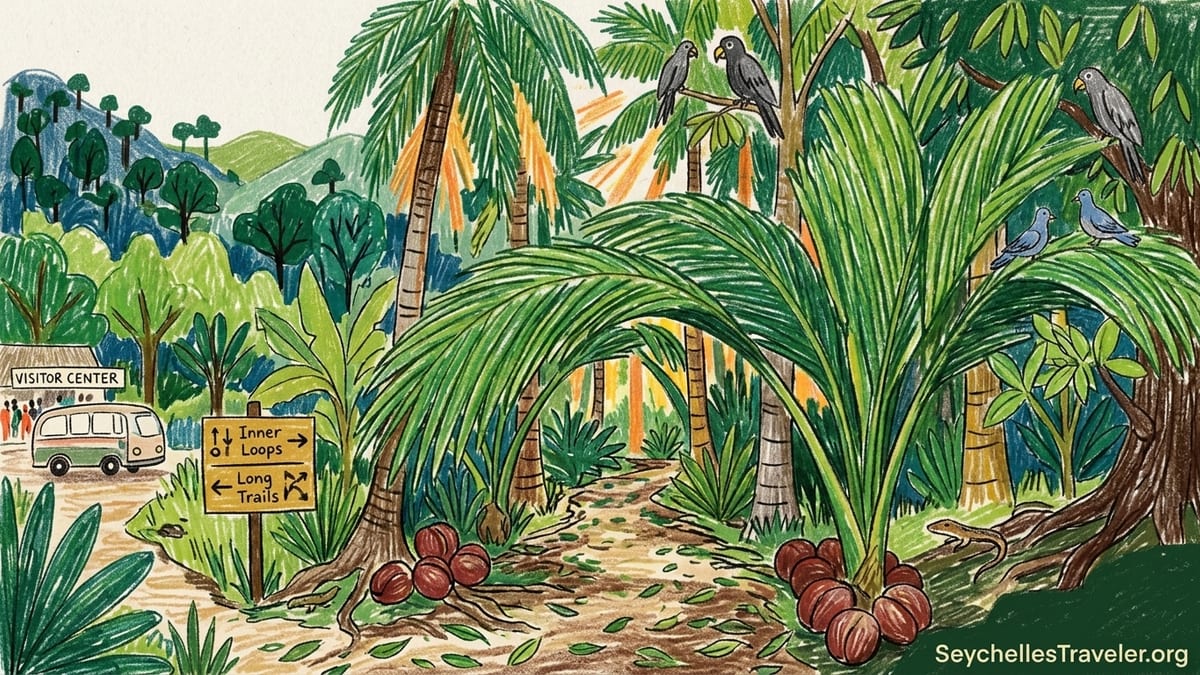
There is no denying that Vallée de Mai feels special at first sight. The main path quickly dives beneath a dense canopy of palms, with huge coco de mer leaves arching overhead and fallen fronds forming natural tunnels. The reserve holds several endemic palms and trees, and SIF has worked for years to remove invasive species and keep the forest structure as close to original as possible. As I walked, interpretive signs introduced the coco de mer’s peculiar biology, from pollination to the long, slow maturation of its record-breaking seeds.
The atmosphere along the main trail is strangely hushed. Even with multiple guided groups moving through the site, their voices were dampened by the thick vegetation and the soft, leaf-littered ground. I saw several shy skinks warming themselves near the roots, a handful of Seychelles blue pigeons deep in the branches, and heard the harsh call of the Seychelles bulbul. Somewhere above, a guide quietly pointed out the silhouette of a Seychelles black parrot to his small group. By the time I reached them and scanned the canopy, the bird had melted into the foliage. It was typical of my experience in Vallée de Mai: I could sense the rarity, but I rarely got a clear, satisfying look at it.
The trails themselves are well maintained, mostly shaded, and relatively easy underfoot, with short stair sections on the steeper parts. On a dry day, most reasonably fit visitors will manage the inner loops in sandals or light trainers. However, the humidity in the enclosed valley is intense, even mid-morning. Within fifteen minutes, I was soaked, and because the route options are compact, you are essentially looping around the same core of forest several times if you want to extend your stay. I completed the main circuit and one short spur in just over an hour without rushing.
As a forest walk, Vallée de Mai is undeniably beautiful, but if you have spent time in other mature tropical forests, it may not feel dramatically different on a purely sensory level. The palm silhouettes are distinctive, but underfoot it is still a shaded path winding between trunks, with occasional shafts of sun. Without a guide stopping you to decode what you are seeing, the nuances of endemism and geological history are easy to miss. That is where the UNESCO label starts to feel more like a concept than a lived experience for the casual visitor.
Paying for UNESCO Prestige and for Aldabra You Will Not See
Vallée de Mai’s SCR 450 entrance fee makes it, in October 2026, one of the most expensive single-entry tickets in Seychelles. For comparison, access to L’Union Estate on La Digue, which includes the iconic Anse Source d’Argent beach and a working copra mill, comes in at roughly a third of that. The official explanation from SIF is that this price not only covers visitor facilities and conservation efforts in Vallée de Mai itself, but also helps cover the very high costs of maintaining Aldabra Atoll, a remote UNESCO-listed coral atoll that cannot fund its operations through mass tourism.
As a conservation argument, this makes sense. Aldabra is more than 1,000 kilometres from Mahé, requires ongoing scientific staffing, boats, fuel, and tight controls on access to protect its giant tortoise population and unique lagoon. Cross-subsidising it through Vallée de Mai, which sits beside a tarmac road and cruise-ready infrastructure, is an efficient way to channel tourist money to where it is needed most. As a visitor standing under the palms on Praslin, however, it raises a fair question: am I paying a premium mainly to keep a distant atoll running, or for the quality of my own experience today.
There is also a psychological element to the UNESCO brand. Many travelers, myself included, arrive at Vallée de Mai expecting a transformative, almost mystical encounter with an untouched Eden, something unmatched anywhere else in the tropics. When the reality turns out to be a pleasant, fairly short forest walk with limited wildlife sightings and a dense crowd of other visitors on peak days, there can be a flicker of disappointment. The science and conservation importance remain unquestionable, but value-for-money is felt, not calculated in an office.
SIF also sells combined tickets that cover both Vallée de Mai and Fond Ferdinand, valid for one entry to each site within 10 days of the selected date. The combined ticket saves a small amount compared with buying the two entries separately, though the exact differential can change slightly with policy updates. Even with this modest saving, the starting point is still a premium price tier, especially for couples and families on a multi-island holiday already shouldering boat transfers, inter-island flights and resort markups.
Fond Ferdinand: Longer Trails, Fewer People, Lower Price
Two days after Vallée de Mai, I took the coastal road down to Fond Ferdinand on the southwestern side of Praslin. The parking area felt sleepier, with just two other rental cars and a small local bus stopped nearby. At the reception hut, the posted entrance fee was SCR 300 per adult in person, matching what Tourism Seychelles had recently been advertising, with a slightly reduced SCR 270 price offered online in advance.
Unlike Vallée de Mai, where independent guiding is optional and costs extra, Fond Ferdinand structures your visit around a guide by default. Entrance includes a guided walk, typically lasting between 2 and 3 hours, with groups formed according to language and arrival time. On my visit, I joined a small English-speaking group of eight. Our guide laid out the plan: a steady climb up through the 122-hectare reserve with multiple interpretive stops, then a final push to a viewpoint looking over Baie Sainte Anne, La Digue and Curieuse, before returning by a slightly different path.
The first section of trail wound through dense palm and mixed forest similar in feel to Vallée de Mai, but the path was narrower and steeper, with more rocky steps and roots. After 20 minutes, the group spread out, and the sense of being on a quiet mountain path, rather than a circular garden route, began to assert itself. Birdlife felt more obvious here. We watched a Seychelles bulbul hopping between branches only a few metres above eye level, and a Seychelles blue pigeon preening on a low horizontal bough that every camera in the group captured easily.
By the time we reached the main viewpoint after a little more than an hour, the pay-off was clear. From the wooden platform near the ridge, the forest fell away and the sea opened up in a broad sweep. We could see the pale sand lines of several beaches, the dark patches of offshore reefs, and the scatter of nearby islands, all under a high, hazy sun. It was the type of multi-layered view that instantly situates you in the geography of the Seychelles, something Vallée de Mai, wrapped in its narrow valley, cannot provide.
Trail Difficulty, Duration and Who Each Reserve Suits
On paper, Vallée de Mai’s 1.5 to 4 kilometre routes sound flexible, and for visitors who prefer not to tackle hills or who are travelling with young children or older relatives, the shorter loops are a real advantage. You can be in and out in under an hour if the heat becomes too much, and the paths are wide enough in many places for two people to walk side by side, which helps with safety and comfort.
Fond Ferdinand, by contrast, demands more from your legs and knees. The main guided route climbs steadily, with a mix of earth steps and stones, and while it is not technical, it does require moderate fitness and decent shoes. Some sections are exposed to the sun, especially near the viewpoint, so a hat and water are non-negotiable. Families with smaller children can absolutely manage it, but you will be lifting little legs up steps and fielding the inevitable “how much further” questions. The reward is a sense of accomplishment that the relatively level circuits of Vallée de Mai seldom create.
In terms of timing, my independent walk in Vallée de Mai lasted just over an hour and a quarter, including stops to photograph palm details and read interpretive signs. I could have stretched that to 90 minutes by repeating sections, but the forest, while lovely, is relatively compact. At Fond Ferdinand, the guided visit from reception to viewpoint and back took a little more than 2 hours, with frequent pauses for explanations and a generous 15 minutes at the lookout for photos and rest.
If you measure value in minutes of meaningful activity per rupee, Fond Ferdinand comes out ahead. For roughly two thirds of the entrance price, my partner and I received a longer, more varied walk with an included guide, plus panoramic views that we still talk about weeks later. Vallée de Mai delivered a concentrated palm-forest experience, but its shorter duration and lack of included guiding made the SCR 450 ticket feel slimmer in return.
Guides, Interpretation and Overall Visitor Experience
One of the biggest contrasts between these two reserves is the role of guides. At Vallée de Mai, several independent guides wait near the entrance and offer their services, but there is no single, clearly presented, official guiding tariff. Some travelers walk straight through this gauntlet to avoid what feels like upselling, and rely instead on the printed map and a scattering of information boards. Those panels are fine as far as they go, but they are relatively sparse given how much ecological and cultural story sits hidden in the vegetation.
On my self-guided walk, I frequently passed tour groups where the guide was miming the unusual shape of the coco de mer flowers or explaining how the valley became core breeding habitat for the Seychelles black parrot. I caught intriguing snippets as I overtook them, but without my own guide, much of that detail remained tantalisingly out of reach. For a first-time visitor, this can create a faint sense of having paid for access to the forest, but not fully to the meaning of the place, unless you add another paid layer.
At Fond Ferdinand, the experience is structurally different. Your guide is included in the entrance fee, and from the first few minutes it shows. Ours introduced key species, explained the history of the reserve’s protection, and was frank about the differences with Vallée de Mai. He pointed out that Fond Ferdinand has fewer endemic plants overall, but that its larger area gives space for quieter corners and better chances to see some birds at eye level. There was no pressure to tip, though a discreet box back at the entrance suggested it for those who wished.
Interpretation also benefits from the topography at Fond Ferdinand. As you gain height, the guide can literally point back across to Vallée de Mai’s location within Praslin National Park and trace how water flows through the landscape, affecting both reserves. The story of conservation becomes three dimensional. That sense of context, tied to the physical effort of the climb, made Fond Ferdinand feel like a more complete experience, rather than a brief UNESCO checkpoint.
Counting the Real Costs for Couples and Families
Entrance tickets are only part of the financial picture. On Praslin, very few visitors stay within walking distance of either Vallée de Mai or Fond Ferdinand, so you will almost certainly factor in transport. A typical return taxi from the hotel zones near Cote d’Or to Vallée de Mai might cost somewhere in the range of SCR 400 to SCR 600 depending on negotiation and time of day, with a similar or slightly higher price to reach Fond Ferdinand on the more out-of-the-way southwestern road. Self-drive rental cars lower the per-person cost but add their own daily rate.
For a couple visiting Vallée de Mai independently, the arithmetic in October 2026 roughly looks like this. Two adult tickets total SCR 900. Add, say, SCR 500 for a return taxi, and you are at around SCR 1,400 for what may turn out to be a 60 to 90 minute forest walk if you decline guiding. Decide to hire a guide at the entrance, and you might add another SCR 500 to SCR 700 between you, depending on the arrangement. Now your couple’s visit is hovering around SCR 1,900 or more.
At Fond Ferdinand, two adult in-person tickets come to SCR 600, including the guide. Add the same hypothetical SCR 500 taxi, and the couple pays around SCR 1,100 for a 2 to 3 hour guided hike with panoramic viewpoints. For a family of four with two children older than 12, Vallée de Mai would cost roughly SCR 1,800 in entrance fees alone, before transport and any guide. A similar family at Fond Ferdinand would pay about SCR 1,200 for entrance with guiding included.
If you book a full-day excursion through a tour company that combines Vallée de Mai with a beach such as Anse Lazio, prices increase further. Packages that include transfers, entrance fees, lunch and a guide often run into the equivalent of several thousand rupees per person once converted from euros. This can make sense for those who want a completely arranged day, but it moves Vallée de Mai even further into “premium spend” territory relative to the amount of time actually spent under the palms.
Is Vallée de Mai Different Enough From Other Forest Walks?
After doing both reserves within the same week, the question that lingered for me was simple. If I stripped away the UNESCO classification and the conservation backstory, did Vallée de Mai feel so distinct in real time that it justified costing significantly more than Fond Ferdinand and more than many other memorable experiences across Seychelles.
Visually, the answer was mixed. The sight of coco de mer palms clustered together, with their improbably long petioles and enormous fronds, is undeniably striking. The knowledge that this valley holds one of the last remnants of this kind of palm forest on earth adds a layer of quiet awe. At the same time, the forest understorey can feel surprisingly ordinary once your eyes adjust. The path design keeps you on relatively similar ground for most of the loops, and without vantage points, the valley’s shape and wider geology remain abstract.
By contrast, Fond Ferdinand’s long climb and high viewpoints made that forest experience feel more dynamic. Watching the light shift over the bay, then dropping back into shaded sections full of ferns and palms, created a rhythm to the walk that Vallée de Mai lacked. It also helped that there were noticeably fewer visitors on the trail. Even at mid-morning, our group encountered only two other parties, giving us periods of real quiet where the only sounds were wind and bird calls.
In pure experiential terms, if someone told me they had time for just one coco de mer reserve on Praslin, and that they cared more about scenery, guiding and value than about ticking off UNESCO sites, I would tell them to choose Fond Ferdinand first. Vallée de Mai is important and historic, but for the ordinary traveler paying cash, it can feel like a slightly compressed, premium-priced version of a forest experience they could enjoy more expansively a few kilometres down the road.
The Takeaway
Vallée de Mai remains a globally significant pocket of palm forest and a cornerstone of Seychelles’ conservation story. Its SCR 450 entrance fee in October 2026 helps fund not only the paths and rangers you see but also the costly, essential work far away at Aldabra Atoll. If you value contributing financially to that effort, and if you are the kind of traveler who actively seeks out UNESCO badges and rare species, then paying the Vallée de Mai premium will likely feel justified, especially if you invest in a good guide to unlock the most from a relatively short visit.
However, viewed through the narrower lens of personal experience per rupee, Fond Ferdinand offers stronger value for most visitors. For roughly SCR 300 in person or SCR 270 booked online, you receive a longer guided walk, richer viewpoints, smaller groups and a clearer narrative about the landscape you are exploring. The trails are more demanding, but that very effort turns the outing into a half-day adventure rather than a quick UNESCO stop. For couples and families watching their budgets, that difference matters.
My own conclusion after walking both reserves is that Vallée de Mai is best reserved for travelers who either have a deep interest in botany and conservation history, or who feel a personal pull toward UNESCO World Heritage sites and are comfortable with their entrance money subsidising Aldabra, a place they will not actually visit on this trip. If that is you, go early in the day, take plenty of water, and seriously consider hiring a guide at the gate or joining an organised small-group tour that includes guiding in the price.
Everyone else, especially those with limited time on Praslin or those who simply want a beautiful forest hike among coco de mer palms, will, in my experience, get better emotional and financial return from Fond Ferdinand. If your schedule and budget stretch to both, visiting Vallée de Mai first and Fond Ferdinand second can work well, since the latter feels like the wilder, more expansive sequel. If you must choose, do not let Vallée de Mai’s UNESCO prestige guilt you into overlooking an equally evocative, more reasonably priced forest just a short drive away.
FAQ
Q1. Is Vallée de Mai worth the SCR 450 entrance fee for most travelers?
For travelers who care deeply about UNESCO sites and want to support conservation at both Vallée de Mai and Aldabra, the SCR 450 can feel worthwhile, especially if they add a guide. For budget-conscious visitors mainly seeking a scenic forest walk, the experience can feel short and expensive compared with alternatives like Fond Ferdinand.
Q2. How much does Fond Ferdinand cost and what is included?
In October 2026, Fond Ferdinand charges about SCR 300 per adult in person or SCR 270 if booked online. The fee includes a guided walk of roughly 2 to 3 hours, with no extra payment required for standard guiding.
Q3. Which reserve is better for families with children?
Families with very young children or relatives with limited mobility may find Vallée de Mai easier because its main loops are short, shaded and mostly gentle. Fond Ferdinand offers better value and more variety for families with active older children who can handle steeper climbs and will enjoy the viewpoints at the top.
Q4. Do I need a guide at Vallée de Mai?
You can walk Vallée de Mai independently using the map and signs, but a guide helps reveal details about the coco de mer, endemic palms and Seychelles black parrot that you could otherwise miss. The downside is that freelance guiding costs extra on top of the already high entrance fee.
Q5. How difficult are the trails at Fond Ferdinand compared with Vallée de Mai?
Fond Ferdinand’s main trail is steeper and longer, with more steps and some sun-exposed sections. It suits visitors with moderate fitness and proper footwear. Vallée de Mai’s core loops are shorter, less steep and more uniformly shaded.
Q6. Can I see the Seychelles black parrot in both places?
Vallée de Mai is part of the core breeding area for the Seychelles black parrot, and you have a fair chance of hearing or glimpsing it there, especially with a guide. It is also occasionally seen in nearby forests, but sightings are never guaranteed in either reserve.
Q7. Is the Vallée de Mai ticket really helping Aldabra, even though I do not visit it?
Yes. The Seychelles Islands Foundation uses revenue from Vallée de Mai to help fund conservation and research at both Vallée de Mai and the remote Aldabra Atoll. Your ticket supports that wider work, even though Aldabra lies far from Praslin and is not part of your visit.
Q8. Is the combined ticket for Vallée de Mai and Fond Ferdinand good value?
The official combined ticket offers a small saving over buying separate entries for each site within a 10 day window. It improves value slightly if you are committed to visiting both, but your overall spend still stays in a relatively high bracket once transport and optional guiding at Vallée de Mai are added.
Q9. If I only have time for one reserve, which should I choose?
If your priority is ticking off a UNESCO World Heritage site and directly supporting a flagship conservation project, choose Vallée de Mai and consider hiring a guide. If your priority is a longer, more varied hike with big viewpoints and better value, choose Fond Ferdinand.
Q10. Is it worth visiting both Vallée de Mai and Fond Ferdinand on the same trip?
Visiting both reserves can make sense for travelers with a strong interest in Seychelles’ forests and enough time and budget. The experiences are similar in that both feature coco de mer and palm-dominated forest, but Fond Ferdinand adds steeper trails and sweeping views, while Vallée de Mai carries UNESCO prestige and a more compact, iconic valley setting.