


Seychelles rewards travelers who slow down. With granite peaks draped in rainforest, powder-soft beaches and protected marine reserves, these islands deserve more than a frantic checklist. A smart island-hopping plan focuses on a handful of bases, builds in time for weather or ferry disruption, and balances beaches with nature reserves and local life. The following 10 and 14 day itineraries are designed around real ferry and flight schedules in 2026, with concrete timings, sample costs and practical advice for couples and families.
How Island Hopping in the Inner Seychelles Really Works
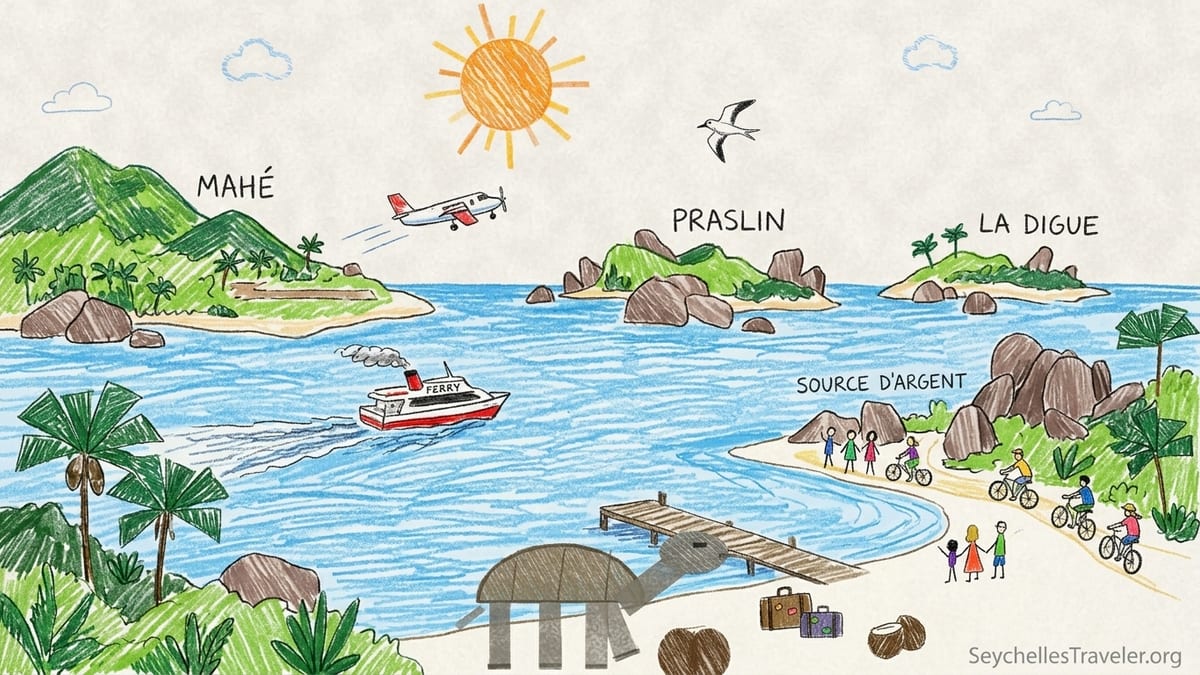
The granitic Inner Islands are compact, but it still takes planning to move smoothly between Mahé, Praslin, La Digue and smaller nature reserves. Fast ferries such as Cat Cocos link Mahé with Praslin and La Digue several times a day in 2026, with a typical Mahé to Praslin crossing of about 60 minutes and Mahé to La Digue around 90 minutes, depending on route and sea conditions. Onward hops between Praslin and La Digue usually take about 15 minutes on smaller ferries such as Cat Rose or on through services continuing from Mahé.
Air Seychelles operates a short domestic hop between Mahé International Airport and Praslin Island Airport in small twin-otter aircraft, with a flying time of roughly 15 minutes. However, you should factor in at least 60 to 90 minutes before departure to check in and walk between the international and domestic terminals, plus potential waiting time and baggage claim on arrival. In practice, a door-to-door Mahé to Praslin journey by air often consumes close to an hour when transfers are counted, which makes the flight competitive with, but not dramatically faster than, the ferry.
For this article, ferry fares are referenced to published starting prices in euros: about €56 one way for Mahé to Praslin, around €68 for Mahé to La Digue, and roughly €15 for Praslin to La Digue in economy class as a baseline. Actual prices vary by season, cabin and booking source, but these reference points let you build a realistic budget. The itineraries below are built to avoid too many crossings, reduce backtracking and allocate full days to nature activities on each island.
Weather and sea conditions matter. Between May and September, stronger southeast trade winds can bring choppier seas, especially on exposed runs between Mahé and Praslin. If you are prone to motion sickness, consider the Mahé to Praslin flight in at least one direction, or choose mid-morning sailings when winds can be calmer. In any season, avoid scheduling an inter-island crossing too close to your long-haul flight, as delays and cancellations do occasionally occur.
A Balanced 10 Day Seychelles Island Hopping Itinerary
This 10 day plan gives roughly three nights on Mahé, three on Praslin and three on La Digue, plus a final night back on Mahé if your flight requires it. It includes a Mahé rainforest and beach day, a full nature day on Praslin at Vallée de Mai or Fond Ferdinand, a Curieuse and St Pierre excursion, and enough time to explore La Digue by bicycle without rushing in from a day trip.
Daily spending estimates below are for a mid-range couple in 2026, staying in guesthouses or small hotels, eating in local restaurants and using taxis or occasional car hire. A typical daily budget for two including accommodation, food, local transport and small activities lands around €250 to €350 on Mahé and Praslin, and €220 to €320 on La Digue. Families of four can expect to add at least 40 to 60 percent to cover larger rooms, extra ferry tickets and meals.
For each day you will see the overnight base, a suggested morning and afternoon plan, an indicative transfer duration, sample admission charges where relevant and a rough daily spend range. Actual figures will shift with your hotel choice, but the pattern gives you a practical framework.
Days 1–3: Mahé Arrival, Rainforest Trails and West Coast Beaches
Day 1: Arrival on Mahé and Beau Vallon or North Coast
Overnight base: Mahé (Beau Vallon or north coast guesthouse). Morning is usually consumed by your international arrival. From Seychelles International Airport it takes around 20 to 30 minutes by taxi to Beau Vallon on Mahé’s northwest coast. Many travelers arriving from Europe in the morning simply check into a small hotel such as a family-run Beau Vallon guesthouse, freshen up and walk the beach. Afternoon can be low-key: swim in the lagoon, rent snorkel gear from a beach shack or stroll to a takeaway stand for grilled fish and rice. There are no major admission charges this day. Daily spending for a couple: airport taxi about €25 to €30 each way depending on hotel location, dinner at a beach restaurant about €40 to €60 for two, plus €120 to €200 for a mid-range room.
Day 2: Mahé Rainforest and Beach Day
Overnight base: Mahé. In the morning, head into the interior of Mahé for a guided walk in Morne Seychellois National Park, reachable by taxi or rental car in around 30 to 40 minutes from Beau Vallon. Several operators in 2026 offer guided hikes to trails such as Copolia or Trois Frères with views over Victoria and the east coast. National park access for independent hikers is usually modest, though exact entry fees can change, so check locally. A reasonable guide cost for a small-group half-day hike is around €40 to €60 per person.
After the hike, drive or take a taxi to the west coast beaches. Baie Ternay and Port Launay are about 30 minutes from Beau Vallon by car, with sheltered waters good for snorkeling when conditions are calm. Lunch could be a local “creole platter” of grilled fish, lentils and chutney at a simple roadside restaurant for roughly €10 to €15 per person. Afternoon is dedicated to the beach, with time to swim, snorkel or simply rest. Dinner back at Beau Vallon at a casual creole restaurant might run €20 to €30 per person with drinks. Estimated daily spending for a couple including guide, meals, taxis and lodging: around €260 to €340.
Day 3: Victoria and South Coast Exploration
Overnight base: Mahé. Use this day to see the capital and Mahé’s quieter south. In the morning stroll central Victoria, about a 15 minute taxi ride from Beau Vallon. Visit the Sir Selwyn Selwyn-Clarke Market for fruit and spices and walk past the small clocktower. There is no admission fee for simply exploring the town. Late morning or early afternoon, follow the east coast road south by rental car or taxi transfer, stopping at Anse Royale or Anse Intendance for lunch and a swim. Taxi costs on such a loop can add up, so many couples choose to rent a car for one or two days at around €45 to €60 per day including basic insurance.
Lunch at a small café along Anse Royale might cost €10 to €18 per person. Plan to be back at your north coast base by late afternoon to pack for Praslin. Daily spending for a couple, including car hire, fuel, meals and accommodation, often totals around €250 to €330, with fewer extra excursions than the previous day.
Days 4–6: Praslin Base, Vallée de Mai and Curieuse & St Pierre
Day 4: Mahé to Praslin Ferry and Cote d’Or Beach
Overnight base: Praslin (Cote d’Or or Baie Sainte Anne). In the morning, check out and travel from your Mahé hotel to the Victoria inter-island quay, which usually takes 15 to 25 minutes from Beau Vallon by taxi. Aim for a mid-morning Cat Cocos departure to Praslin. The Mahé to Praslin sailing is about 60 minutes and published starting fares in economy class are around €56 one way. Budget an additional €15 to €25 for a taxi from the Praslin jetty at Baie Sainte Anne to Cote d’Or beach or other accommodation.
Afternoon is for settling into Praslin. Cote d’Or’s long, shallow beach is ideal for walking and swimming, and you will find small supermarkets and beach bars within easy reach. No paid activities are essential today unless you rent kayaks or snorkel gear from a local shop, which might cost roughly €10 to €20 per person for a few hours. Ferry, local transfers, lunch, dinner and a mid-range guesthouse usually push daily spending for a couple to around €260 to €340.
Day 5: Vallée de Mai or Fond Ferdinand Nature Day
Overnight base: Praslin. This is your Praslin nature day. In the morning, take a bus, taxi or rental car inland to Vallée de Mai Nature Reserve, a UNESCO World Heritage site famous for its coco de mer palms. The reserve lies about 15 to 20 minutes by road from both Baie Sainte Anne jetty and Cote d’Or. Adult entry fees for international visitors have in recent years been set at a significant amount in local rupees; in 2026, you should expect to pay the equivalent of roughly €25 to €35 per adult, with guided tours at extra cost.
Walk one of the marked trails for two to three hours, listening for endemic birds such as the Seychelles black parrot. Alternatively, some travelers now prefer Fond Ferdinand Nature Reserve on Praslin’s southeast, which typically charges somewhat lower entry fees and offers guided walks through coco de mer forest with viewpoints over Curieuse Island. Whichever reserve you choose, plan to finish by early afternoon.
Afternoon is open for beach time at Anse Lazio on the northwest tip of Praslin, often reached by car in about 25 to 30 minutes from Cote d’Or. There is no admission fee at Anse Lazio, though some parking areas may charge small fees. Meals in this part of the island can be slightly more expensive, with a sit-down lunch or early dinner near Anse Lazio commonly around €20 to €30 per person. Including reserve entry, taxi or fuel, meals and lodging, a couple can expect daily spending of roughly €280 to €360.
Day 6: Curieuse and St Pierre Boat Excursion
Overnight base: Praslin. Today is dedicated to Curieuse Island and the snorkel sites around St Pierre islet, usually visited on small-group boat trips departing from Cote d’Or or Baie Sainte Anne. In 2026, full-day excursions including park landing fees, barbecue lunch and snorkel stops often cost around €90 to €130 per adult, with lower rates for children. After a short 15 to 20 minute boat ride, you land on Curieuse, where giant Aldabra tortoises roam freely near the ranger station and boardwalks lead through mangrove forests.
After lunch on the beach, boats typically continue to St Pierre for snorkeling over coral heads with reef fish. Remember reef-safe sunscreen and a rash vest to avoid sunburn. You return to Praslin mid-afternoon, leaving time to relax on Cote d’Or. With the excursion fee as the main cost, plus incidentals and dinner, daily spending for a couple generally lands between €320 and €420, depending on operator and drinks.
Days 7–10: La Digue Time and Return to Mahé
Day 7: Praslin to La Digue and First Look by Bicycle
Overnight base: La Digue. In the morning, make the short hop from Praslin to La Digue. Ferries such as Cat Rose and through services from Cat Cocos complete the crossing in about 15 minutes. Published starting prices around €15 one way from Praslin to La Digue in economy class are useful budgeting figures for 2026. From your Praslin hotel to Baie Sainte Anne jetty takes 10 to 20 minutes by taxi or bus.
Once you arrive at La Passe jetty on La Digue, walk or take an ox-cart style taxi to your guesthouse; most popular accommodations are within 5 to 20 minutes on foot. Many visitors immediately rent bicycles, which generally cost about €8 to €12 per person per day. Afternoon is for gentle exploration: cycle south toward Anse Source d’Argent, arguably Seychelles’ most photographed beach, where an estate access fee is charged at the gate. This fee has increased over time and is often in the equivalent range of €10 to €15 per adult; check the current price on arrival. Daily spending for a couple, including ferry, simple lunch, bike hire, estate access and dinner, plus accommodation, might total around €260 to €340.
Day 8: La Digue East Coast and Remote Coves
Overnight base: La Digue. Dedicate this day to exploring beyond the classic postcard spots. Morning can be a bicycle ride across the interior to the quieter east coast beaches such as Grand Anse, which are around 25 to 35 minutes by bike from La Passe depending on fitness. There are no formal admission charges for these beaches, although you may purchase drinks or snacks at small local kiosks. The surf here can be powerful; families with younger children may prefer to paddle in the shallows and save full swimming for calmer coves.
In the afternoon, adventurous travelers may hike, in suitable weather and with good shoes, to more remote spots such as Anse Cocos or Petite Anse following coastal paths. Others may opt for a half-day snorkeling trip by small boat to nearby islets, often arranged locally at around €40 to €70 per person. Meals on La Digue tend to focus on creole curries, grilled fish and tropical fruit; plan around €30 to €50 per person for all meals that day if you mix takeaways and simple restaurants. Including bikes, any boat trip, meals and lodging, a couple usually spends around €260 to €360.
Day 9: Slow Island Life and Optional Diving or Yoga
Overnight base: La Digue. Keep this day deliberately loose. Morning could be a sunrise walk back to Anse Source d’Argent or a guided dive with one of the island’s dive centers for certified divers, at typical two-tank dive rates of roughly €110 to €150 per person including equipment. Non-divers may join a morning yoga session at a beach pavilion, with prices similar to a European group class.
Afternoon is best spent simply living the La Digue rhythm: reading under palm trees, stopping for fresh coconut water from a roadside stand and capturing the granite boulders in changing light. This unscheduled time is also a buffer for any previous day’s activity that might have been rained out. Daily spending for a couple ranges widely depending on whether diving is included; expect around €220 to €260 without major excursions, or €360 to €420 with a dive package.
Day 10: La Digue to Mahé and Departure
Overnight base: En route or Mahé, depending on your flight time. If your international departure from Mahé is in the late afternoon or evening, it is safer not to rely on a same-day chain of ferries from La Digue and Praslin immediately before a long-haul flight. A cautious pattern is to leave La Digue for Mahé the day before departure, but if timing forces a same-day transfer, aim to arrive back on Mahé at least five hours before check-in for long-haul flights.
Typical routing is La Digue to Praslin (15 minutes by ferry), short wait at Baie Sainte Anne, then Praslin to Mahé (60 minutes). Including waiting and transfers between jetties and airport, many travelers find this door-to-door journey can take three to four hours. For a couple, combined ferry fares from La Digue to Mahé can total around €80 to €100 one way, depending on class and route, plus €25 to €30 for an airport taxi and meals. If you overnight on Mahé before flying out, add your usual hotel rate.
A Slower 14 Day Route with Silhouette and Mahé’s South Coast
With four extra days, you can make the itinerary meaningfully different rather than merely stretched. The 14 day route keeps three nights on Praslin and three on La Digue but adds around two nights on Silhouette Island and slows the pace on Mahé, particularly along the south coast. Silhouette lies northwest of Mahé and is home to a protected national park with mountainous hiking and remote beaches. Access in practice is via scheduled boat transfers from Mahé, often arranged by the island’s main resort operator, which adds to the cost but offers a very different, nature-focused experience.
A realistic sequence for 14 days is Mahé (3 nights), Silhouette (2 nights), Praslin (3 nights), La Digue (4 nights), then back to Mahé for a final night if needed before departure. This approach reduces backtracking and allows you at least one full unscheduled day in each location.
Compared with the 10 day plan, the longer route increases transport and accommodation costs but can feel less rushed, particularly for families with younger children or travelers planning several full-day nature excursions. For budgeting, adding four nights and extra transfers can easily add €1,200 to €1,800 for a couple in mid-range comfort and more for a family, but in return you gain additional hiking, snorkeling and wildlife-watching opportunities.
14 Day Itinerary Breakdown: Day by Day
Days 1–3: Mahé with Extra South Coast Time
Overnight base: Mahé. Follow the same arrival, rainforest and Victoria days as in the 10 day itinerary, but use the additional time for Mahé’s south. On Day 3, instead of looping back to the north coast, consider staying your third night on the south or southwest coast, in areas such as Anse Royale or Baie Lazare. Transfer from the airport to these southern bays generally takes 30 to 45 minutes by taxi.
With a southern base, your Day 3 morning can be a relaxed beach start, followed by a scenic drive around the southern tip of Mahé, stopping at beaches such as Anse Forbans and Police Bay where conditions permit, or at a local rum distillery for a tasting. Taxi touring along this loop may cost €80 to €120 for the day, or you can continue a rental car arrangement. Daily spending for a couple with car hire, meals and mid-range lodging sits around €260 to €340.
Days 4–5: Silhouette Island Wilderness
Overnight base: Silhouette Island. On Day 4, transfer from Mahé to Silhouette by scheduled boat arranged through your chosen accommodation. The crossing time is roughly 45 minutes, but transfers to the pier and check-in can push the total journey toward 90 minutes. Because Silhouette is served primarily by one large resort plus a handful of smaller lodges or guesthouses, prices are generally higher than on Mahé or Praslin.
On Day 4 afternoon, settle in and explore the shoreline or house reef on a guided snorkel. There are no public roads, so exploration is on foot or by boat. On Day 5, dedicate a full day to hiking trails into Silhouette National Park with a licensed guide arranged through your accommodation. Entry and guiding fees can total around €60 to €120 per person depending on route and group size, reflecting the remote and protected nature of the island. Daily spending for a couple here, including full-board or half-board meal plans typical of island resorts, can easily reach €450 to €700 per night or more, so it is important to match this extension to your budget.
Days 6–8: Praslin as in the 10 Day Plan
Overnight base: Praslin. Return by boat to Mahé on Day 6 and connect with a Cat Cocos ferry or Air Seychelles domestic flight to Praslin. Build in at least two hours between your Silhouette boat’s scheduled arrival and any onward departure to manage potential delays. Once on Praslin, repeat the pattern of Cote d’Or arrival day, Vallée de Mai or Fond Ferdinand nature day and Curieuse plus St Pierre boat trip, as described for Days 4 to 6 of the 10 day itinerary.
Because you are coming off relatively expensive days on Silhouette, you may wish to choose more budget-friendly self-catering apartments on Praslin for three nights, which can help rebalance the overall budget. For a couple in 2026, that might mean nightly rates of €100 to €160, plus groceries and occasional restaurant meals for another €50 to €80 per day.
Days 9–12: Slower La Digue Stay with Cousin Island Excursion
Overnight base: La Digue. On Day 9, transfer from Praslin to La Digue by 15 minute ferry as before. With an extra night here compared to the 10 day itinerary, you can slow the pace and integrate a day trip to Cousin Island Special Reserve while still enjoying unstructured bicycle time.
Settle in on Day 9 with an easy cycle to Anse Source d’Argent. Day 10 can be your east coast and Anse Cocos exploration day. On Day 11, arrange a Cousin Island excursion, usually booked from Praslin but also offered by some La Digue-based operators who combine ferry and boat transfers. In practice, many travelers dedicate a full day to this, traveling early from La Digue to Praslin, then joining a morning boat that lands directly on Cousin’s beach. Guided walks with reserve wardens explore nesting seabird colonies and conservation projects. Published visitor fees support conservation and have been set in recent years at levels comparable to major nature reserves in the region, often bundled into tour prices that may range around €100 to €150 per adult including transport.
Day 12 is intentionally easy. Keep it open for favorite beaches, a repeat snorkel spot or simply resting with short bicycle rides. This extra buffer also helps in case weather forces your Cousin Island trip to move by a day. For four nights on La Digue at a mid-range guesthouse plus meals, bikes and two organized boat days (Cousin and perhaps a local snorkel), a couple might spend in the region of €1,200 to €1,600 all in.
Days 13–14: Return to Mahé and Fly Out
Overnight base: Mahé. Plan to return from La Digue to Mahé by late afternoon on Day 13 rather than risk a tight connection on departure day. Use the remaining daylight for last-minute shopping in Victoria or a sunset walk at Beau Vallon. Staying near the airport on your final night can reduce early morning stress; several guesthouses and small hotels sit within 10 to 20 minutes’ drive of the terminal.
On Day 14, factor in the usual two to three hours before an international flight for check-in and security, plus another hour in case island ferries or roads are slower than expected. Daily spending on these last two days is mostly accommodation, local taxis, restaurant meals and any remaining souvenirs, likely totaling €250 to €400 for a couple excluding big shopping splurges.
Costs, Seasickness, Weather Disruption and the Environmental Levy
The largest costs in a Seychelles island-hopping trip are accommodation, inter-island transport and paid excursions. For the 10 day itinerary, a mid-range couple in 2026 can realistically expect to spend in the region of €3,500 to €5,000 including flights from Europe, with a rough breakdown of €1,600 to €2,500 for accommodation, €400 to €700 for ferries or domestic flights, €600 to €900 for excursions and admission fees, and the remainder for meals and local transport. Families of four might see total trip costs of €6,000 to €8,500 depending on room types, child discounts on ferries and choices of paid activities.
For the 14 day route that adds Silhouette and extra nights, it is reasonable to plan for at least €5,000 to €7,000 for a couple, and more if staying in higher-end Silhouette resorts or booking multiple guided hikes and private boat trips. Because prices are quoted in both euros and Seychelles rupees, it helps to track approximate exchange rates before your trip and to verify current fares directly with ferry operators and airlines, especially for peak months such as August and December.
Seasickness and weather disruption are genuine considerations. The Cat Cocos ferries are stable catamarans but crossings can still be rough when swells are high, particularly on the more exposed Mahé to Praslin leg. Travelers prone to motion sickness should sit near the center of the vessel, look toward the horizon and consider over-the-counter anti-nausea medication started before boarding. If this is a serious concern, taking the short Mahé to Praslin flight at least in one direction may be worth the higher per-seat cost to reduce time at sea.
Strong winds or heavy rain can lead to ferry delays and, more rarely, cancellations, as well as occasional disruption to domestic flights, especially small aircraft. There have been recent instances of all Mahé to Praslin flights cancelled on a day of strong wind, forcing travelers to overnight unexpectedly on Mahé. Similarly, day trips to outer islands may be rescheduled at short notice. This is why it is unwise to book an inter-island transfer too close to an international departure; building in an extra night on Mahé before your flight home is the safest approach, particularly for once-a-day or long-haul connections.
Since August 2023, Seychelles has applied a Tourism Environmental Sustainability Levy collected by accommodation providers on a per-person, per-night basis to support conservation and climate resilience projects. Regulations updated for 2026 confirm that the levy is not charged for children aged 12 and under and that, from 1 January 2026, small establishments with 1 to 24 rooms are no longer required to collect the levy, while larger hotels, resorts and yachts still are. In practice, guests see the levy itemized separately on their bill. The exact rupee amount depends on the size and type of accommodation, with higher nightly charges for big resorts and lower, or zero, for small guesthouses. When comparing hotel offers, check whether quoted rates already include this levy and local value-added tax or whether they will be added at checkout.
Budgets for Couples, Families and Wildlife-Focused Travelers
For a couple following the 10 day itinerary in mid-range comfort, a practical ground budget excluding international flights could be structured as approximately €2,000 to €3,000. Within that, you might allocate €1,200 to €1,800 for accommodation, €350 to €550 for ferries and any Mahé to Praslin flight, €400 to €700 for excursions such as Vallée de Mai, Curieuse and St Pierre, and possibly one diving or snorkeling day, and about €450 to €700 for meals, taxis, bikes and small extras. Budget travelers willing to stay in simpler guesthouses, self-cater some meals and skip a few boat trips may get close to €1,400 to €1,800 for the same 10 days on the ground.
Families of four need to factor in extra beds or second rooms. Some guesthouses offer family apartments that bring the per-person rate down; others require two separate rooms. A realistic ground budget for a family on the 10 day route would begin around €3,000 to €4,000 for those mixing self-catering with restaurants and sharing some excursions, and can easily rise above €5,000 if staying in resort-style properties or booking several private boat trips. Ferry fares for children may be discounted, so checking each operator’s child policy before booking can save significant amounts over multiple crossings.
Wildlife-focused visitors who plan to prioritize protected areas and guided excursions should set aside a larger activity budget. For example, a couple doing Vallée de Mai or Fond Ferdinand with a guide, a Curieuse and St Pierre day, a Cousin Island special reserve visit, plus one or two guided hikes on Mahé or Silhouette and possibly a whale shark snorkeling or diving trip in season could easily spend €800 to €1,200 purely on nature activities over two weeks. In return, they gain access to some of Seychelles’ best bird colonies, marine life and endemic plants.
Regardless of profile, it is wise to book travel insurance that covers missed connections and weather-related disruption, given the multi-leg structure of island-hopping. Keep an emergency fund in euros or Seychelles rupees for last-minute hotel nights on Mahé or Praslin if seas or winds force schedule changes.
Practical Booking Sequence and Smart Alternatives
A logical booking sequence for either itinerary starts with international flights to Mahé on dates that align with your vacation window and airline preferences. Once flights are locked in, choose your island order and secure accommodation on each island, starting with smaller places on La Digue and Praslin that may have limited room counts. Confirm cancellation policies that allow some flexibility for date shifts in case you later adjust ferry times.
Next, book key inter-island transfers. For travelers using Cat Cocos between Mahé and Praslin or La Digue, reserving tickets several weeks in advance for busy months is sensible, especially for specific morning or afternoon sailings. If you plan to fly the Mahé to Praslin route with Air Seychelles, align flight departures with your international arrival times, leaving at least two hours between scheduled landing and domestic check-in to handle immigration and baggage. After that, lock in day trips that have limited capacity, such as Cousin Island special reserve landings or small-group Curieuse excursions.
Budget travelers might consider trimming the number of islands. One strong value option is to base entirely on Mahé for 7 to 10 days, renting a car for a few days to explore all corners of the island and booking just one or two day trips or overnight hops to Praslin or La Digue. This removes multiple ferry fares and keeps accommodation in smaller guesthouses or self-catering apartments that, under 2026 rules, may not collect the environmental levy if they fall below the room threshold.
Families may find it simpler to choose just two bases, for example Mahé and Praslin, and then do a full-day excursion from Praslin to La Digue and Curieuse instead of changing hotels repeatedly. While a La Digue day trip can feel rushed, it may be a better fit for parents with strollers and beach gear who prefer fewer moves. Wildlife-focused travelers, on the other hand, might prioritize longer stays on Praslin and La Digue plus dedicated excursions to Cousin and Curieuse, only dipping into Mahé for arrival, departure and one rainforest day.
Regardless of style, think in terms of minimizing one-night stays and clustering transfers. Aim for blocks of at least three nights per island, back up your departure plans with an overnight buffer on Mahé, and ensure your budget covers not only the postcard-perfect beaches but the practicalities that make an island-hopping itinerary smooth rather than stressful.
FAQ
Q1. Is it better to travel between Mahé and Praslin by ferry or by plane?
For most travelers the ferry is the more economical option, taking about 60 minutes at a starting fare around €56, while the 15 minute Air Seychelles flight saves some time and can be smoother for those prone to seasickness but usually costs more per person once luggage and peak-season fares are factored in.
Q2. How far in advance should I book Seychelles inter-island ferries?
For high season months such as August, December and Easter, it is advisable to book Cat Cocos and Praslin to La Digue ferries at least four to six weeks in advance, while outside peak times a lead time of one to three weeks is often sufficient for securing preferred departure times.
Q3. Can I visit La Digue as a day trip from Mahé?
It is physically possible to take an early ferry from Mahé to Praslin, connect onward to La Digue, spend a few hours and then return the same day, but the schedule feels rushed and much of the day is spent in transit, so staying at least two or three nights on La Digue is strongly recommended.
Q4. How much should a couple budget for 10 days of island hopping in Seychelles excluding flights?
A realistic ground budget for a mid-range couple in 2026 is roughly €2,000 to €3,000 for 10 days, covering accommodation in guesthouses or small hotels, ferries between Mahé, Praslin and La Digue, a few nature excursions and meals at local restaurants.
Q5. What is the Tourism Environmental Sustainability Levy and will I have to pay it?
The Tourism Environmental Sustainability Levy is a per-person, per-night charge collected by many Seychelles accommodation providers to fund conservation and climate projects, and under 2026 rules small establishments with up to 24 rooms are exempt from collecting it while larger hotels and resorts must charge it, so whether you pay depends on where you stay and your age, as children 12 and under are exempt.
Q6. How can I reduce seasickness risk on Seychelles ferries?
Choose morning sailings where possible, sit in the middle of the vessel, focus on the horizon, avoid heavy meals and alcohol before boarding, and consider over-the-counter seasickness tablets started in advance; if you are very sensitive you might opt for the short Mahé to Praslin flight instead of the ferry for at least one direction.
Q7. Is Seychelles suitable for families with young children?
Yes, Seychelles works well for families, especially if you limit the number of island changes, choose shallow, sheltered beaches such as Beau Vallon and Cote d’Or, allow rest days without long excursions, and book apartments or family rooms to simplify meals and bedtime routines.
Q8. Do I need to rent a car on every island?
On Mahé and Praslin a rental car is very useful for reaching multiple beaches and trailheads in one day and can be cost-effective compared with several taxi rides, while on La Digue most visitors get around happily by bicycle or on foot and rarely need a car or frequent taxis.
Q9. How many islands should I include in a 10 day Seychelles trip?
For 10 days, focusing on three main islands Mahé, Praslin and La Digue is ideal, giving about three nights on each plus transfer time; adding more overnight islands tends to fragment the trip and increase transport costs without adding much depth.
Q10. When is the best time of year for an island-hopping itinerary in Seychelles?
The periods around April and October often offer a balance of calmer seas and pleasant weather, while December to March and May to September are also viable but may bring either heavier showers or stronger southeast trade winds that can make some ferry crossings choppier.